

The Gallery

Dumont and her extended family
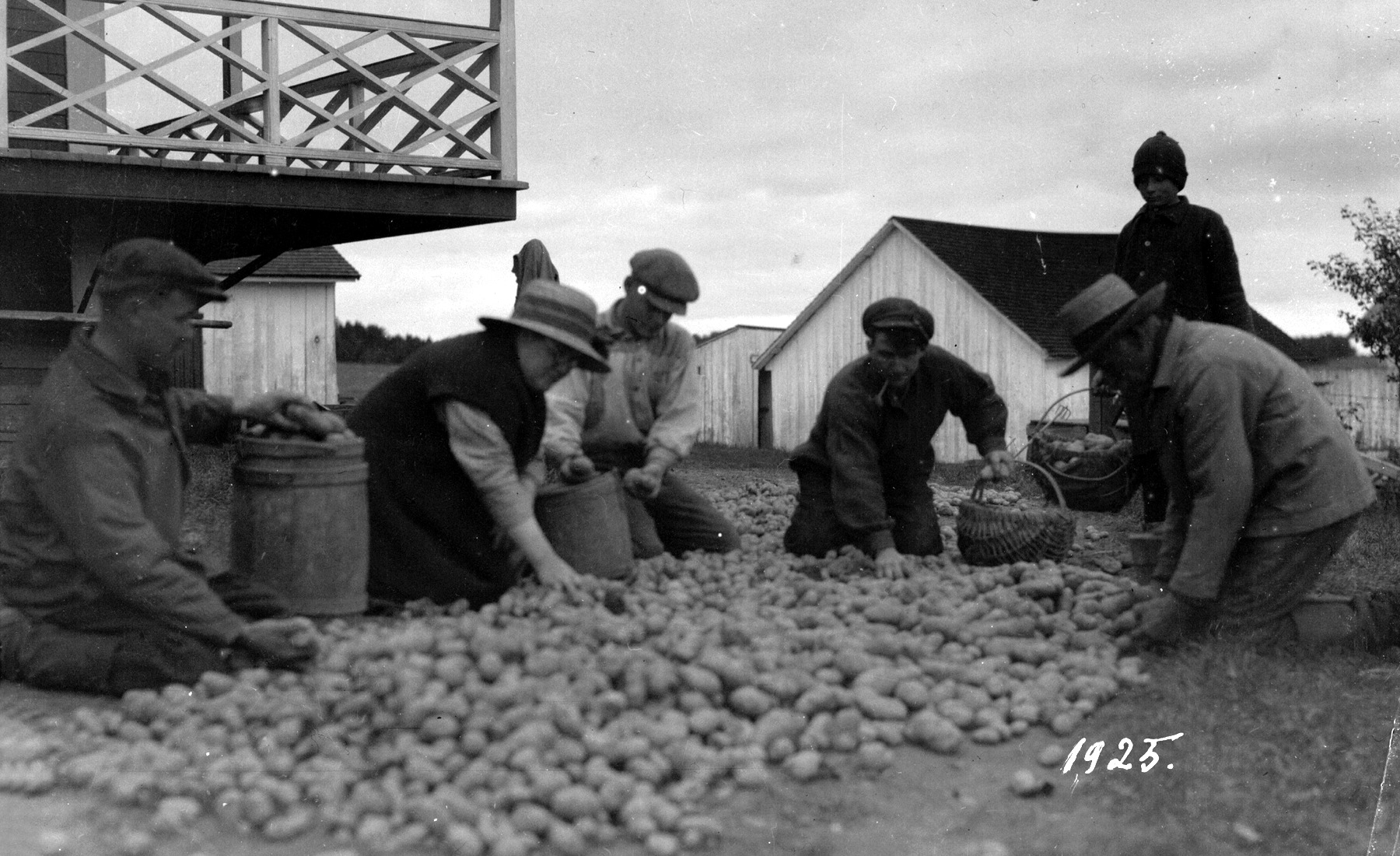
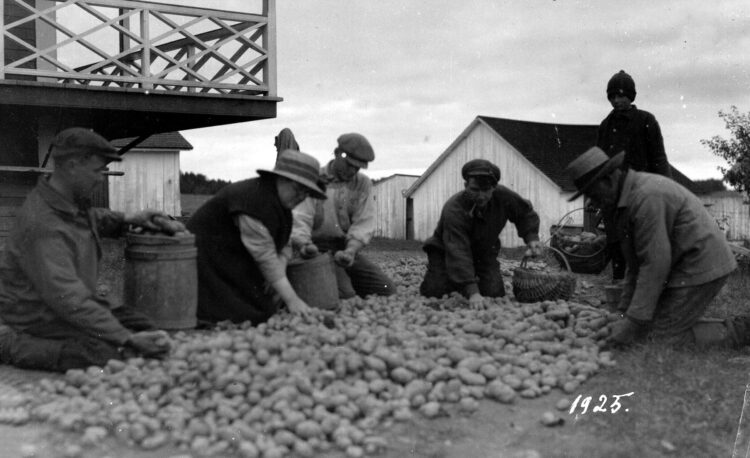
The women of the Dumont family took part in farm work. In this photo, Marie Pelletier (second from the left) stands among the men, sorting potatoes.
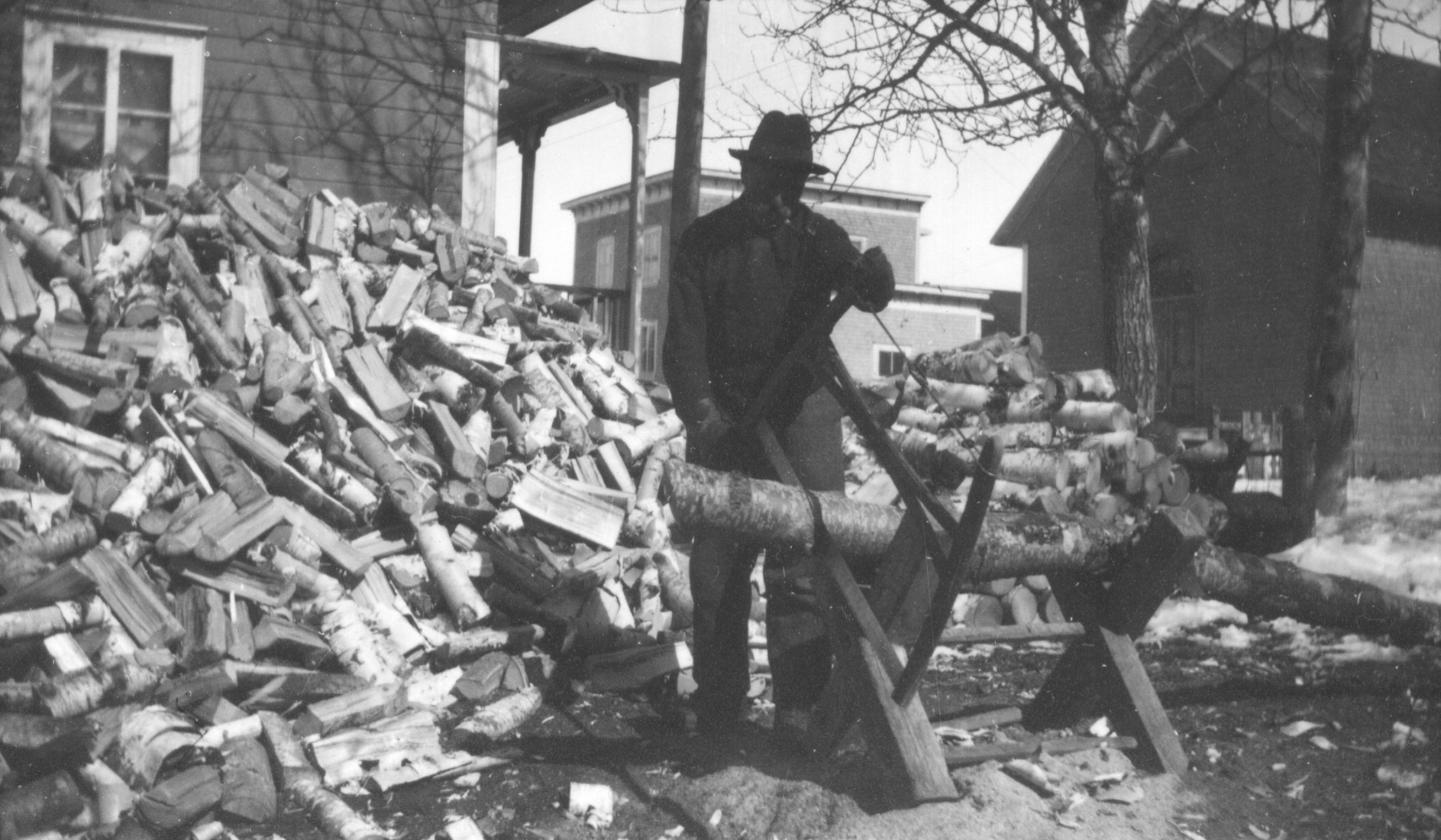
Uldéric Dumont had always taken care of his family’s firewood needs by harvesting this precious resource from his own land. Cutting firewood by hand saw was an enormous task.
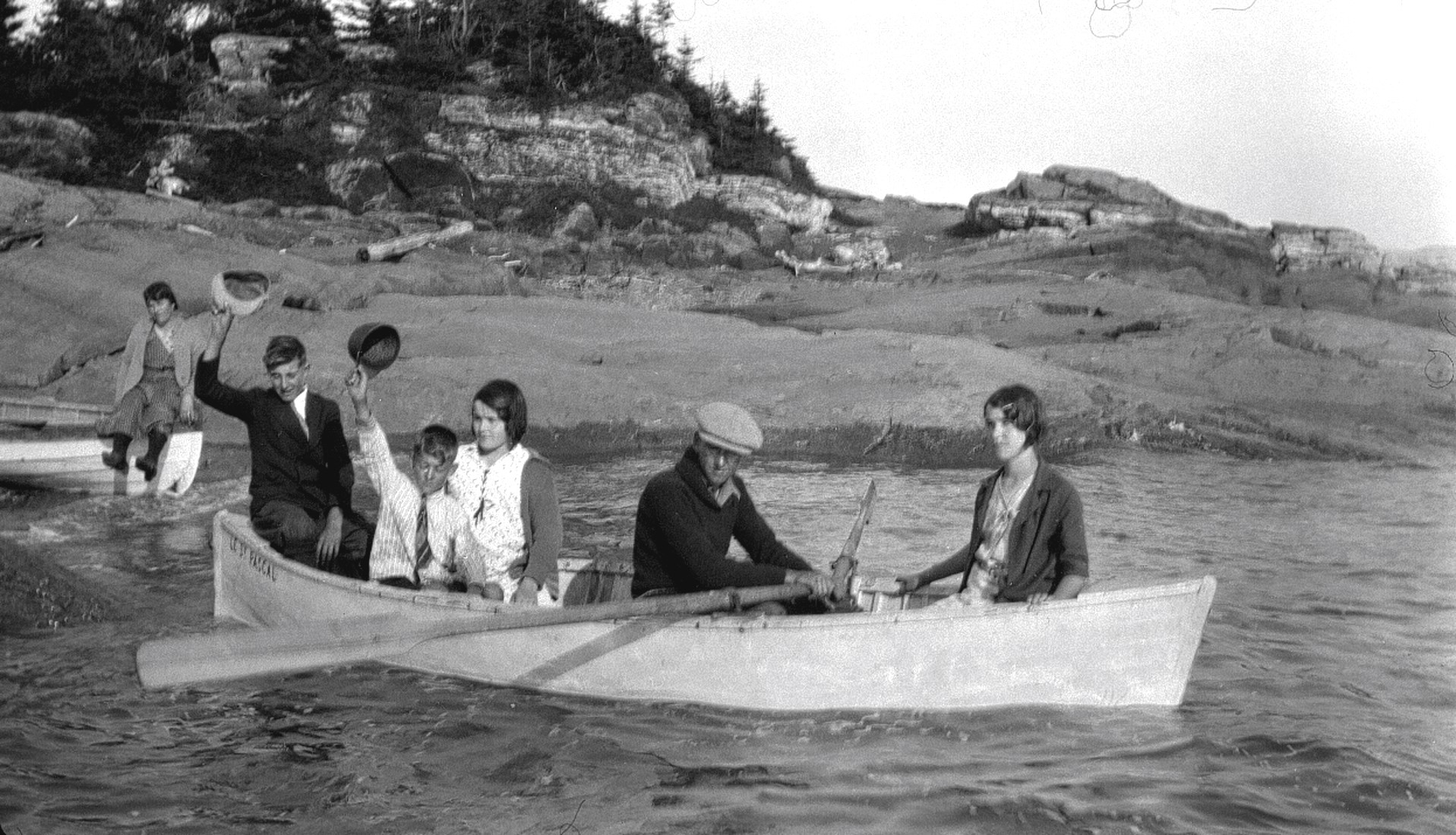
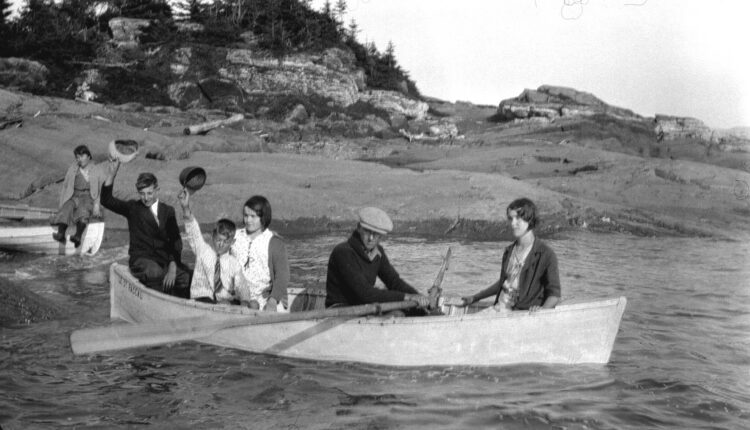
What are these five Ouellet nieces and nephews doing aboard the boat named Le St-Pascal? Under the watchful eye of their mother, Émilia, are they welcoming Aunt Alice to Patins Island or perhaps bidding her farewell?
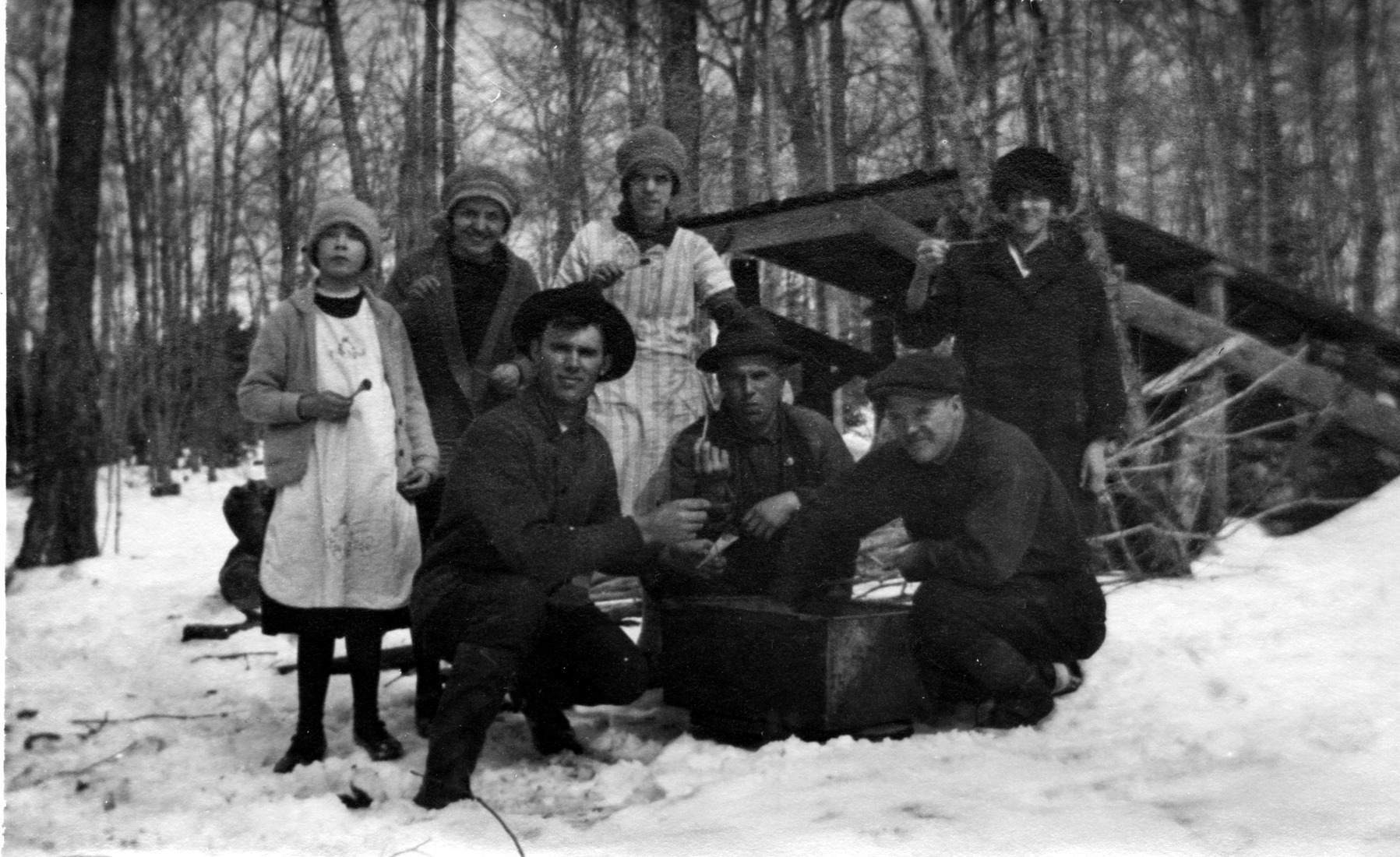
Living in Kamouraska meant having a sugar shack close to home. That was certainly the case for Rosalie Bergeron and Marie-Alice Dumont, seen here on the left, ready to enjoy some maple taffy.
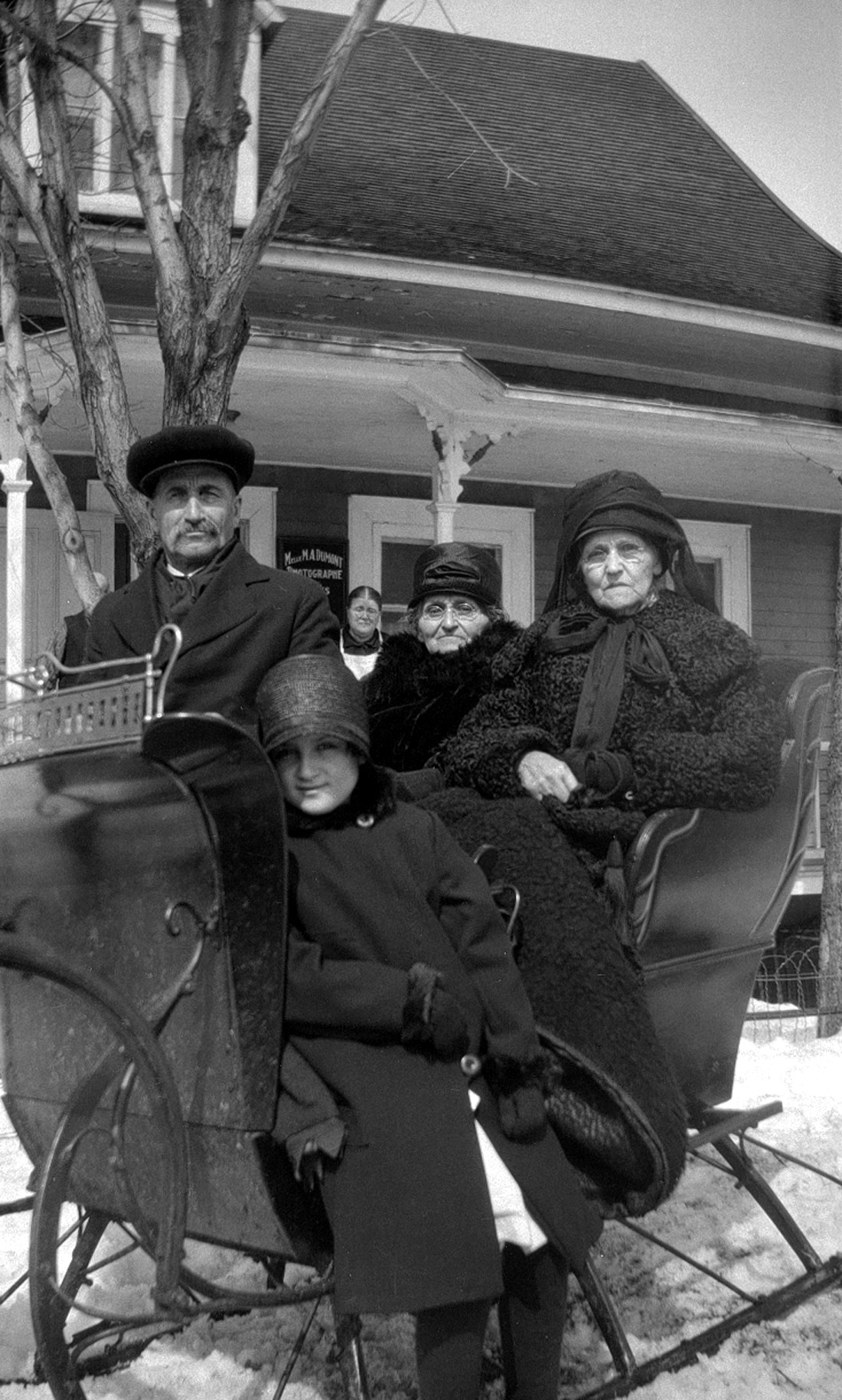
This photograph was taken during a visit from Uncle Georges to the village. Visits from family were practically a part of daily life for the Dumont family. As François, the photographer’s brother, once recalled, in the days before television, radio or cars, it was family and neighbours who provided most of the “entertainment.”
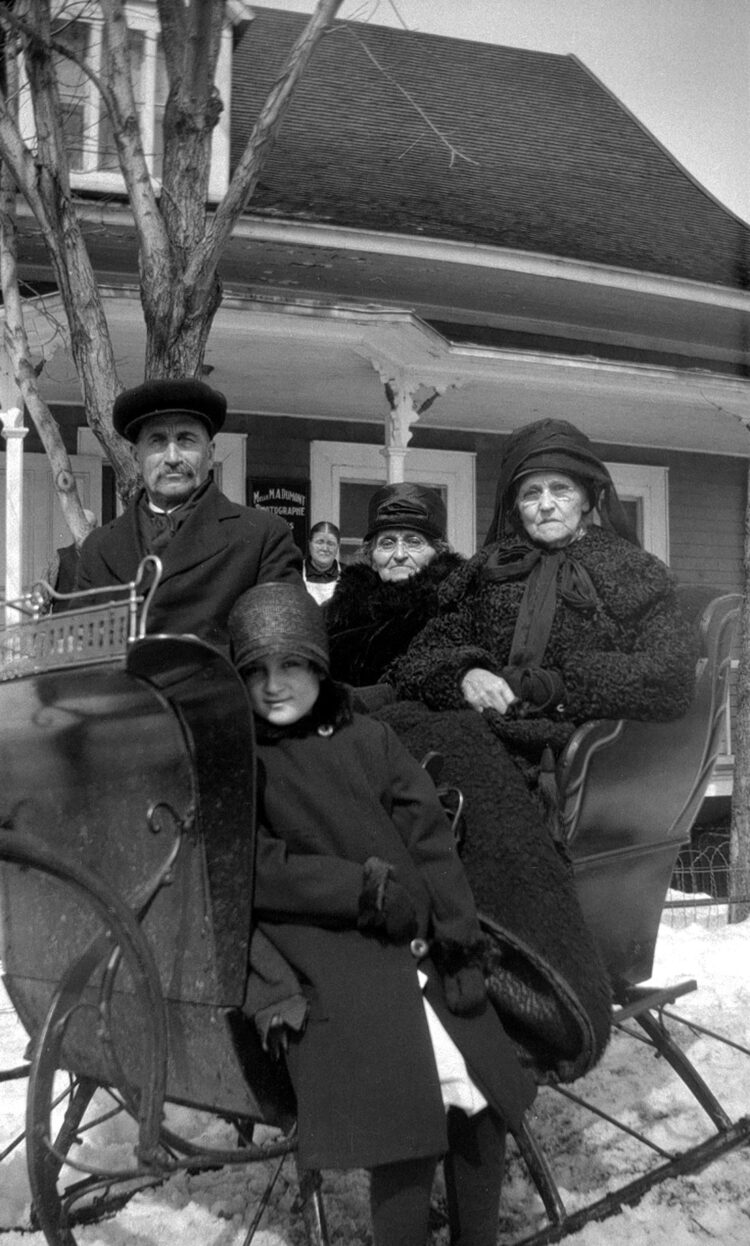
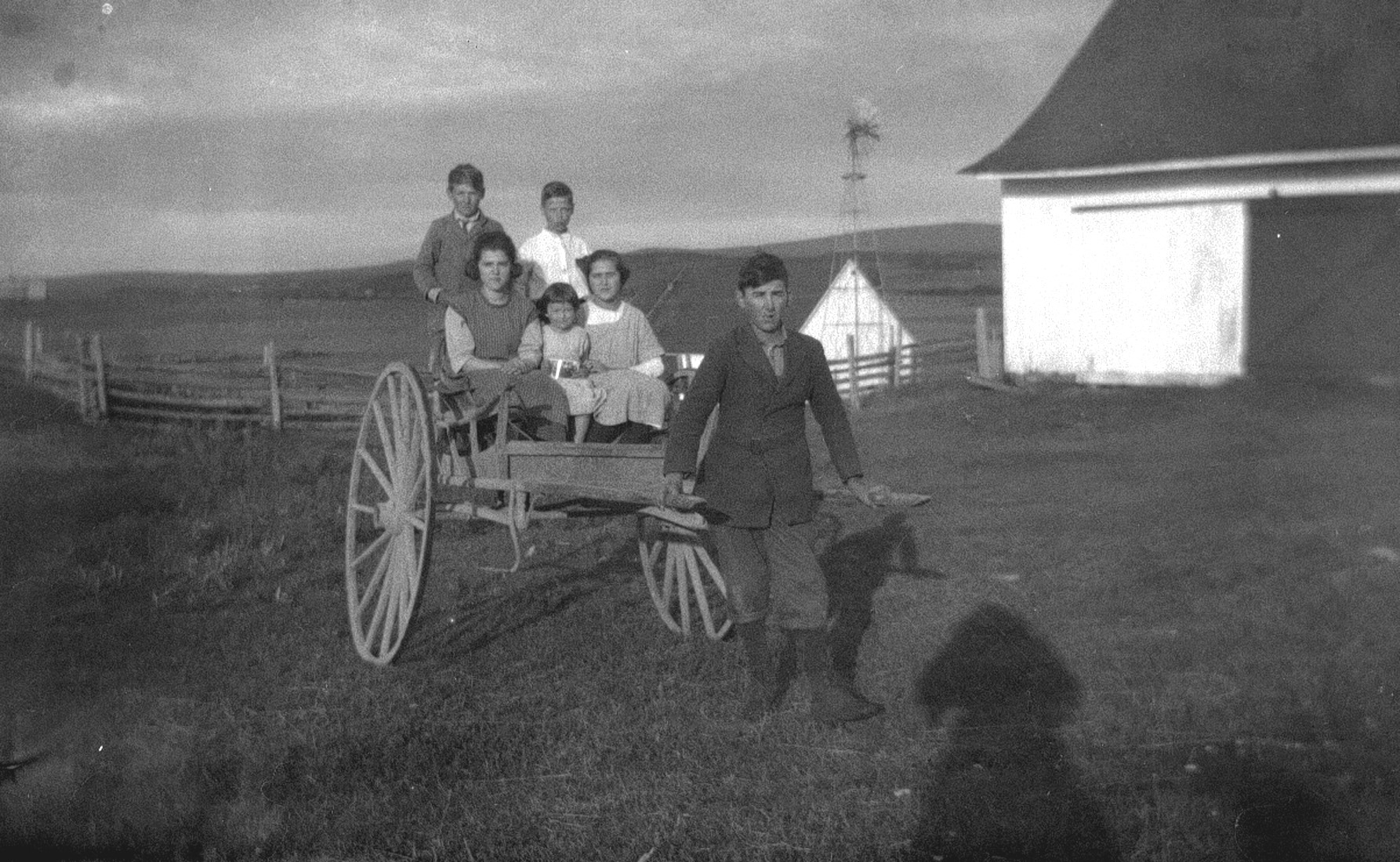
This lovely snapshot captures a joyful moment shared by Ouellet and Dumont cousins on the Dumont family land, on the 5e Rang.
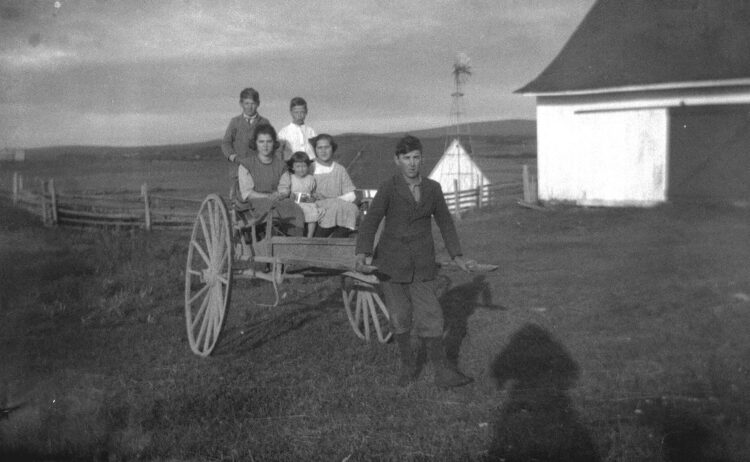
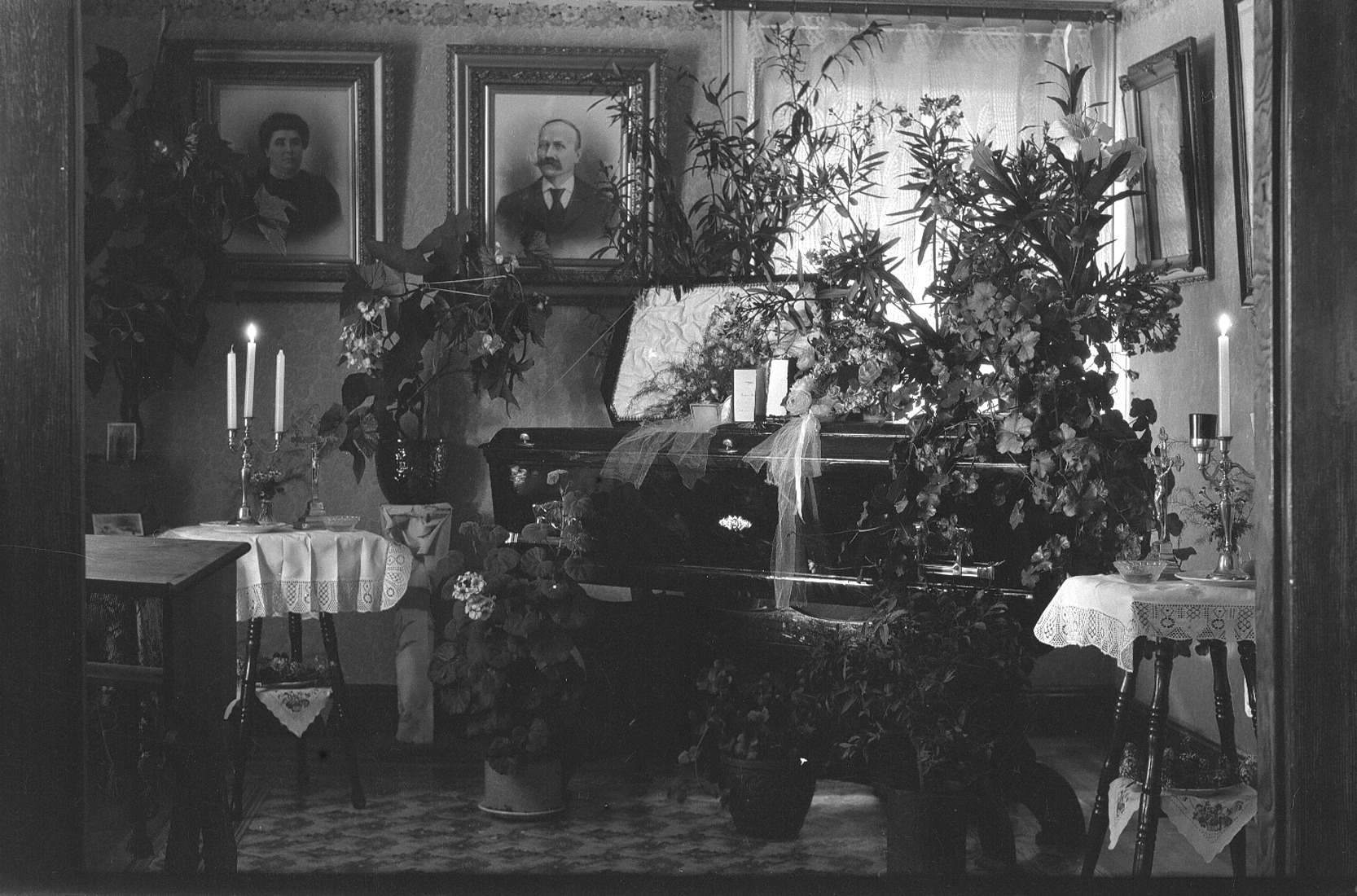
At the time, it was customary to hold wakes at home. Here, the body of Marie-Louise Dumont lies in repose, under the watchful gaze of her parents, whose portraits are displayed on the wall behind her.
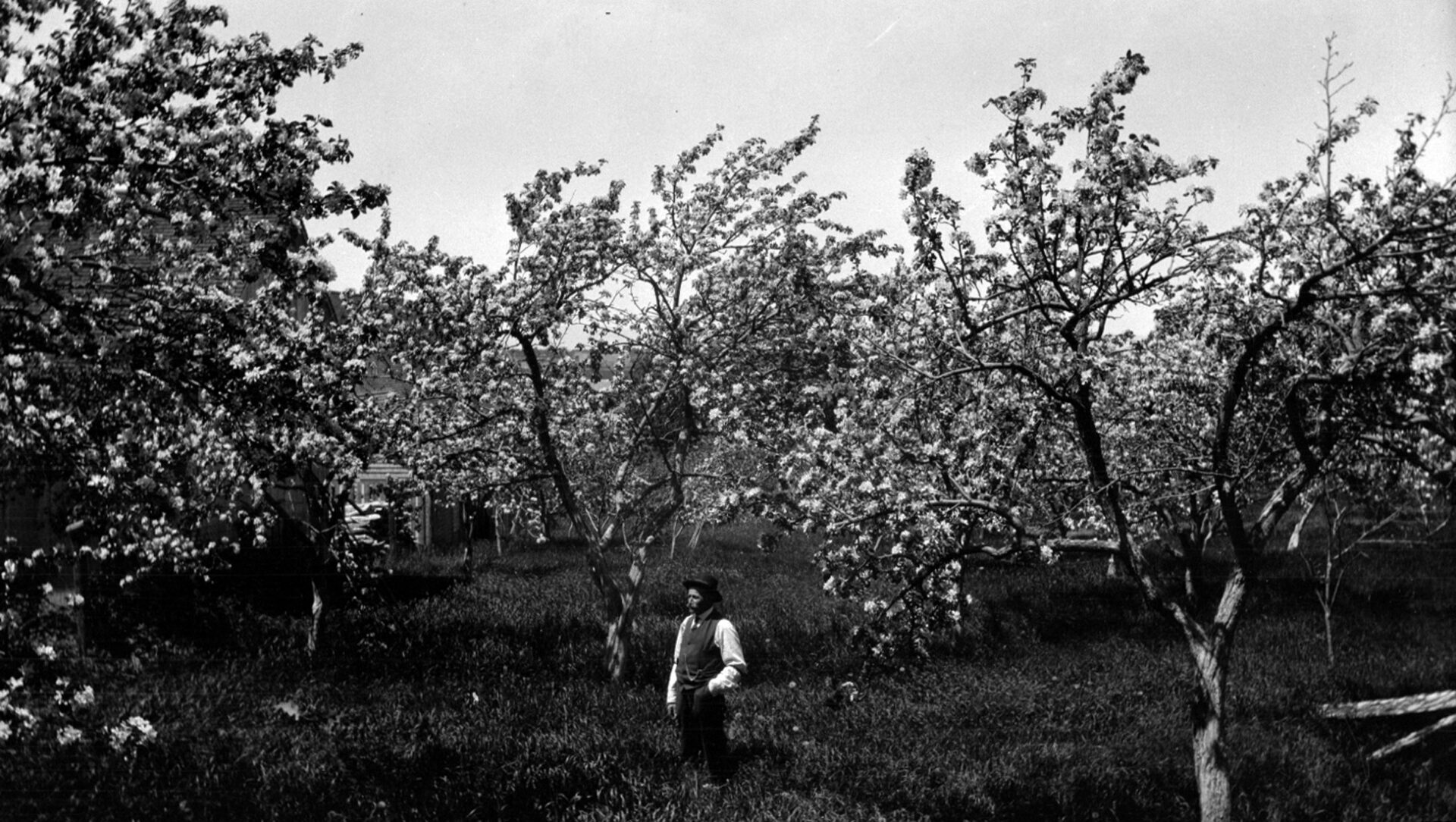
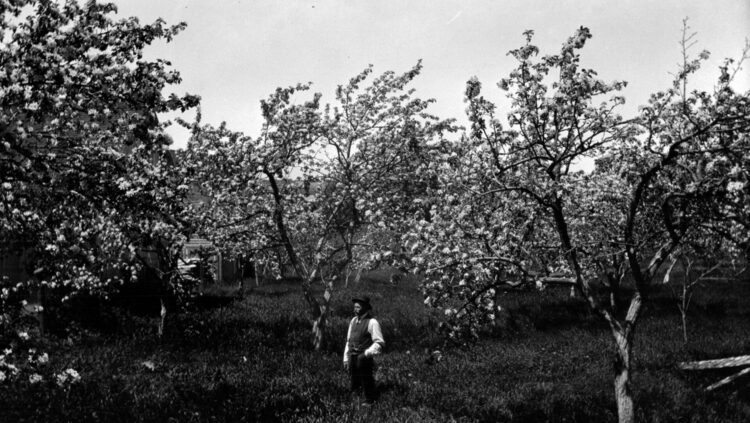
Uldéric Dumont stands proudly in the middle of the orchard, which he tended with his eldest son, François, and his photographer daughter. Is he the subject of the photograph, or did Dumont wish, instead, to capture the majesty of the surrounding landscape?
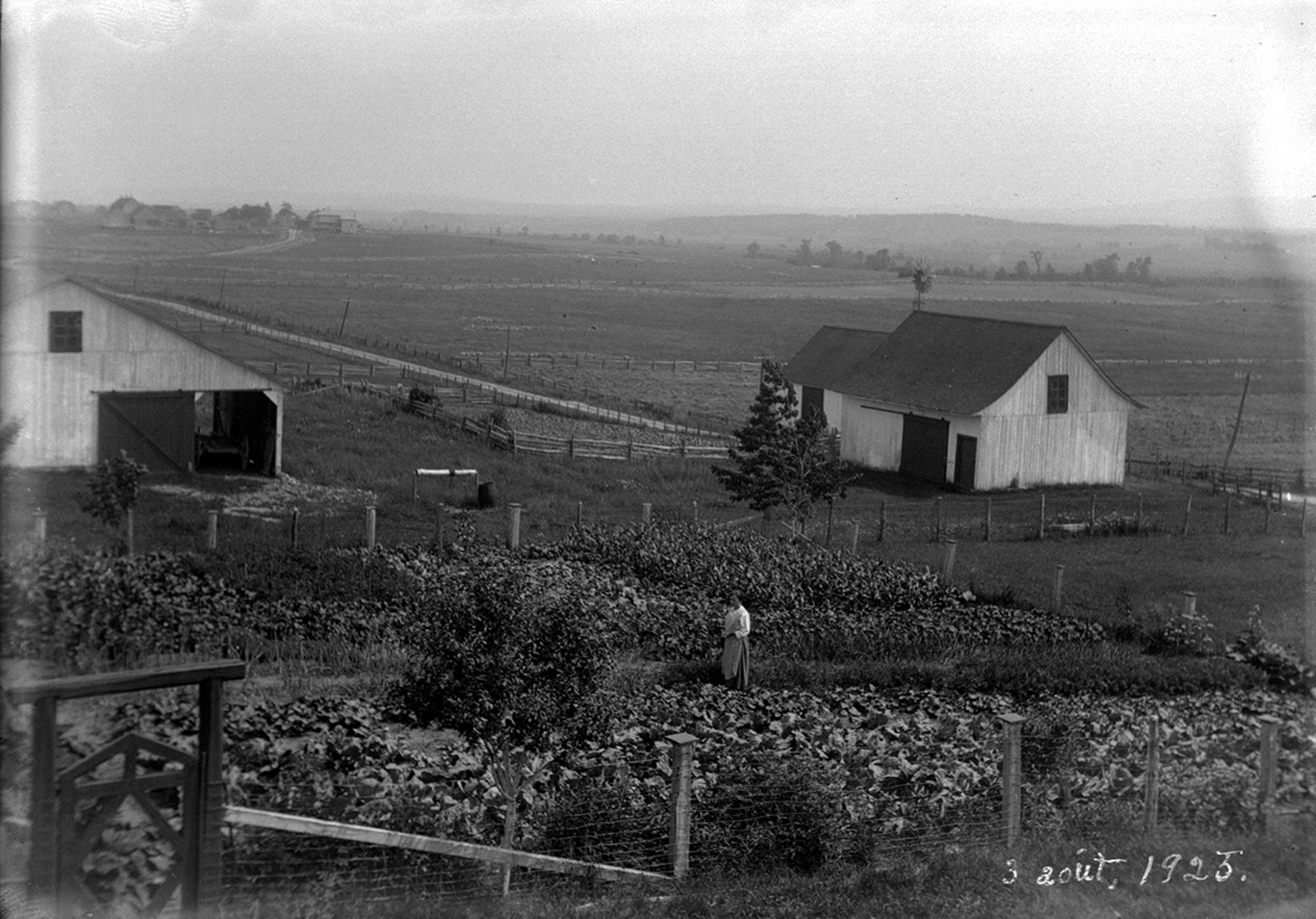
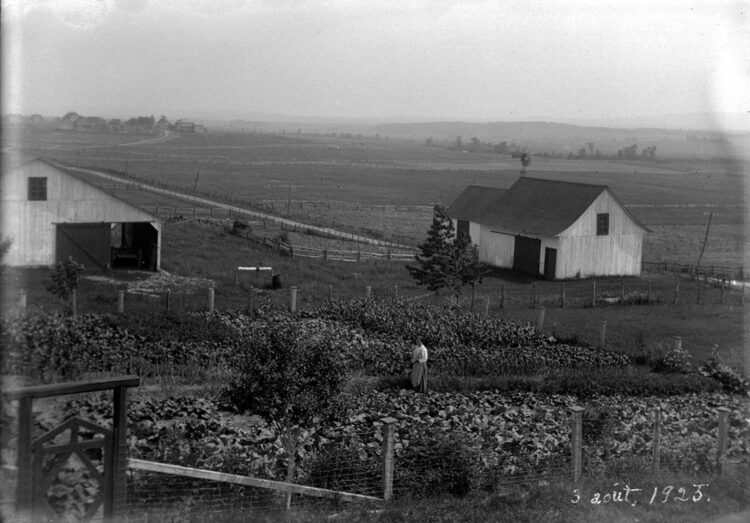
This photograph of Marie-Alice standing in the middle of the family garden offers a glimpse into the Dumont family’s way of life and the rural landscape that surrounded them.
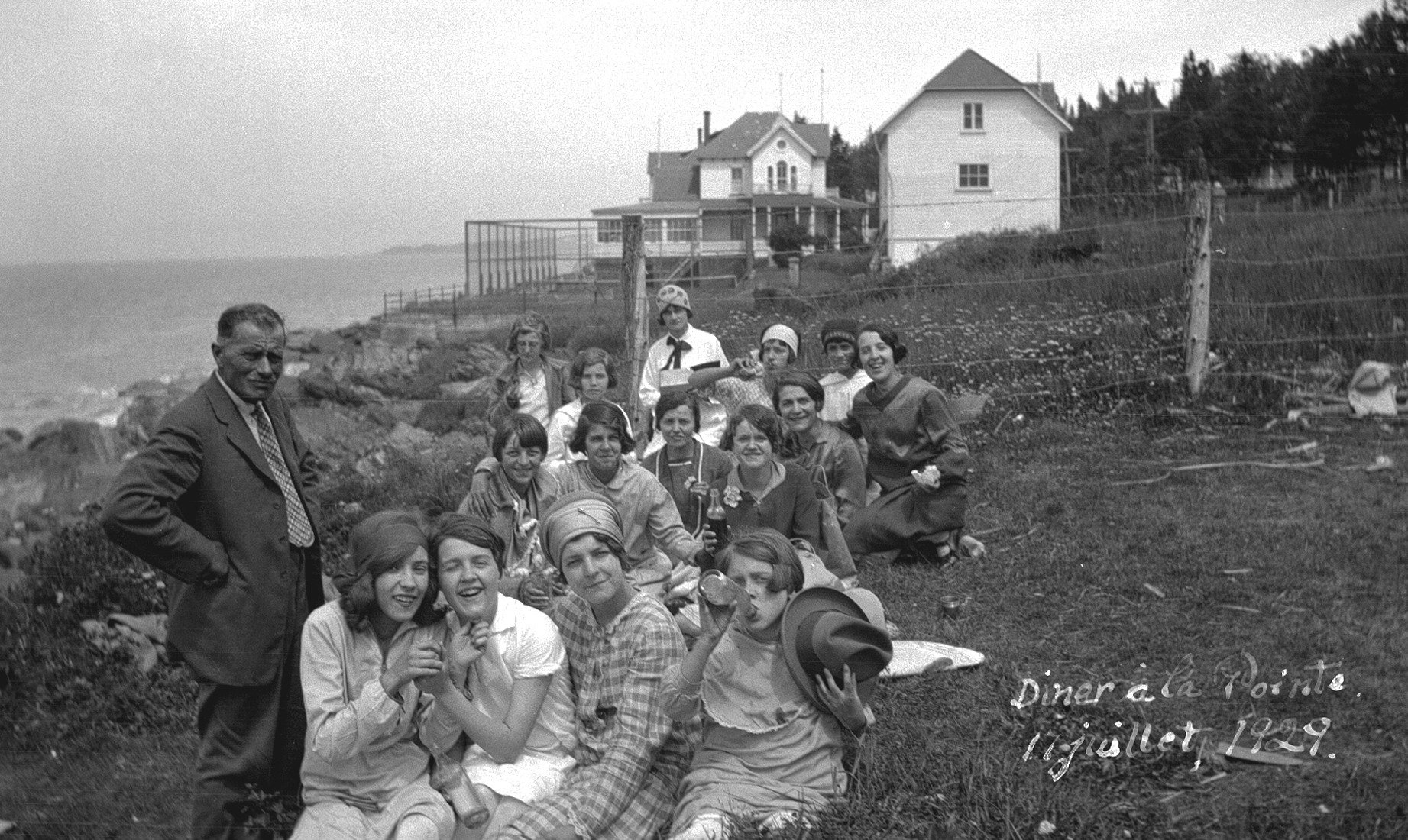
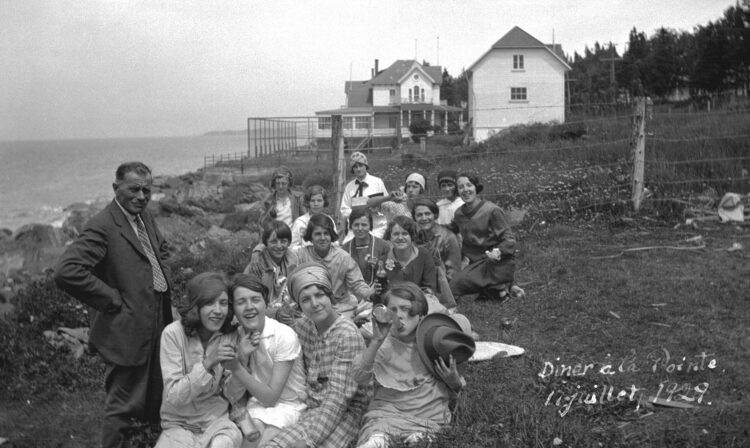
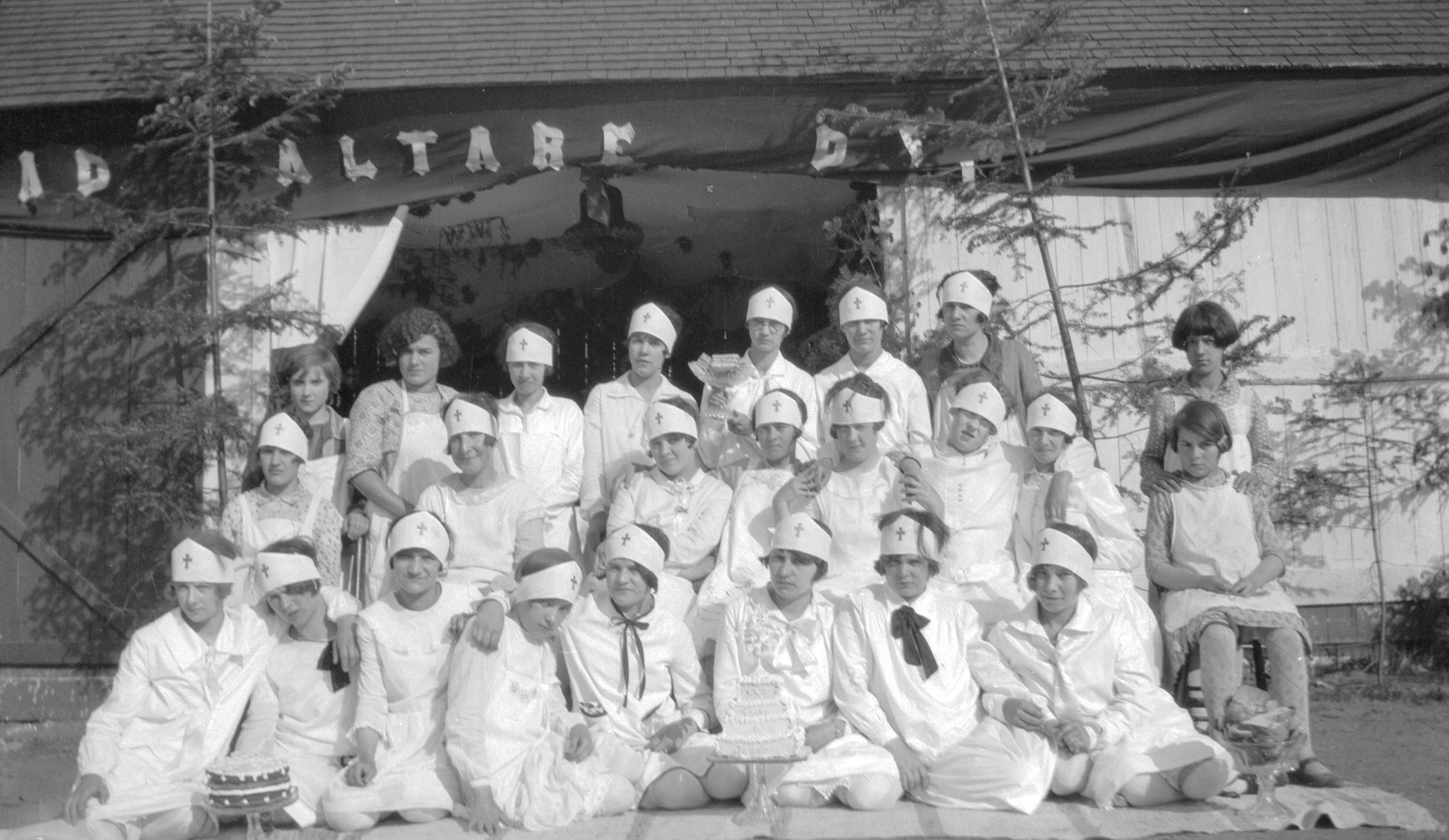
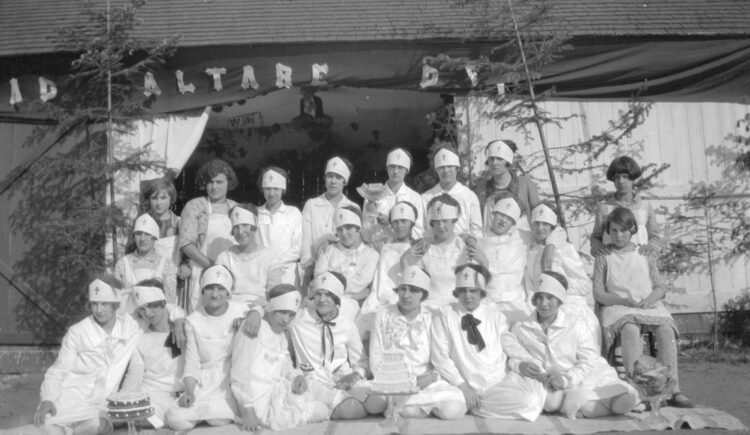
On July 17, 1929, a cheerful group of young women, led by a chaperone, set off from Saint-Alexandre for a picnic on the point in Rivière-du-Loup. Dumont (seated in the centre) brought along her Kodak camera so that she and her assistant Rosalie (behind the lens) could capture the memories of the day on film.
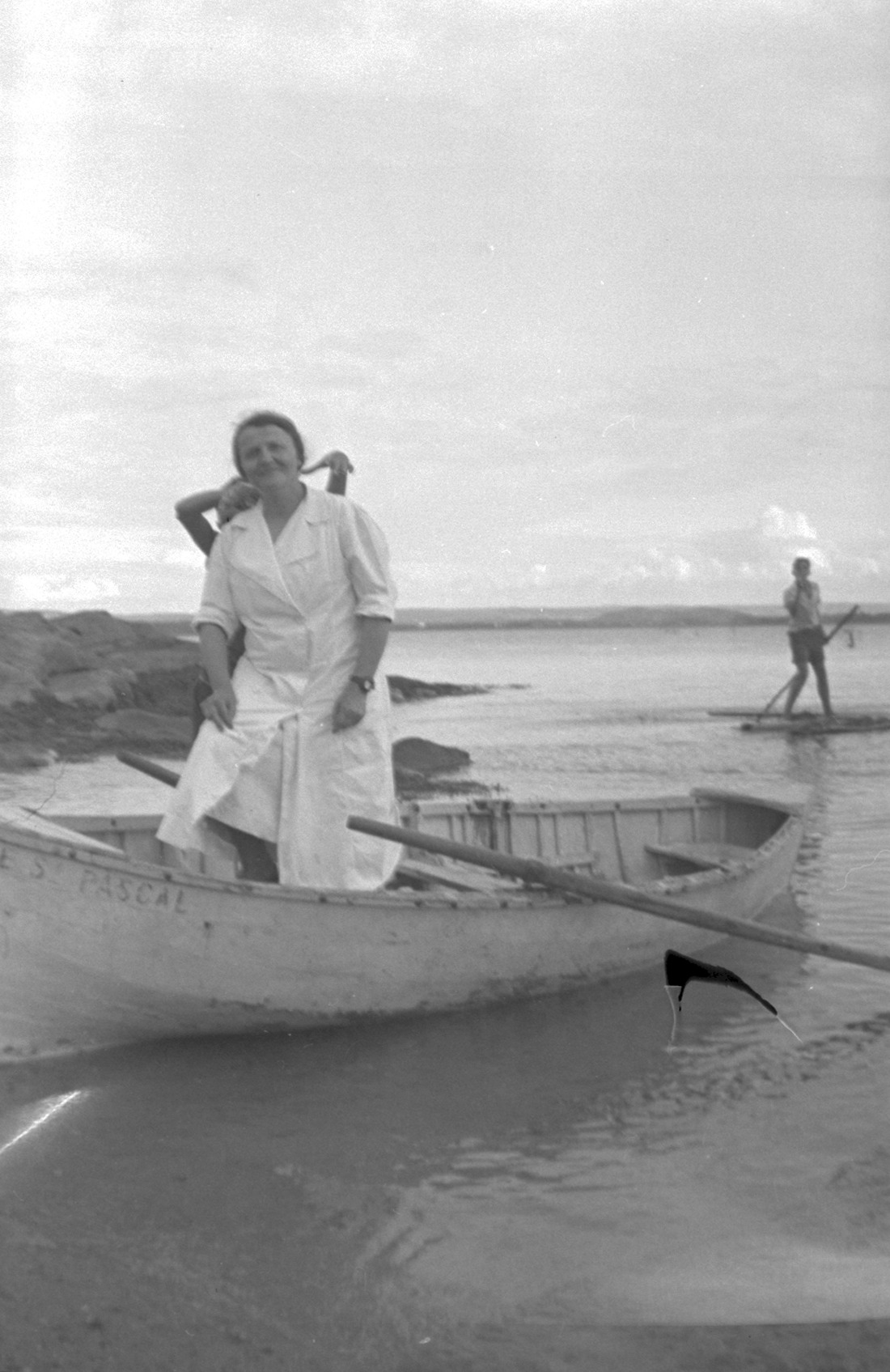
Marie-Alice Dumont was visiting her sister Émilia on Patins Island. Invited to take a dip in the St. Lawrence River with some of her nephews, she gladly accepted, without suspecting their mischievous intentions!
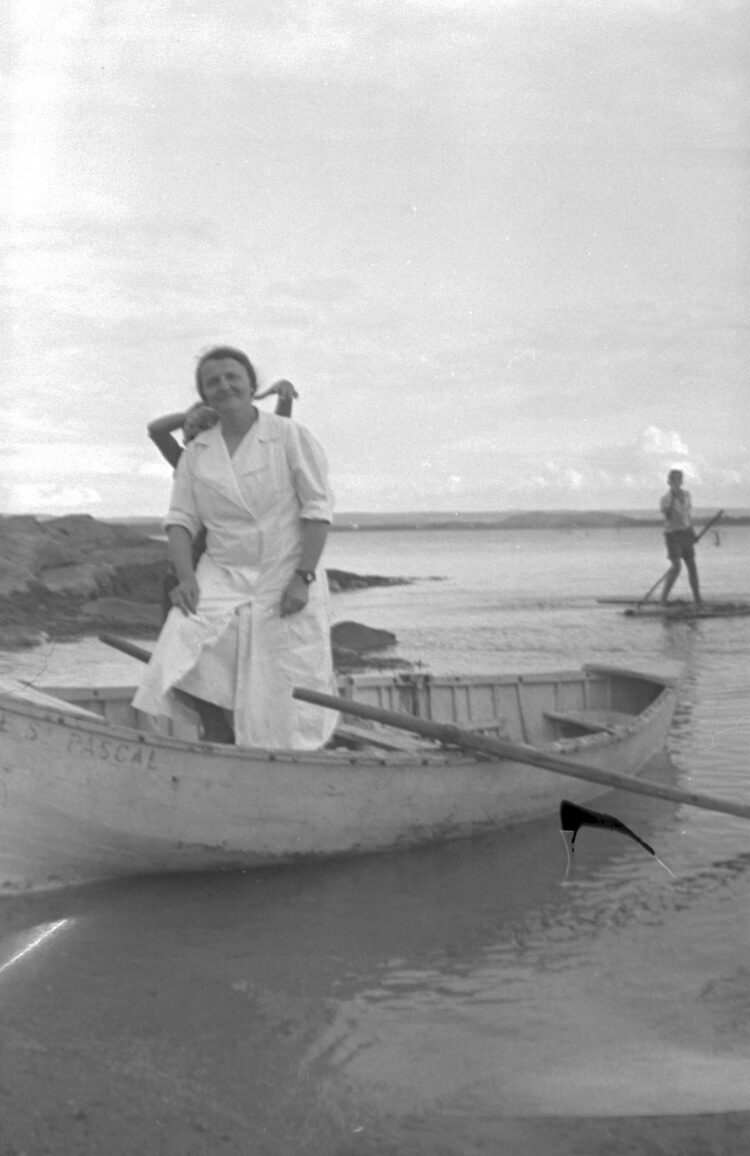
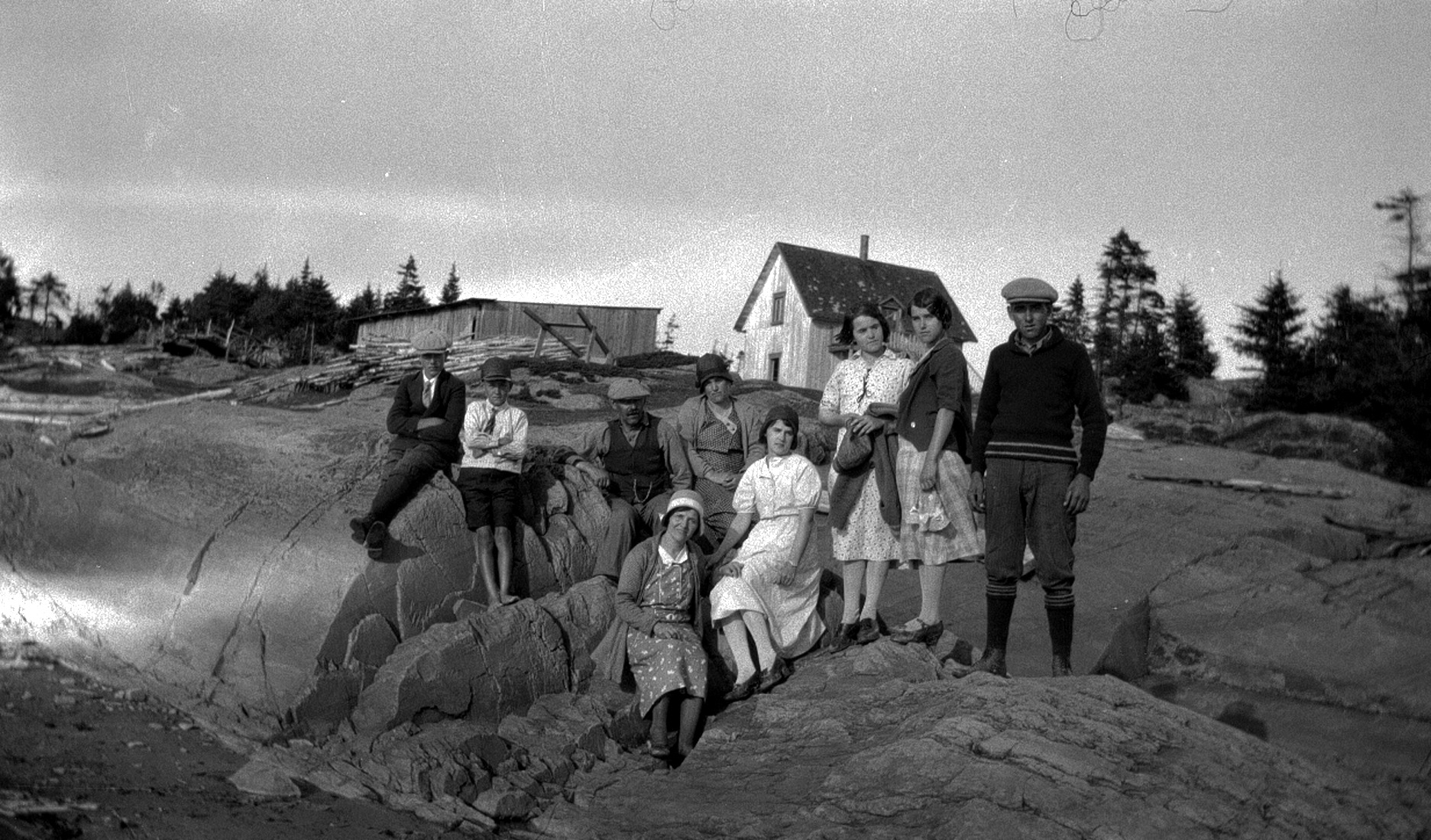
Here is another portrait of Marie-Alice Dumont with her sister Émilia’s family on Patins Island. The crossing to this small island paradise could be perilous. One day, Dumont’s brother and her nephew Charles-Eugène were caught by the rising tide. The water already reached their waists when they were only barely halfway across. Out of breath, they had to push their physical limits to avoid drowning.
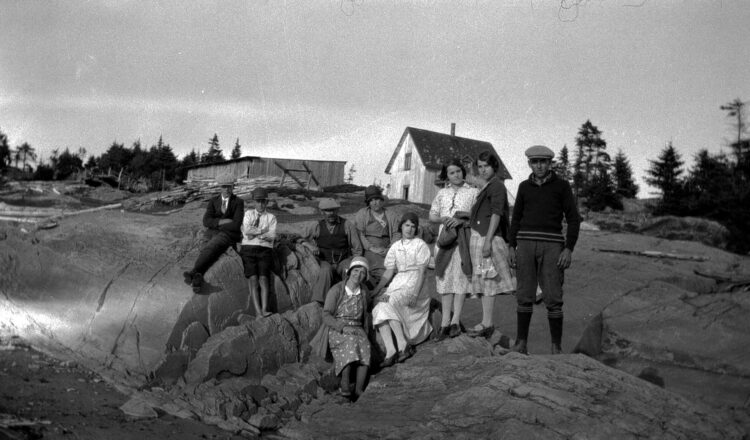
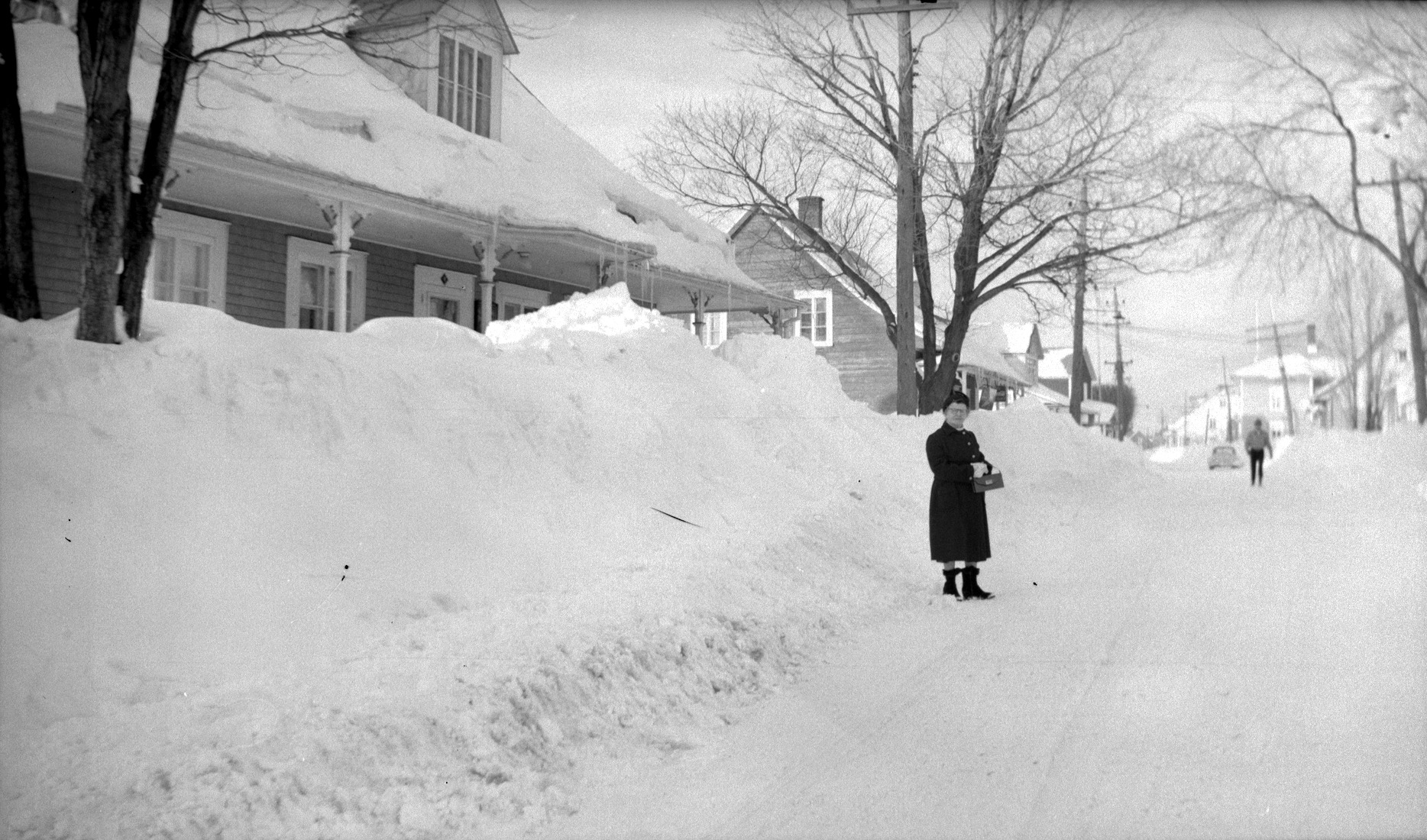
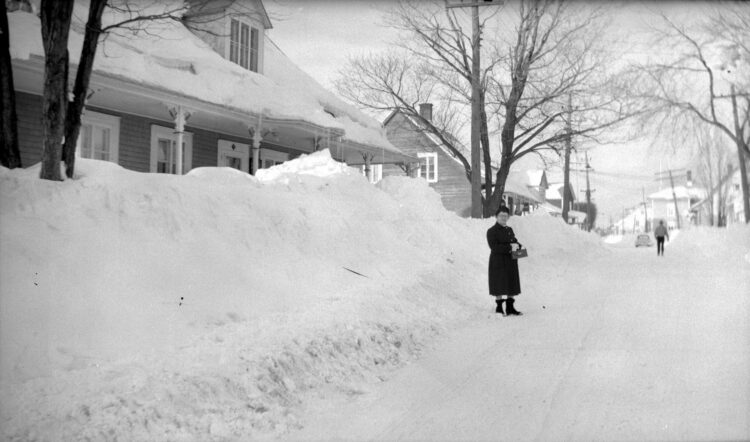
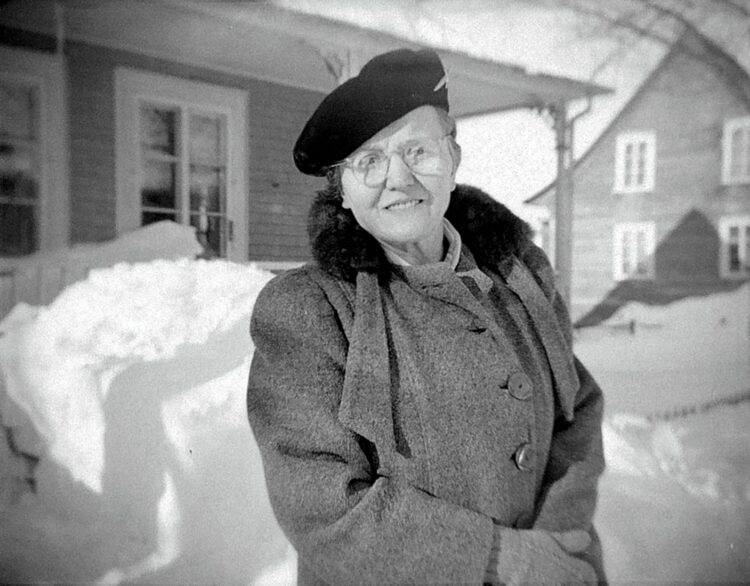
Ah, the infamous Quebec snowstorms… They always seem more impressive in our ancestors’ time or in our own backyard! Marie-Alice Dumont appears tiny beside the towering snowbanks that partly conceal her house.
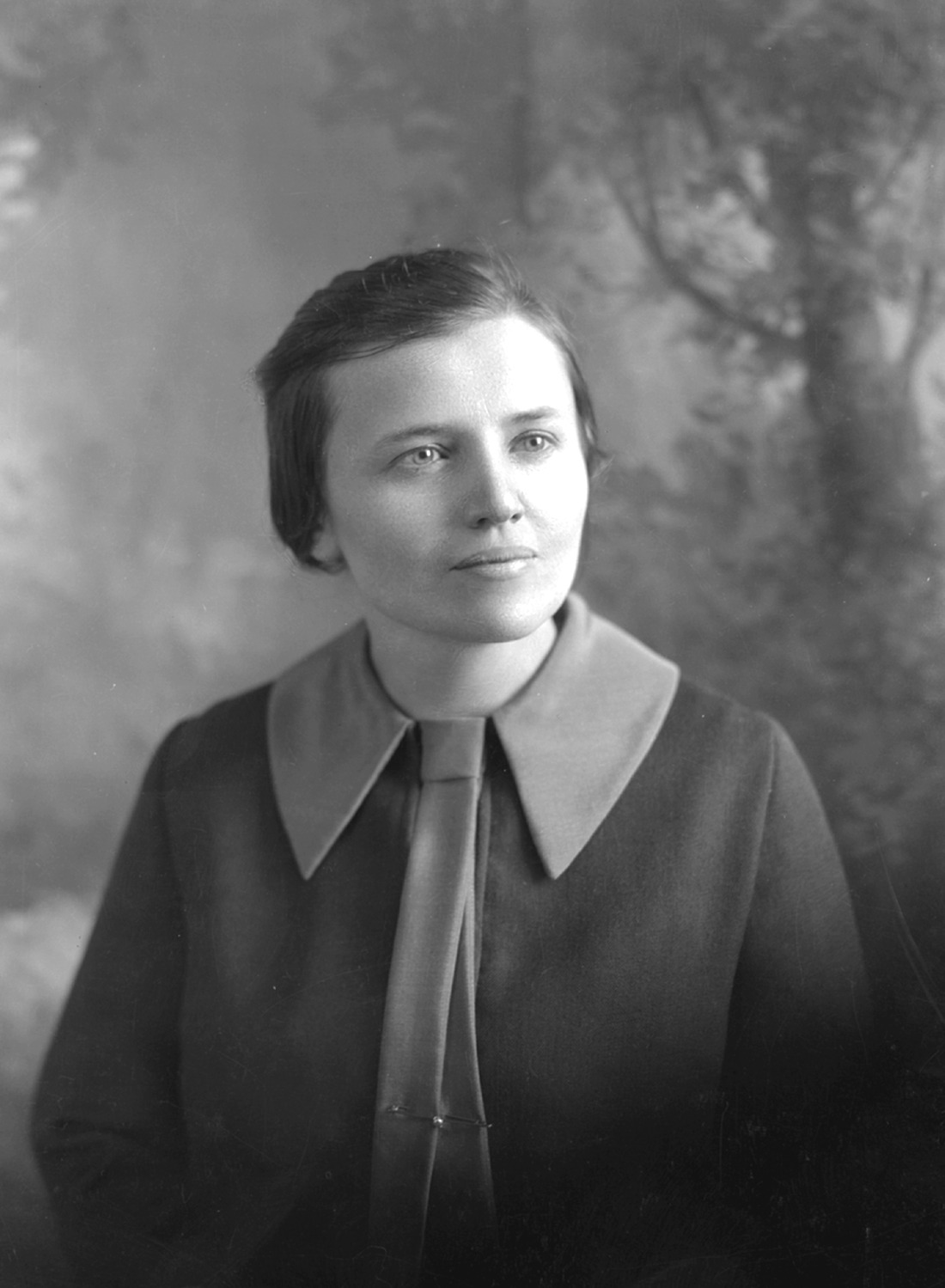
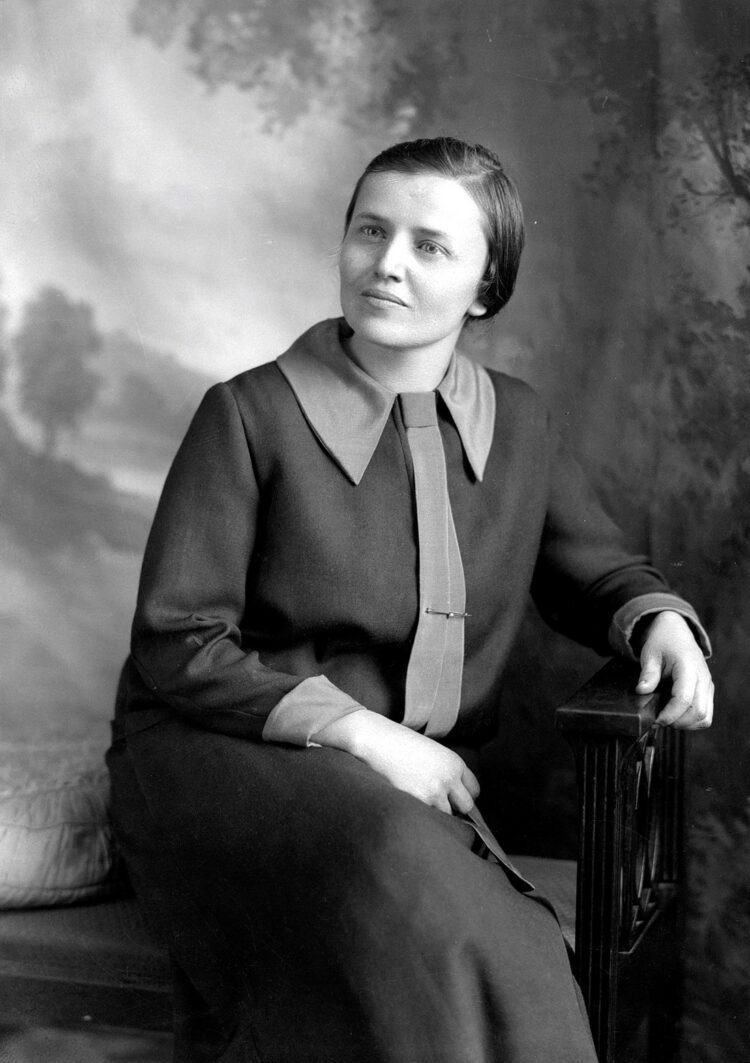
This could very well be the most refined portrait of Marie-Alice. Ulric Lavoie took it at the very beginning of Dumont’s career. Did she intend to use it as a professional carte de visite or a promotional image? Lavoie clearly took great care in retouching the photo, especially the face, which, on closer inspection, appears very smooth, almost flawless. Marie-Alice even looks a few years younger! She is smiling slightly and gazes off into the distance, lending her an expression that is both soft and serious, and creating a certain distance between her and the viewer. For the occasion, the photographer chose a modest yet fashionable outfit, one she often wore when sitting for studio portraits.
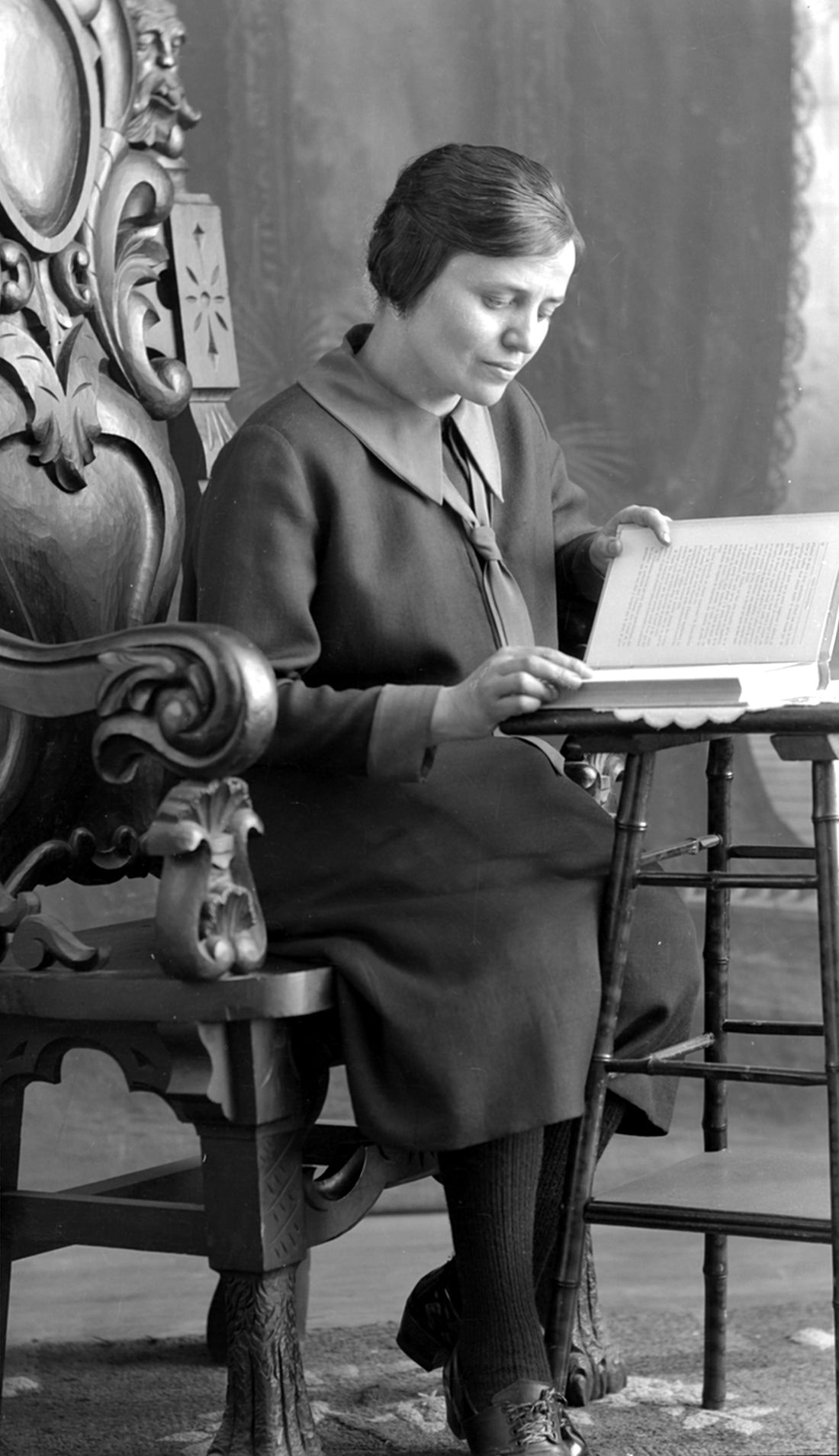
This self-portrait is undoubtedly one of the most striking Dumont ever created. She is seated on the grand yet elegant “Devil’s Chair,” her feet barely touching the floor. With a serious expression, she pretends to read a book. What image is she trying to project? That of a serious, educated and busy woman.
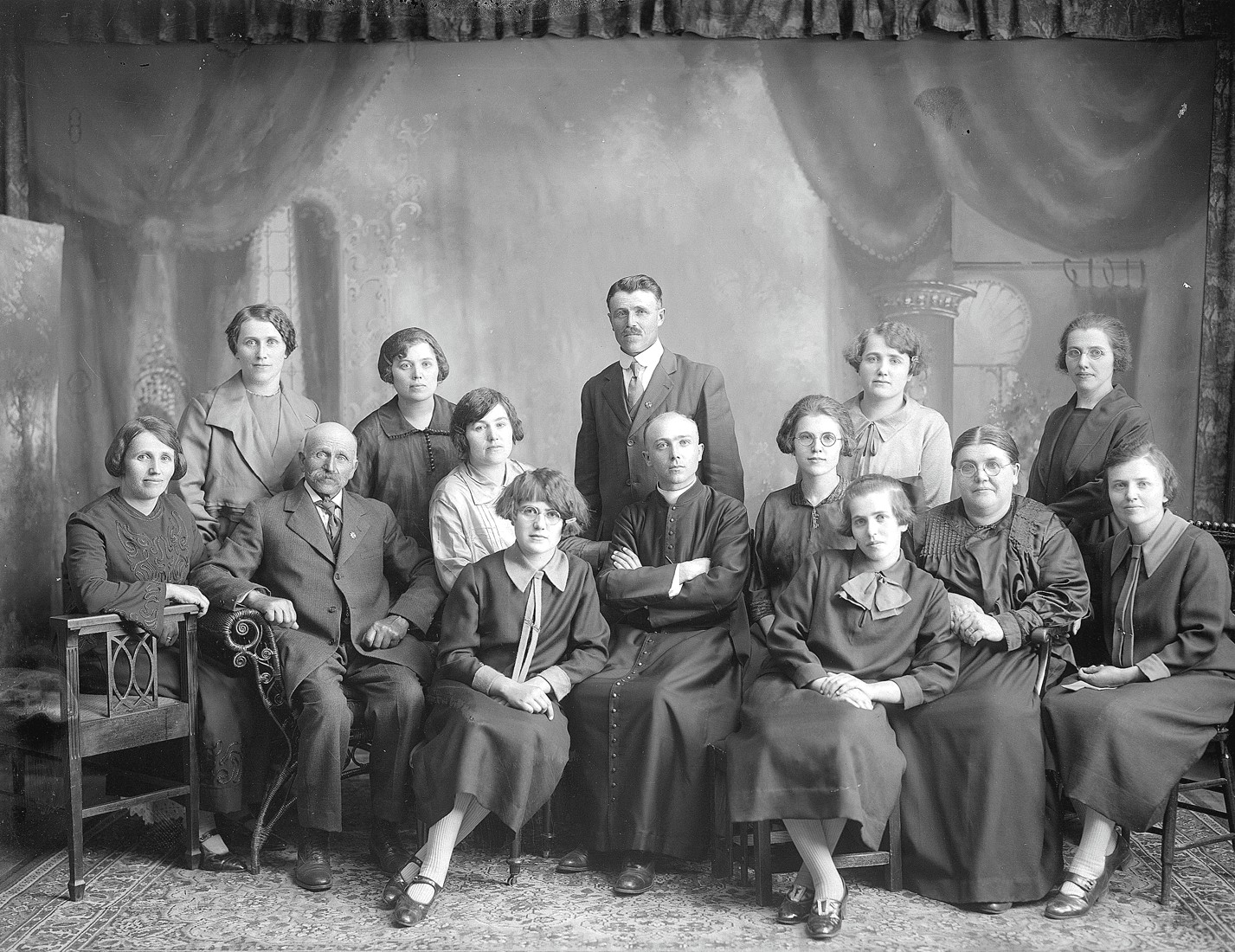
In this photograph of the Dumont family taken by Ulric Lavoie, the two sons are prominently placed at the centre of the composition. Joseph-Napoléon, the younger of the two, is seated in the front row at the very centre, while, by his height and position, the elder boy François towers over the group from the second row. The father (Uldéric, on the left) and mother (Marie, on the right) are surrounded by their many daughters. Marie-Alice stands at the far right, next to her mother.
Back row, left to right: Anna, Marie-Louise, François, Marie-Jeanne, Marie-Claire.
Front row, left to right: Albertine, Uldéric, Émilia, Elizabeth, Napoléon, Gabrielle, Berthe, Marie, Marie-Alice.
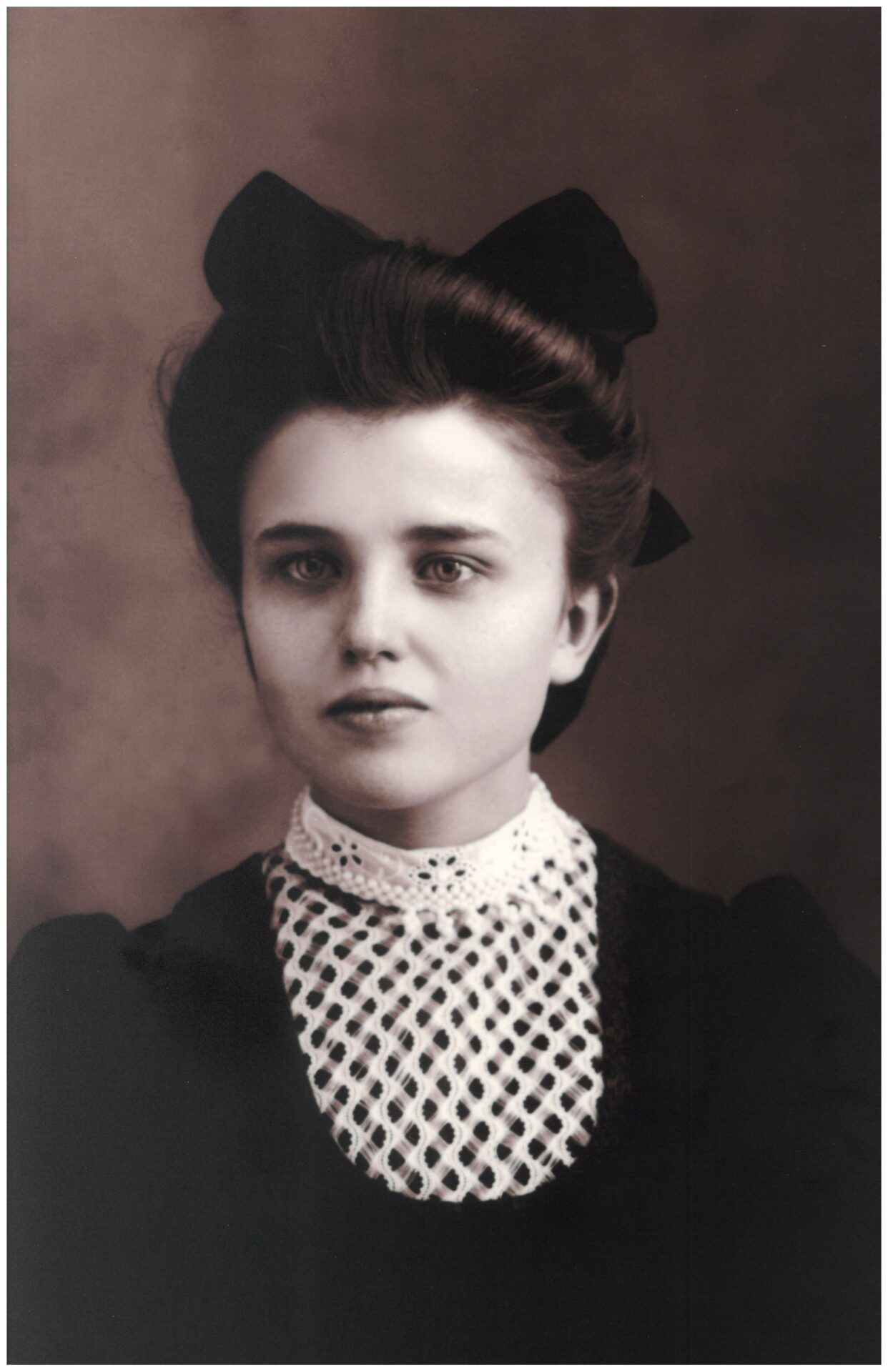
This portrait is one of the few known images of Marie-Alice Dumont before her twenties. It already reflects an aesthetic quite similar to the one Dumont herself would later adopt when she found herself on the other side of the lens, in her own studio. The stream of light coming from the left softens the young woman’s gaze and lends her a mysterious quality. It also heightens the already striking contrast between the white high-buttoned blouse and the black of the rest of her outfit, which nearly blends into the background. The viewer’s eye is naturally drawn to the centre of the image, to the subject’s face. Did Marie-Alice draw inspiration from this image when crafting her own portraits?
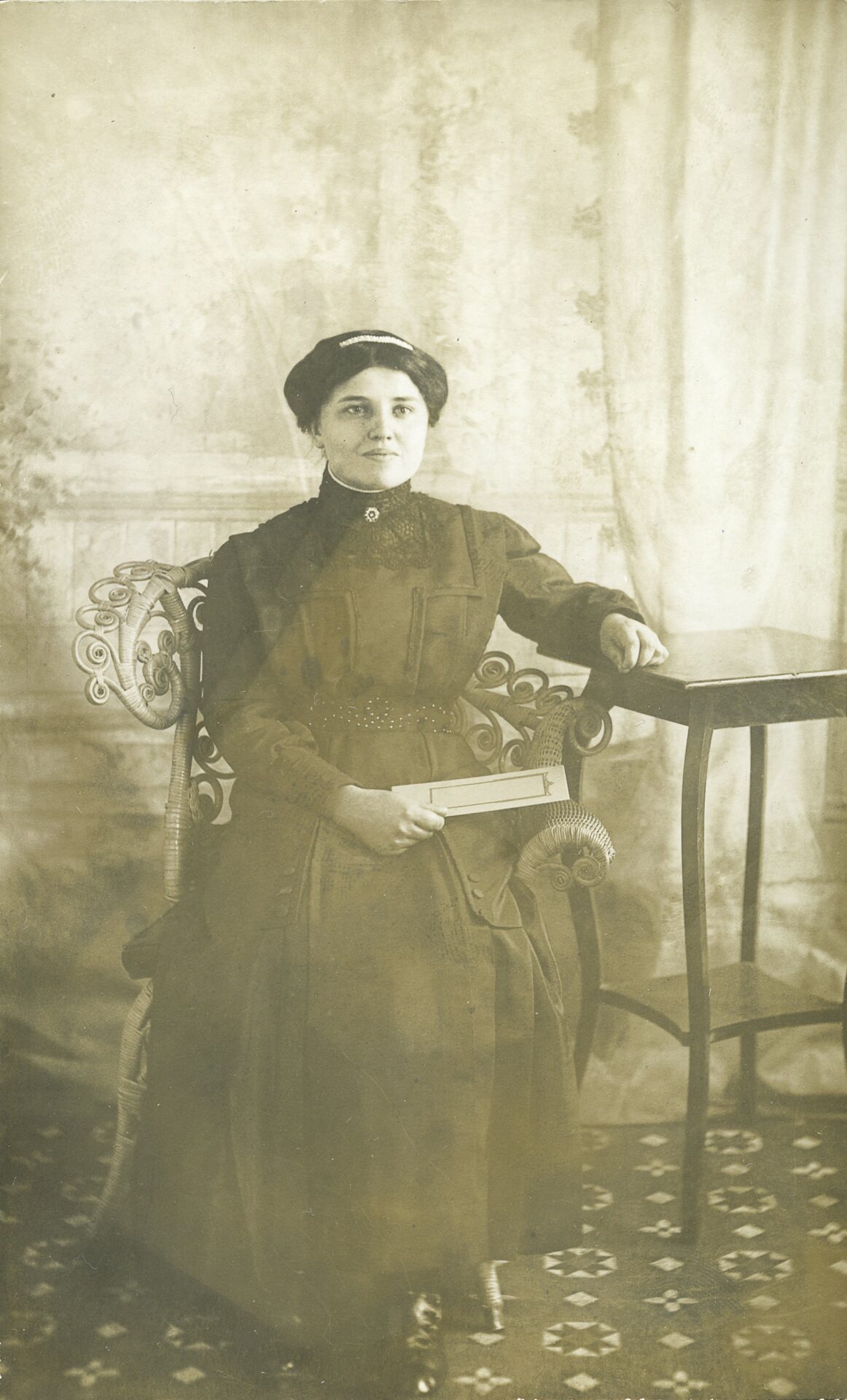
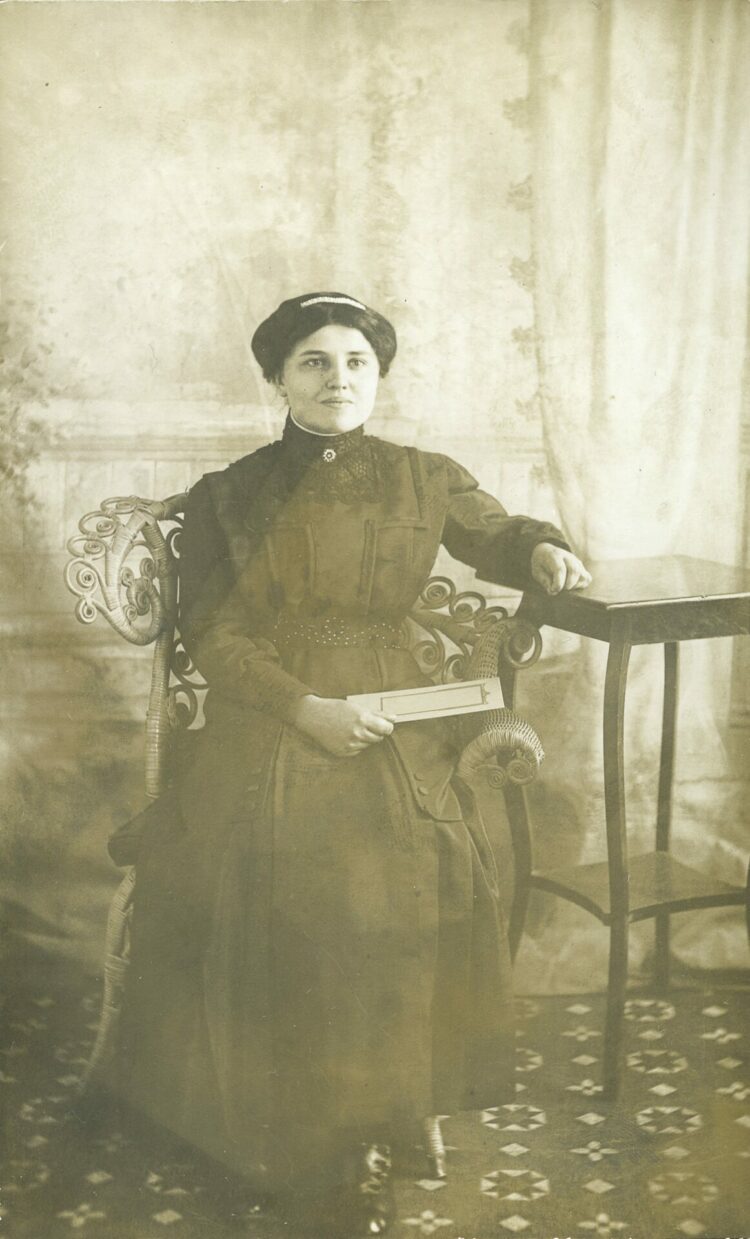
In this portrait, Marie-Alice must be between 18 and 20 years old. Around this time, circa 1910, she is preparing to leave for the novitiate in Québec City. Although she never realized her dream of becoming a nun, she is still remembered within the family as a deeply devout woman, often seen wearing clothing as modest and sober as a nun’s habit.
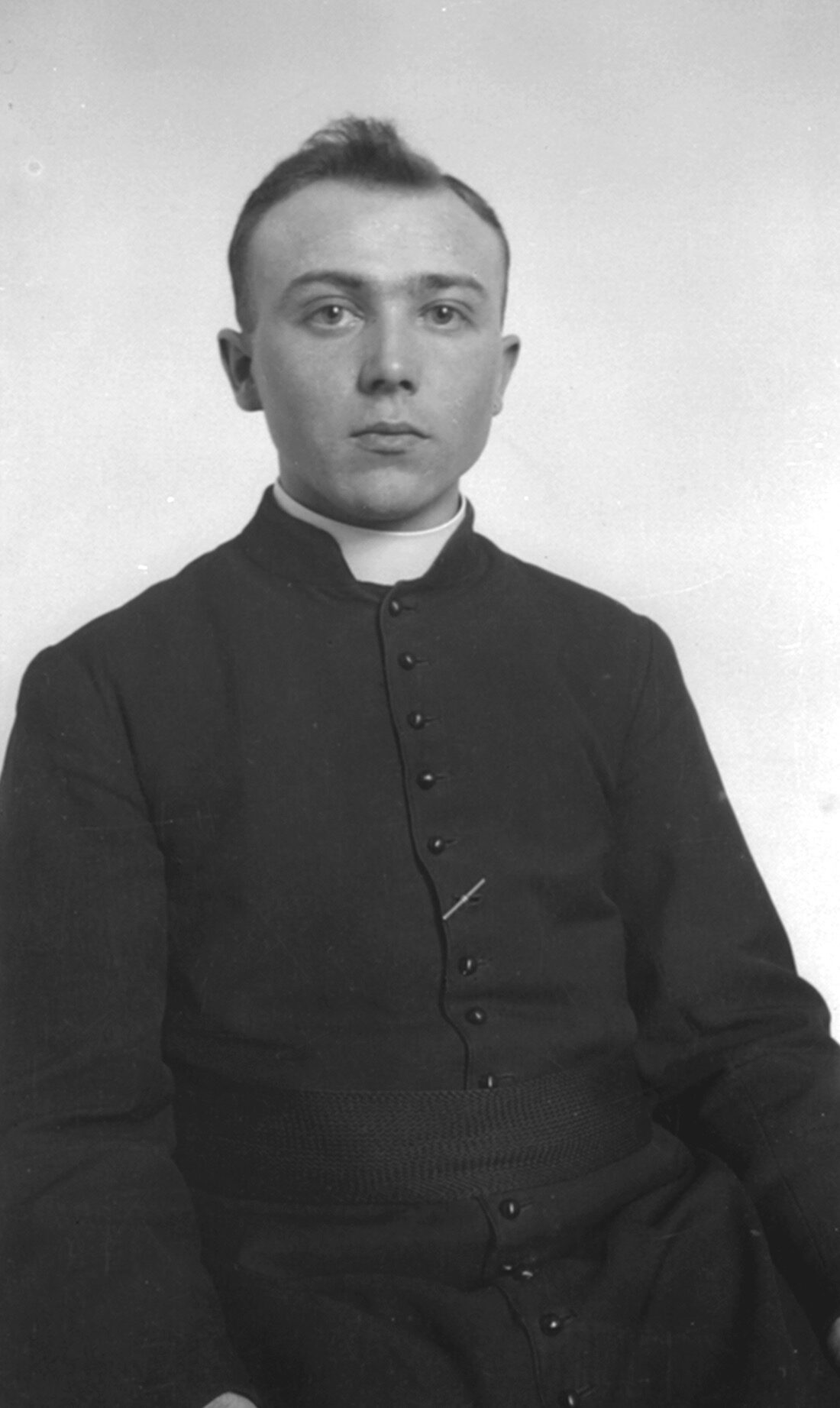
Could this be the first portrait Marie-Alice Dumont took of her younger brother Joseph-Napoléon (1897–1985)? About 23 years old at the time, Napoléon introduced his sister to the basics of photography in the summer of 1920. An amateur photographer himself, he was a priest who lived out his vocation. Dumont and her brother would remain close throughout their long lives.
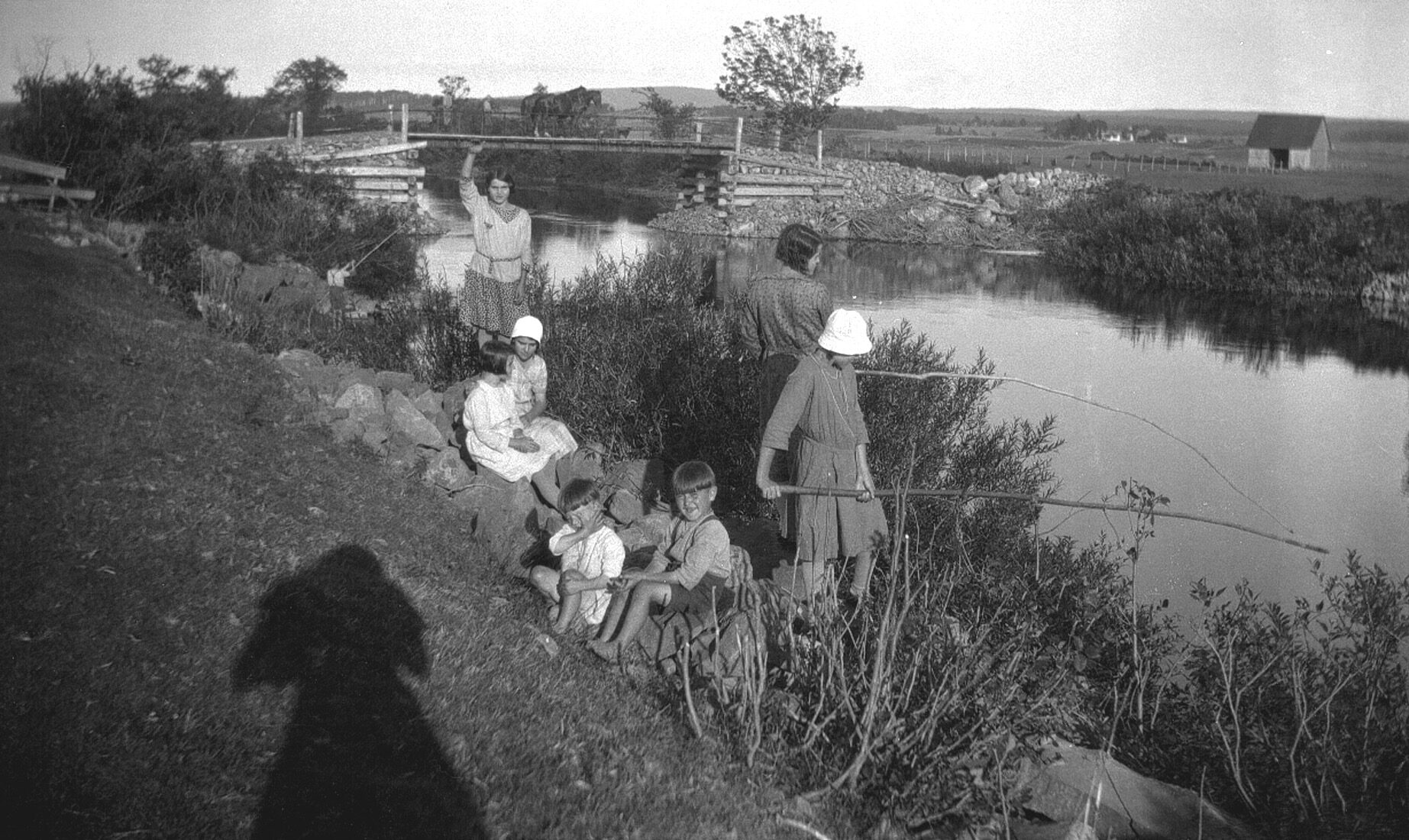
The Dumont family land is crossed by the Du Loup River. In her youth, Marie-Alice would go there to fish for trout and carp with her brothers, sisters and other neighbourhood children. The fish they brought home were, by the next day, rolled in flour and fried in salted pork fat, much to the family’s delight. Can you spot the photographer’s shadow in the foreground? We can clearly make out the outline of the black cloth she draped over her head and camera to capture this moment during a sunny day in 1920. Indoors and outdoors, Marie-Alice was honing her skills as a photographer.
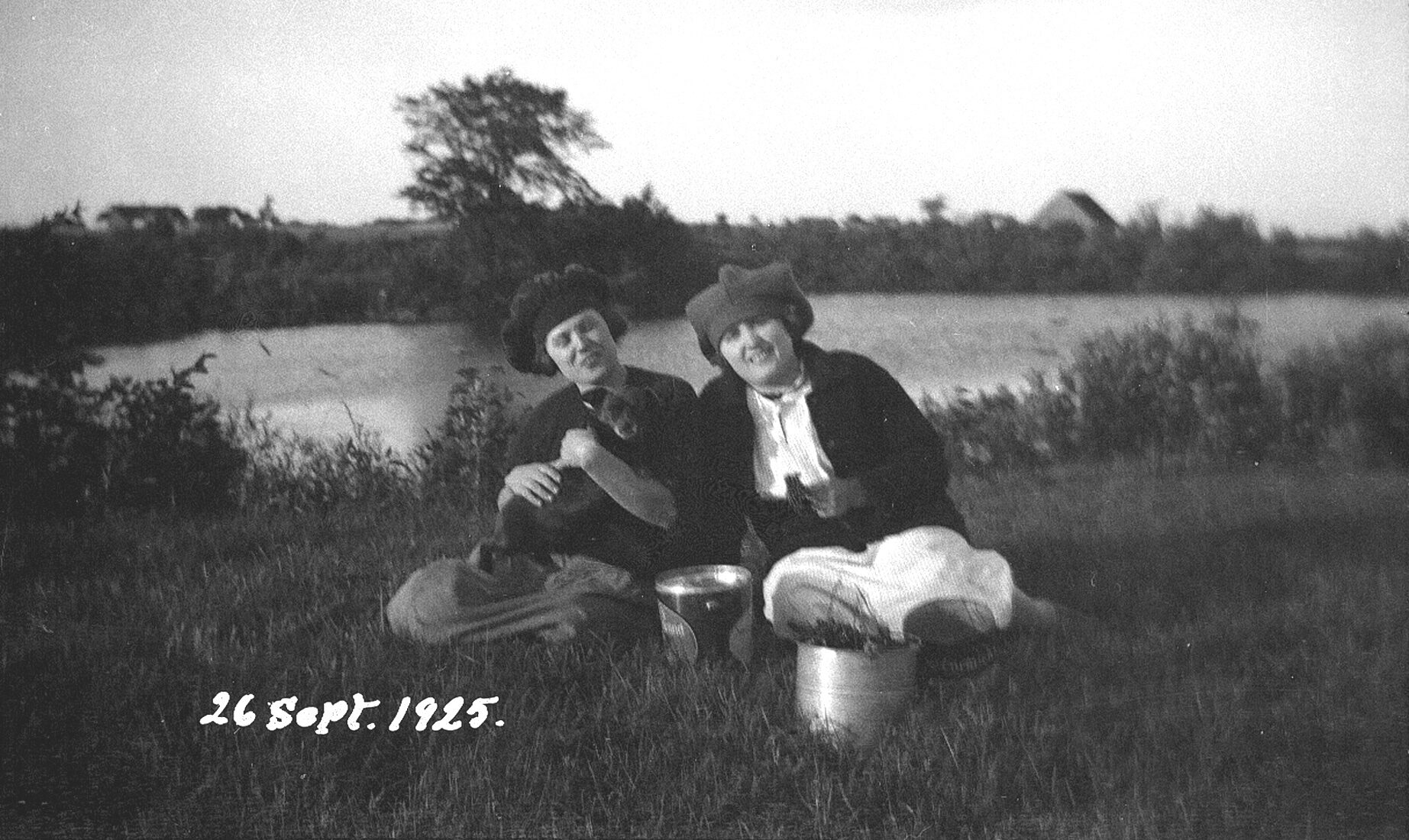
On this beautiful September weekend in 1925, Marie-Alice headed out with her sisters Marie-Louise (left) and Marie-Jeanne (right) to pick highbush cranberries. She was determined to take the opportunity to practise outdoor photography. The two young women in the photo had just stepped out of the canoe taken to cross the river and gather the small red berries. François Dumont, Marie-Alice’s older brother, remembered those days fondly: “On Sundays, when the weather was nice, young people from the neighbouring farms would come by to eat cranberries. We had so much fun!”
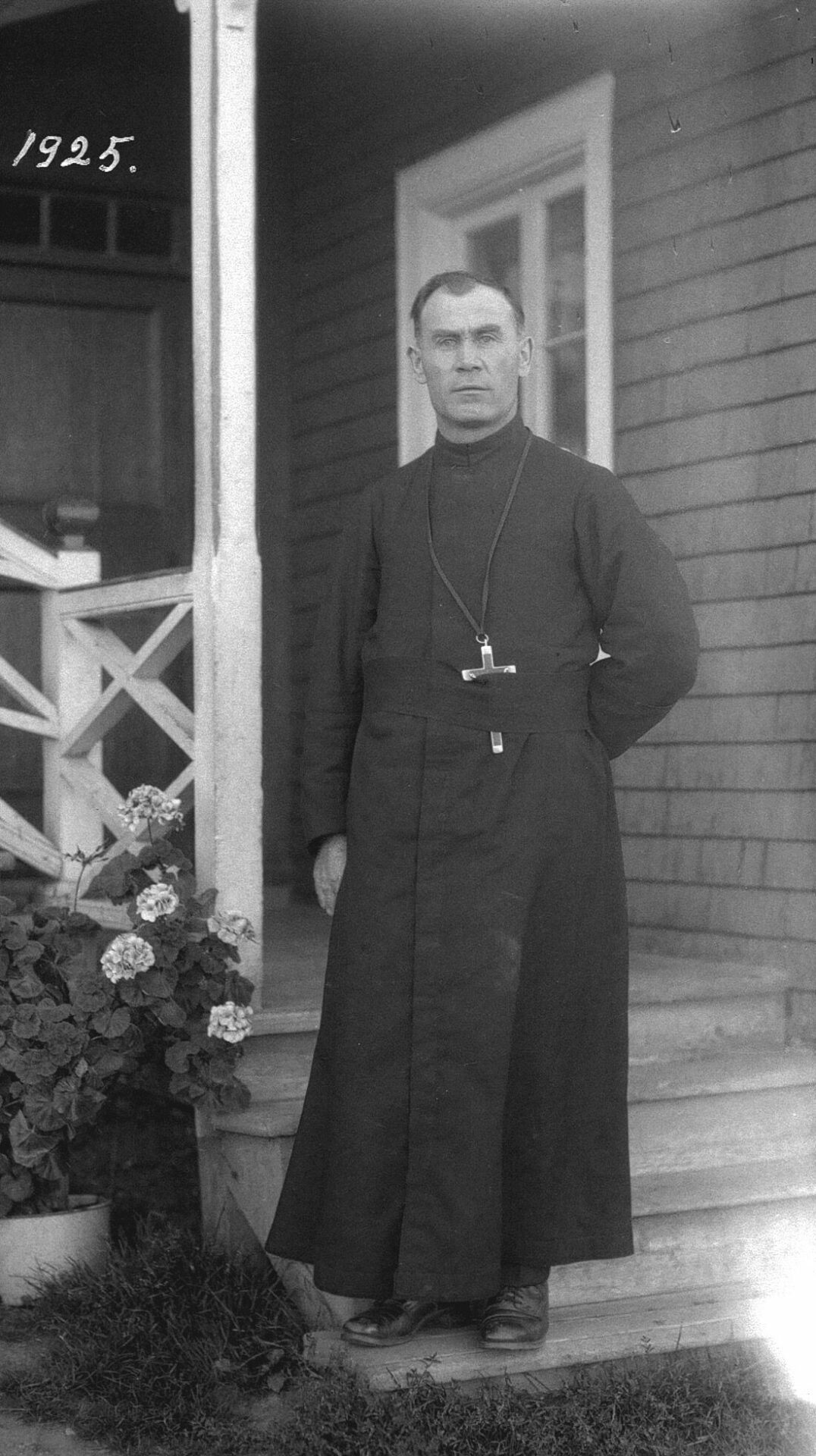
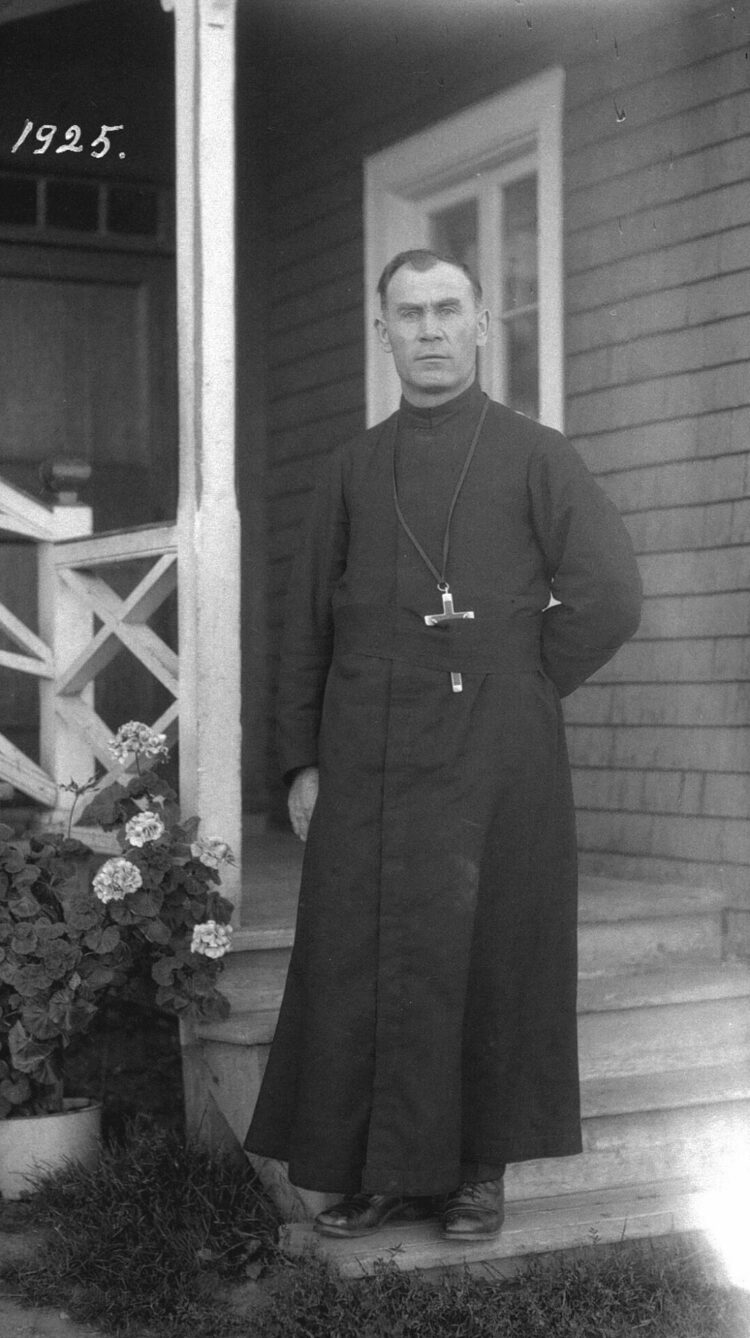
François Pelletier, Marie-Alice’s uncle, was a lay brother in the congregation of the Oblates of Mary Immaculate. In the words of Joseph-Napoléon Dumont, lay brothers “are men who, though not highly educated, still wished to live a religious life. They are invaluable helpers to the Fathers.” In other words, they carried out a variety of manual tasks in service to both religious and secular priests. Little is known about François Pelletier’s day-to-day duties as a lay brother, but according to Joseph-Napoléon, he earned great respect and led an exemplary life within his congregation.
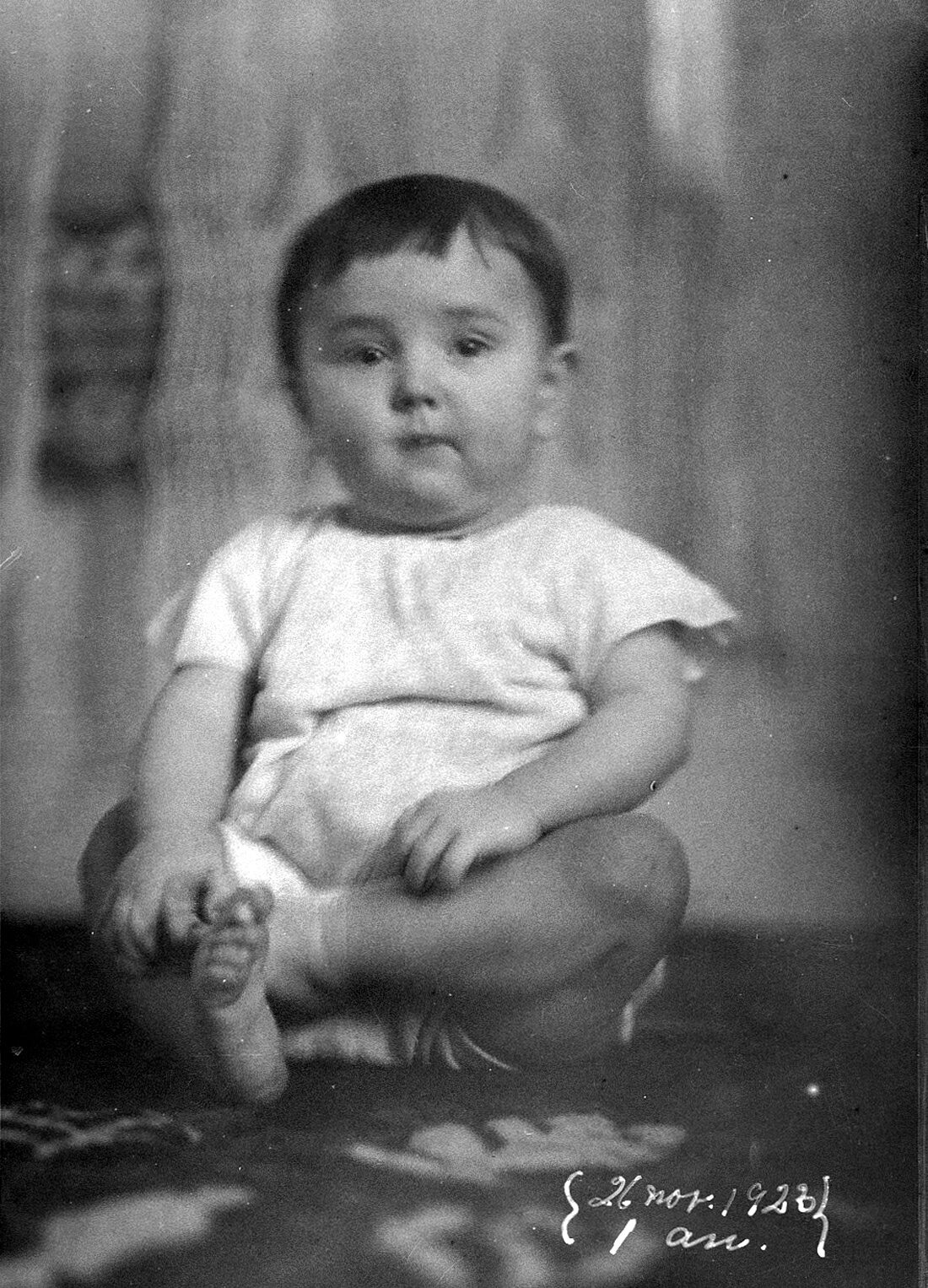
Origène Dumont was the nephew of Marie-Alice Dumont, who took this portrait with her Kodak camera, which she carried with her everywhere. The child had just celebrated his first birthday. In his youth Origène showed a knack for farming, a trade he pursued for decades, following in the footsteps of his father and grandfather. A skilled handyman, he was often said to be like an engineer. In 1947, he married Daria Lavoie, and together they raised a large family.
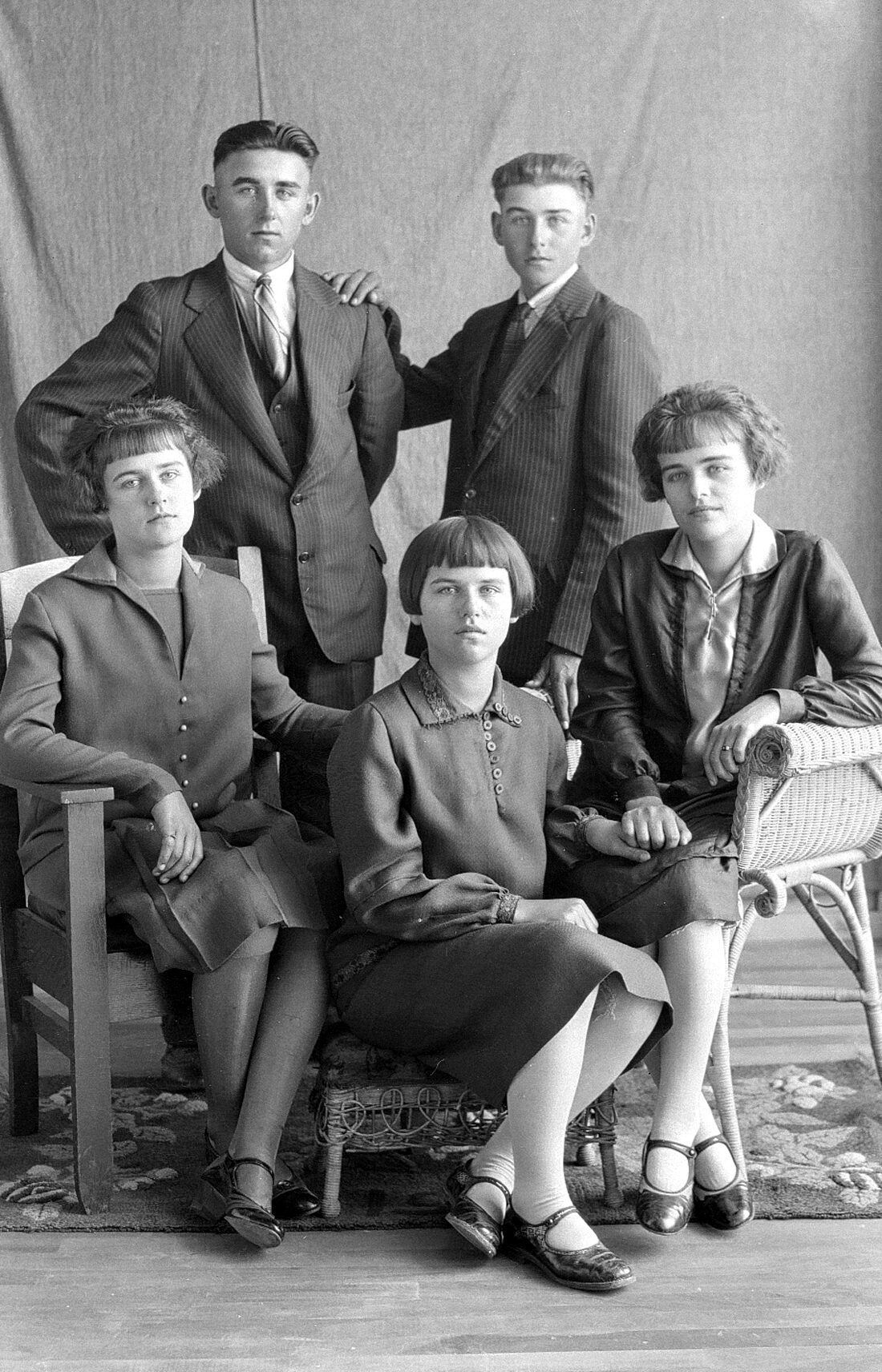
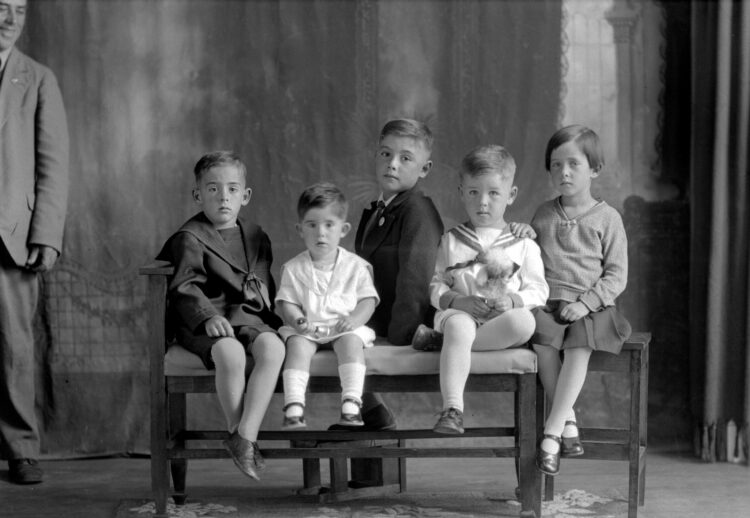
Marie-Alice Dumont already had many nieces and nephews when she began her photography career in the early 1920s, and many of them posed in front of her lens. Here, five of her sister Émilia and brother-in-law Flavius Ouellet’s children are dressed in their Sunday best for a portrait taken in the little studio at the family home on the 5e Rang.
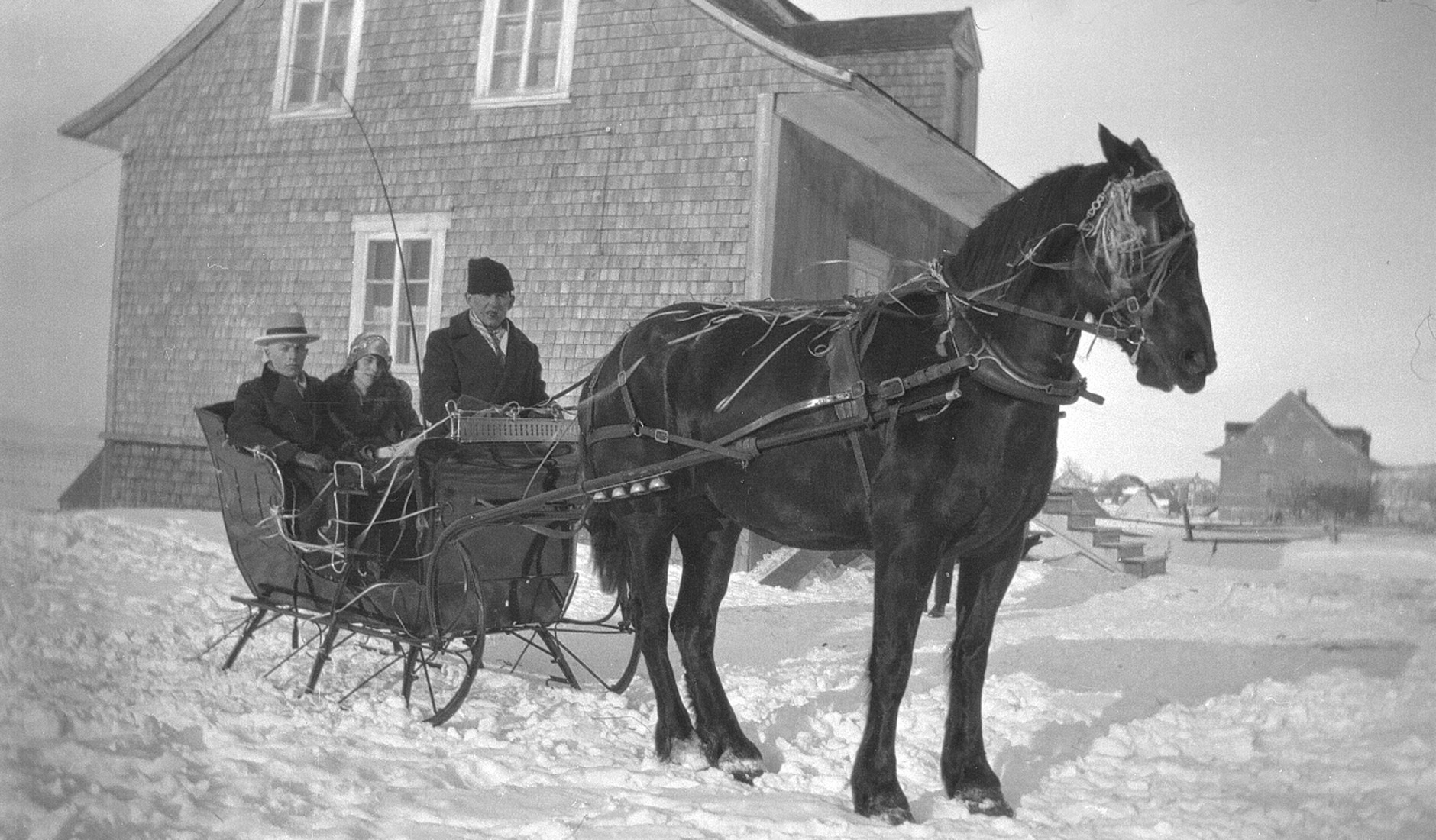
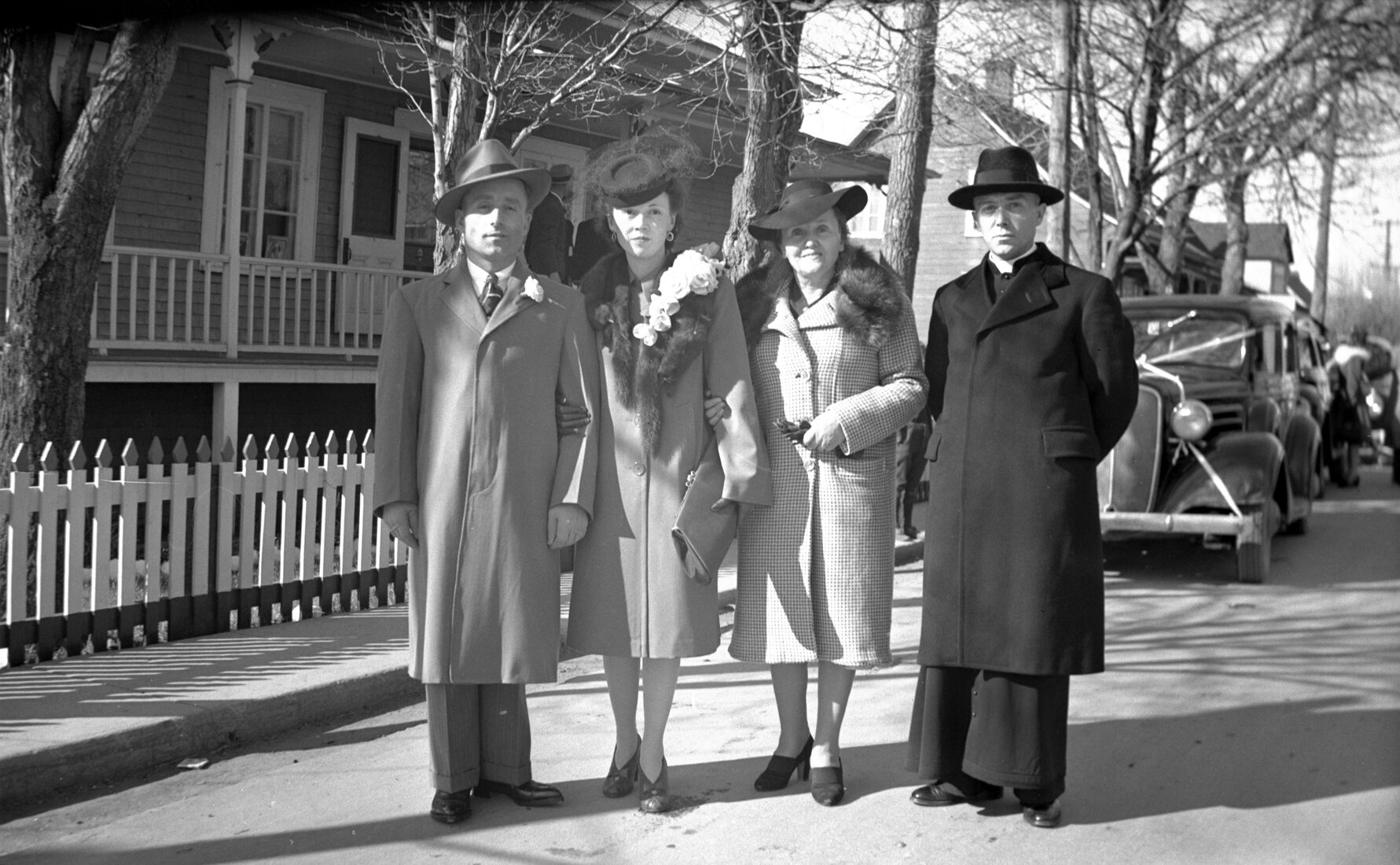
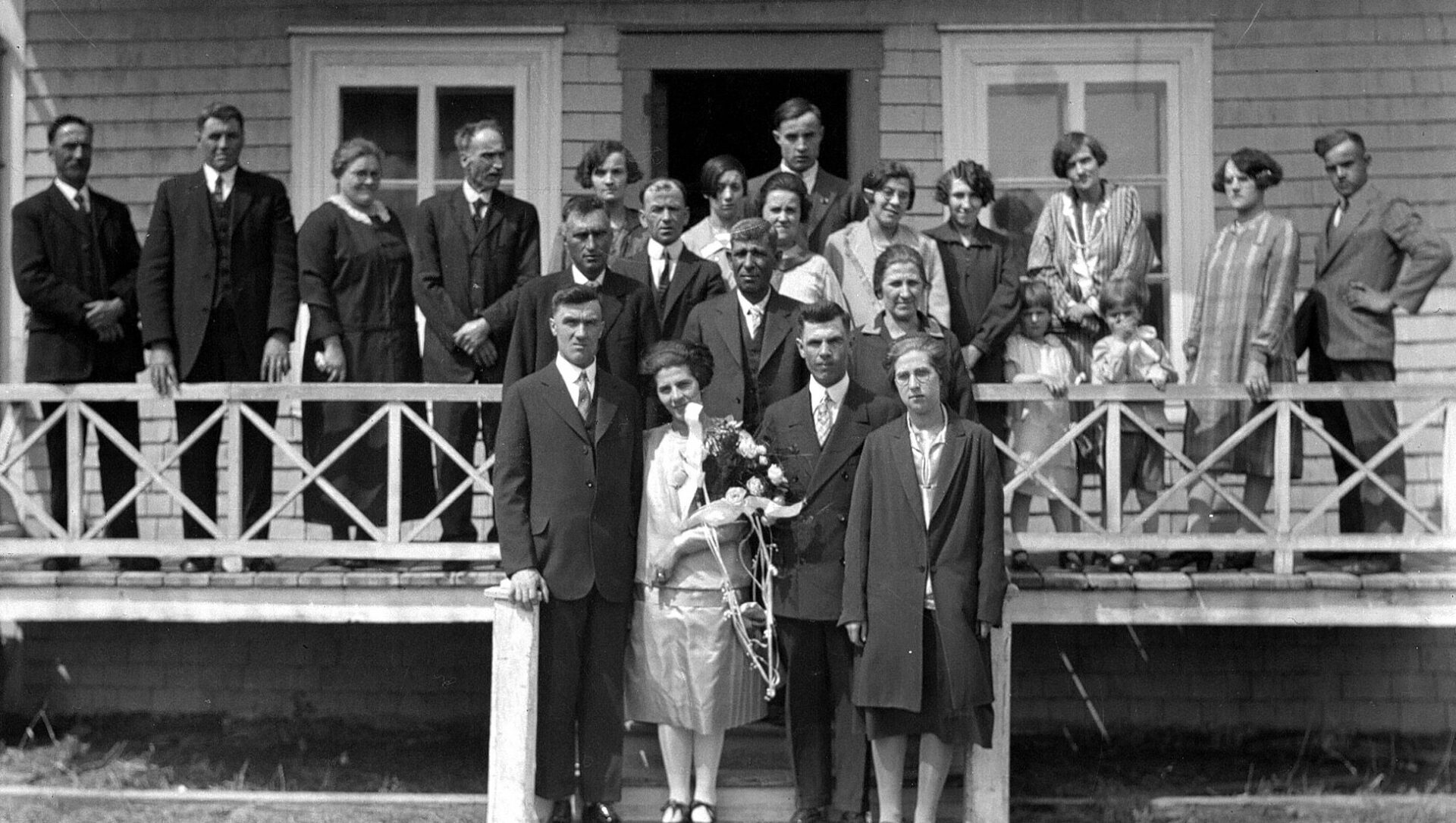
The Dumonts celebrated weddings in grand style! Several photographs remain from that very special day for Marie-Jeanne Ouellet, the photographer’s niece, and Paul-Émile Lajoie.
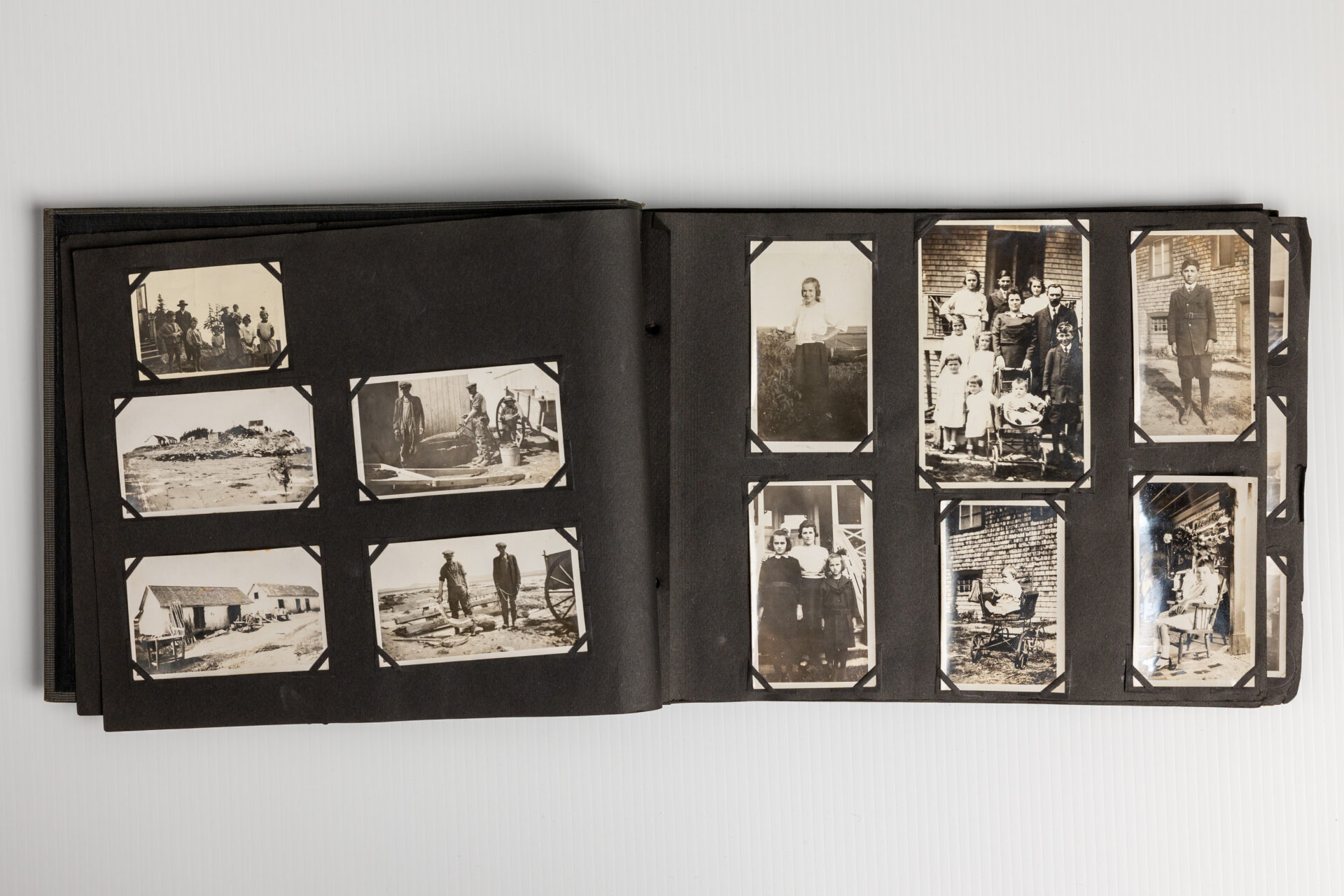
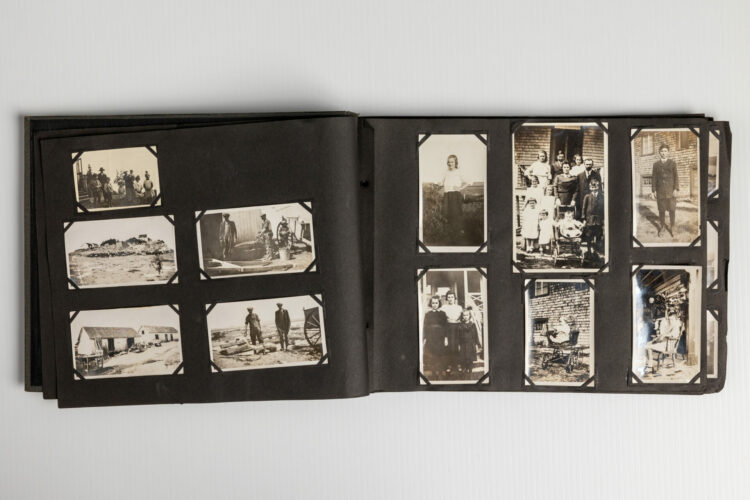
This photo album belongs to the Dumont family. Inside, studio portraits sit alongside candid snapshots documenting everyday family life. The album also contains several images of the fishing weirs operated by Flavius Ouellet and Émilia Dumont on Patins Island, across from Kamouraska.
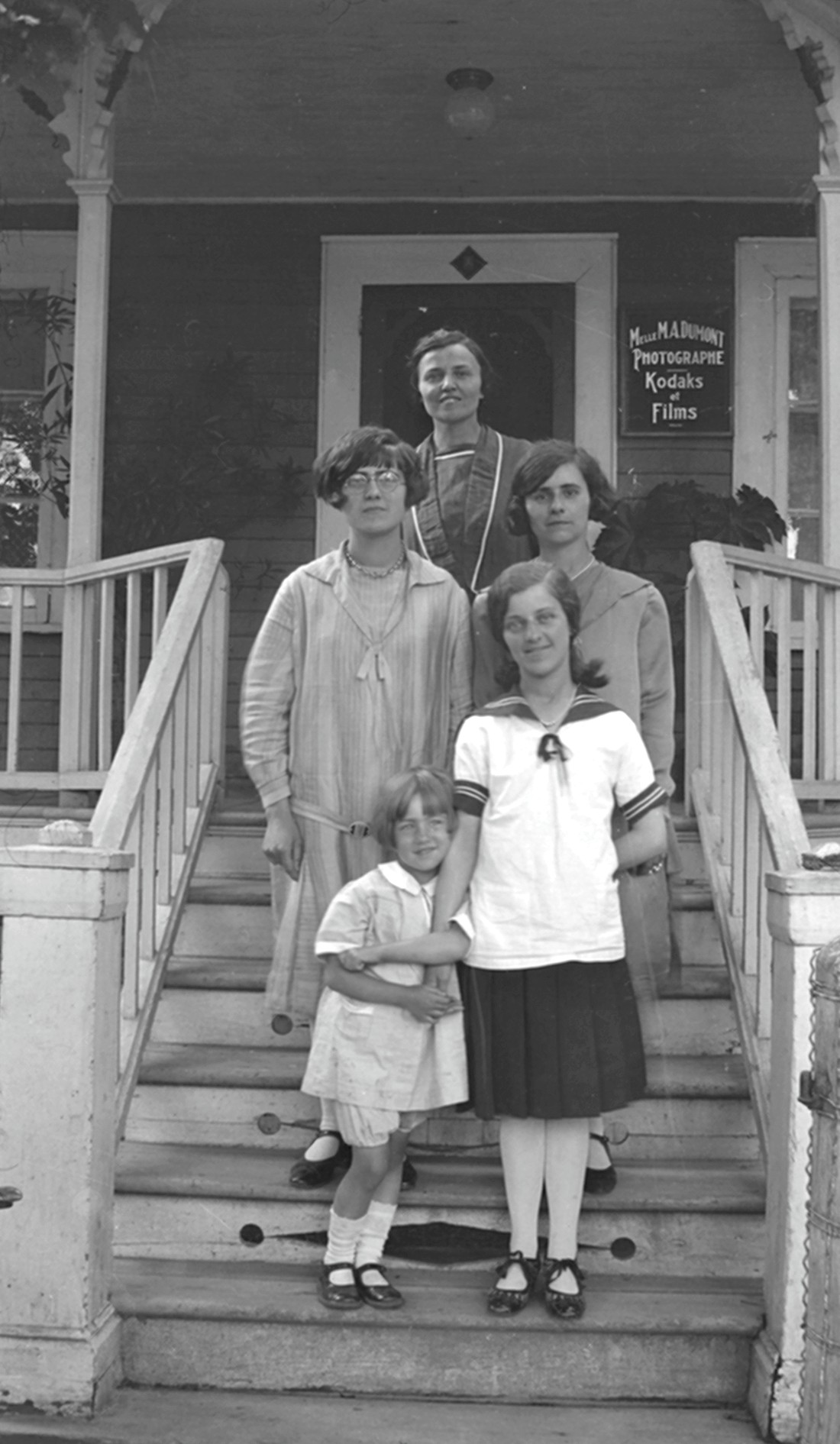
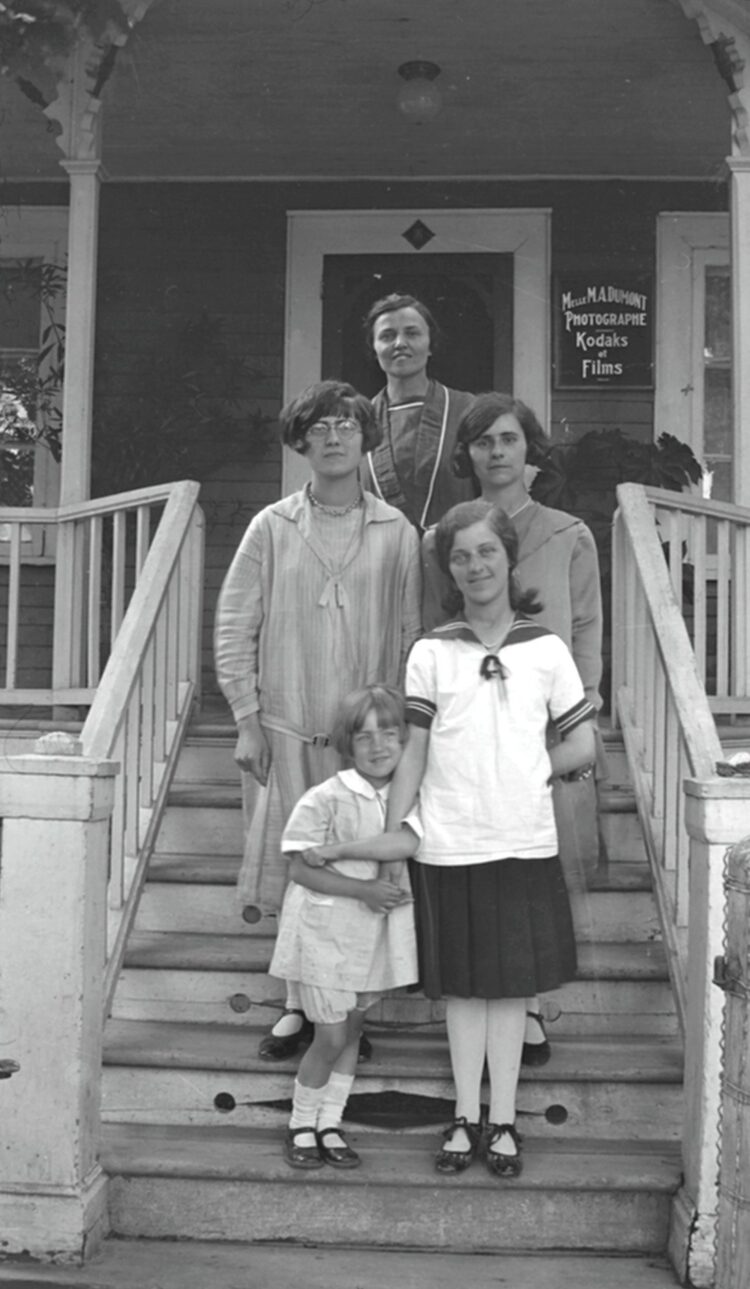
This portrait of Marie-Alice Dumont (at the top), accompanied by her younger sister Elizabeth (left) and three other young women, is one of the very first taken on the front steps of Dumont’s new studio. The studio sign is clearly visible, bearing the inscription: “Melle M.A. Dumont Photographe Kodaks et Films” [Miss M.A. Dumont photographer Kodaks and Films].
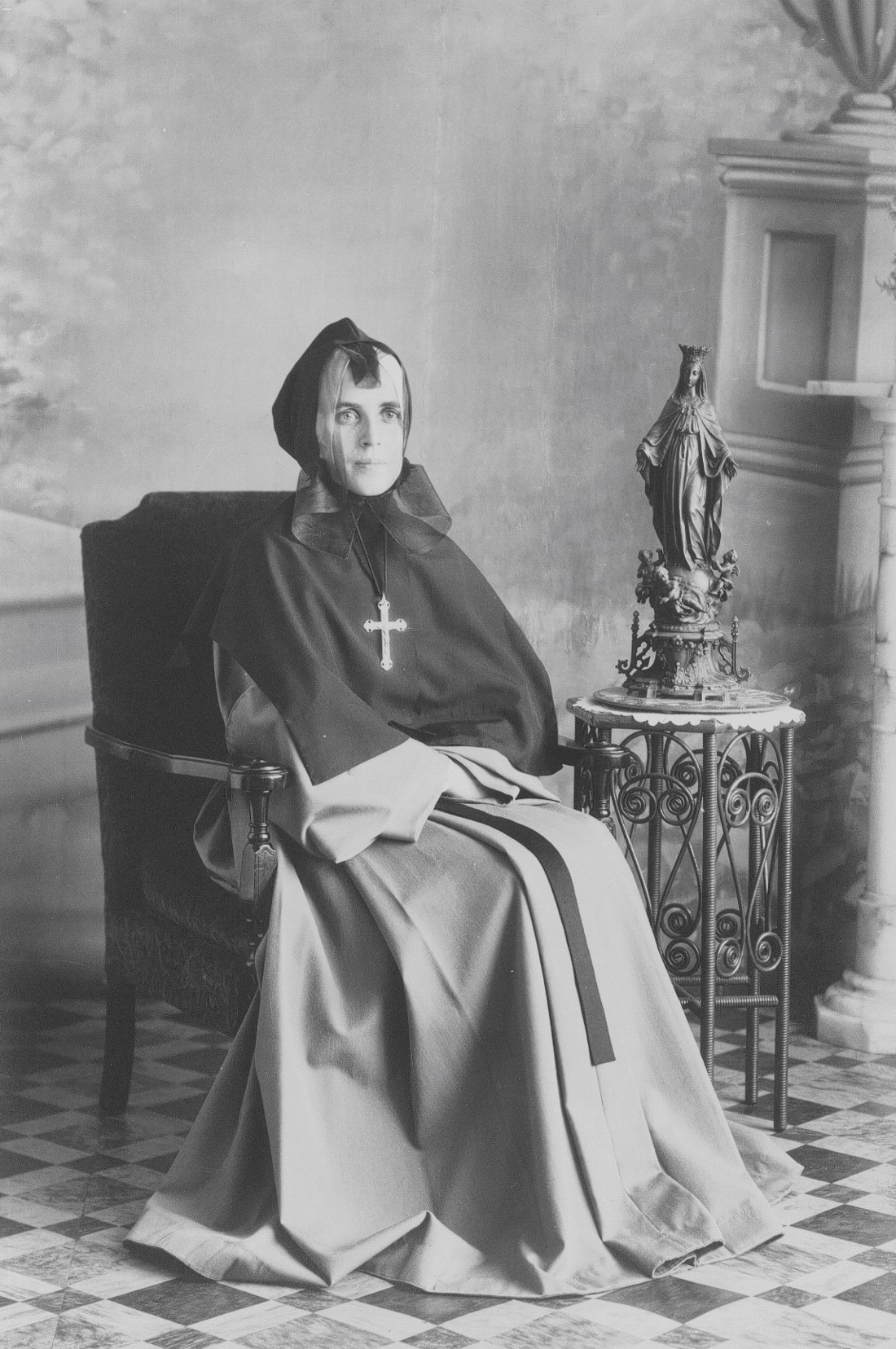
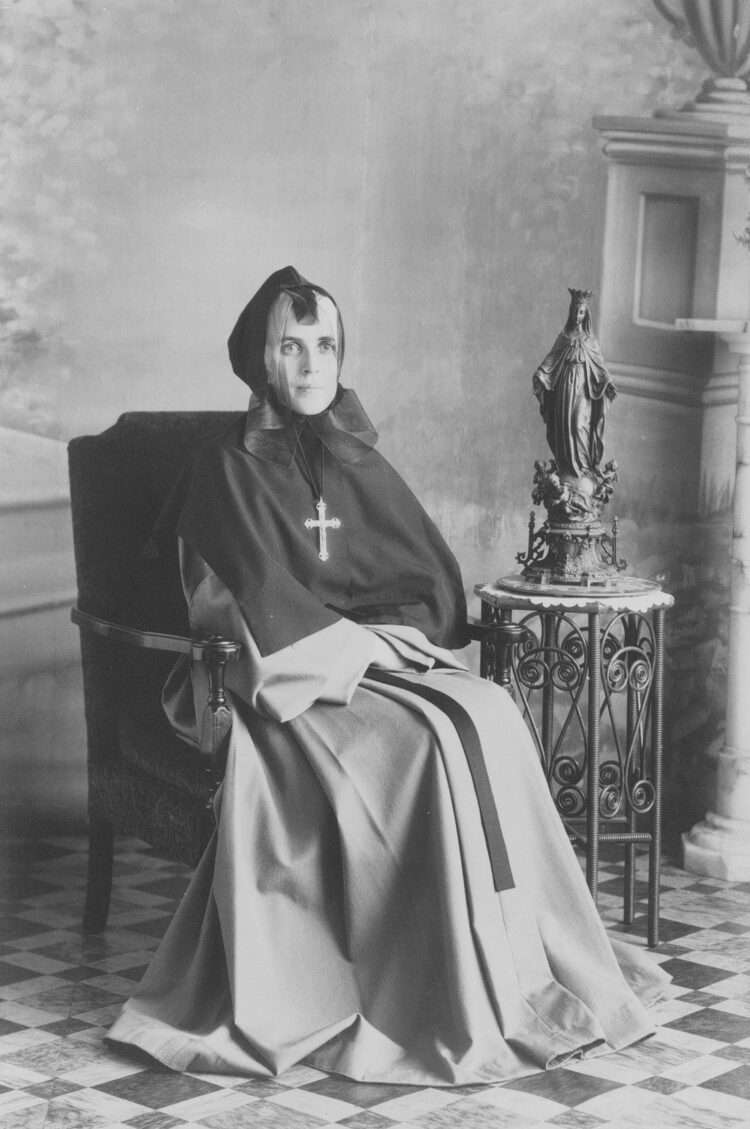
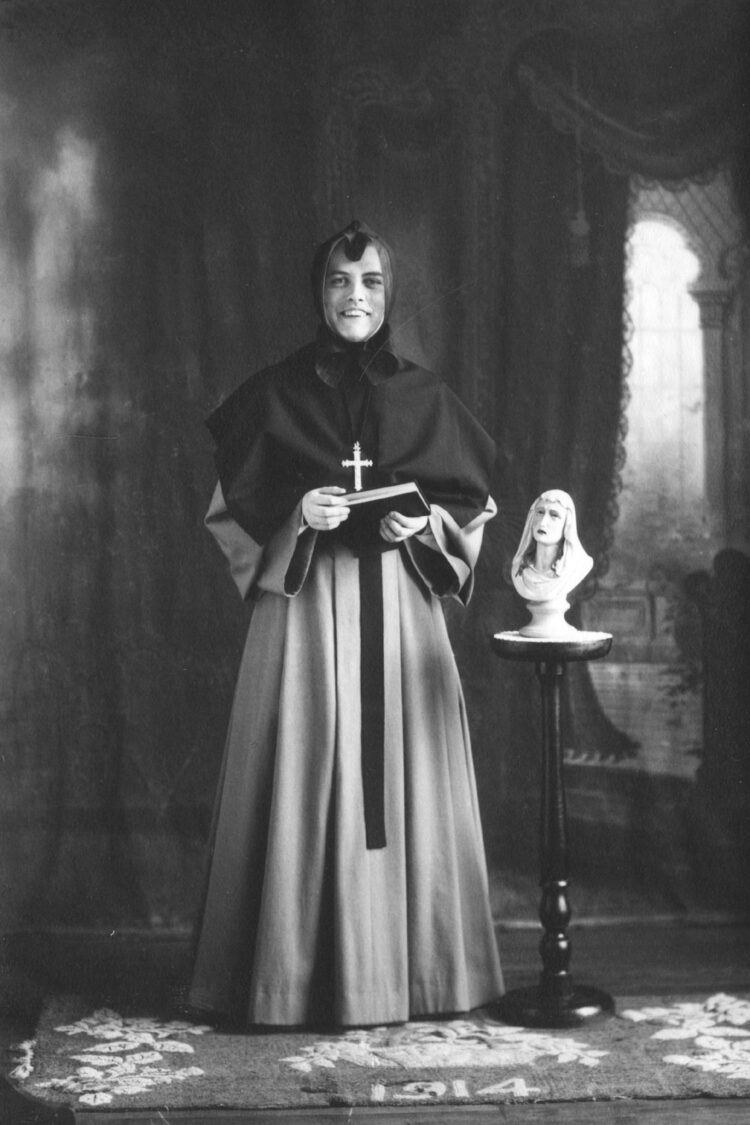
Berthe, Marie-Alice’s younger sister, is shown here in a setting frequently used by Elmina Lefebvre for portraits of nuns and religious figures. Berthe entered the novitiate of the Sisters of Charity at the age of 17, taking the name Sister Sainte-Marie-Anne. As she herself later recounted, it was thanks to Marie-Alice that she was able to pursue her vocation. Not only had her big sister taught her at home for several years—preparing her, among other things, for her first communion—but, by choosing to remain at home to care for their parents, Marie-Alice made it possible for Berthe to leave and follow her dream of entering religious life.
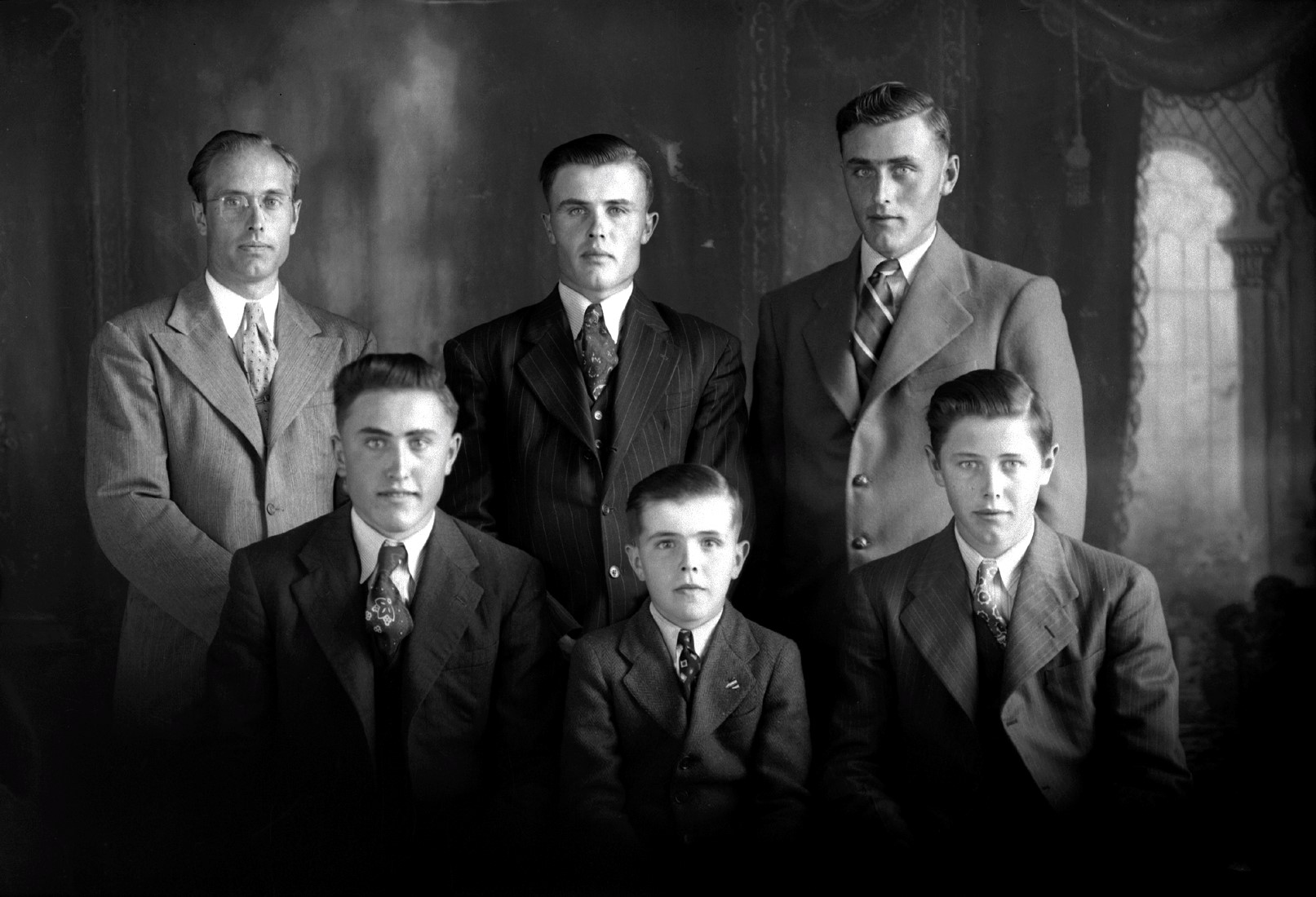
Most of Marie-Alice Dumont’s sisters had many children. These were Anna Dumont’s sons. Each would come to their aunt’s studio several times over the course of their lives. In a 1990 interview, Réal Beaupré gave a moving account of his experiences at Dumont’s studio. He remembers the curious “ceremonies” involved in taking each portrait. Unaware of it as a child, he realized with hindsight that the photographer was a “true artist” and a “pioneer” playing an active part “in women’s liberation.”
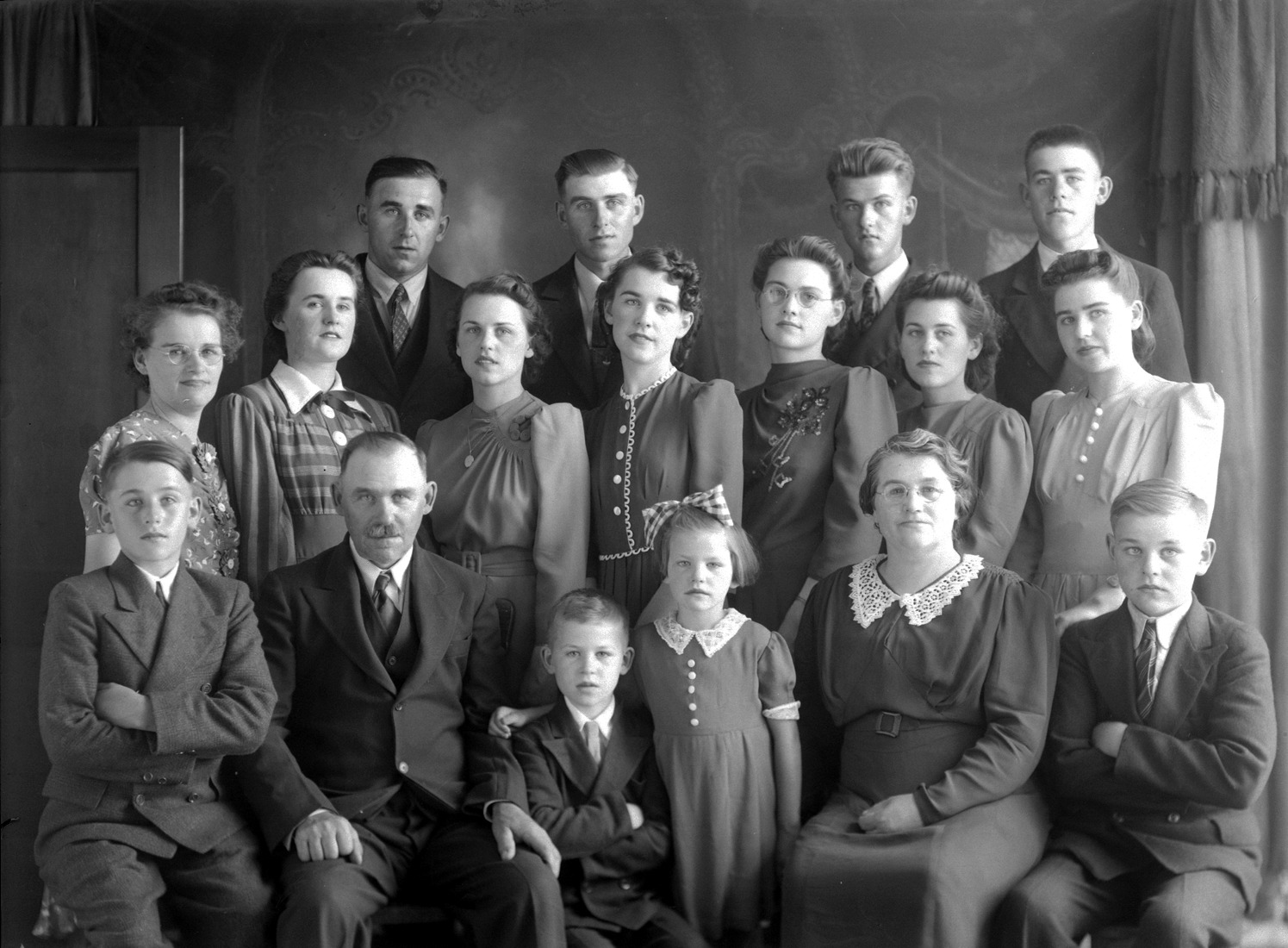
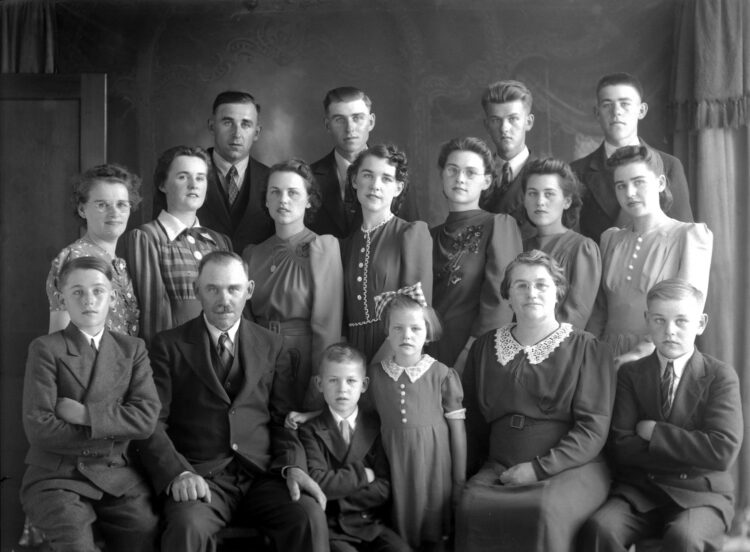
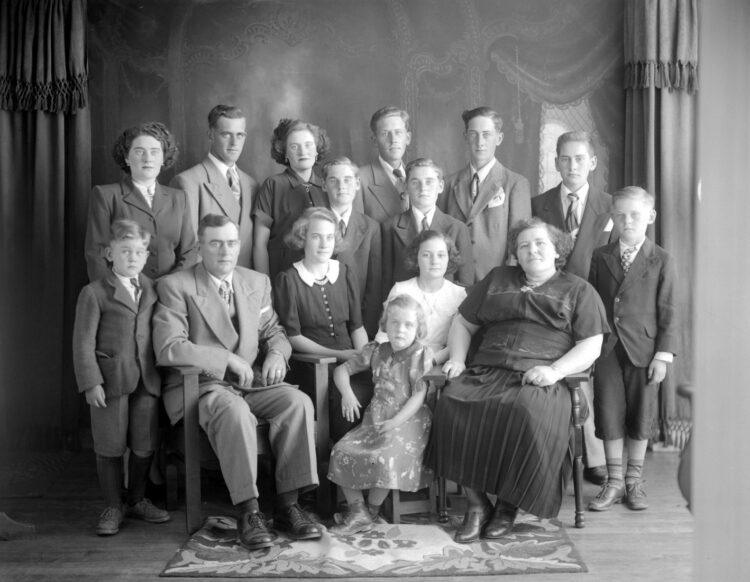
In rural Quebec, large families remained the norm well into the 1950s. So-called “complete” families, where both parents lived to at least age 50, had, on average, eight or nine children. Marie-Alice Dumont did not have to look far for examples; one of such family was that of her sister Émilia and husband, Flavius Ouellet.
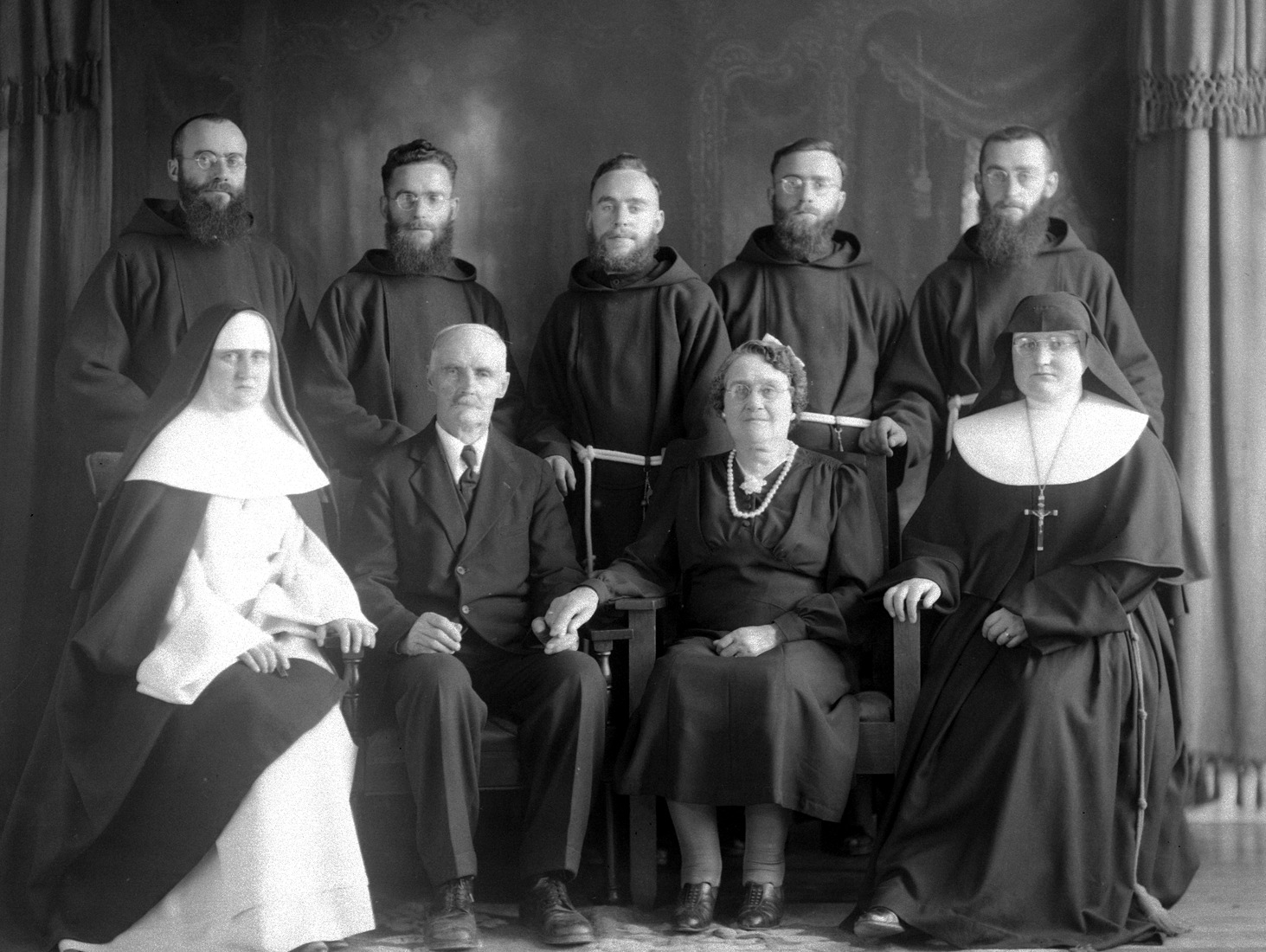
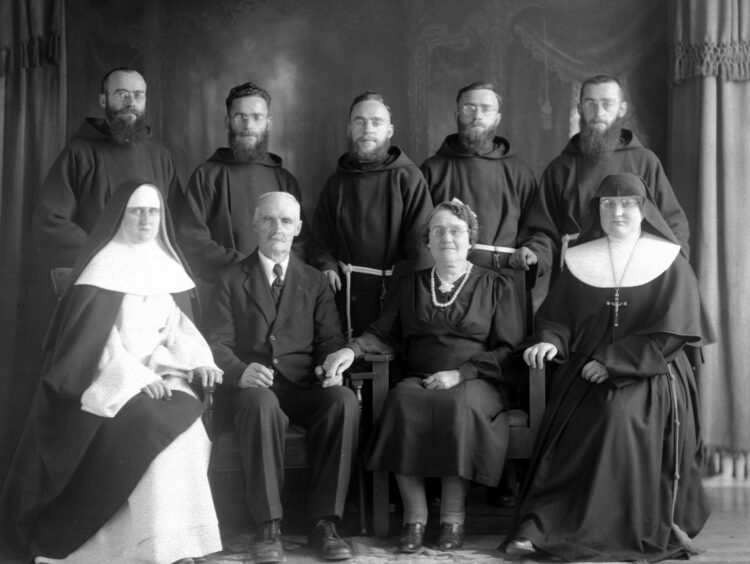
Here is another example of a large family from Marie-Alice Dumont’s circle: her sister Albertine and husband, Ludger Bérubé. The seven adults standing with them are their children who went on to pursue religious vocations.
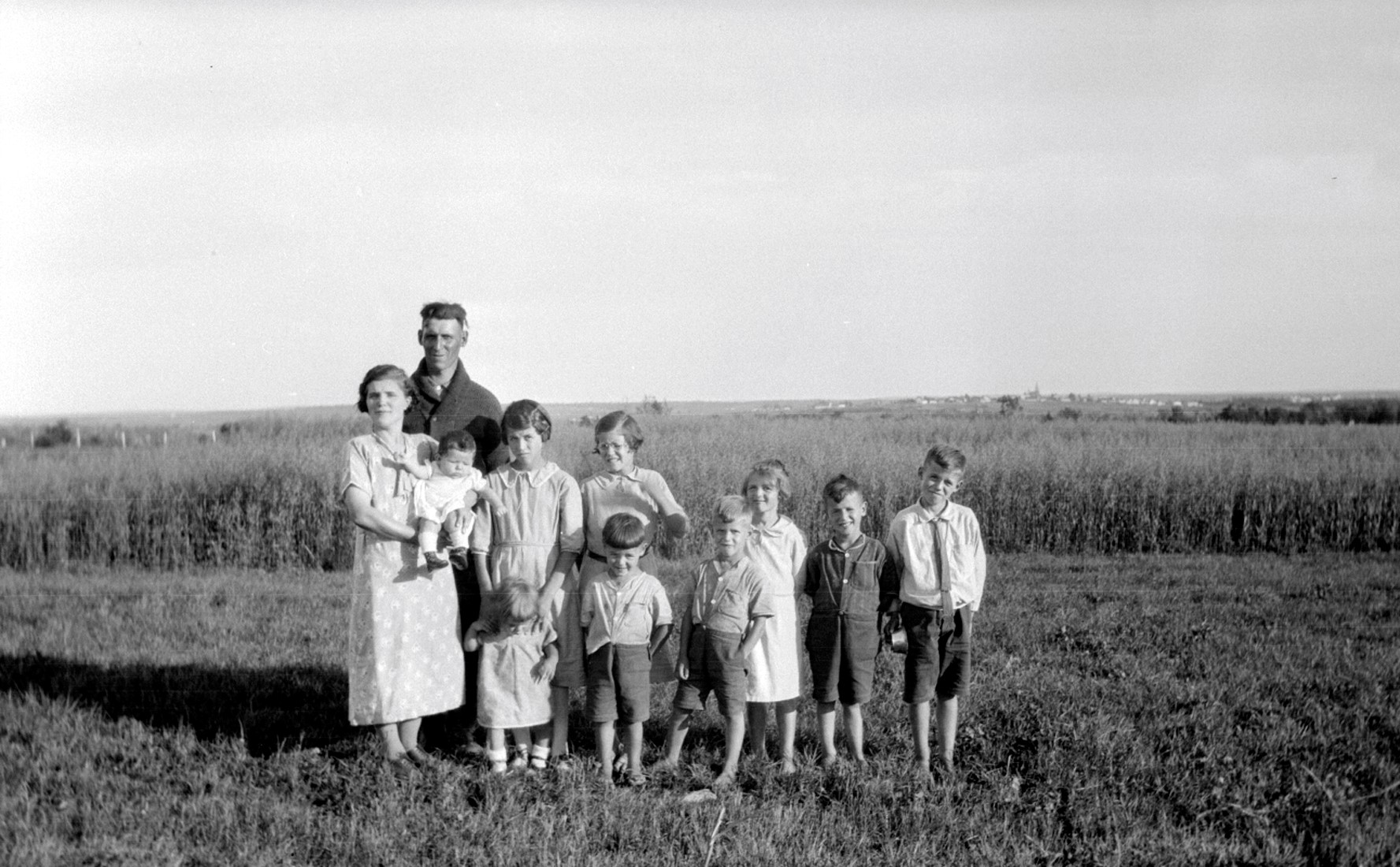
Émile Boucher and Gabrielle Dumont, another of the photographer’s sisters, are shown here with their first nine children. (They would eventually have 16). Remarkably, among their children, eight daughters became nuns and one son became a priest.
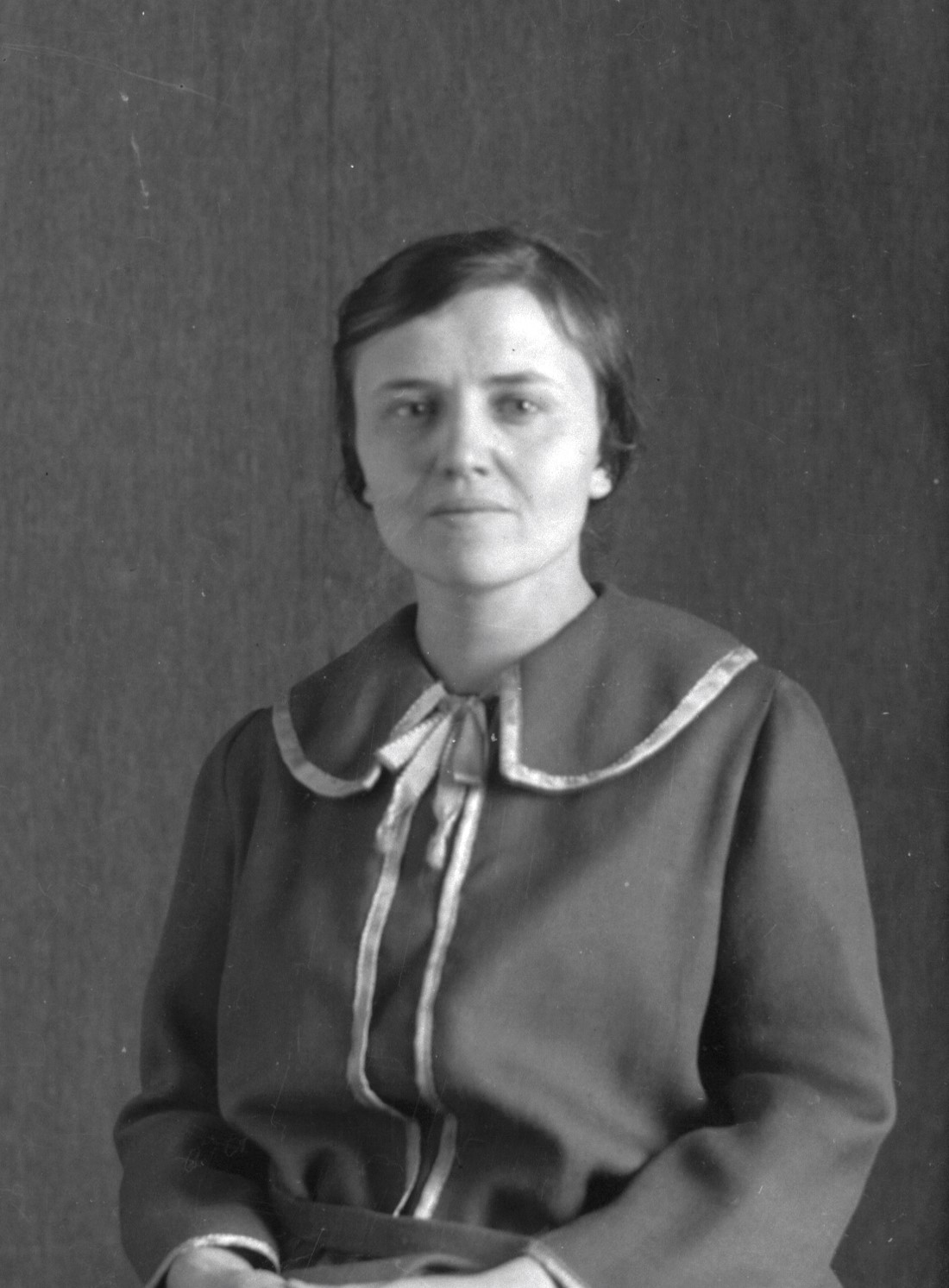
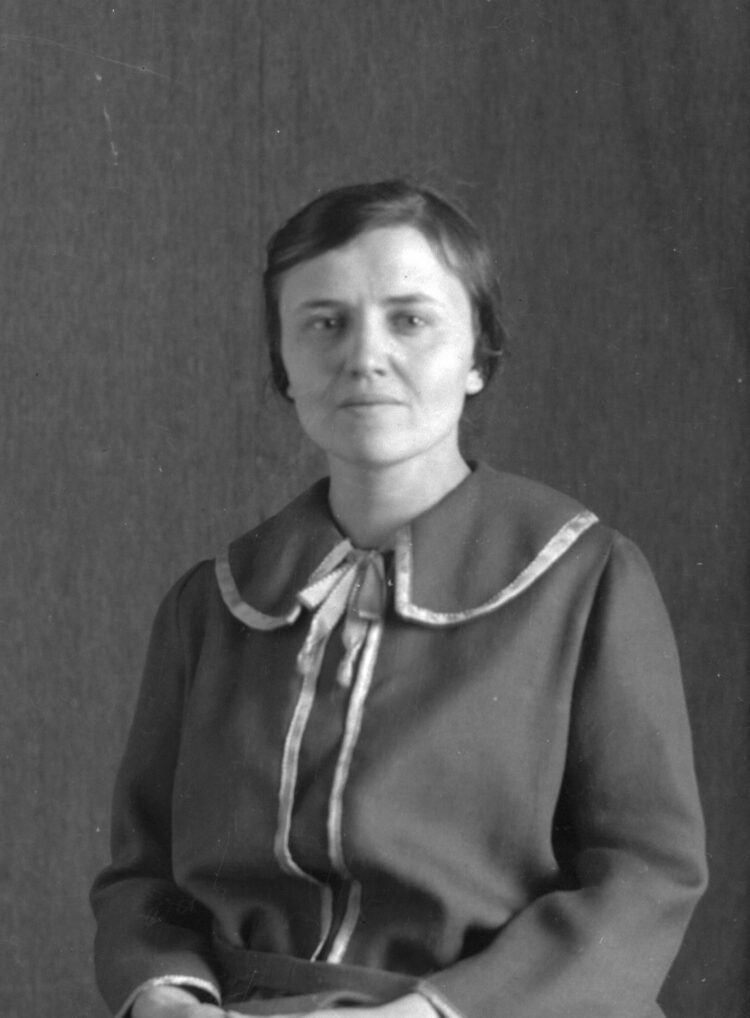
This is possibly Marie-Alice Dumont’s first self-portrait, taken when she was about 30 years old. She was then living in the family home on the 5e Rang. Why did she take this photograph of herself? Was it a practice photo before she welcomed her first clients? Did she want to test the camera’s focus? Maybe she was attempting to perfect her bust portrait technique? Or experimenting with light and a slightly turned posture? Was the budding photographer trying to find her identity as a professional and an artist? Perhaps she sought, also, to carve out a place for herself in the world? Her whole life, Marie-Alice photographed others. A self-portrait like this one was a way of saying, “I, too, exist.”
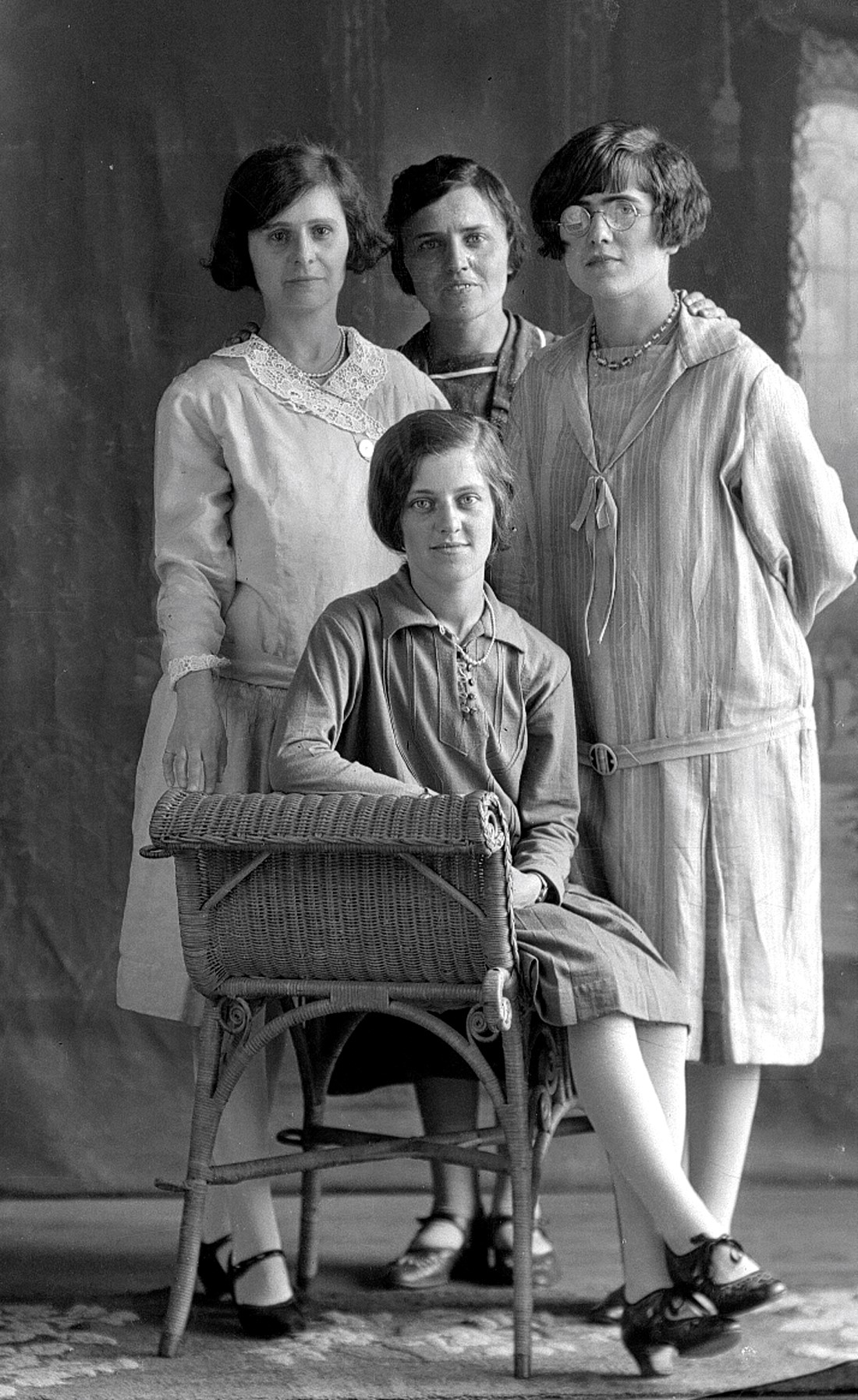
Here, Marie-Alice Dumont posed with her younger sister Elizabeth (to the right, with glasses) and two other girls, who might have been her nieces. The photographer had just set up her studio in the village centre of Saint-Alexandre. A large window had been installed on the north side, and a broad backdrop had been purchased as well: two signs that the studio was fully equipped and ready to welcome a great many clients.
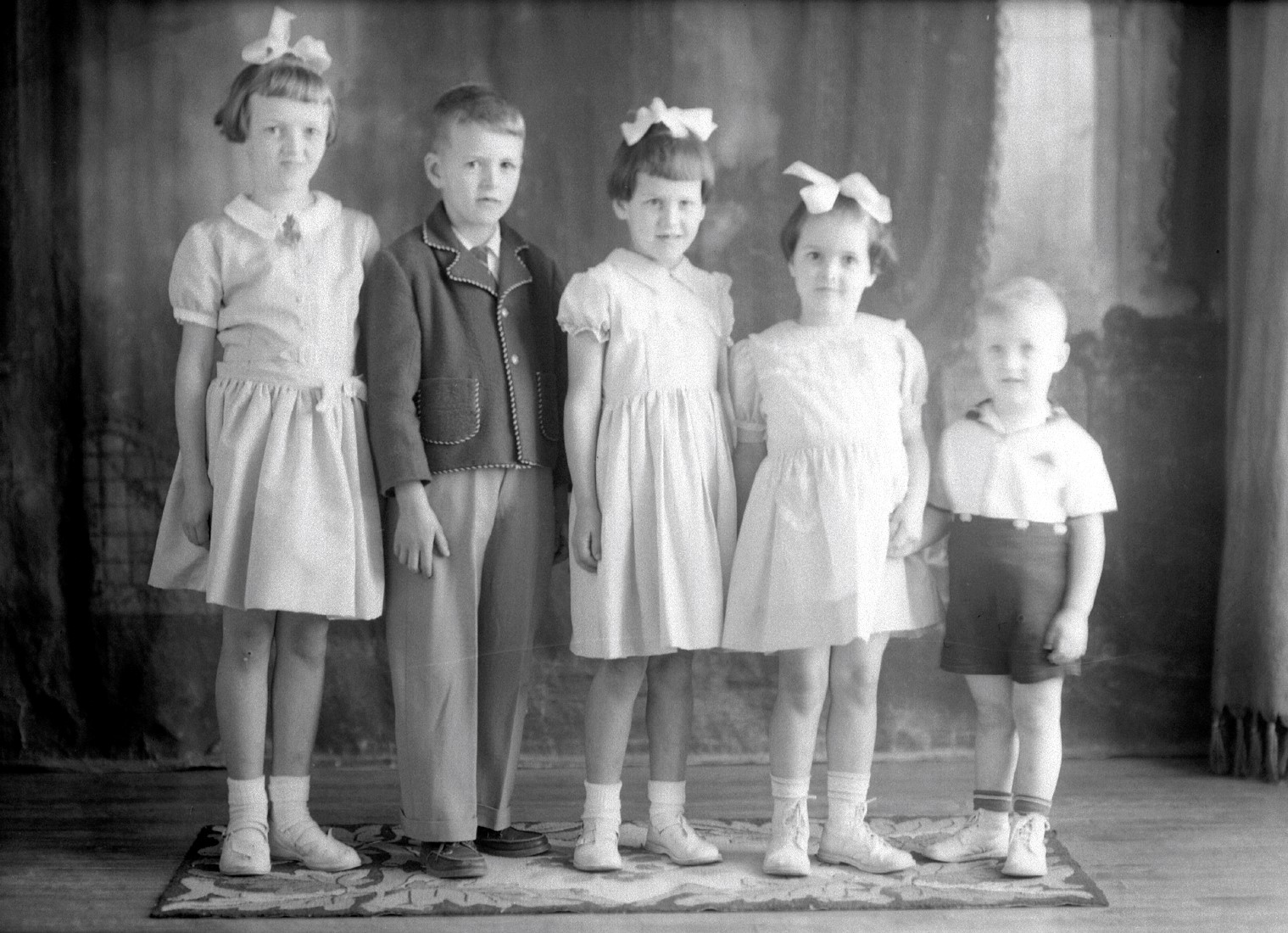
In family portraits taken in the studio, individuals were often placed in such a way as to reflect their position in the family. Here, Daria and Origène Dumont’s five oldest children are placed in order of their birth and, by happy circumstance, by height. Françoise, the oldest, is on the far left. Jean-Paul, Céline, Nicole and Gérard follow in succession.
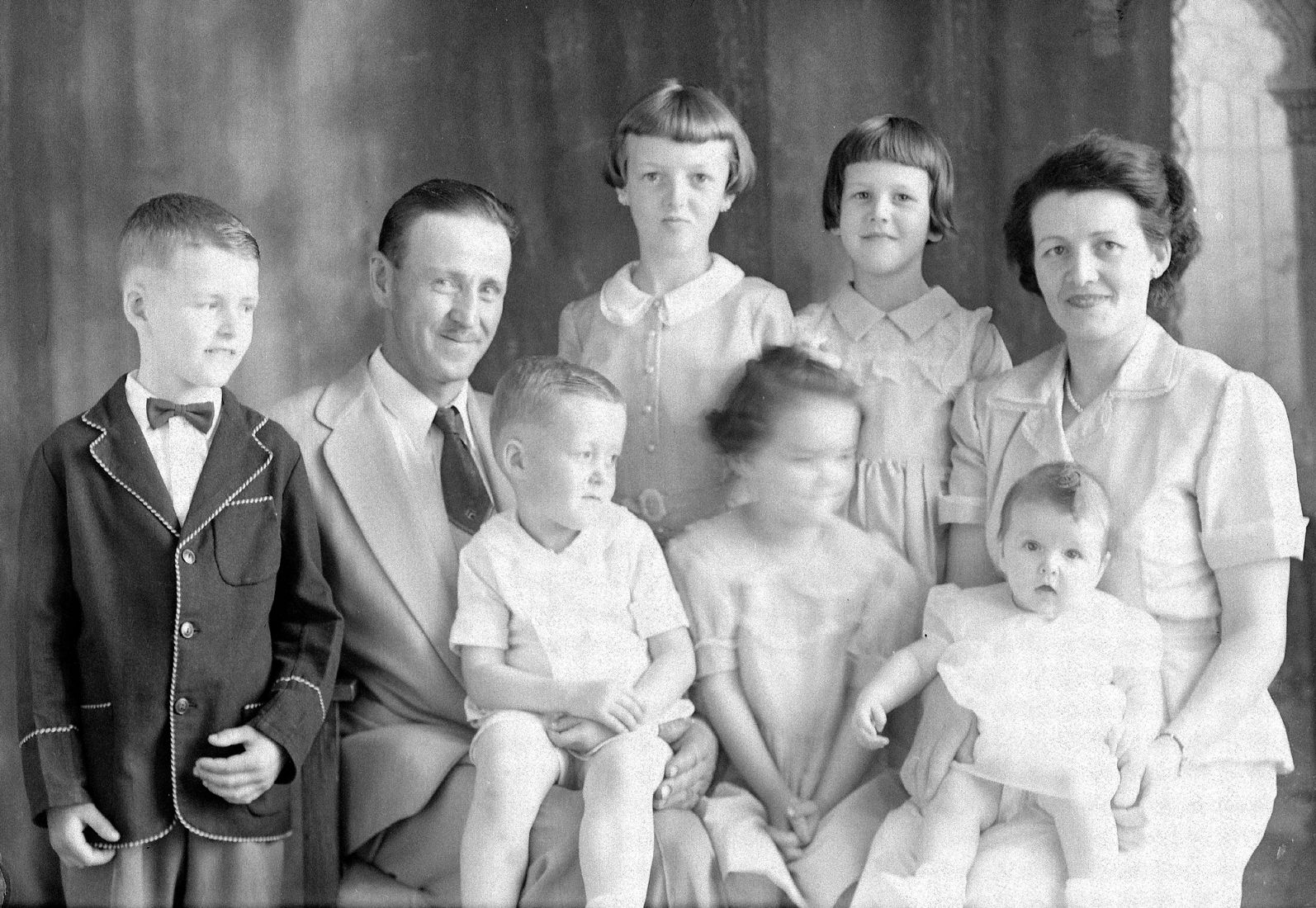
Daria Dumont, Marie-Alice Dumont’s niece by marriage, was very dear to her and played an important role in preserving the enduring memory of the photographer. First, Daria made every effort to conserve Dumont’s archives and, on many occasions, shared her own precious memories, sometimes on film. In the early 1980s, she also bought “Auntie’s” house and covered the walls with large-scale reproductions of the photographer’s most beautiful pictures. And she preserved family archives that help contextualize Dumont’s life and work. In this family portrait taken at Studio Dumont, we see Daria, seated on the right, with her six children and husband Origène.
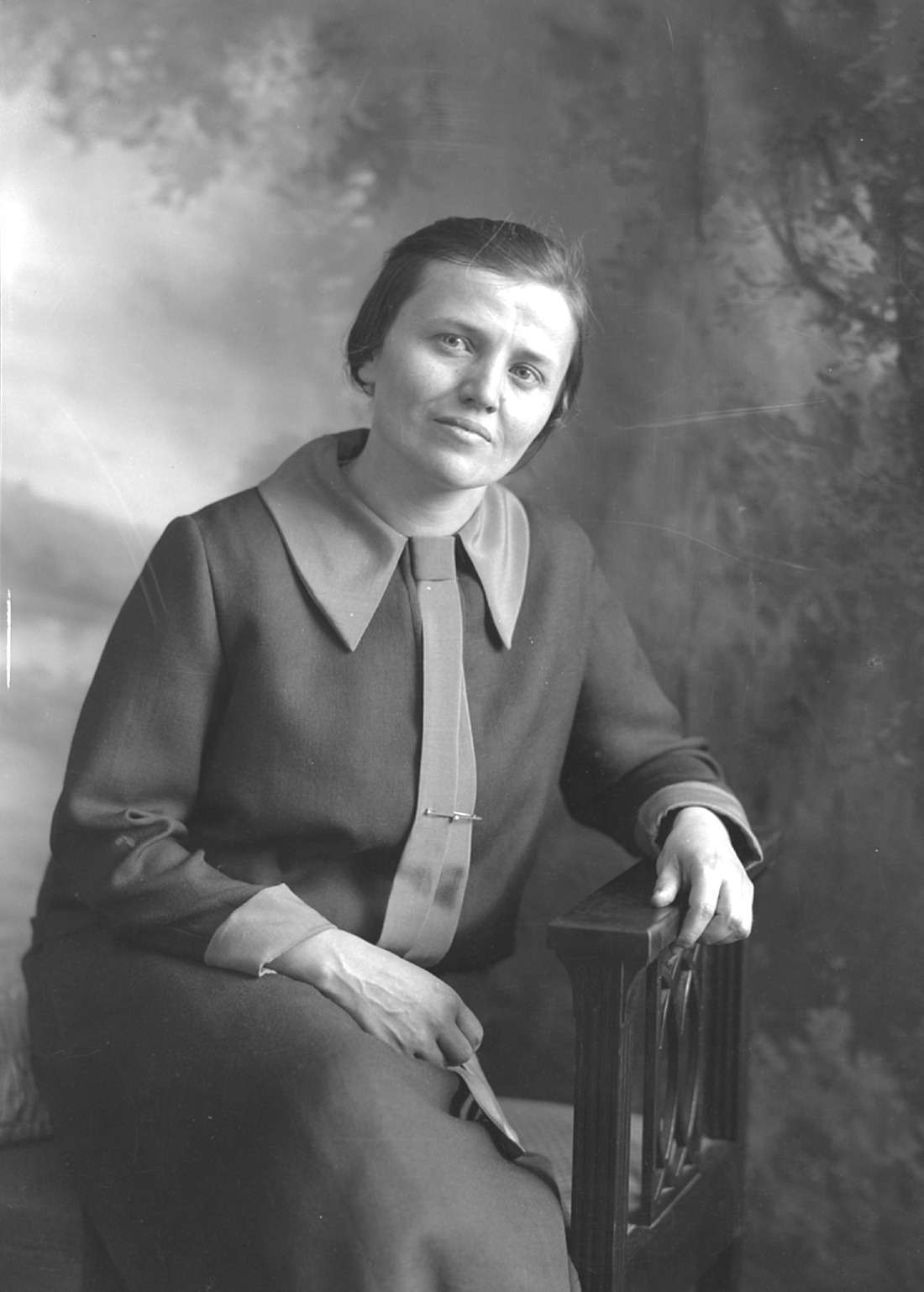
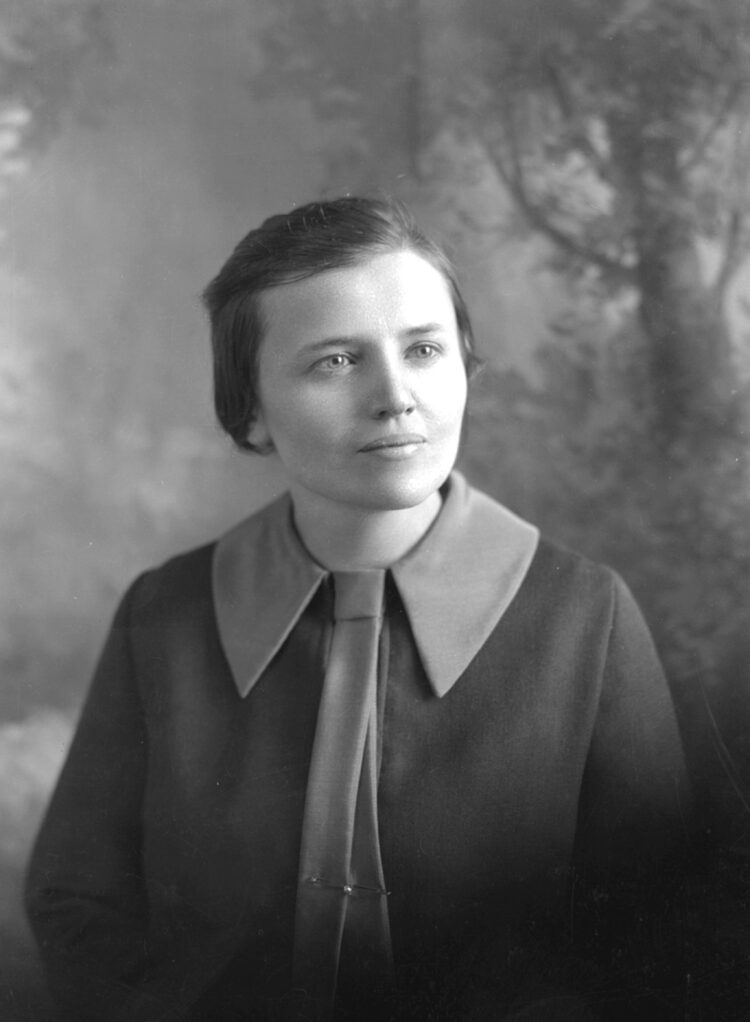
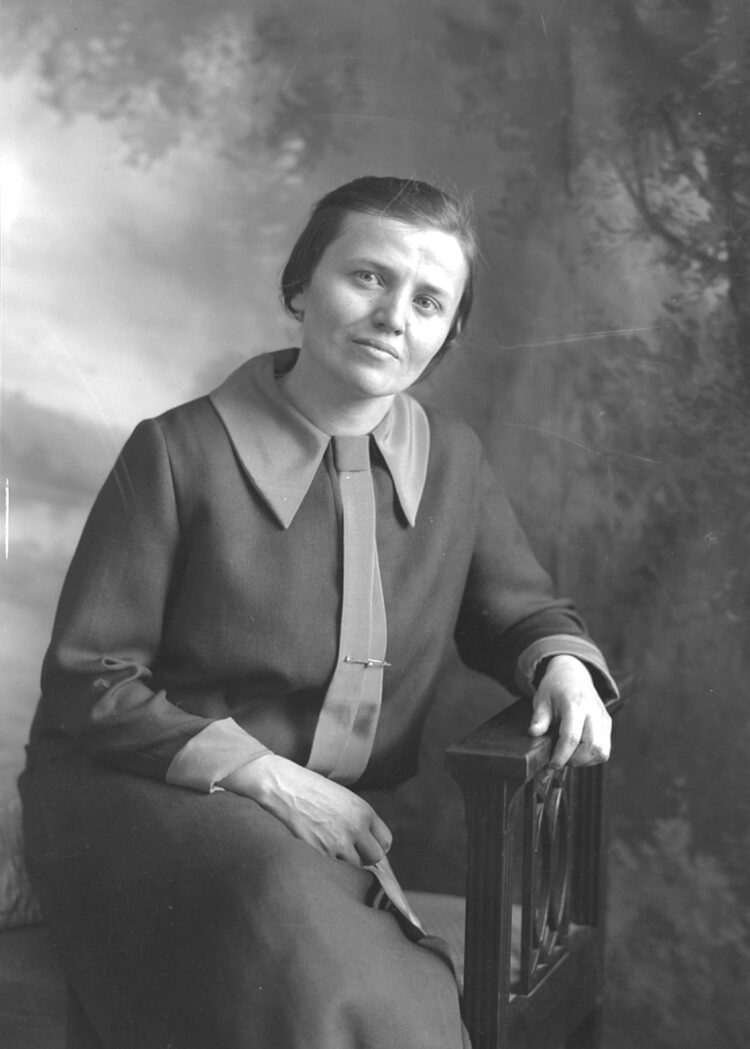
Let us compare the previous portrait of Marie-Alice Dumont with this one. Both were taken by Ulric Lavoie during the same photo shoot. If you look closely at Dumont’s face here, you will immediately notice “imperfections” that were absent from the other portrait. Her hair is a little more rebellious and there are crow’s feet around her eyes. Wrinkles can be seen on her forehead, as can slight creases and furrows framing her mouth and nose. Not to mention her neck, which now sports a few folds. These are the normal signs of aging for a woman in her 40s, and so this portrait is therefore more authentic, more natural. But isn’t it convenient, sometimes, to use photography to create an idealized self-image?
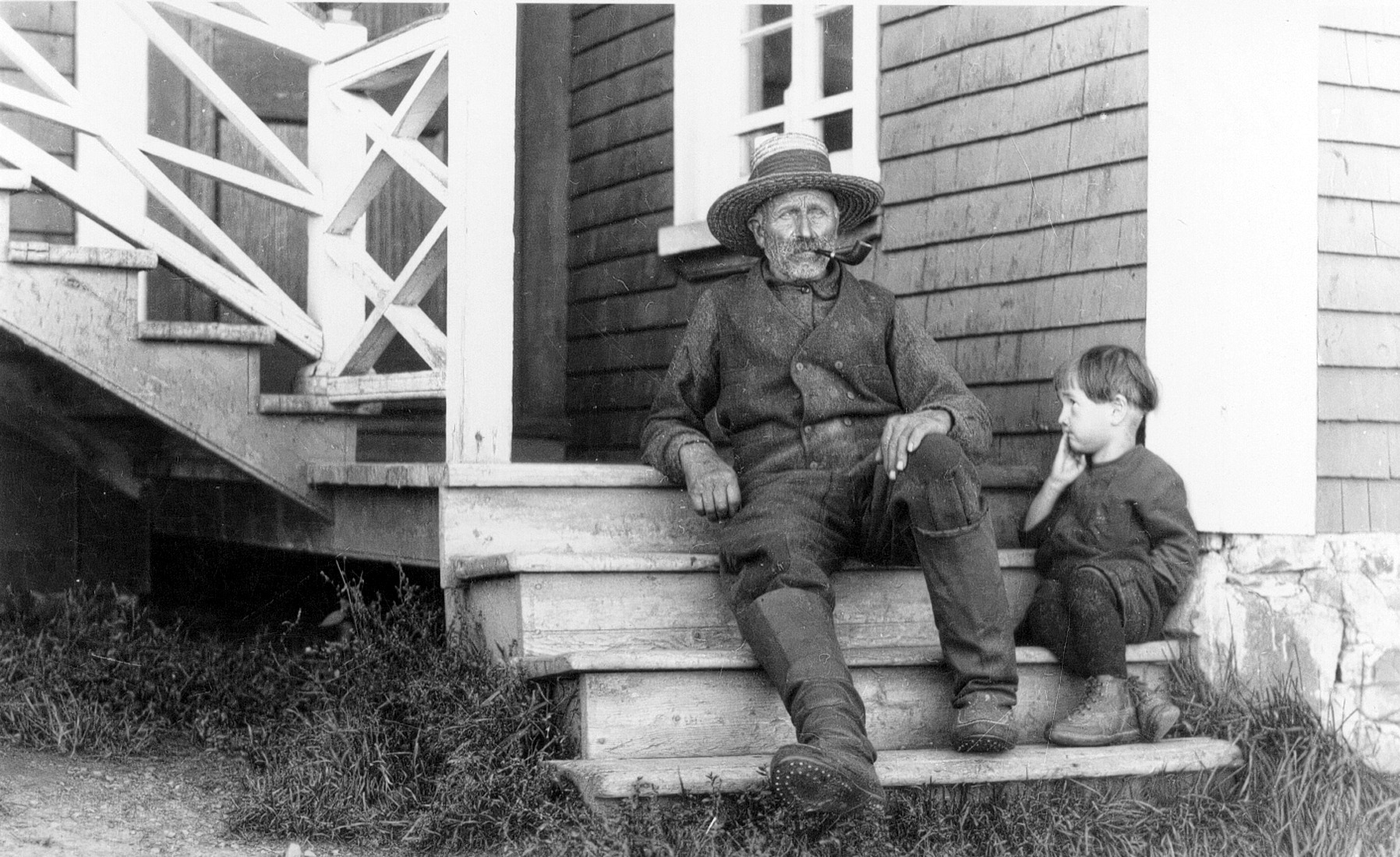
This is one of Marie-Alice Dumont’s best-known photographs. Taken in the early days of her practice, it shows her father, Uldéric, smoking a pipe and wearing a straw hat, gazing into the distance as he sits comfortably on the steps of the family home. Marie-Alice’s nephew Origène Dumont looks at his grandfather with a mixture of shyness and admiration. Were they posing, or was it a spontaneous scene?
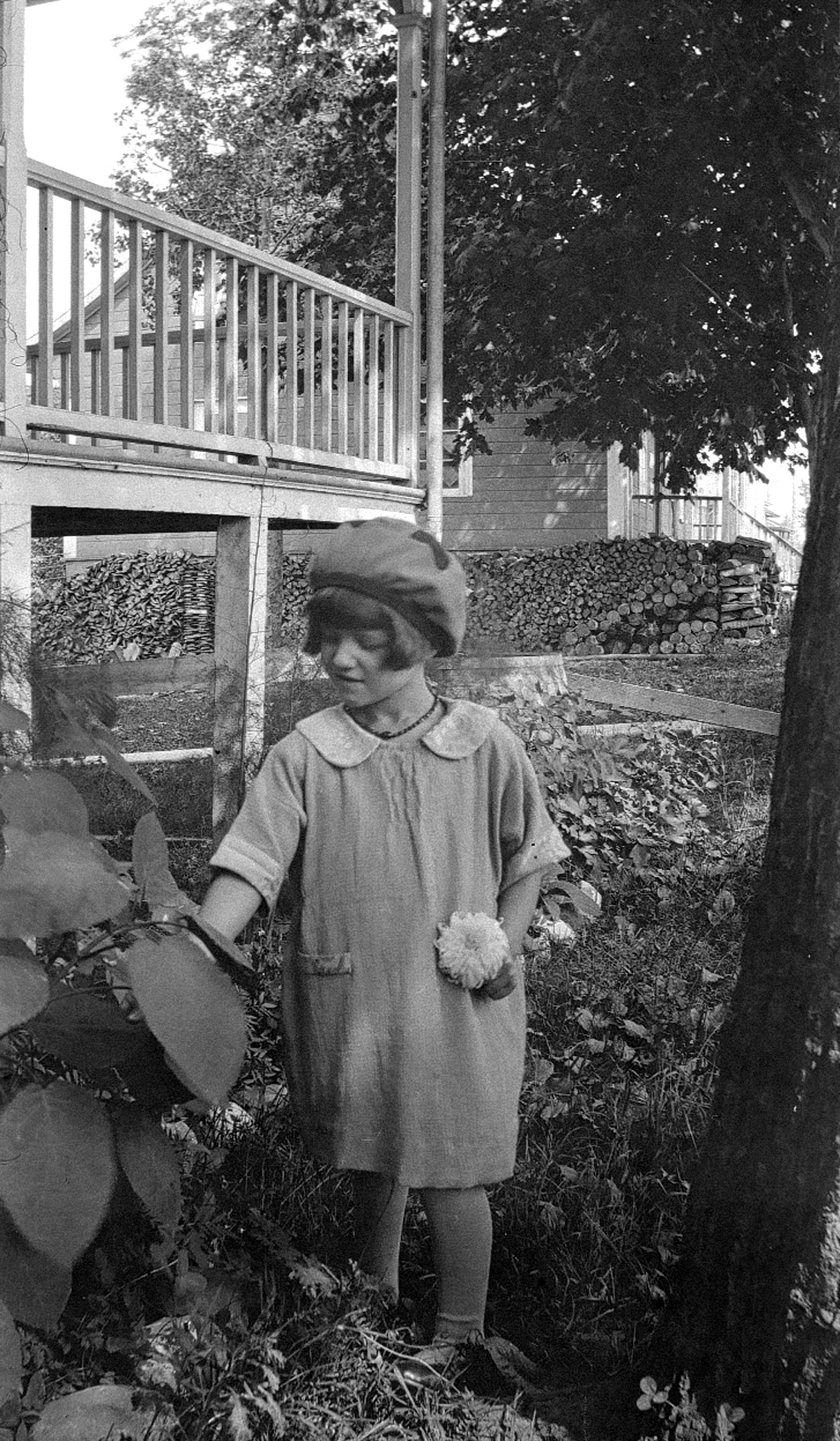
This little girl, probably one of Marie-Alice Dumont’s nieces, often appears in her shots: on the front porch, in the studio, on the family plot, alone or in a group. Here, we see her in front of the house in the heart of the village. She is on the right, picking a flower. Is she enjoying herself as much as the photographer behind the lens?
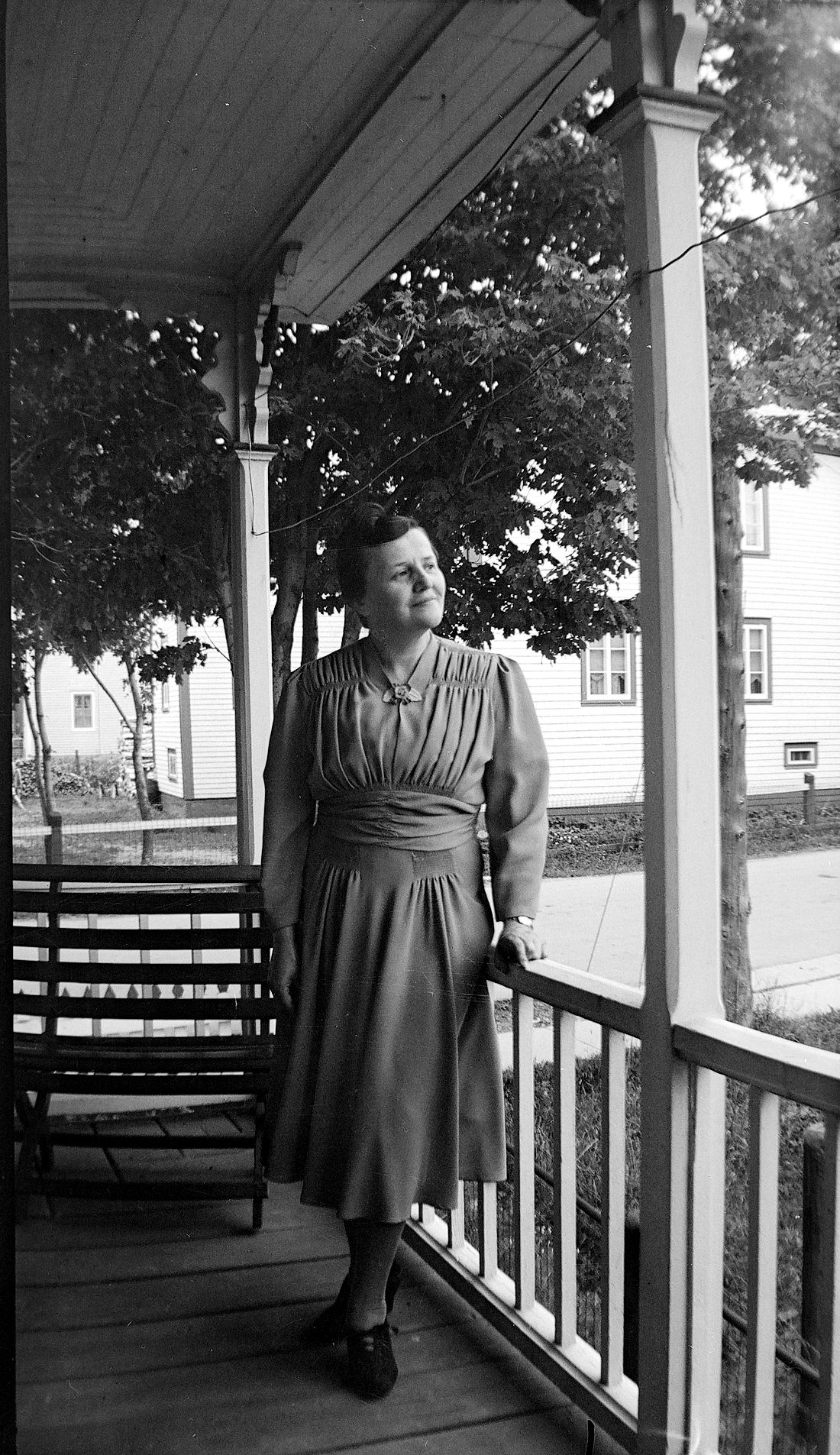
In this portrait, perhaps taken by one of her assistants, Marie-Alice Dumont is elegantly dressed, standing on the front porch of the house containing her studio. Is she on her way to mass?
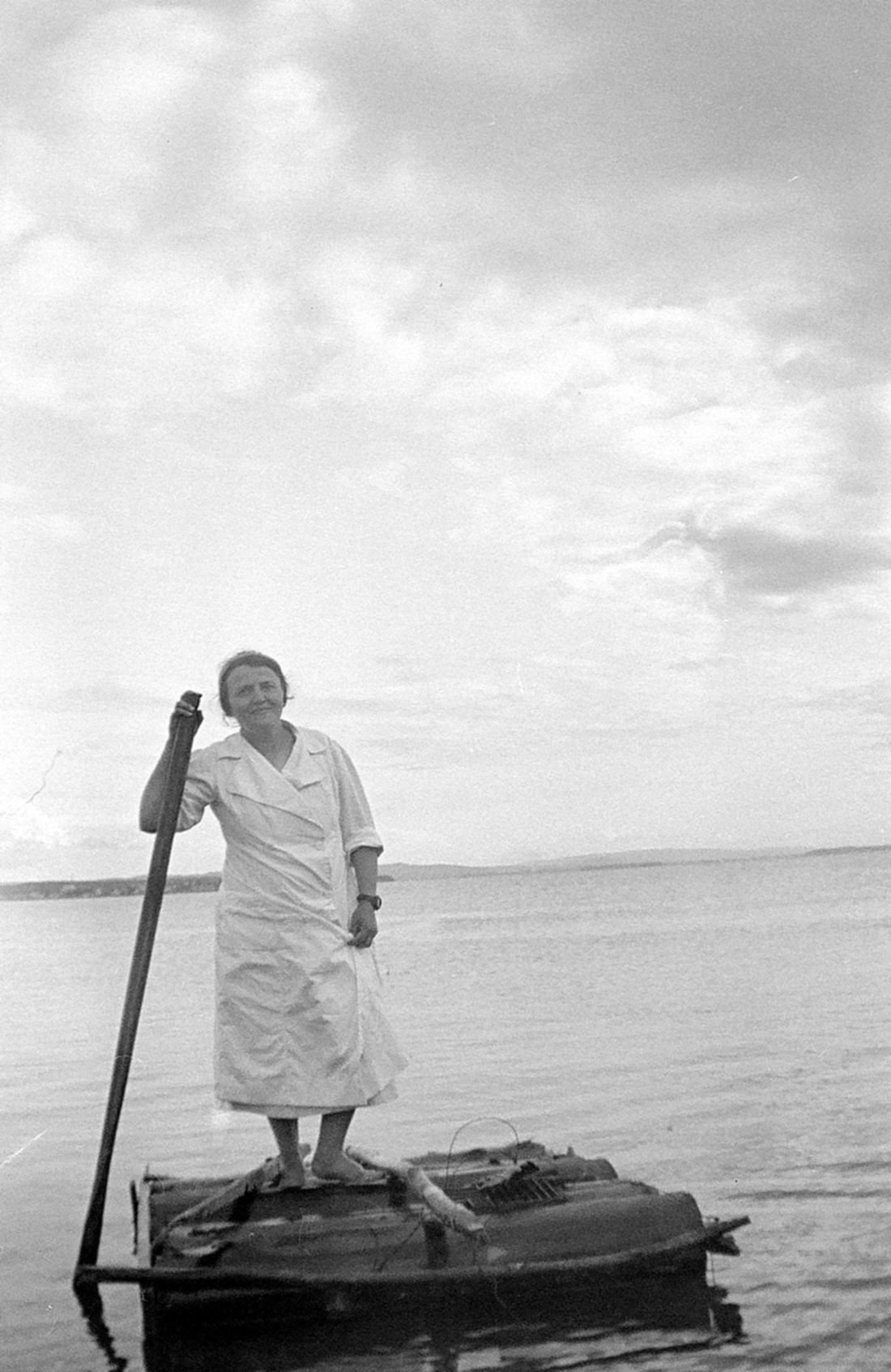
The St. Lawrence River is part of everyday life for many residents of the Kamouraska area. Here, Marie-Alice Dumont is testing the buoyancy of a rudimentary raft while enjoying a swim with some of her nephews.
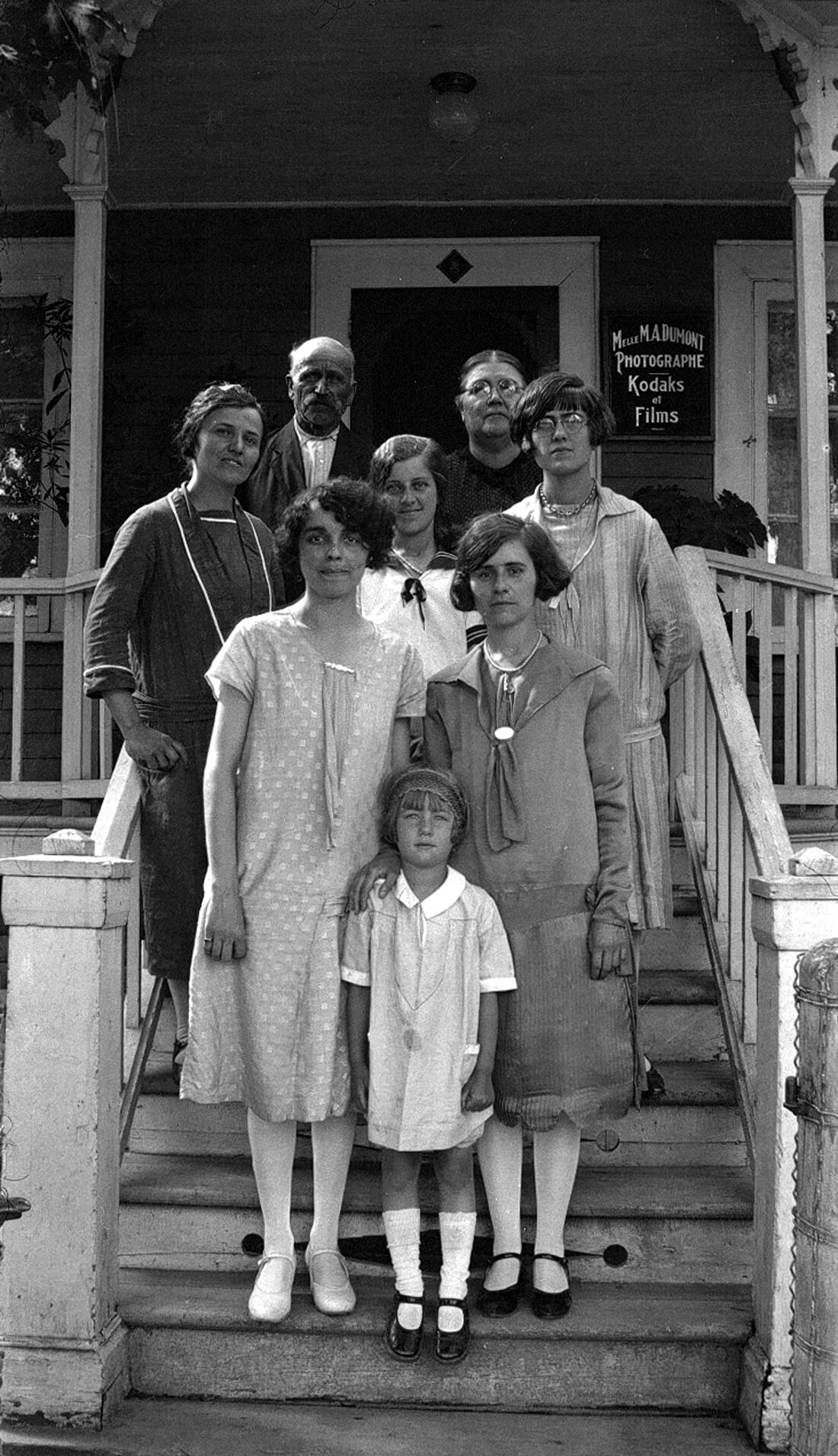
Do you see her? Marie-Alice is on the far left! Perhaps you also recognize her parents, Uldéric and Marie, in the back row? Or her sister Elizabeth, on the far right, wearing glasses? They were not just visiting Marie-Alice; in fact, they were all living with her, even though she was a professional photographer working from home. In the early 20th century, it was not at all unusual for several generations to live together in the same house. The four young girls seen here could be Dumont’s nieces. This family portrait illustrates the strong connection between the photographer’s career and her family. It is easy to imagine Dumont greeting her clients by saying: “Welcome to our home!” By the way, did you notice the studio’s sign next to the front door? It reads: “Mlle M. A. Dumont Photographe Kodak et Films” (which translates as “Miss M. A. Dumont Kodak and Film Photographer”). The sign can be seen in many other photographs in this exhibition.
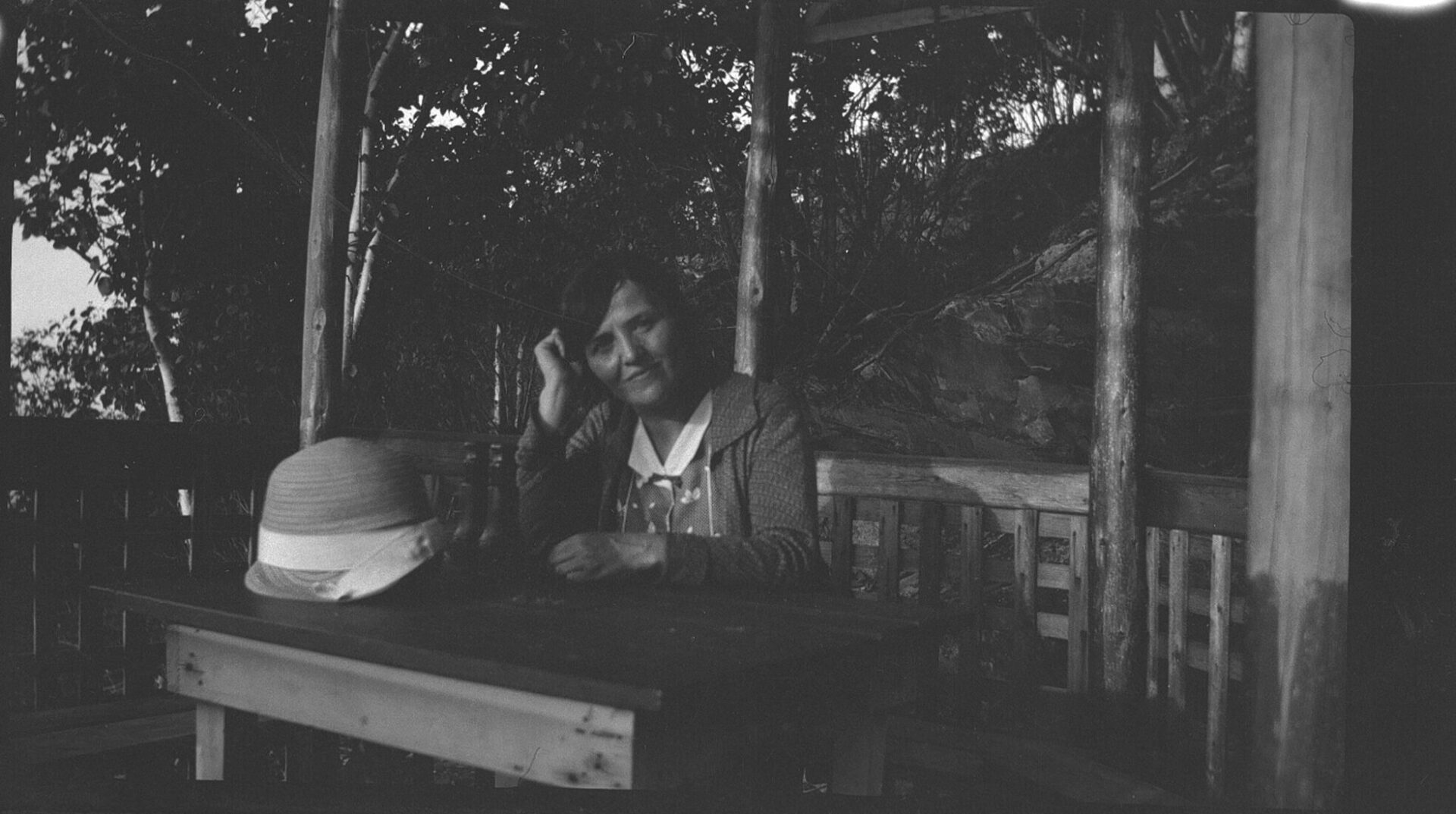
Marie-Alice Dumont worked independently and owned a small business, all of which was hard work! Here, the photographer is taking a break at the home of her sister Émilia, who was hosting her for a short stay on the Île aux Patins, across the water from Kamouraska. Dumont had just spent the day exploring the area, breathing the sea air and listening to the sounds of the St. Lawrence River. Then, as we can see from the soft light on the horizon, Marie-Alice sat down to enjoy the magnificent sunset.
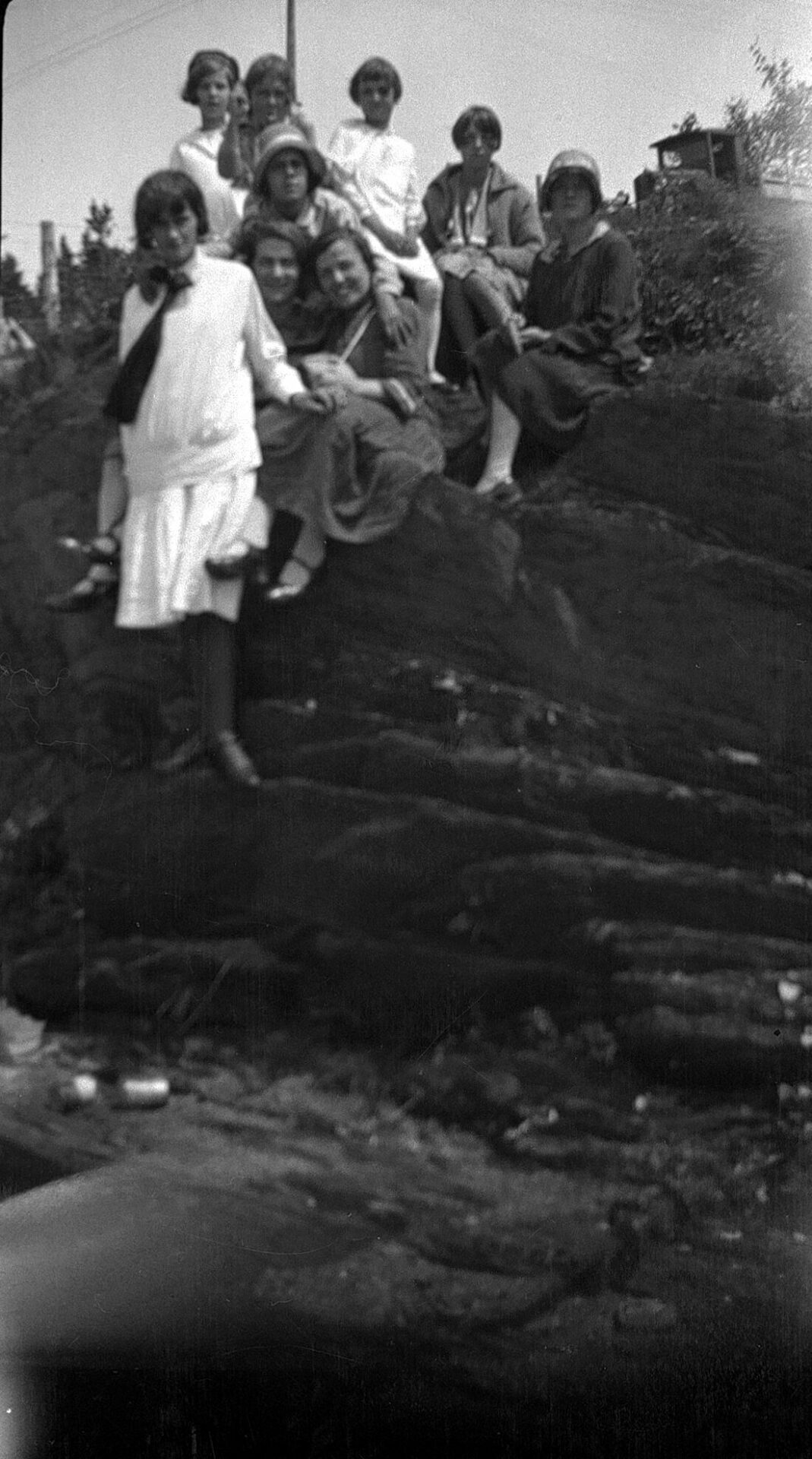
In this “joyful jumble of bodies,” as art historian Lucie Bureau put it, Marie-Alice Dumont can be seen in the middle, wearing a dark dress. The small group has just arrived at Pointe-de-Rivière-du-Loup, on the banks of the river, having travelled in the truck just visible in the background. Like many other locals, these cousins, nieces and friends would picnic and spend part of their day off there.
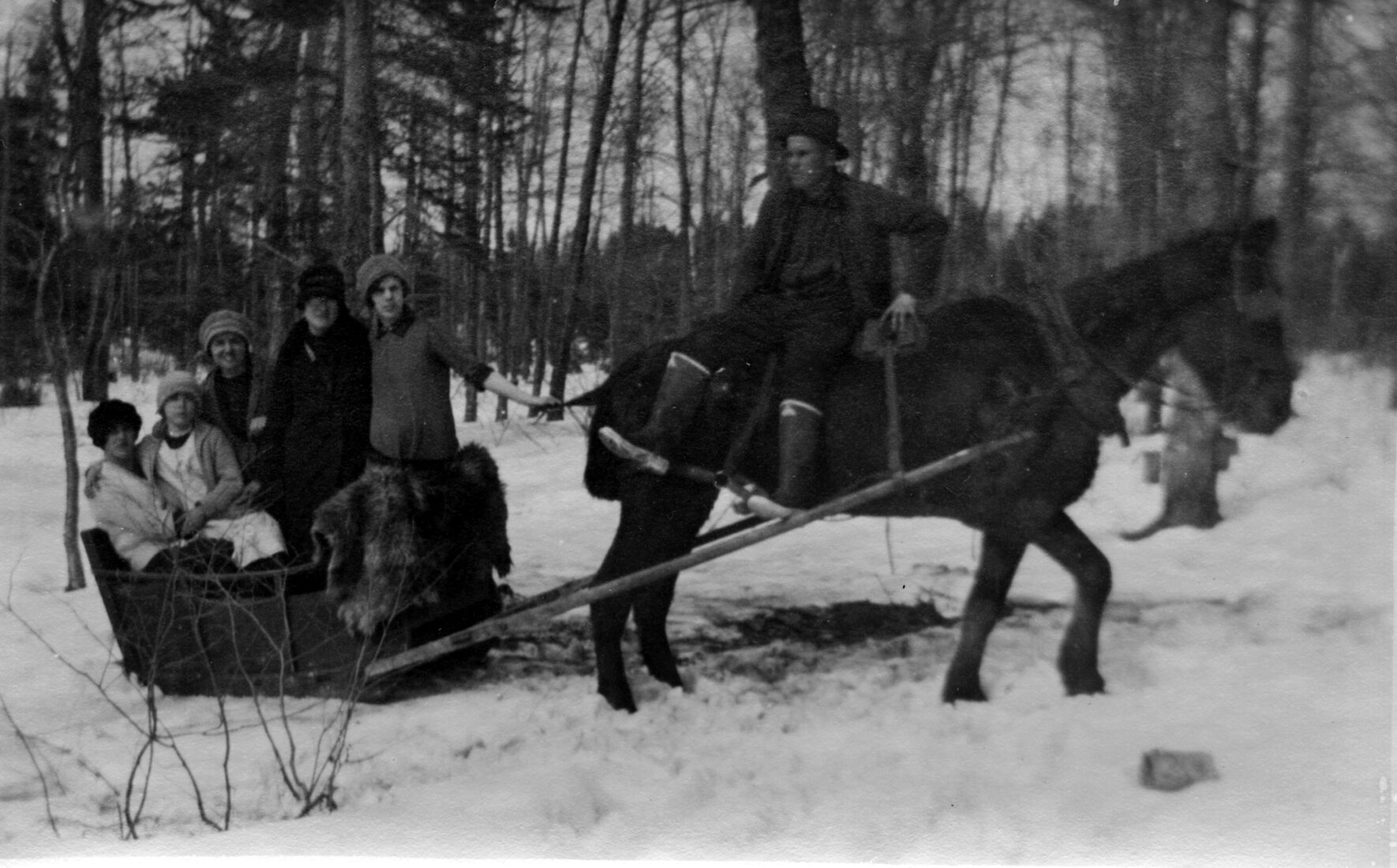
What could be more typically Québécois than a visit to the sugar shack in the spring? And in a horse-drawn sleigh at that! Here, Marie-Alice Dumont, third from left, is accompanied by a young Rosalie Bergeron, second from left. Could the photographer have been helping her newly adopted sister integrate into her family?
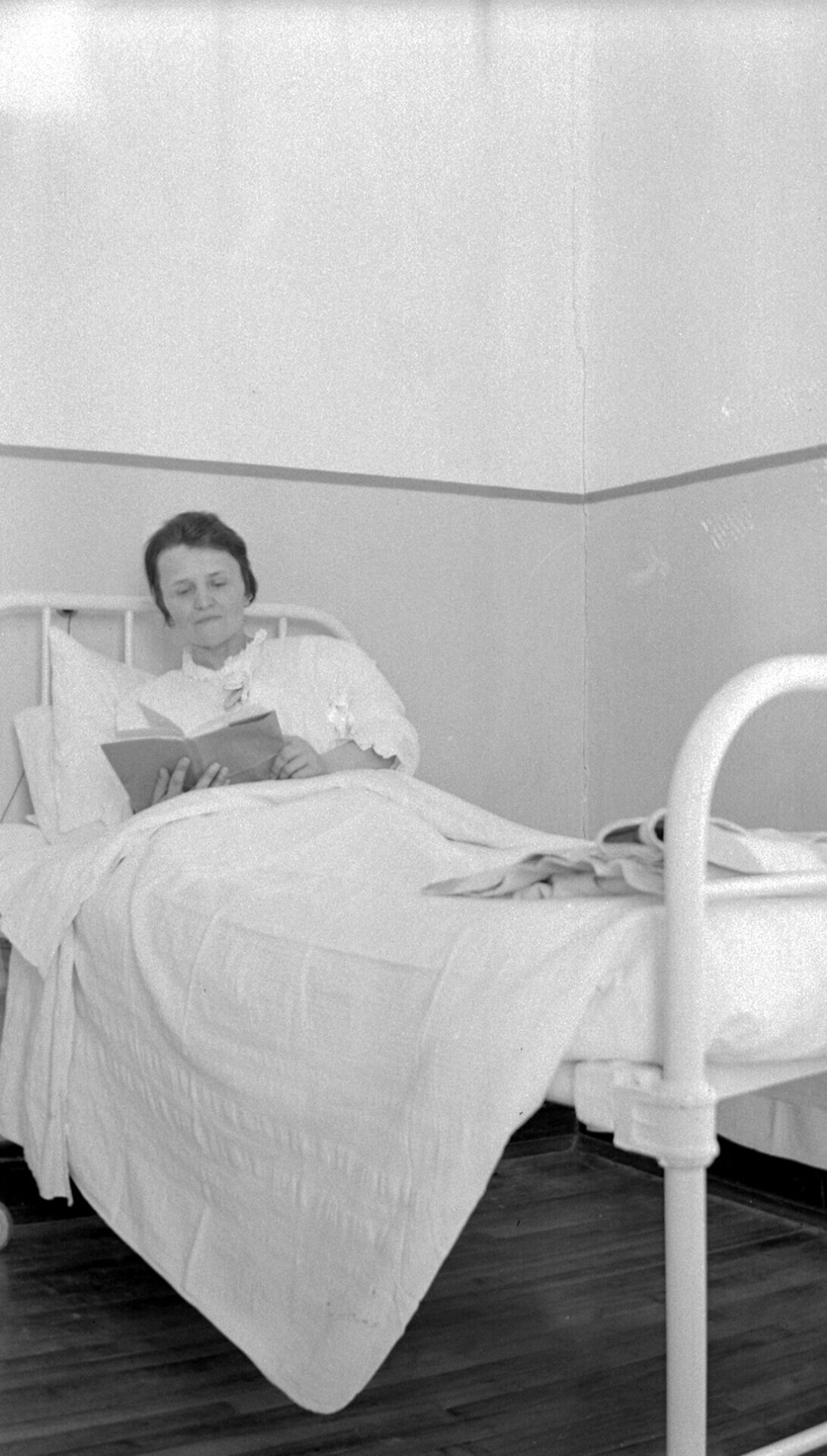
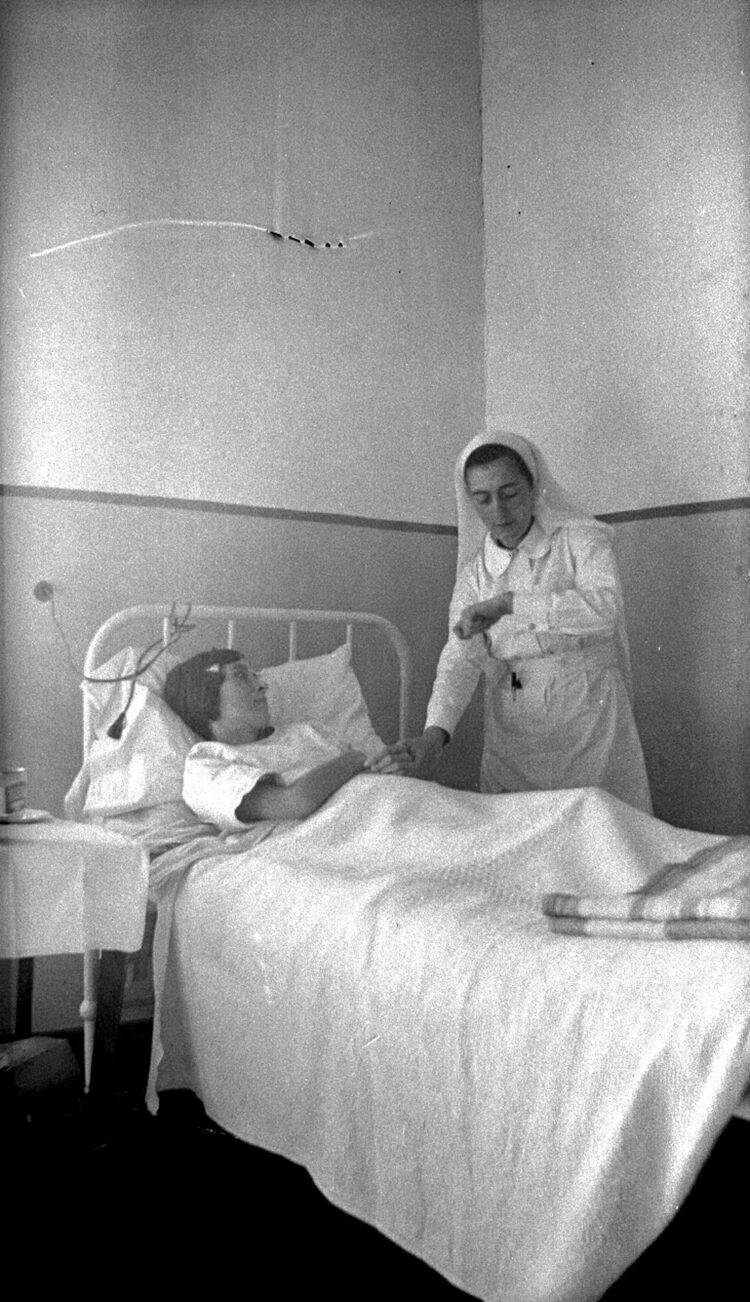
In 1936, Marie-Alice Dumont underwent an operation and was hospitalized for two months in Rivière-du-Loup. During her stay at the hospital, she took several photos of the nurses, doctor, other patients and staff. She also had her portrait taken a few times, as shown here. Did she intend to give these snapshots to the nurses? Or did she simply want to distract herself? As art historian Lucie Bureau points out, whatever the reason, this series of photos, kept carefully in an envelope, tells us about life at the Rivière-du-Loup hospital at the time.
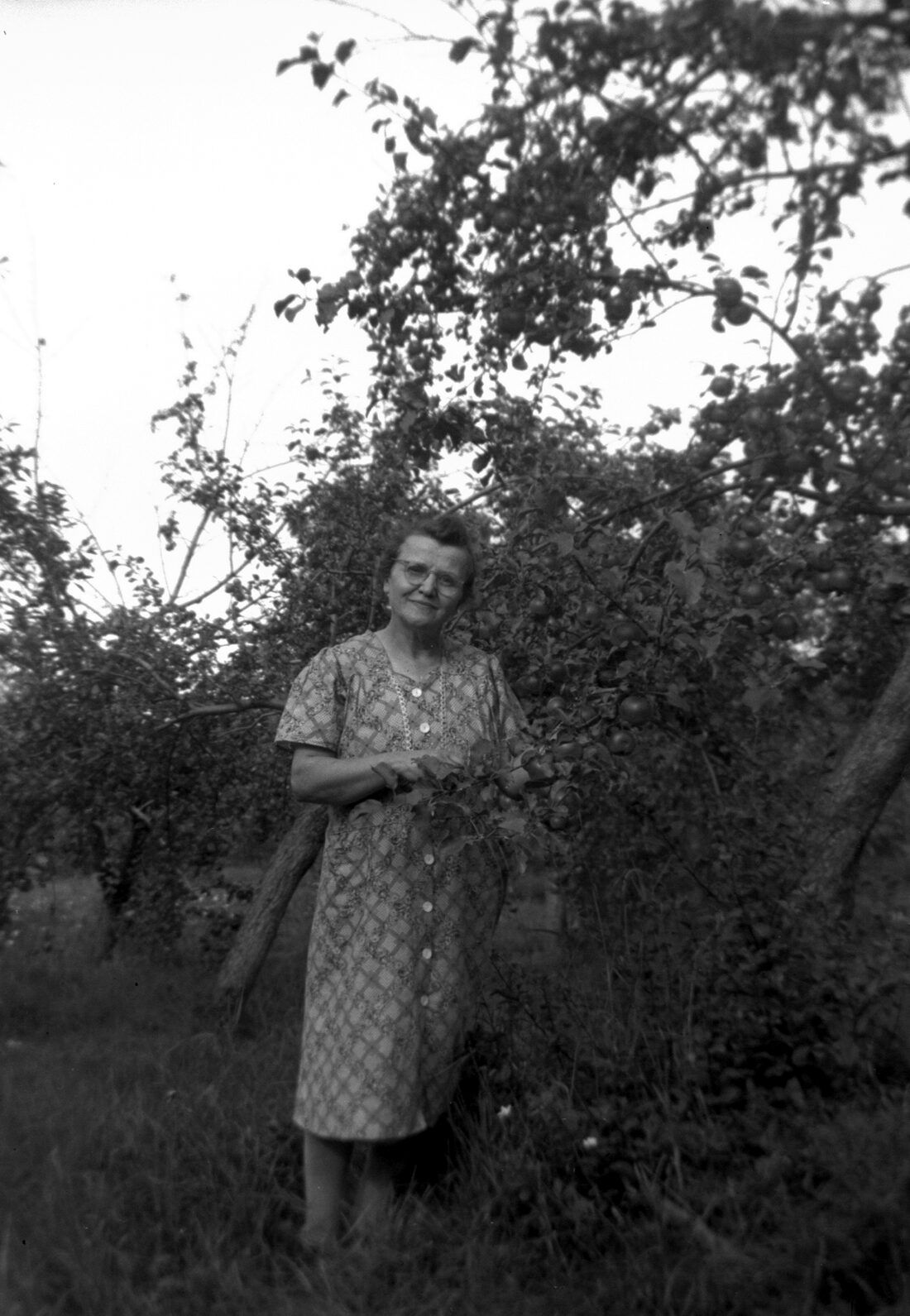
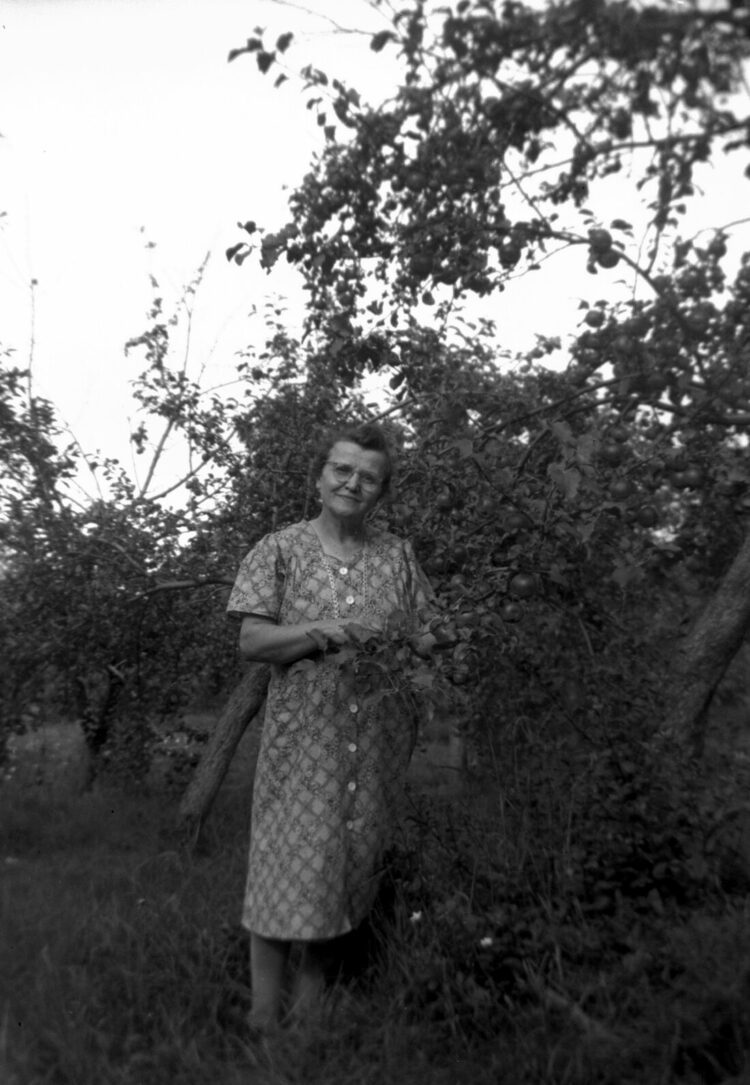
Here, the photographer poses in her orchard, proudly showing off the branch of an apple tree laden with fruit. Along with the vegetables she grew in her garden, apples and plums were an important additional income source. Marie-Alice Dumont could augment her income from photography by selling produce—a big help when money was tight. The Dumont family had always kept large gardens and fruit trees. As a result, the family fared relatively well, even during the economic crisis of the 1930s. As for Marie-Alice, she had so many apples that she wouldn’t have worried too much if one got pilfered now and then!
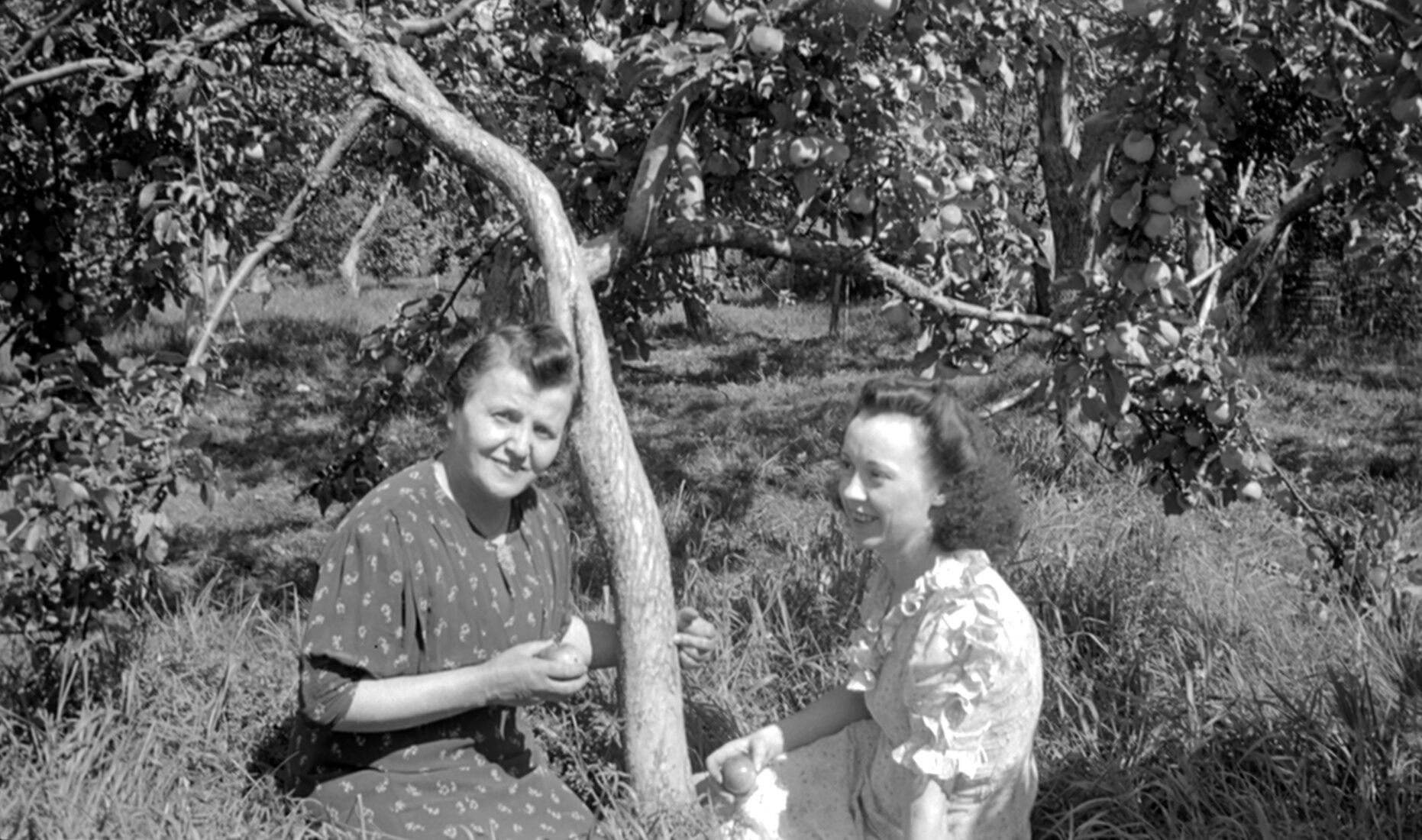
Marie-Alice Dumont and Rosalie Bergeron, aged around 50 and 25, respectively, sit in the orchard behind the home studio. They each hold an apple in their hands. Do you notice Dumont’s rather inscrutable expression, which seems to make Rosalie laugh? Does this have anything to do with… the middle finger Dumont is flashing with her left hand? Who would have thought! Always polite and well groomed, the photographer also had a good sense of humour and a good quip when teased.
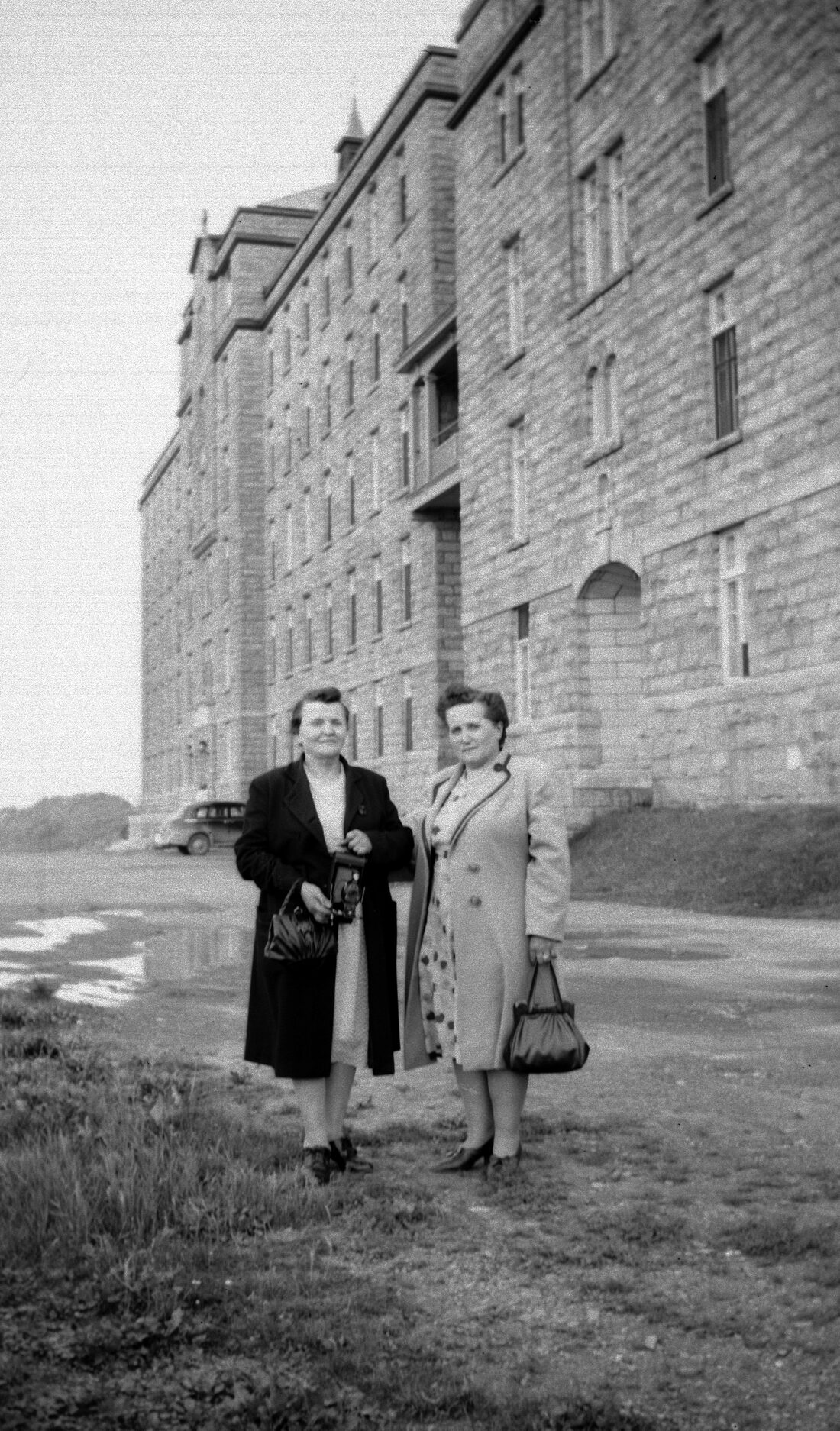
Marie-Alice Dumont poses with her sister Marie-Jeanne in front of the imposing Collège de la Pocatière building. Dumont is holding a Kodak camera, which suggests that her brother Napoléon is taking the photo, using his own camera. All three are preparing to leave on a trip to visit family in Lotbinière, and to pay their respects at the shrine of Cap-de-la-Madeleine in Trois-Rivières.
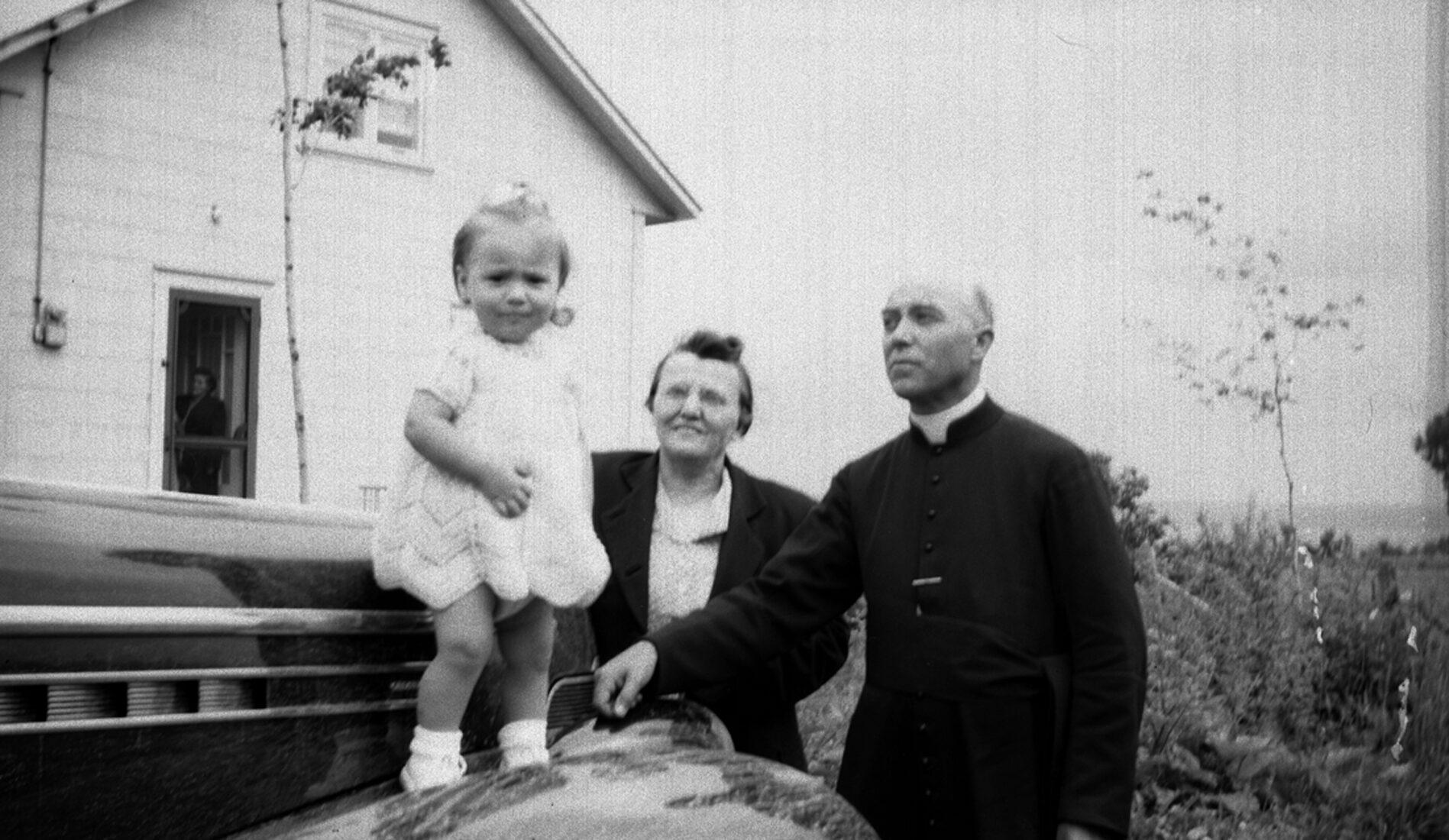
In this photo, Marie-Alice (centre) and her brother Joseph-Napoléon pose with their goddaughter Céline Dumont, aged around one or two years old. Céline is Rosalie Bergeron’s eldest daughter. In 1947, the year this photo was taken, Rosalie had been married for two years and lived in Sainte-Croix, in the Lotbinière region, with her husband, Lorenzo. But Rosalie sorely missed the Dumont family and Saint-Alexandre! Marie-Alice and Napoléon knew this all too well, and they visited her whenever they could. Here, brother and sister are on their way to the shrine of Cap-de-la-Madeleine in Trois-Rivières.
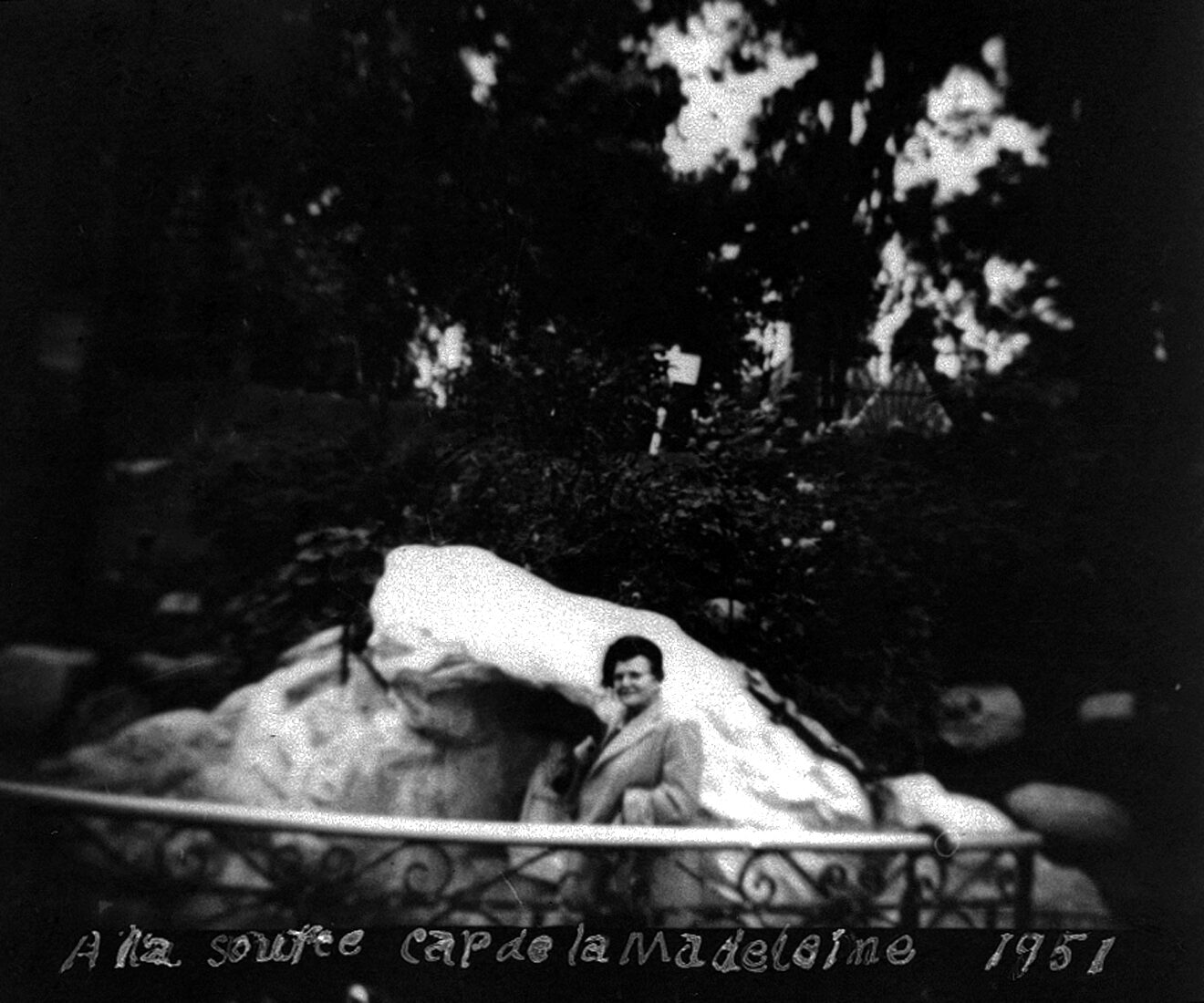
Marie-Alice Dumont, her brother Joseph-Napoléon and their sister Marie-Jeanne visit the shrine of Cap-de-la-Madeleine in Trois-Rivières. This Catholic pilgrimage site dedicated to the Virgin Mary is the second largest of its kind in North America. Here, as this portrait by Dumont shows, there is a spring, also known as the “miraculous fountain,” whose water is said to have remarkable properties. Every pilgrim in the Dumonts’ little group went there to reflect and recharge and, while there, have their portraits taken.
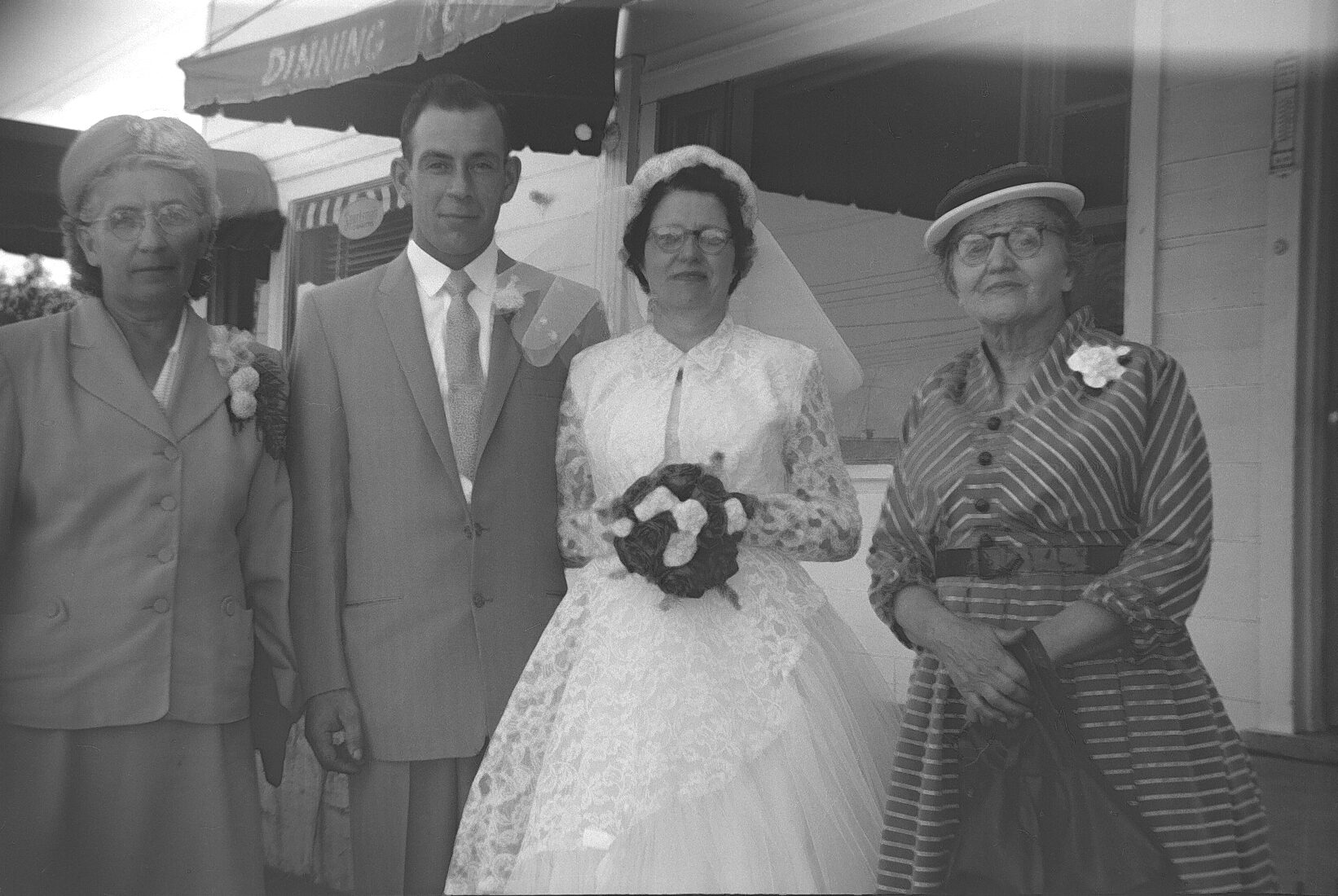
When Rosalie left home in 1946, Marie-Alice Dumont had no one to help out in the studio. This was a great loss for the photographer, as Rosalie worked with her for almost 20 years. But she did not dwell on it! Shortly afterwards, the photographer welcomed Lucille Bérubé into her home. Lucille stayed with her for 10 years, until 1957. At that point in time, at the age of 64 or 65, the photographer was nearing the end of her career, and fortunately had had studio assistance for almost all of it. This emphasizes how difficult photography could be, indeed often requiring a team effort. As she had done with Rosalie, Dumont developed a wonderful working relationship with Lucille. This portrait shows Dumont at Lucille’s wedding to Léonard Gagné. The photographer, on the right, wears a striped dress and a flower brooch. Is she acting as bridesmaid to her former assistant?
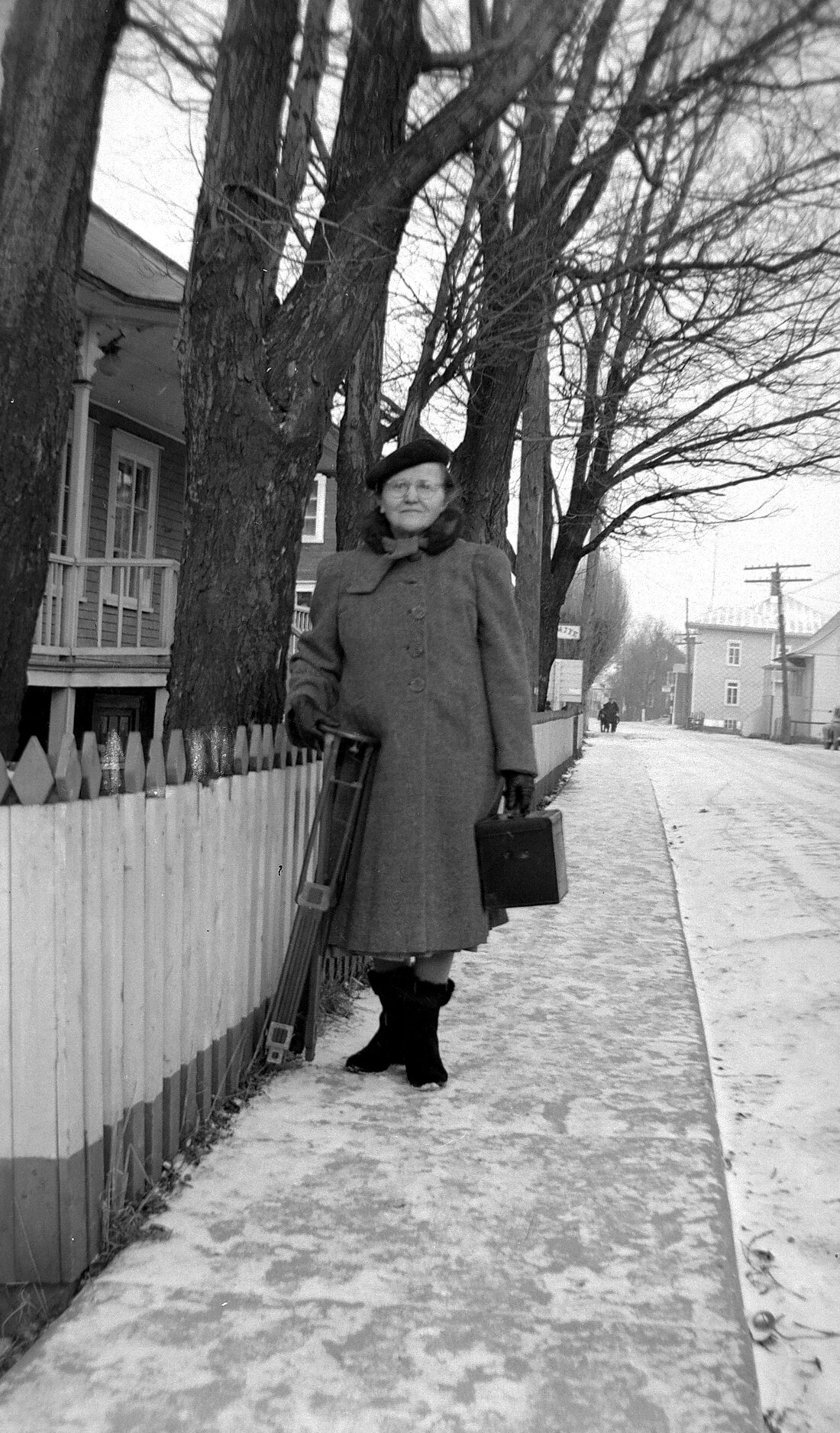
Dumont had chosen not to get married and, instead, to pursue an atypical career. She also never owned a car, though she often took photographs outside her studio, in various spots around the greater Kamouraska area. Did she walk to every location? Of course not! Throughout her career, Dumont’s customers would give her a ride so that she could take photographs at events large and small: picnics among friends, weddings, religious gatherings, parades, family reunions and so on. In this photo, Dumont has just left her home. Tripod in one hand, camera in the other, the photographer (aged around 60) once again takes to the road for her work.
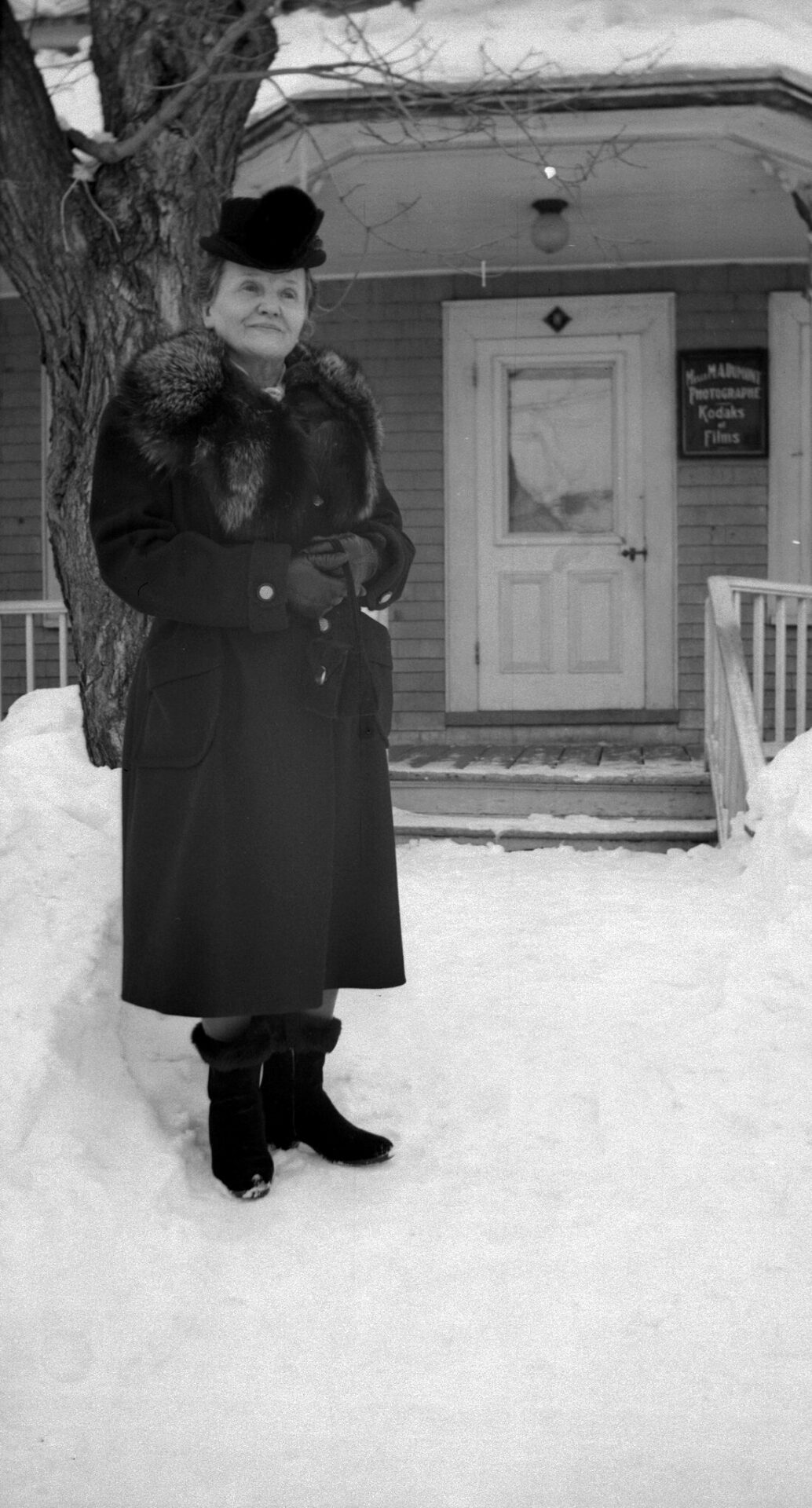
According to Daria Dumont, Marie-Alice Dumont’s niece by marriage, her “Aunt Alice” was a proud woman who liked to dress in fashionable clothes. These two aspects of her personality come through in this magnificent portrait of the photographer, taken towards the end of her career. She stands tall, her gaze sure, in front of the entrance to her studio. Its sign is clearly visible on the right. She is elegantly dressed in a coordinated outfit—fur coat, stylish hat, impeccable boots and leather gloves—completed with a small purse. Where do you think she is going, dressed up like this?
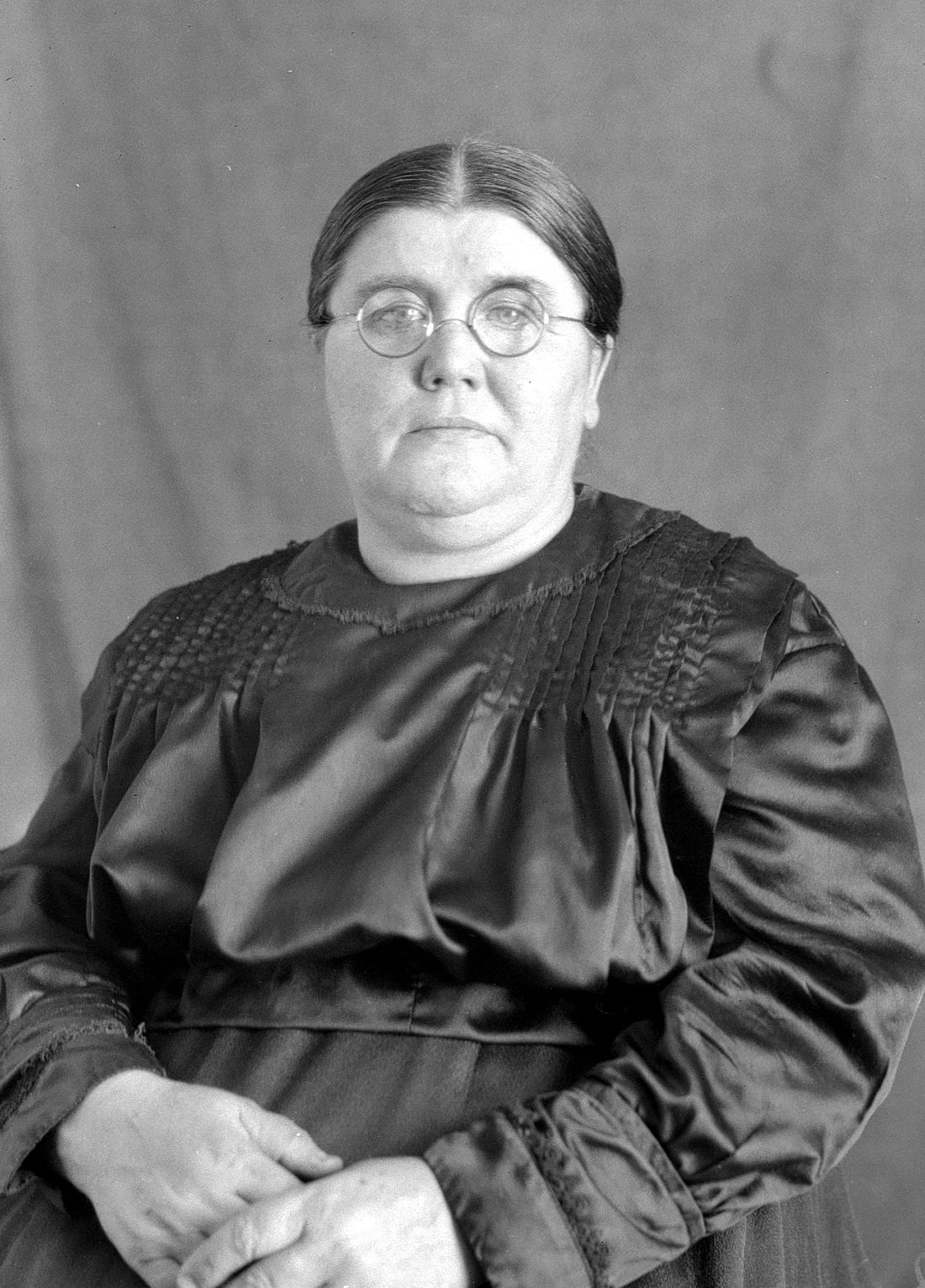
Daughter of François-Xavier Pelletier and Arthémise Garon, Marie Pelletier (1868–1932) was born into a farming family in Saint-Alexandre-de-Kamouraska. Her parents owned land on the 5e Rang in Saint-Alexandre. In 1885, she married Uldéric Dumont, who was 13 years her senior. She died of cancer at the age of 64. If we are to believe Joseph-Napoléon, Uldéric “was full of praise for this woman who was so good, so Christian, so skilled at the domestic duties of the time, so understanding, so thrifty, so hard-working and so strong in the face of life’s trials.”
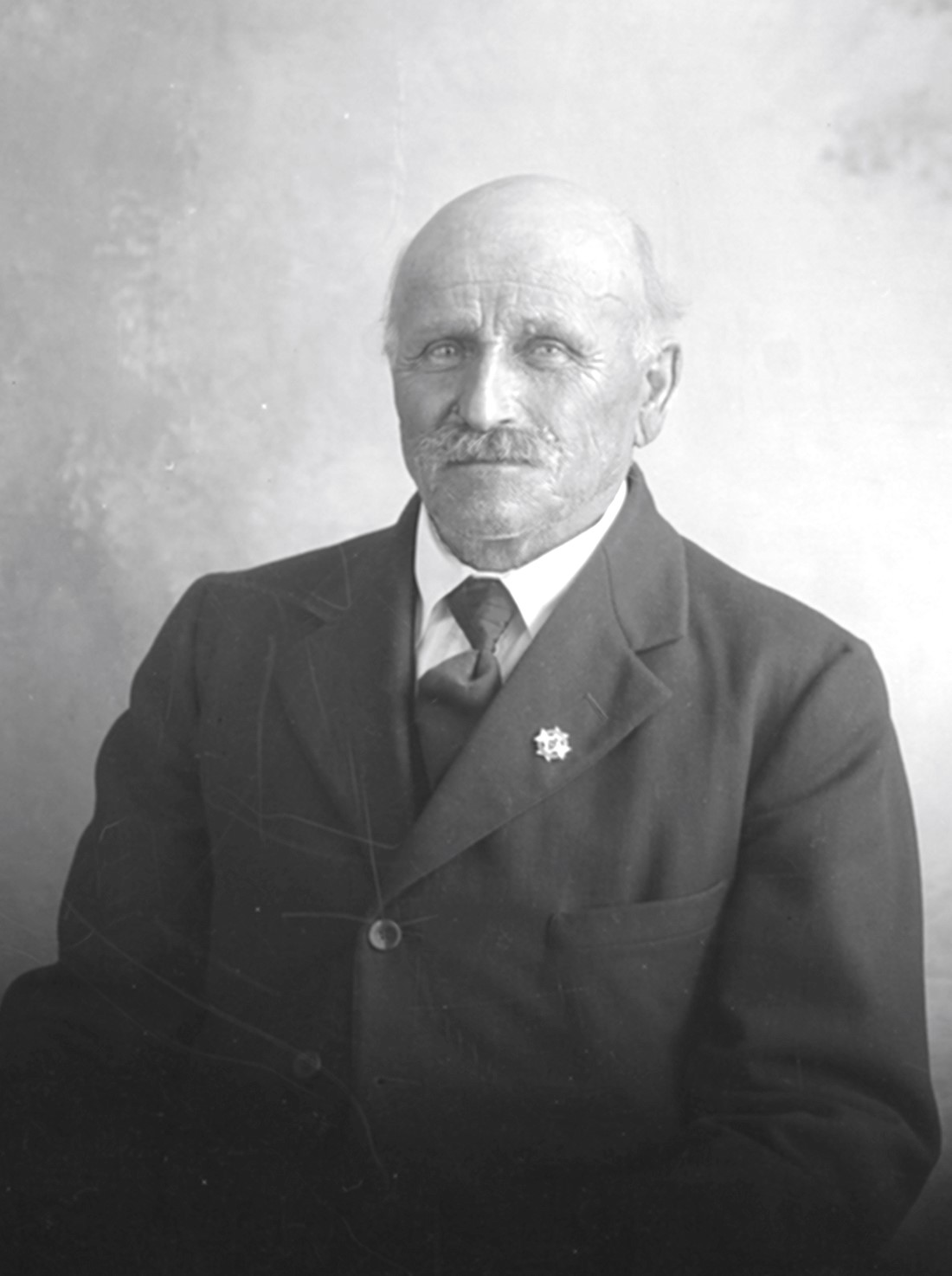
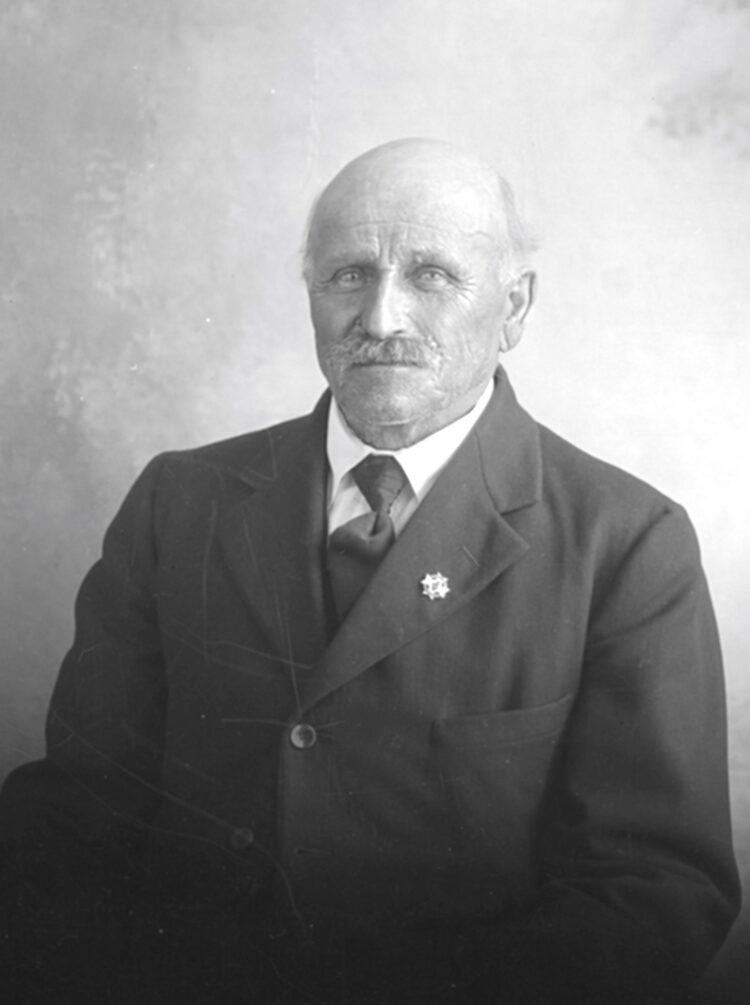
Son of Georges-Létus Dumont and Marie-Séraphine Anctil, Uldéric Dumont (1855–1945) was born in Saint-Alexandre-de-Kamouraska. He is shown here at the age of 80, posed by his daughter Marie-Alice. His wife, Marie Pelletier, had recently passed away, making him a widower. In the words of his son Joseph-Napoléon, Uldéric “walked with dignity in the footsteps of his ancestors, all trailblazers and farmers, all brave pioneers, models of courage, constancy and perseverance.” Napoléon clearly had great admiration for his father! Uldéric seems to have commanded enormous respect within the family. On his 80th birthday, his 56 surviving grandchildren got together to send him a letter of praise, in which they thanked their “revered grandfather” for his “blessings.”
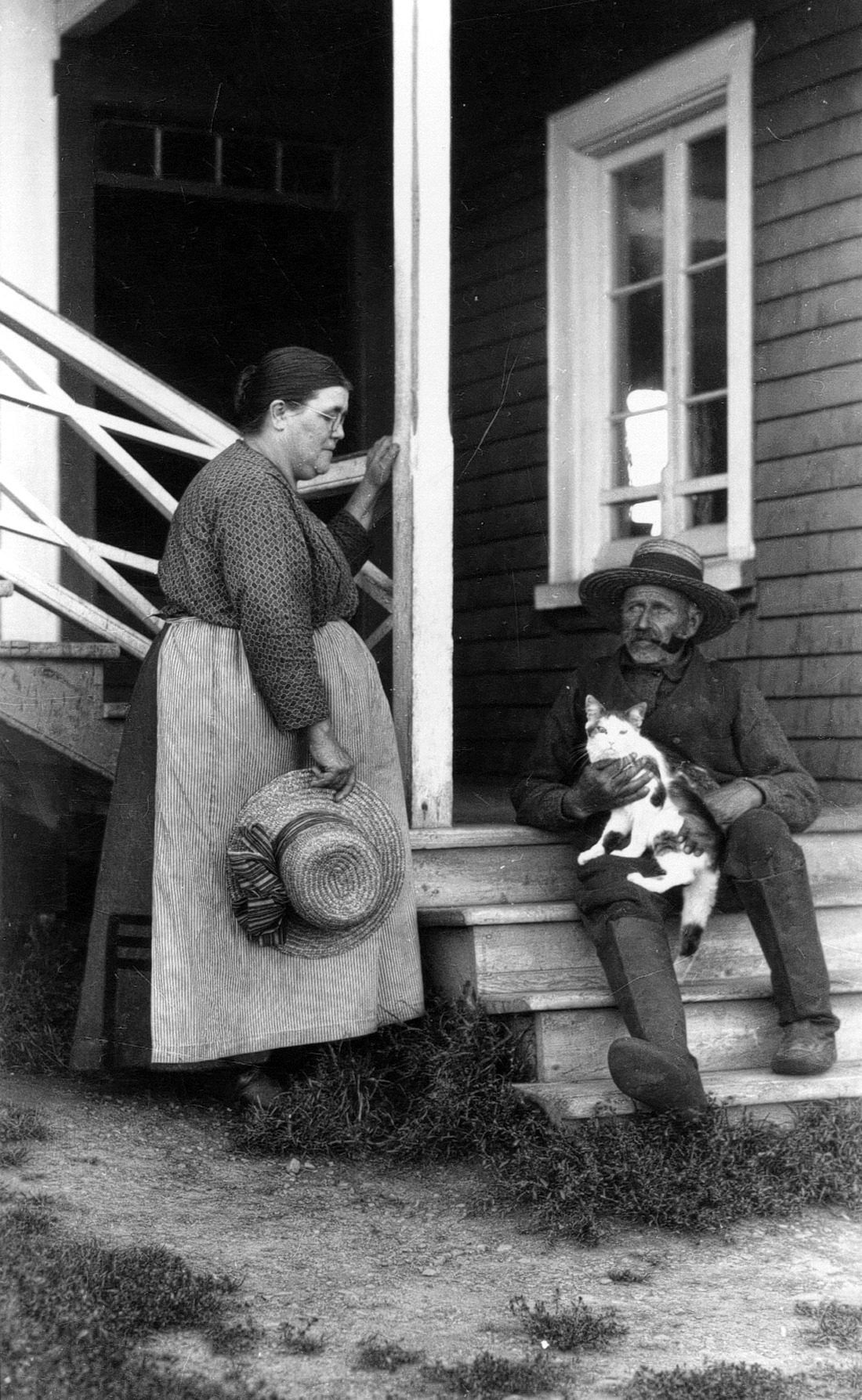
Marie-Alice Dumont’s parents, Marie and Uldéric, were favourite subjects in her early photographs, and they willingly lent themselves to their daughter’s visual experiments. Art historian Madeleine Marcil observes that they seem “very comfortable” in front of the camera. Here, Uldéric sits on the porch steps, smoking a pipe and stroking the cat—the only one who’s looking at us. Marie stands next to him, leaning on the railing, holding a straw hat in her right hand. She made this hat herself, as well as Uldéric’s. She also made the fabric to make their clothes. Marie and Uldéric were very resourceful, capable people. In a 1990 interview, Réal Beaupré, the photographer’s nephew, expressed the wistfulness he felt when looking at this portrait of his grandparents: “Let’s just say it sums up the times. In those days, they took the time to sit down and pet the cats.”
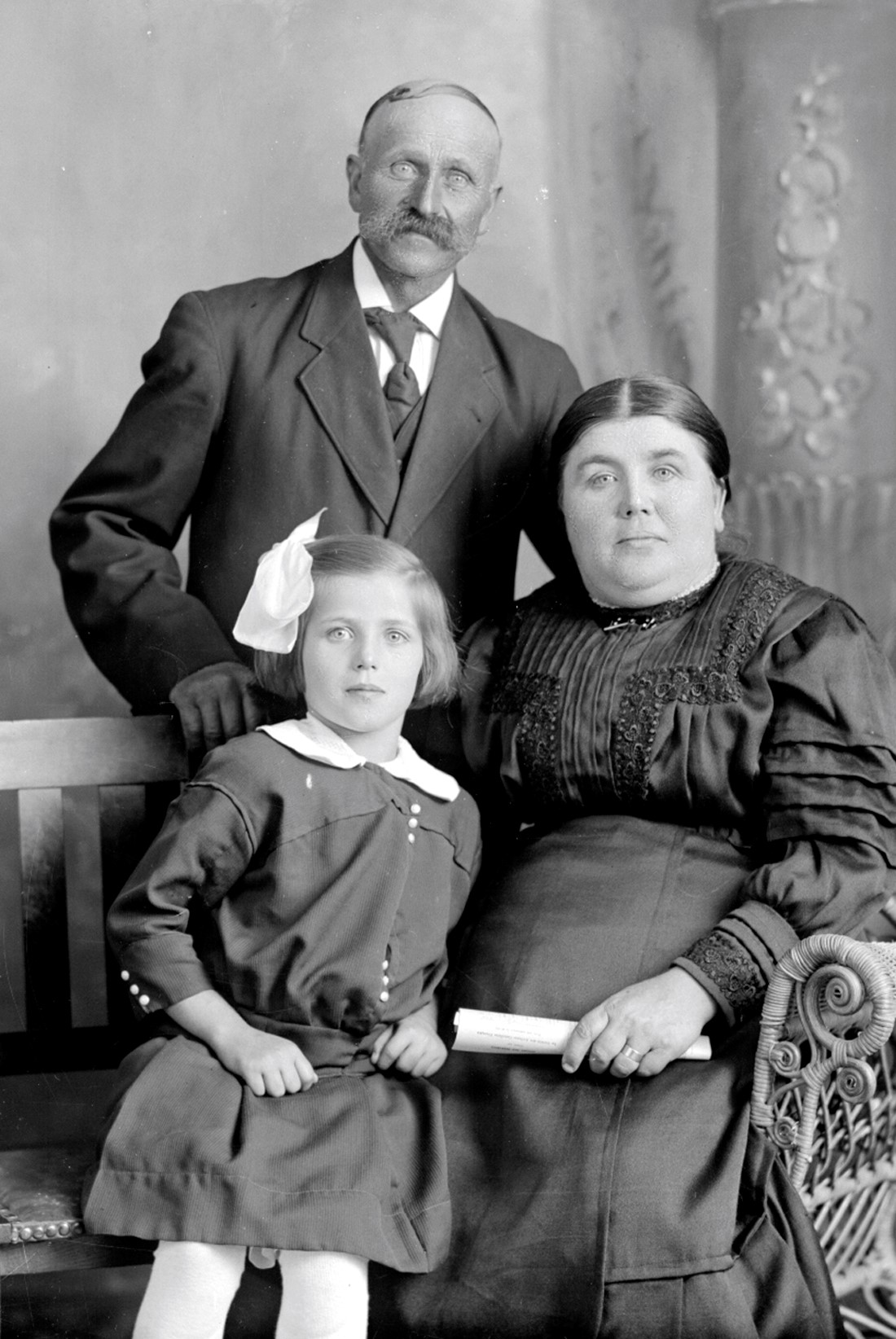
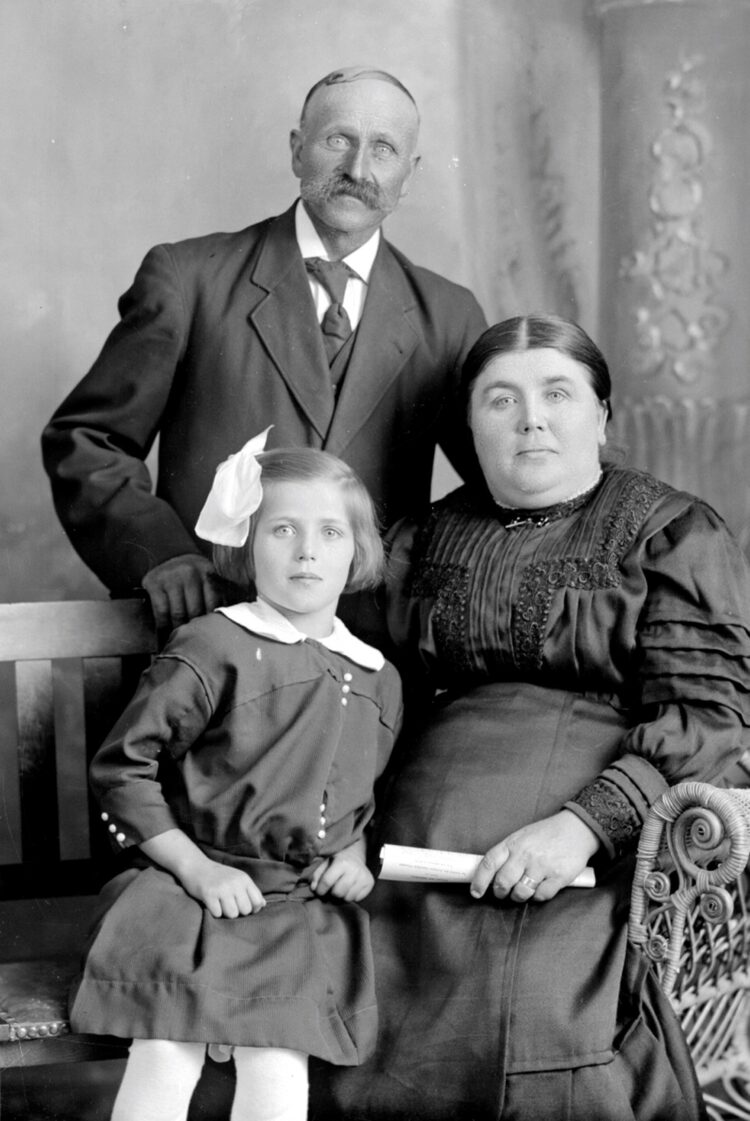
Marie-Alice Dumont grew up surrounded by photography. In the Dumont family, photo albums were passed down from generation to generation. Family members also frequented the Rivière-du-Loup studios, as revealed by the archives of photographers Stanislas Belle and Ulric Lavoie, which include portraits of François, Joseph-Napoléon, Émilia, Anna, Marie-Jeanne and Marie-Louise, all siblings of Marie-Alice. Lavoie’s portrait shows the photographer’s parents and her younger sister Berthe.
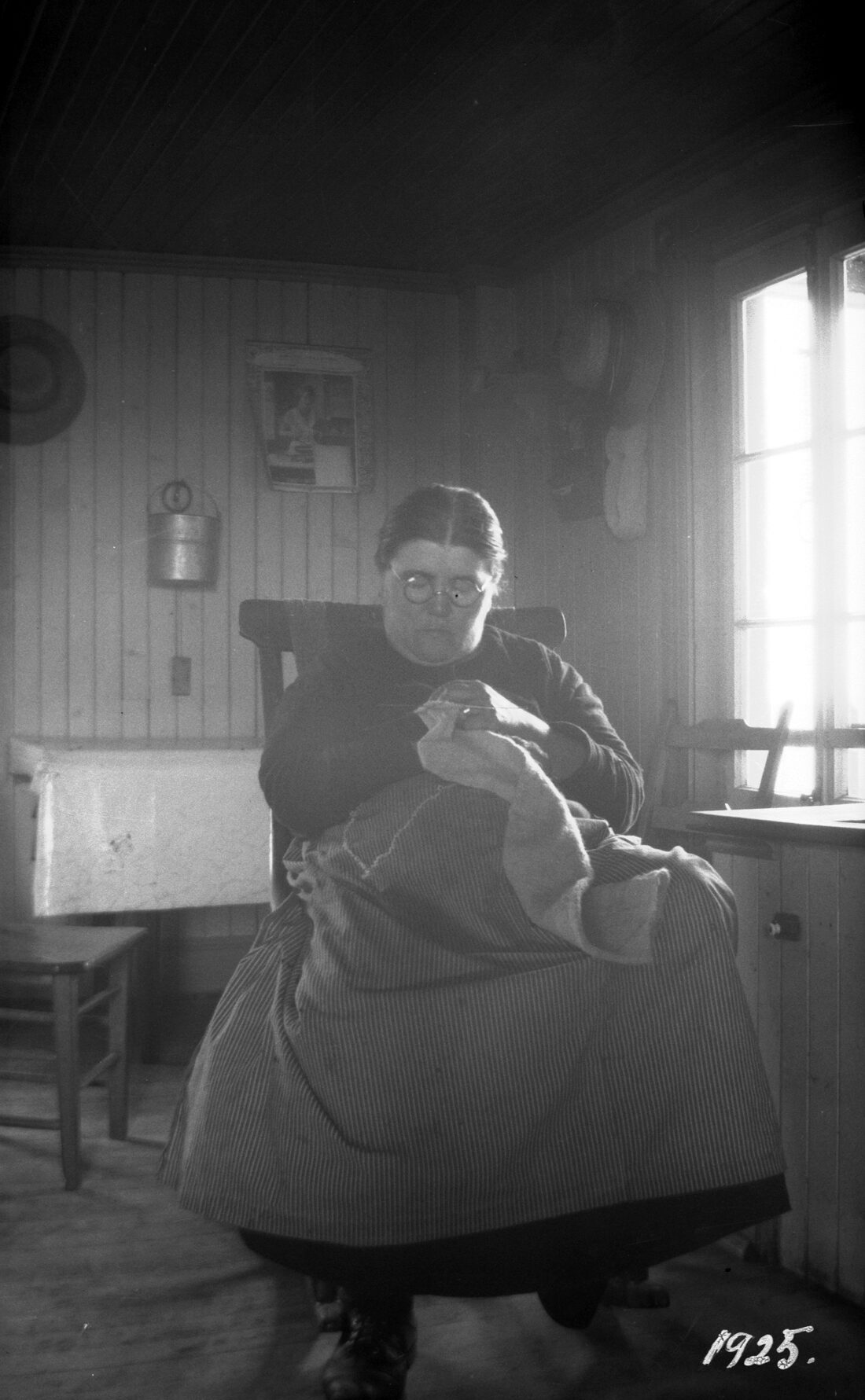
From 1920 to 1925, Marie-Alice Dumont was mastering the techniques and craft of photography. During this period of experimentation, she took photos of her loved ones going about their daily activities. The budding photographer could sometimes be a little mischievous, which resulted in some very authentic shots! This is the case with various portraits of her parents dozing off, such as this one of Marie Pelletier, who had fallen asleep while knitting.
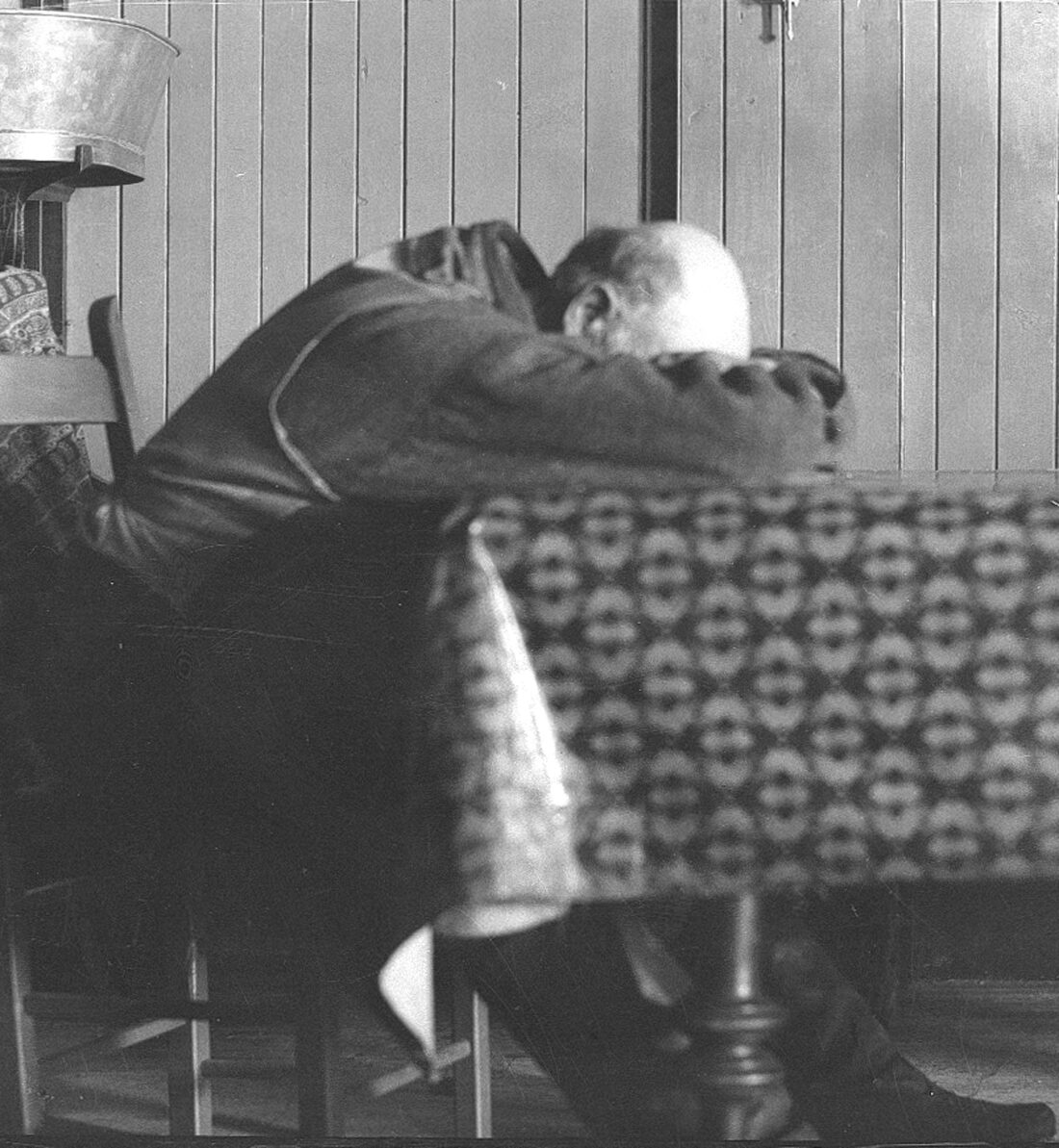
Here is another shot Marie-Alice Dumont took of a sleeping parent, this time her father, Uldéric. Although it is hard for us to imagine pioneer life in the 19th and early 20th centuries, we know it was certainly exhausting. Uldéric was only able to go to school long enough to learn his catechism and the basics of reading, writing and arithmetic. From an early age, he had to help his parents with farm work. He learned how to make his own farming implements (rakes, forks, carts, etc.). He could also make a host of other useful items, such as shoes and household furniture, as well as putting up farm buildings. Throughout his farming life, Uldéric never used machinery or tractors, or even electricity. Instead, he relied on horses and elbow grease. His example shows us just how many different skills were required to be a farmer in his day.
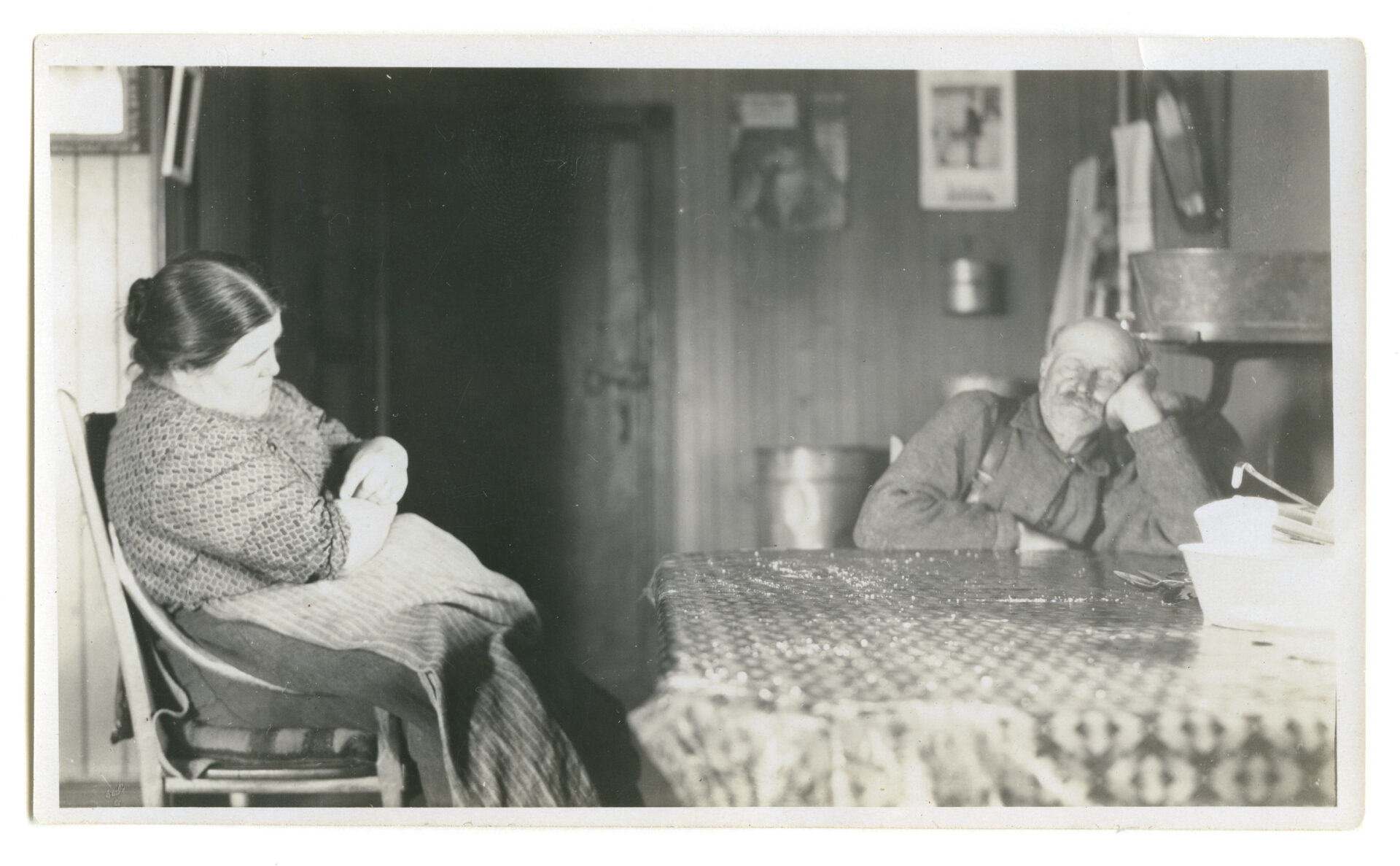
In her 1981 filmed interview, Marie-Alice Dumont recalls the time she photographed her parents asleep at the dining table. The photographer explained: “After the girls had eaten, [my parents] were talking together. Suddenly, [my mother] fell asleep, [my father saw her], and he fell asleep too. It was the perfect time to take their picture. We cleared the dishes, closed the curtains [and then I took the shot].” Dumont also remembers her parents’ surprise and amusement when they found out. Intrigued by the anecdote, the interviewer asked Dumont if surprises like this happened from time to time, to which the photographer replied with a knowing smile: “Yes, yes.”
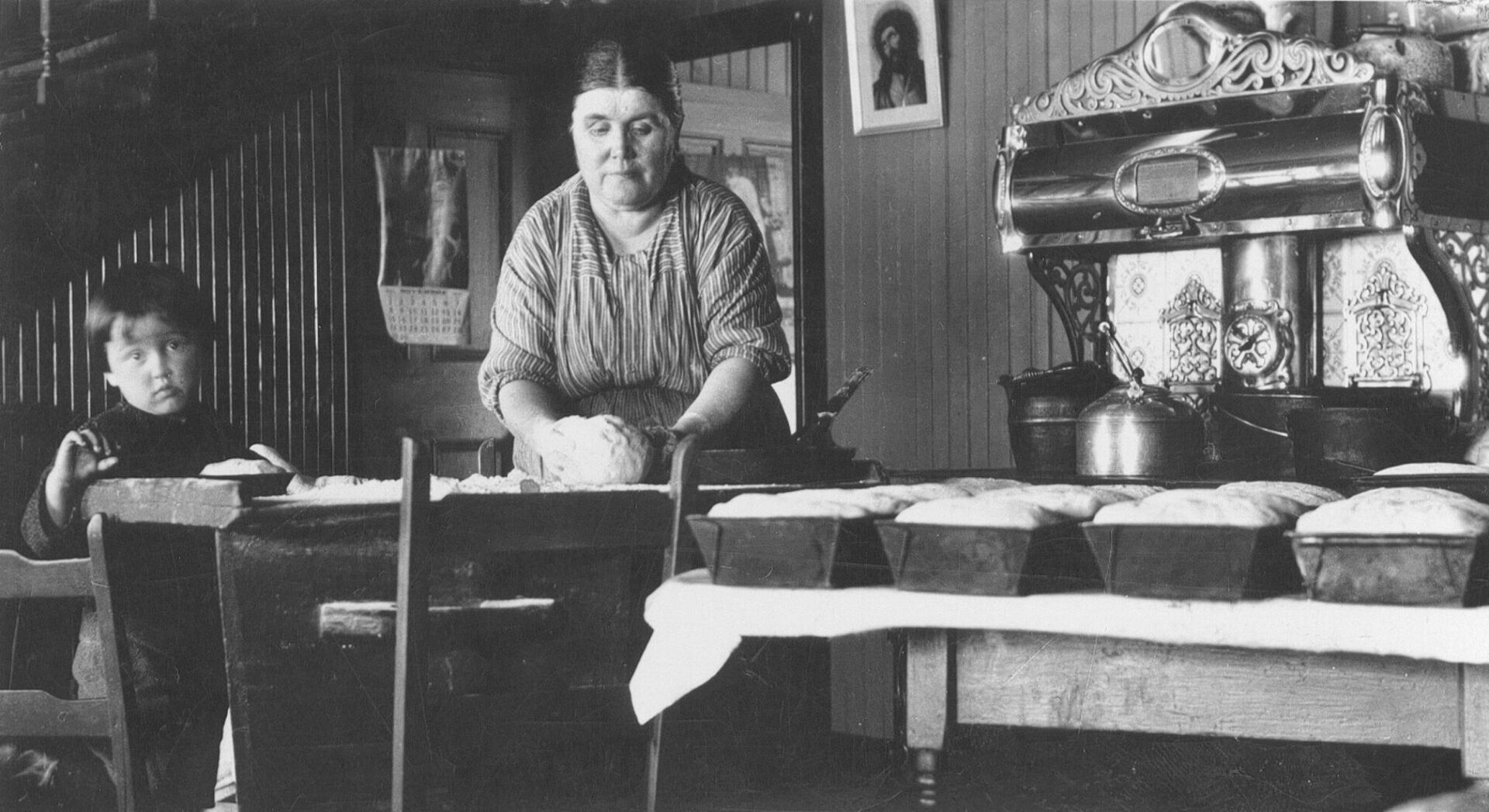
In Marie-Alice Dumont’s day, the task of feeding a large family was one faced by many mothers, Marie Pelletier included: she had 12 children who survived into adulthood. In this magnificent portrait, another window into the home life of the Dumonts, Marie is busy preparing a huge batch of bread. Her grandson Origène mimics her, equipped with a small baking pan.
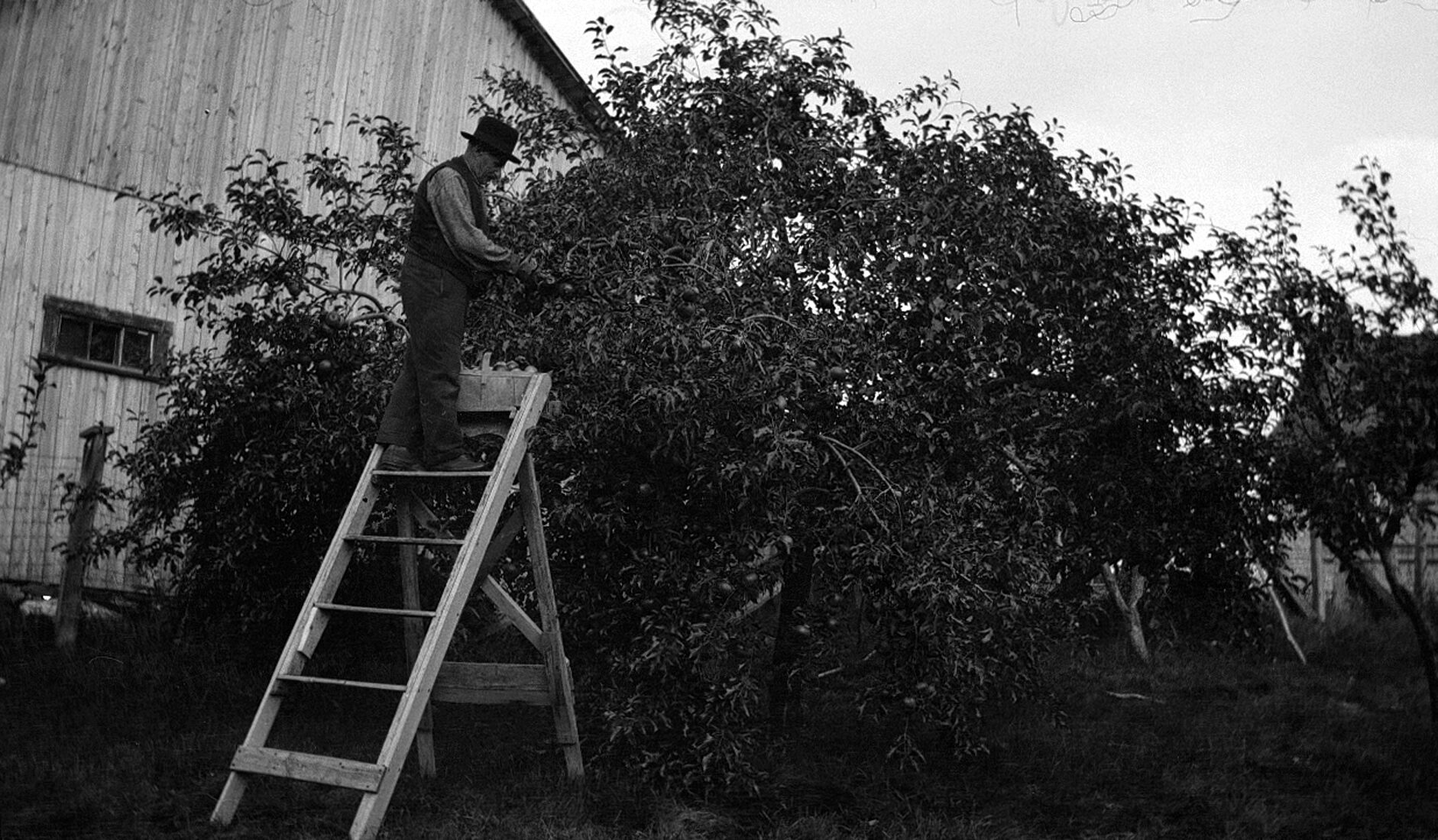
Uldéric Dumont was a seasoned farmer. He is seen here picking apples on his family’s property on the 5e Rang, in 1925. In the following years, together with his daughter Marie-Alice and son François, he also cultivated a 300-tree orchard of apple and plum trees on the grounds of the new village house. The family made a sizeable income from it.
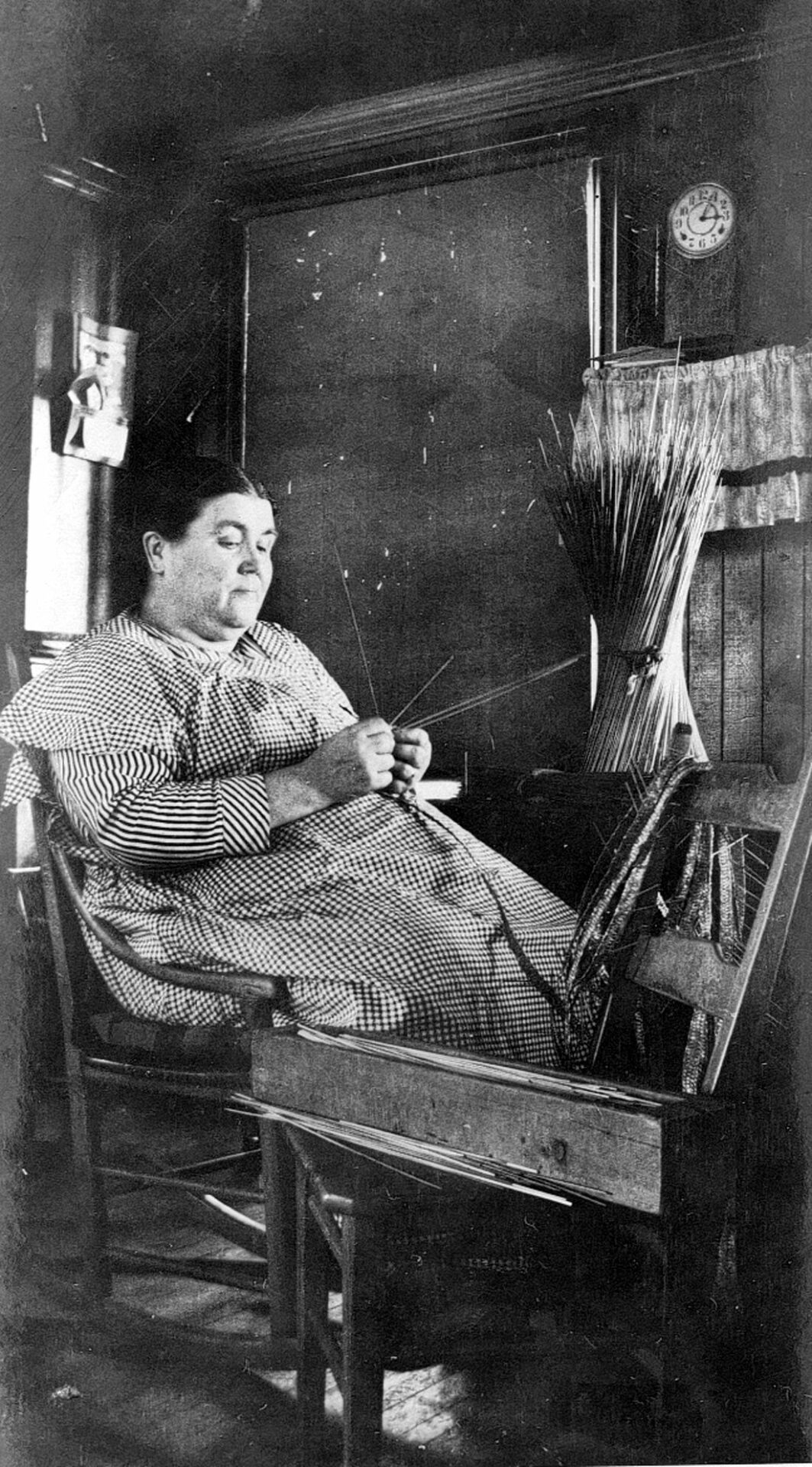
Marie Pelletier seems to have enjoyed carrying out daily tasks from her rocking chair. At least, that is what some of Marie-Alice Dumont’s portraits of her suggest! Here, Marie weaves a straw hat that will come in very handy for herself or her husband Uldéric during the long days spent working outside on the farm.
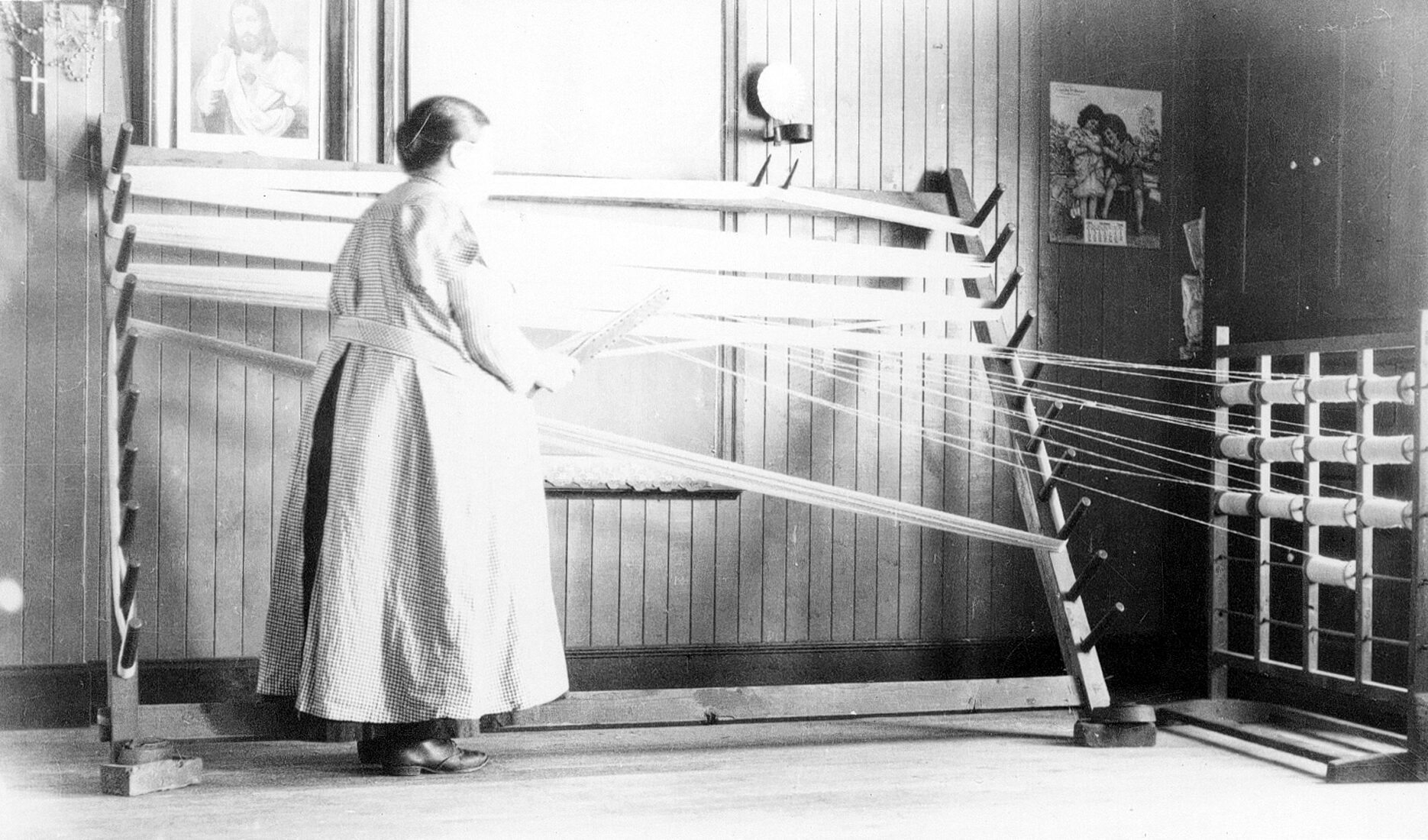
Another task performed by Marie Pelletier was warping: preparing threads into a warp that is then mounted on the loom. Such work required a great deal of dexterity.
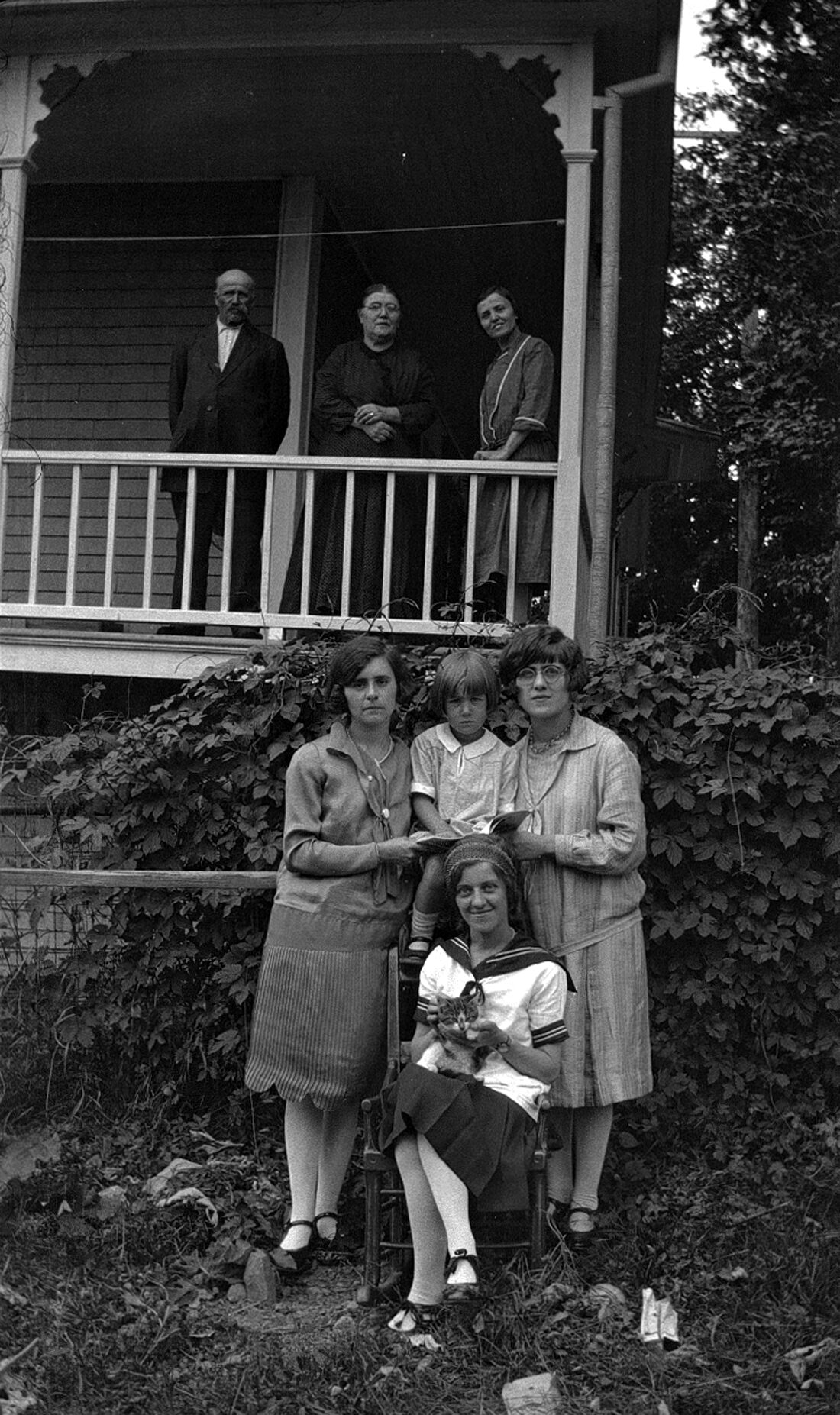
This group portrait illustrates the domestic, even familial, nature of Marie-Alice Dumont’s business. Here, Uldéric, Marie and the photographer stand on the porch of the home that also housed Studio Dumont. In the foreground, we see Marie-Alice Dumont’s younger sister Elizabeth (far right), who would become her assistant in the photography studio.
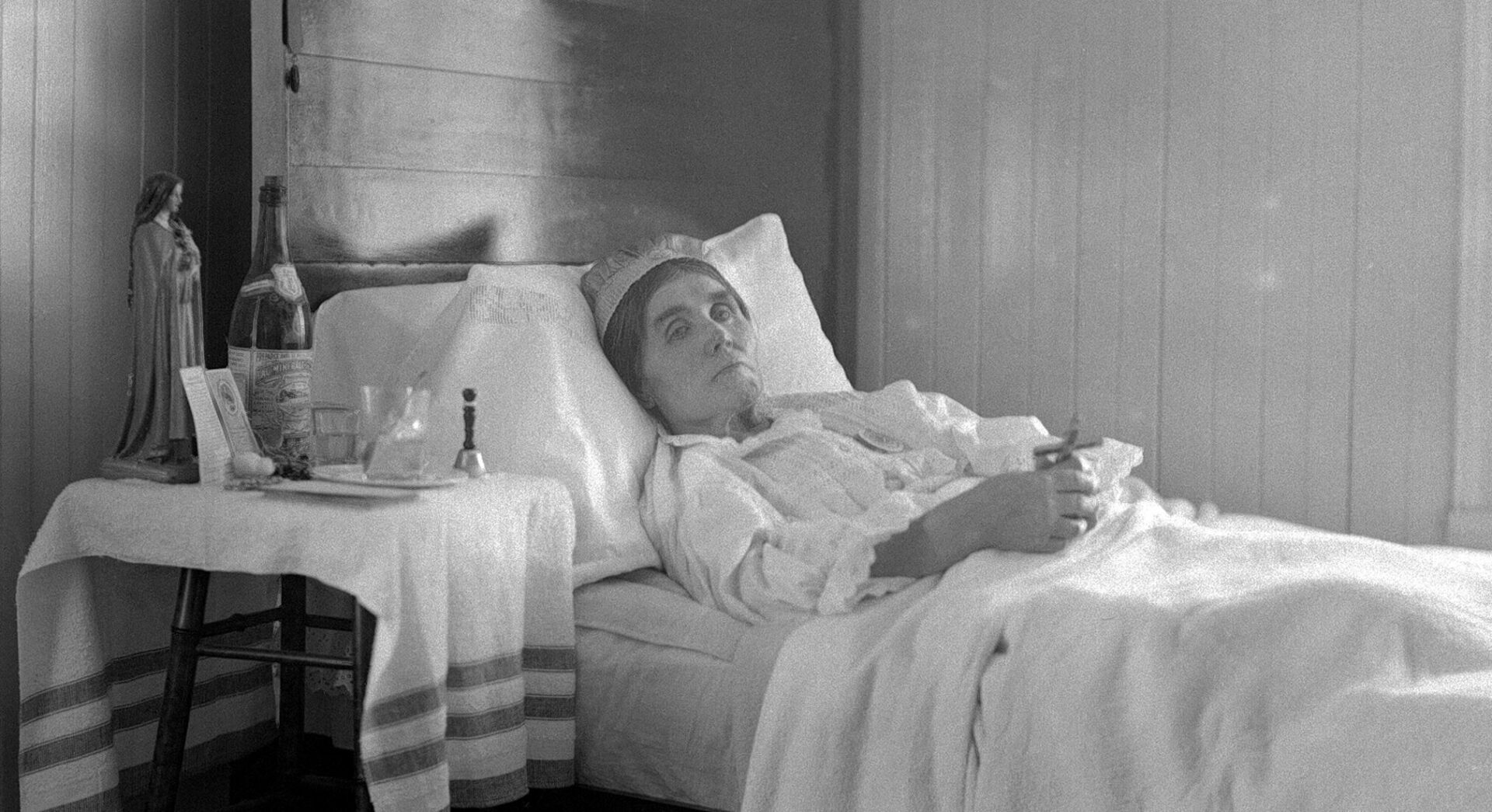
The expression “Death is part of life” was particularly meaningful in Marie-Alice Dumont’s day. It was common practice for parents to live with their children until they died. They often grew old in the care of their loved ones, then died at home. This was the case for Marie Pelletier, shown here bedridden at the end of life, in a room just behind Marie-Alice’s photography studio. While plump throughout her adult life, Marie appears here with an emaciated face. Approaching the end of a difficult battle with cancer lasting many years, she is exhausted and very weak. Berthe, seeing her mother’s suffering, thinks, “She must be looking forward to seeing dear Jesus!” This portrait captures the moment when Marie was ready to make the great journey, crucifix in hand, trusting in God’s grace. The photographer must have had a heavy heart when she took this photo. Berthe knew how well Marie-Alice looked after her mother until the end. Berthe wrote to her: “My dear Alice, you deserve such praise.”
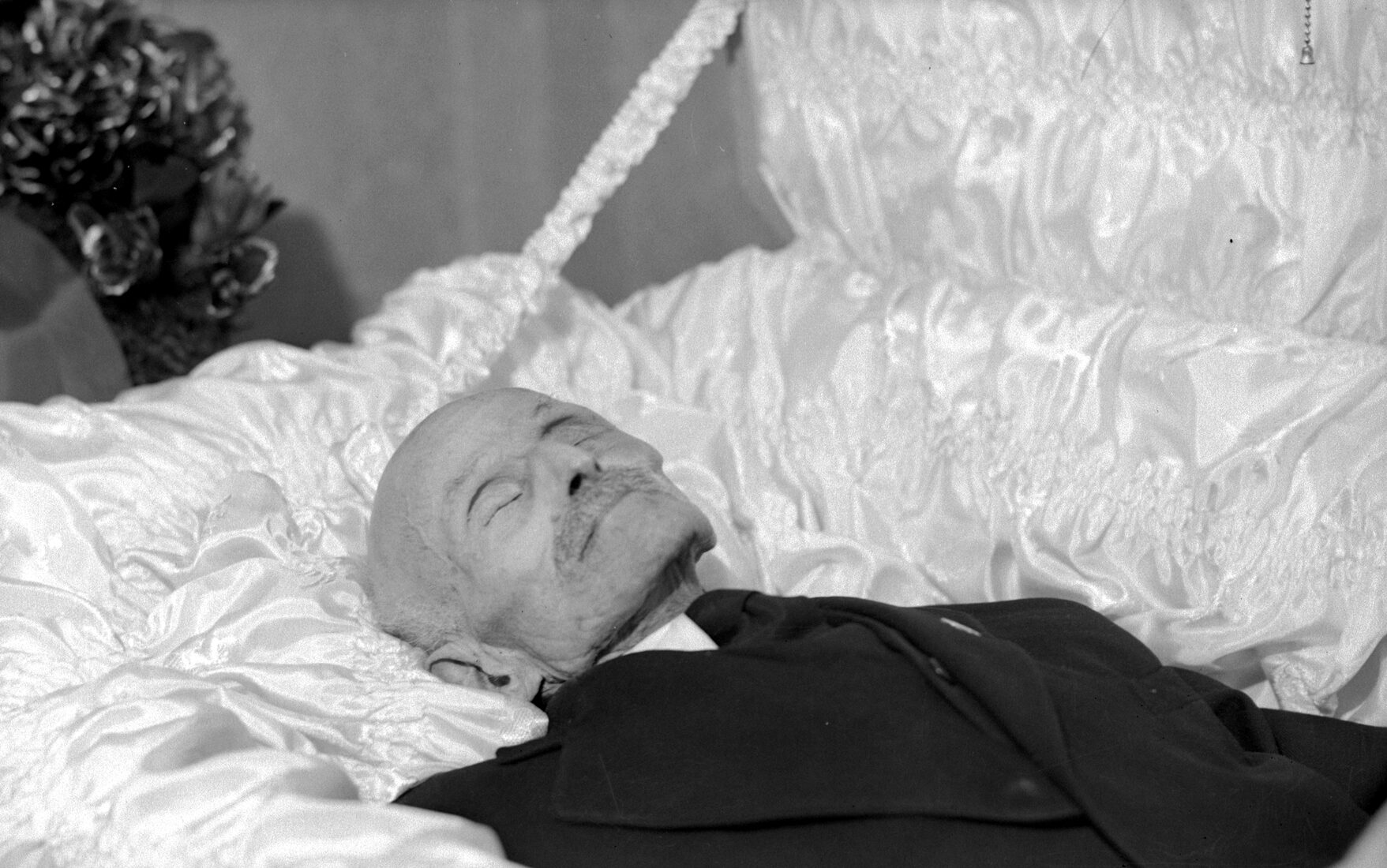
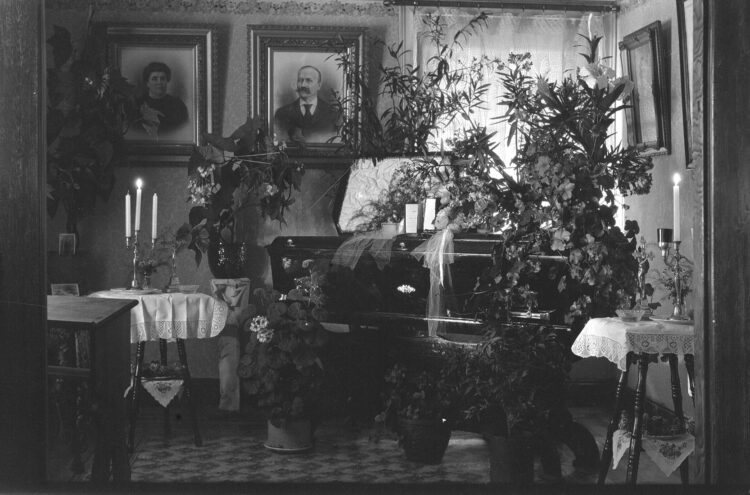
Although much older than his wife Marie Pelletier (he was 30 when they married; she was 17), Uldéric Dumont outlived his wife by a dozen years (she died in 1932). He is shown here in his coffin, displayed in the living room of his daughter Marie-Alice’s home and studio. As she had cared for her mother, the photographer also cared for her father until his death in 1945. The obituary that appeared in L’Action catholique on October 5, 1945, described Uldéric as follows: “A model farmer and pioneer, Mr. Dumont gave his family and fellow parishioners the example of a life filled with hard work. His piety edified all who knew him. […] after many years of hard work, he had achieved an honest standard of living, and he gave his family of 14 children a suitable education.”
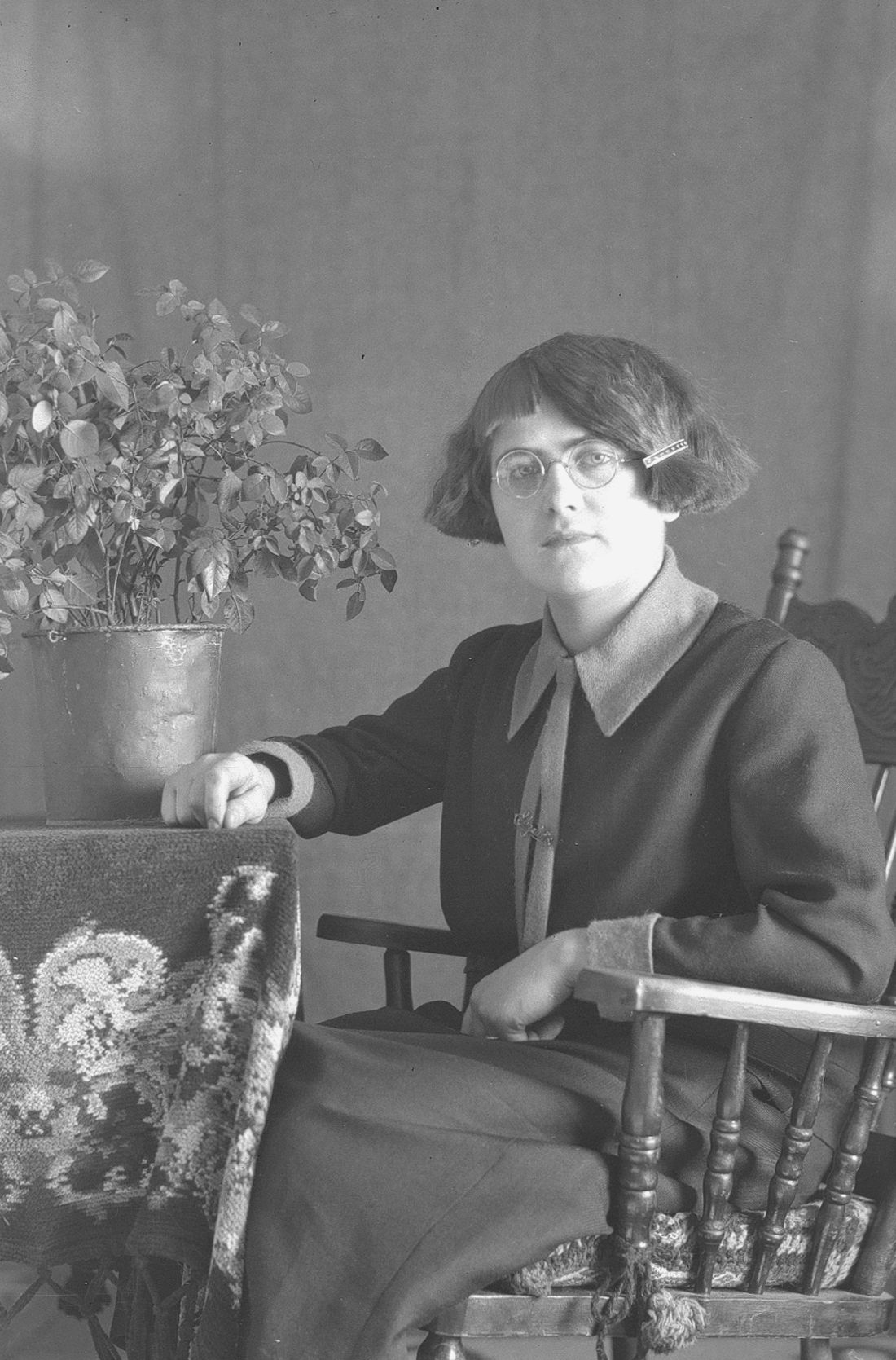
Elizabeth poses here in the rudimentary setting of the first studio set up by her sister Marie-Alice Dumont in the family home. She is around 15 years old.
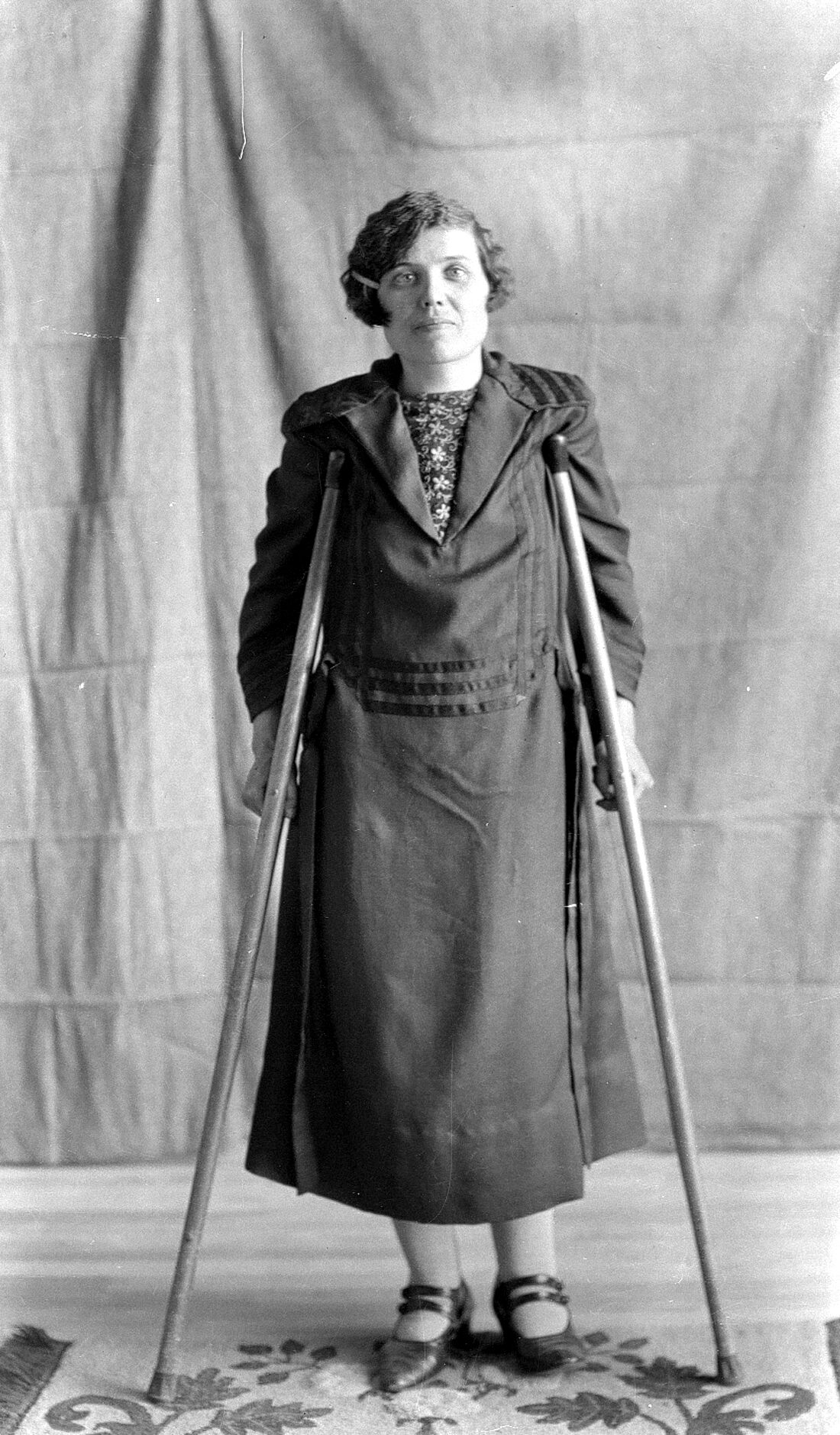
Marie-Louise, like many members of her family, gave Marie-Alice the opportunity to practise by posing for her in her first photo studio. Aged around 30 in this portrait, Marie-Louise is at a stage in her short life when she needs her crutches at all times.
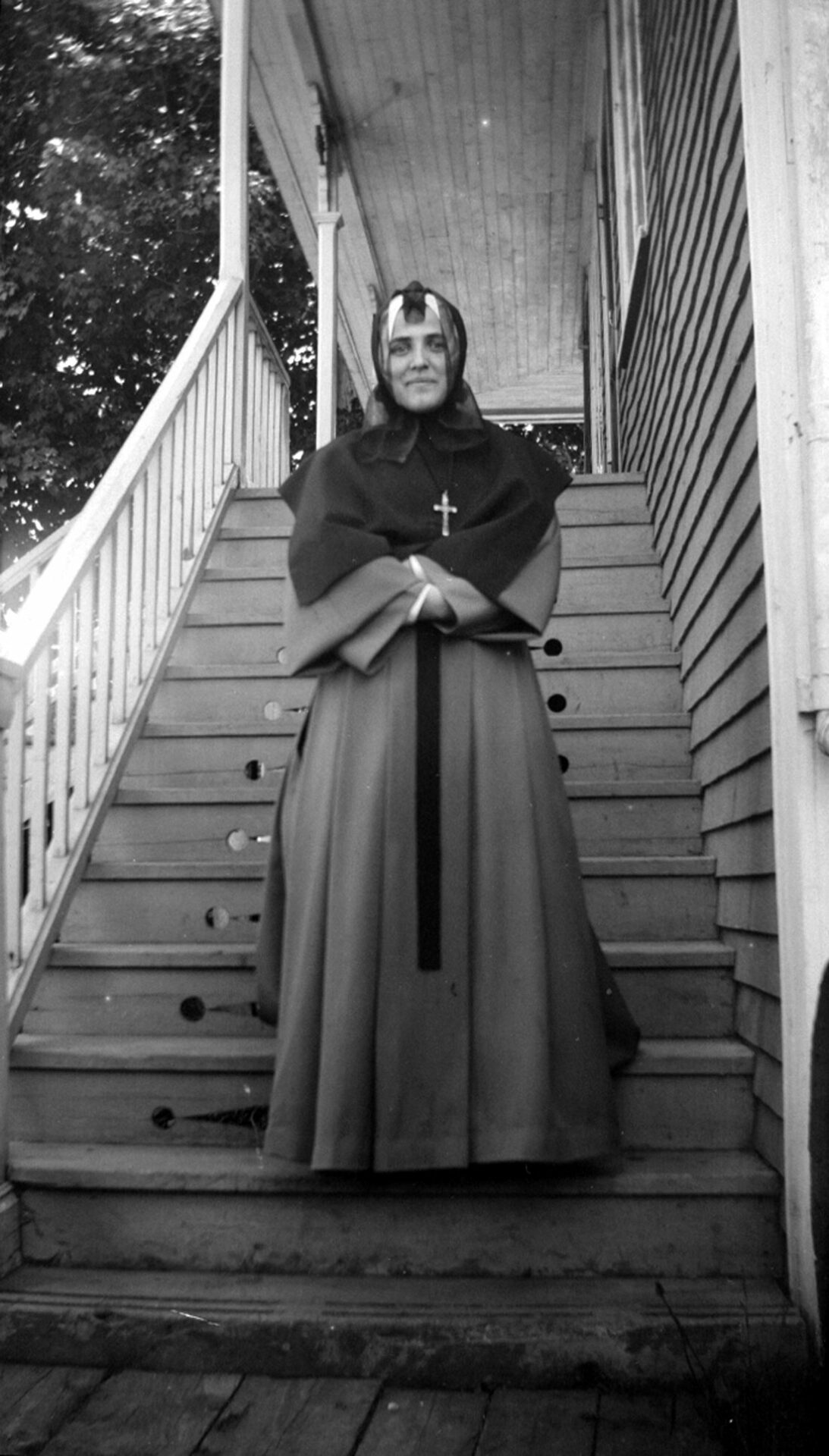
The youngest Dumont child poses here on the side staircase of her sister Marie-Alice’s home and studio. She is between 25 and 30 years old, and she had taken her vows as a Sister of Charity some 10 years earlier. In a letter dated May 21, 1928, at the age of 18 or 19, Berthe wrote to her parents with great emotion that she would be taking her perpetual vows on July 16. After all the “sacrifices” she and her parents had had to make to “reach this point,” she was delighted to finally become “the Bride of the great God we adore.” She wrote that she had no regrets, and that she had “freely and willingly” decided to devote her life “to Our Lord.”
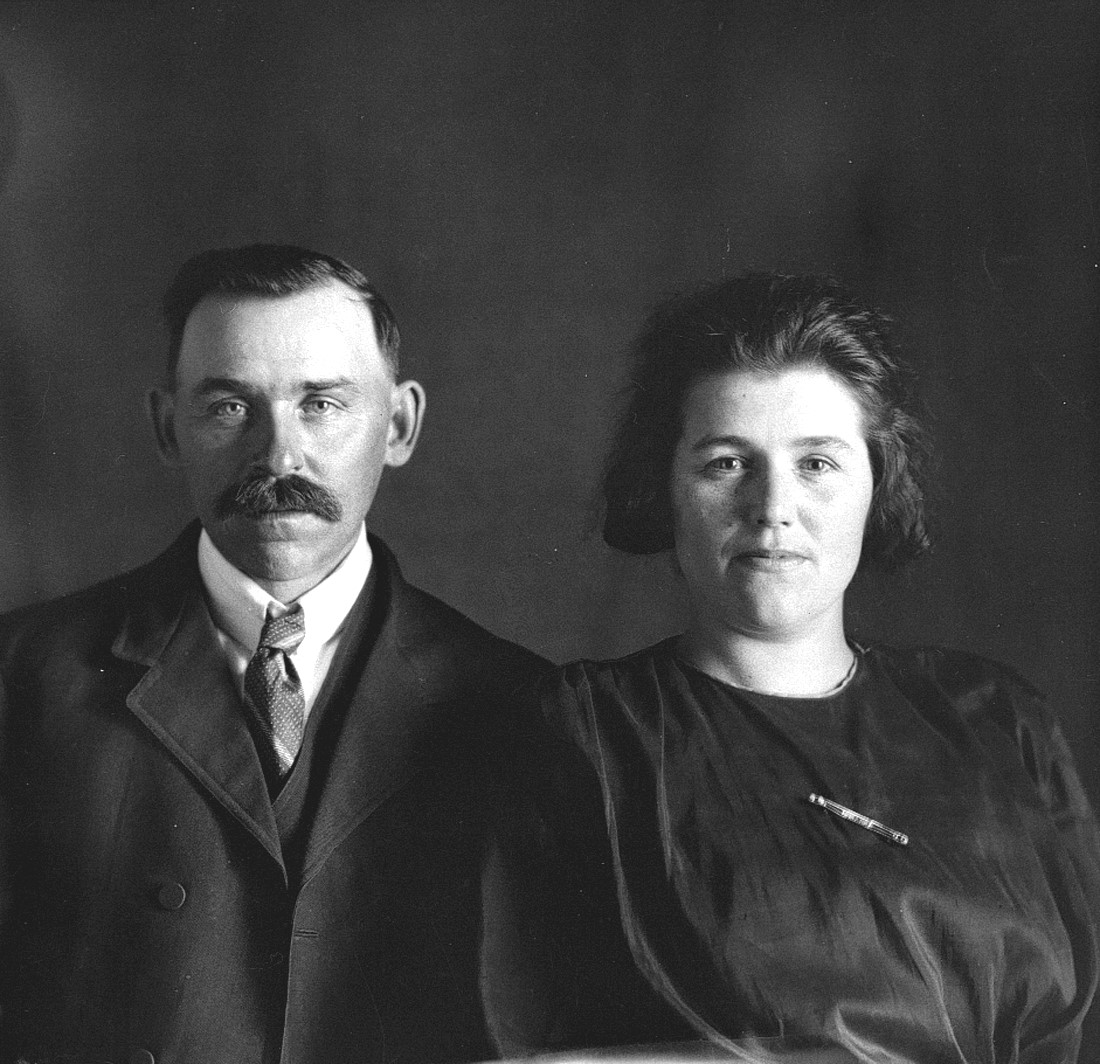
Émilia, the Dumont family’s eldest daughter and second-born after François, married Flavius Ouellet (1878–1961) in 1906, when she was 18 and he was 27. When this portrait was taken in Marie-Alice Dumont’s first small studio, they were aged around 40 and 50, respectively. They had been married for almost 20 years and already had 12 children together… with three more to come!
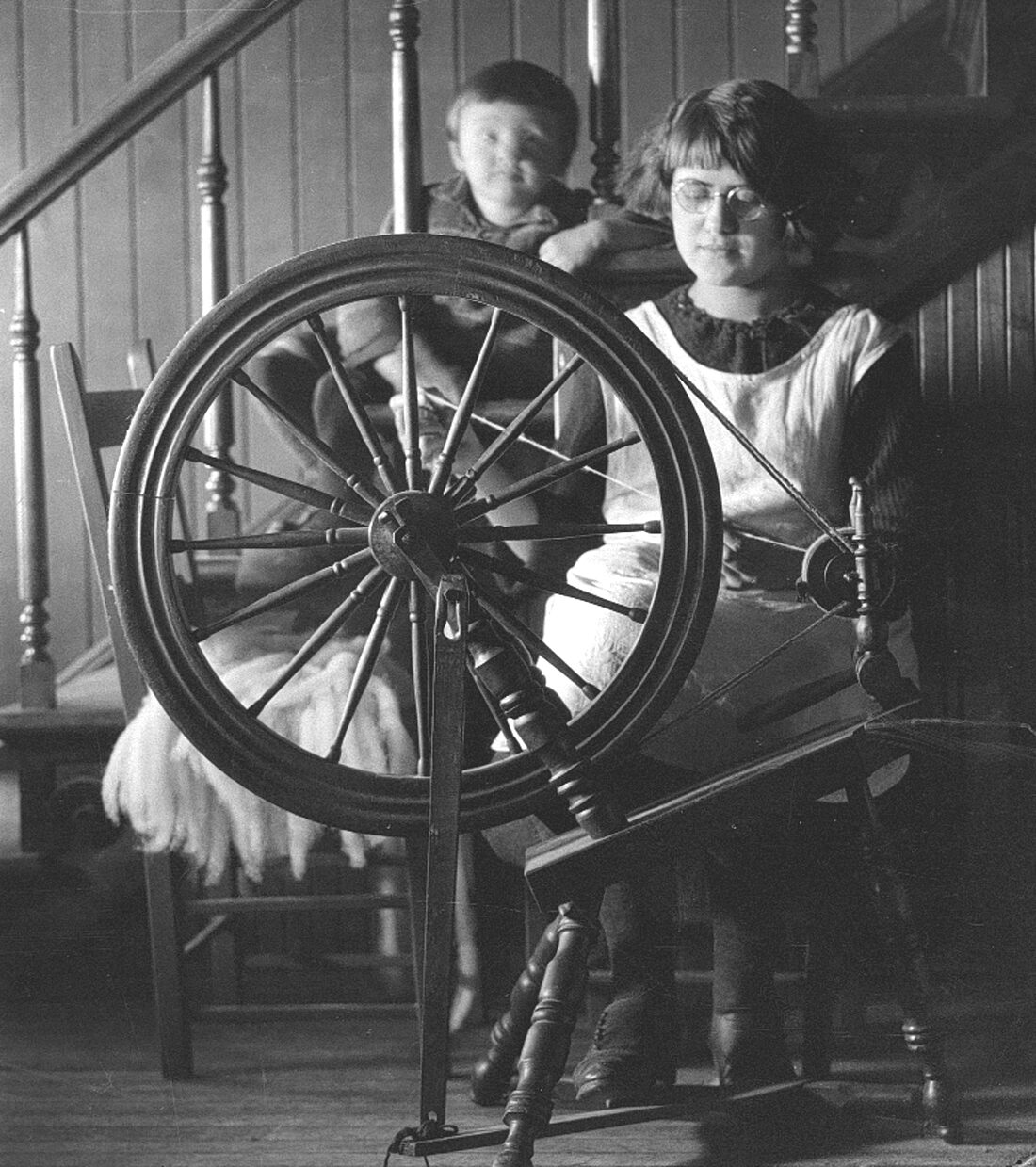
In this portrait of Elizabeth aged around 18, we see that she is able to use the spinning wheel, and therefore could contribute to making clothing. This was a crucial skill for large farming families in the early 20th century, many of whom had to be resourceful and thrifty. The Dumonts’ mother, Marie, was a gifted craftswoman, and, as we can see from portraits like this one, she probably passed on much of her know-how to her daughters.
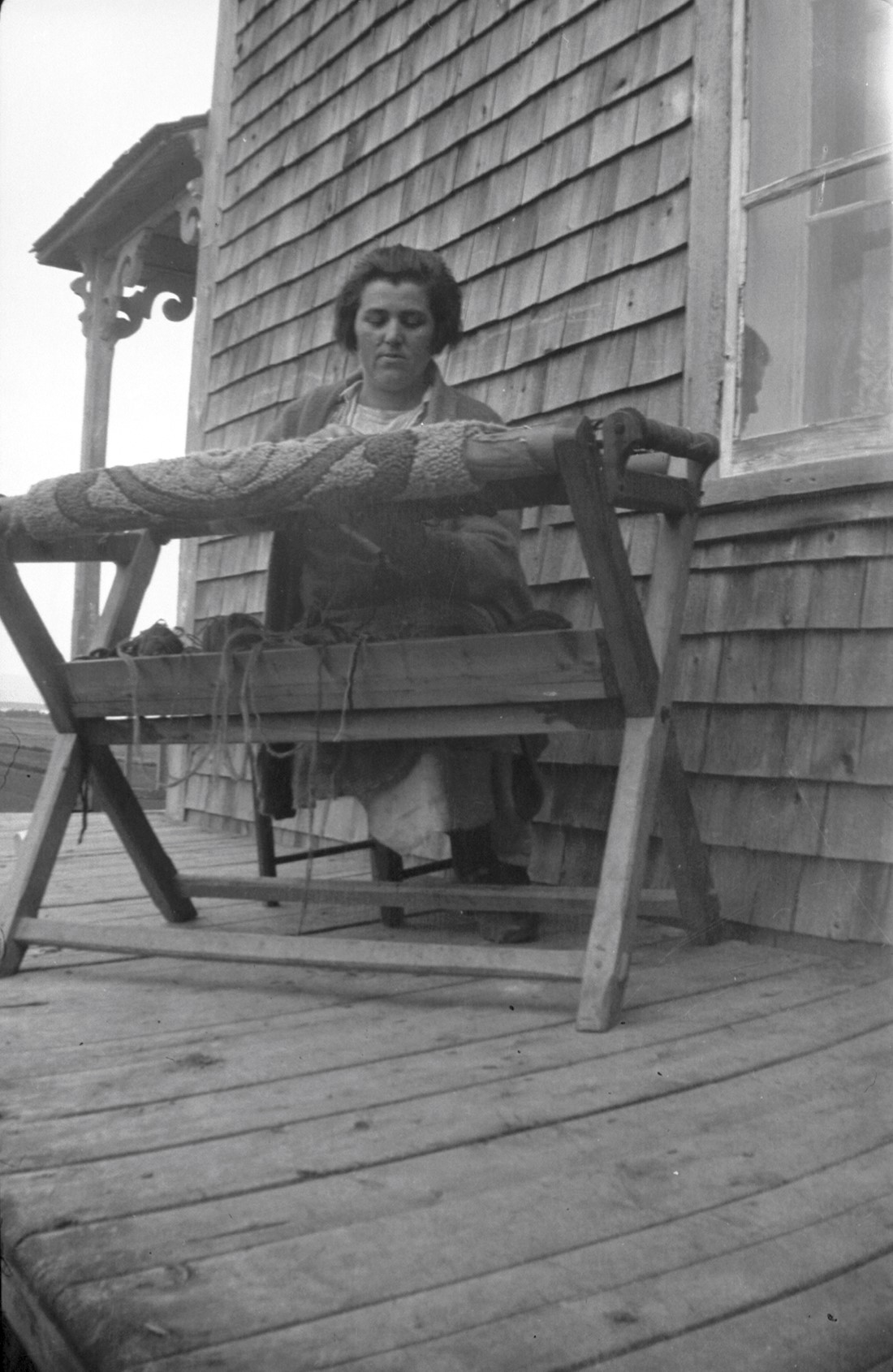
In this candid-like portrait, Émilia Dumont is busy hooking a rug. She is comfortably installed on the porch of her home on the Île aux Patins. Marie-Alice Dumont probably took the photo during one of her vacations on the island.
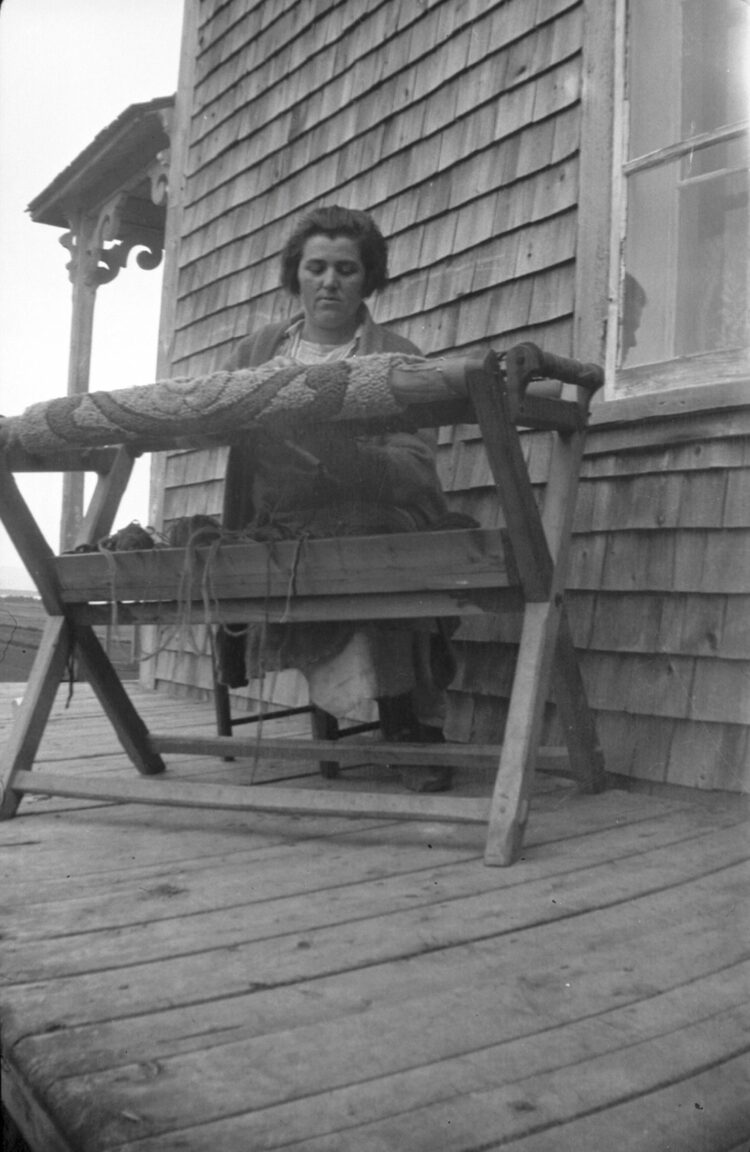
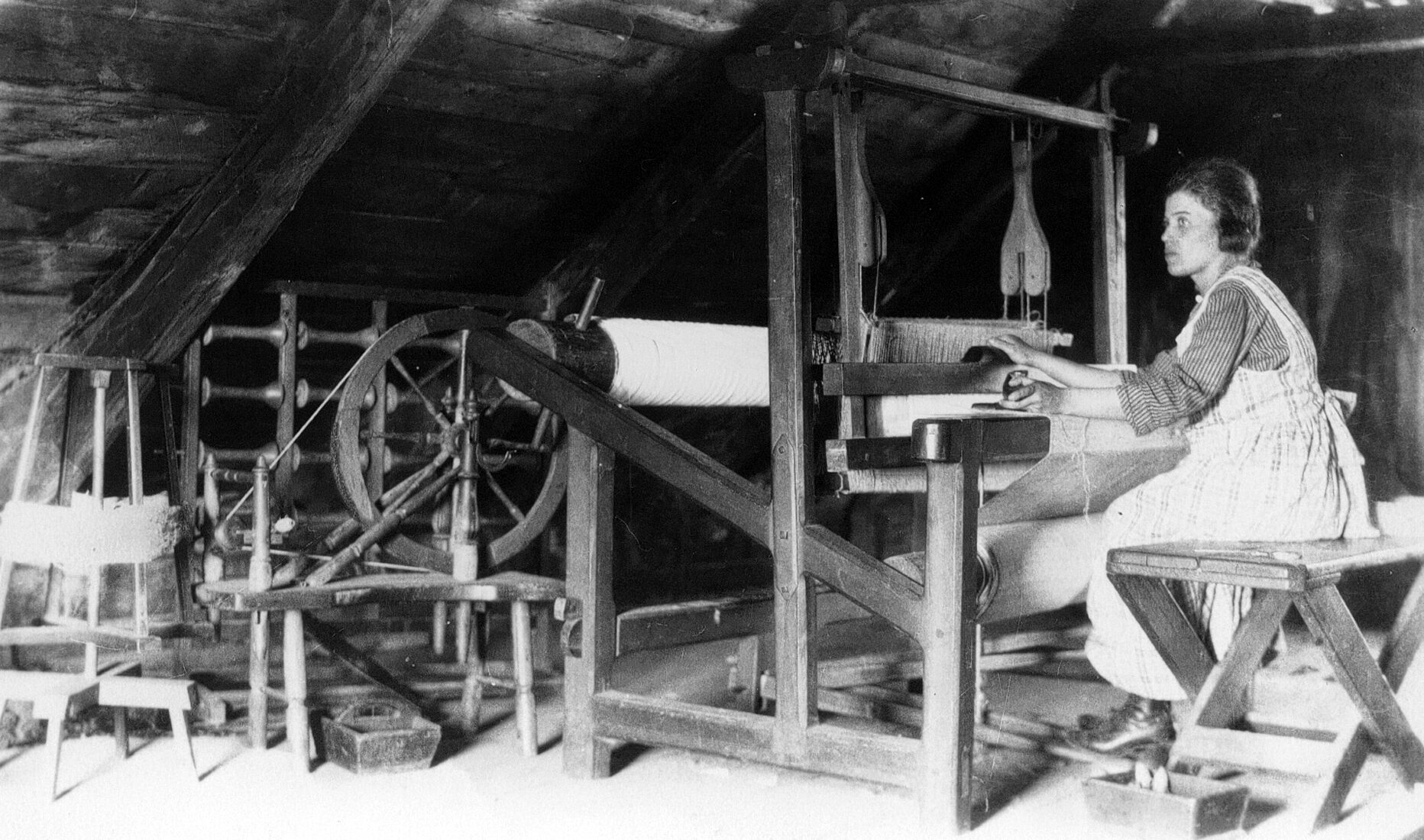
After Elizabeth at the spinning wheel and Émilia hooking a rug, here is Marie-Louise at the loom. And, of course, there are many similar portraits of their mother! Marie-Alice Dumont paid a great deal of attention to the women of the family and their technical skills.
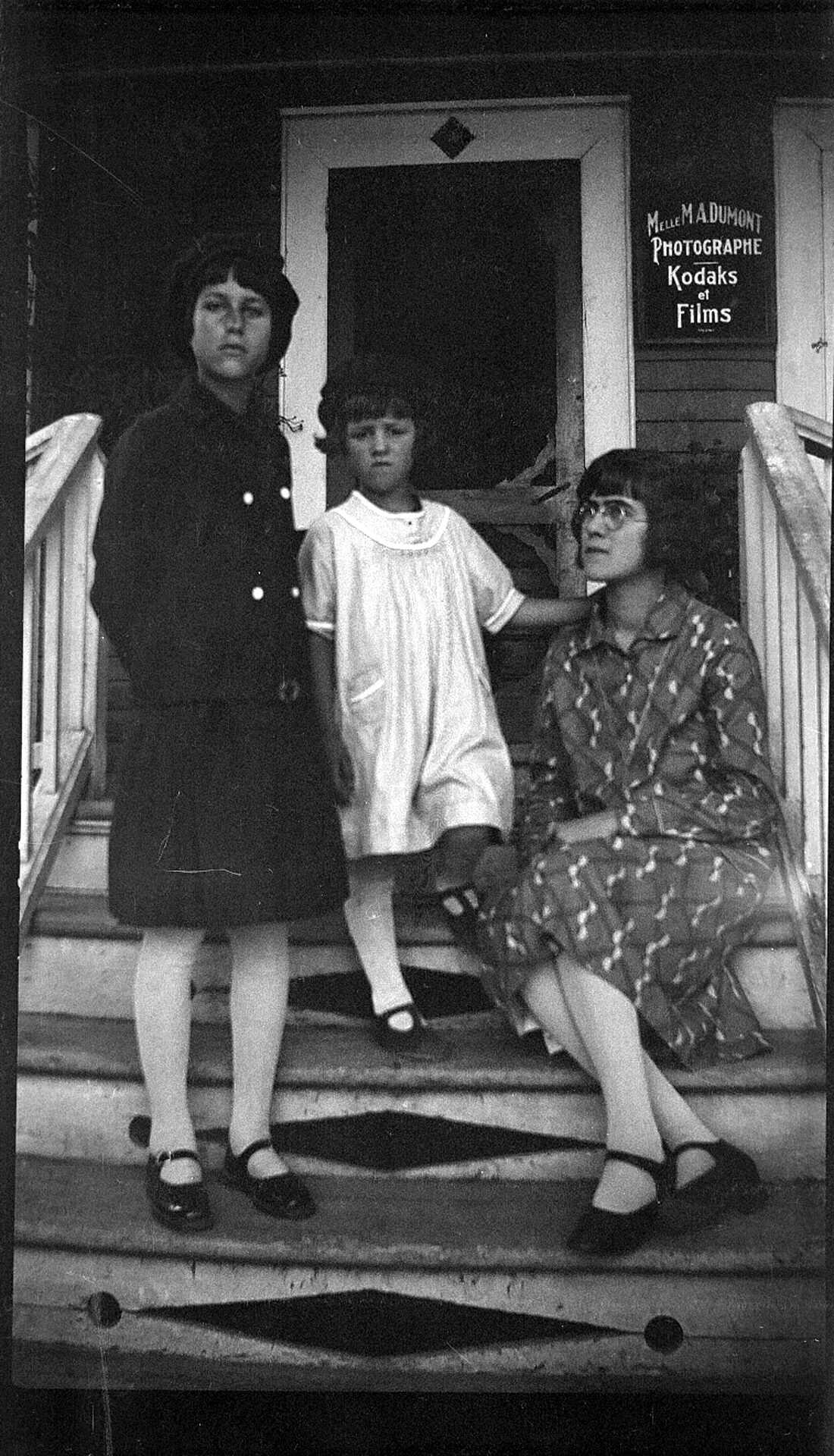
Among the three girls posed here on the porch of the Dumont house is Elizabeth, far right, wearing glasses. She was already acting as an assistant to her older sister, as Marie-Alice had just recently opened her studio in the family home. The studio sign is clearly visible in this portrait.
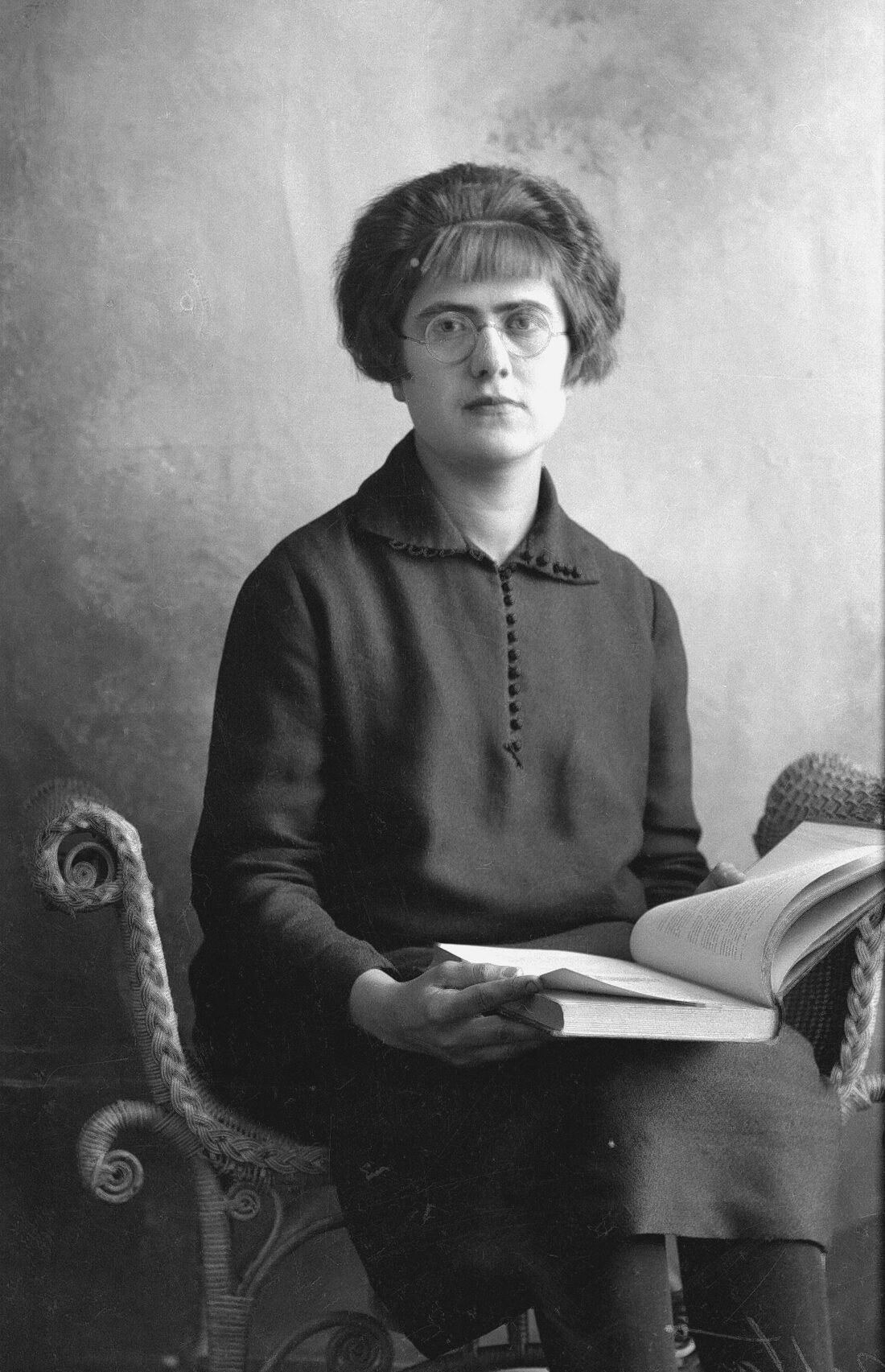
The title of this portrait of Elizabeth reveals what was probably her family nickname: Zelta. She is posing once again for her sister, who recently set up her studio in the village of Saint-Alexandre. Zelta, fashionably dressed, takes on a confident air and looks directly at the lens. In keeping with the staging often adopted by women in Dumont’s studio, she pretends to be interrupted while reading a book.
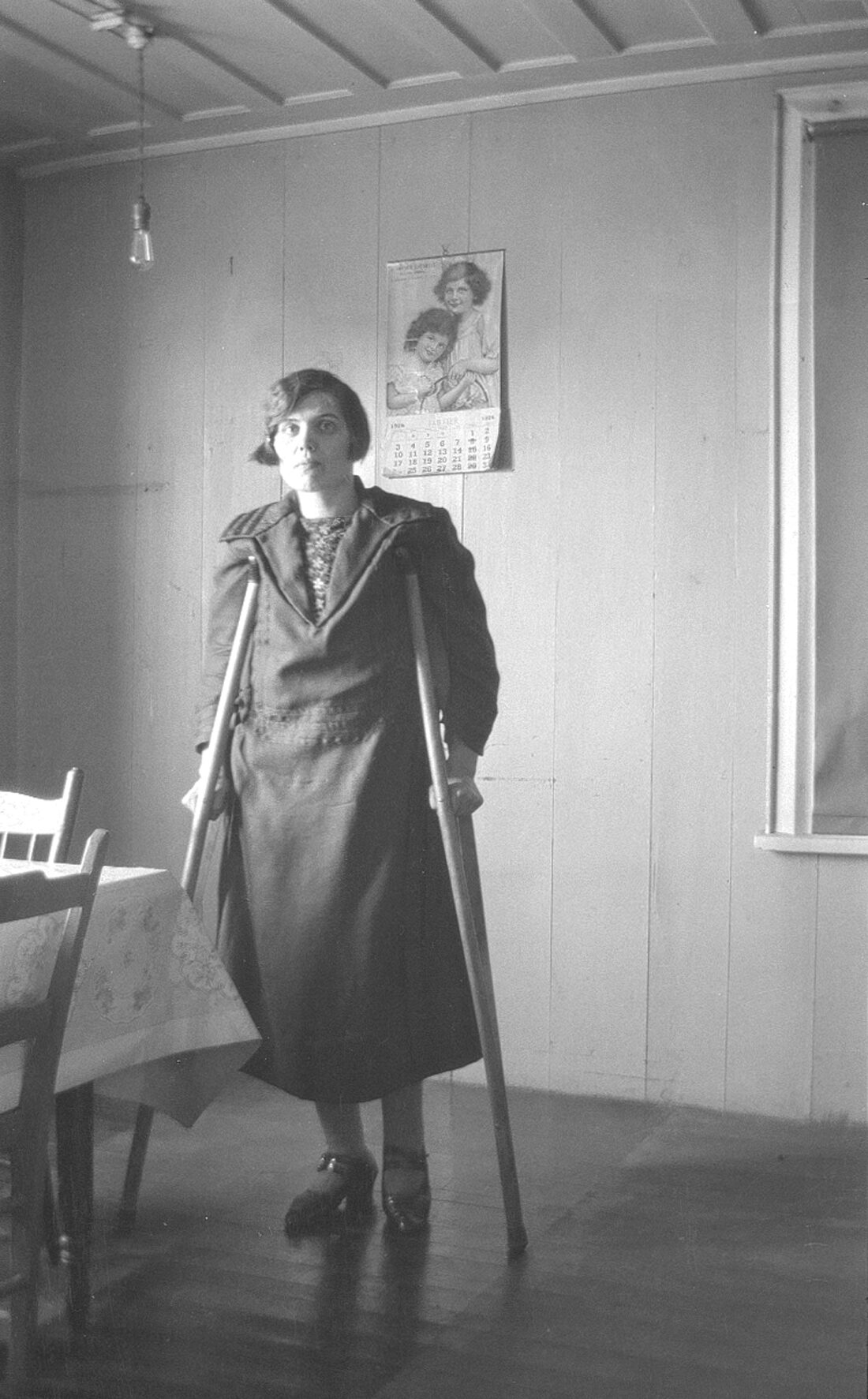
According to Daria Dumont, Marie-Louise suffered a fall at the age of one, which caused health problems for the rest of her life. She is often photographed with crutches, as in this portrait taken in a kitchen; one of the most touching photographs by Marie-Alice Dumont. Despite the challenges, Marie-Louise worked as a schoolteacher in the Saint-Alexandre district for 10 years. It probably took great strength of character to achieve this.
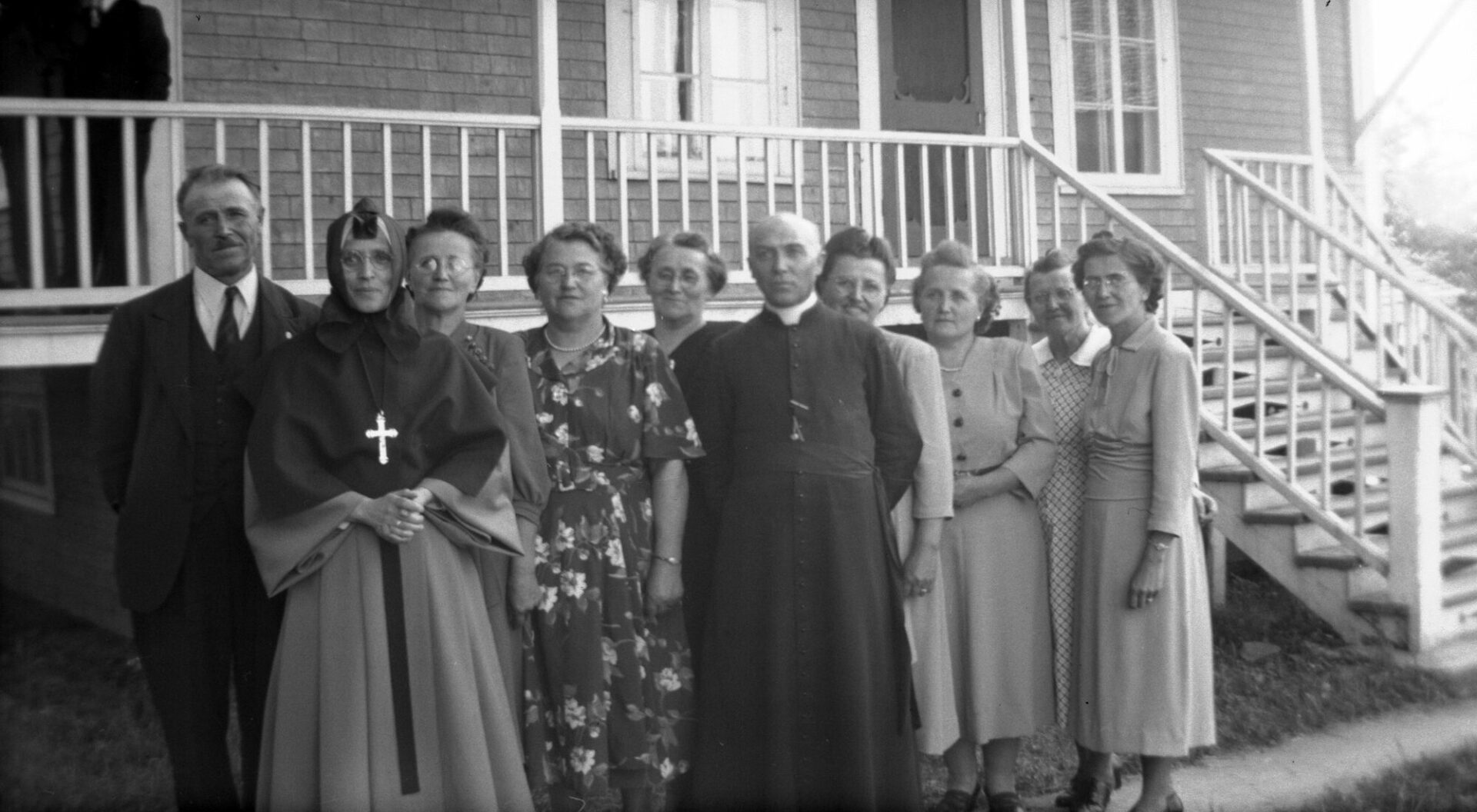
Here, the Dumont siblings are gathered in front of what appears to be the home of the eldest, François, on the 5e Rang in Saint-Alexandre. What is the occasion? Perhaps a visit from Berthe (Sister Sainte-Marie-Anne), who was rarely able to visit her relatives during her life as a nun. From left to right, we can see François, Berthe, Albertine, Émilia, Anna, Joseph-Napoléon, Marie-Claire, Marie-Jeanne, Marie-Alice and Elizabeth. Missing are Marie-Louise, who had died over 20 years prior, and Gabrielle.
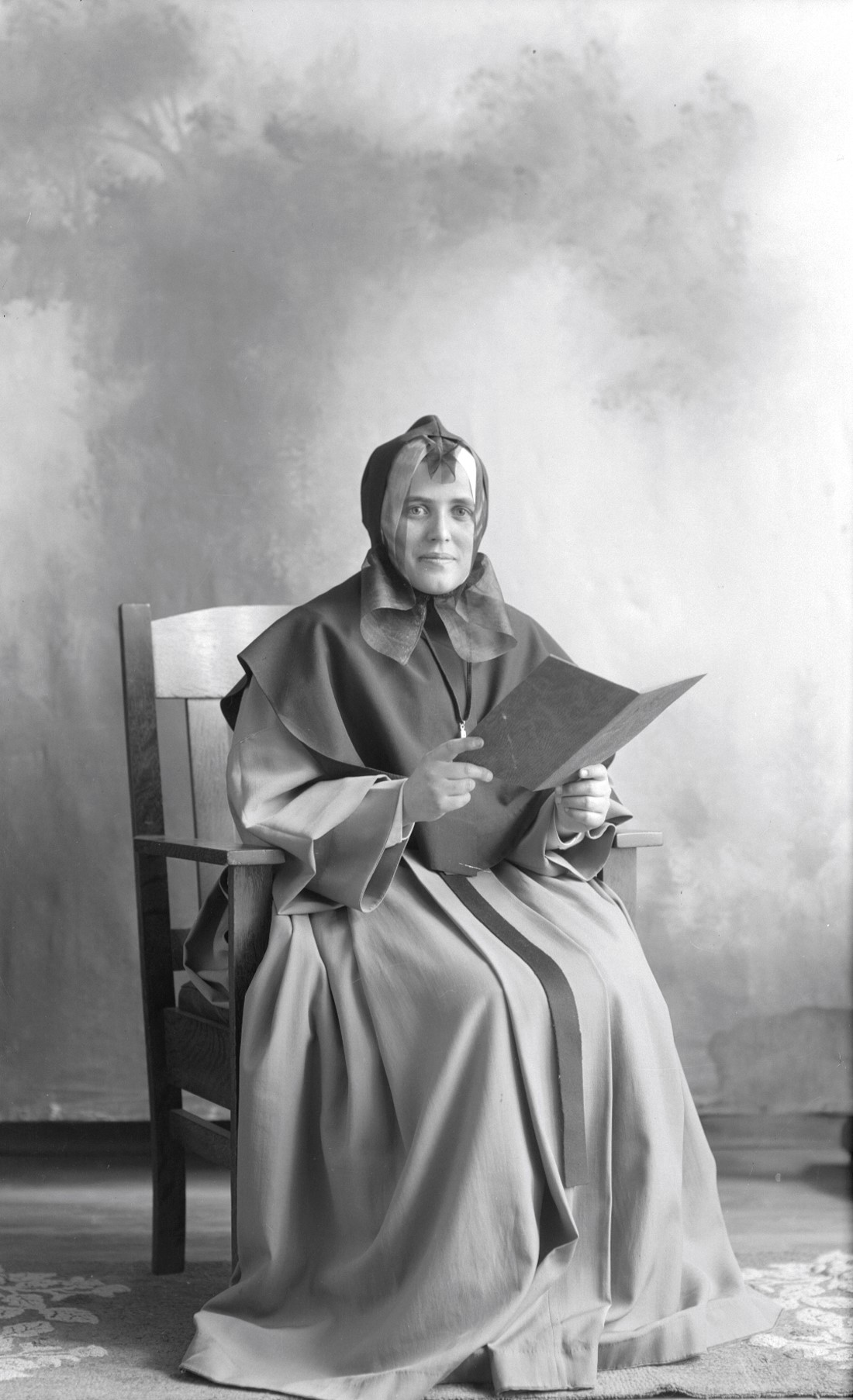
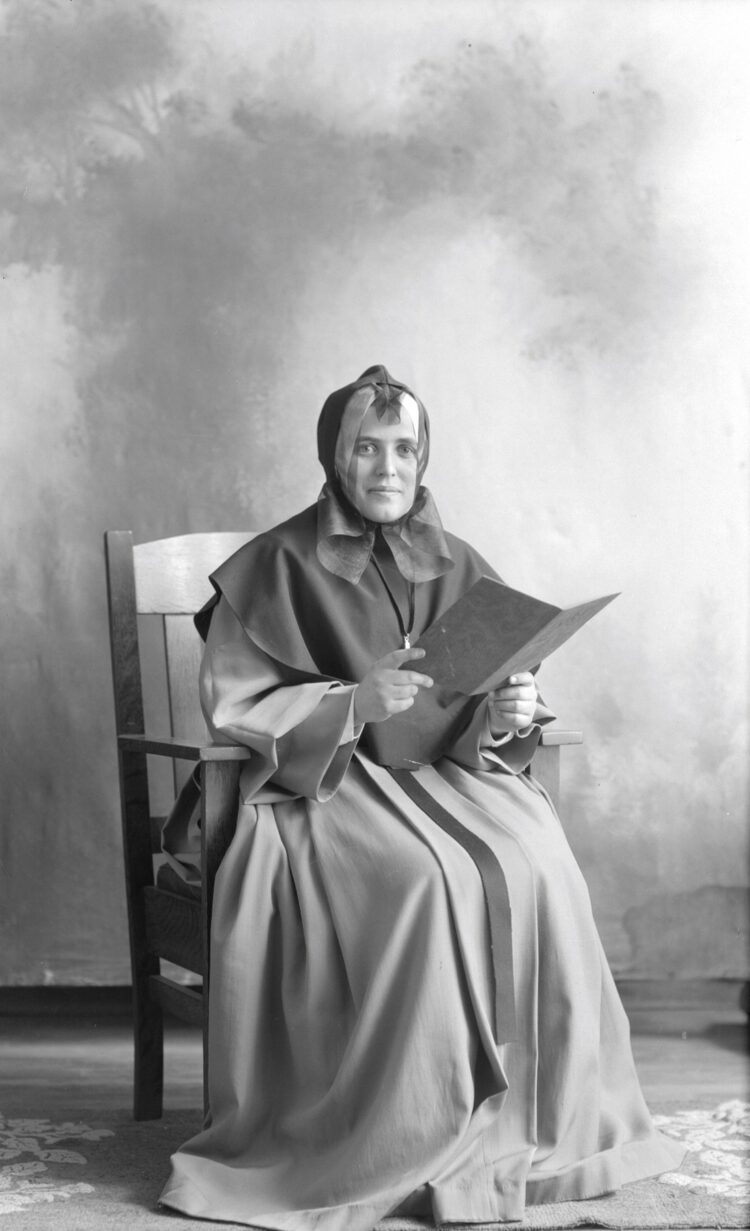
This is another portrait of Berthe, the youngest of the Dumont siblings, between the ages of 25 and 30. In her nun’s garb, she is posing this time in her sister’s photography studio during one of her rare visits. After entering the convent at the age of 17, Berthe saw very little of her family. She spent most of her time teaching at the Sisters of Charity convent at the Saint-Alphonse de Thetford church. She sometimes complained about this in her letters to her parents.
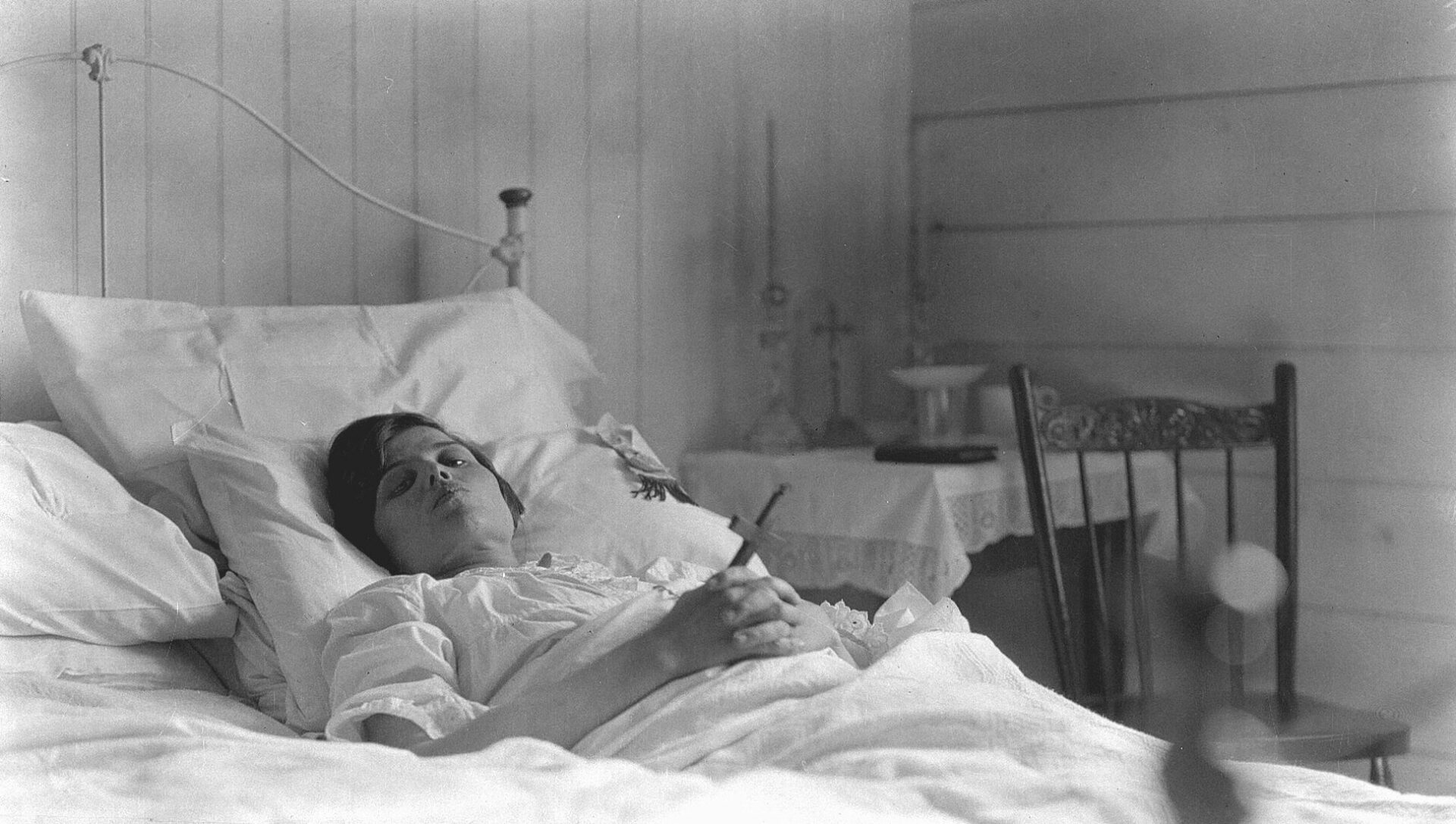
Marie-Louise Dumont did not have an easy life, especially during her final months, when she was bedridden and unable to move. As she would do five years later for her mother, Marie-Alice Dumont photographed her younger sister in bed, dying, cross in hand. Marie-Louise died “piously” on August 8, aged 31 years and 10 months, as reported by Le Peuple, a Montmagny newspaper. A “large crowd of friends and family” attended her funeral on August 12.
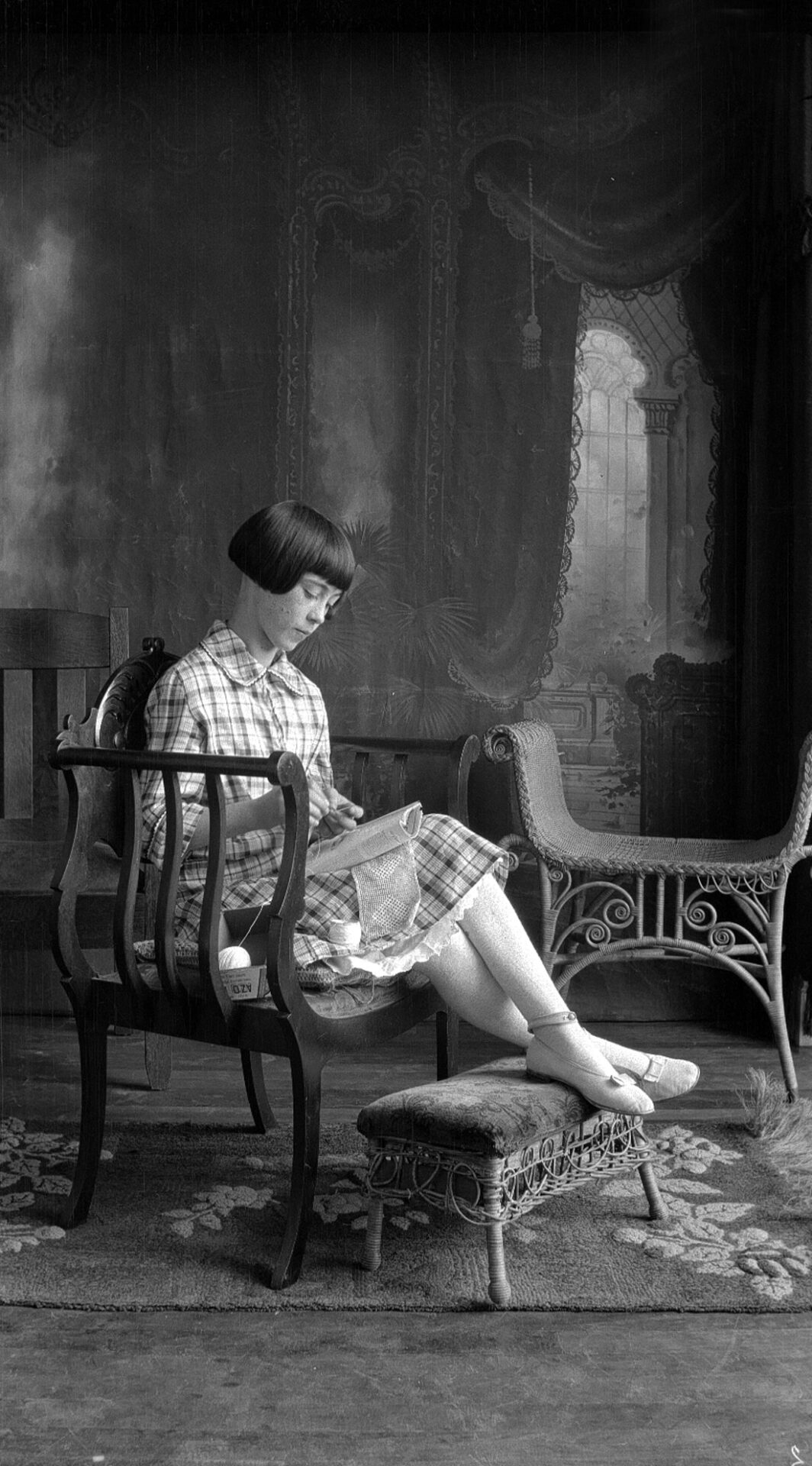
Rosalie Bergeron joined the Dumont family in 1928, at the age of 11. She would stay until just after she got married in April 1945, at the age of 29. Her teenage years and first experiences of adulthood were therefore spent with Marie-Alice Dumont. Here she is between 12 and 15 years old. The portrait shows her practising embroidery, a craft learned by many young girls in those days. Dumont’s staging is rather serious. Rosalie looks diligent and focused. She is not looking at the camera, but at her hands or the instruction manual on her lap. Although the portrait was taken in a studio, it is meant to appear authentic and natural. It also suggests a false spontaneity, as if the photographer were saying, “See this young girl at work? This is part of her daily routine. She will soon be an adult and a responsible woman.” This portrait symbolizes the Dumont family’s acceptance of Rosalie after her difficult childhood.
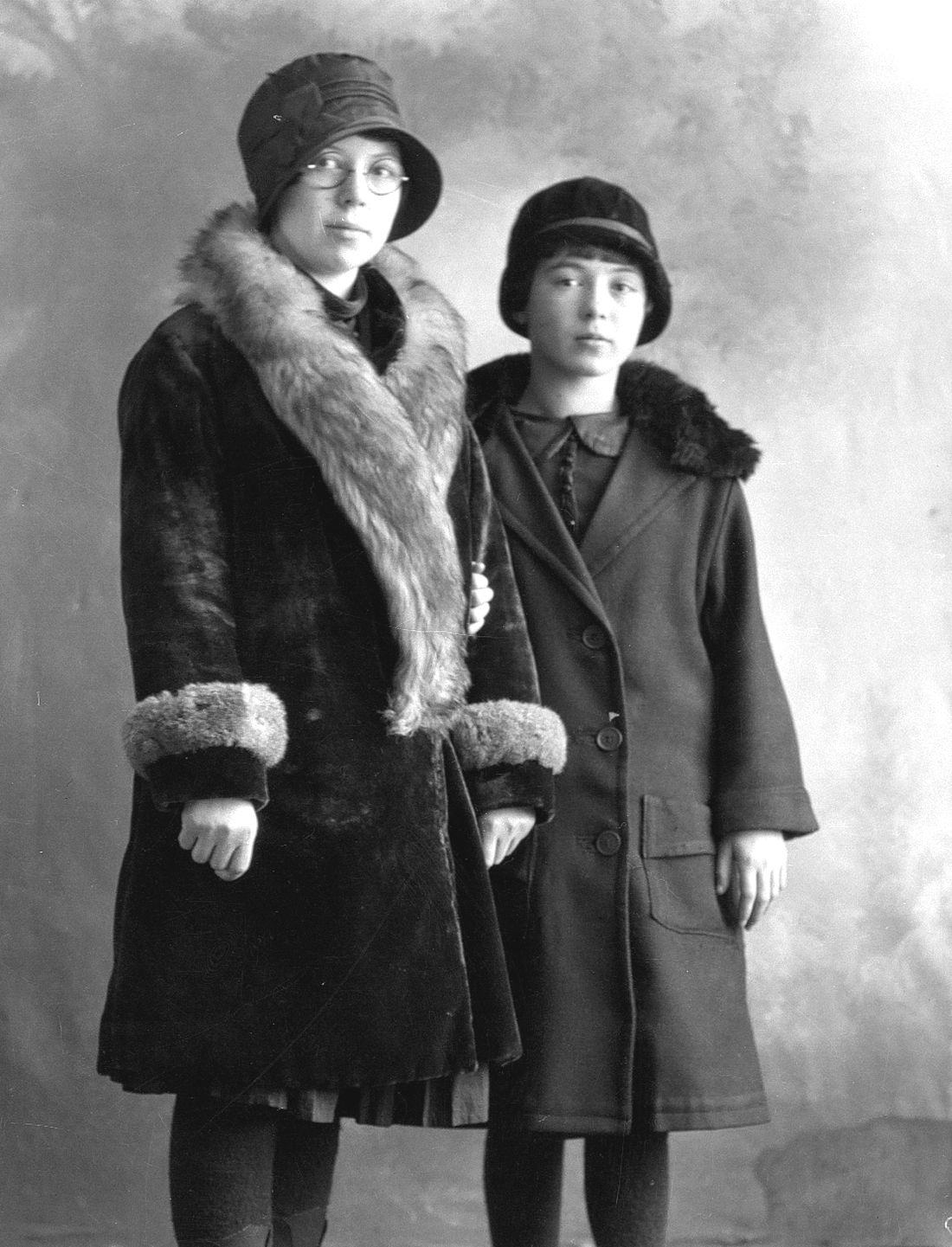
In January 1928, Joseph-Napoléon went to Lotbinière to collect Rosalie (right) and her older sister Marguerite (left). Much to Napoleon’s surprise, the girls had no winter clothes; Rosalie was dressed in cotton garments full of holes. It would have been impossible to make the journey by train and horse-drawn cart, in strong winds and in temperatures of -20 °C, dressed like that. Napoléon lent the two girls his coats and heavy woollen stockings, and all three endured the icy journey as best they could. In this portrait, one of the first that Marie-Alice took of the Bergeron sisters, Rosalie and Marguerite are dressed quite differently. They wear warm, fashionable winter coats trimmed with fur, which was a luxury. What a change! A far cry from the “poor rags” they arrived in, as Napoléon wrote. It is clear that the Dumont family quickly changed Rosalie’s life.
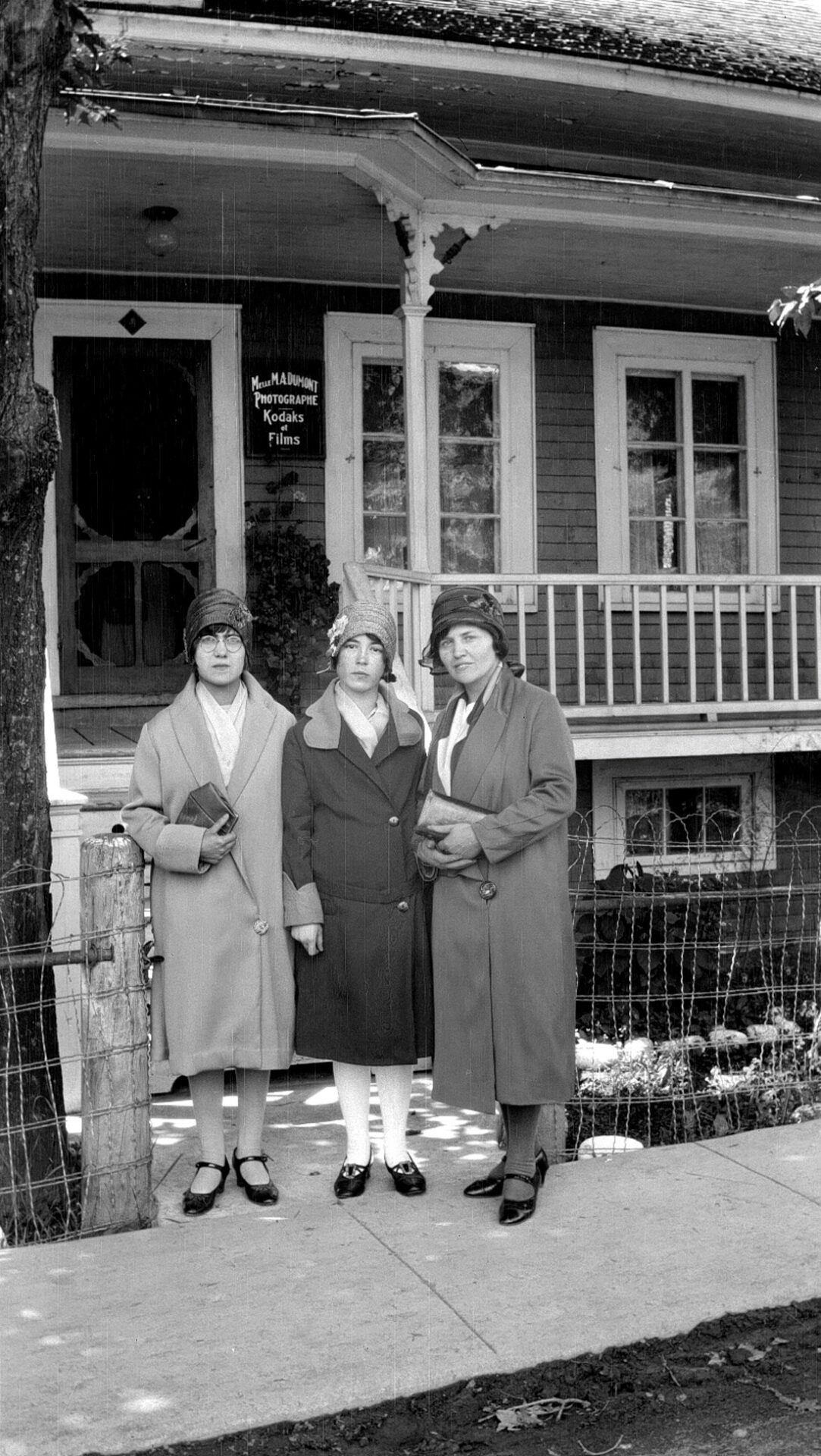
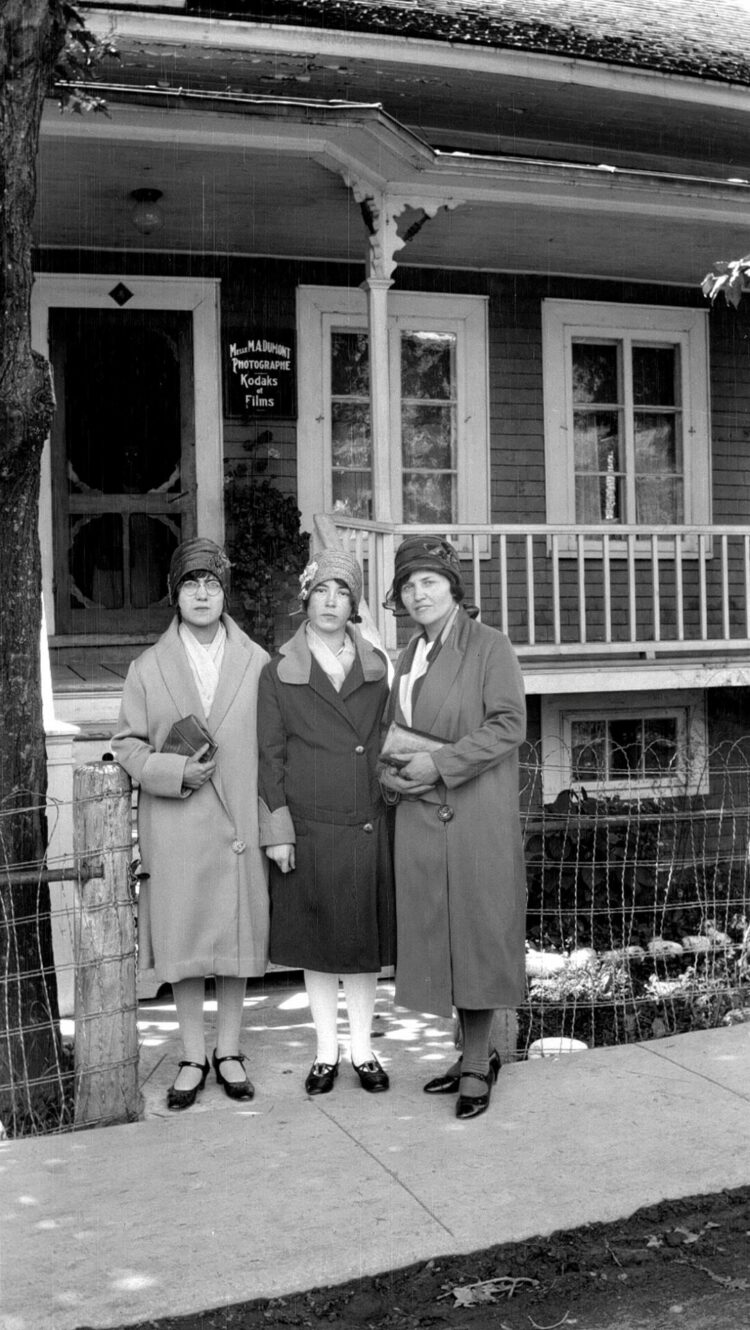
Rosalie soon settled into “her new home,” wrote Napoléon. After her first year at Saint-Alexandre, Uldéric and Marie were very attached to Rosalie and decided to officially adopt her. She took the opportunity to change her name. Her parents had named her Rosalia at birth, but everyone in the Dumont household called her Rosalie. According to Napoléon, she “was happy and loveable.” She became particularly fond of Marie-Alice and Elizabeth. Still in their teens, Rosalie and Elizabeth stayed with the photographer and helped her with her studio work. The three seemed to form a close-knit trio. All three are pictured here, in front of the home and studio.
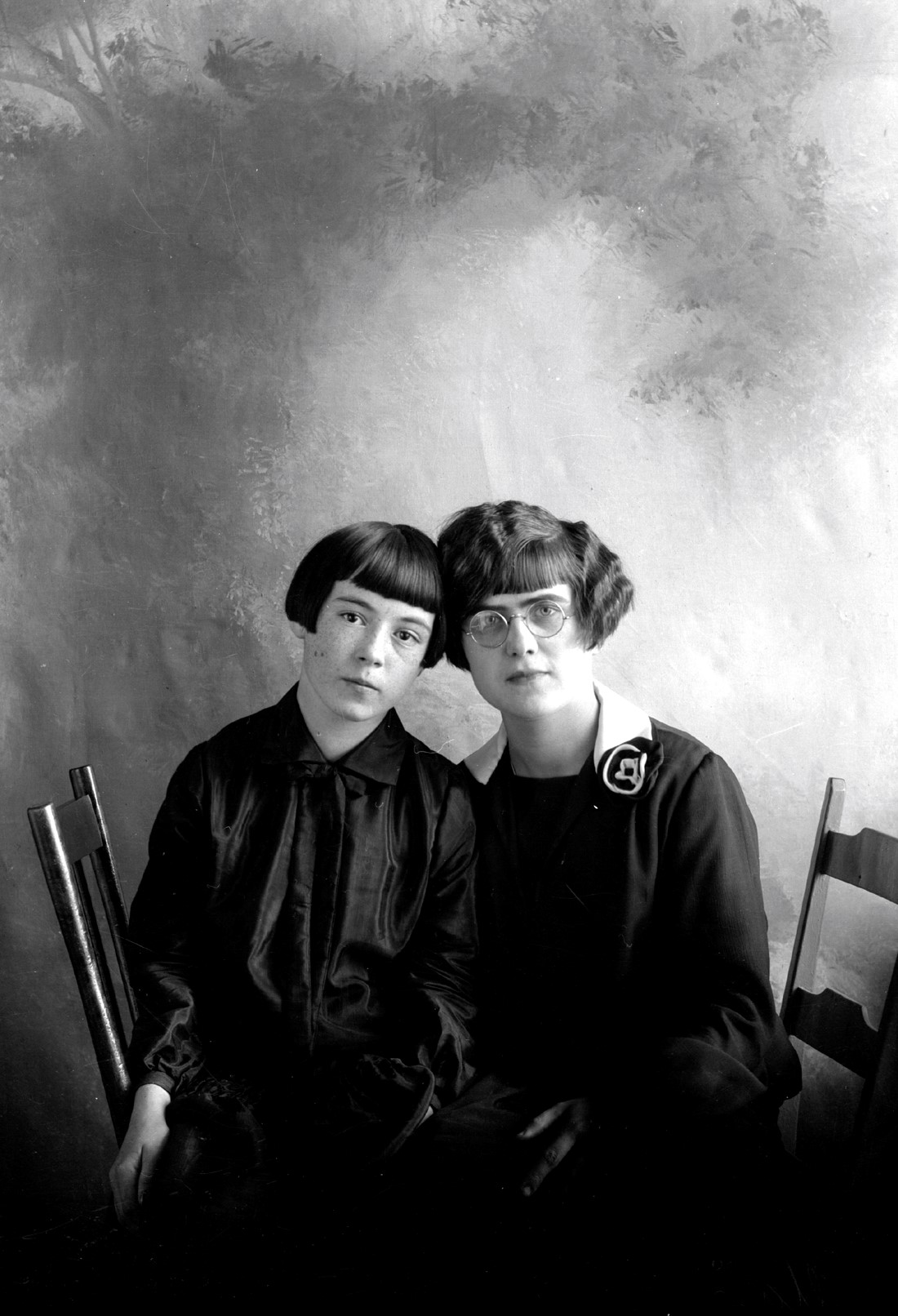
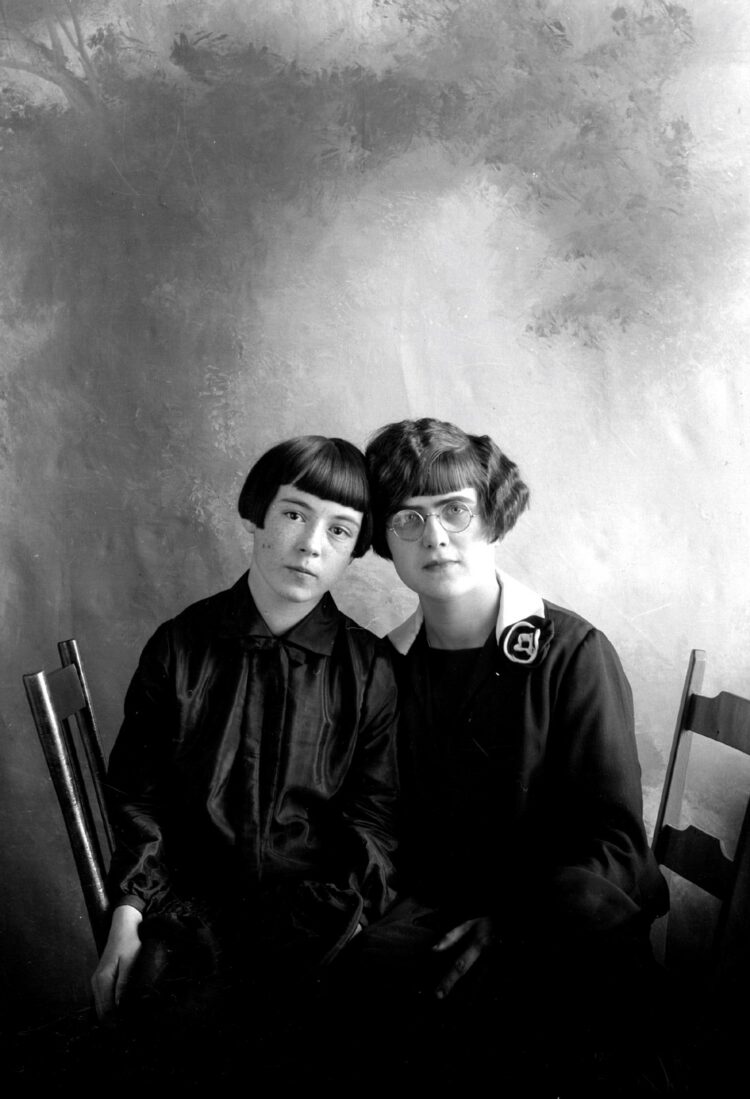
In this portrait, we can see the strong bond between Rosalie (left) and Elizabeth (right). Rosalie is about 12, and Elizabeth, about 15. The composition of the photo emphasizes the closeness of the two subjects: their heads are leaning against each other, their bodies are touching and their chairs are placed opposite one another. The shadow effect at the bottom of the image, combined with their dark clothing, contrasts with the glow that bathes the two faces. It is unlikely that the photographer retained all these details in the print, but the final portrait would surely give a sense of softness and tenderness.
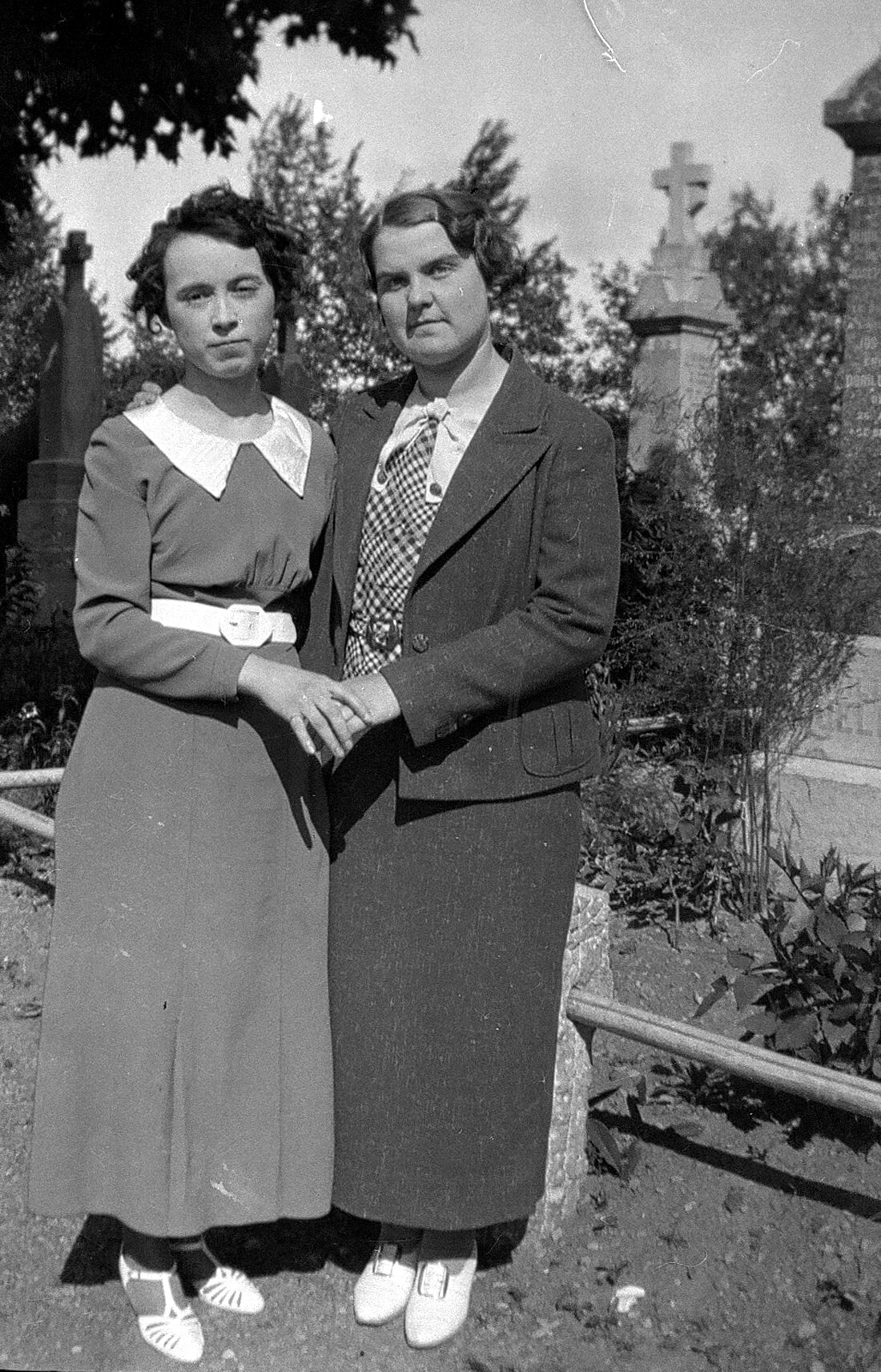
When she arrived in Saint-Alexandre, Rosalie attended the local convent school. Here, nuns prepared young girls like her for adult life. At school, Rosalie met Blanche Landry (right), who became her best friend. The difficulties they experienced as children seemed to bring them so close that they felt like sisters. They were inseparable and saw each other almost every day. They are about 18 to 20 years old in this photo.
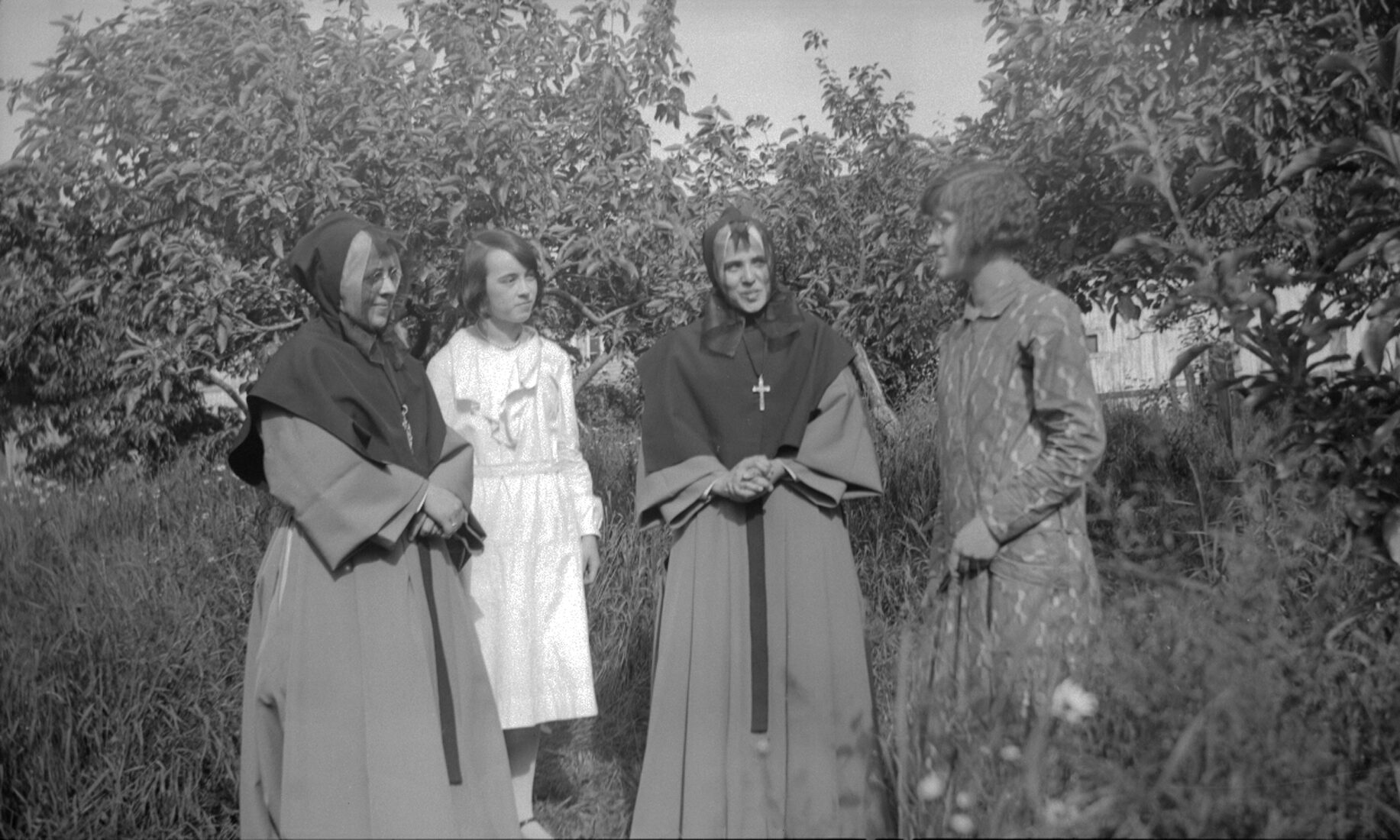
In this photo, taken in Marie-Alice Dumont’s orchard, Rosalie Bergeron appears with two nuns. Rosalie seems very interested in what they are doing. On February 14, 1934, at the tender age of 18, Rosalie entered the postulancy of the Sœurs dominicaines de l’Enfant-Jésus in Québec City, becoming a religious apprentice. But not everything goes according to plan. As it happened, Rosalie was not serious-minded enough to become a nun. A funny anecdote illustrates this very well: One day, Rosalie emptied the contents of a washbasin over the head of the Mother Superior, who annoyed her. In November, she returned to Saint-Alexandre, convinced that she did not have a religious calling after all.
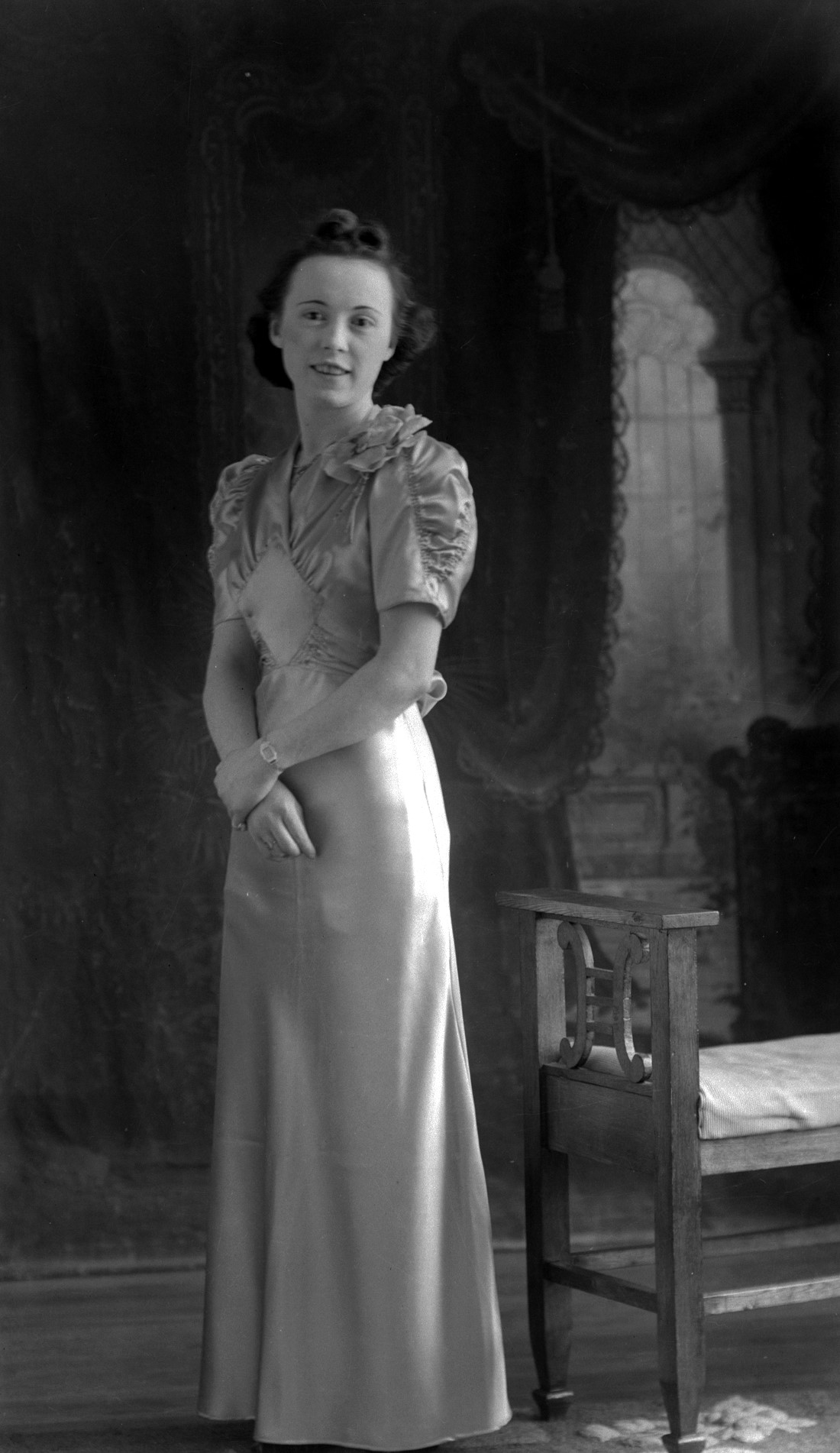
On her return from the Dominican postulancy in November 1934, Rosalie was very “happy to get back to the old routines,” wrote Napoléon. This was good news for the Dumont family, too: Rosalie was determined, clean and tidy, and a good cook. It was not just Marie-Alice who was grateful for her help in the studio; everyone appreciated her spirit of hard work. This portrait is one of the first of Rosalie once she was firmly out of childhood and adolescence. Here, she is around 20 years old. Her makeup and hair are elegantly done, and she is wearing a more adult-style dress (it is fitted but still covers her legs). Although high school proms did not exist in Rosalie’s day, you would almost think that was where she was going! Here, Rosalie looks directly at the lens. This is in stark contrast to the portrait showing her embroidering. Altogether, the image is much more formal and conventional. Once again, Marie-Alice Dumont’s camera immortalizes a new stage in Rosalie’s life.
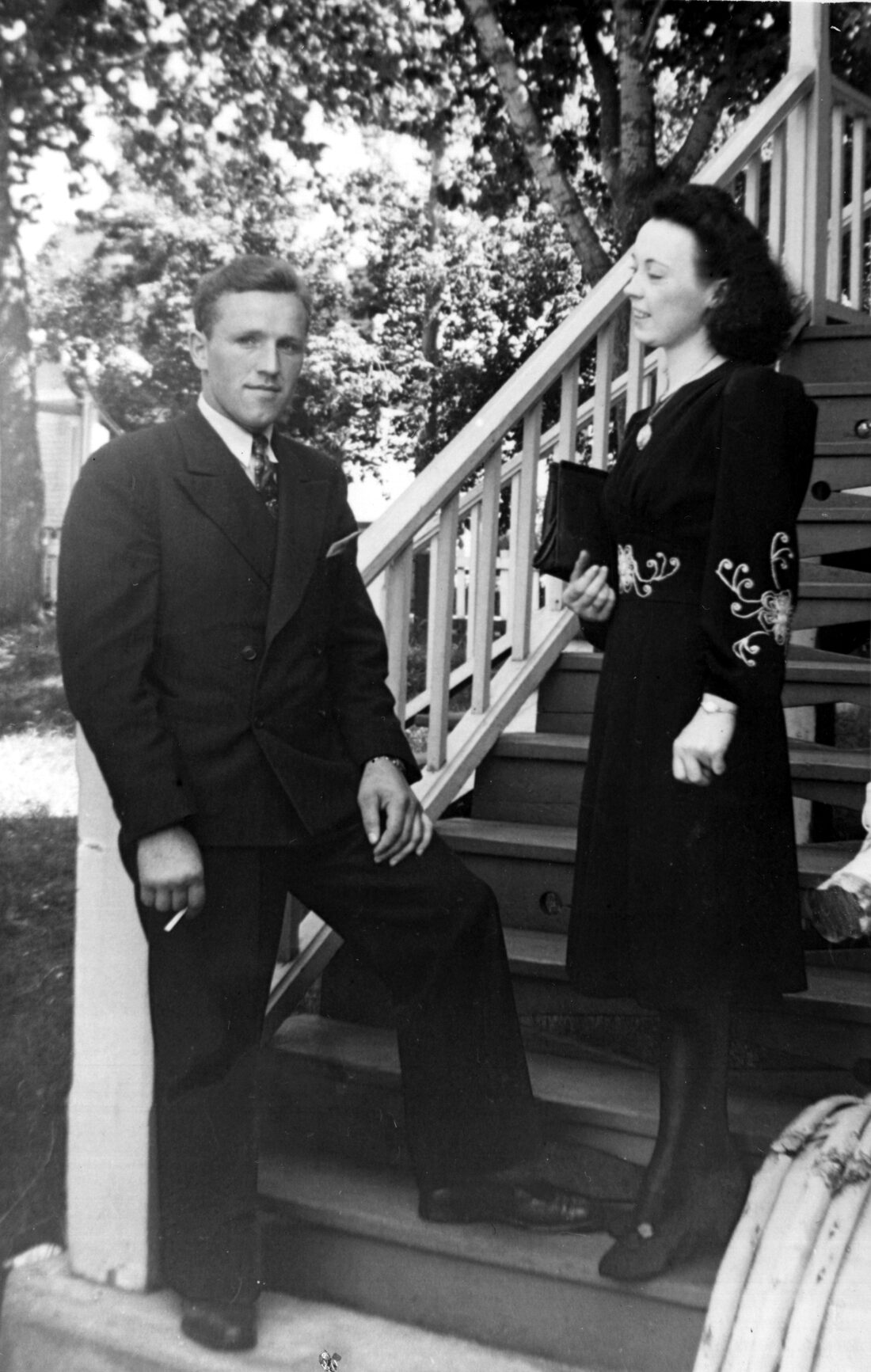
Young Rosalie Bergeron seems to have been a sought-after woman in the village. In this portrait, we see her at around 25, with Camille Soucy, who may have been her first boyfriend. Tall, smart in his suit and tie, relaxed, cigarette in hand and gazing into the camera, he is undoubtedly the star of this photo. Rosalie, who looks at him with interest and perhaps a little admiration, also looks very elegant. Are they dressed up for an outing somewhere? On the same day, the couple poses in the orchard, looking into each other’s eyes. Rosalie seems to have been very affected by this short-lived relationship, and she kept this photo in a small, heart-shaped box.
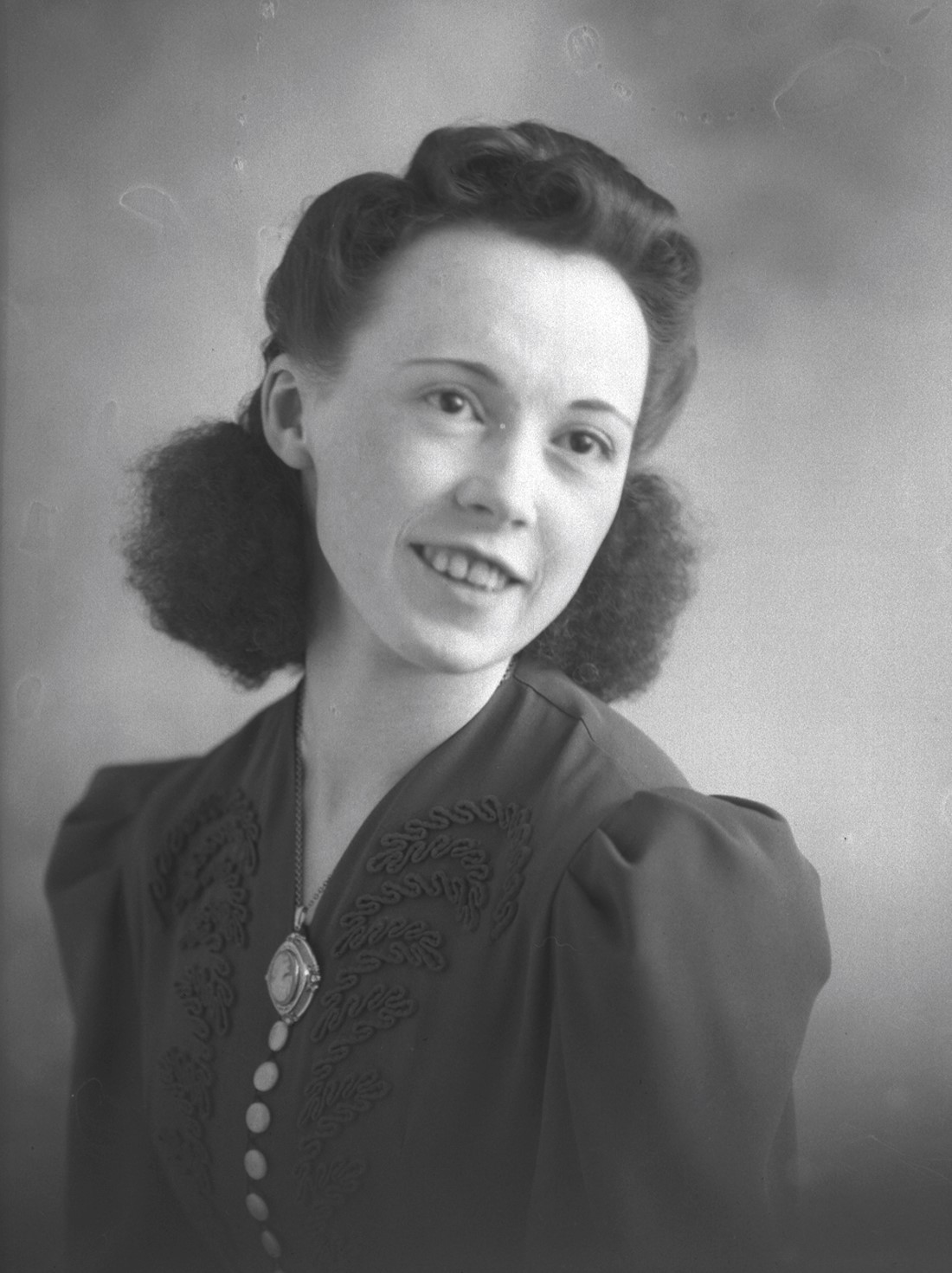
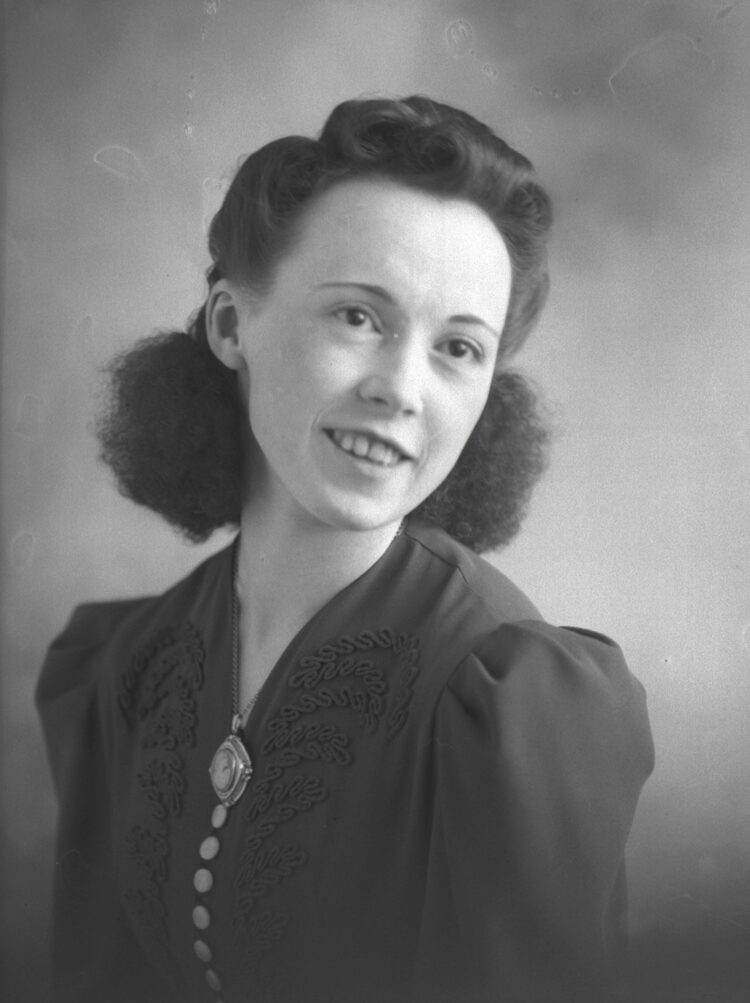
In this photograph, Rosalie Bergeron is 27 years old. At this age, she was already a resourceful young woman who had been seeking financial independence for some time. Her very first job was selling beauty products. Looking at this Hollywood-style portrait, we can imagine that Rosalie liked to keep up with the latest fashions. Marie-Alice Dumont, taking the photograph, was the same—she produced a number of portraits in this style from the 1940s onwards.
Rosalie Bergeron was well loved by the Dumonts and had truly become one of the family. Before long, Alcide Dumont (1873–1949), Marie-Alice’s uncle, spotted in her a potential match for his son Lorenzo. He praised her “talents” and arranged a meeting. It looked like there was a spark! There was just one drawback: Lorenzo had no fixed employment and no home of his own. It was decided that the young couple would stay at Marie-Alice’s house until Lorenzo’s situation stabilized. Lorenzo eventually found work in a foundry in Sainte-Croix, Lotbinière, where the couple moved in October 1946. In the meantime, they did not waste any time: they married on April 23, 1945, and welcomed their first child, Céline, on January 26, 1946.
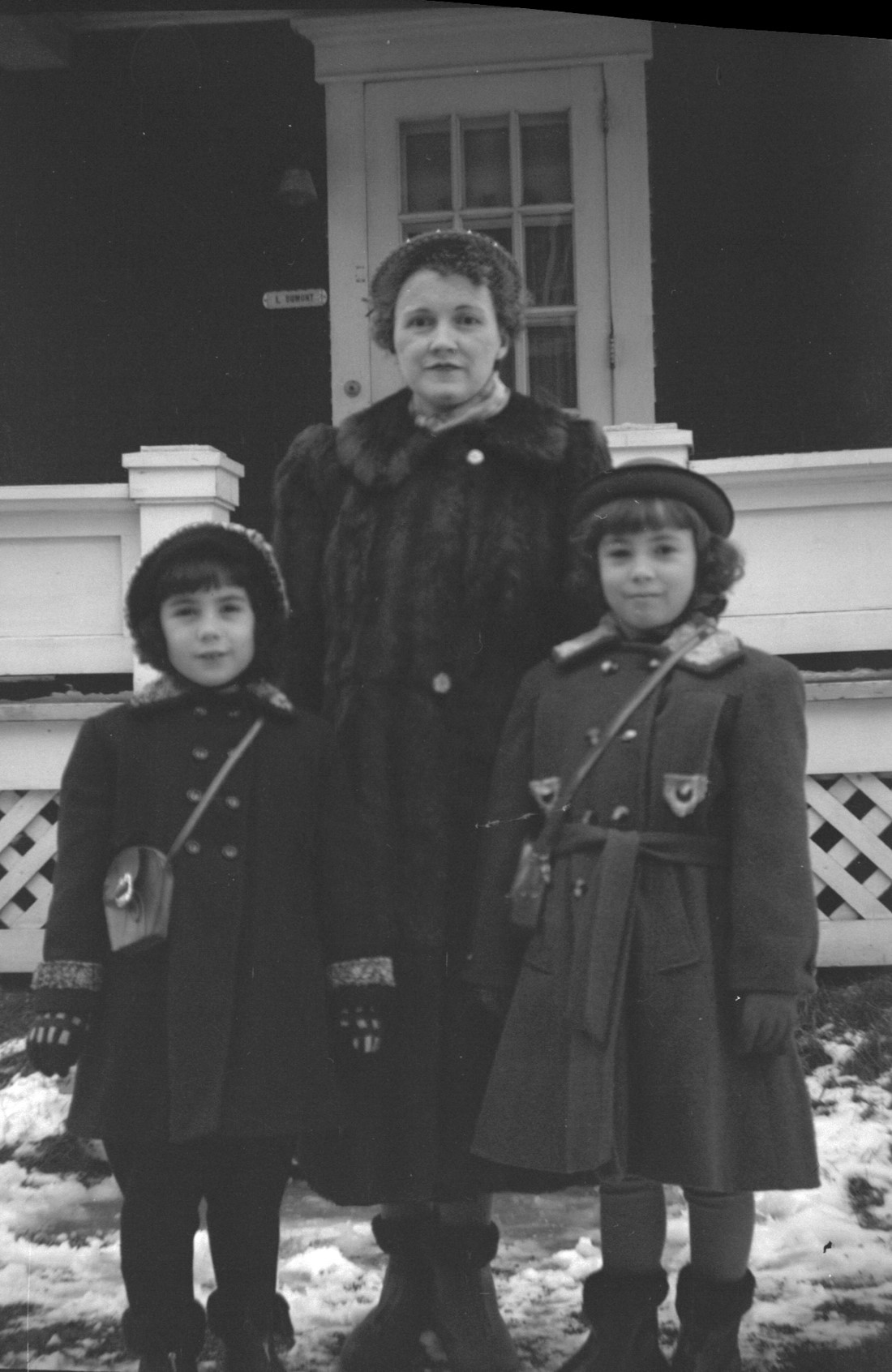
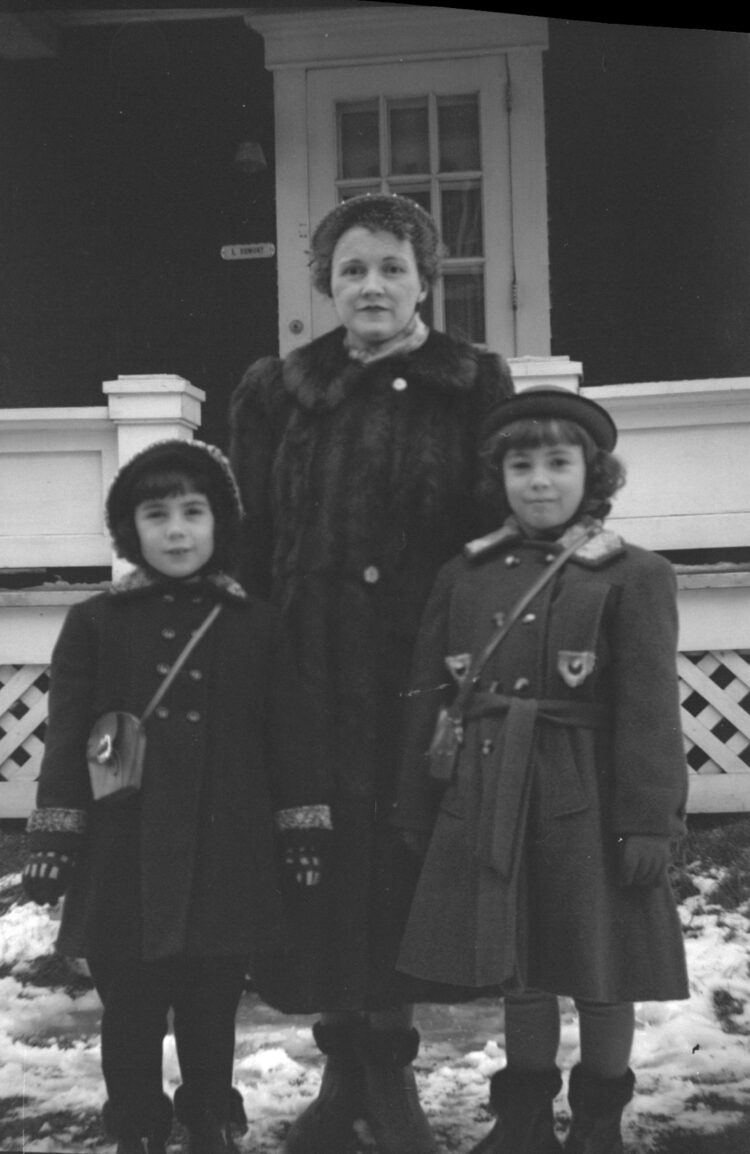
Shortly after their arrival in Sainte-Croix, the couple’s second child, Pierrette, was born. Here she is (left) with her mother and older sister, Céline. This is one of the last portraits Marie-Alice Dumont took of Rosalie. As can be seen here, Rosalie and her family lived quite comfortably in a big, beautiful house. The girls are dressed warmly for winter, and Rosalie wears a coat made entirely of fur—a great luxury. But, unfortunately, Rosalie was not happy. First, her husband Lorenzo had quit his job at the foundry because it was too hard on his health, and instead he was regularly working far from home. Rosalie also felt cut off from her family and friends, especially Marie-Alice and Napoléon. Her rheumatism did not help in the slightest. In fact, she had such pain in her legs that she had difficulty walking. Finally, to make matters worse, Rosalie developed heart problems at an early age. According to Napoléon, this was because she had “abused aspirin to relieve her suffering.” One day in February 1962, Céline, then aged 16, found her mother in her bedroom, having died suddenly at the age of just 45. It was a tragic end to Rosalie Bergeron’s story.
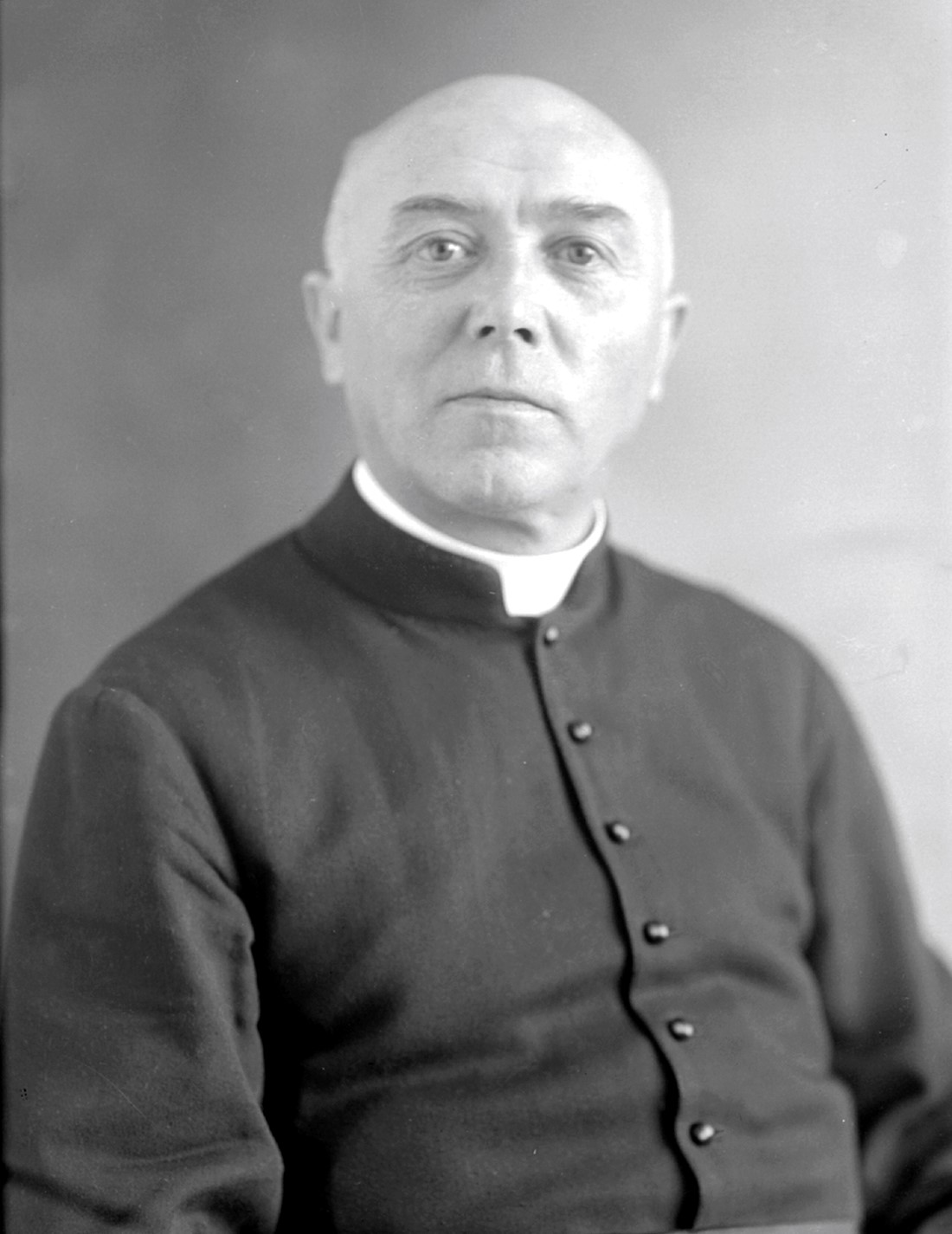
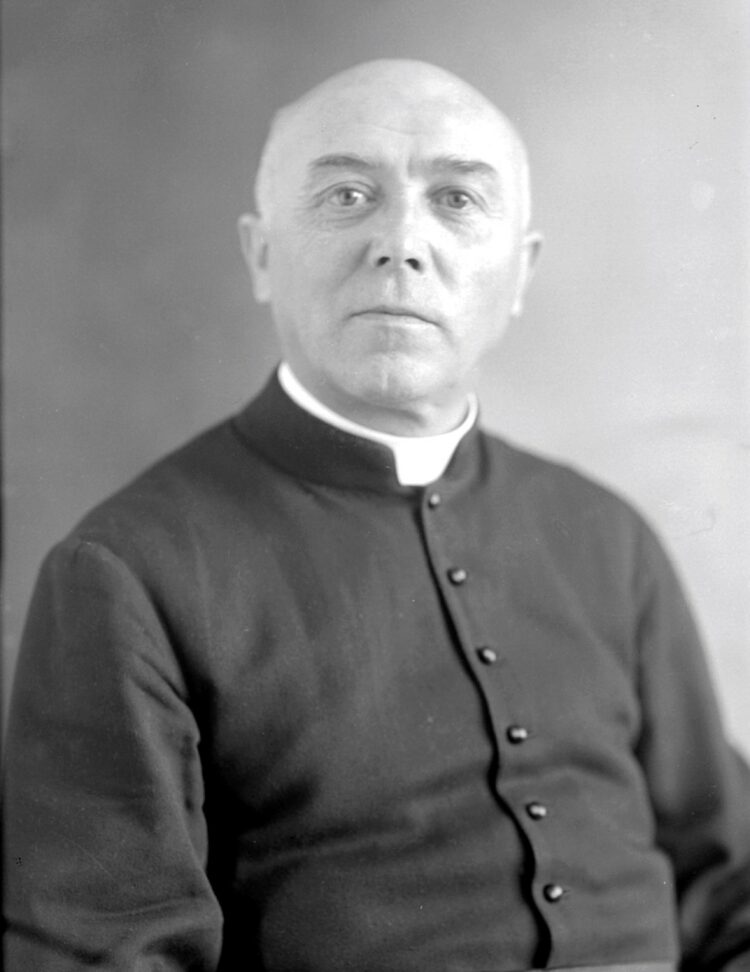
In this studio portrait, Marie-Alice Dumont’s younger brother, Joseph-Napoléon, is approaching the age of 55. After more than 30 years in the priesthood, the time for retirement was fast approaching. Napoleon would soon have plenty of time to gather his archives and to write his memoirs and family history. What a wealth of information and anecdotes he left us!
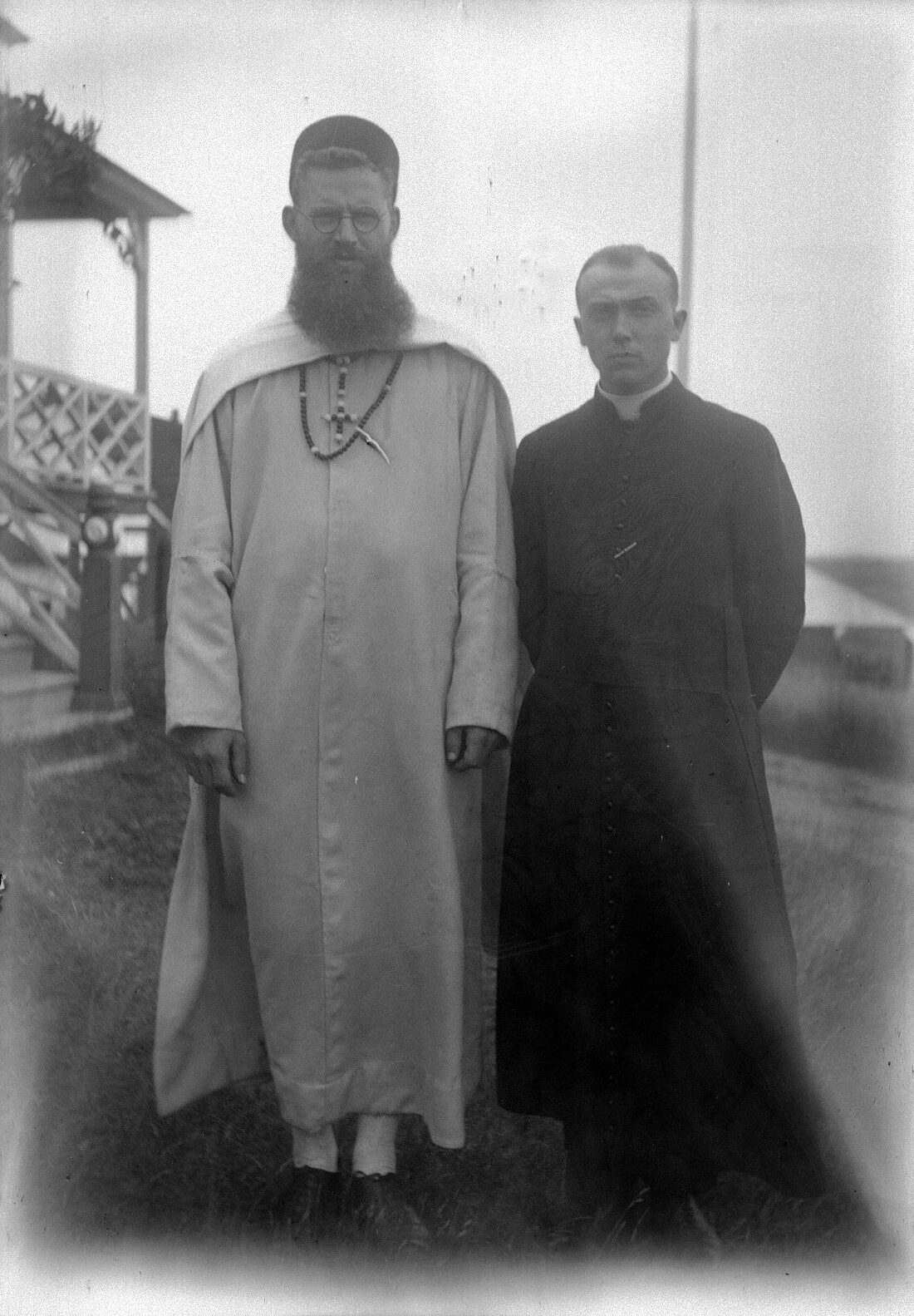
Joseph-Napoléon Dumont made many friends during his time at the Collège de la Pocatière. He is shown here (right) with a classmate, François-Xavier Létourneau. Shy, serious and very kind, François-Xavier certainly made an impression on his classmates, but especially because of his height! As you can see, he stands a head taller than Napoléon, and looks to be at least seven feet tall. Father Létourneau visited Saint-Alexandre-de-Kamouraska in 1924, but only briefly, as he was a missionary in Africa. He was a member of the White Fathers, as we can see from his clothing, which includes a large white cassock and a black and white cross worn around his neck. Like several hundred other Quebecers at the time (and still today), Father Létourneau devoted his life to the evangelization of the African continent. But his story does not have a happy ending. When he left college in 1919 (he was 23 or 24 at the time), he decided to become a missionary. After several years in Algiers (Algeria) and Carthage (Tunisia), he found himself at the Bolgatanga mission station in Ghana. He was there just over two years before he drowned in early August 1927, at just 30 years old. This portrait of Father Létourneau by Marie-Alice Dumont, along with another in which he poses alone in the studio, are perhaps the only existing photos of him.
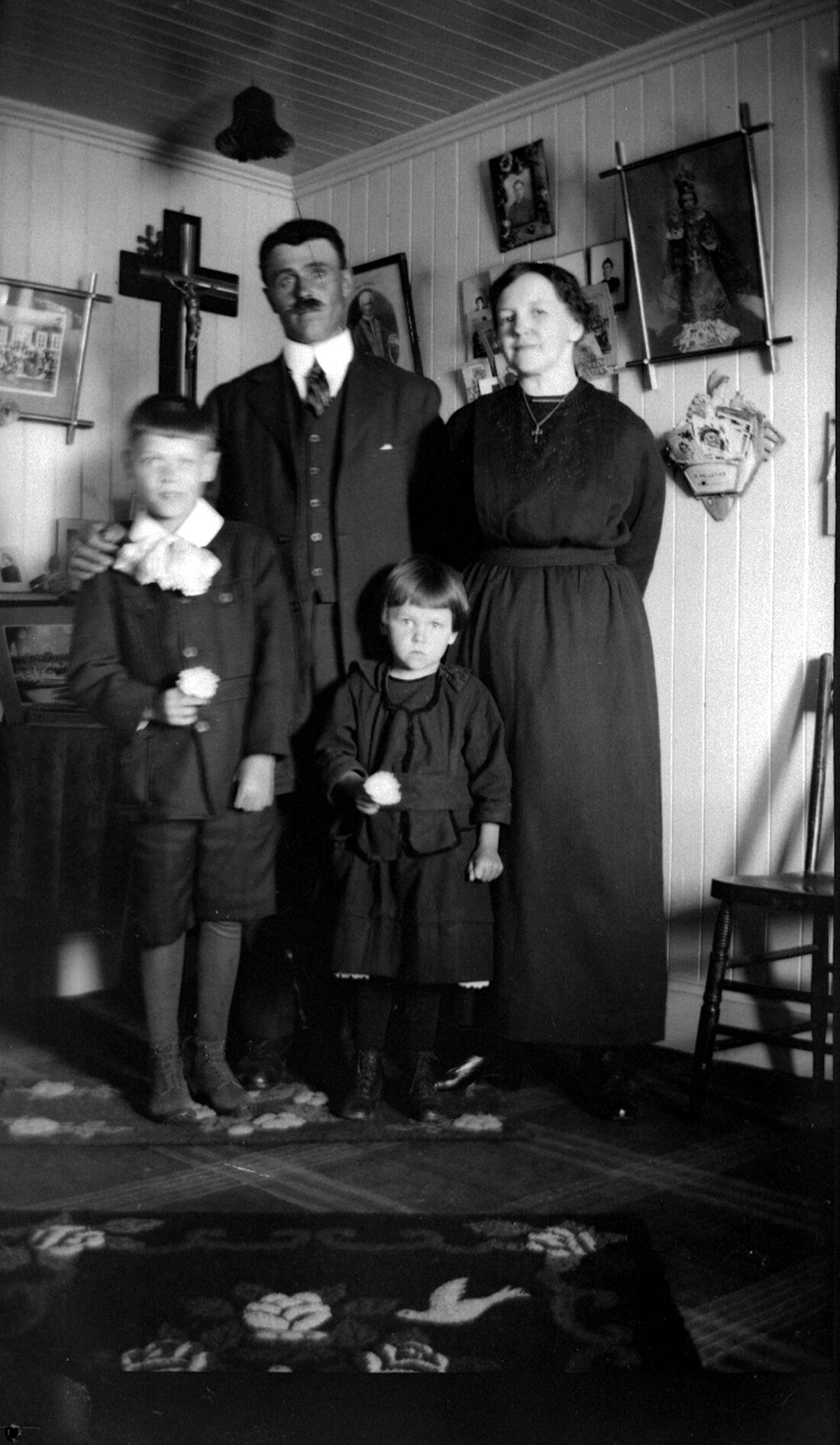
This portrait shows the family of Marie-Alice Dumont’s older brother. François Dumont (1887–1981) stands beside his second wife, Mary April (1889–1968). They are both around 40 years old. The taller of the two boys is named Félix. He was about 12 years old, the child of François’s first marriage to Délima Sirois, who died young of dropsy. The youngest is Yvan, aged around five. Not in the photo is Origène, who isn’t born yet, although probably in his mother’s womb when this photo was taken. The family poses in a domestic setting, perhaps their own home, the former house of Marie-Alice Dumont’s parents on the 5e Rang in Saint-Alexandre.
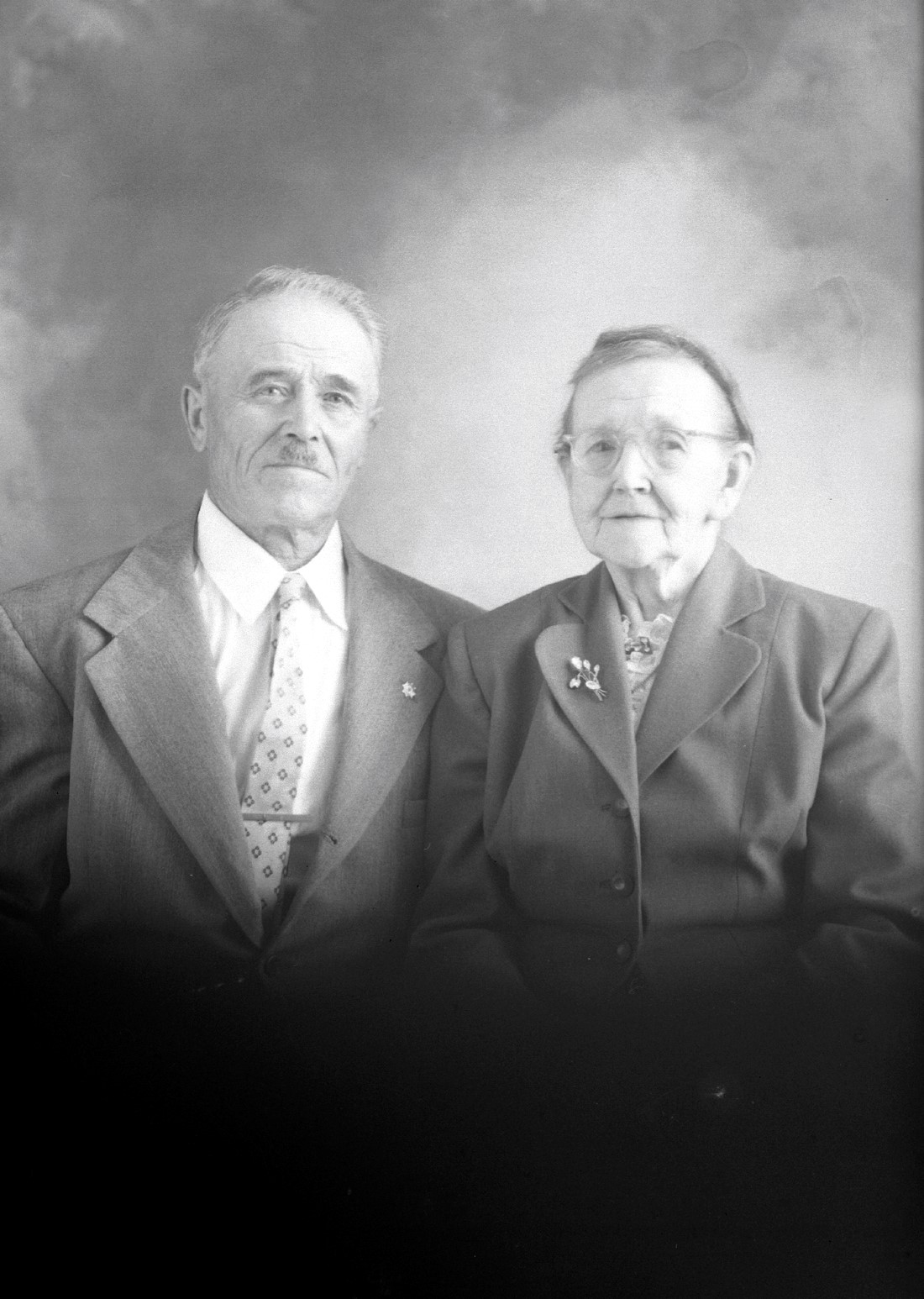
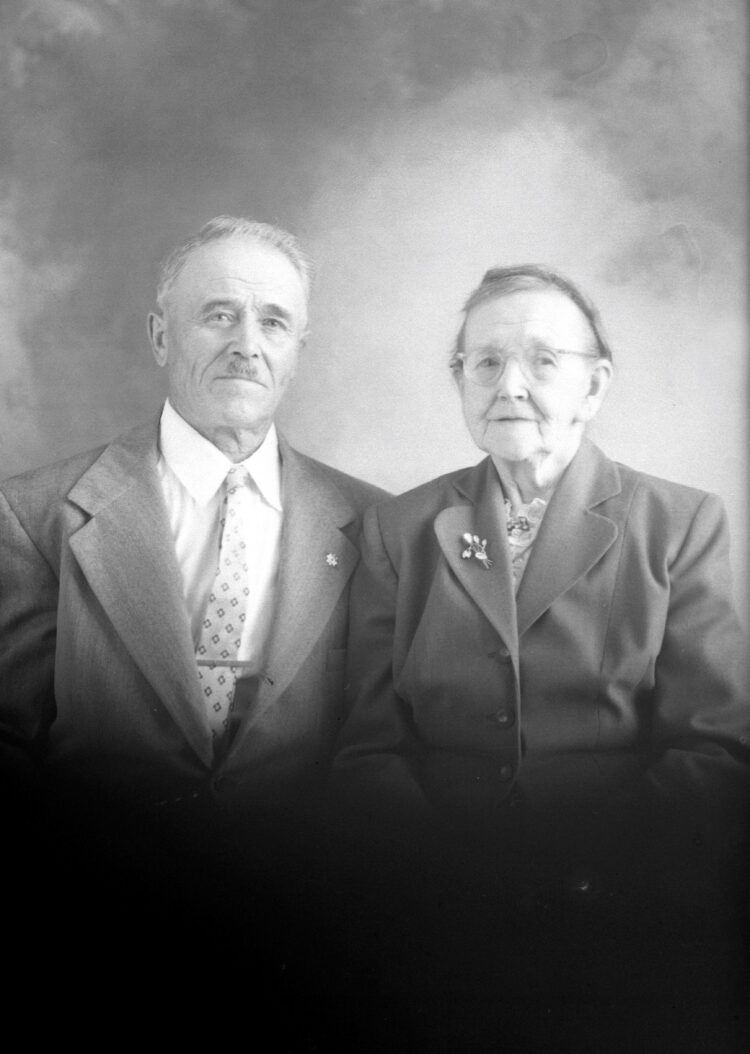
François Dumont and Mary April were married on February 13, 1917. They were photographed here by Marie-Alice Dumont when they were about 65 years old. They had always lived in the Dumont family home on the 5e Rang in Saint-Alexandre. In biographical notes, Joseph-Napoléon describes Mary as “brave, very pious, thrifty and hard-working,” all “qualities” that helped the family “get through the difficult period of the economic crisis of the thirties.” Napoléon’s assessment of his older brother François is equally admiring: a good Catholic, excellent at Gregorian chant, generous, a resilient and prosperous farmer. François inherited his father’s land in 1926, when his parents moved to the village with their daughters.
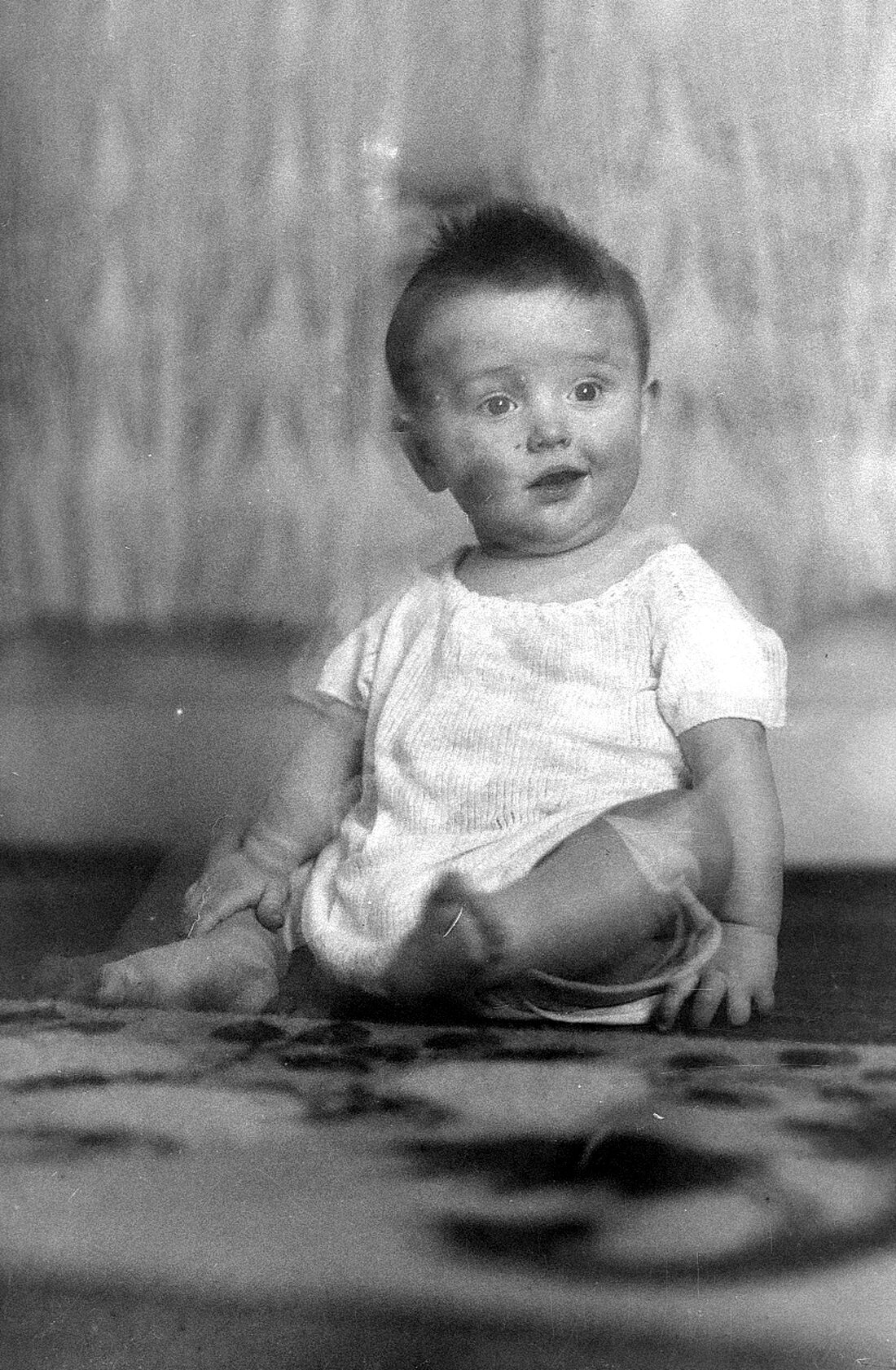
Little Origène is posed here at barely a year old. Note the blurry shot: it is not easy to photograph a baby of this age without them moving! The photographer, who was still learning at the time, might have had more luck by increasing the shutter speed on her Kodak. Or perhaps the blurred effect was intended?
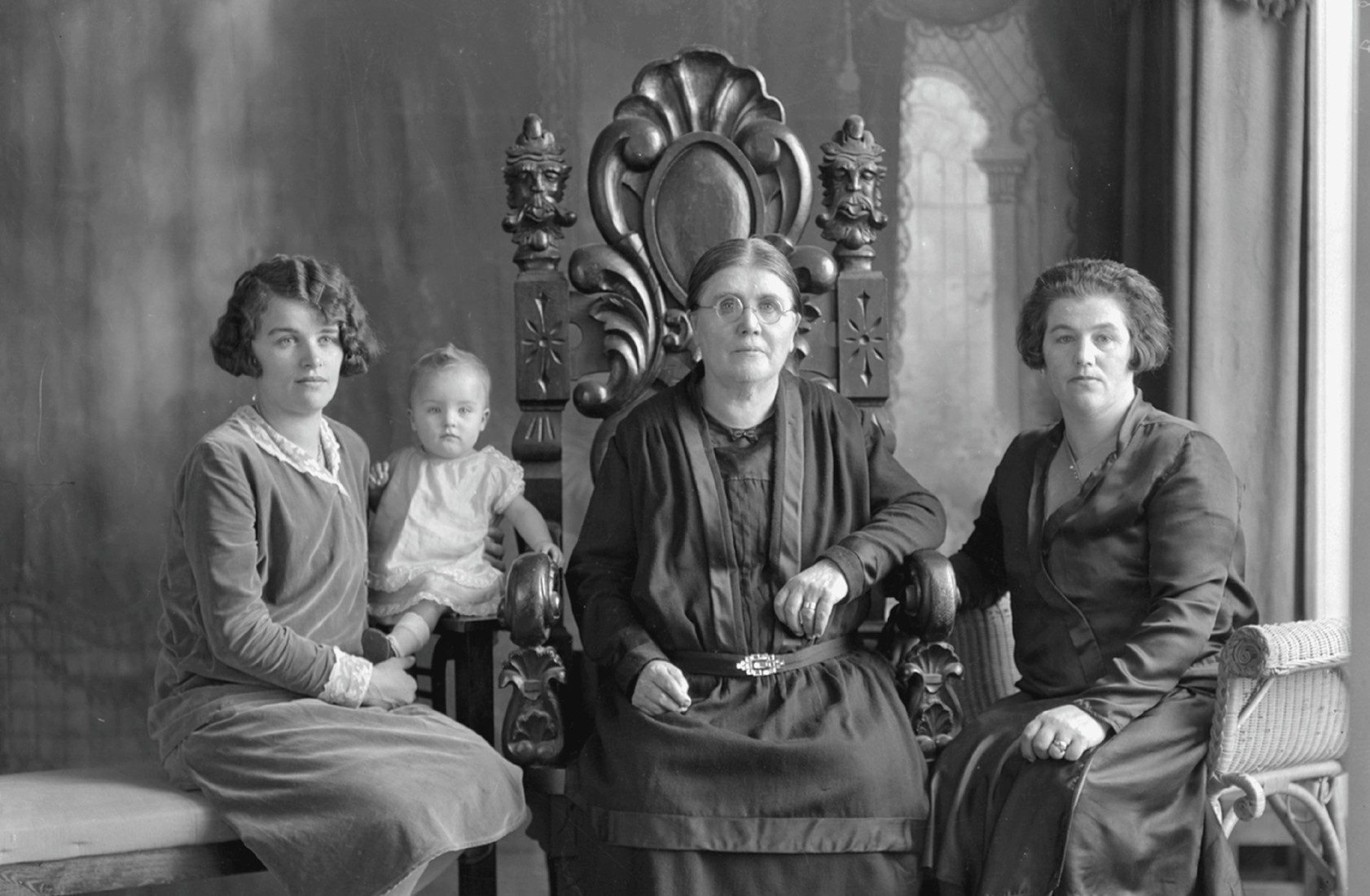
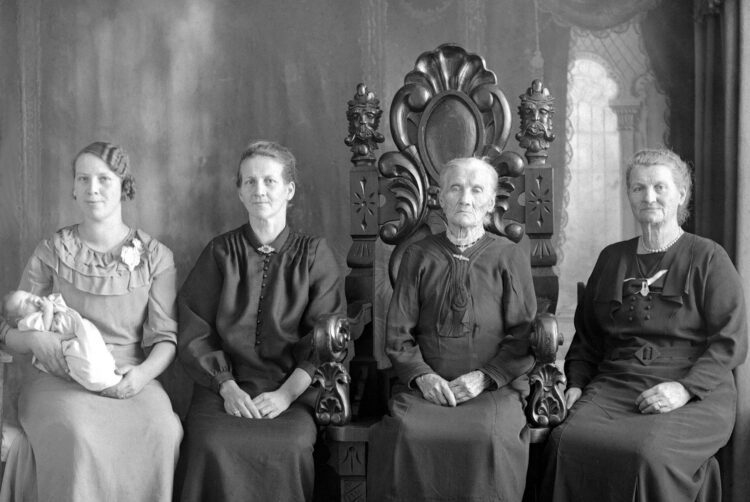
There are many multi-generational portraits of women in the archives left by Marie-Alice Dumont. Here, her niece Marie-Jeanne Ouellet holds her baby daughter and poses with her mother Émilia Dumont and grandmother Marie Pelletier. The grandmother is seated in a large, carved wooden chair, the grandest seat in the image. The figures carved on either side of the backrest were said to frighten children, who nicknamed it the “Devil’s Chair.”
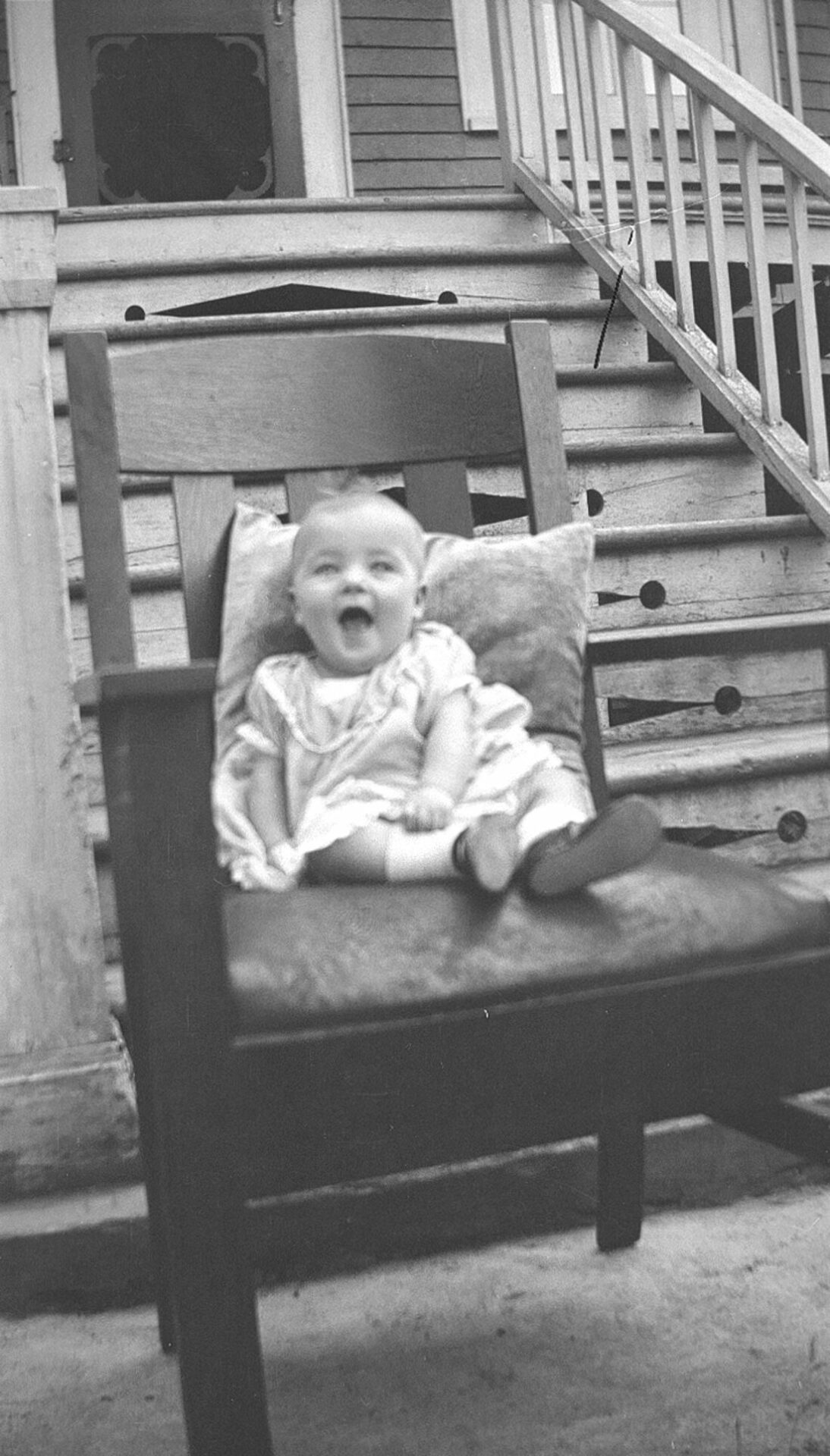
This little niece of Marie-Alice Dumont seems to be enjoying her time in front of the camera! Still a baby, she is sitting on an armchair that the photographer had brought out of her studio for the occasion. Was this before electricity was installed in the studio in 1929? Perhaps there was not enough light inside to take the portrait.
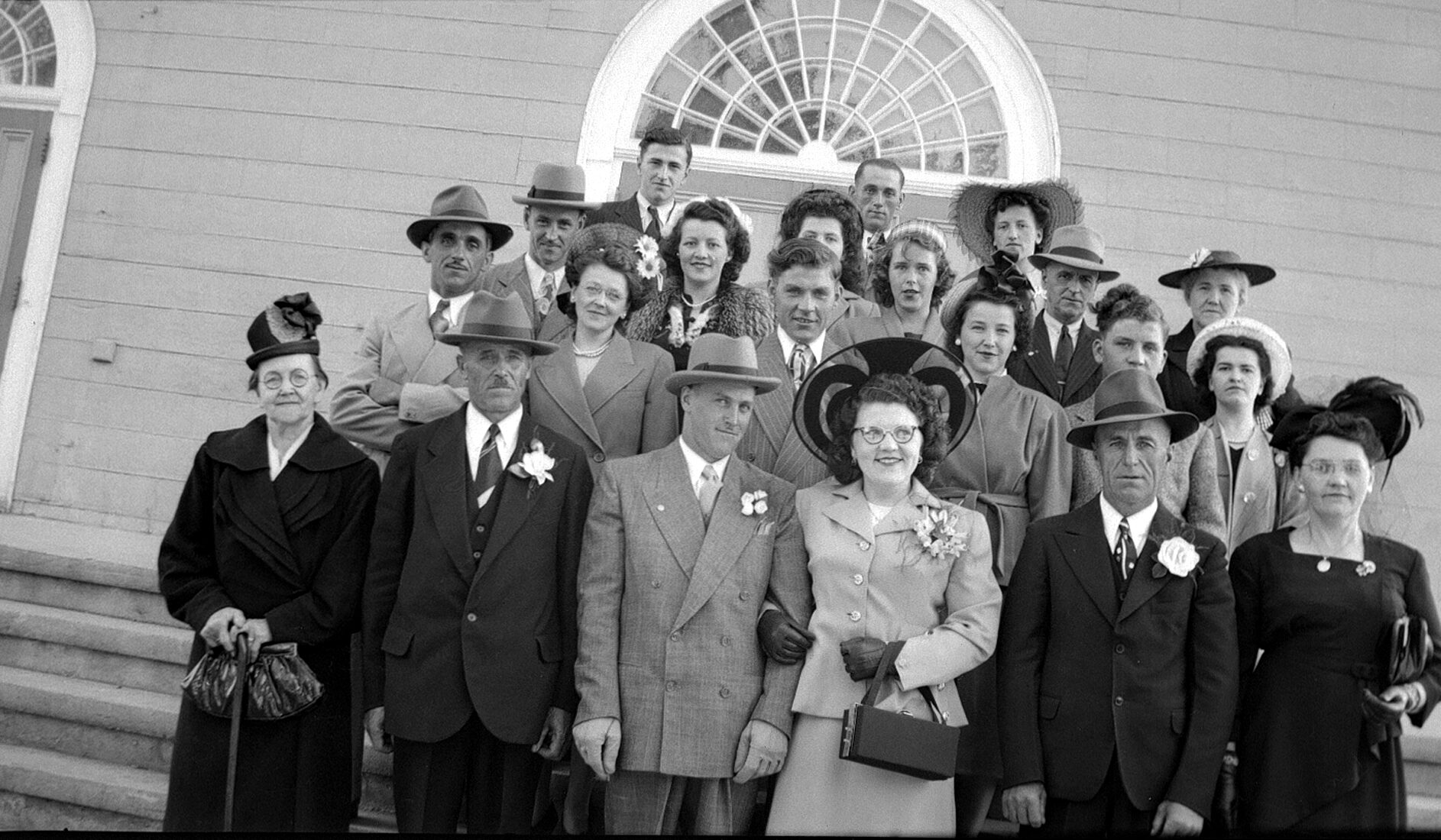
This group was gathered in front of the Saint-Alexandre church for the 1948 wedding of Thérèse Massé and Yvan Dumont, nephew of Marie-Alice Dumont. Yvan worked as a farm manager for various women’s religious communities. Also present in this group are Yvan’s parents (Mary and François, in the left foreground) and his brother and sister-in-law (Origène and Daria, in the third row, to the left).
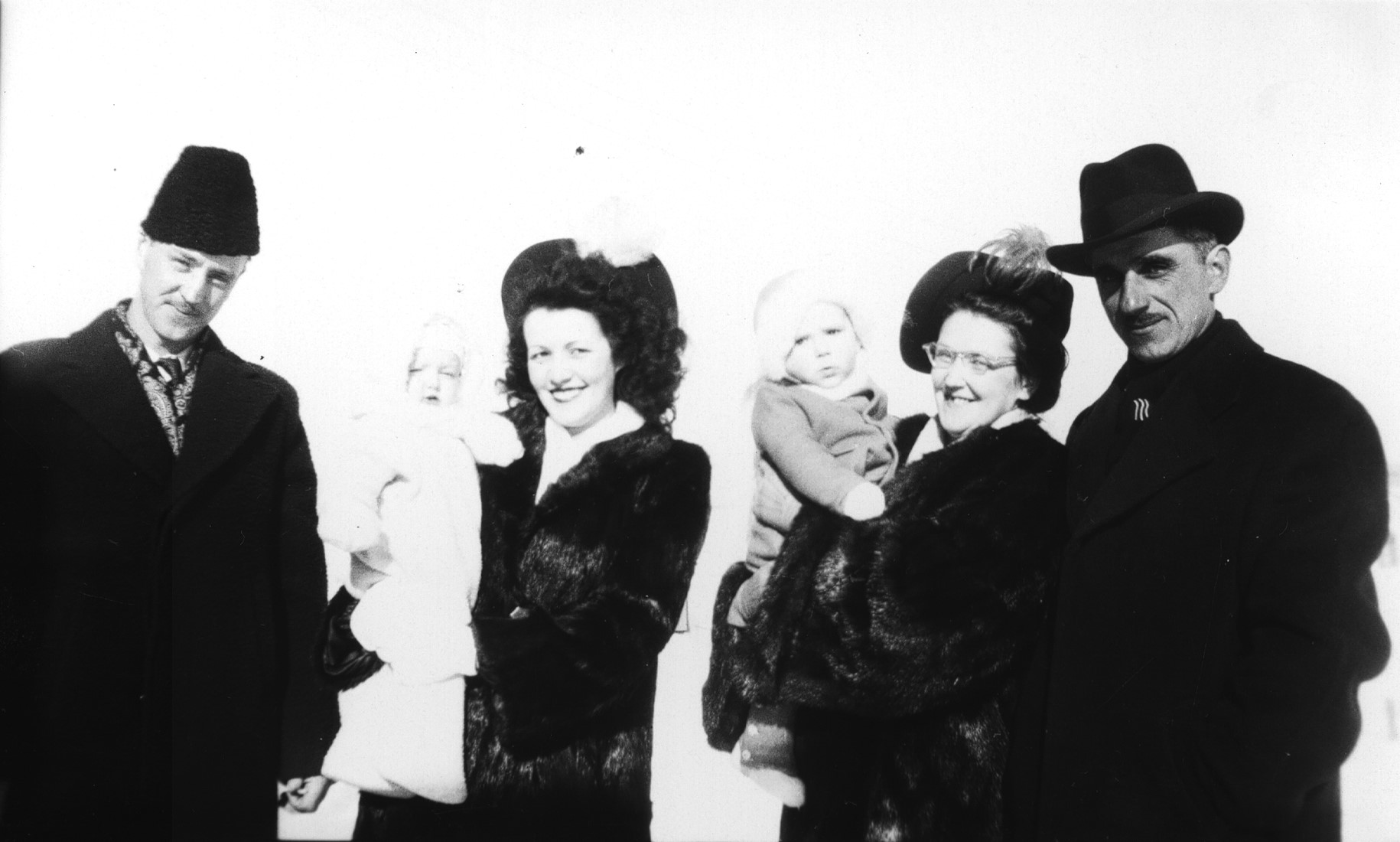
In this semi-successful shot (was it developed by Marie-Alice Dumont, or did she take it herself?), Origène Dumont and Daria Lavoie pose with their eldest daughter, Françoise, and a couple of close friends. Their wedding comes with an interesting story: On July 15, 1947, they were married in Saint-Denis-de-Kamouraska, along with two of Daria’s sisters and one of her brothers. That means four children from the same family were married in the same ceremony!
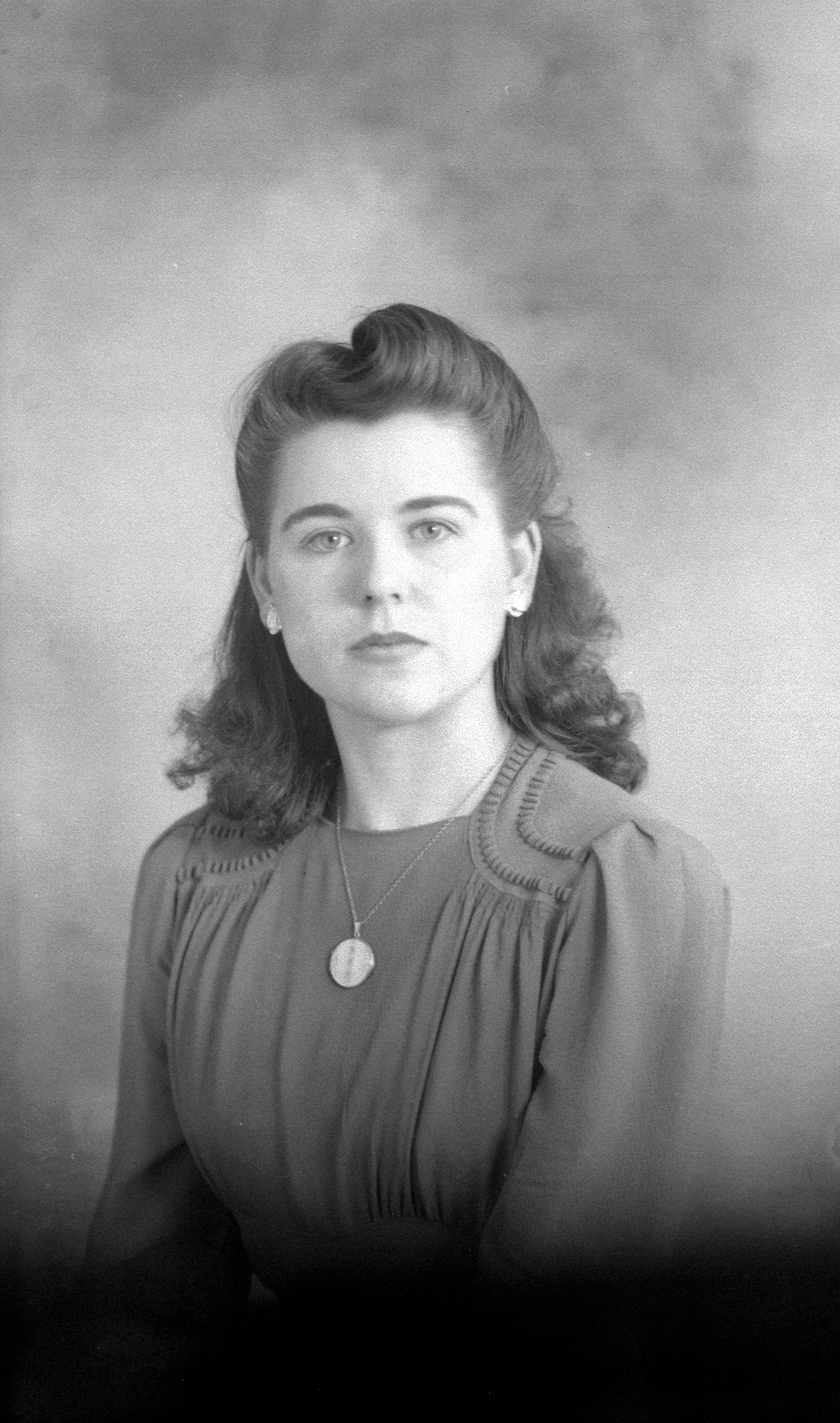
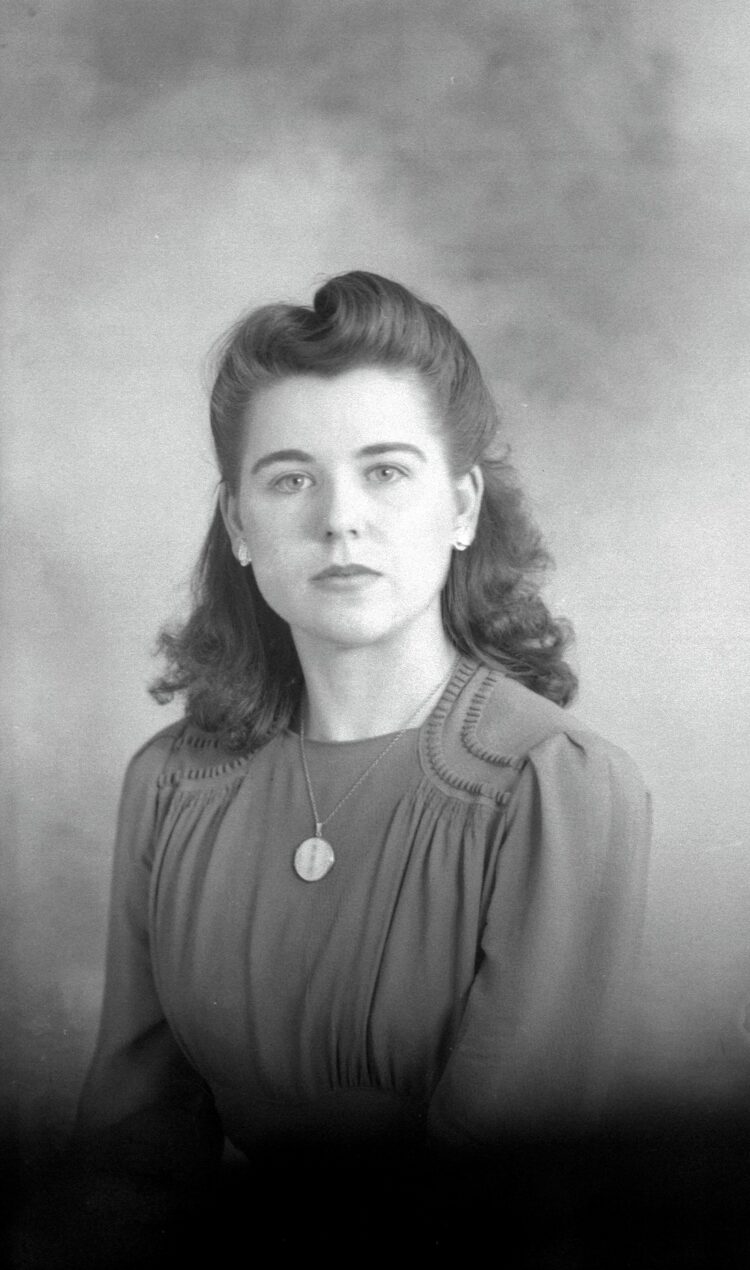
This beautiful bust portrait is of Georgette Ouellet (1923–2016), aged about 20. Another niece of Marie-Alice Dumont, Georgette was the eighth of 16 siblings, 15 of whom reached adulthood. She married Gilles Caron of Trois-Rivières in 1956.
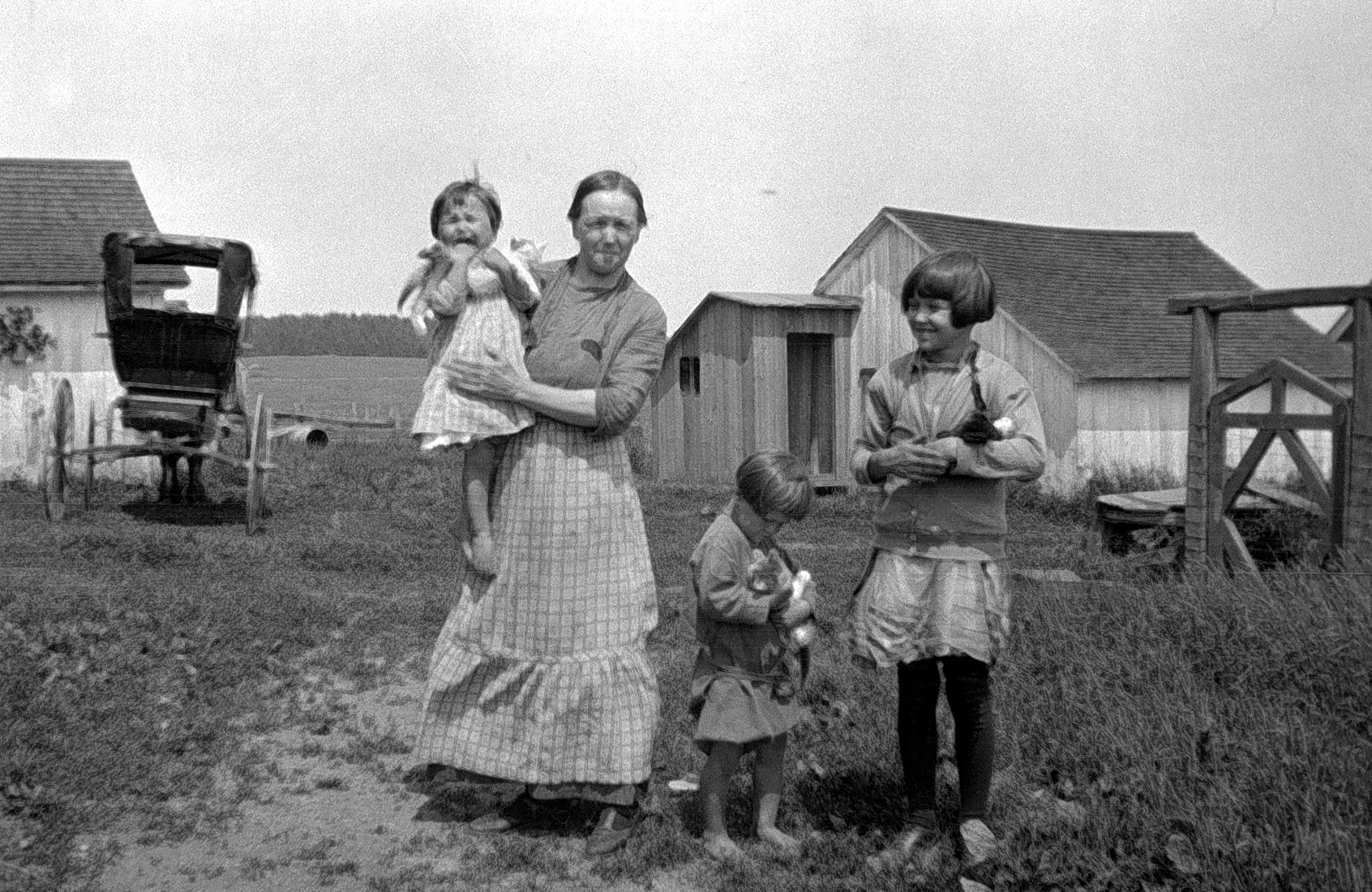
This portrait shows Mary April with the three children she cared for with François Dumont. Each carries a small animal, possibly a cat. Origène, the youngest, cries in his mother’s arms. Yvan keeps a close eye on the little creature in his hands. Meanwhile, Félix smiles, gazing into the distance. At what time of day was the photograph taken? What were they doing beforehand? What will they do afterwards? We can only speculate. However, the farm setting gives us a clue to their daily life, which was shaped by the work and chores required to maintain a farm property.
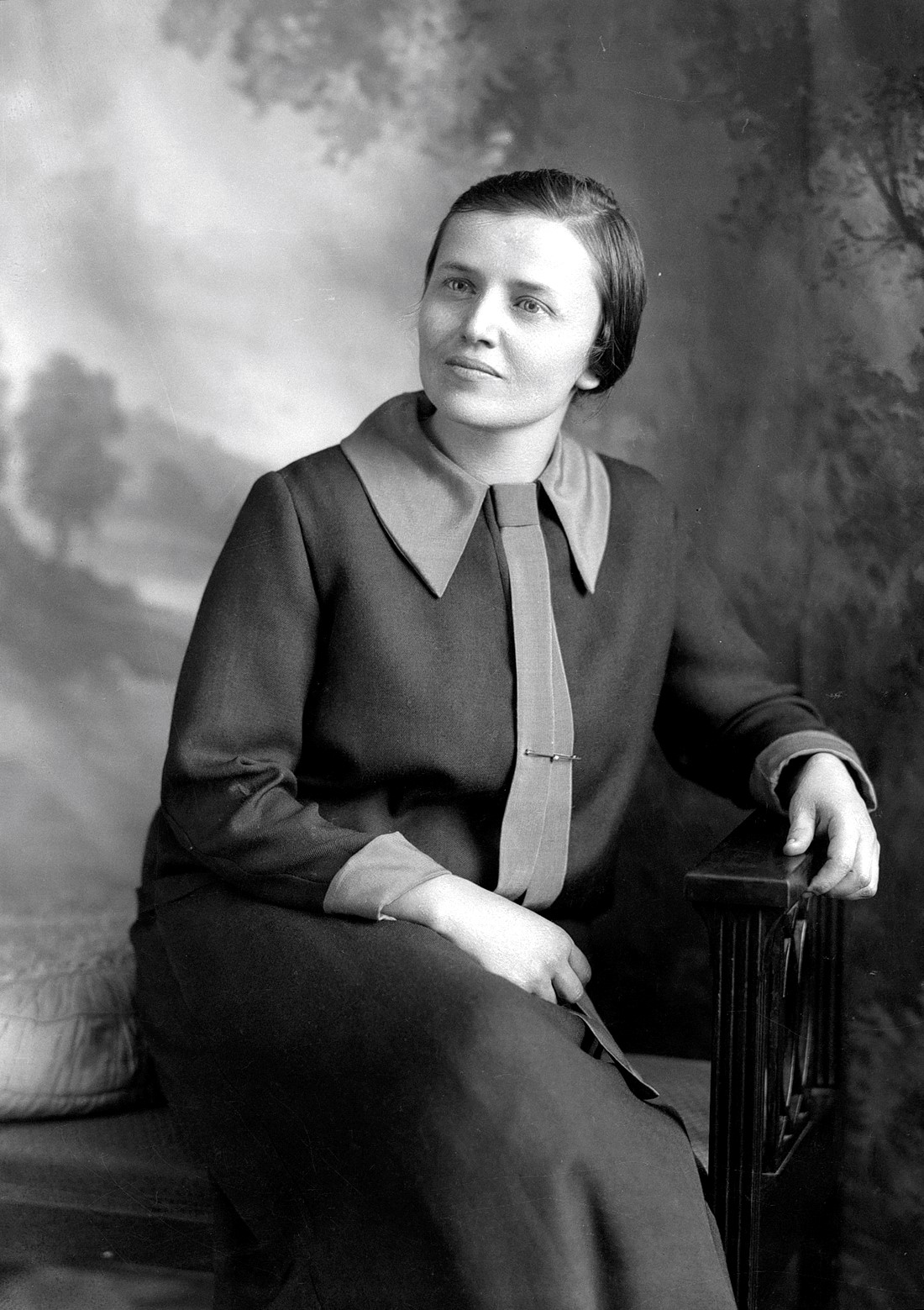
Here is one of three portraits taken in one sitting by Rivière-du-Loup native Ulric Lavoie of his colleague Marie-Alice Dumont. She would have been around 40 years old. Lavoie retouched two of the three portraits, including this one where he softened Dumont’s facial features.
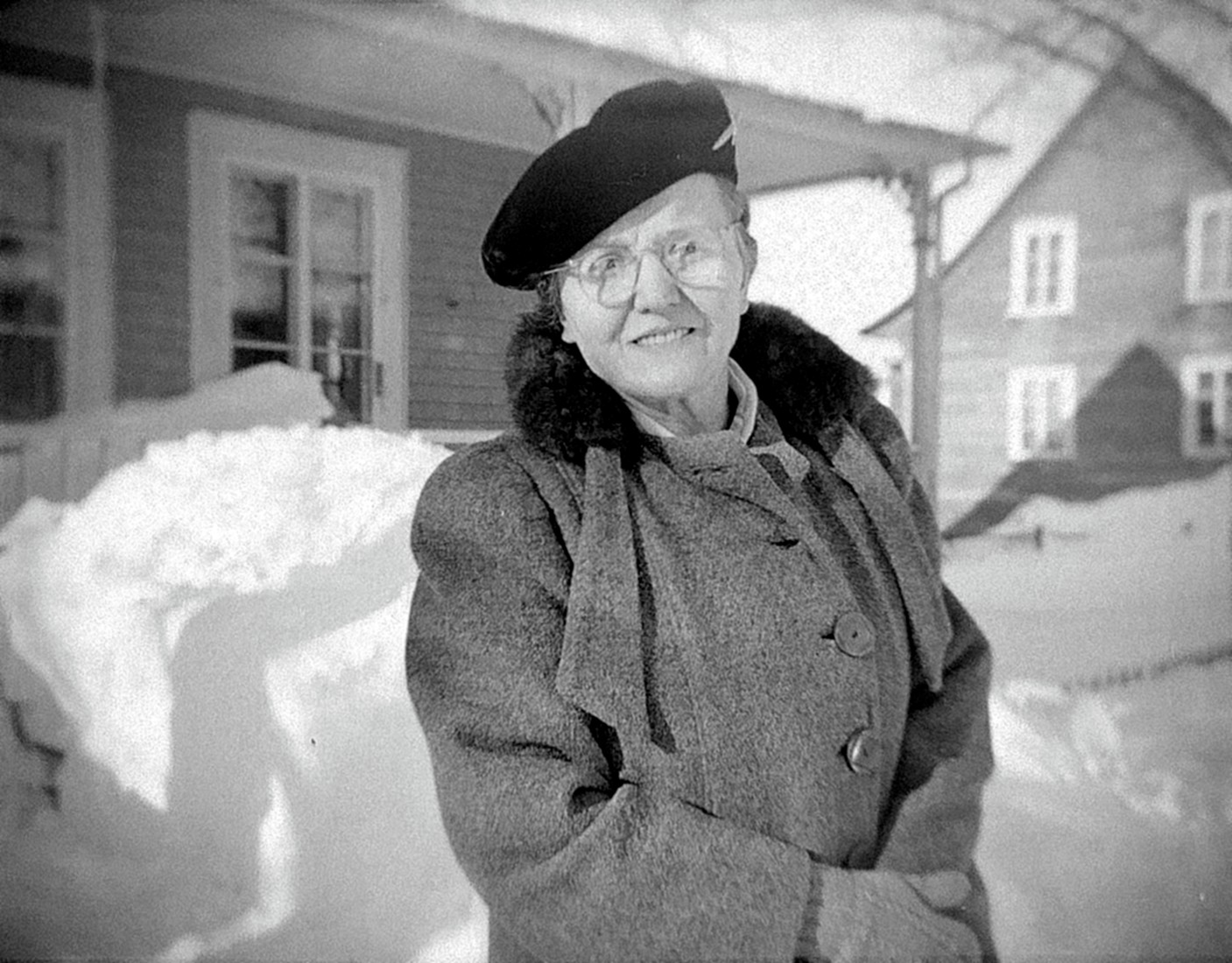
This portrait was taken around 1950, near the end of Marie-Alice Dumont’s career. It appears to be part of a series created with Lucille Bérubé, who was Dumont’s assistant for about 10 years. (Bérubé left the studio in 1957). Were the two women preparing Christmas greetings for their family and clients?
Couples
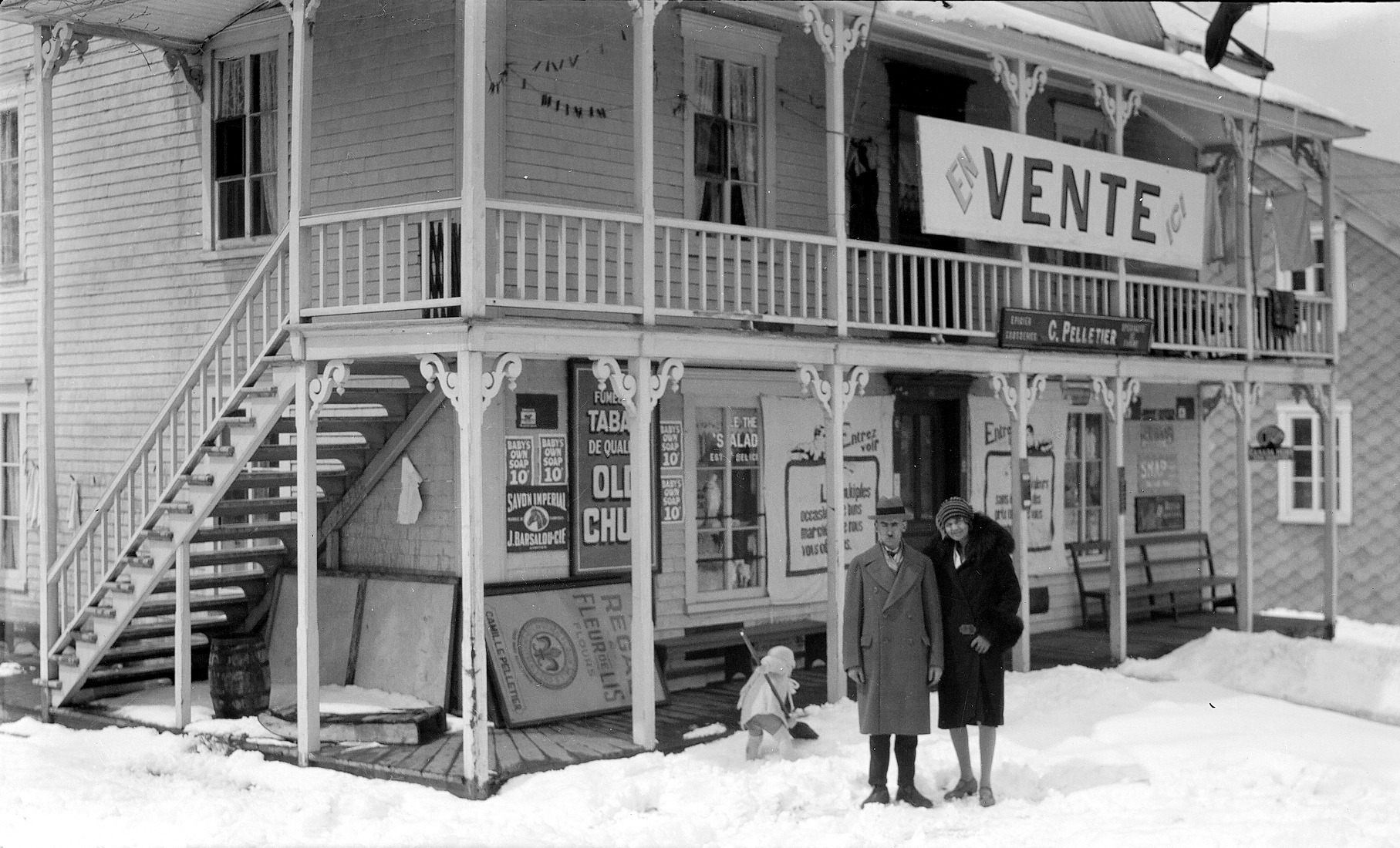
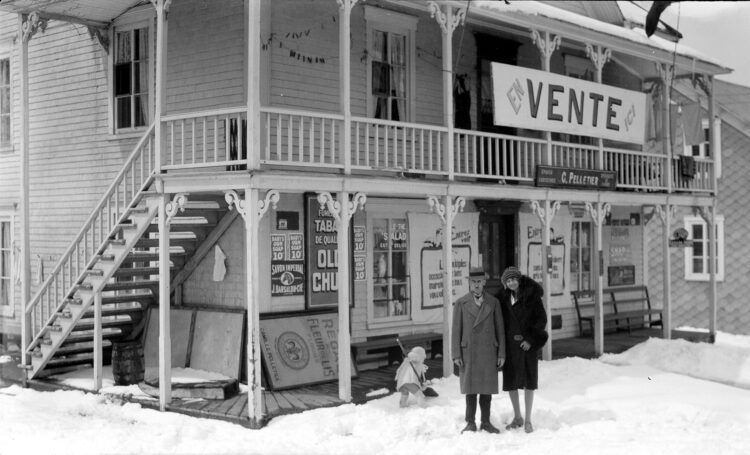
Marie-Alice Dumont photographed many of the local shopkeepers in her village. Here, Camille Pelletier and his wife pose in front of their store, the oldest shop in Saint-Alexandre parish.
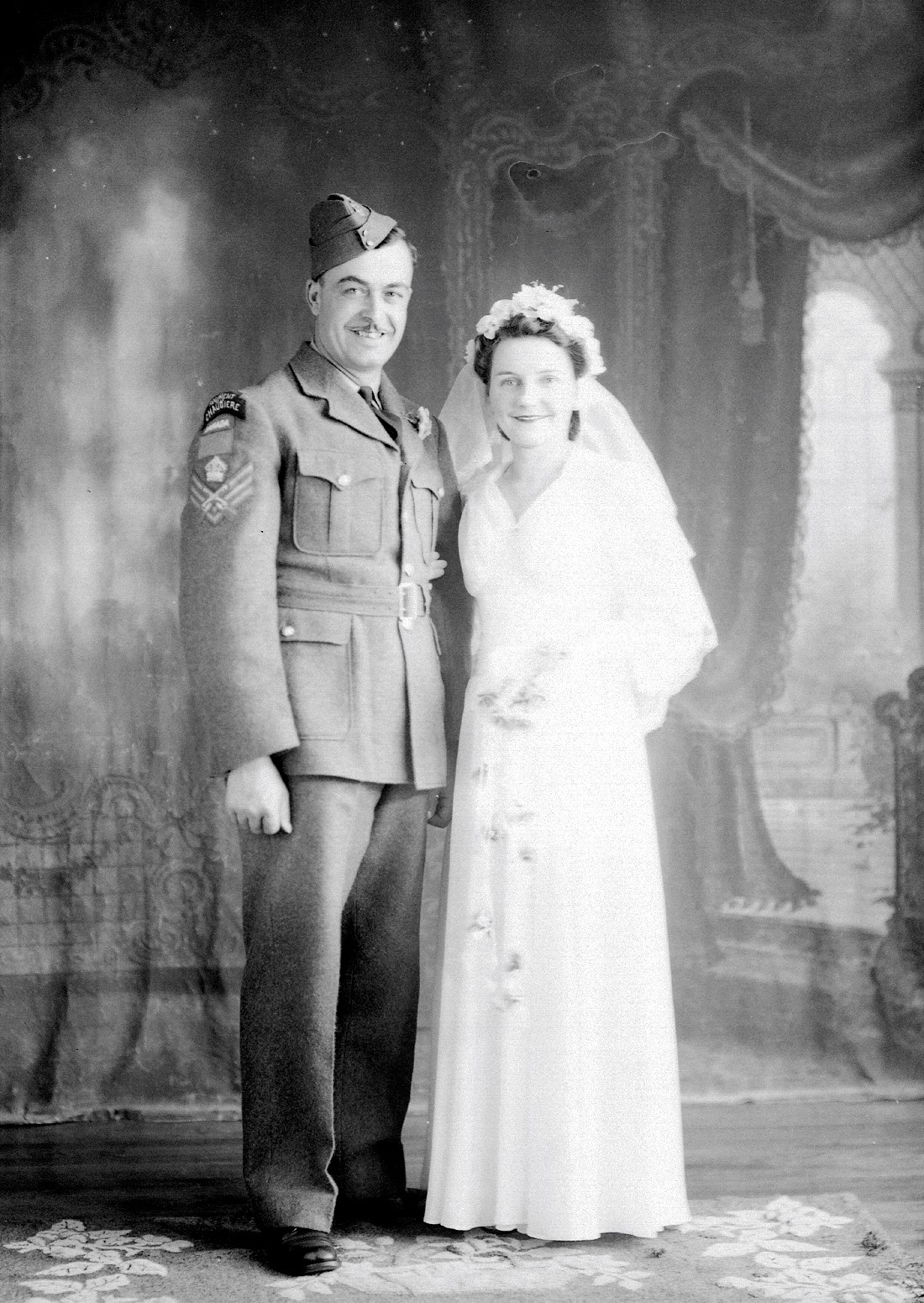
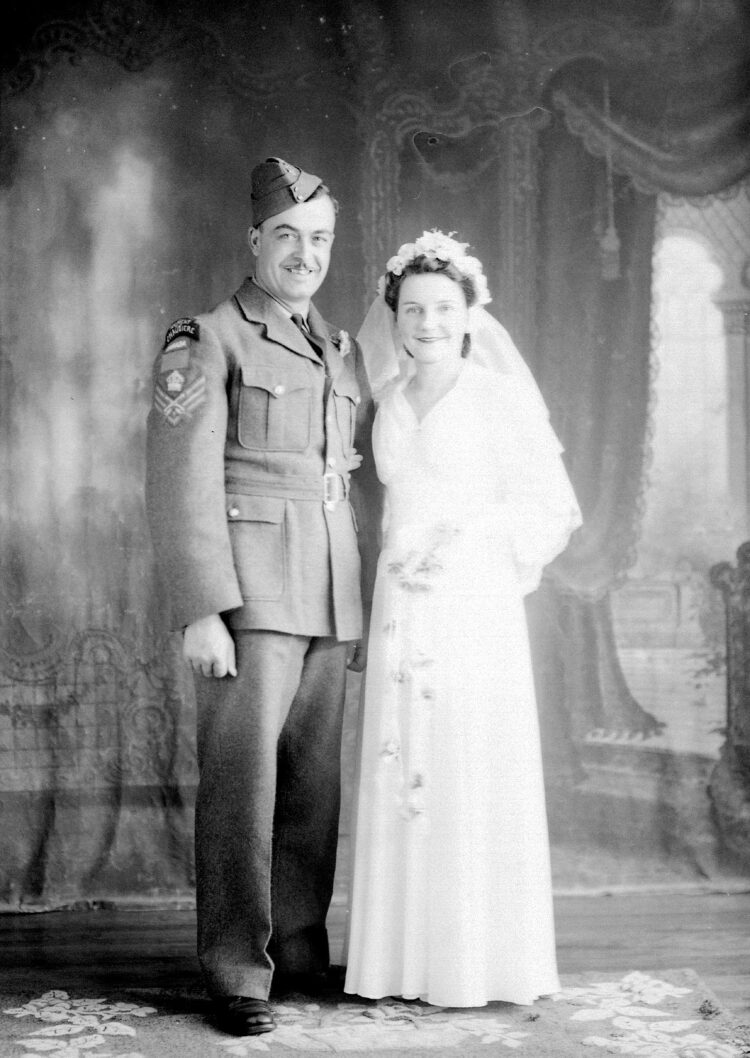
André Pelletier was a member of the Régiment de la Chaudière, which took part in World War II, including the Normandy landings. He is photographed here with his bride in 1944, the year of the D-Day invasion in which his regiment was involved. Did he go to the front? If so, we can assume this wedding portrait was taken just before his departure, since his regiment continued fighting in Europe until the end of the war.
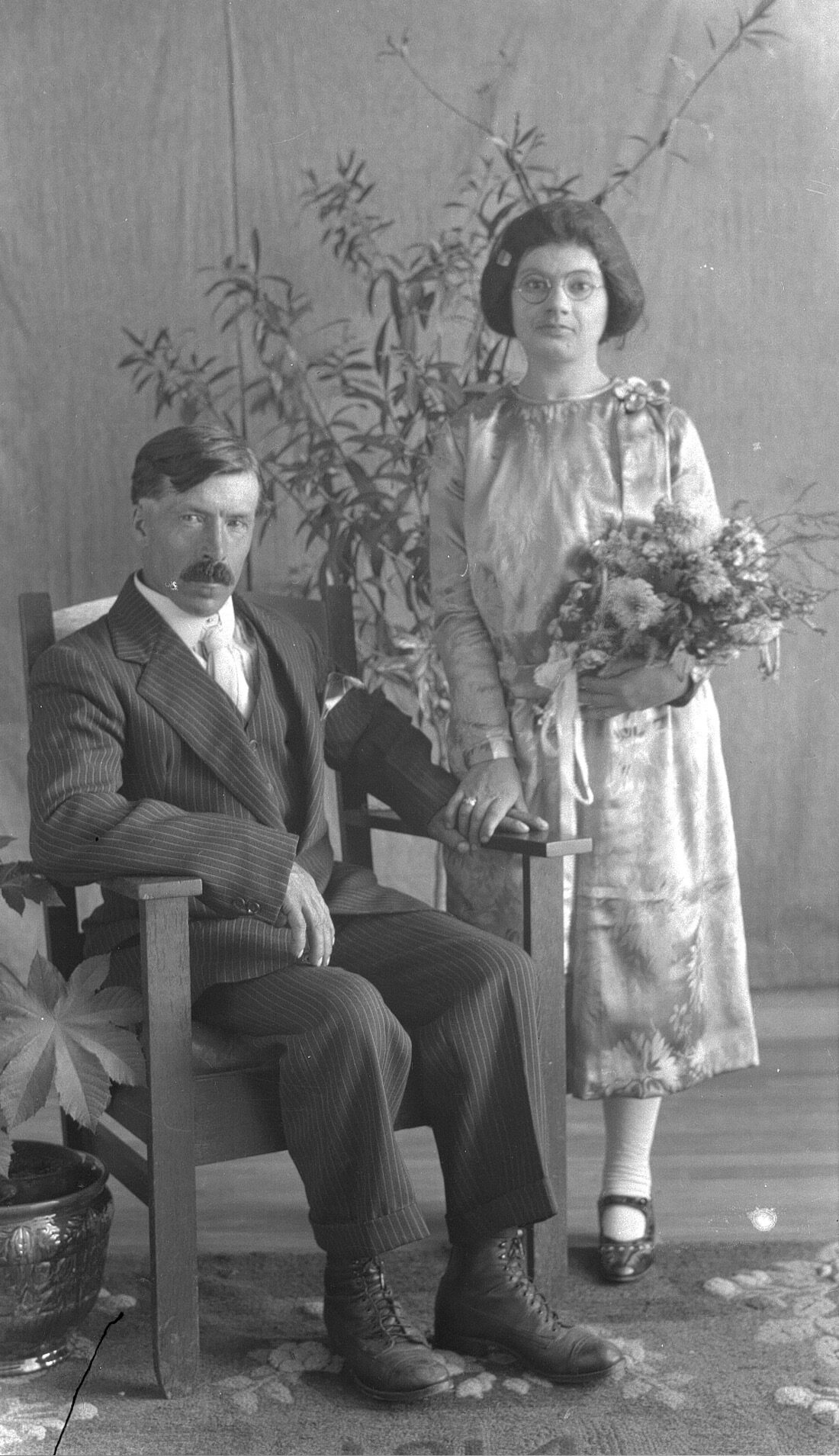
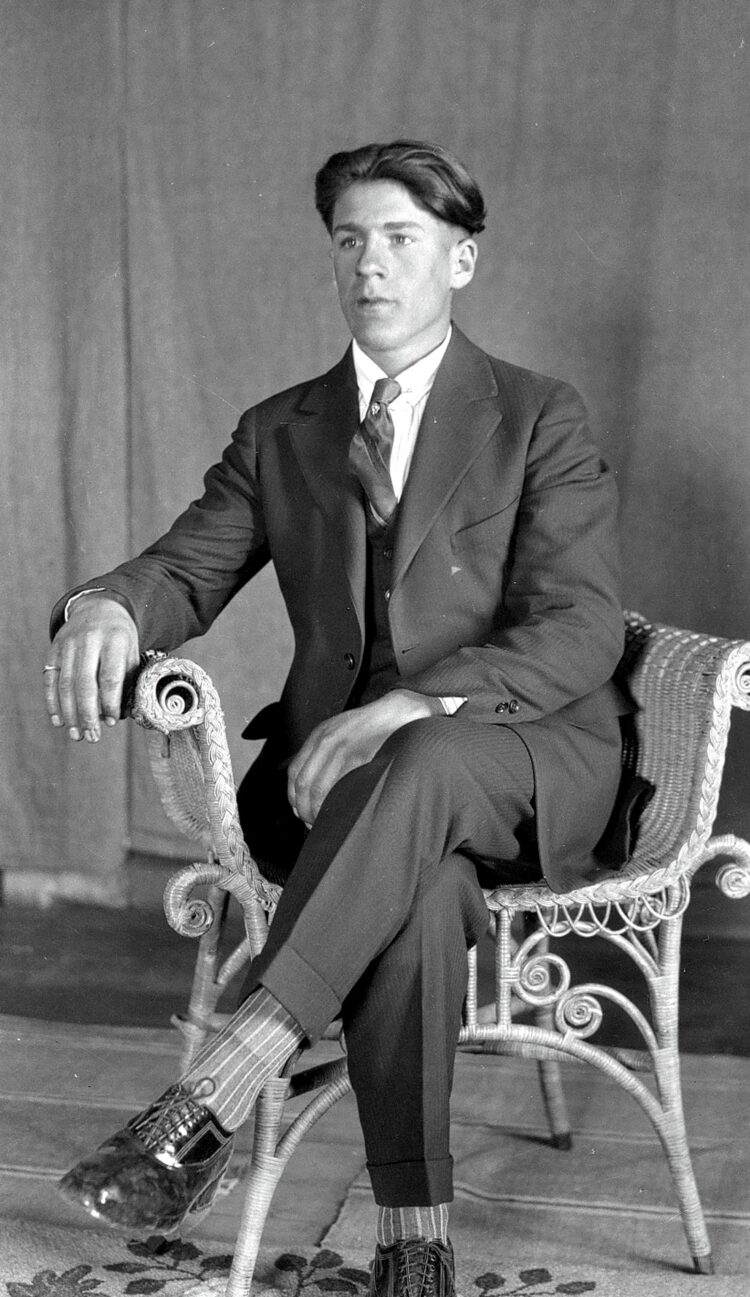
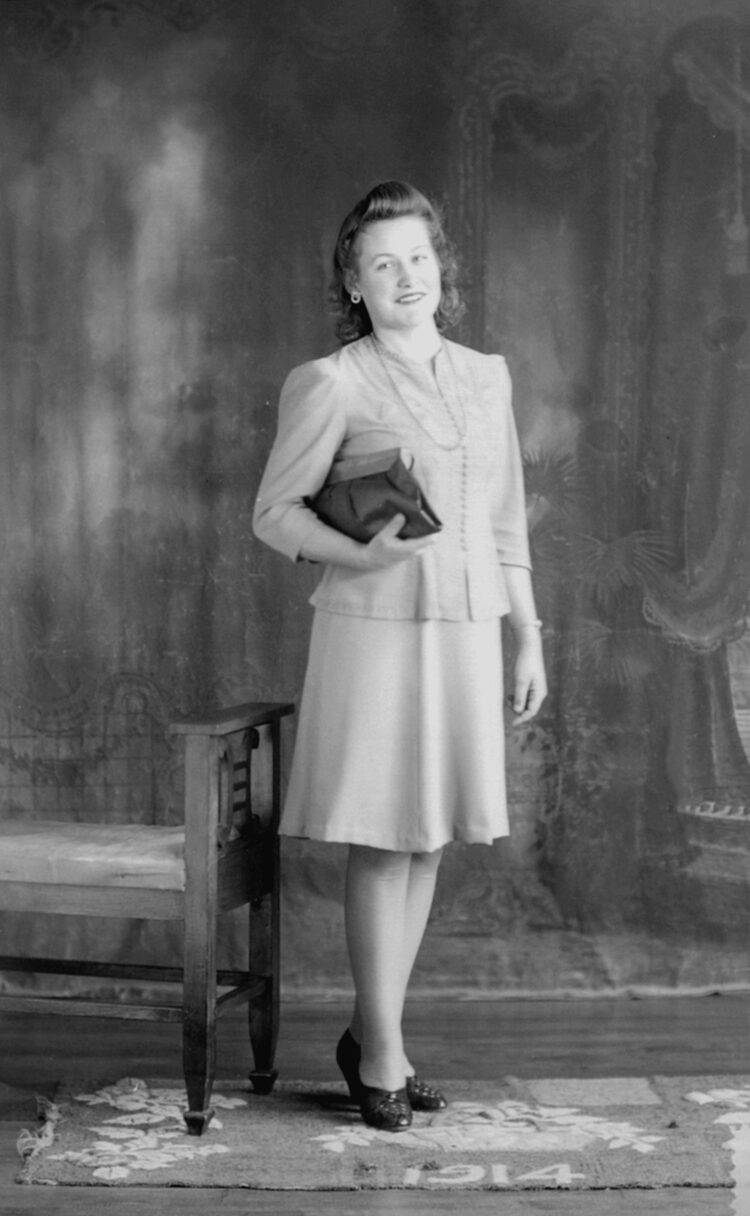
Although Marie-Alice Dumont’s early portraits are staged fairly simply, the photographer occasionally made use of a few props. She was experimenting! Here, a few plants and flowers brighten up the otherwise plain setting of a simple backdrop sheet, a rug and a wooden chair with no decorative elements. It is clear that, in the early 1920s, Dumont was gradually and methodically taking hold of her craft.
Marie-Alice Dumont photographed weddings throughout her entire career. Early on, she often posed her subjects on the veranda or stairs of her family’s home. Given the small size of the house, this was a convenient way to include everyone in the frame. Once again, the photographer showed creativity and resourcefulness as she learned her trade.
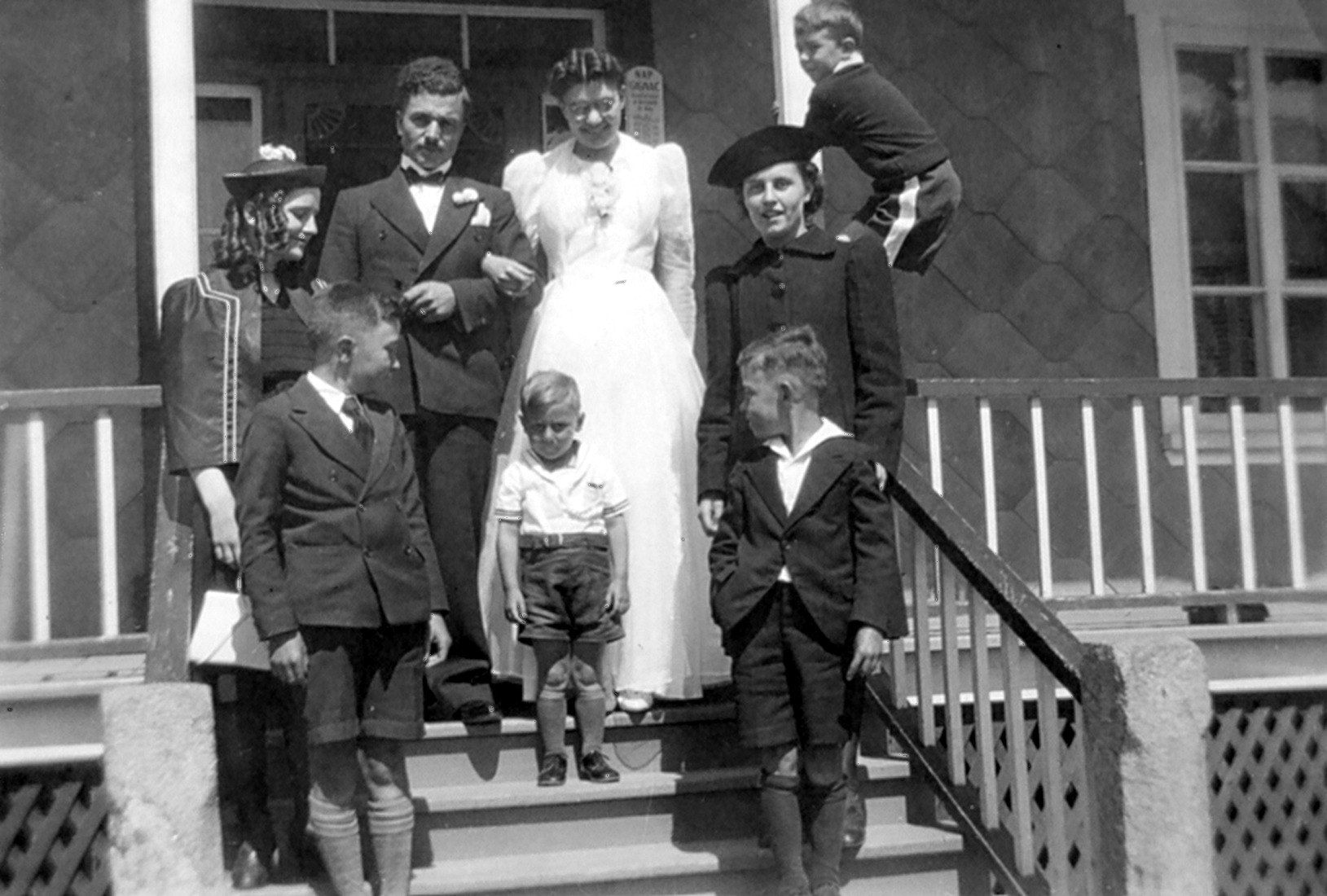
The little boy at the centre of this photograph quite literally steals the show from the bride and groom as onlookers watch him pout. The photographer may have just asked him to smile, and he, sulking, decided otherwise, much to everyone’s amusement. The portrait may not be perfect, but it brims with spontaneity and authenticity.
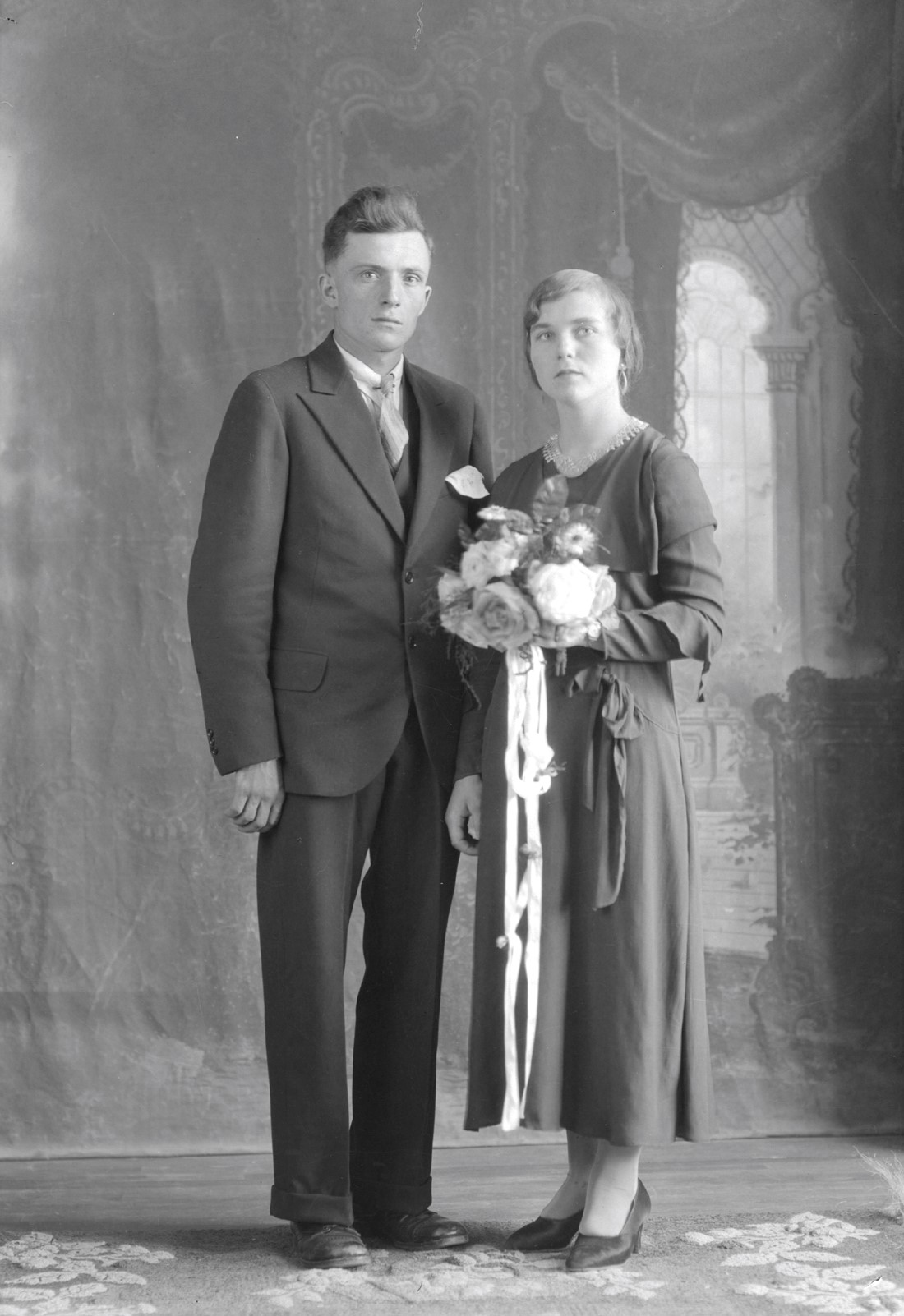
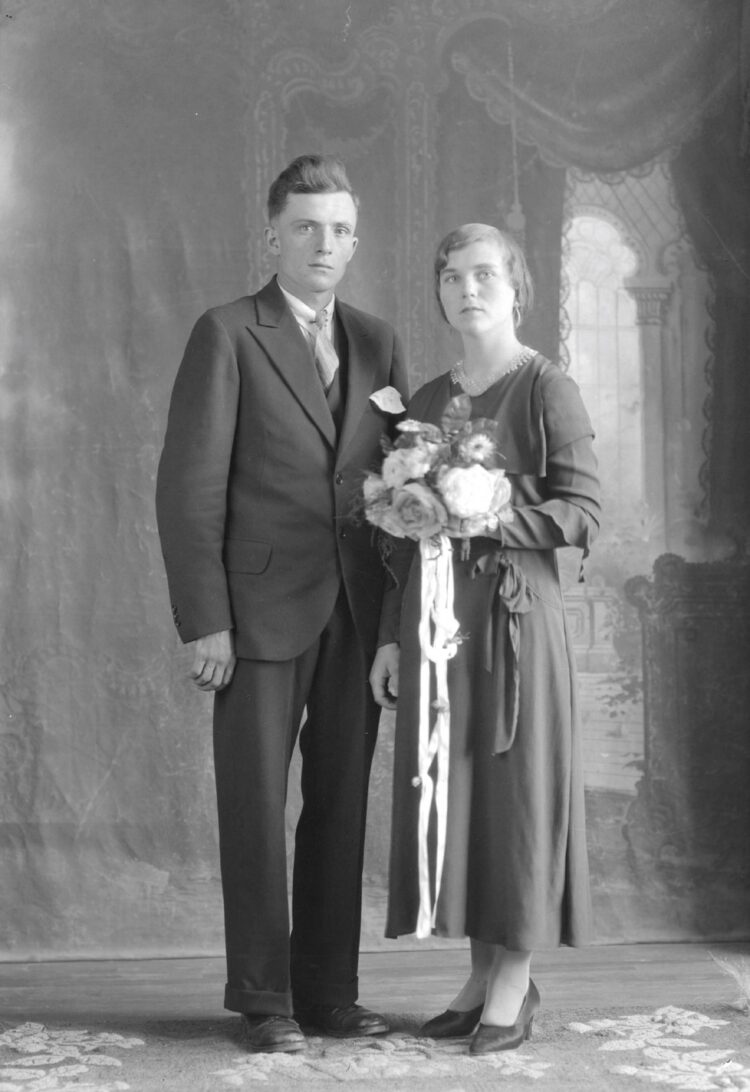
The Great Depression of the 1930s brought record levels of unemployment and severe hardship across Canada, so much so that “many people hesitated to take on the financial and social responsibilities of marriage.” Indeed, Statistics Canada data shows that, between 1928 and 1932, the country’s marriage rate fell sharply, from 7.5 to 5.9 per 1,000 people. What worries played on the minds of these young newlyweds as they posed for Marie-Alice Dumont in 1932?
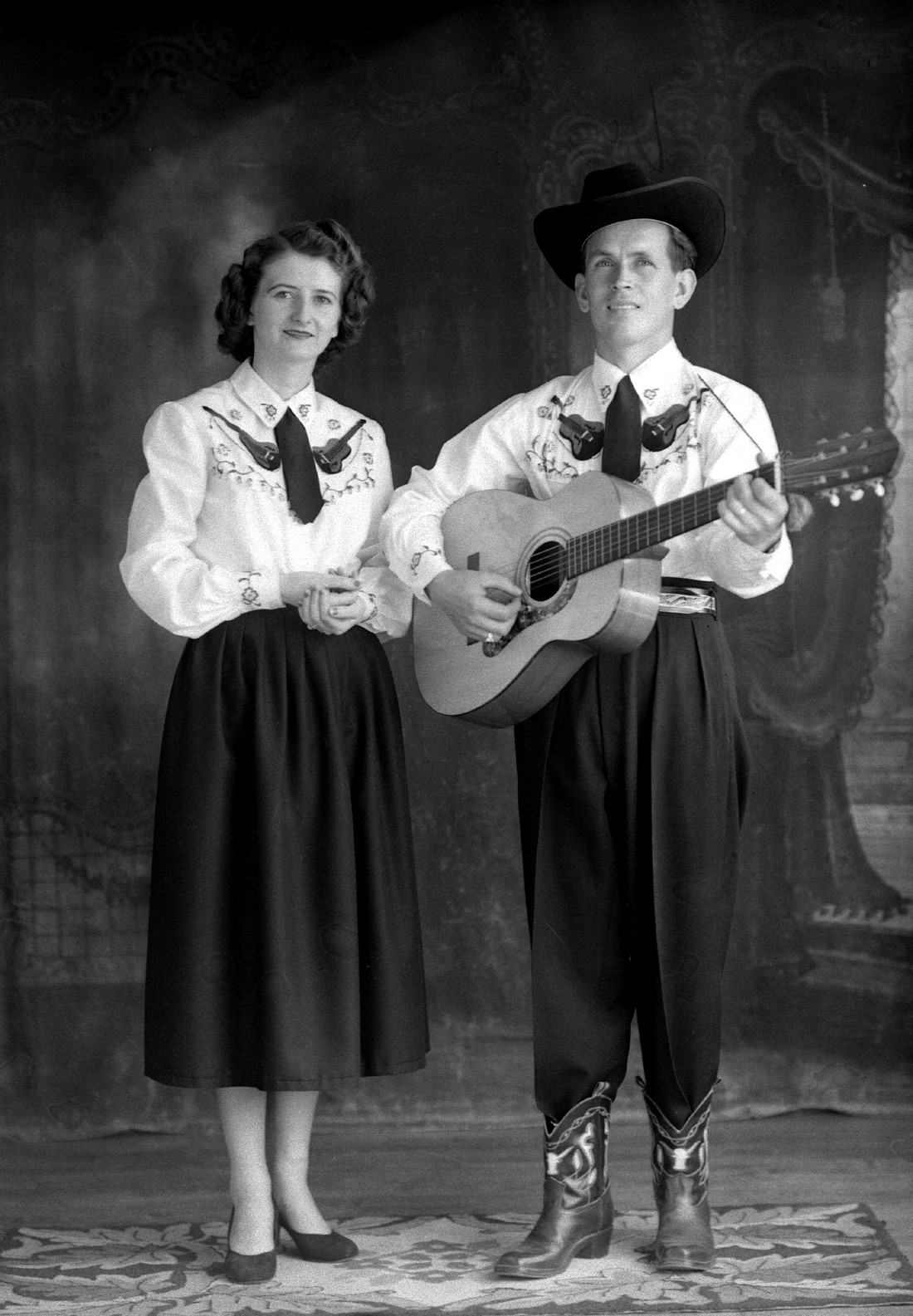
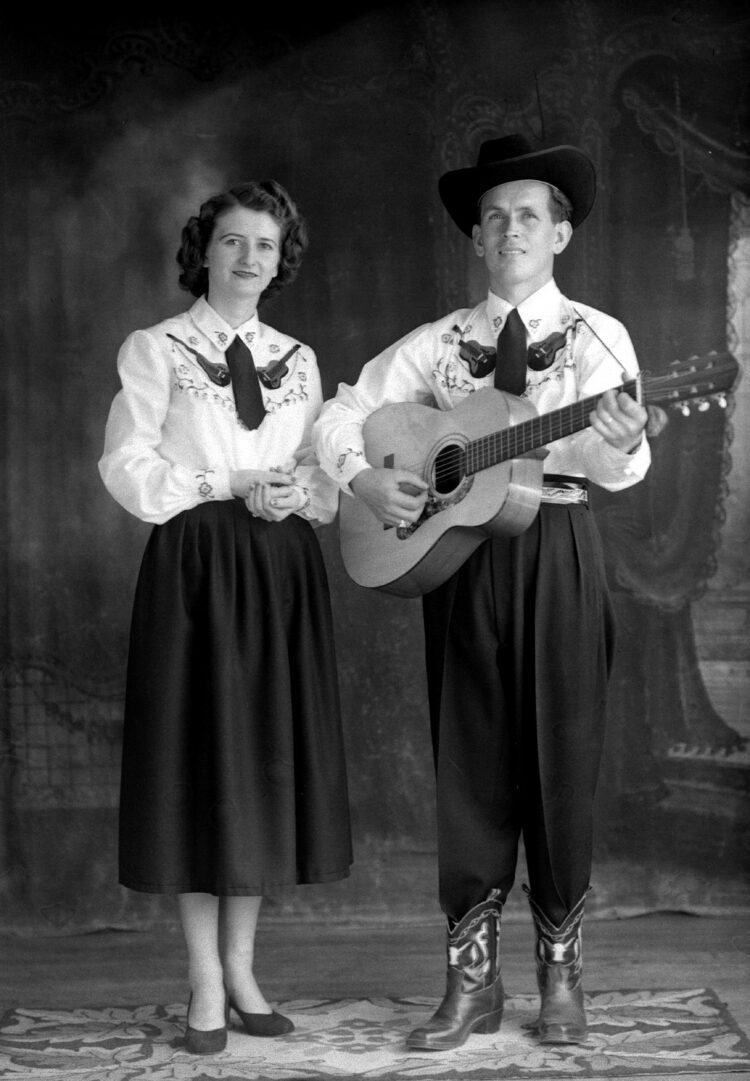
Photographs often included objects or costumes to contextualize a studio portrait. Here, the guitar held by the man and the costumes the couple are wearing clearly show that music and entertainment were part of their lives. In fact, they are none other than Anita and Édouard Castonguay, key figures on Quebec’s country music scene in the second half of the 20th century. At the time Dumont took this portrait, Édouard had just recorded his first album, and he and Anita had been touring the province with great success. With their two sons, Martin and David, they formed La Famille Castonguay, a band that enjoyed a certain notoriety. Édouard Castonguay performed his last show in Saint-Alexandre on October 8, 2005.
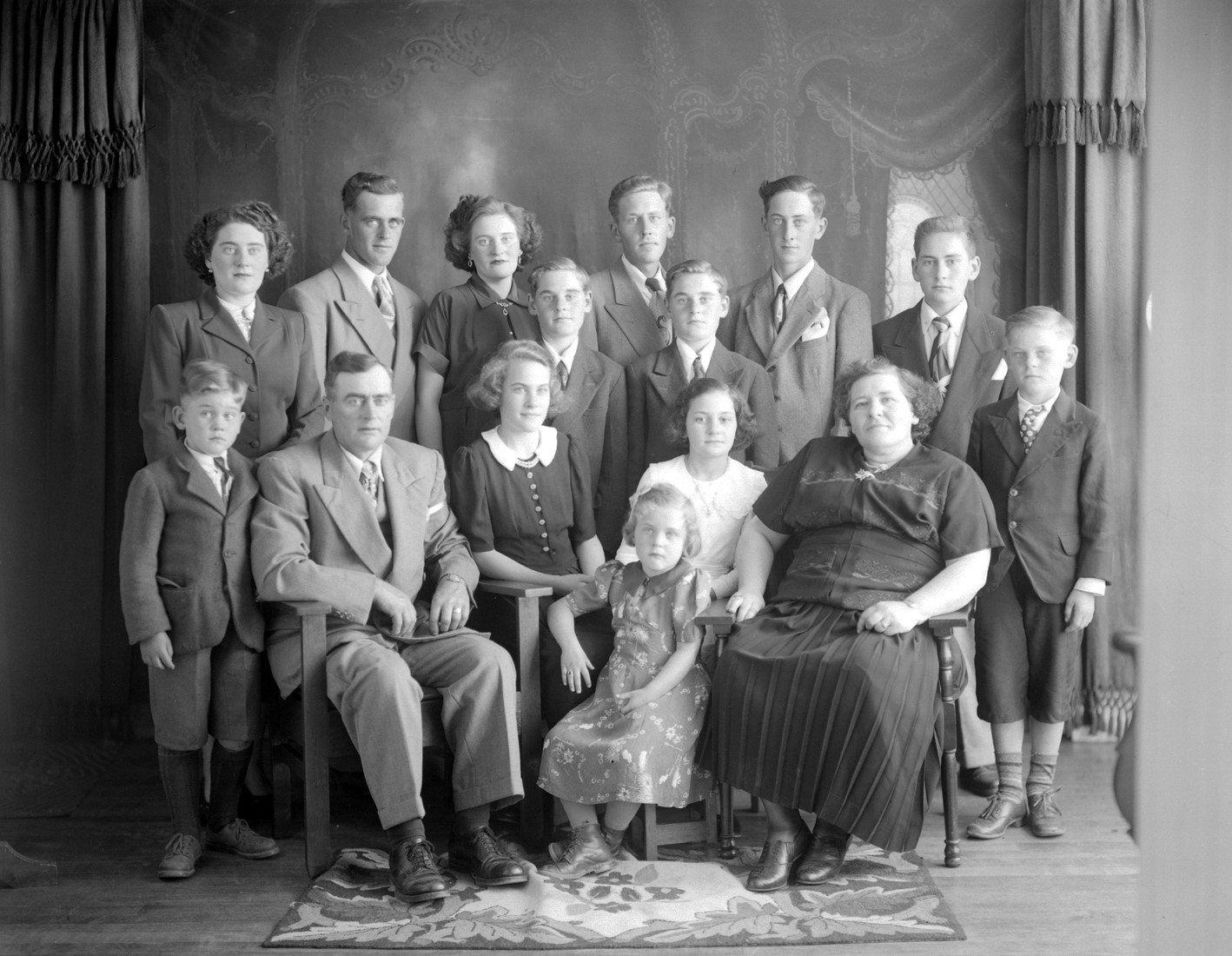
Alexandre Bérubé and Yvonne Léveillé, pictured here with their children, used this photograph in their “homage to local families,” featured in the centennial album of Saint-Alexandre in 1952.
Women
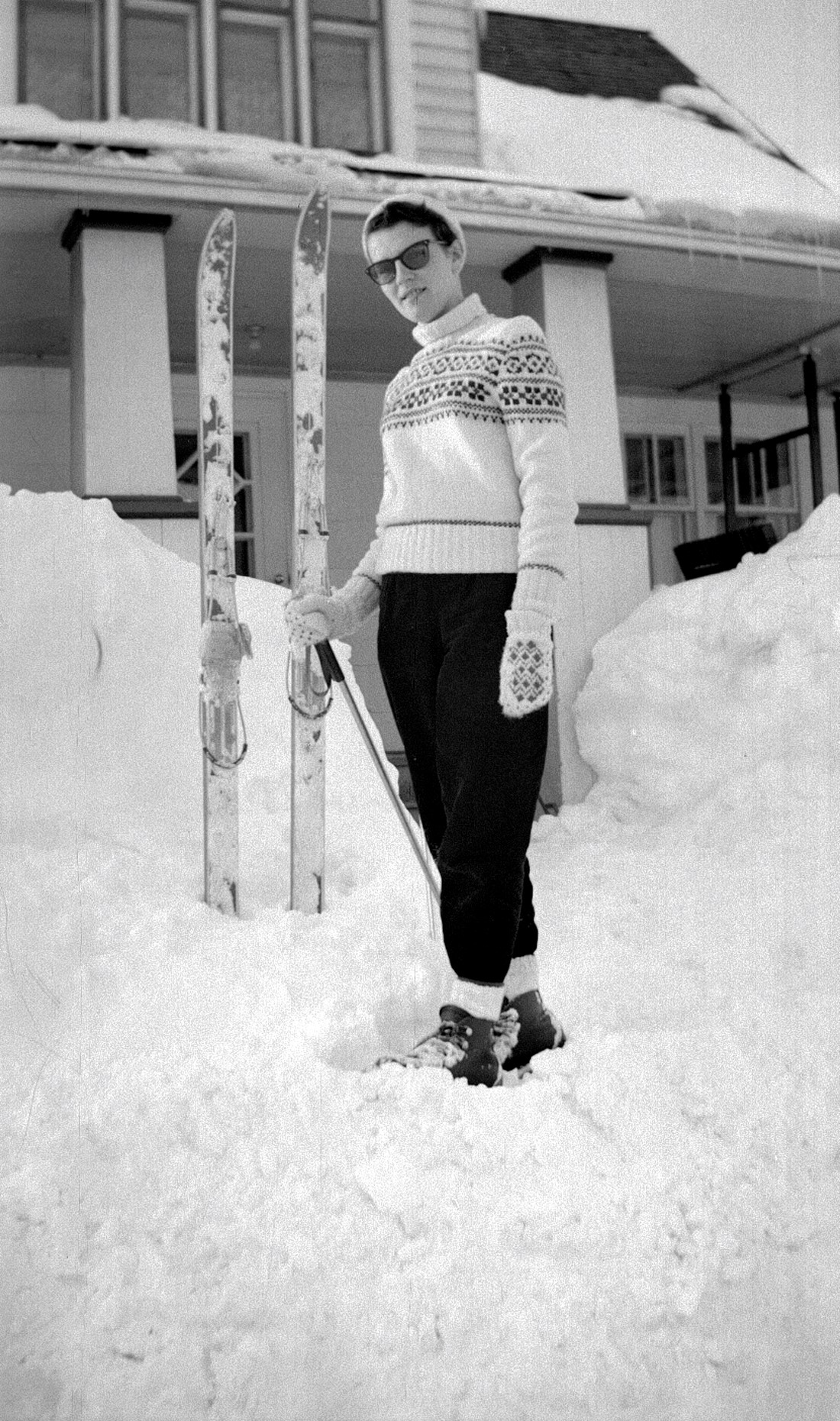
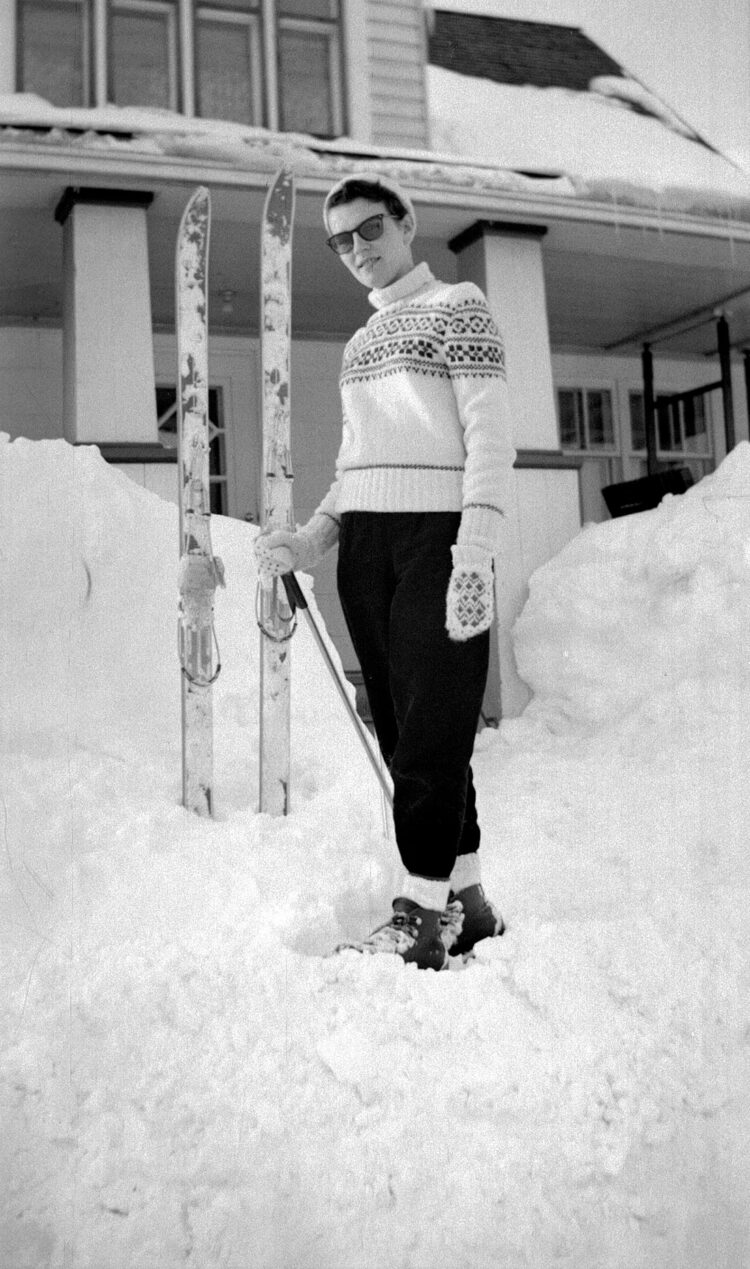
Skiing has been practised in Quebec since the late 19th century. By the time this photo was taken, in the 1920s, the sport was rapidly gaining popularity across the province, and the Bas-Saint-Laurent region was no exception.
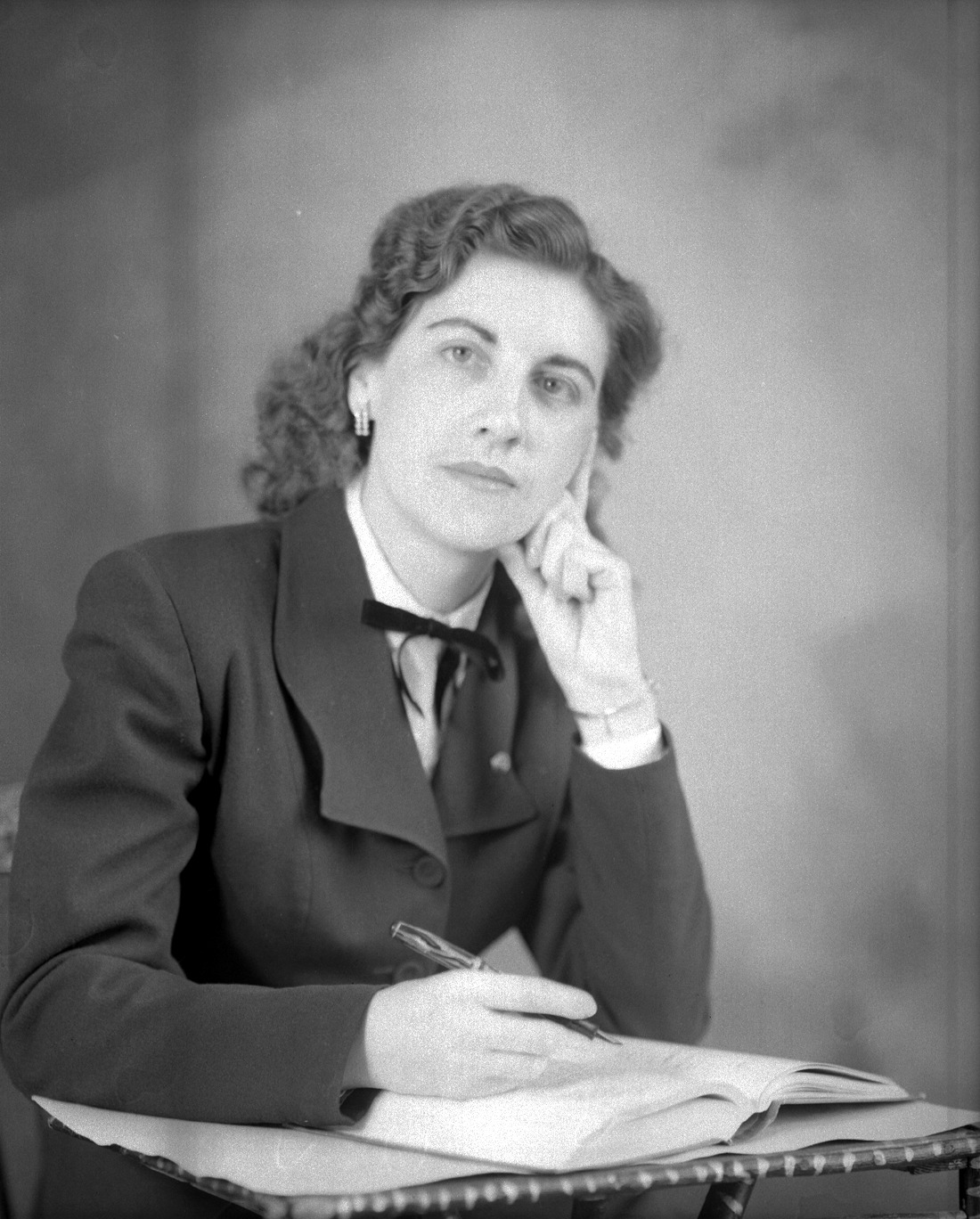
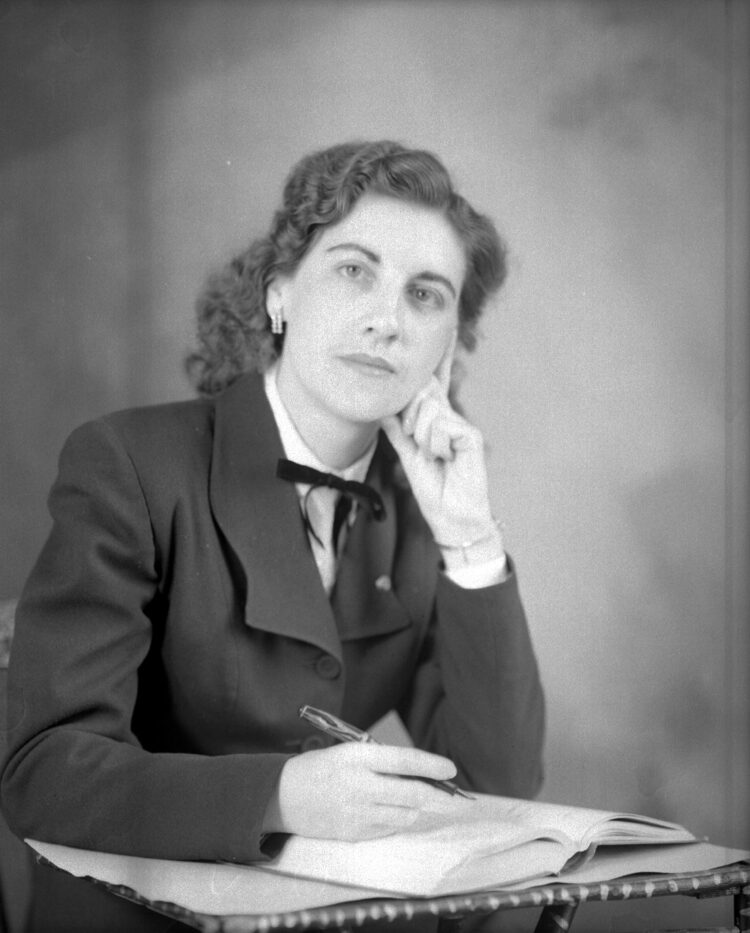
The photographer chose to portray Dolorès Garneau in a pose that reflects her profession. With pencil in hand, an open book in front of her and a thoughtful posture, the schoolteacher appears to be preparing a lesson.
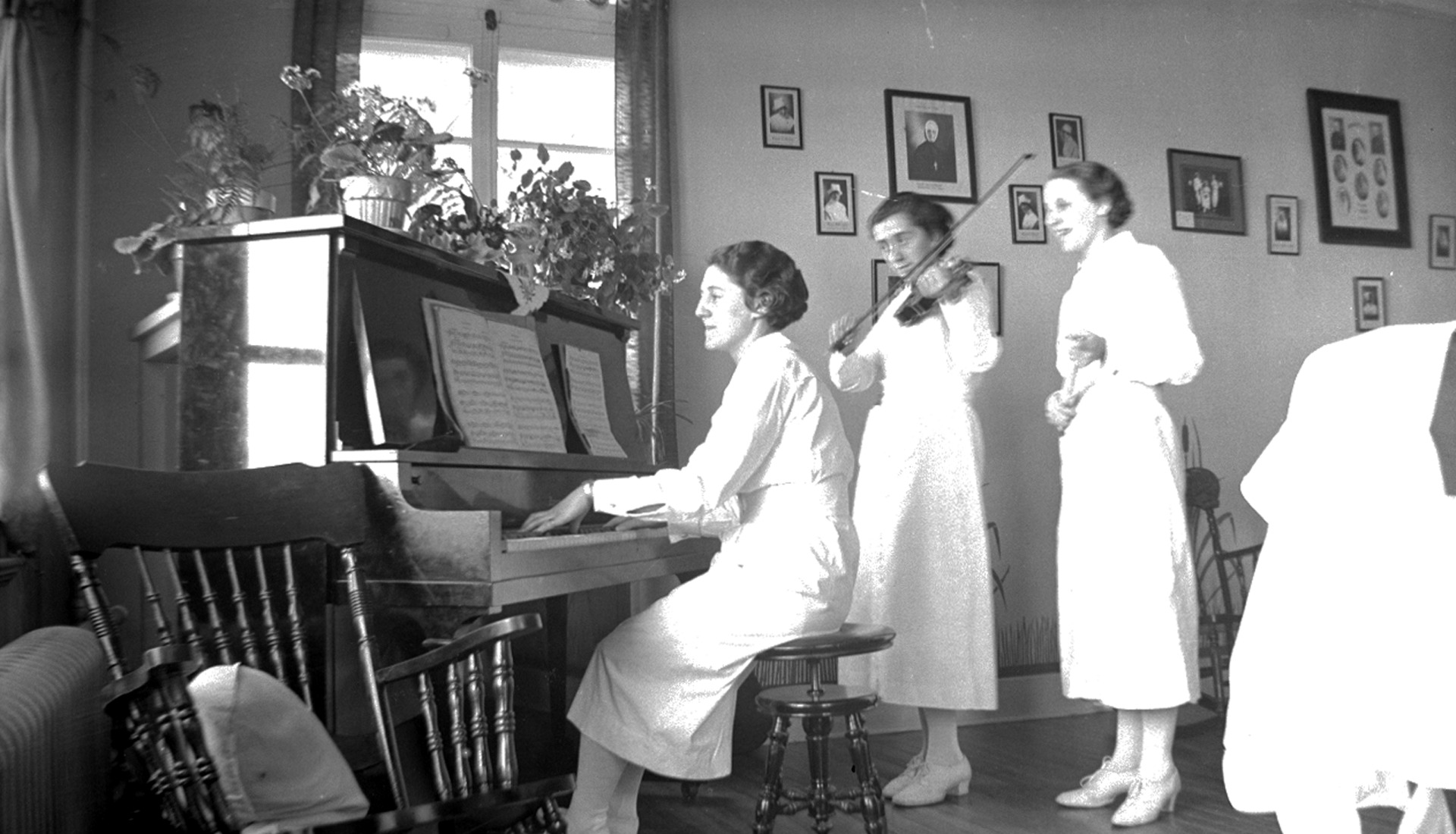
When Marie-Alice Dumont was hospitalized in Rivière-du-Loup in 1936, she took the opportunity to document the daily life of the nursing staff. Beyond the medical care, there were also moments of amusement like this one, where three nurses are caught mid-performance: one at the piano, another on the violin and the third playing the flute.
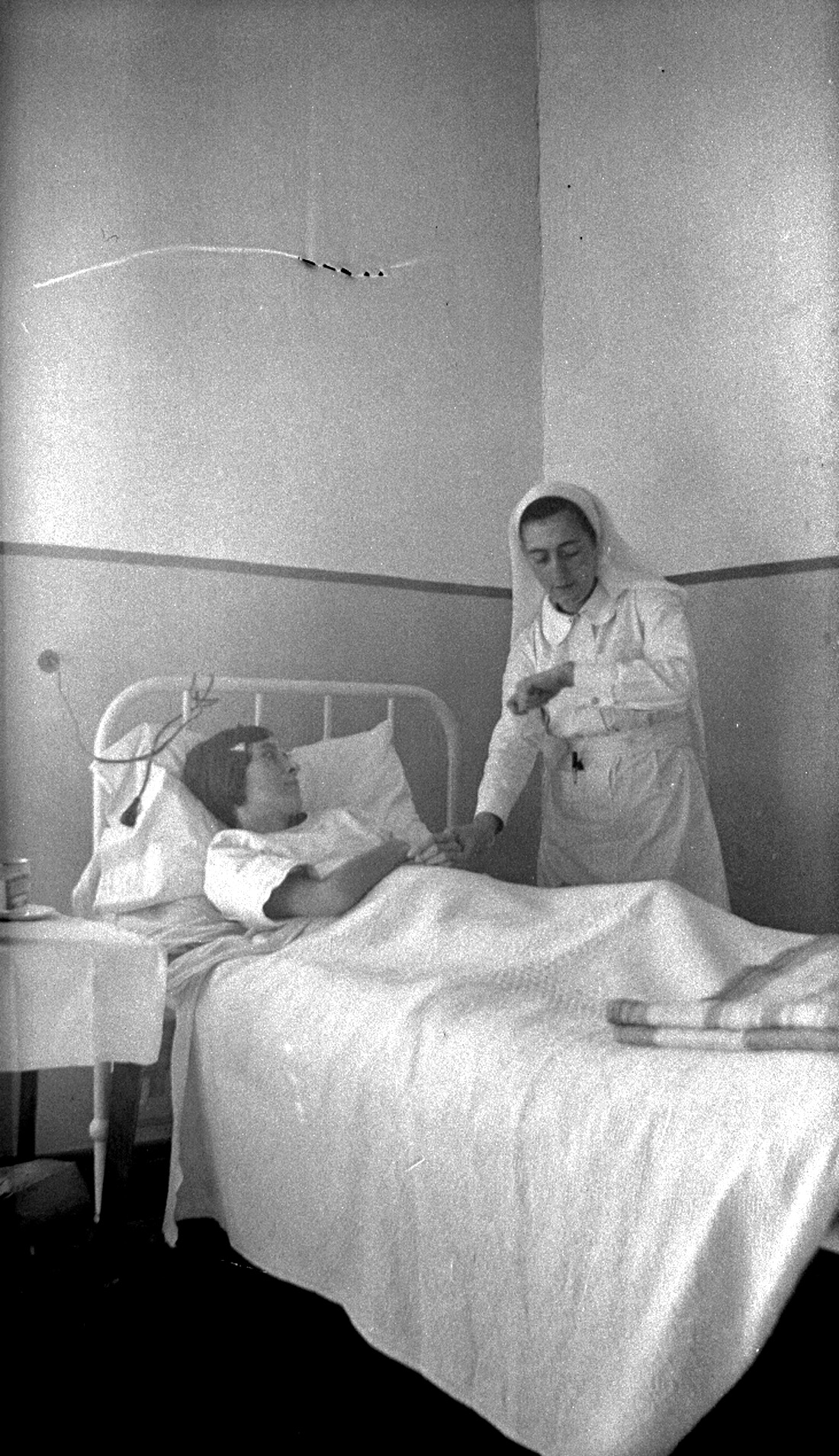
The photographs Dumont took at the Rivière-du-Loup hospital in 1936 provide valuable insight into the work of healthcare staff in early 20th-century Quebec. This image is a beautiful example.
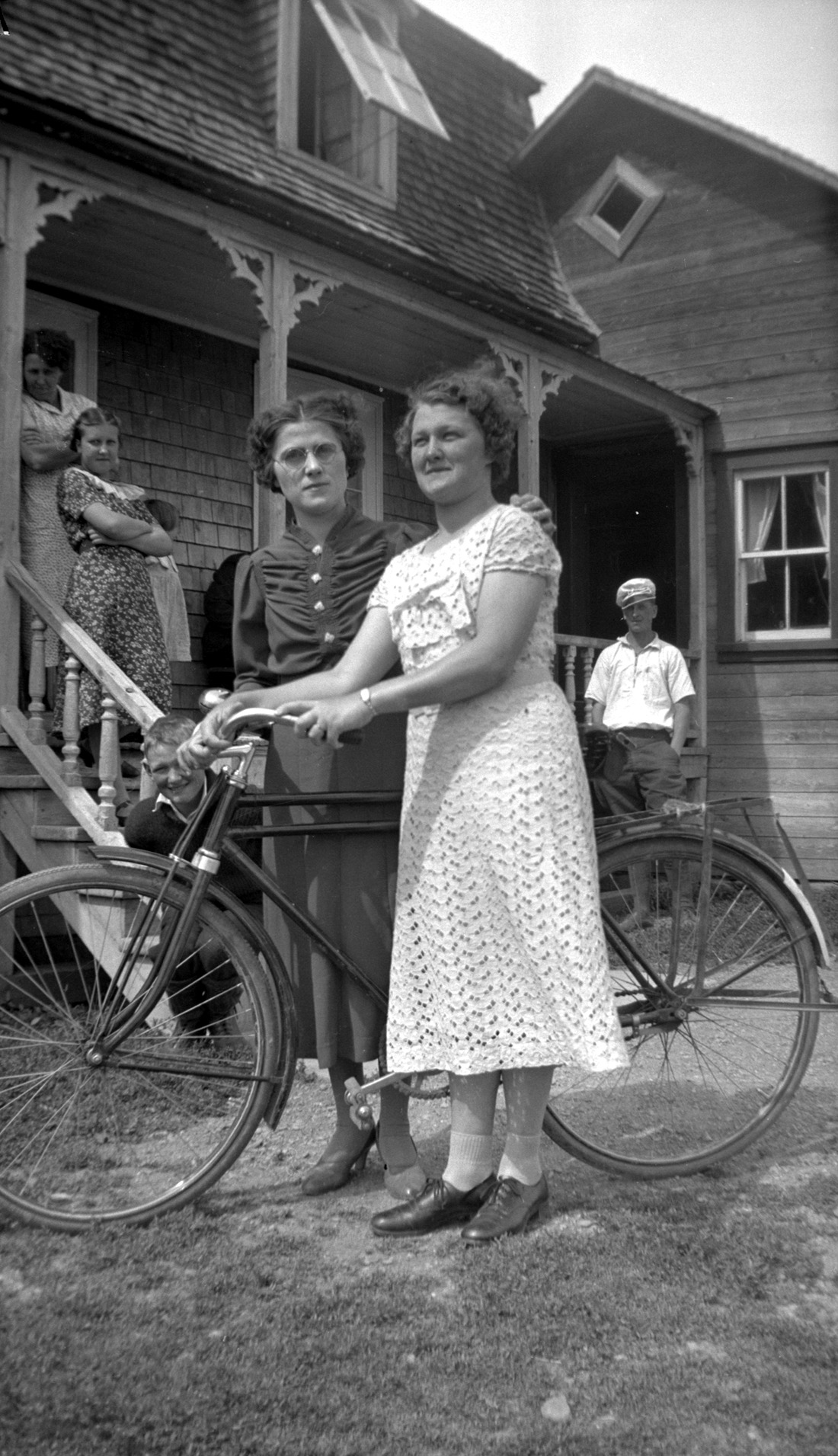
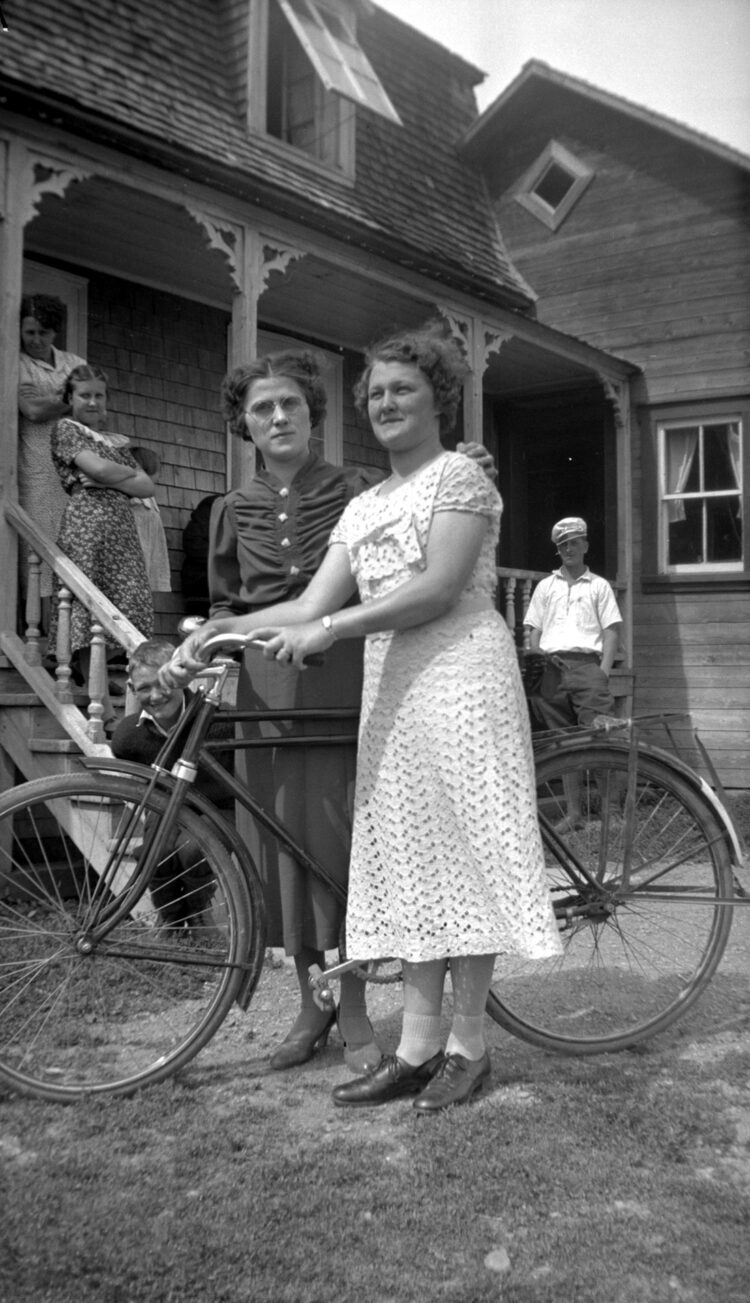
According to some historians, the bicycle, which gained popularity around the turn of the 20th century, offered women a temporary escape from the domestic sphere. In the 1930s and 1940s, cycling was the most accessible means of transportation for women in rural areas, since it was still only men who drove cars!
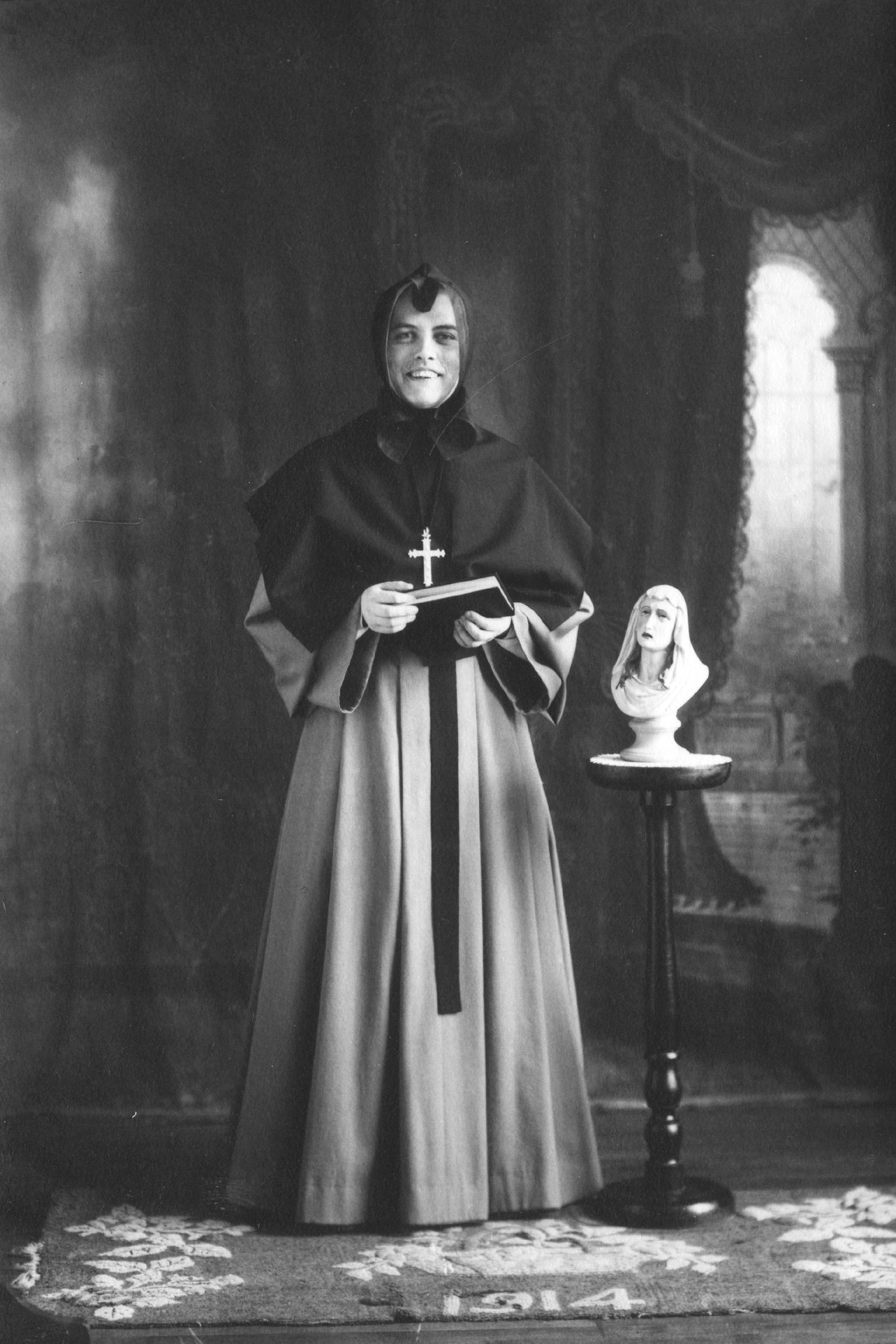
Sister Jeanne-de-la-Trinité, a Sister of Charity, smiles warmly at Dumont’s camera. She was part of the teaching staff at the convent in Saint-Alexandre.
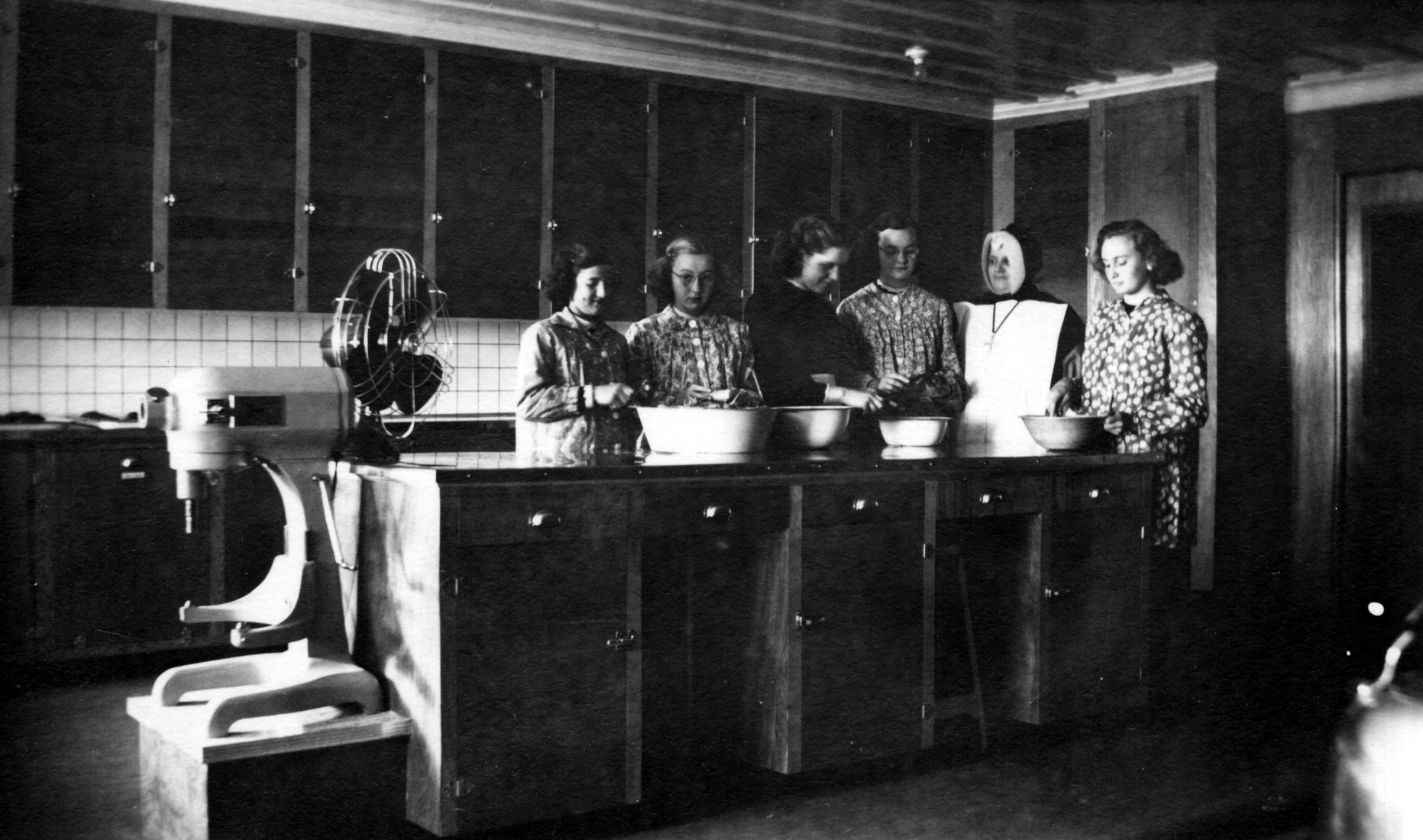
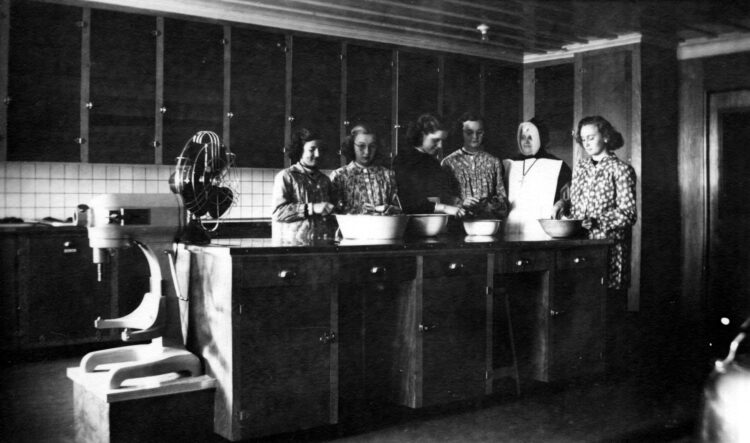
In Quebec’s convents, girls were taught the basics of the “domestic arts” until the 1960s. This curriculum later evolved into home economics, which was offered to both boys and girls in secondary schools until 2006.
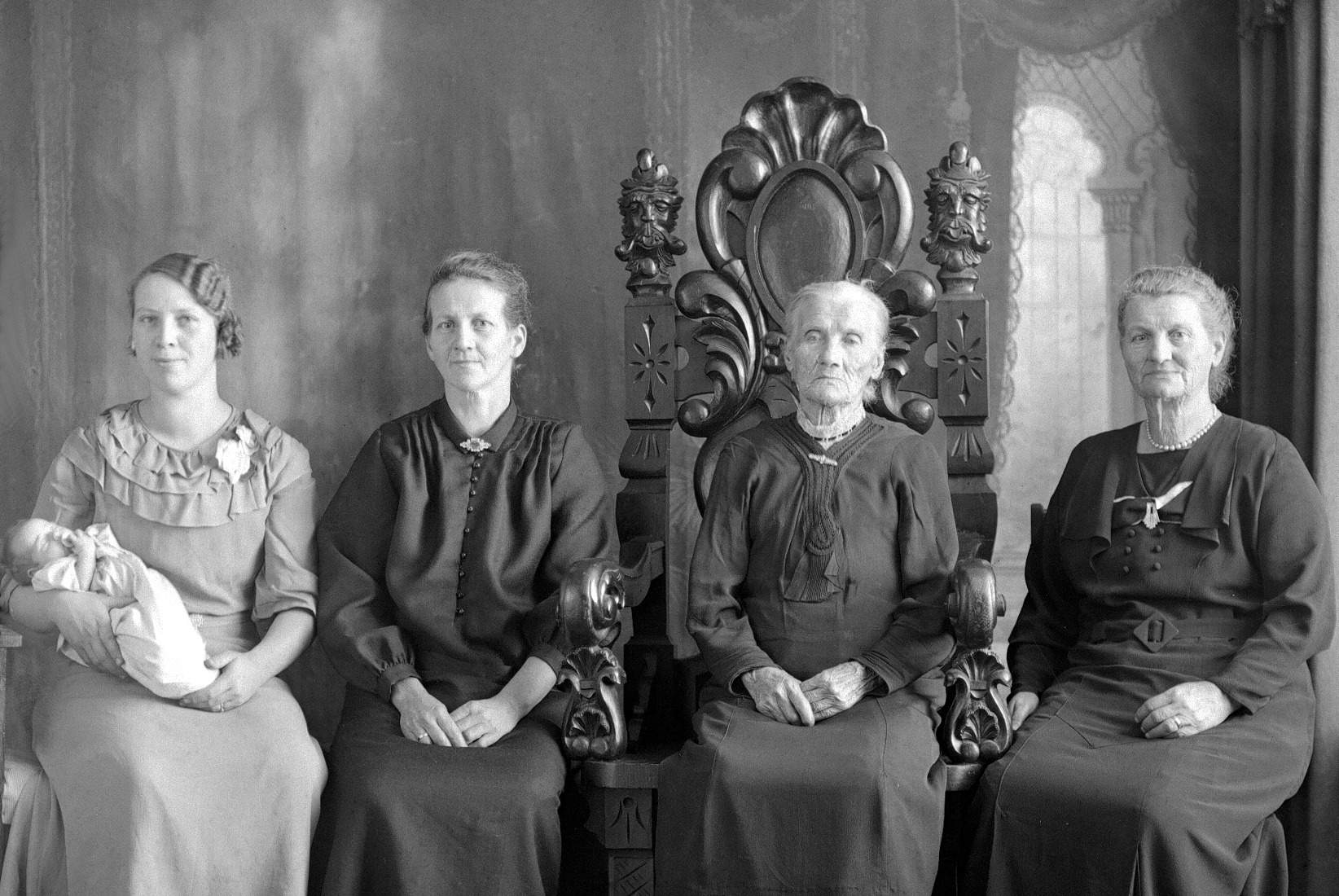
As this multigenerational portrait shows, many of Dumont’s clients could proudly say they had known their great-grandmother, or even their great-great-grandmother.
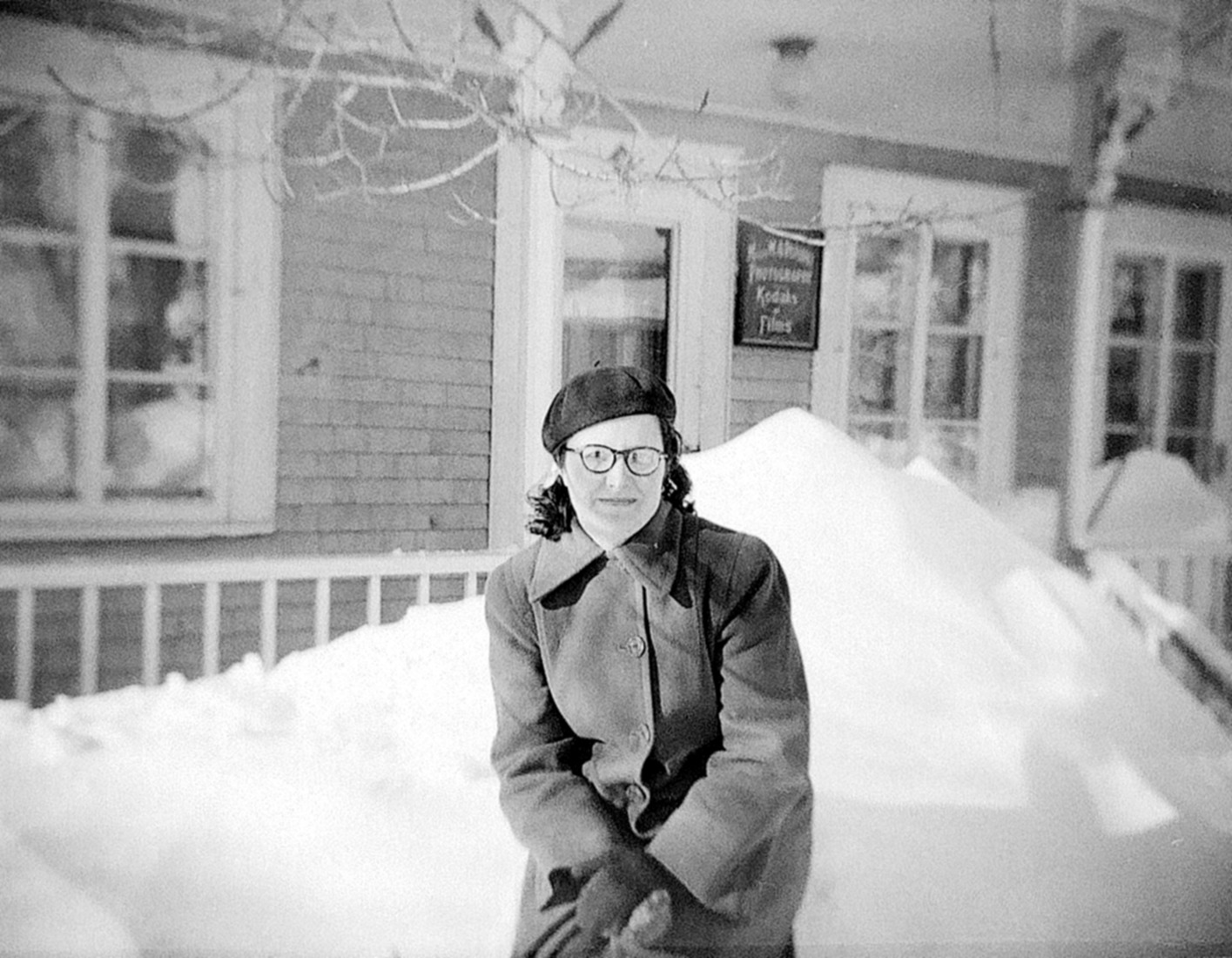
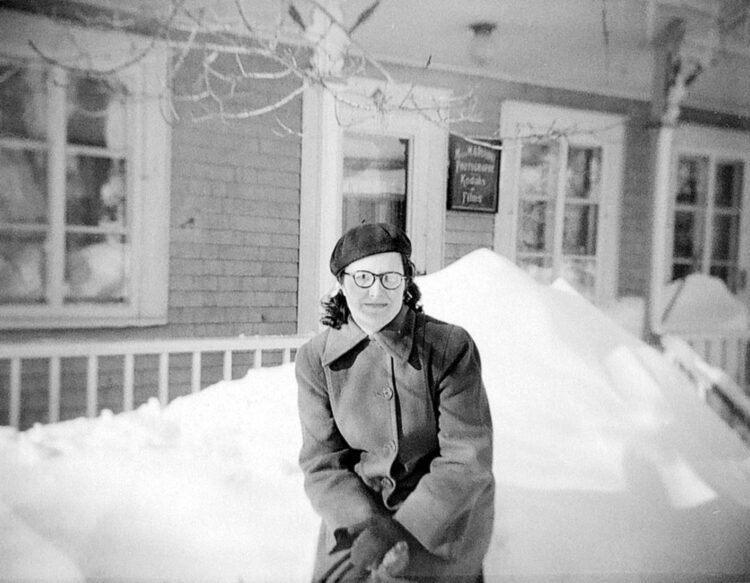
Dumont worked in a profession that was quite unusual for a woman of her time. The same could be said of her three assistants, including Lucille Bérubé, shown here standing in front of Dumont’s studio.
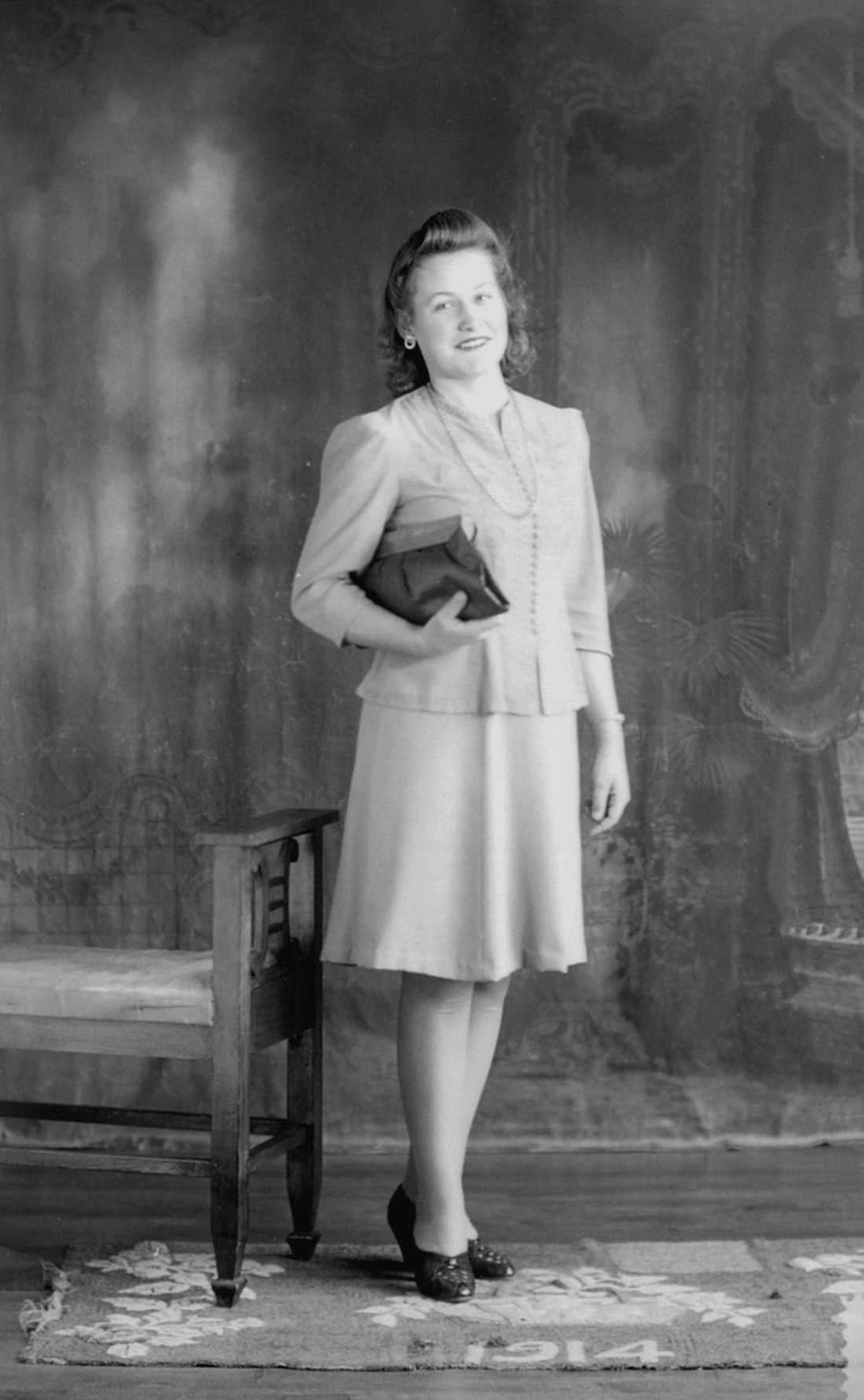
Marie-Anne St-Pierre, also a teacher, likely worked in one of the one-room schoolhouses of Saint-Alexandre. Her job was a challenging one: limited teaching materials, a poorly heated classroom, meagre pay, a large class, students of various grade levels, and an often solitary life. Such was the daily reality of rural schoolteachers.
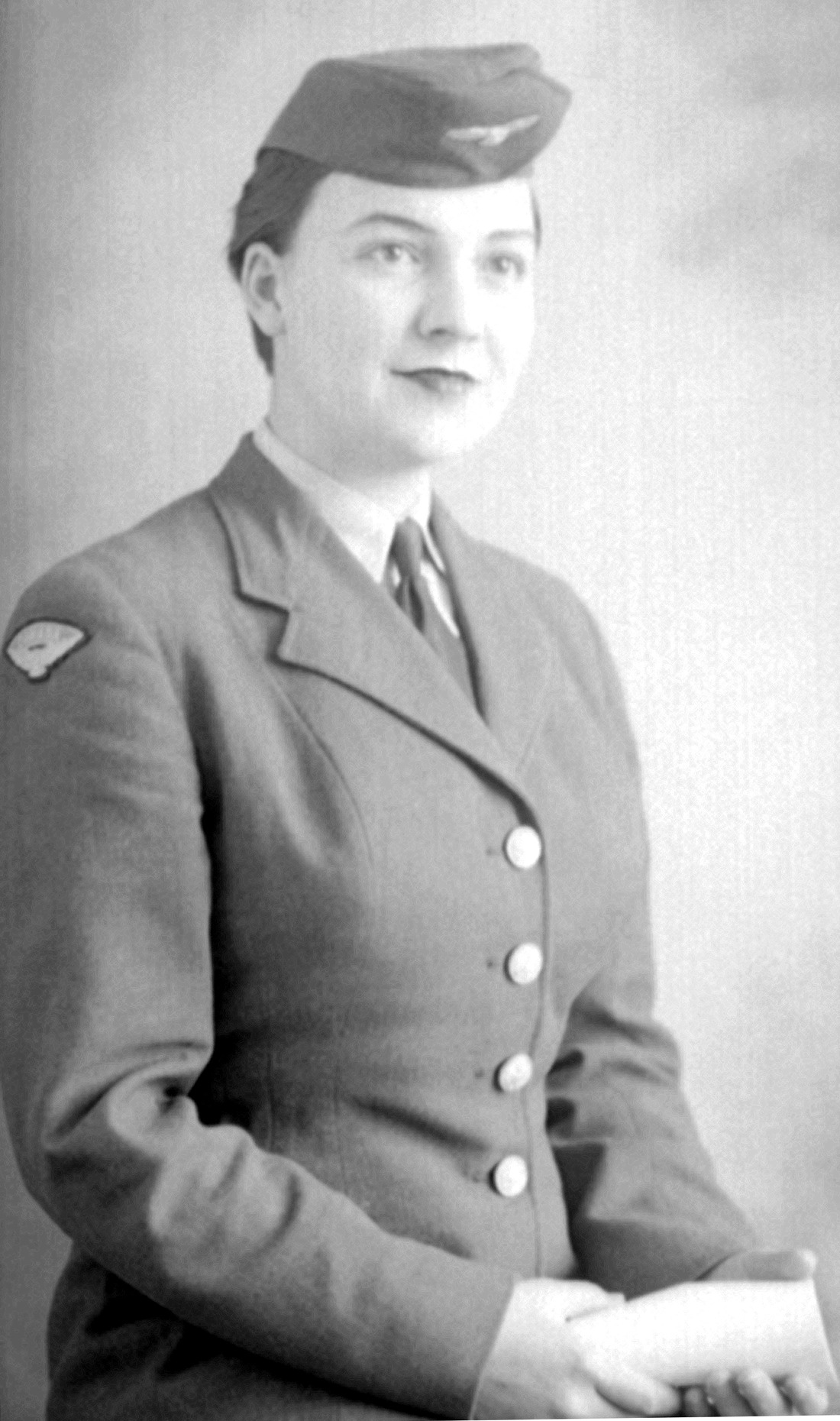
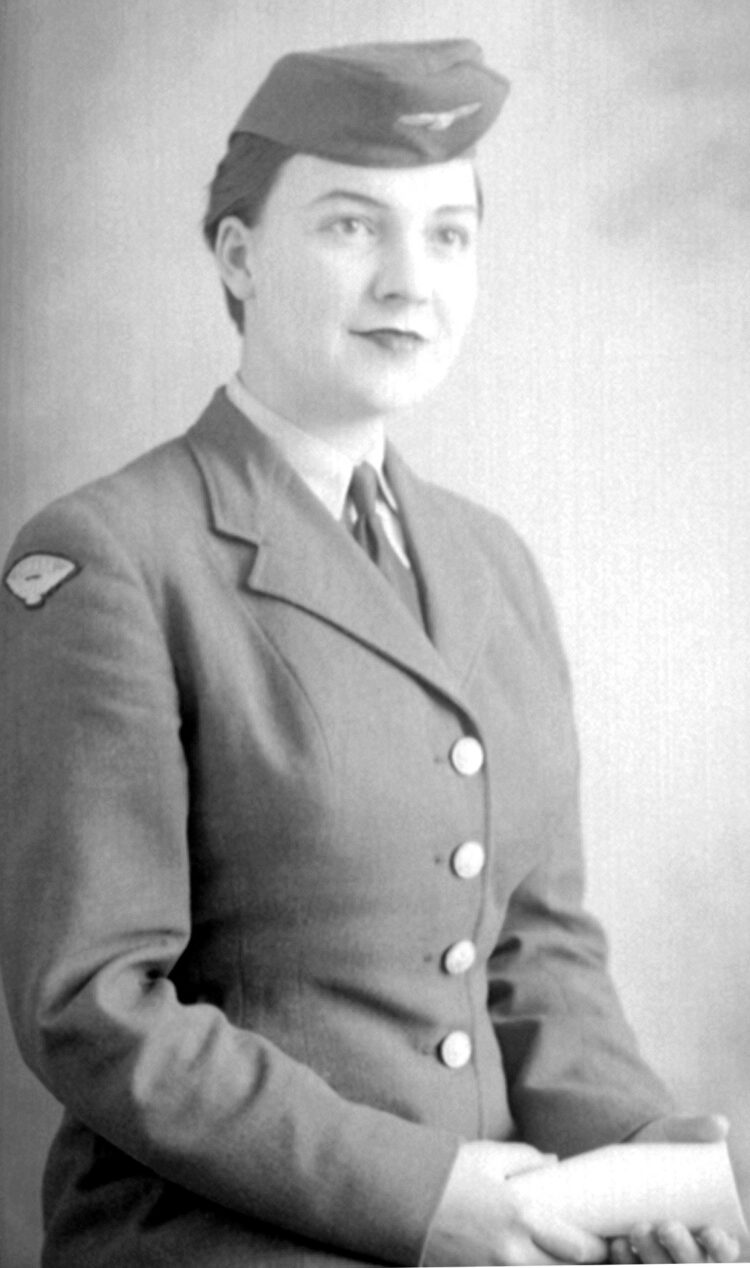
Here is a striking portrait of Pierrette Lavoie in her flight attendant uniform. Up until at least the 1960s, the hiring criteria for stewardesses were extremely strict. At Trans-Canada Air Lines, for instance, candidates had to be young, attractive, single, bilingual, slender, healthy and neither too tall nor too short.
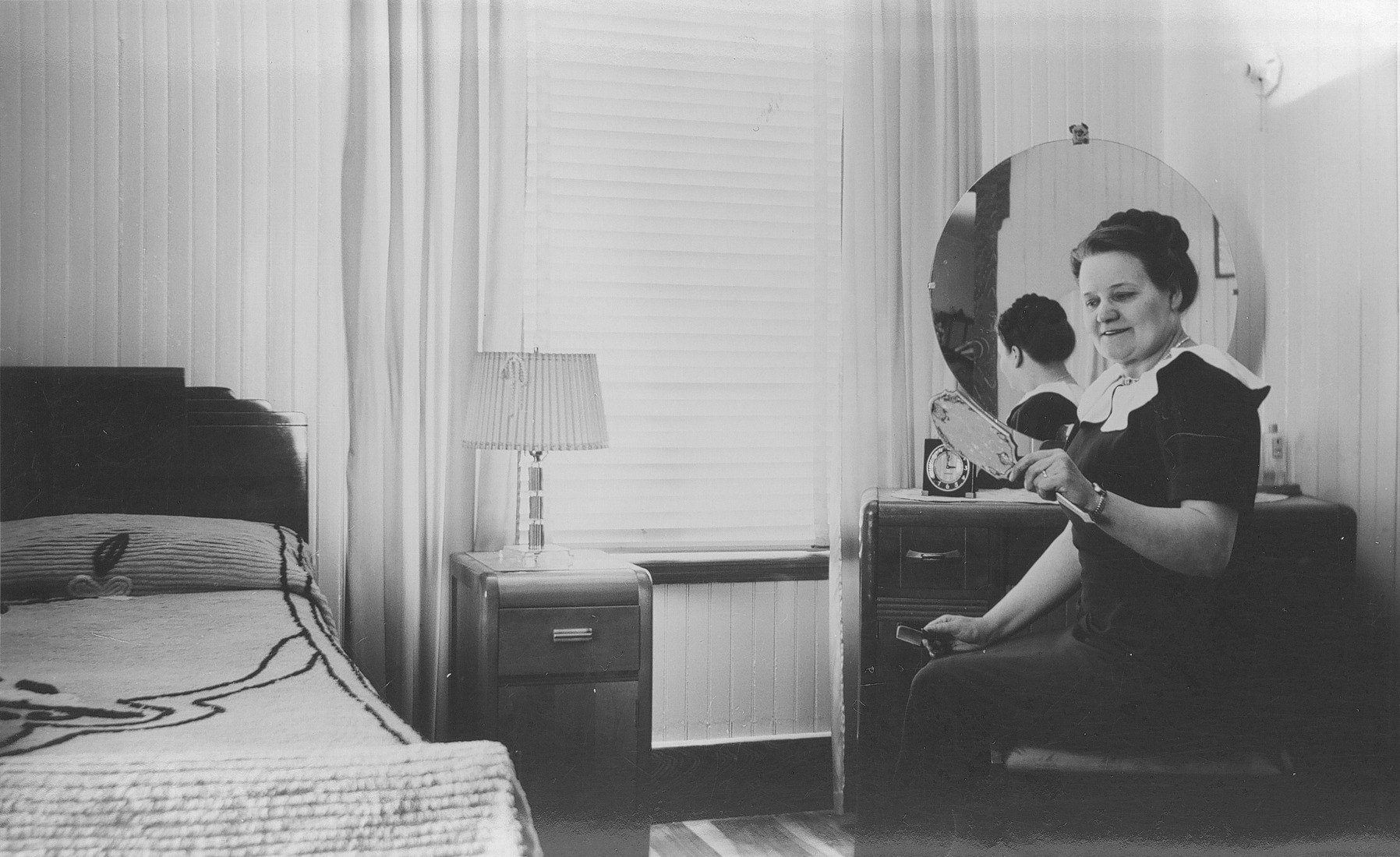
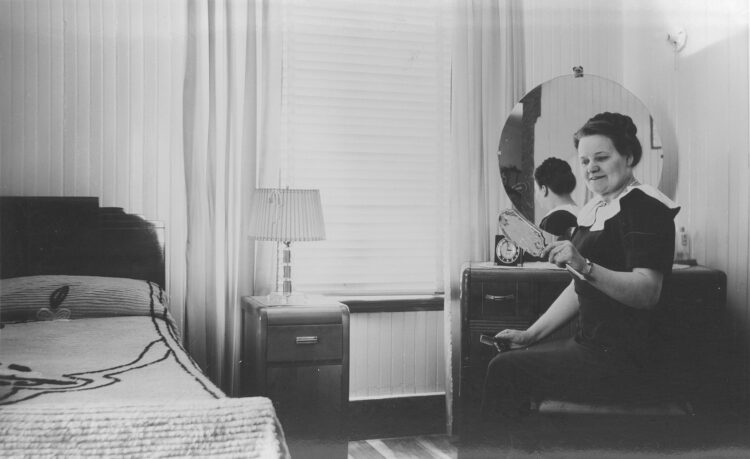
On a sunny afternoon in 1950, Marie-Alice Dumont visited the Pelletier store for a photo session with the women of the household. Mrs. Camille Pelletier and her daughters posed alone or together, in various settings that reflected their daily lives. In this scene, Mrs. Pelletier sits at her vanity in the modern comfort of her bedroom.
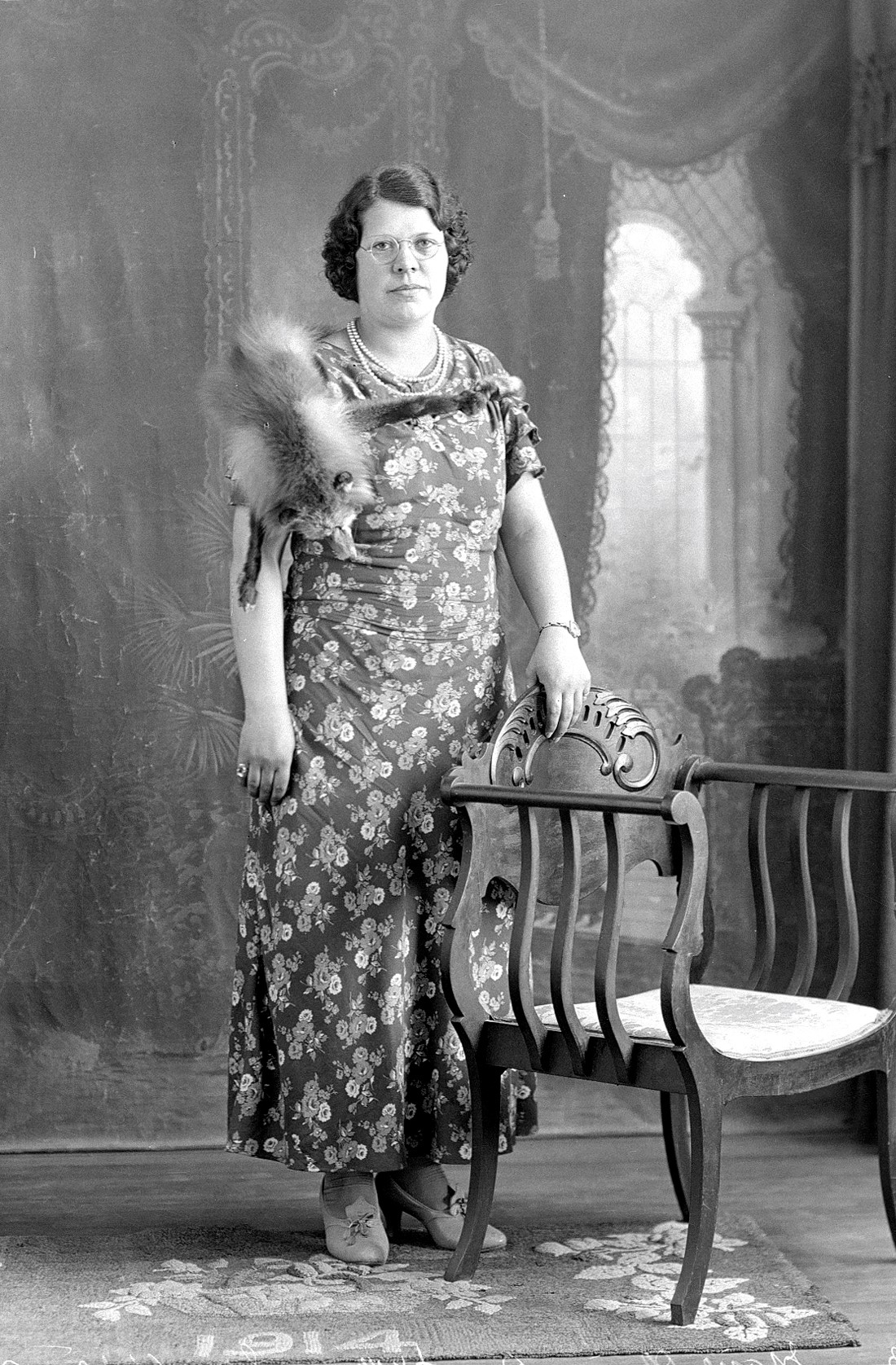
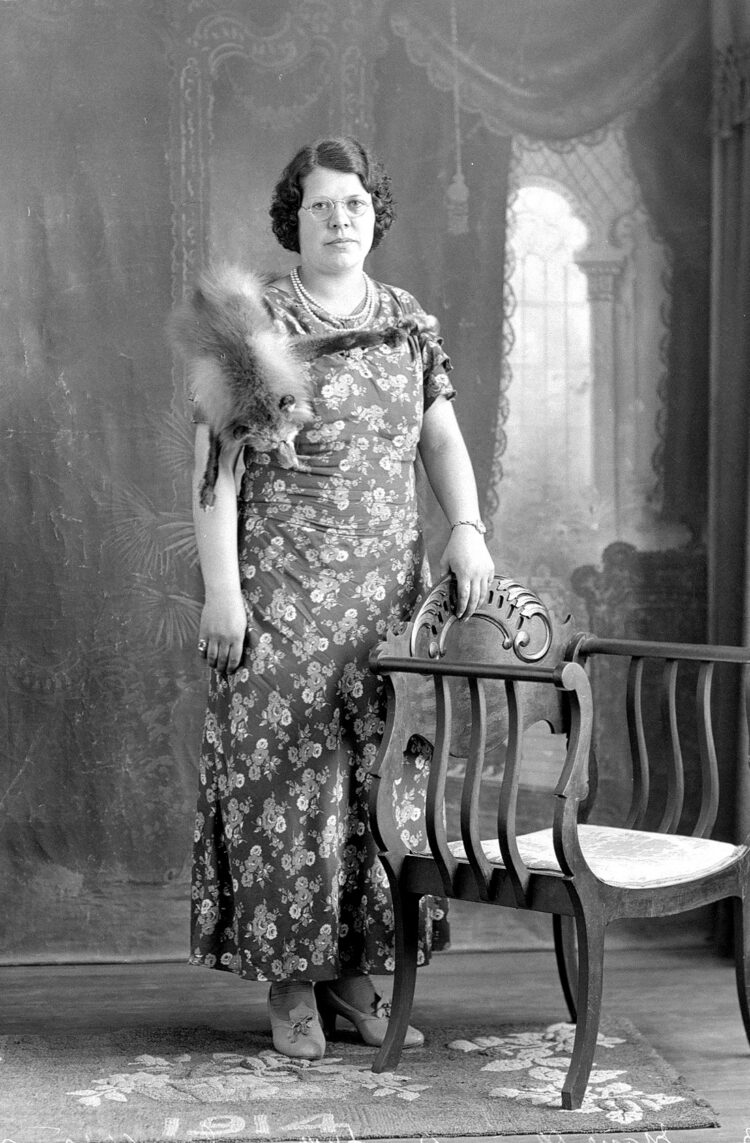
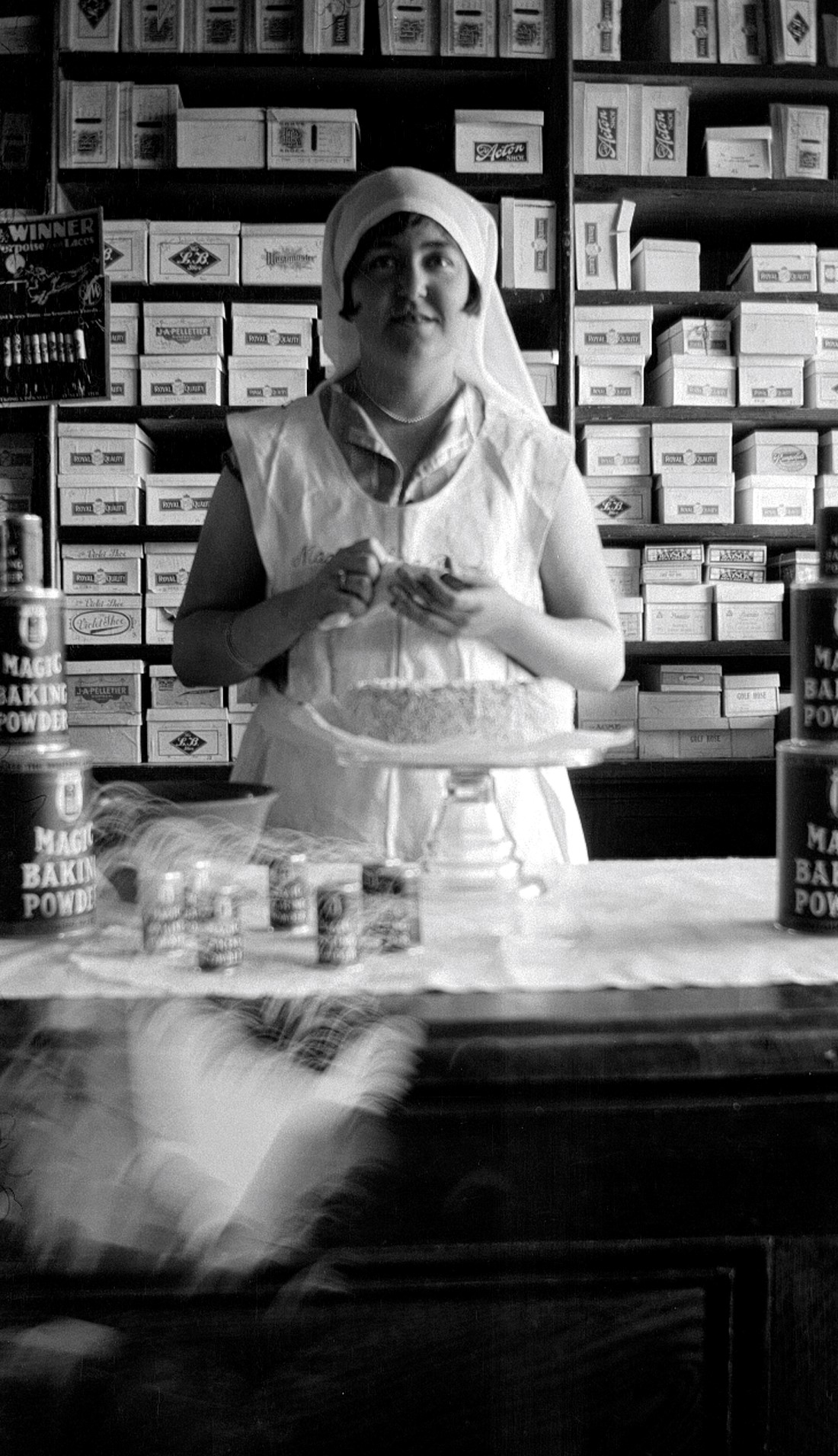
From the very beginning of her photography career, Marie-Alice Dumont documented the life of her community with a particular focus on local trades and traditions, as if she were paying tribute to them. Many of these images, like this one, are marked by their simplicity and authenticity.
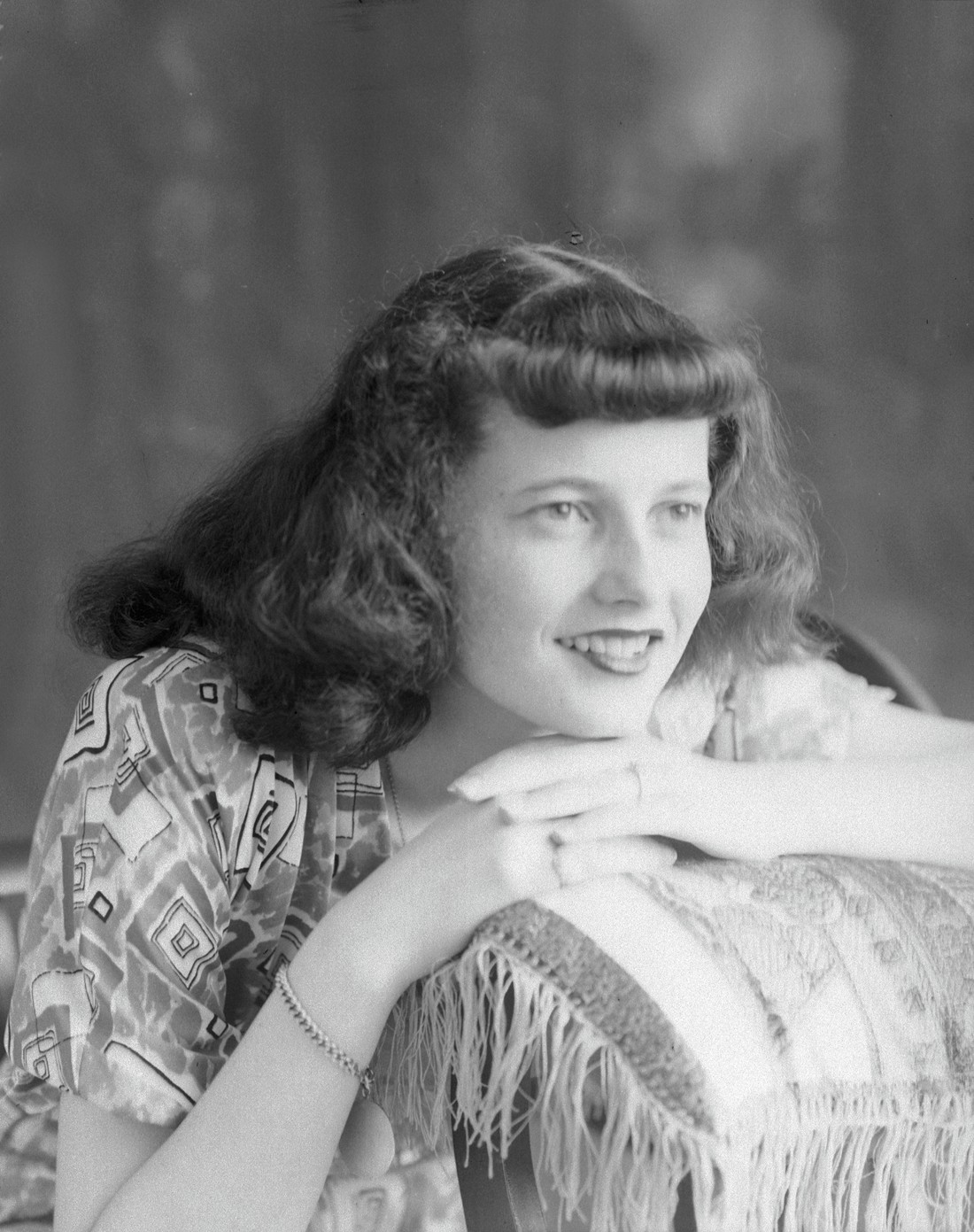
From the 1940s onwards, the young women who came to Dumont’s studio increasingly adopted relaxed poses that were less conventional and more “modern.” Perhaps they were even considered a little daring, too. Would this have been at the photographer’s suggestion or at her clients’ request? Probably a bit of both because both the photographer and her subjects wanted to be fashionable. The two portraits of Gaétane Bélanger in the Dumont collection are similar: the subject is seated, captured from the waist up and posed at an angle, the body relaxed, her eyes focused away from the camera. Here, her chin is resting on both hands poised on a cushion, as if Gaétane were being photographed in a natural moment of contemplation.
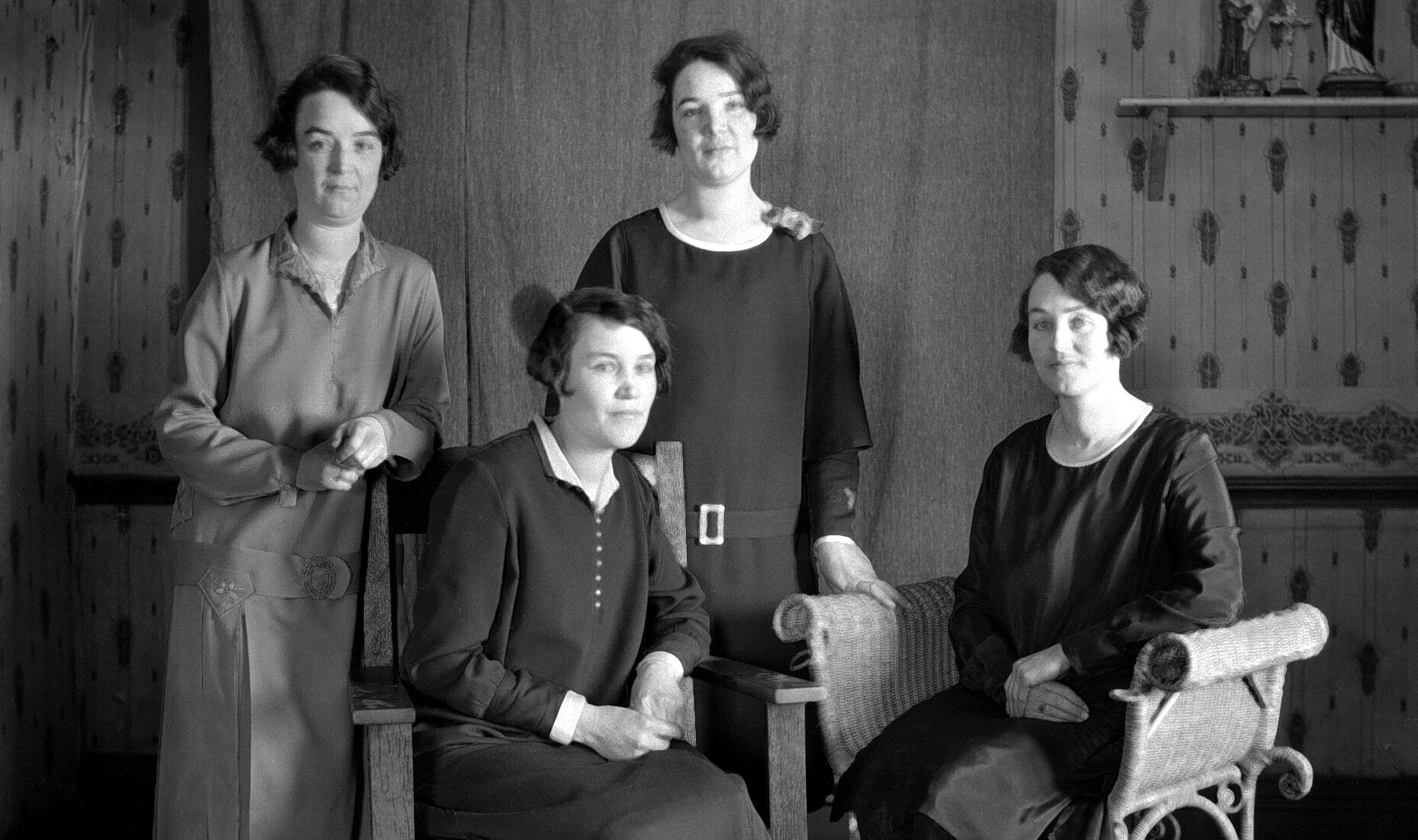
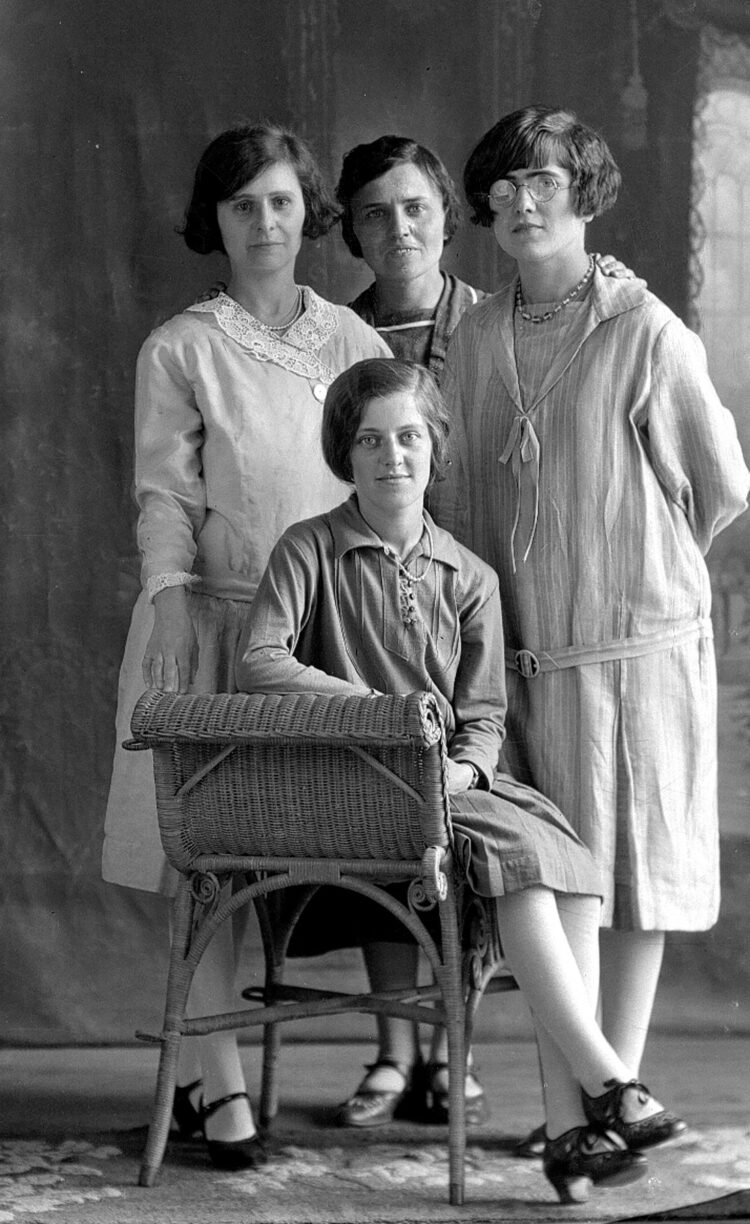
This portrait of four women was taken in the Dumont family home on the 5e Rang in Saint-Alexandre, where Dumont created her first studio portraits. It gives us a sense of how limited her workspace was. We also get a glimpse of the domestic world she grew up in: Note the wallpaper and the small shelf to the right, displaying religious objects.
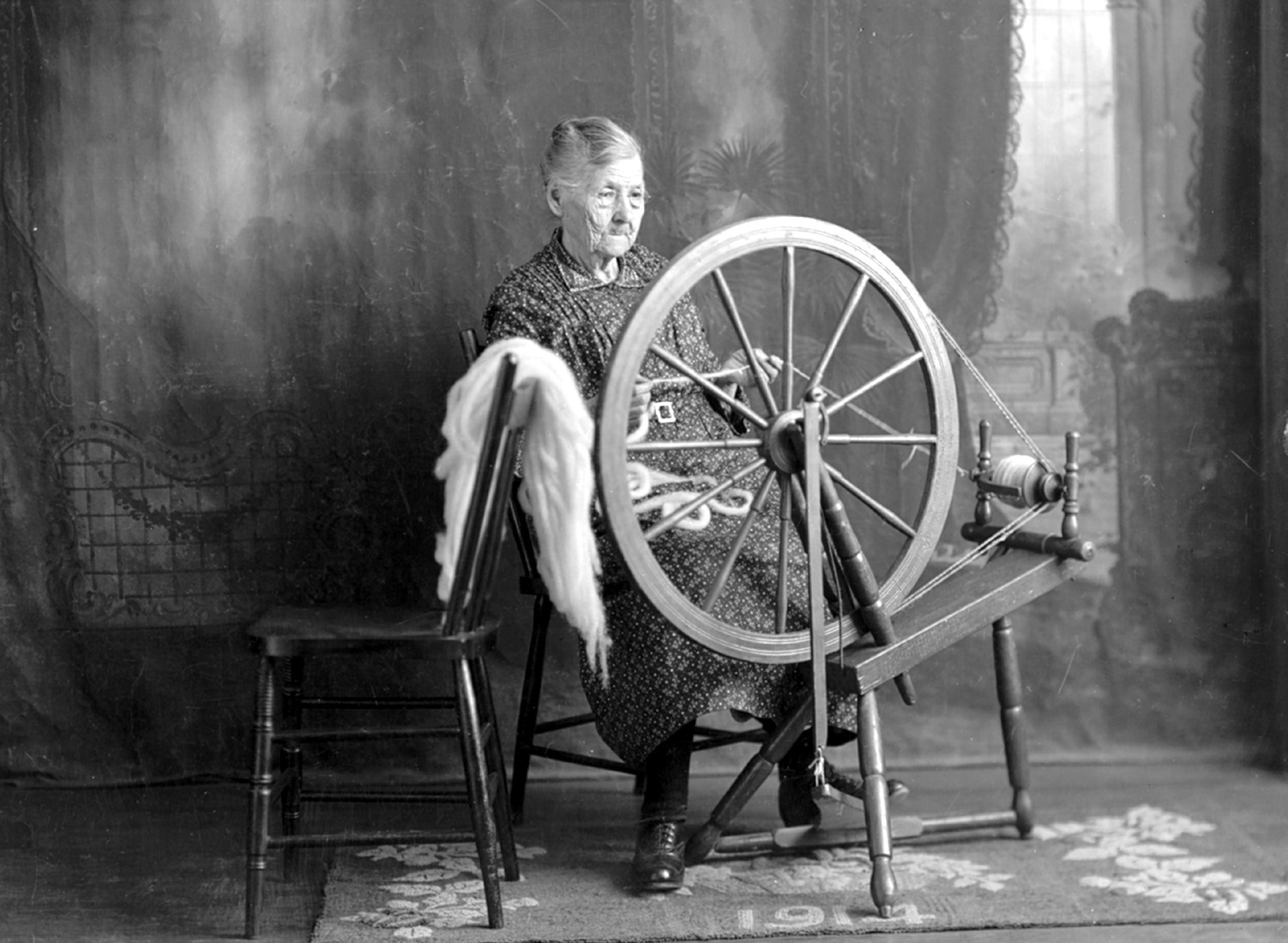
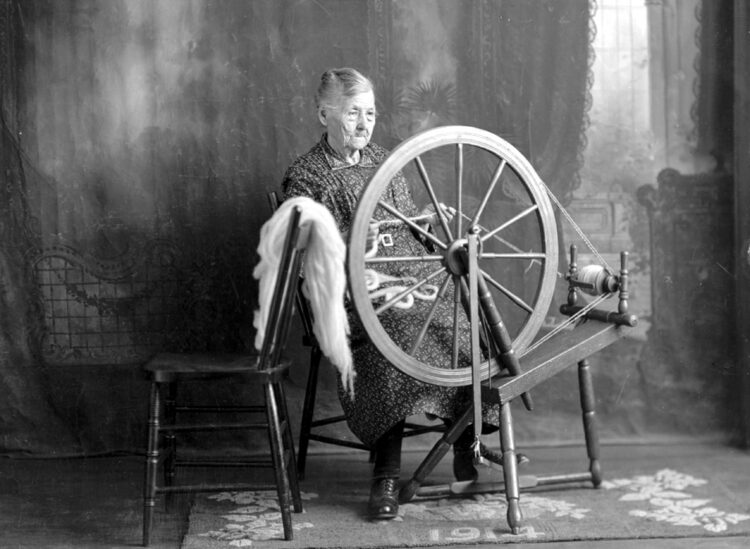
Why was this elderly woman photographed at her spinning wheel in Dumont’s studio? Isn’t it curious that the scene is set in a studio and not in a domestic setting? Were the light and other conditions bad in her home? Might an organization, like the Cercles des fermières, have commissioned such a beautiful portrait? Whatever the case, this photograph stands out from Marie-Alice Dumont’s other portraits of craftspeople, which, typically, were shot in a home setting and with an aesthetic that feels more like a snapshot.
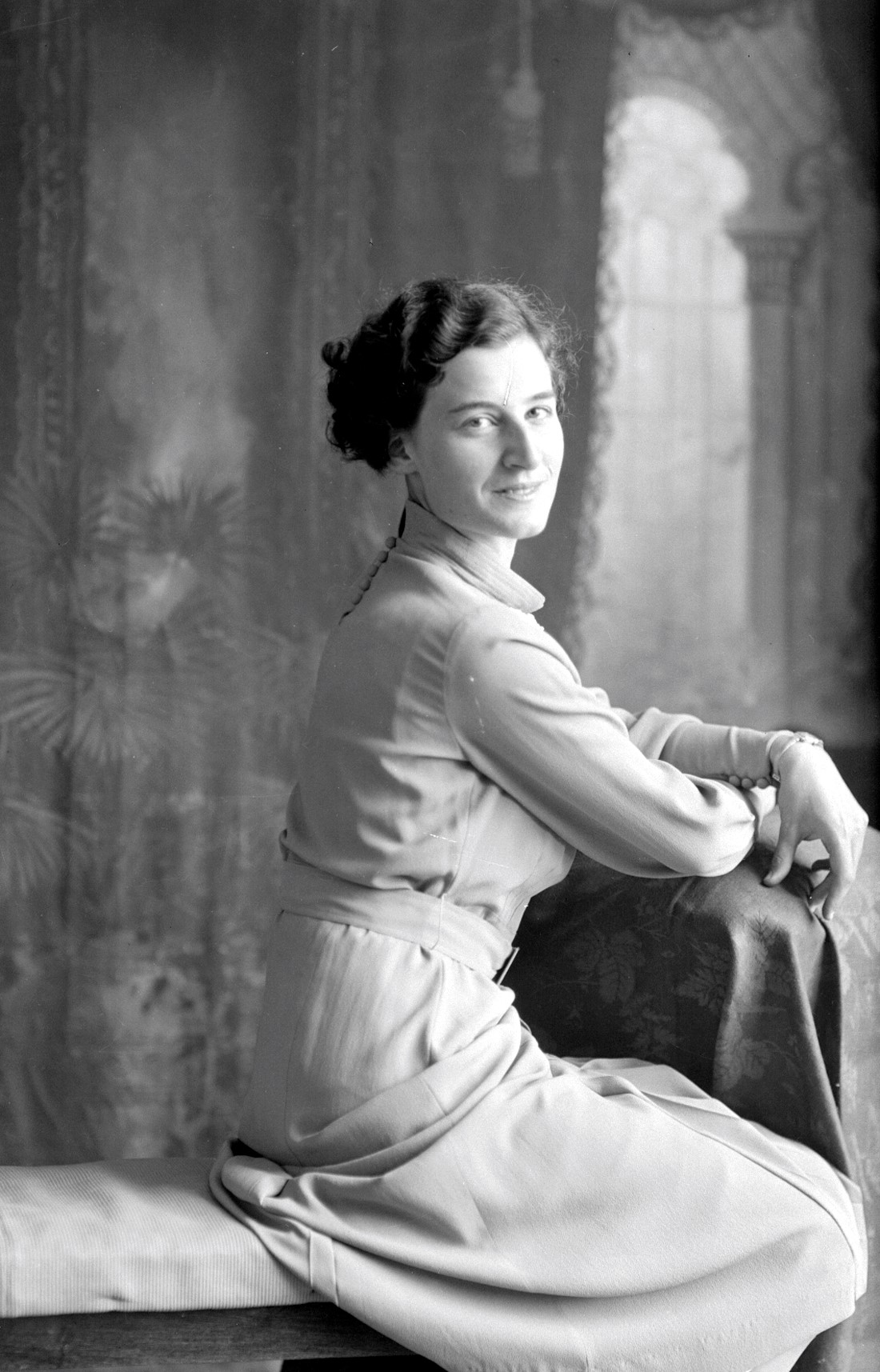
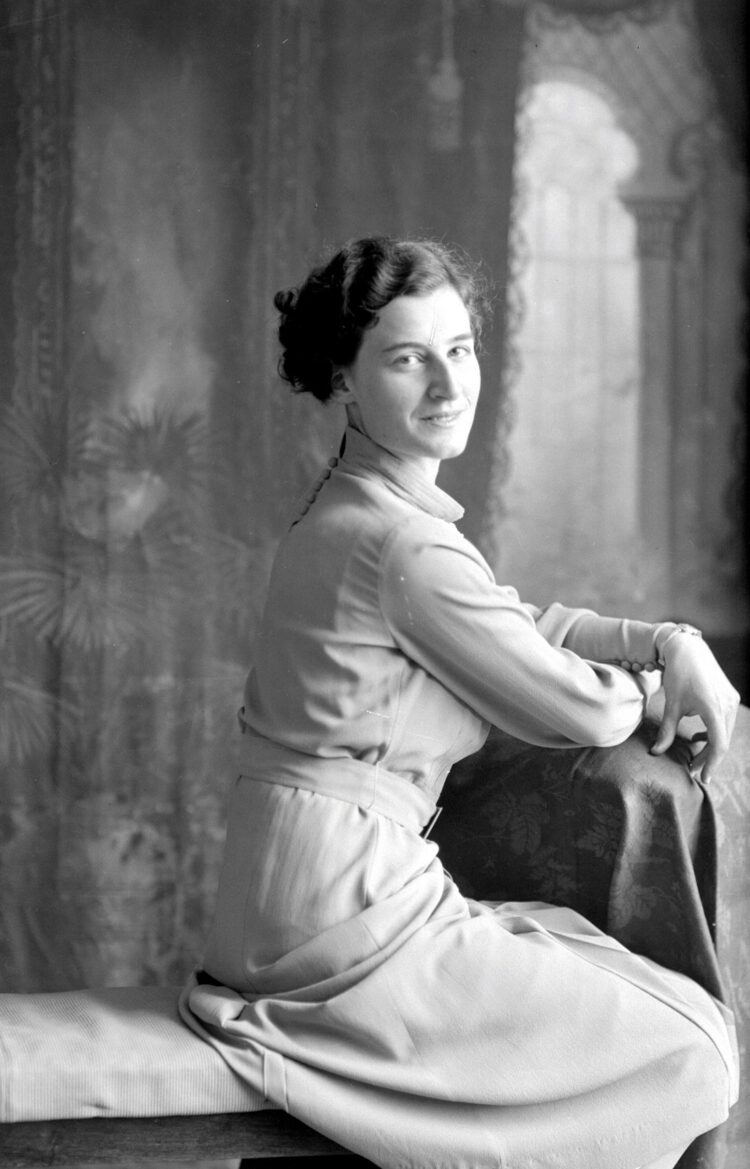
This portrait of Madeleine Marquis is one of many examples of how Marie-Alice Dumont’s portraits “modernized” over her career, particularly those of women. Here, we see Mrs. Marquis relaxed, with her body, face, arms and legs pointing in different directions. Madeleine is looking at us, but at an angle. The pose is dynamic despite the subject’s seated posture.
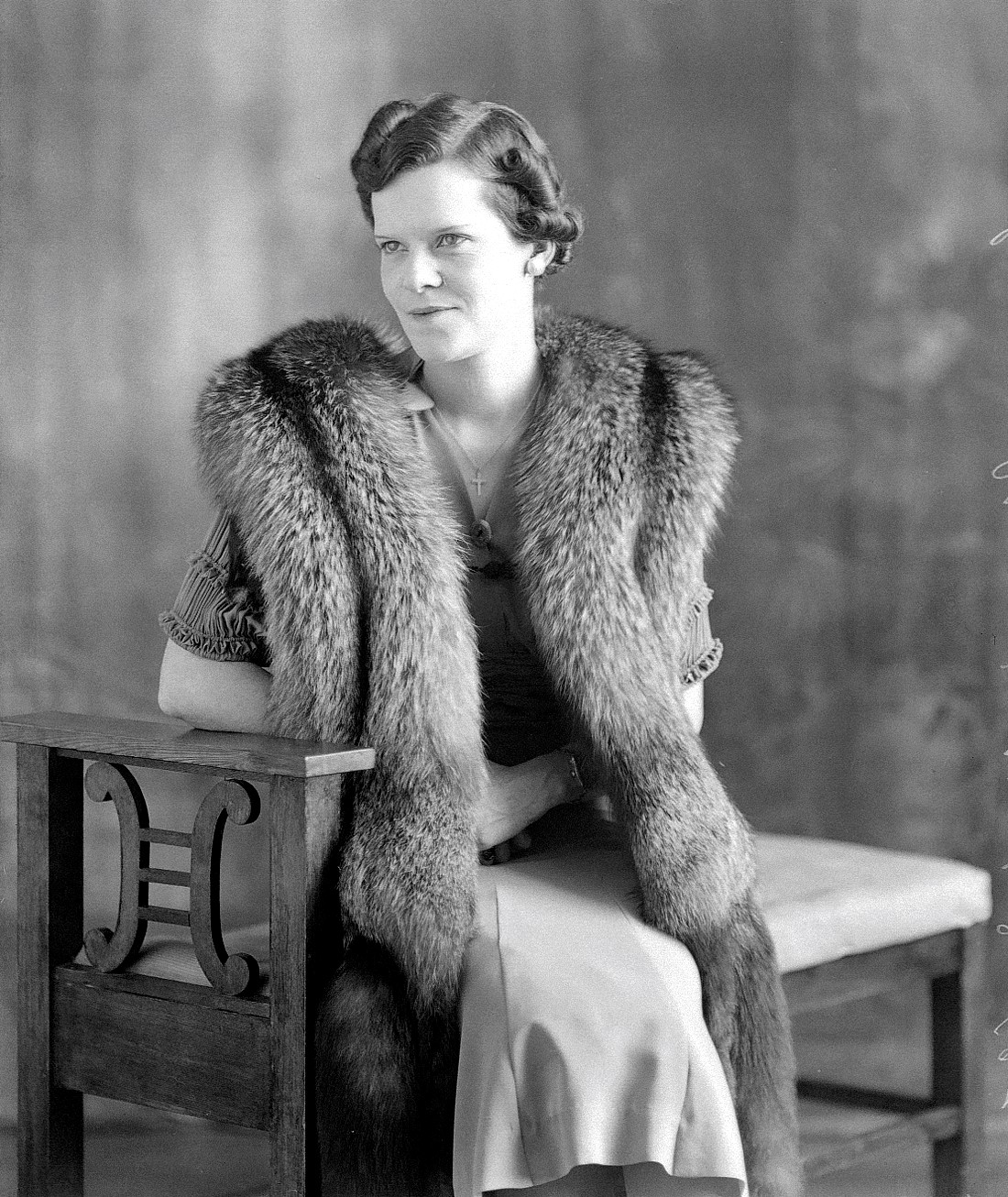
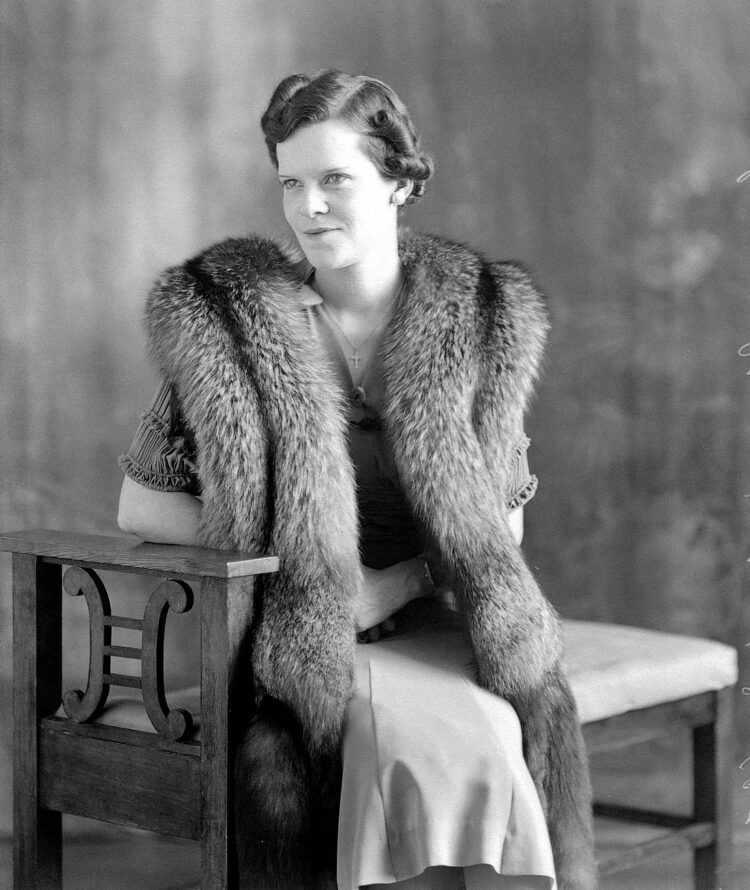
Skill in the art of posing also means being able to shed a flattering light on the subject, taking them as they come. Simone Gagné certainly did not wear that huge fur collar for nothing! Dumont did a good job of emphasizing it in a frontal pose slightly at an angle. Miss Gagné, with her penetrating gaze, sports an elegant hairstyle. Her positioning also highlights this detail.
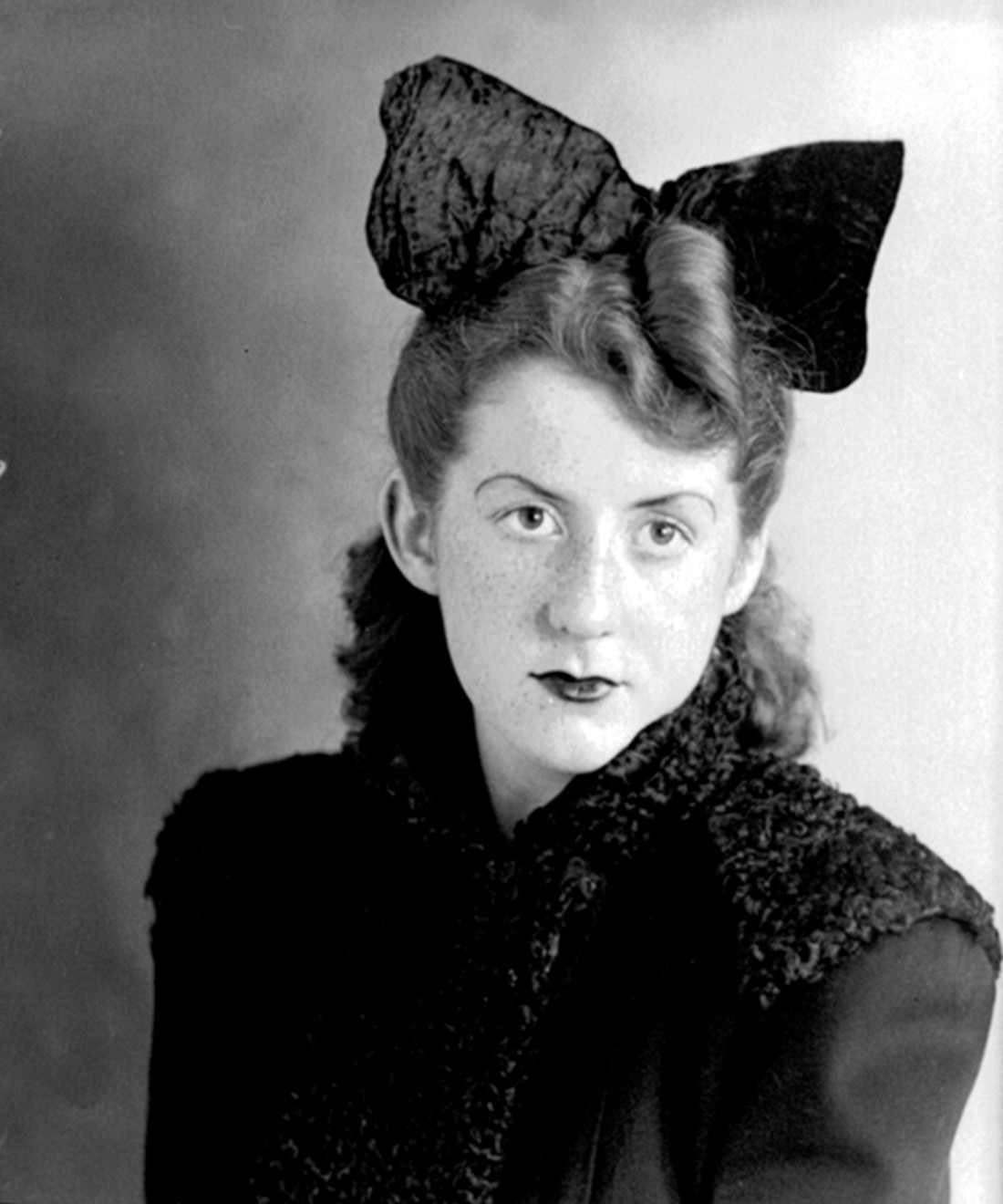
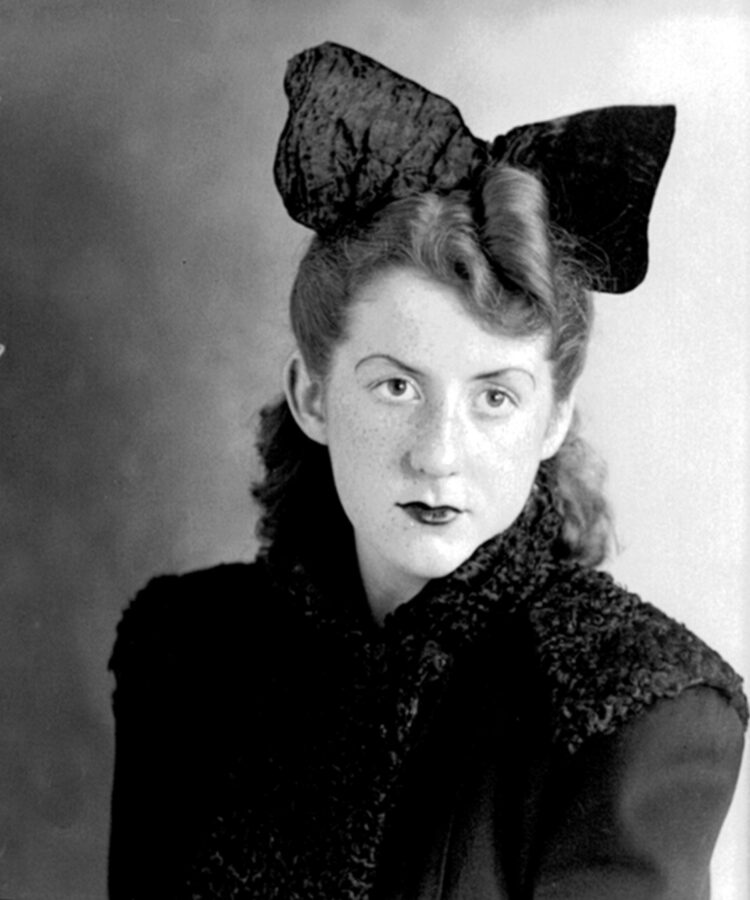
Here we see Angélina Desjardins, once again before Dumont’s lens. Four years had passed, and she had become a young woman of 16. The visual style of this portrait is completely different from the previous one. The subject posed in bust form. In the manner of Hollywood stars of the time, her torso is slightly at an angle, while her face is aimed directly at the camera, lending movement to the portrait. The young woman’s makeup and attire appear flirtatious, especially the huge velvet bow in her hair. Angélina’s gaze is direct, frank, intense and confident. It has nothing of the innocent child’s gaze she donned in the previous portrait.
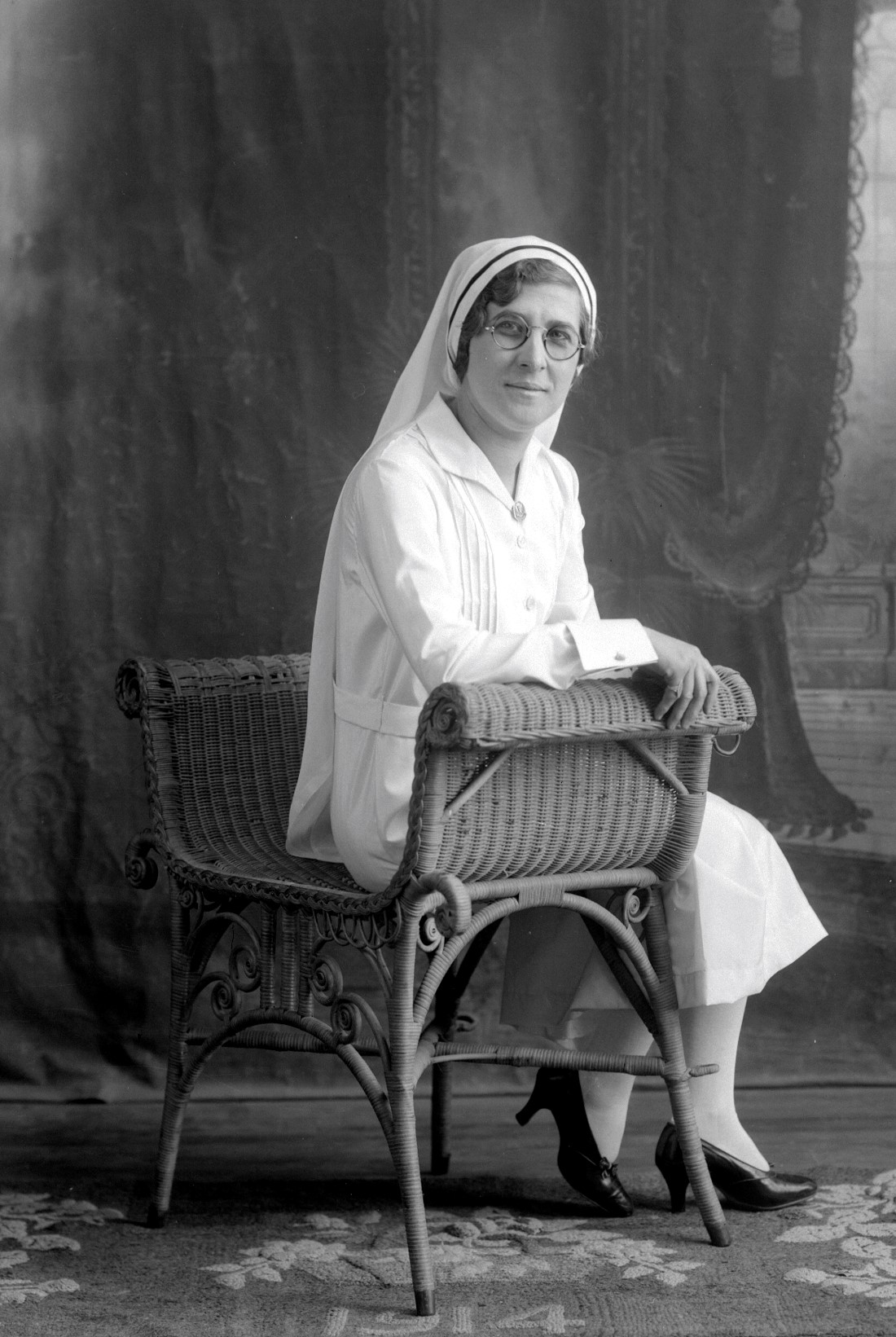
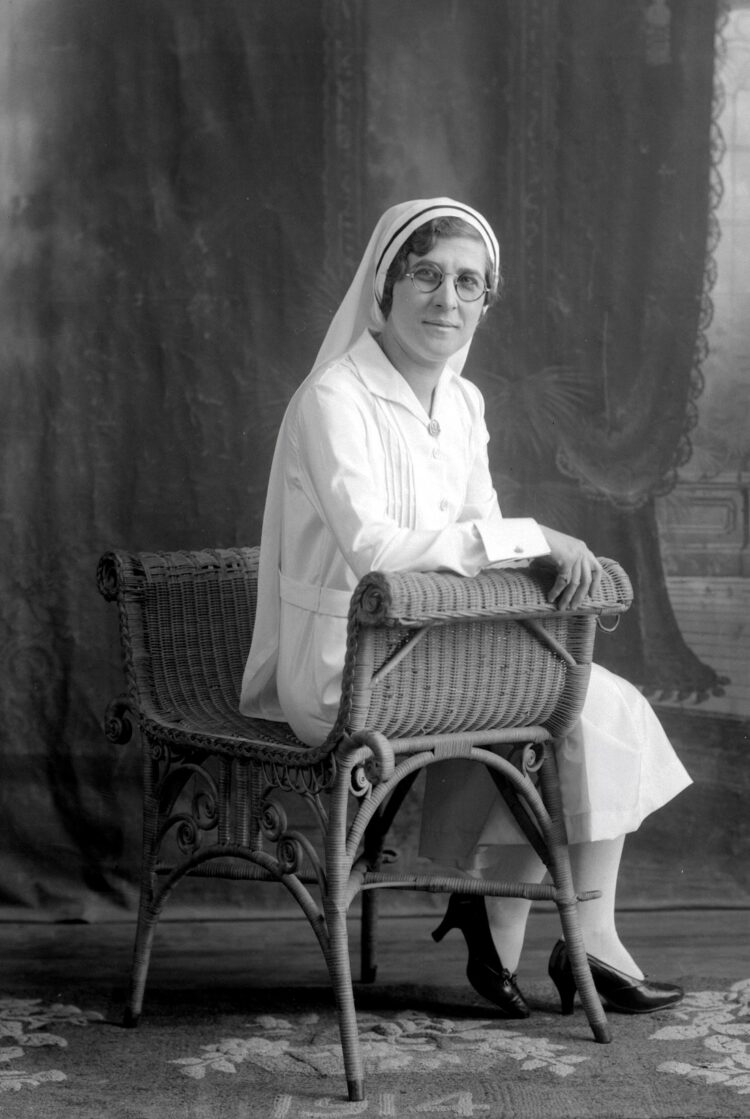
It was not unusual for Dumont’s clients to pose in a work uniform. Indeed, many people trusted Marie-Alice Dumont to make them an attractive professional portrait. The example of Eugénie Lavoie, a nurse, illustrates this. Might she have been one of the nurses who cared for the photographer during her long hospitalization in 1936?
Men
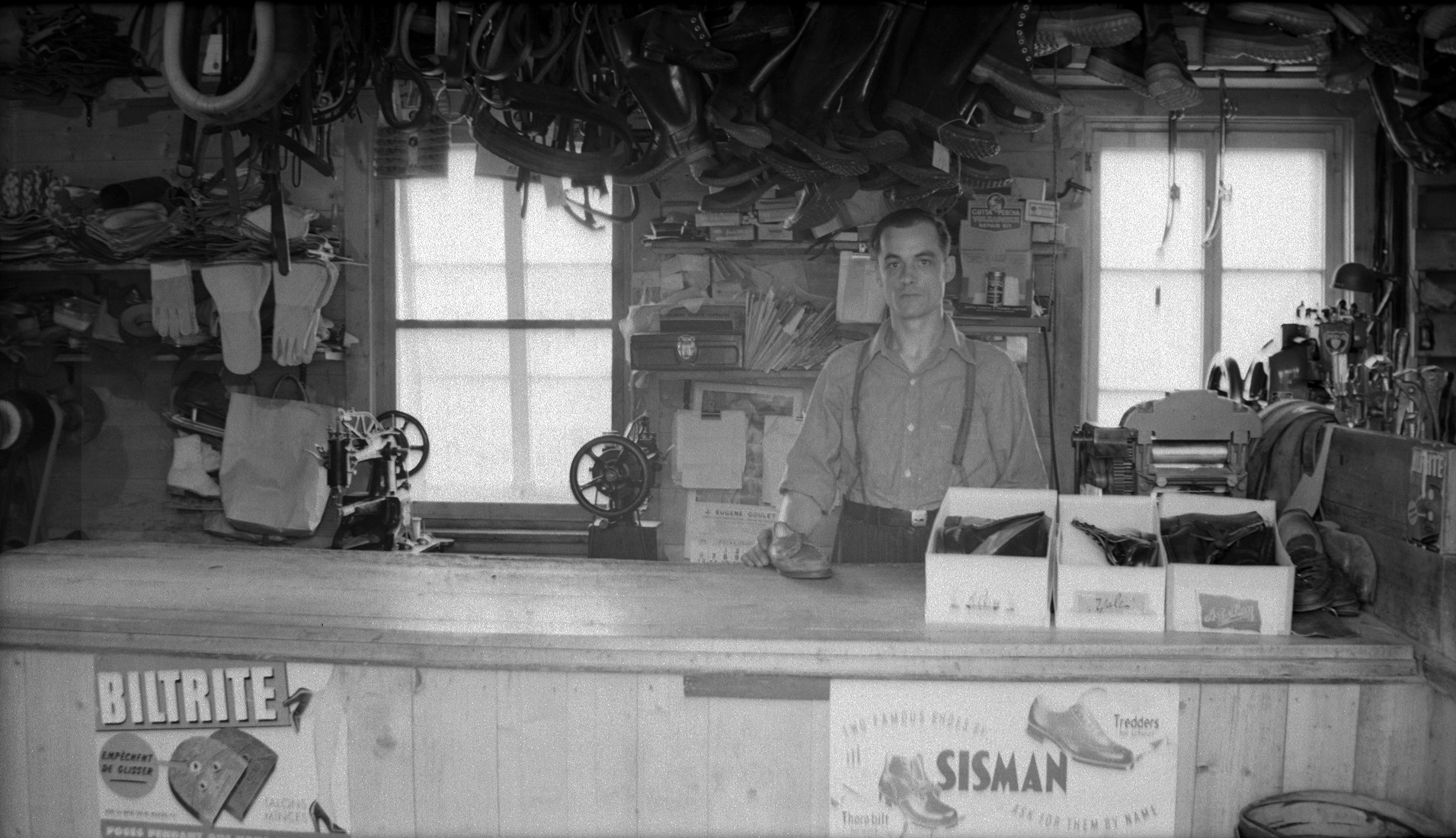
Many men in Dumont’s era were skilled tradesmen who played vital roles in their community. In 1952, during the creation of Saint-Alexandre’s centennial souvenir album, the family of Ludger Chouinard used this photograph to pay tribute to the local shoemakers, their “homage to cobblers.”
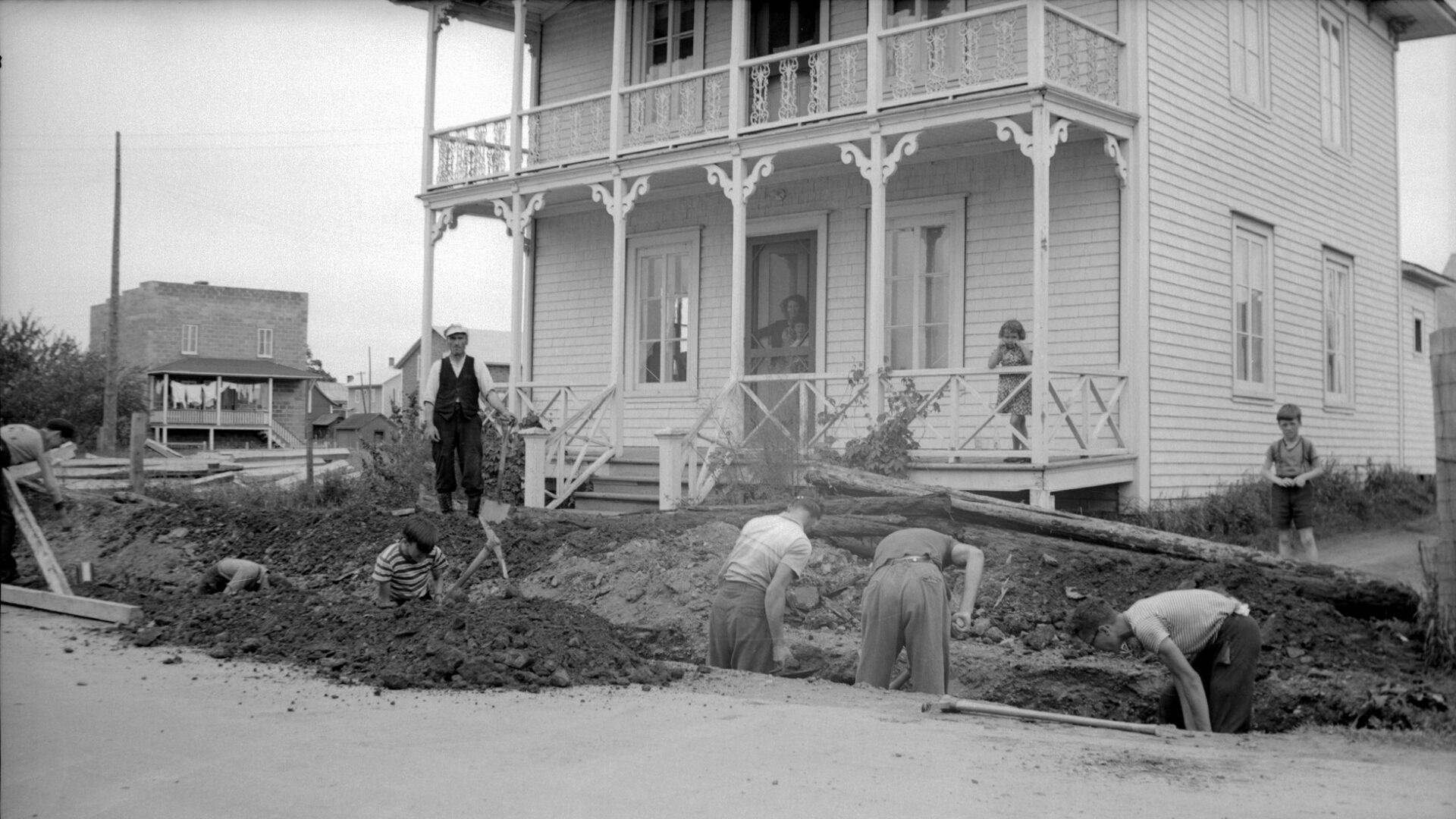
Armed with pickaxes and shovels, the men and boys of the village built and maintained essential public infrastructure, including sewers and aqueducts. This is how towns and villages across Quebec began to modernize in the early 20th century.
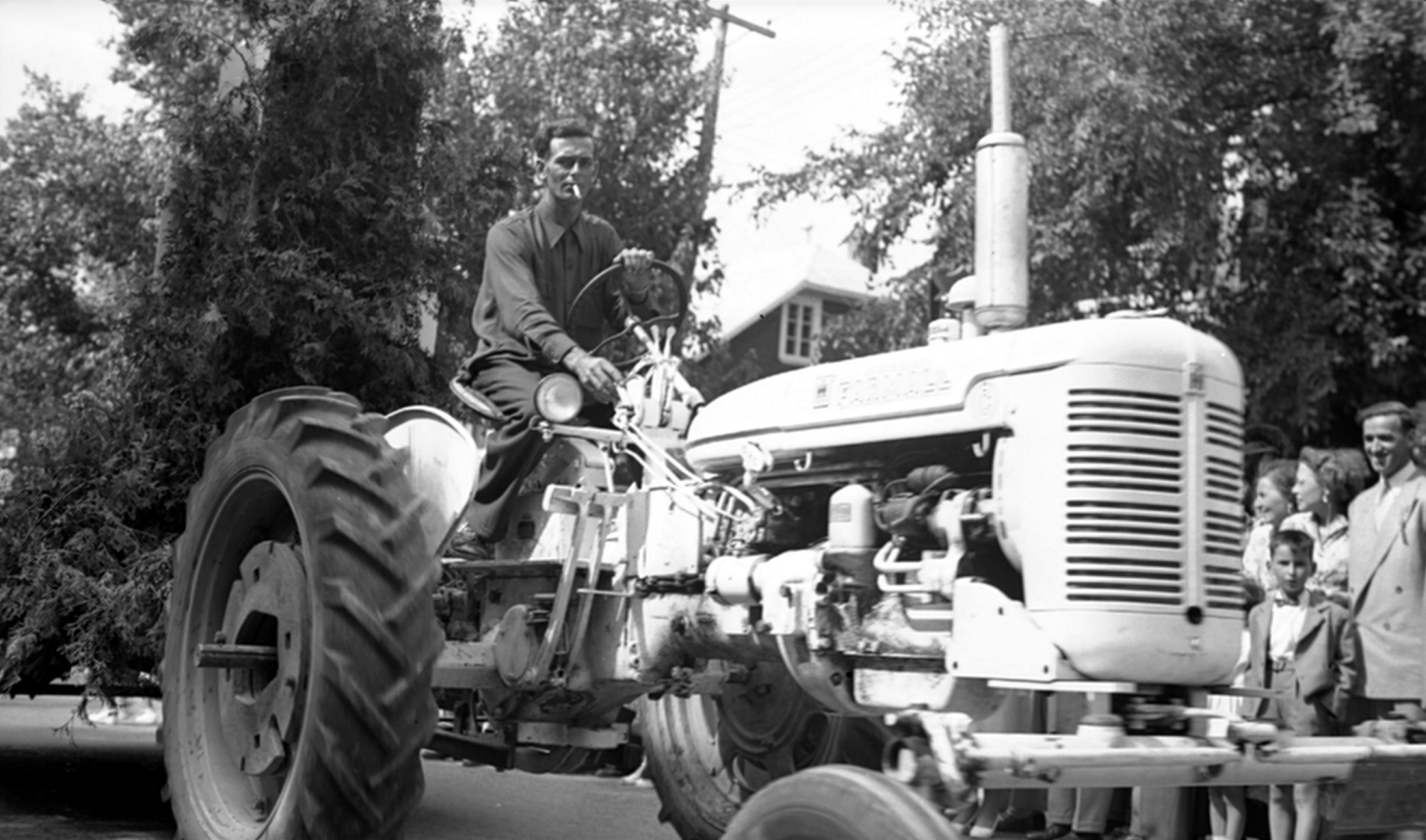
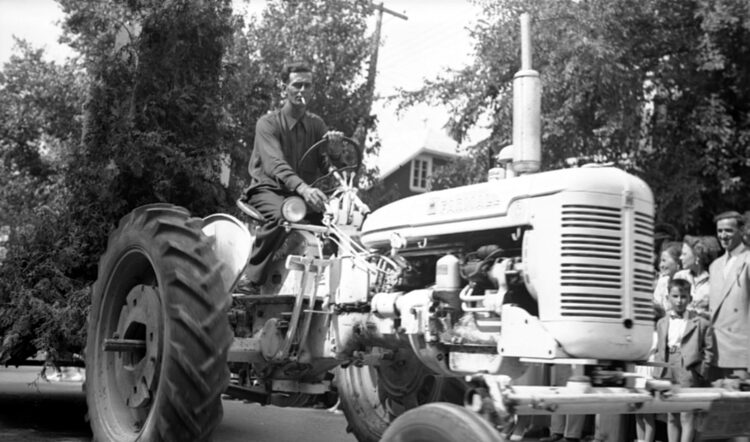
The entire village took part in the Saint-Alexandre centennial celebrations. The man behind the wheel of this tractor was no doubt proud to play a part in the event and to have loaned his machine for the parade of decorated floats.
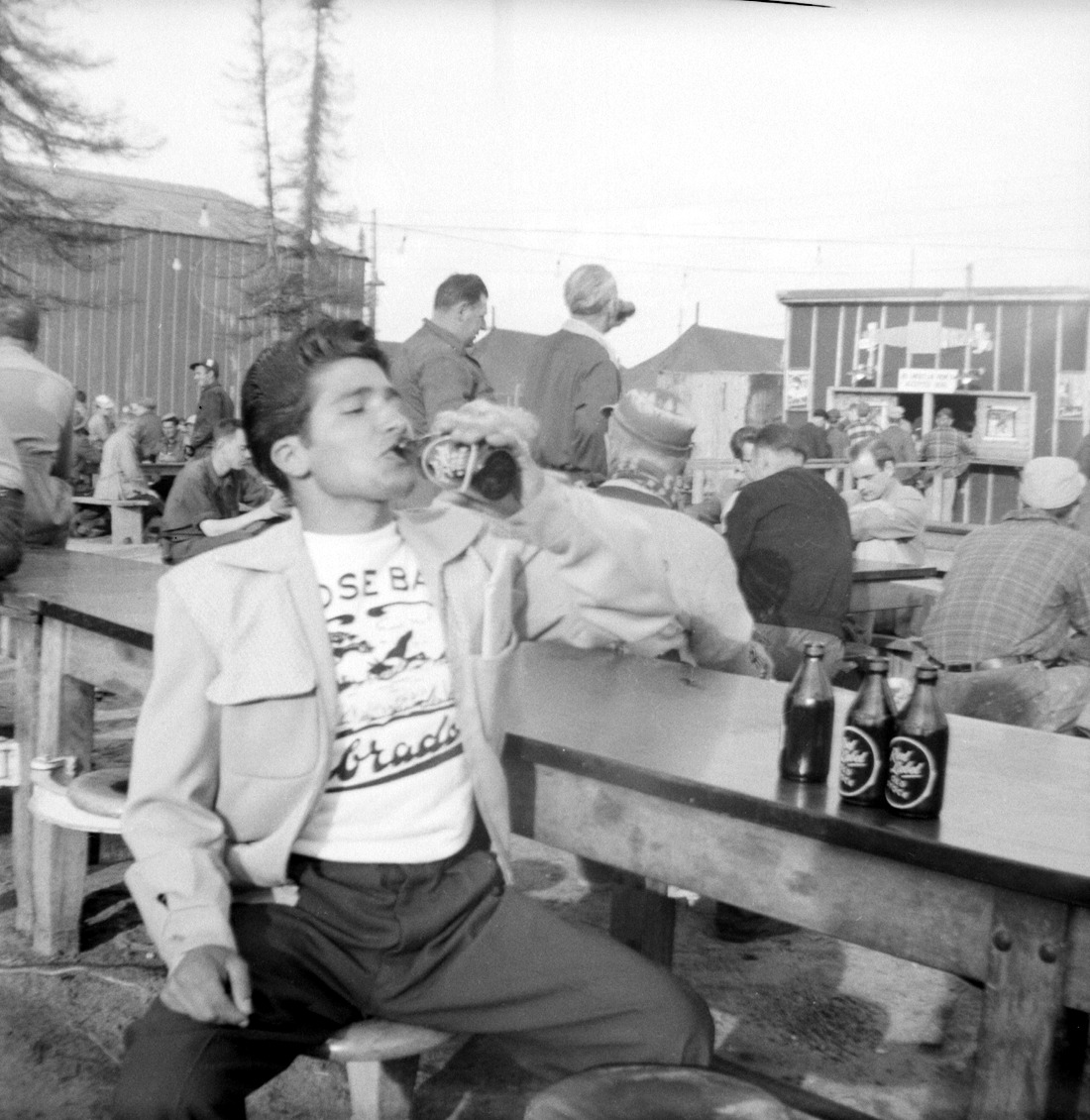
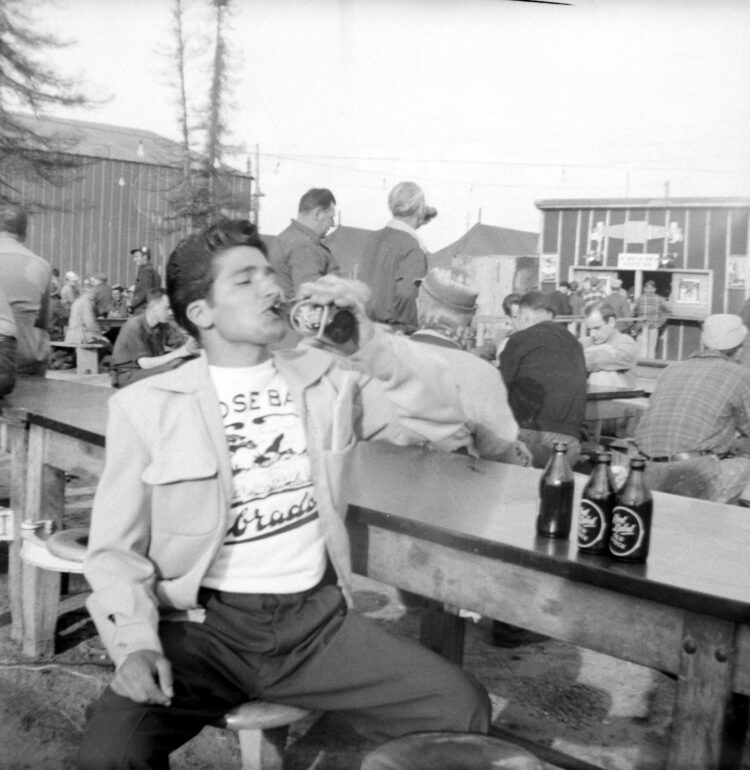
Several negatives preserved by Dumont appear to have been taken by amateur photographers who brought them in for development. In this image, a young man is pictured drinking a Red Label beer. It is part of a series of candid shots taken by two friends at a male-only worksite. It would have been surprising to see Dumont herself in such a setting like, for instance, an all-male dormitory!
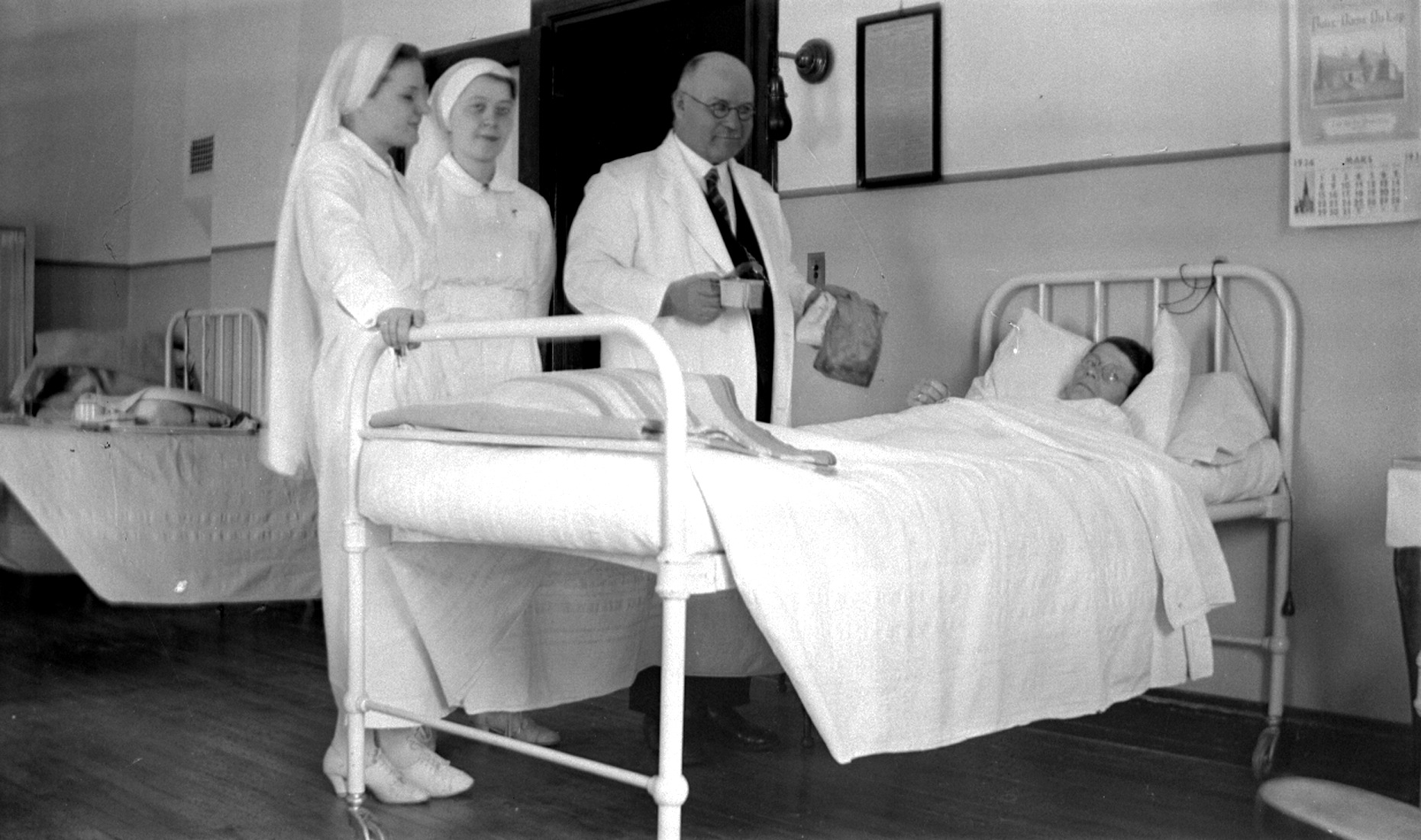
In Dumont’s time, it was mostly men, like this physician, who held professional occupations: lawyers, accountants, engineers, doctors and notaries. In 1971, 35 years after this photo was taken, women still account for only 11% of those professions. But that number rose dramatically in the decades that followed, reaching 51% by 2006.
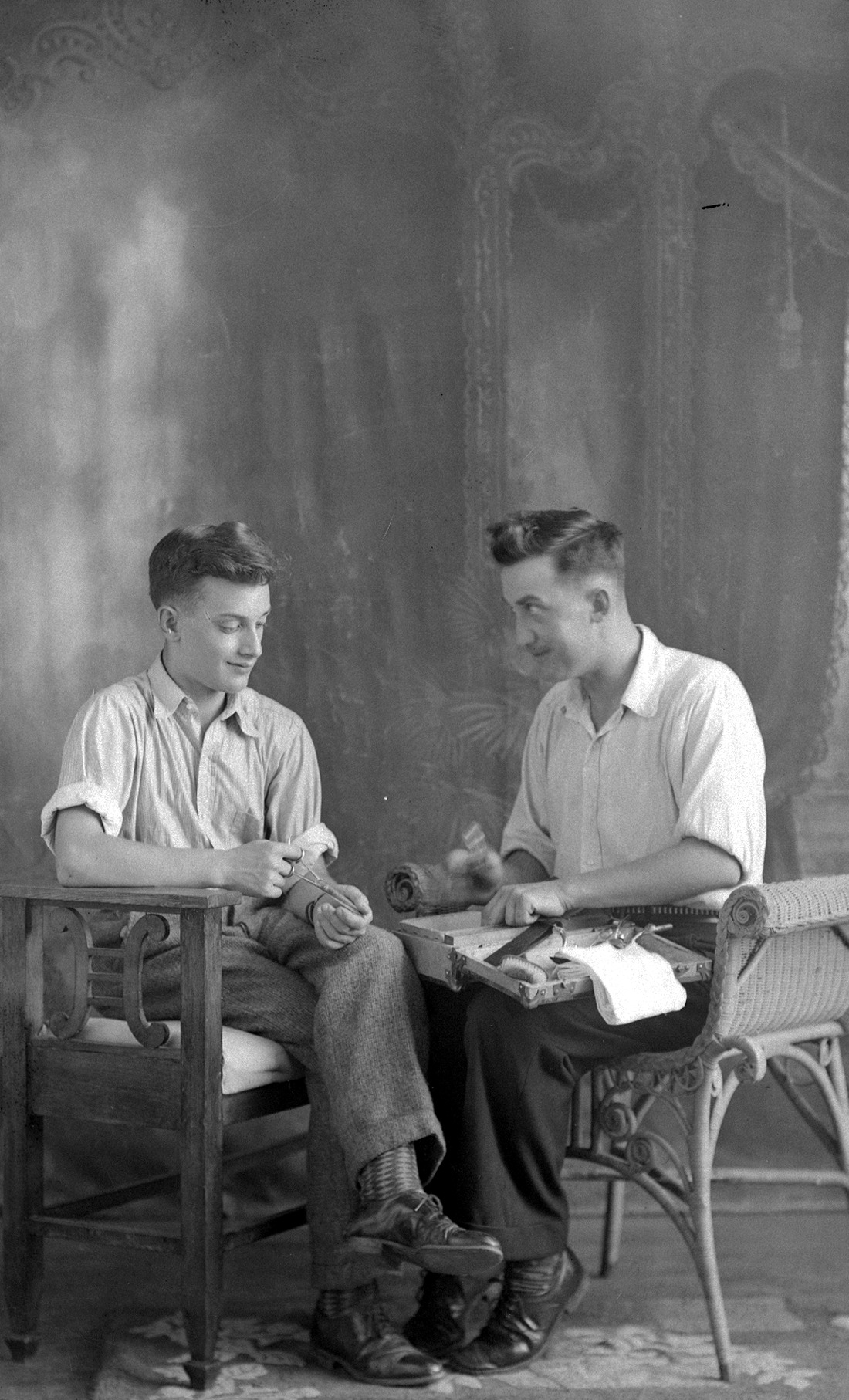
Among families of craftspeople, trades were often passed from father to son, or sometimes from uncle to nephew. Is that what this image shows? In it, Roméo Blier appears to be explaining to his nephew the use of various tools—perhaps a barber’s tools?—from his kit.
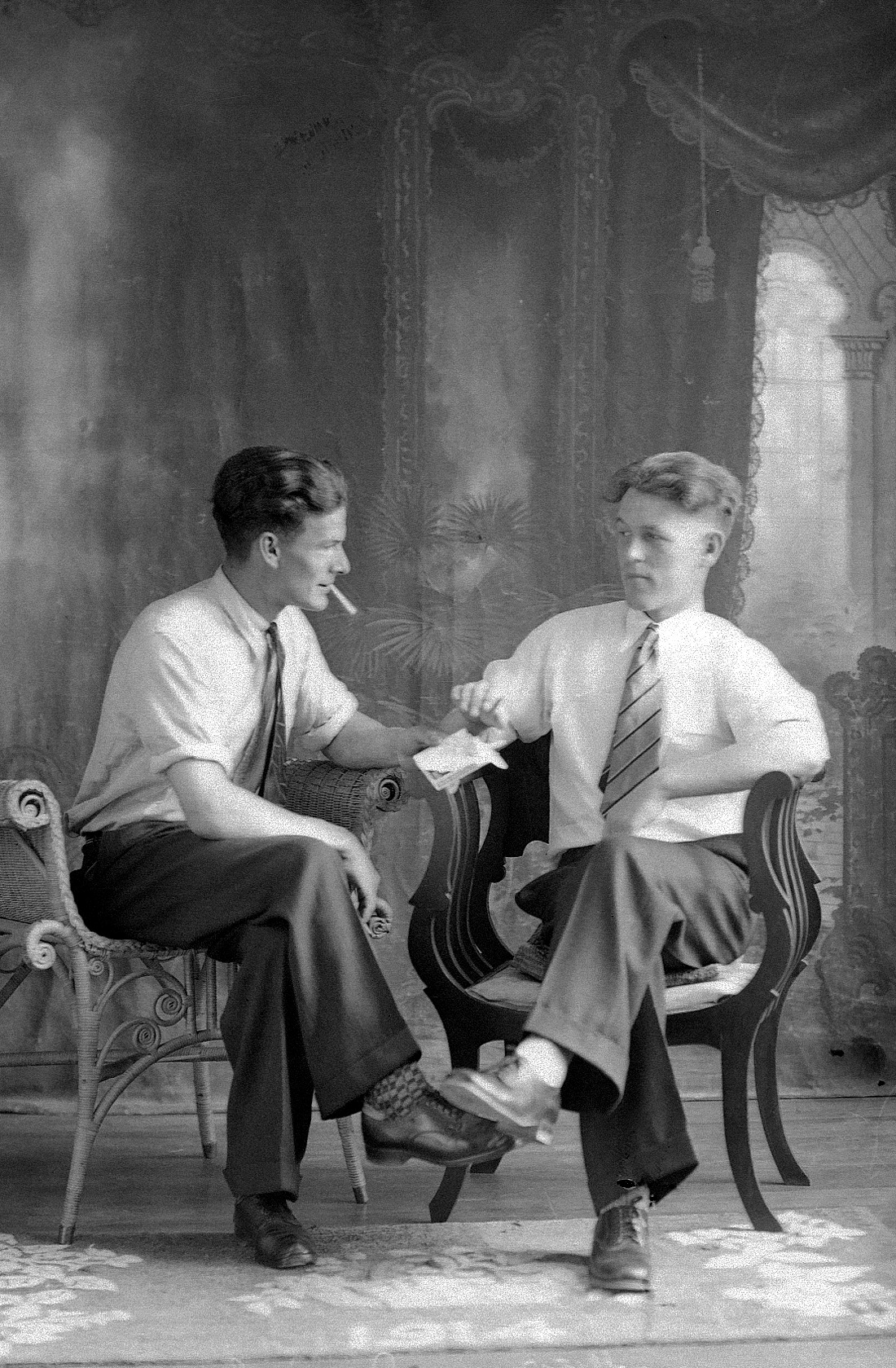
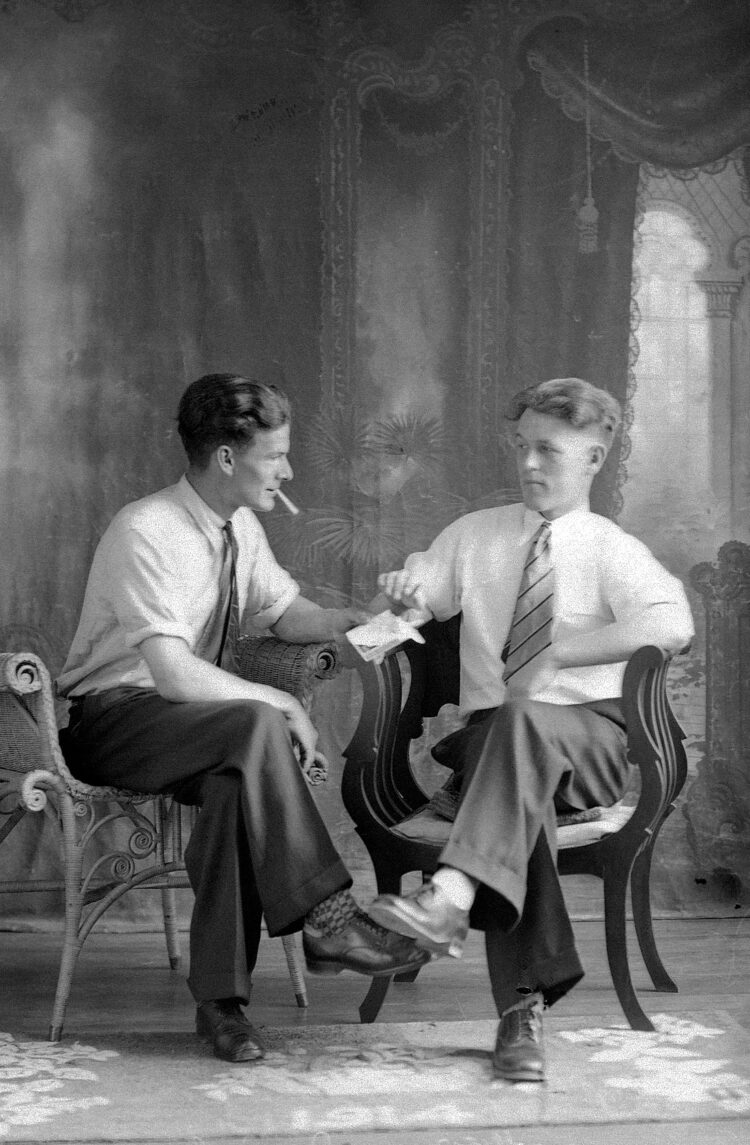
In the first half of the 20th century, cigarettes symbolized masculinity and manliness. A few of Dumont’s clients had no hesitation in posing with a cigarette in hand or between their lips. Who came up with the idea for this scene: the two friends in the photo or Dumont herself?
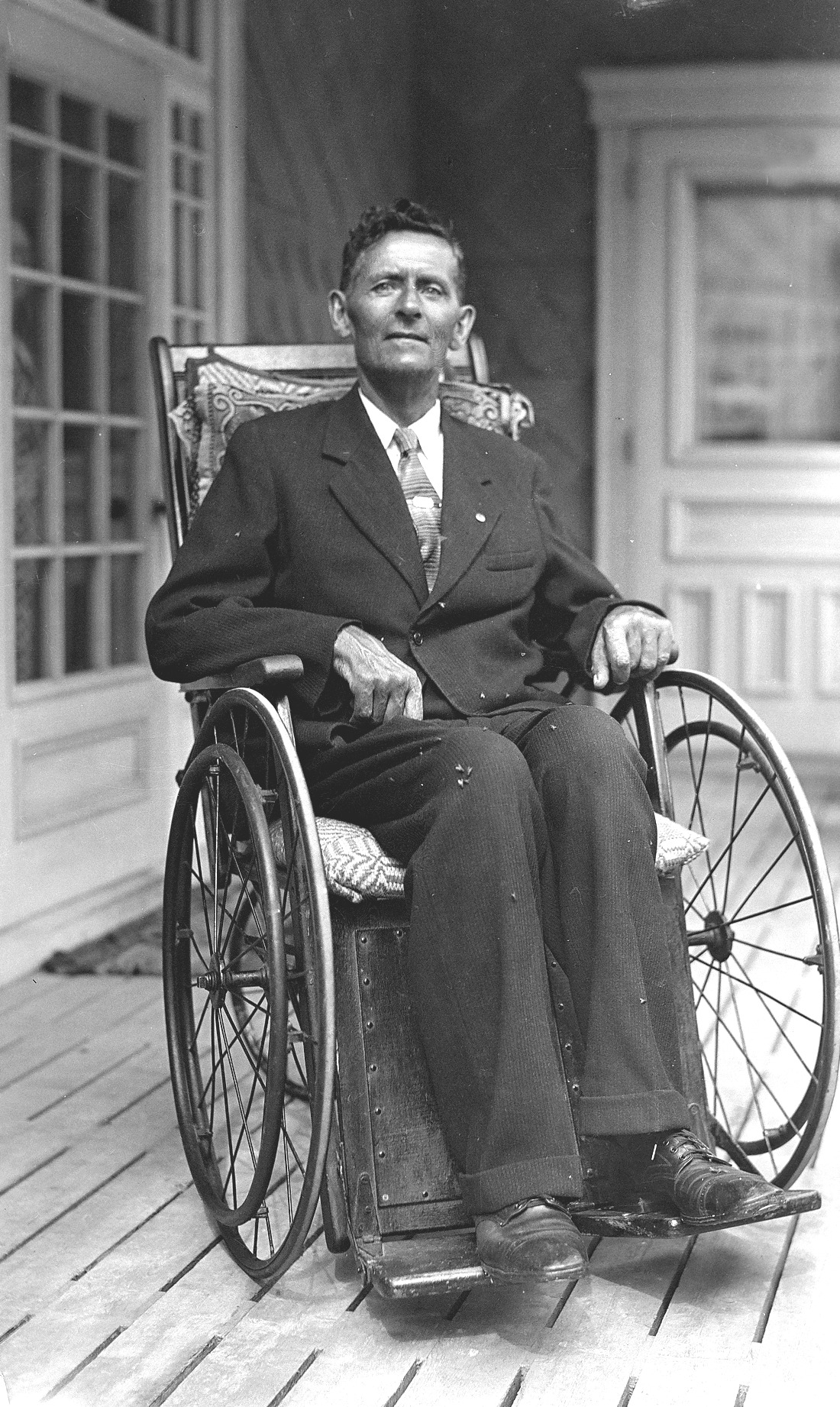
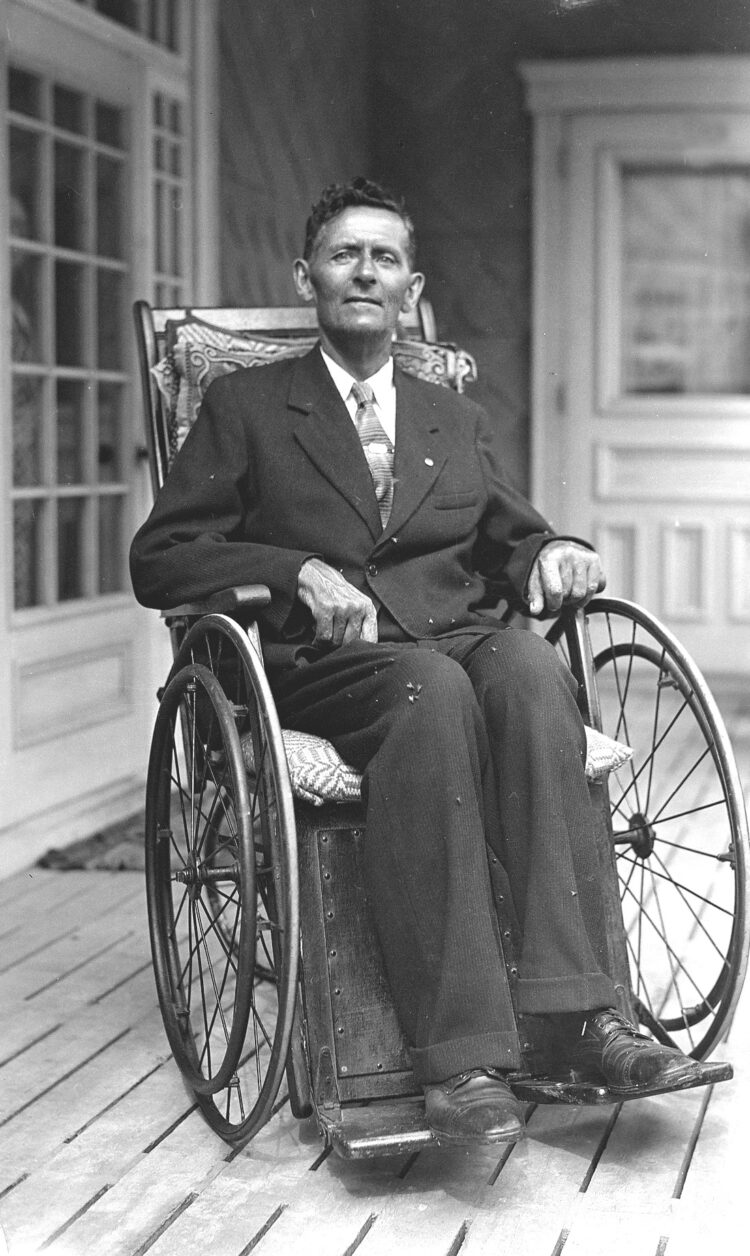
Jean-Baptiste Soucy is shown here on the porch of his house. In the village’s 1952 centennial album, Camille Soucy, a manufacturer and lumber merchant, pays tribute to both Jean-Baptiste and Joseph Soucy with these words: “Thanks to our Fathers. They left us a legacy of ‘Justice and Charity.’ Let us preserve it and pass it on to our children!” [our translation]
The church beadle is a crucial role in any parish. These laymen, like Donat Lamarre, are responsible for maintaining the church. They must be devout and good with their hands.
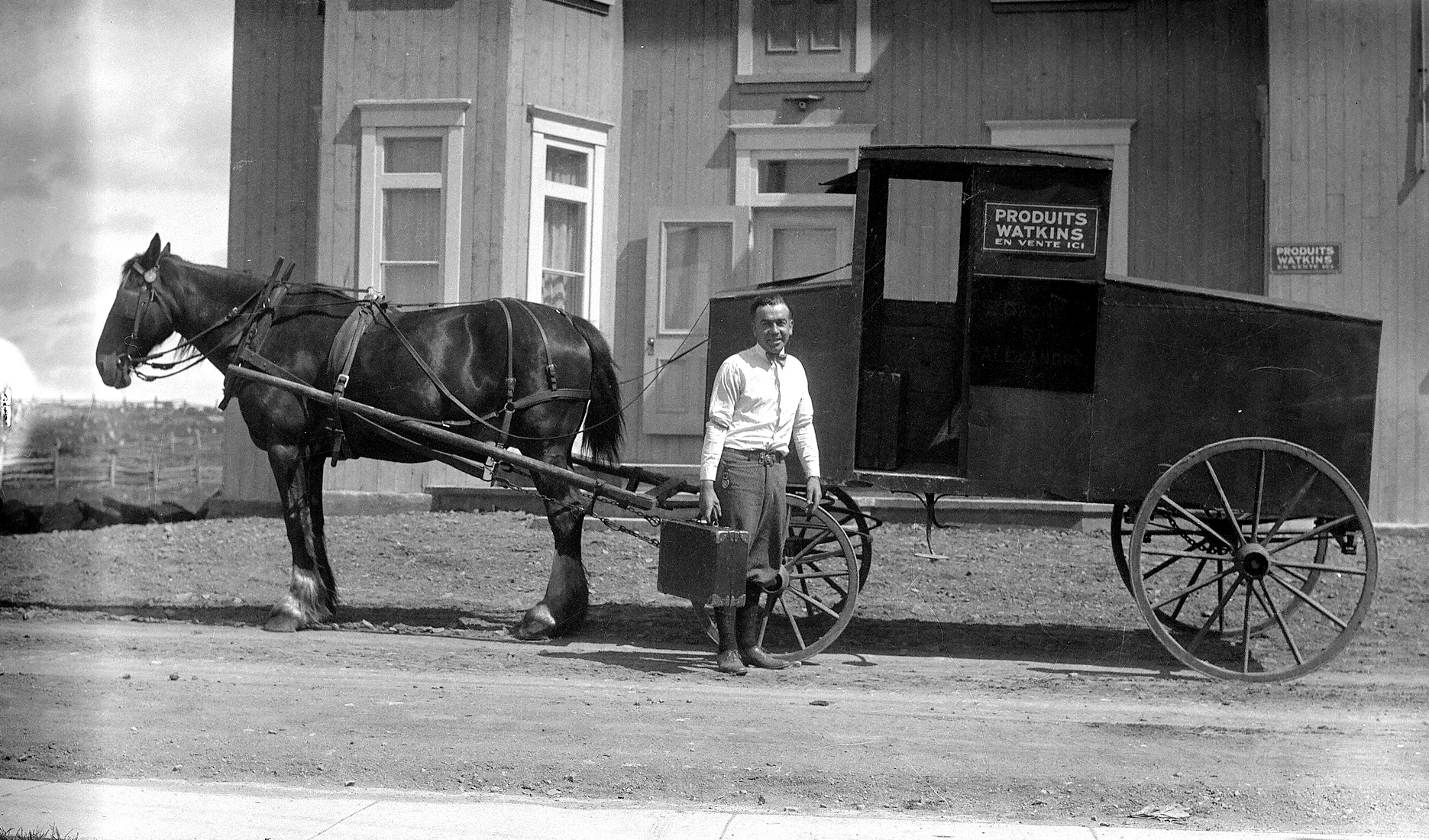
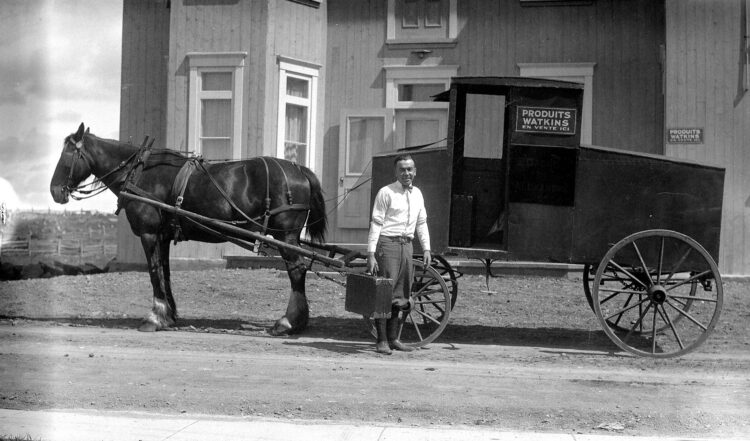
The travelling salesman was a familiar figure in rural Quebec in the early 20th century. For people living in the countryside, far from commercial centres, these door-to-door vendors were not just welcome, they were a necessity.
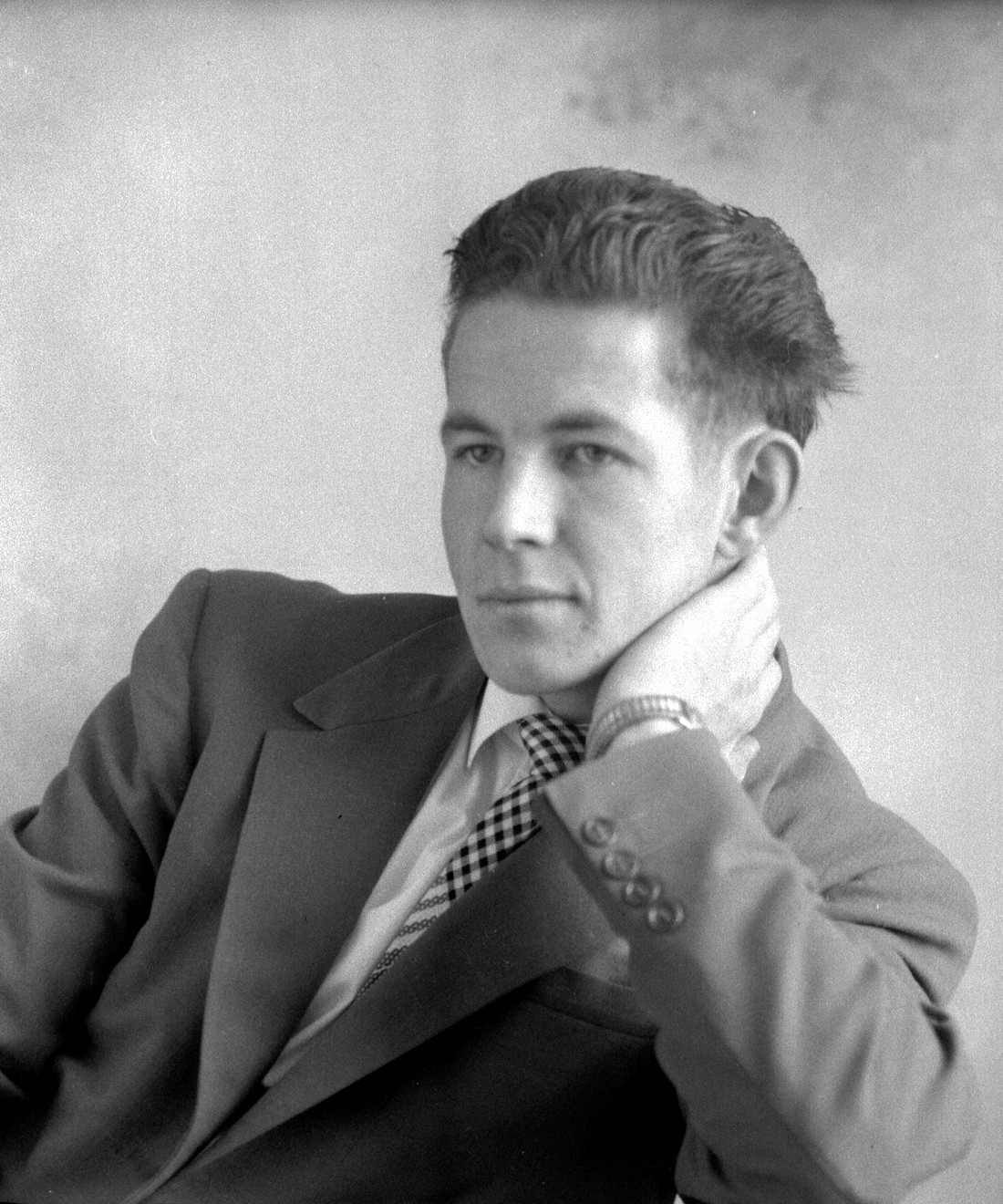
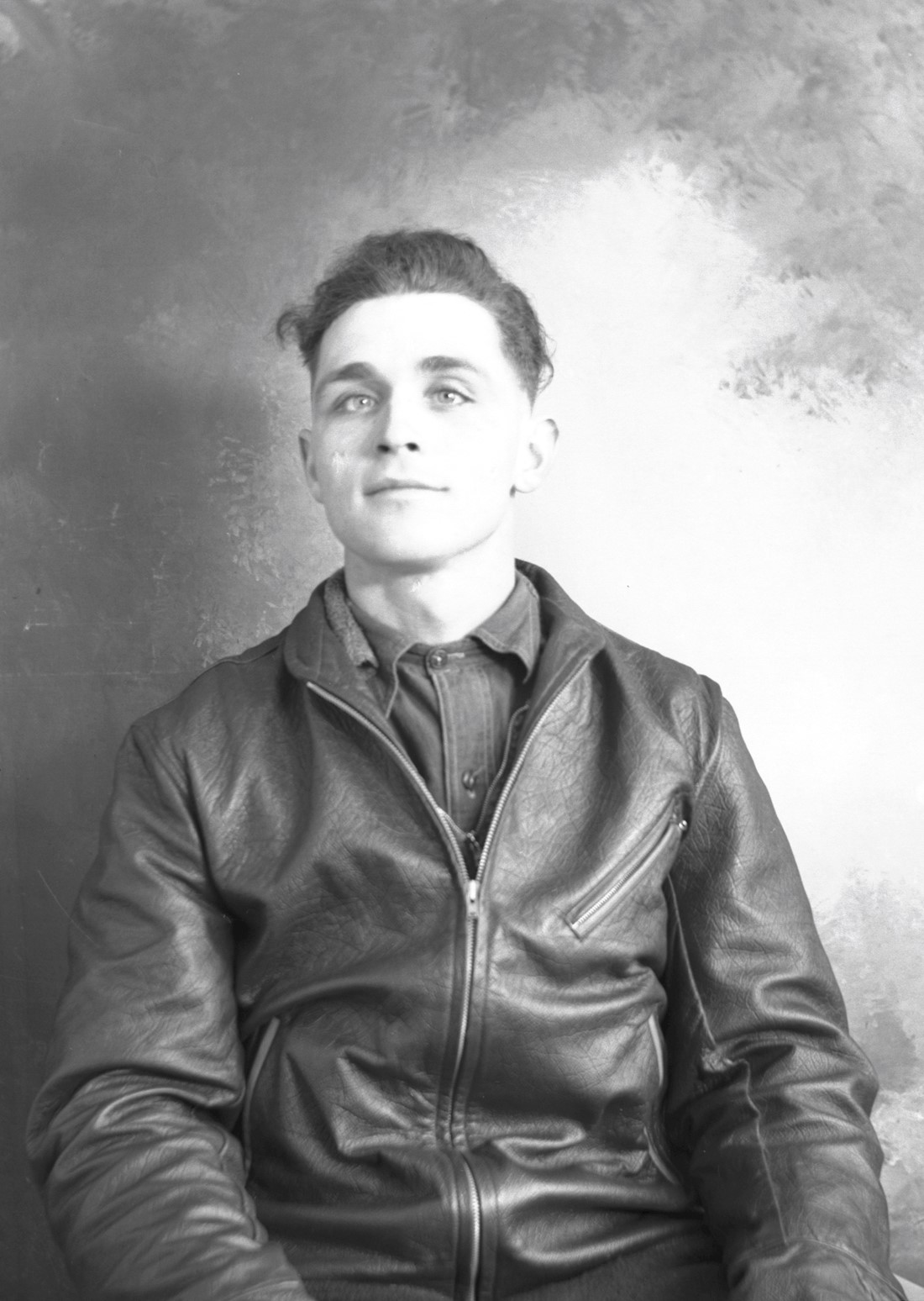
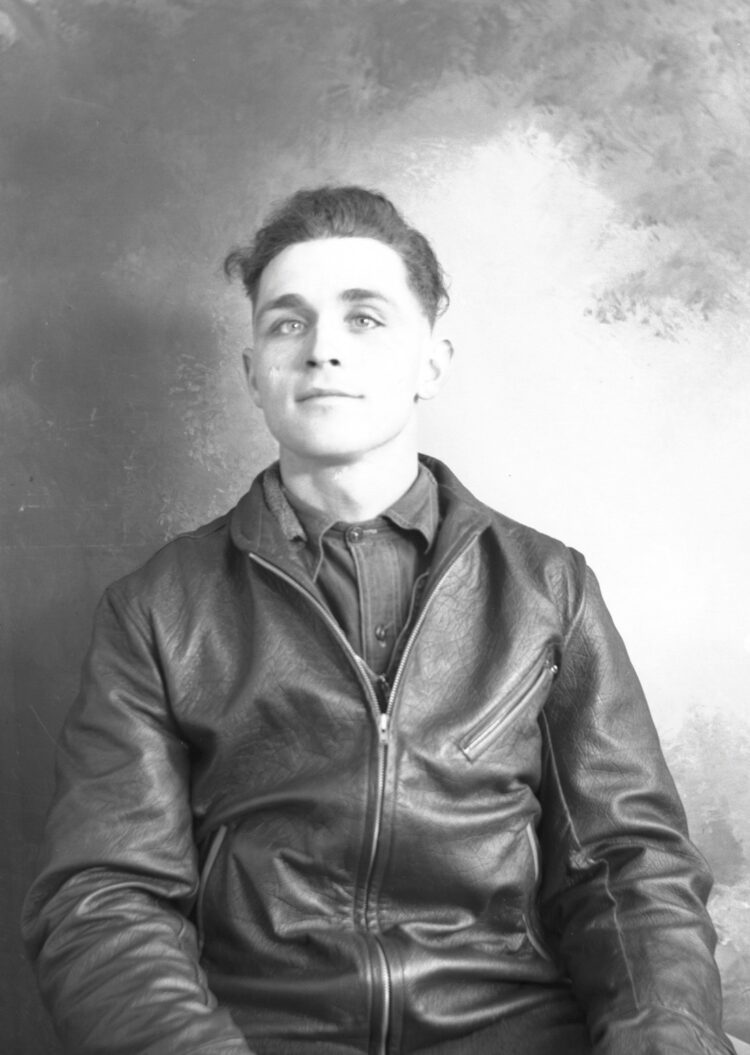
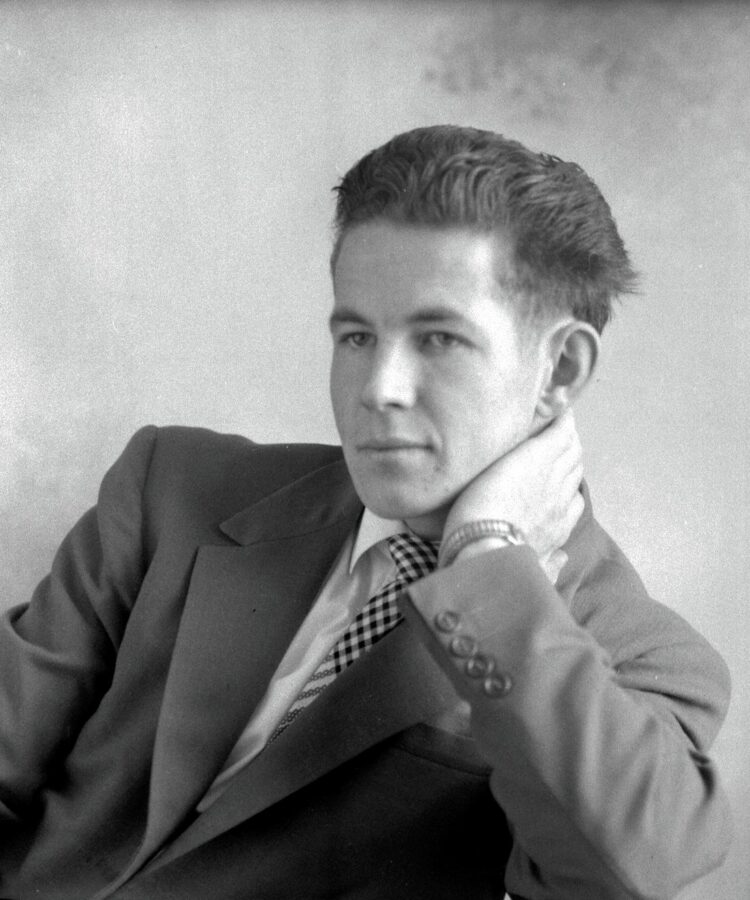
During his visit to Dumont’s studio, Jacques Thériault posed three times. First, the photographer set him up rather conventionally, posing him in bust form. Then, the young man sat with his two brothers for a group photo. Finally, perhaps at the request of Marie-Alice Dumont, he is seated in an armchair, a casual elbow on the backrest, neck resting on his hand. Which portrait did he like best?
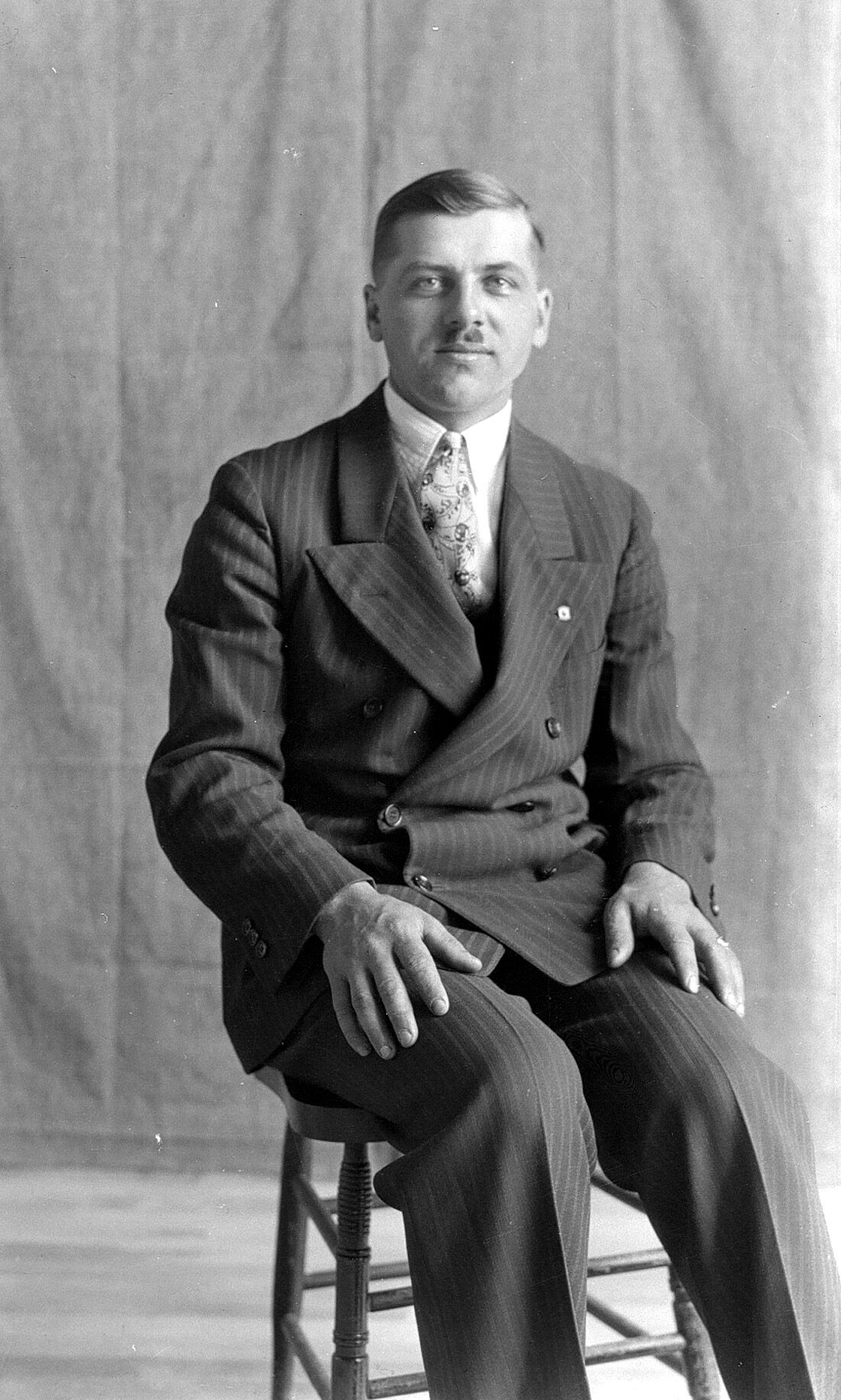
This portrait, taken in 1924, reflects the simplicity of many of Marie-Alice Dumont’s early works. The setup is free of any elaborate aesthetic touches: a large sheet serves as the backdrop, and no props are used. The subject is simply seated on a small wooden chair. Perhaps the client had requested a portrait with a simple, unadorned style.
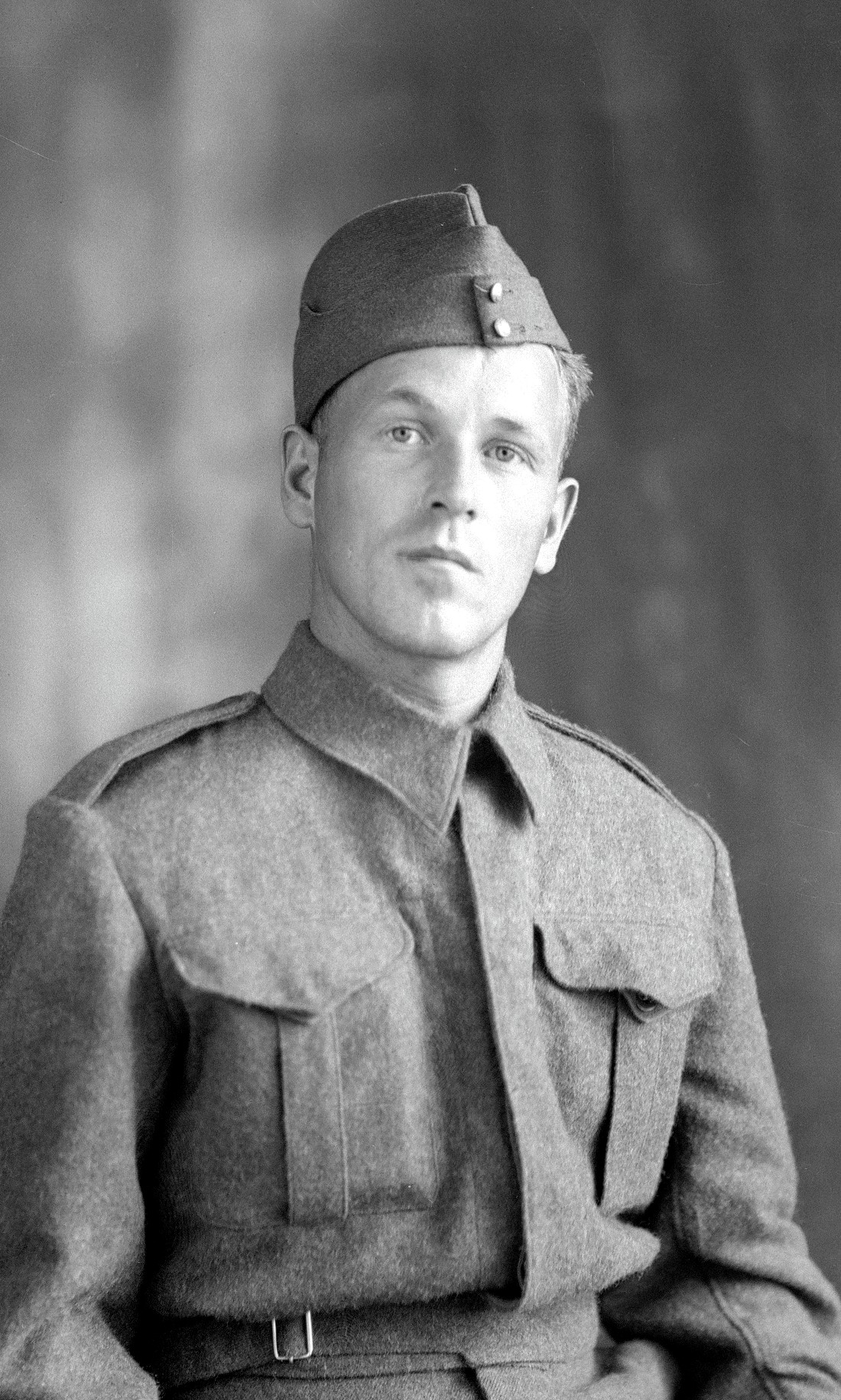
As World War II approached, and during the conflict itself, many soldiers came to Dumont’s studio to be photographed. Jos Michaud (known as “Ti-Jos”), a painter by trade, was one of them. Around 1940, he had several portraits taken: some alone (first in civilian clothing, then in uniform), others with Miss Alice Sirois (perhaps his girlfriend?), and on other occasions with Alexandre Dolbec, also known as “le zoute à Dolbec” (a friend?). Was Jos Michaud feeling the urgency of the moment?
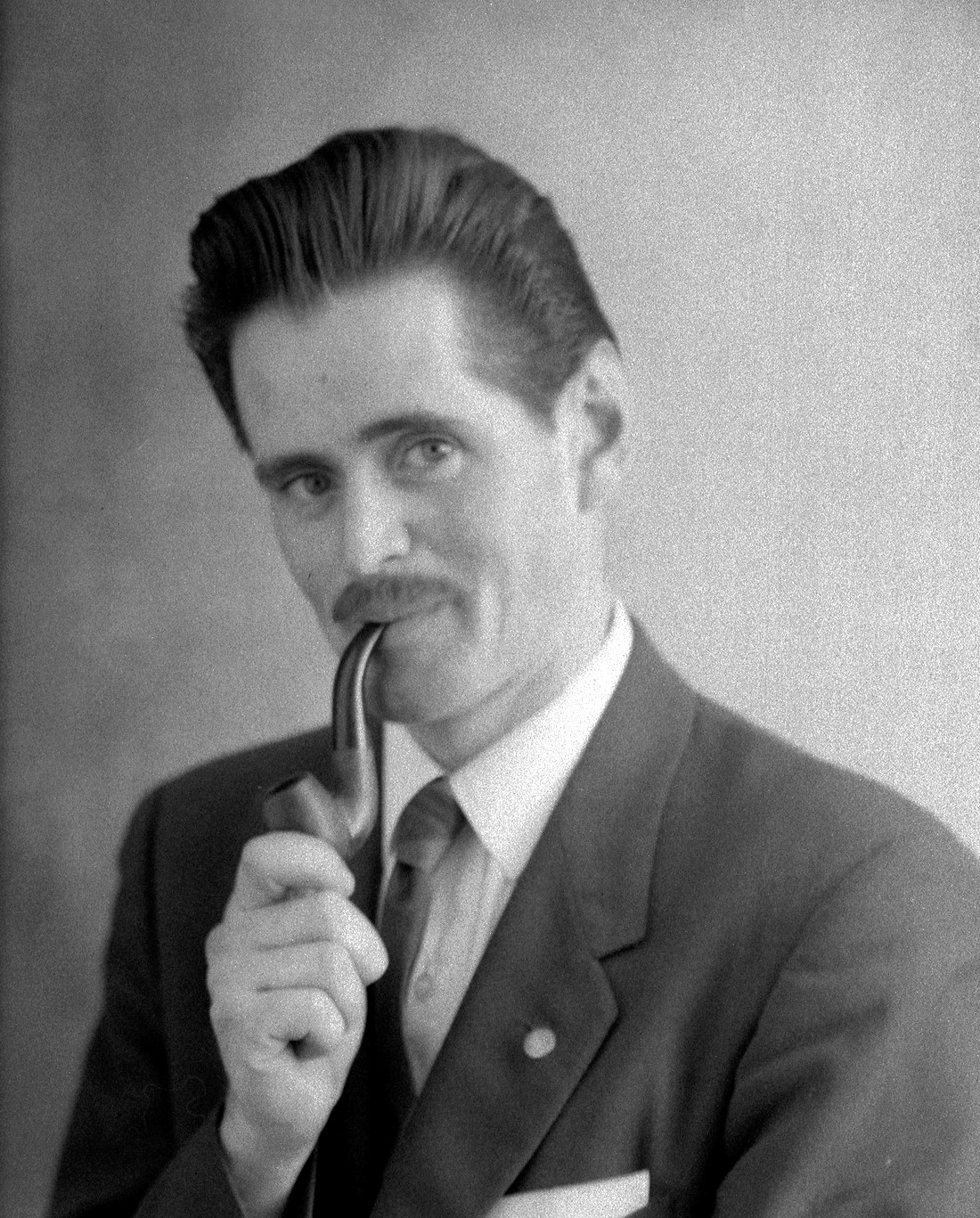
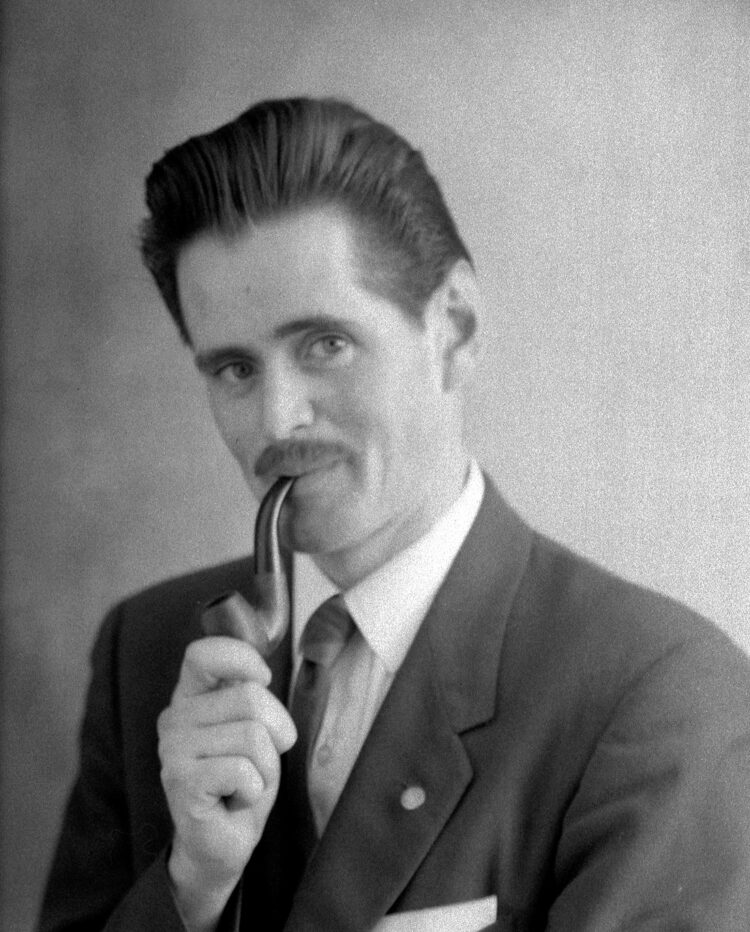
Marie-Alice Dumont’s portraits are sometimes a little comical, like this one of Pierre Nadeau. Was he known in the village as the life of the party? Or did he take himself too seriously? Perhaps it was all in jest. Was he making fun of himself or of the photographer? Were the smirk and the pipe we see here key traits of his personality?
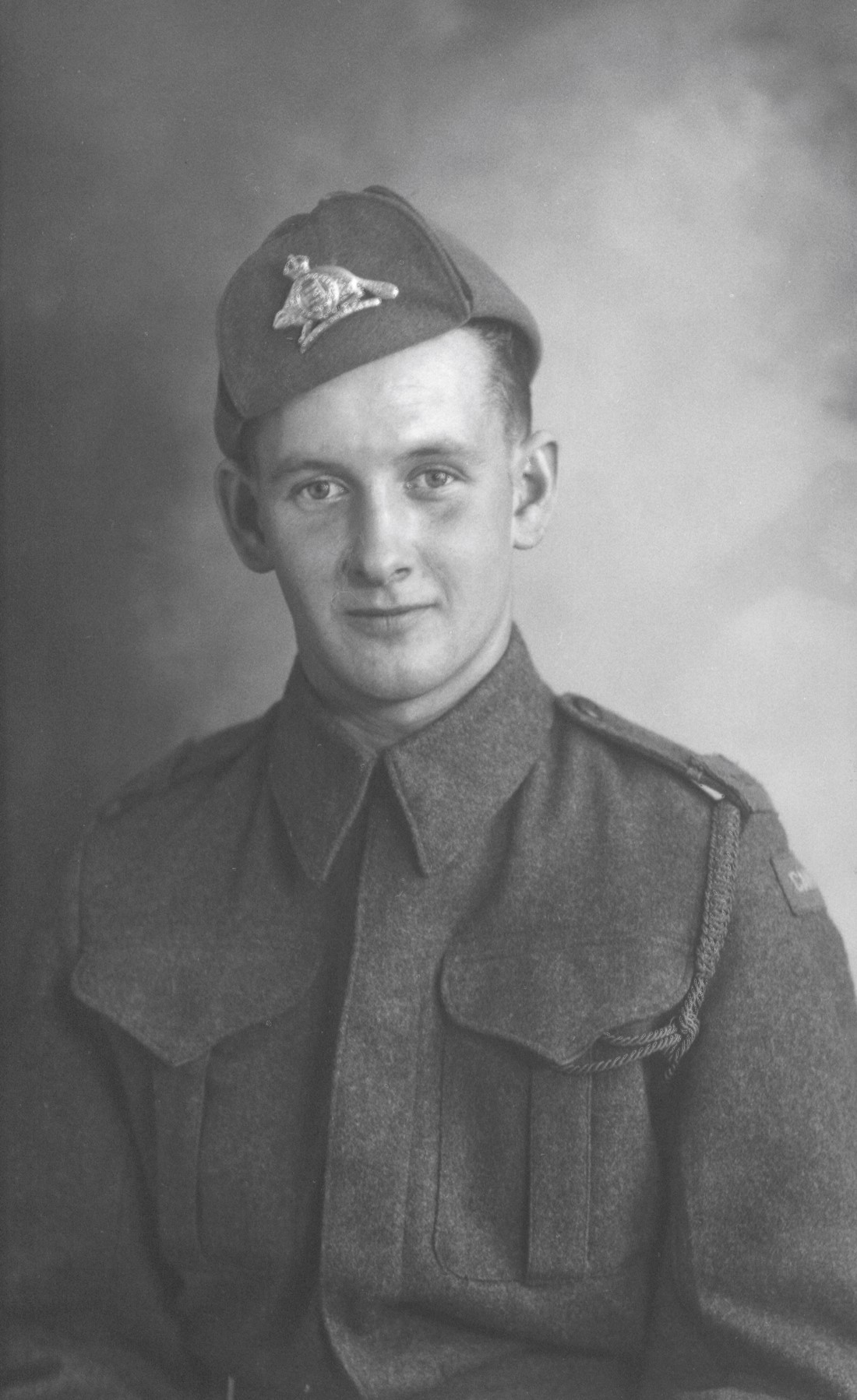
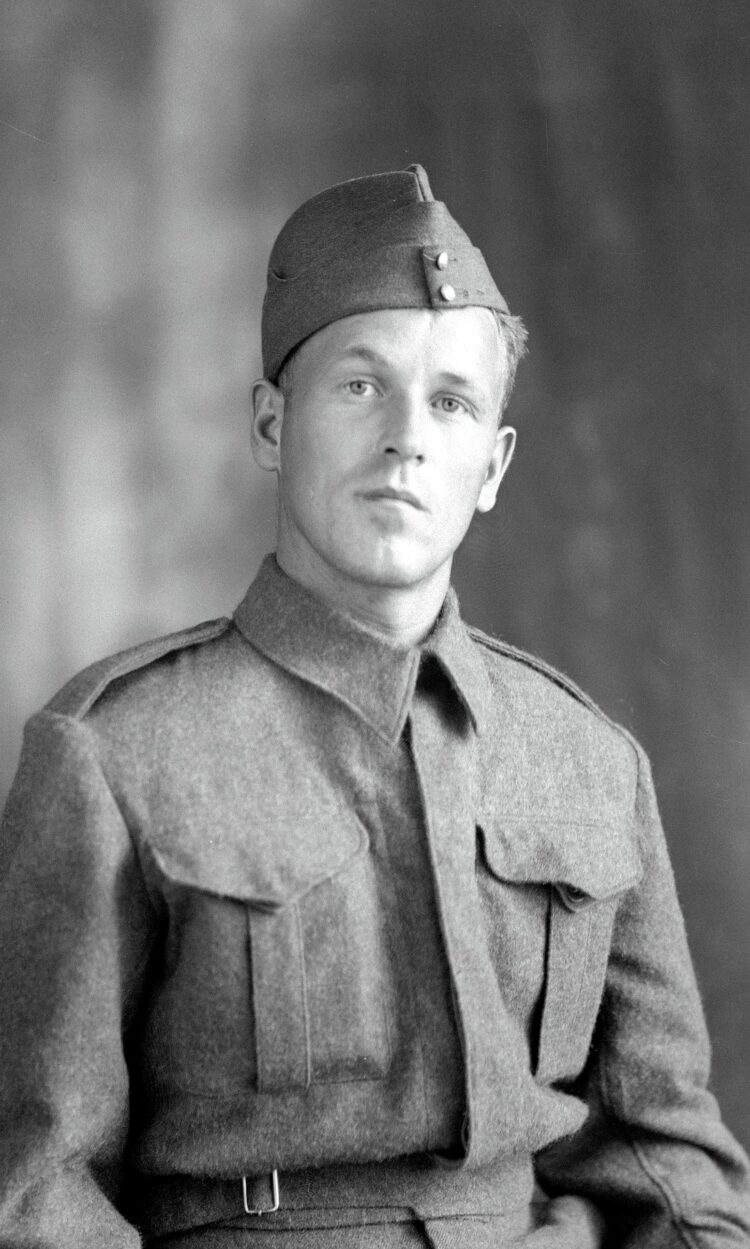
Marie-Alice Dumont had a small, sober-looking backdrop for portraits of people alone and of couples. She often photographed them head-on, without accessories, in a bust pose. In doing so, she followed in the footsteps of the great French photographer Nadar (1820–1910), renowned for his highly successful studio portraits of the leading figures of his time. Thanks to Dumont’s masterful art, the loved ones of Roland Thériault, a member of the Royal Canadian Air Force and a soldier in World War II, had a magnificent portrait of him to cherish while he was away at the front.
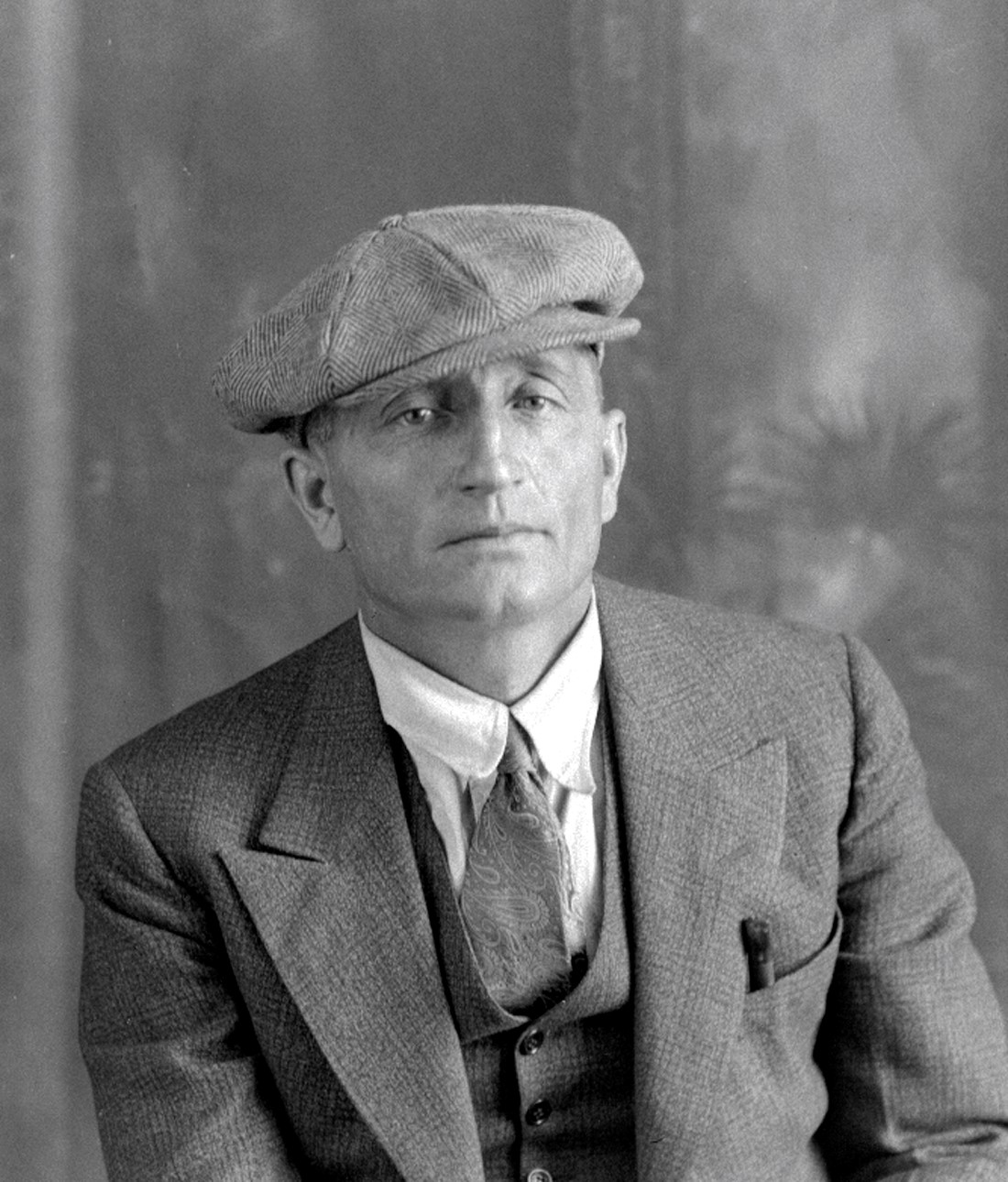
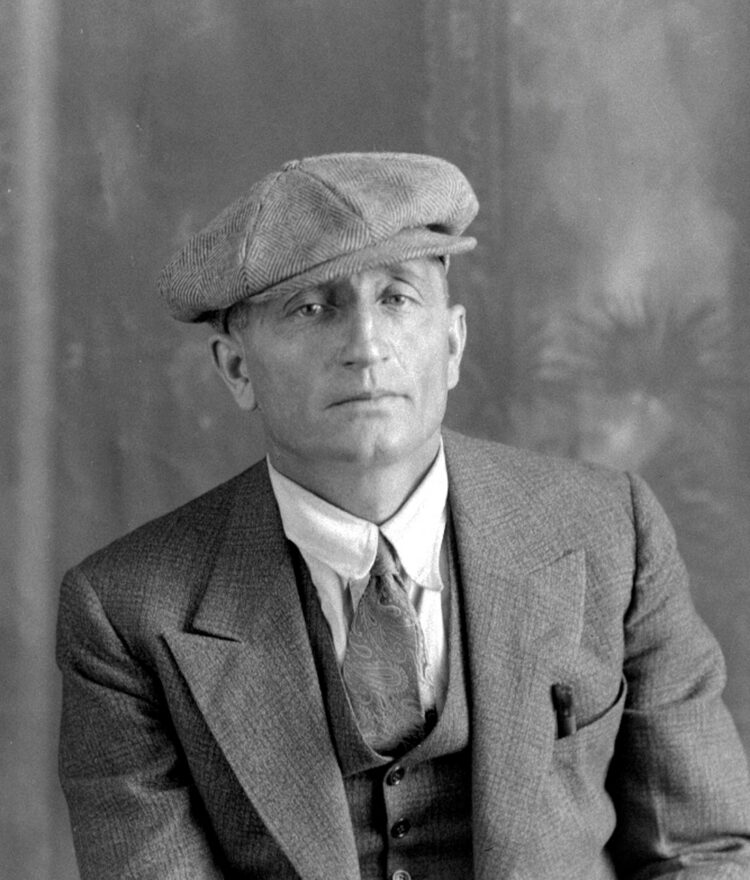
Pitre Bouchard once again visited the small Saint-Alexandre studio. Dressed in his best suit, he posed with his couvre-chef and then again without it. When in the lens with his wife and many children, he never wore a hat; but, when he was alone in front of the camera, he allowed himself the choice. The cap we see here suited him particularly well. Its slight tilt on his head echoes the angle formed by the subject’s equally inclined shoulders. Mr. Bouchard is not standing quite straight either: rather than holding himself up tall, shoulders slightly rolled back, he appears here slightly hunched over. The effect is not necessarily bad! It gives him a relaxed, natural look that goes well with his slightly drooping eyes. Dumont had a gift for producing portraits packed with personality.
Youth
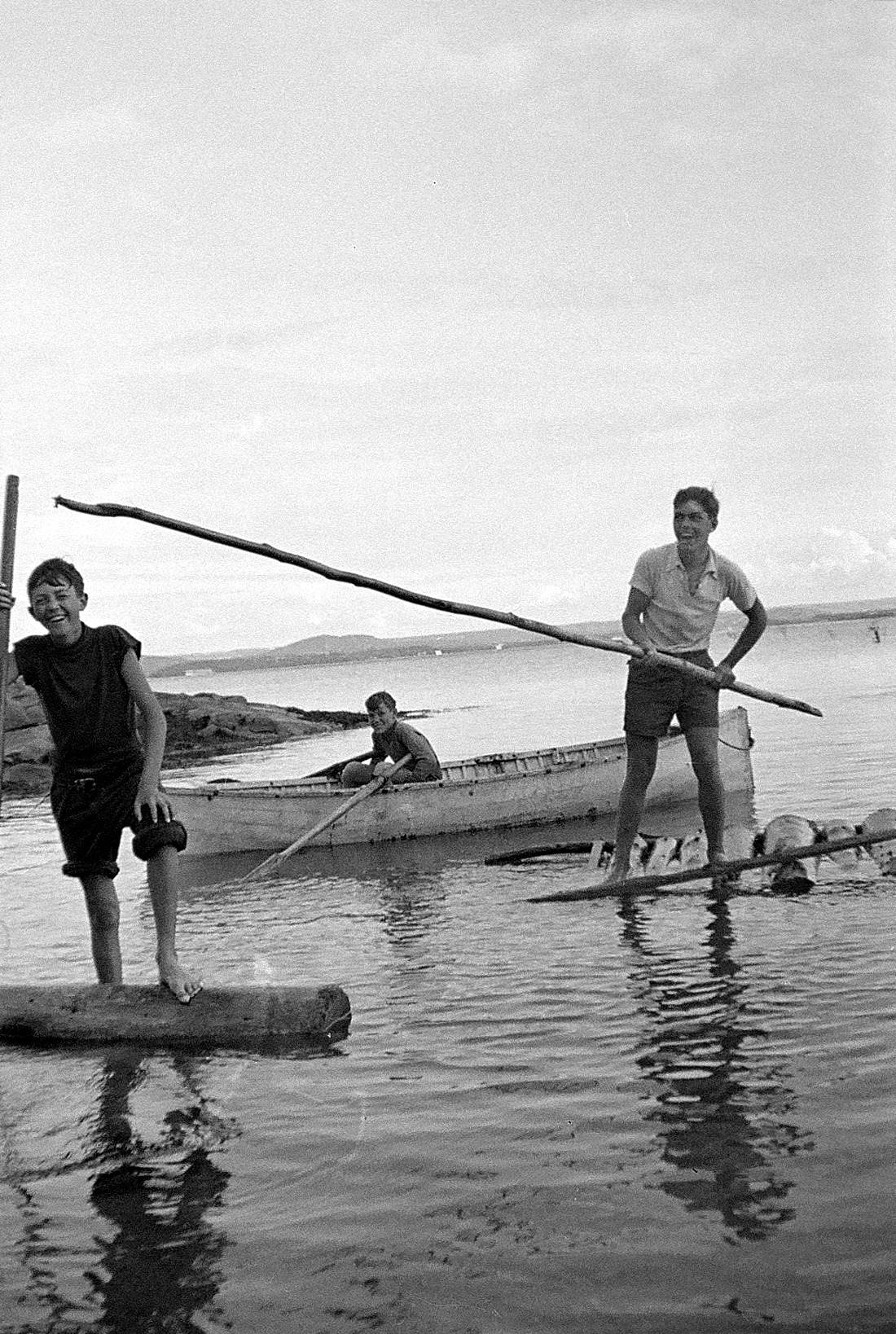
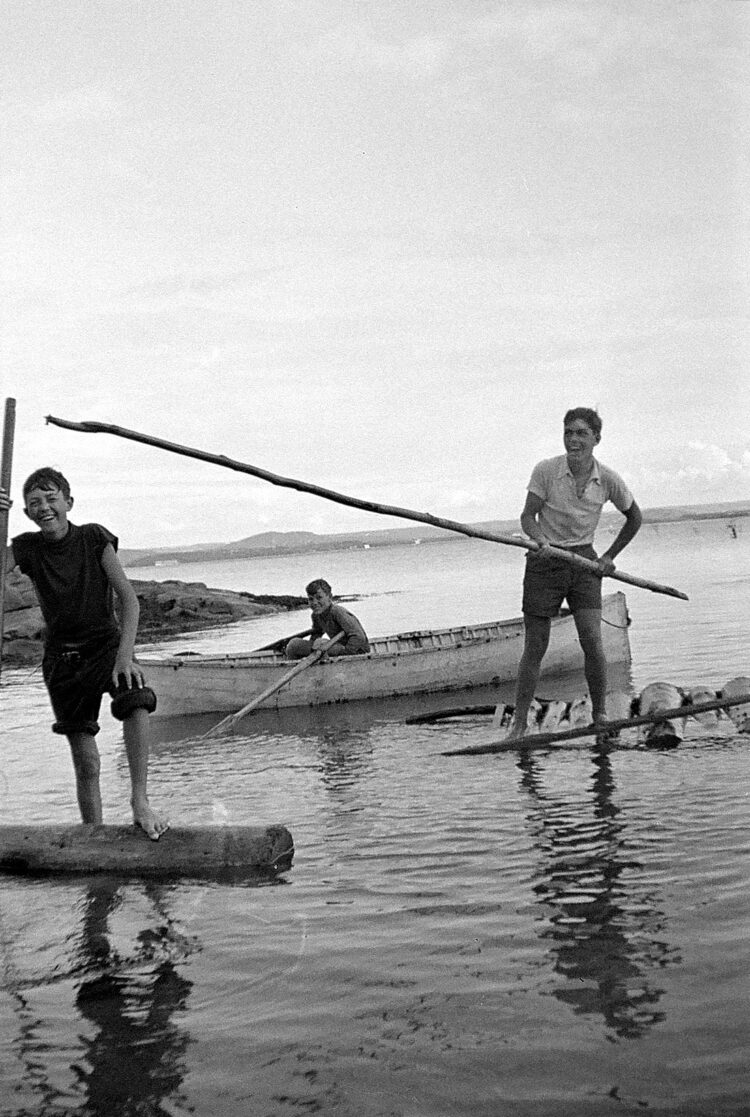
The St. Lawrence River has always been part of daily life for young people in Kamouraska. Today, just as in the early 20th century, it is a place to swim, play and spend time outdoors. The boys in this image are likely Marie-Alice Dumont’s nephews.
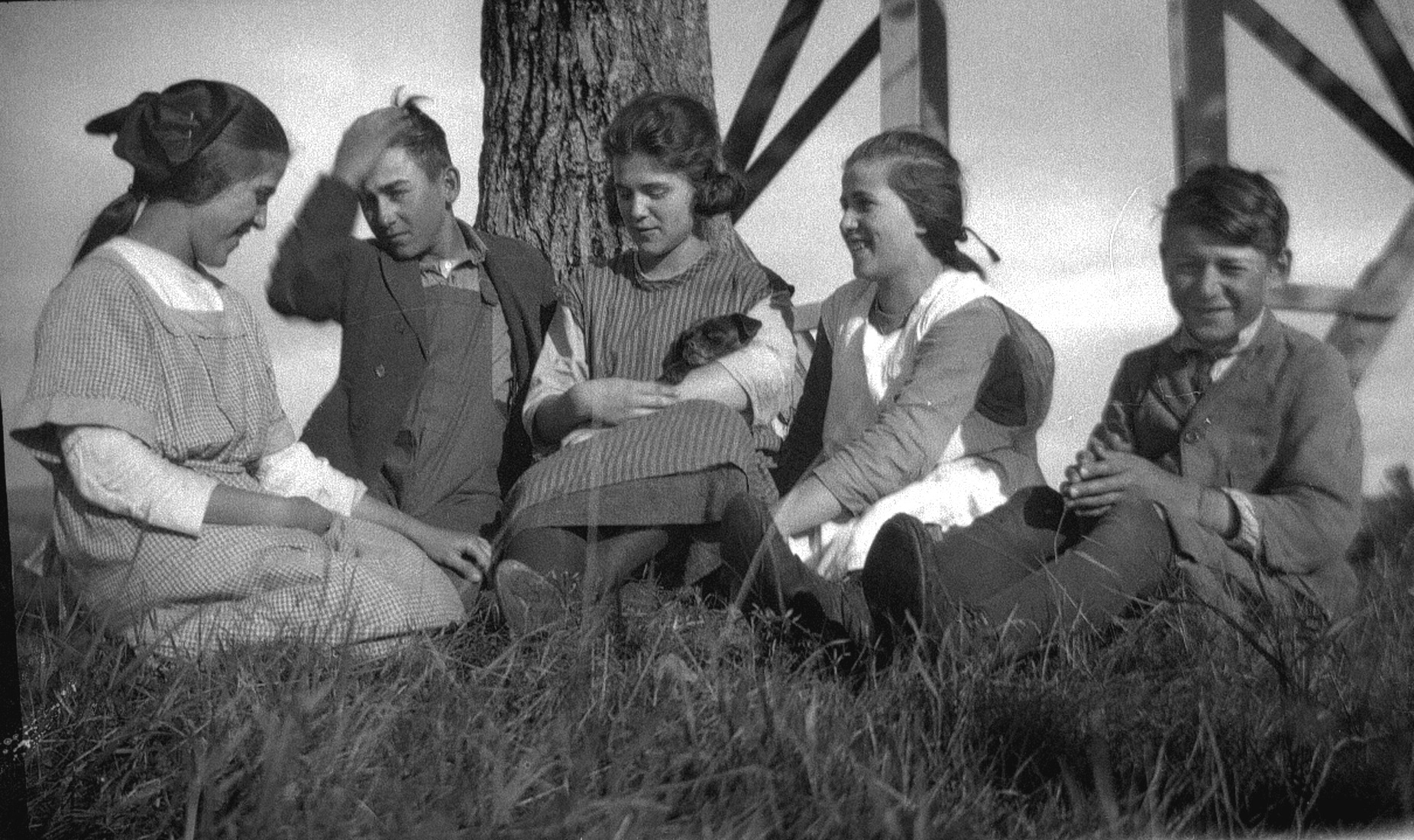
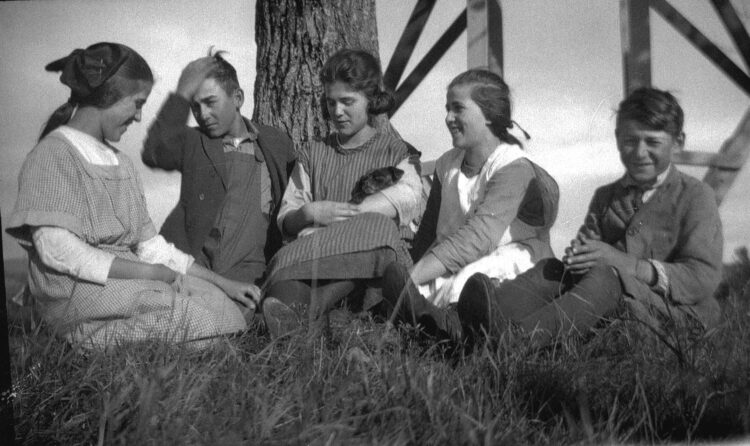
One of the Dumont family’s favourite pastimes was visiting relatives on the weekends. In this photo, Marie-Alice Dumont captures one of those cherished moments between cousins.
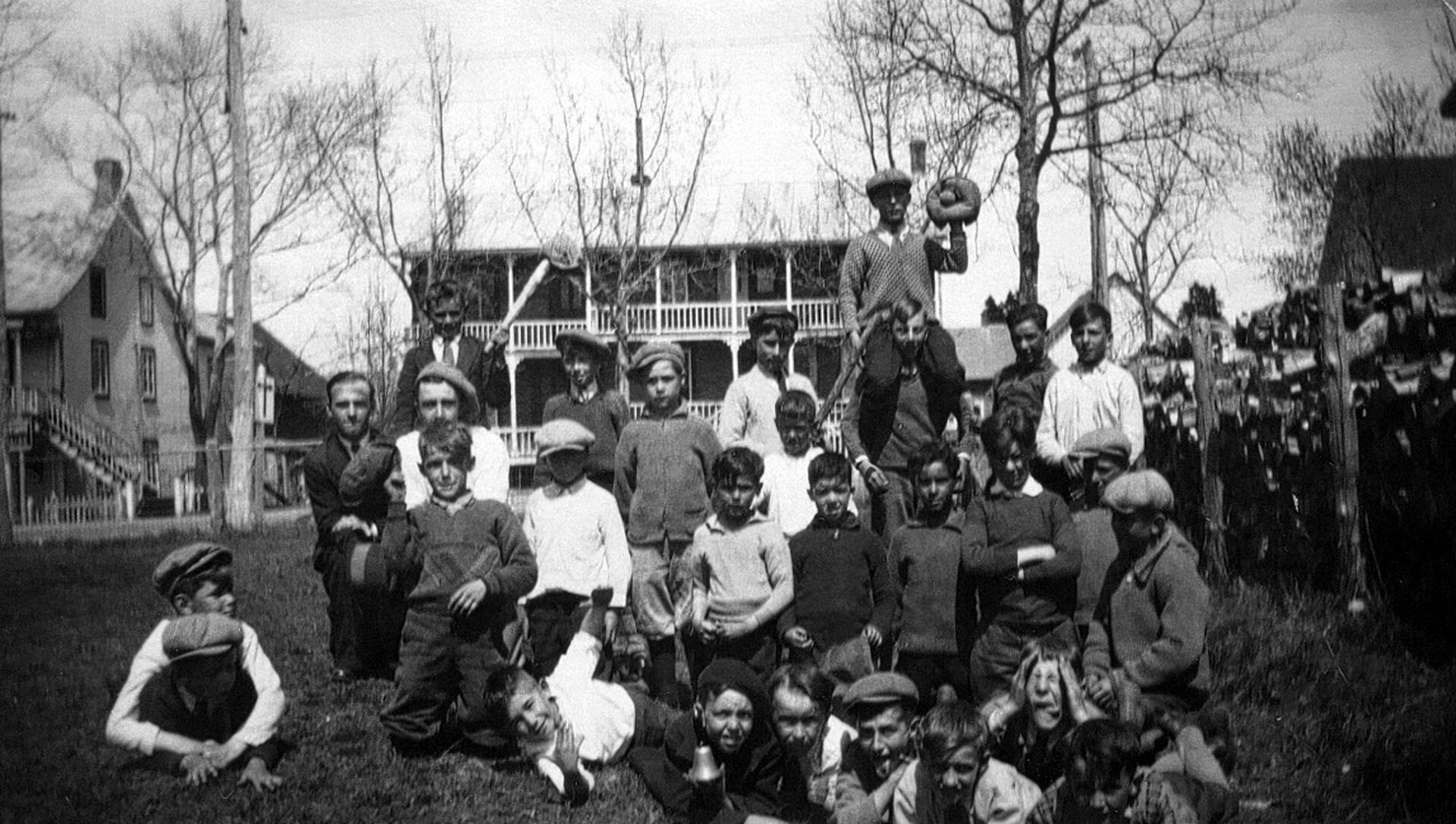
At the time this playful photo was taken, literacy was on the rise in Quebec, despite a decline in school attendance and the fact that compulsory schooling for all children up to age 14 would not be enacted until 1943.
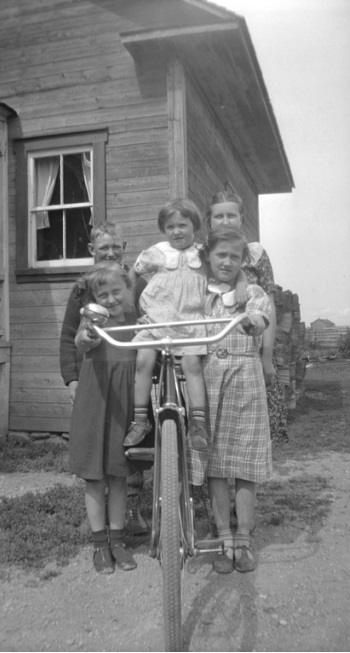
What a joy to receive a bicycle as a gift! Even though the new bike was gifted to the older sister, the whole family was thrilled and wanted to pose for Aunt Alice’s camera to mark the occasion.
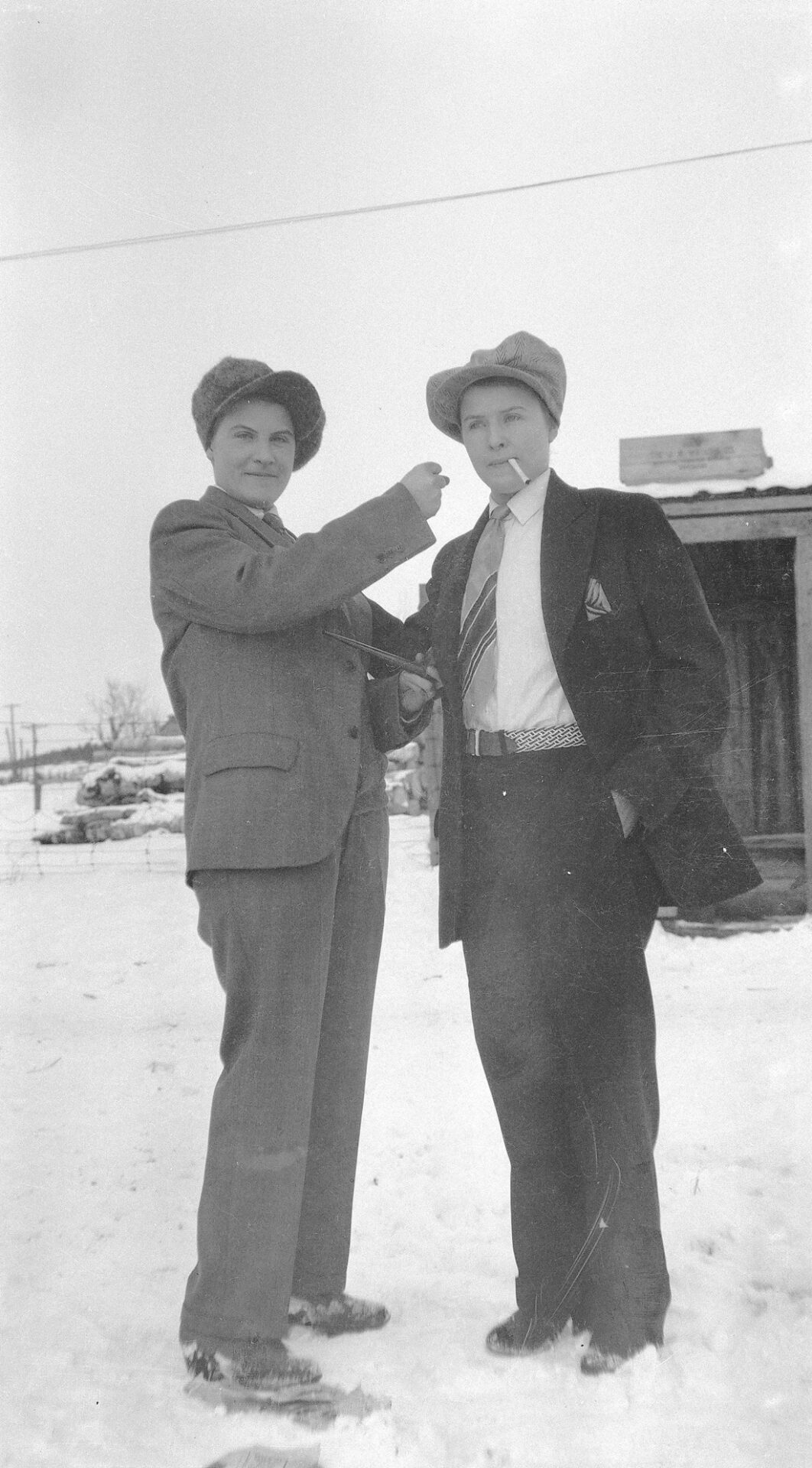
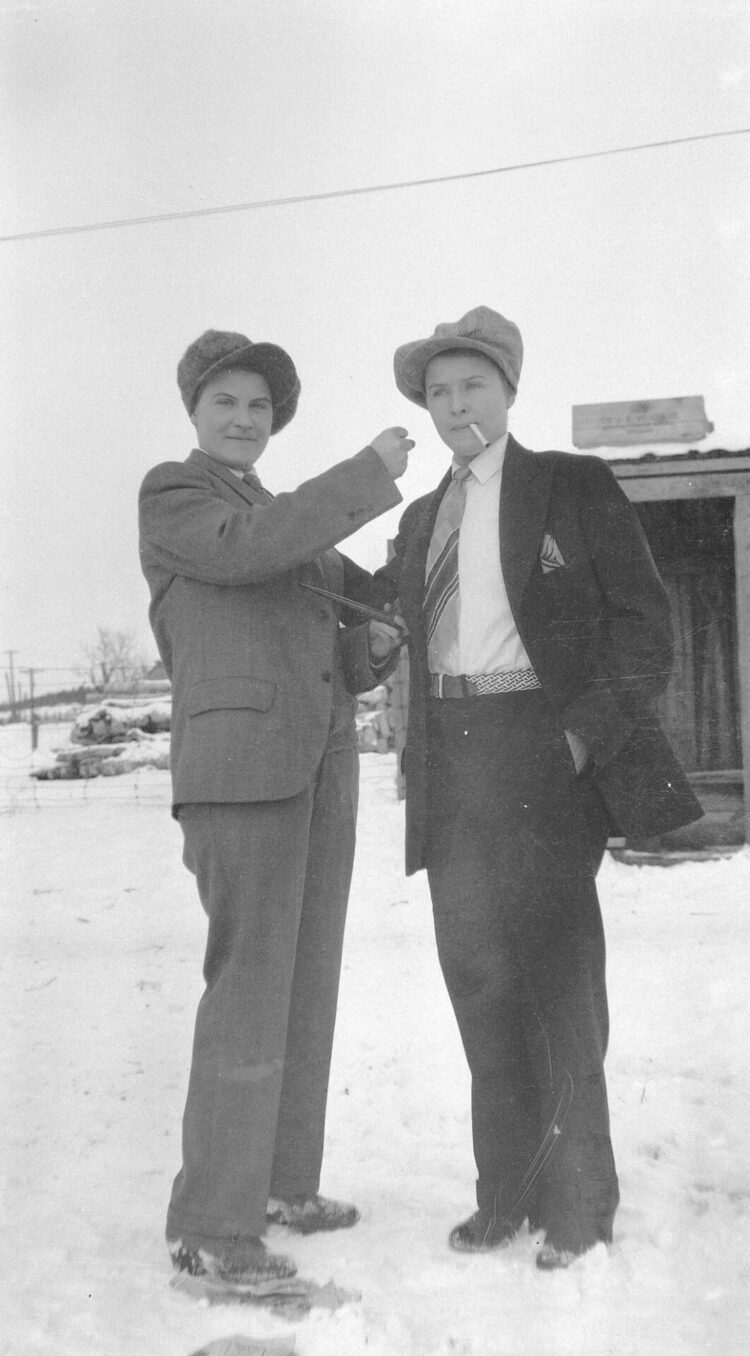
These two girls, dressed as men, chose props like a cigarette and a pipe, mocking a punch to the face to mimic the behaviour of their male counterparts. Is it just a caricature or a subtle commentary on masculinity in their time?
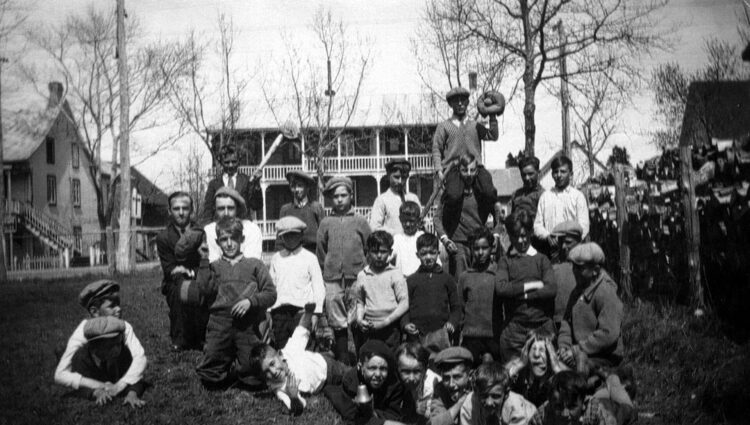
Scouting was a popular Catholic youth movement in French Canada during the 1930s. It served as a way for the Church to guide young people and pass on Christian values during a time of significant social and economic upheaval.
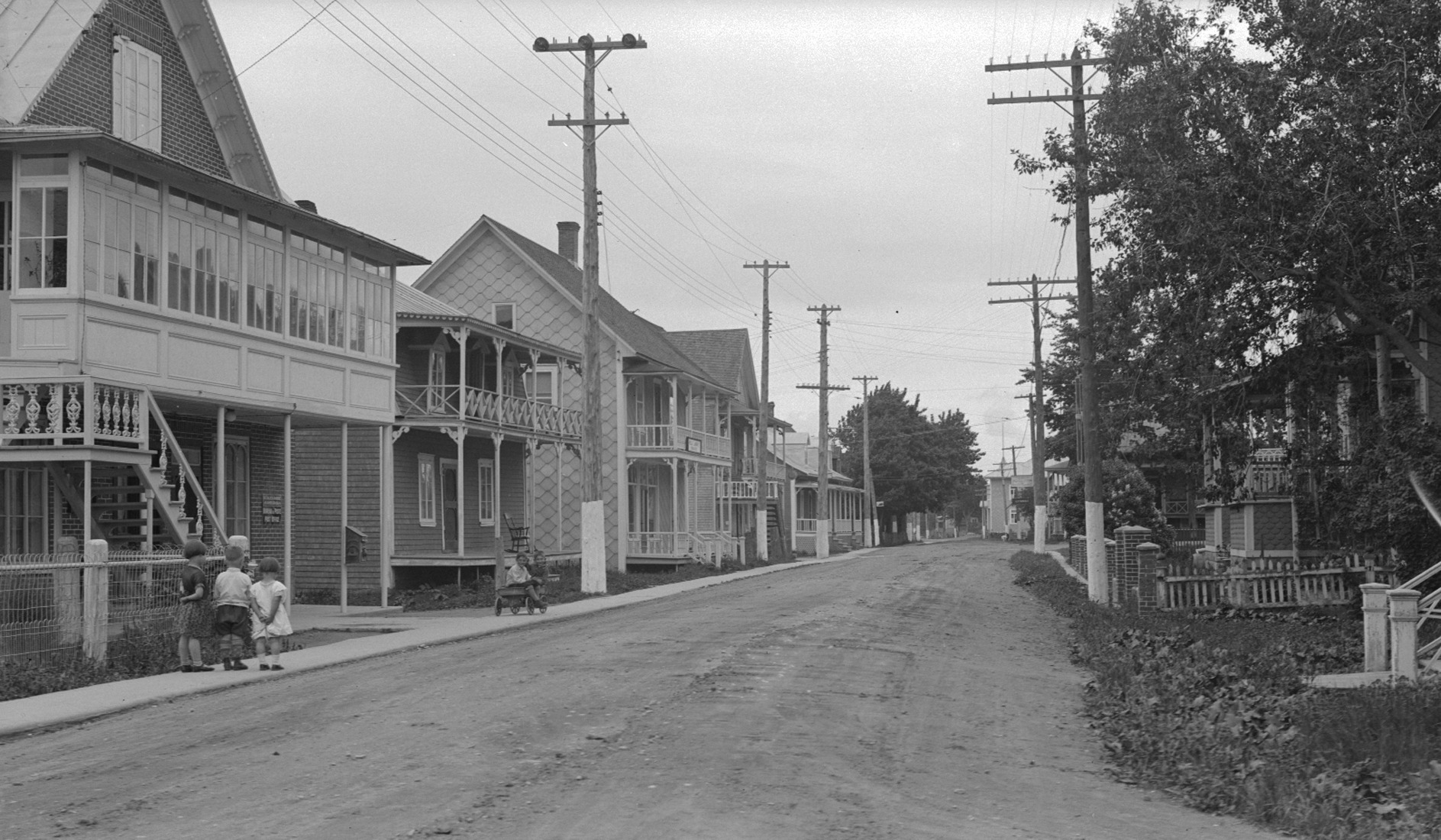
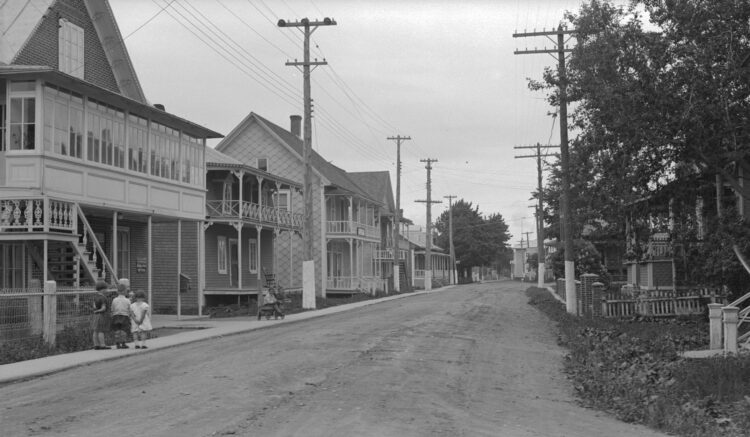
This street scene is one of Dumont’s most striking images. In addition to offering a beautiful view of this area of Saint-Alexandre, it captures a quiet moment of pause in the midst of children’s sidewalk play.
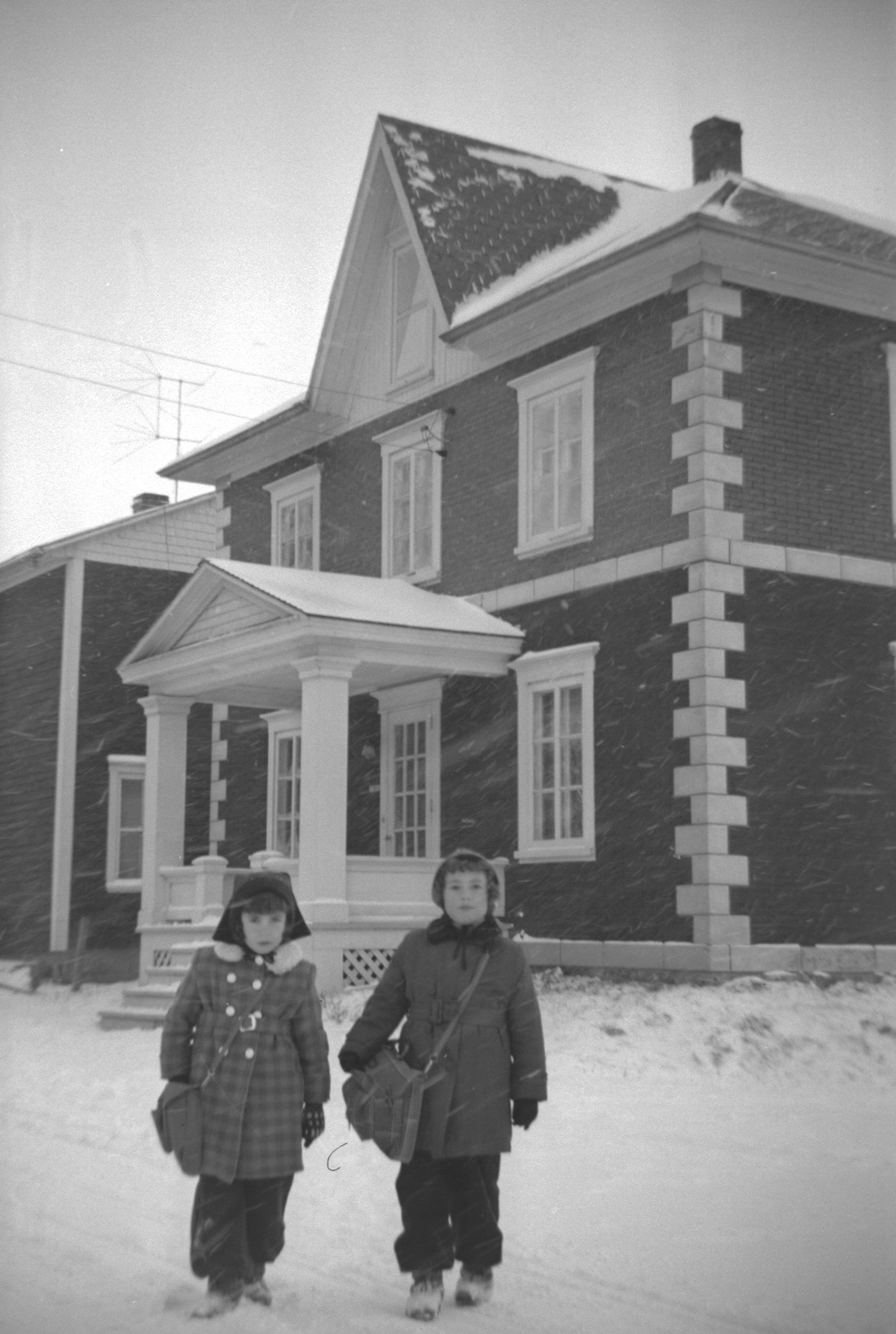
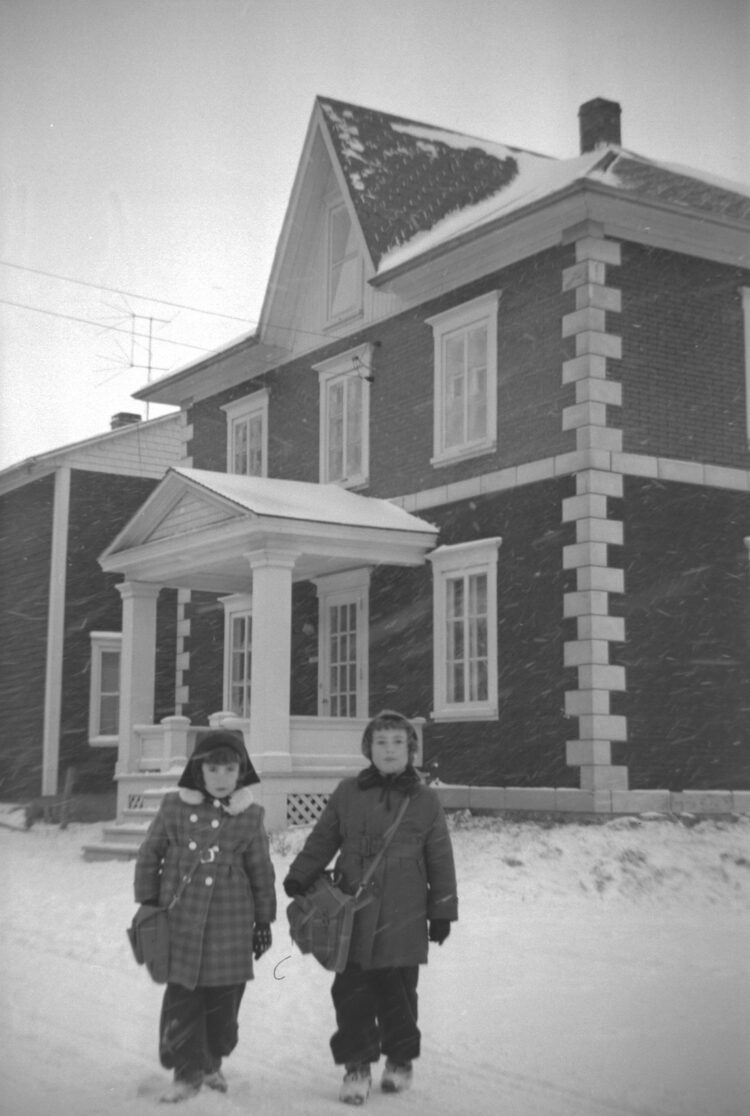
“In my day, we walked miles to school, even in a snowstorm!” You can easily imagine Céline and Pierrette Dumont, nieces of the photographer, sharing this story in their later years.
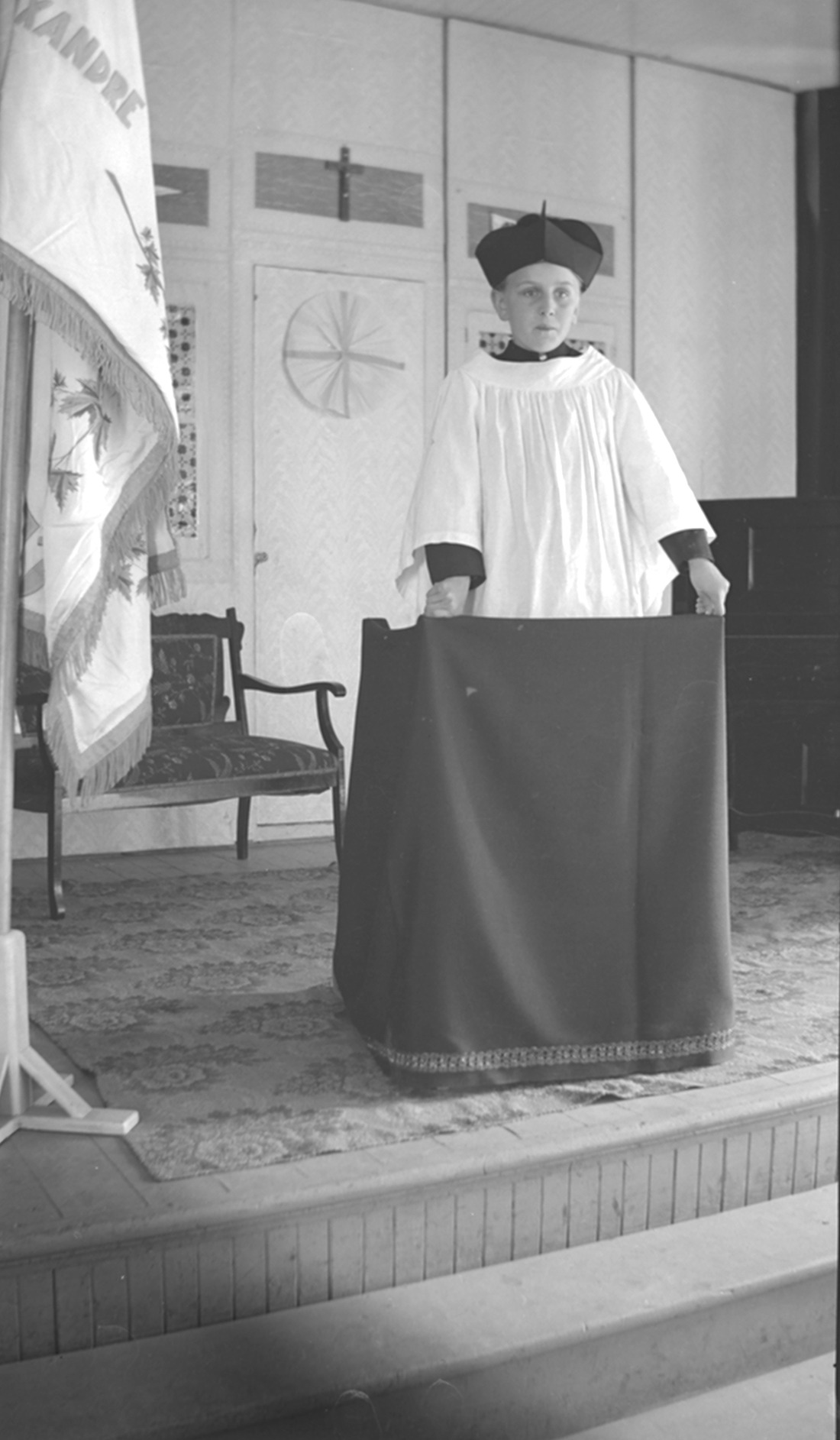
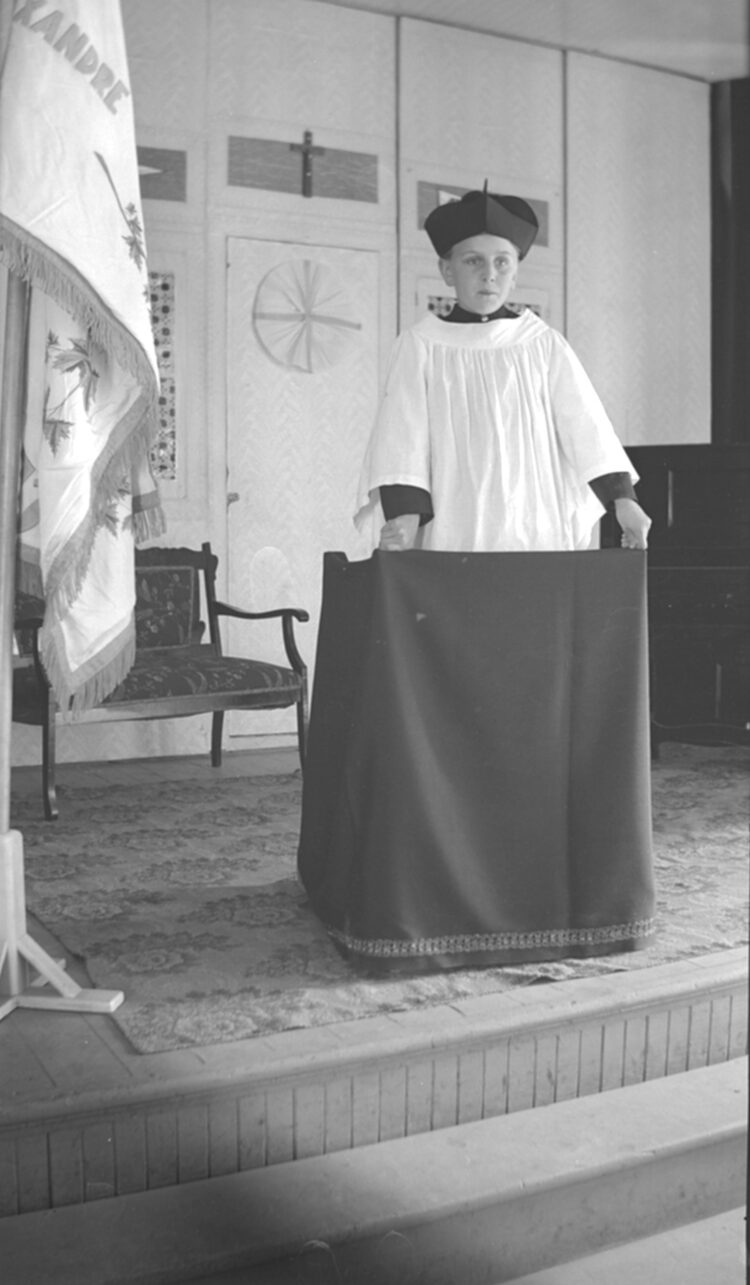
In Dumont’s era, many young boys served as altar boys during Mass or sang in the choir. Their role assisting the priest during religious ceremonies was important.
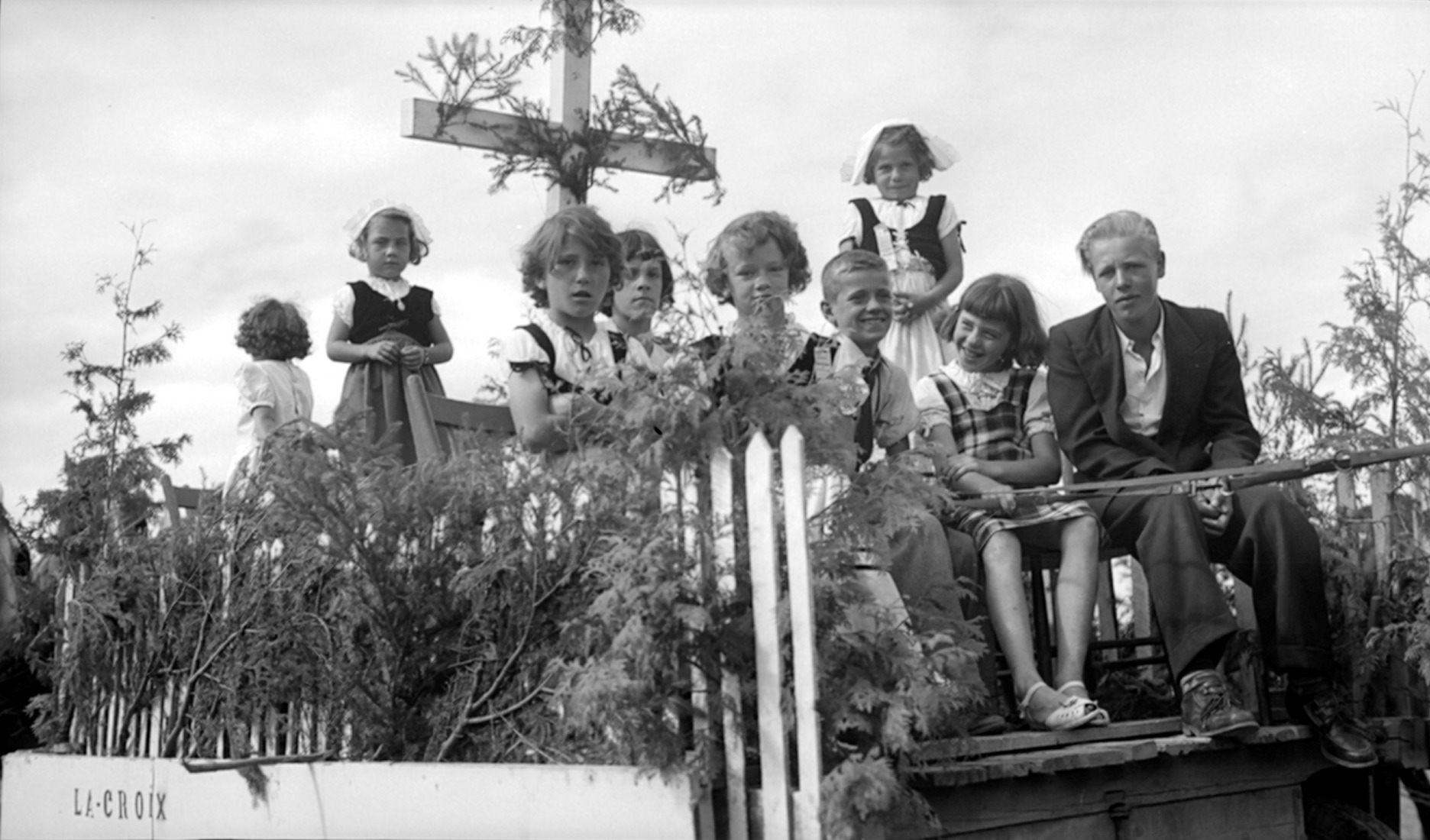
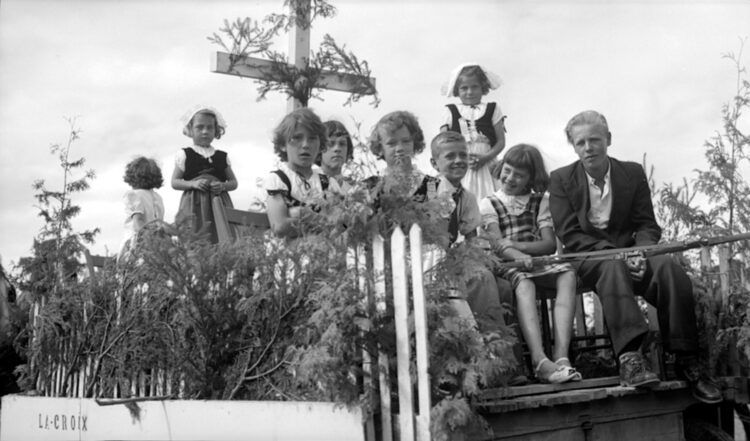
Many youth groups were involved in the parade of decorated floats for Saint-Alexandre’s centennial celebrations. In this one, about 10 participants staged a representation of the Cross, perhaps a roadside cross, a common feature of Catholic popular devotion.
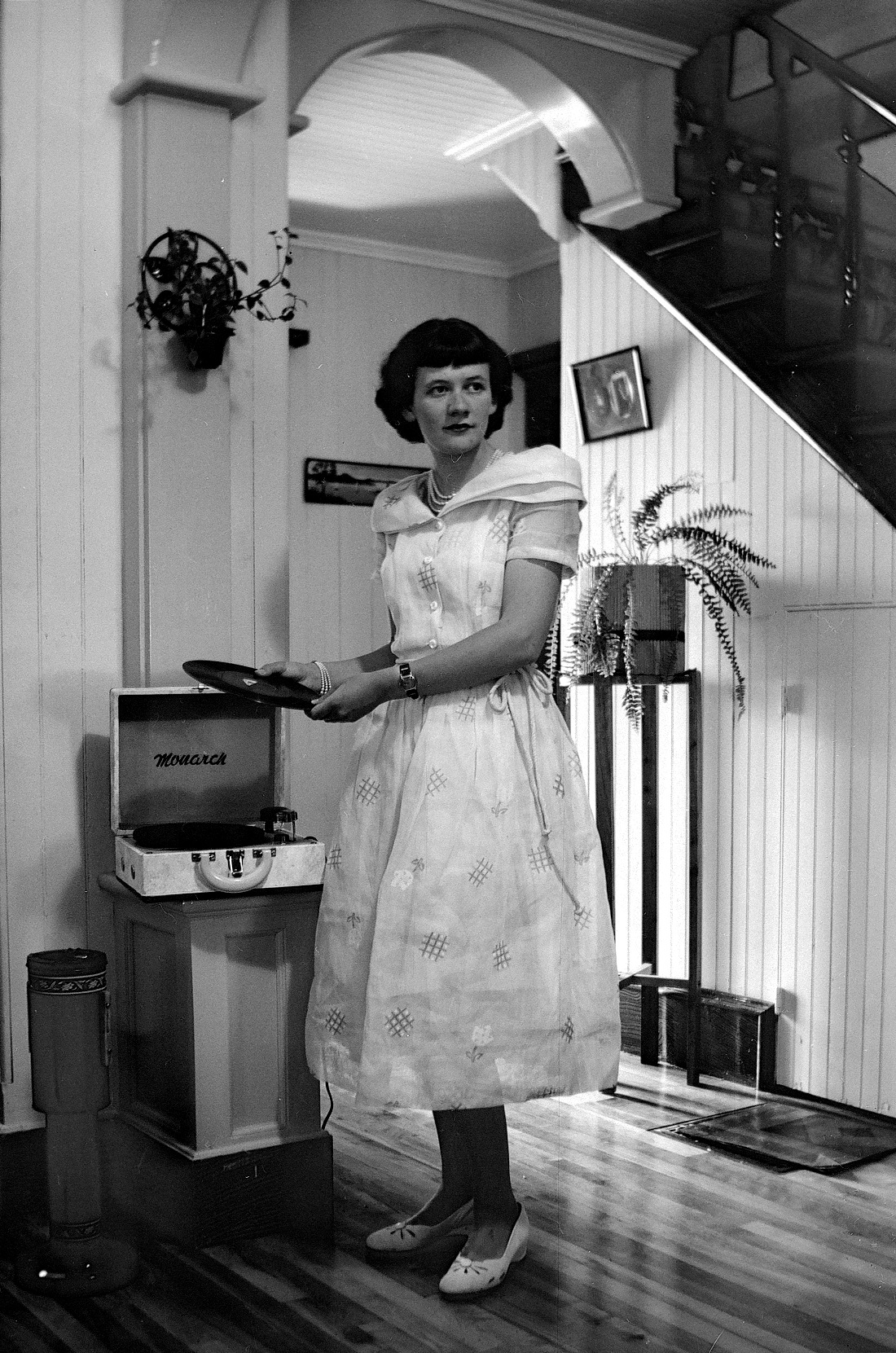
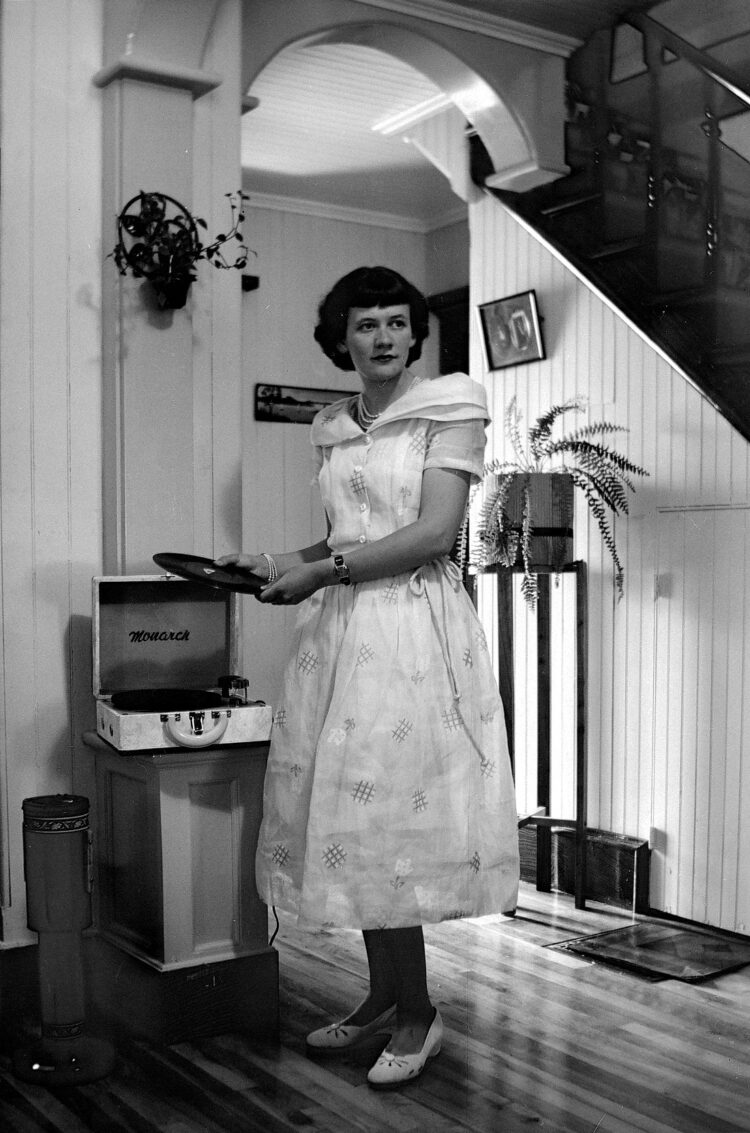
Louise Pelletier and her sister Denise proudly show off their vinyl record collection. When the photographer visited their home, not only did they put on their finest dresses, but they also asked Dumont to take their portrait with their treasured records.
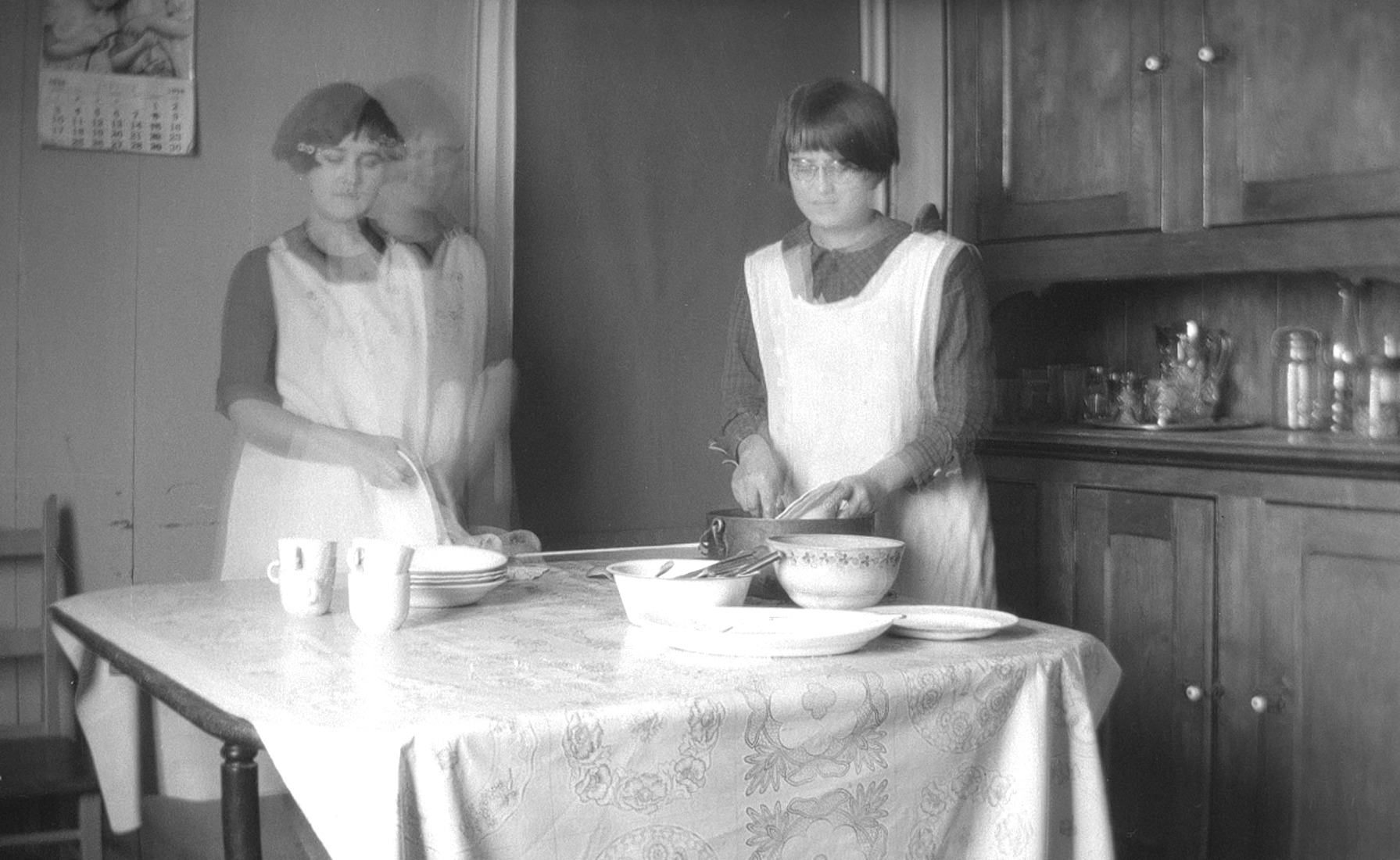
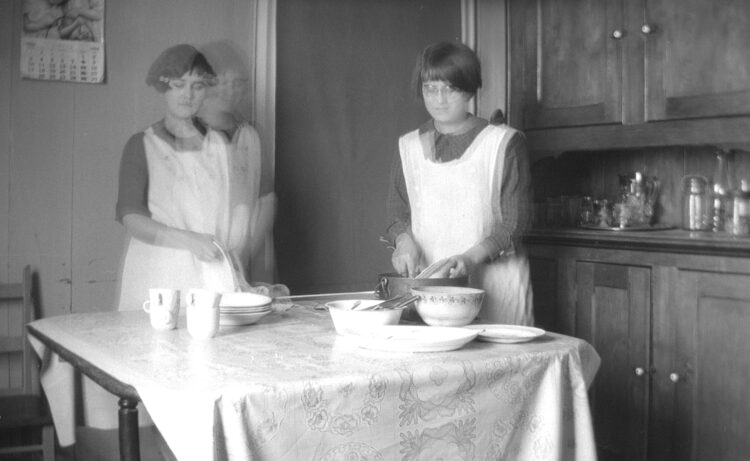
In the Dumont family, young girls were involved in domestic chores from an early age, like doing the dishes. In a household that large, everyone had to pitch in!
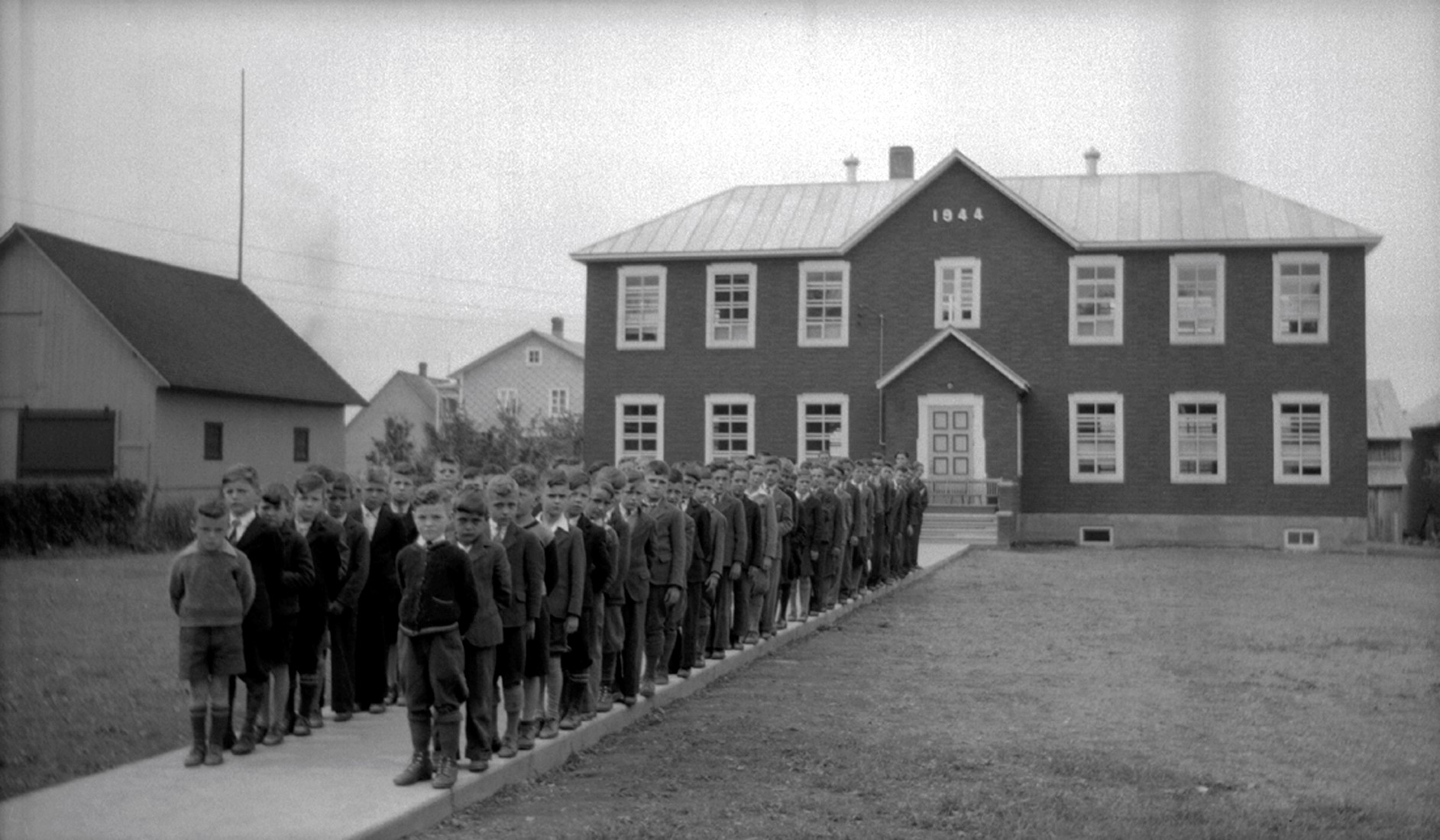
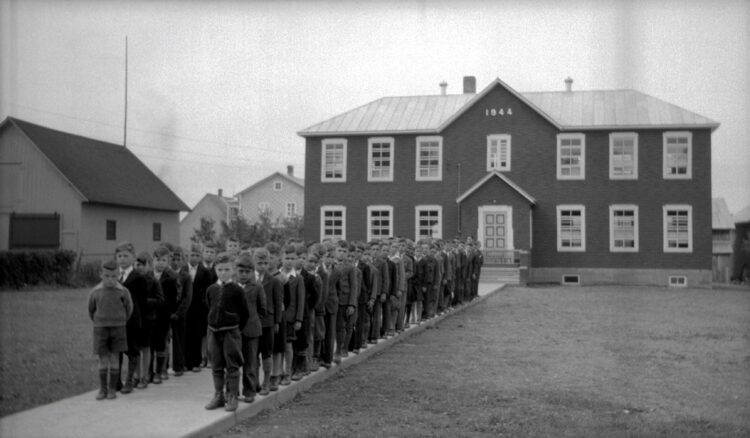
Who does not remember lining up in formation at school to the sound of the bell? The 60 or so boys patiently waiting here for the photographer to finish her work were likely among the first students at this newly built school.
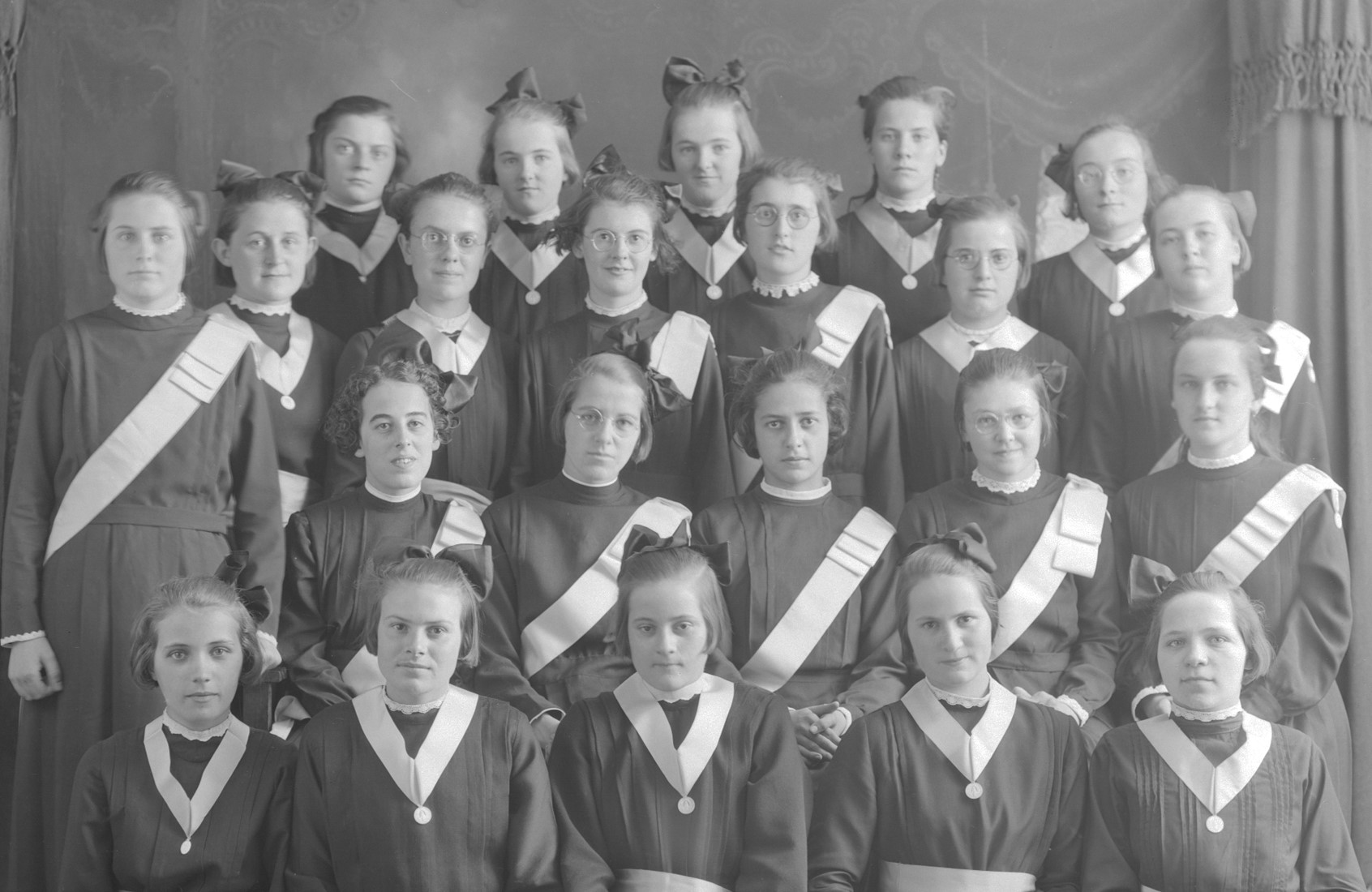
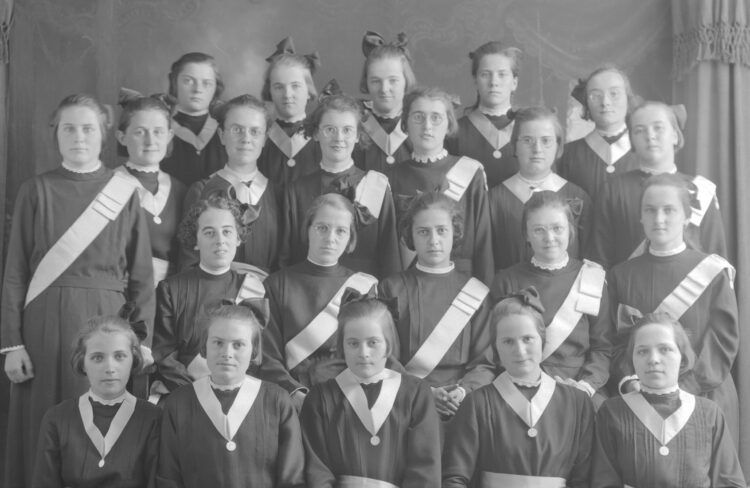
When Abbot Joseph-Napoléon Dumont addressed young women about careers and vocations, the options were limited. Marriage was, of course, one such option; though it usually meant being confined to the home. As for single women, he said they had “great value on this Earth,” as they could raise younger siblings, become teachers or serve as housekeepers. Napoléon did not mention the case of his own sister, who became a professional photographer. This is a telling omission, both of the exceptional nature of her career and of the narrow paths available to women at the time! What kind of future did these 1935 graduates imagine for themselves?
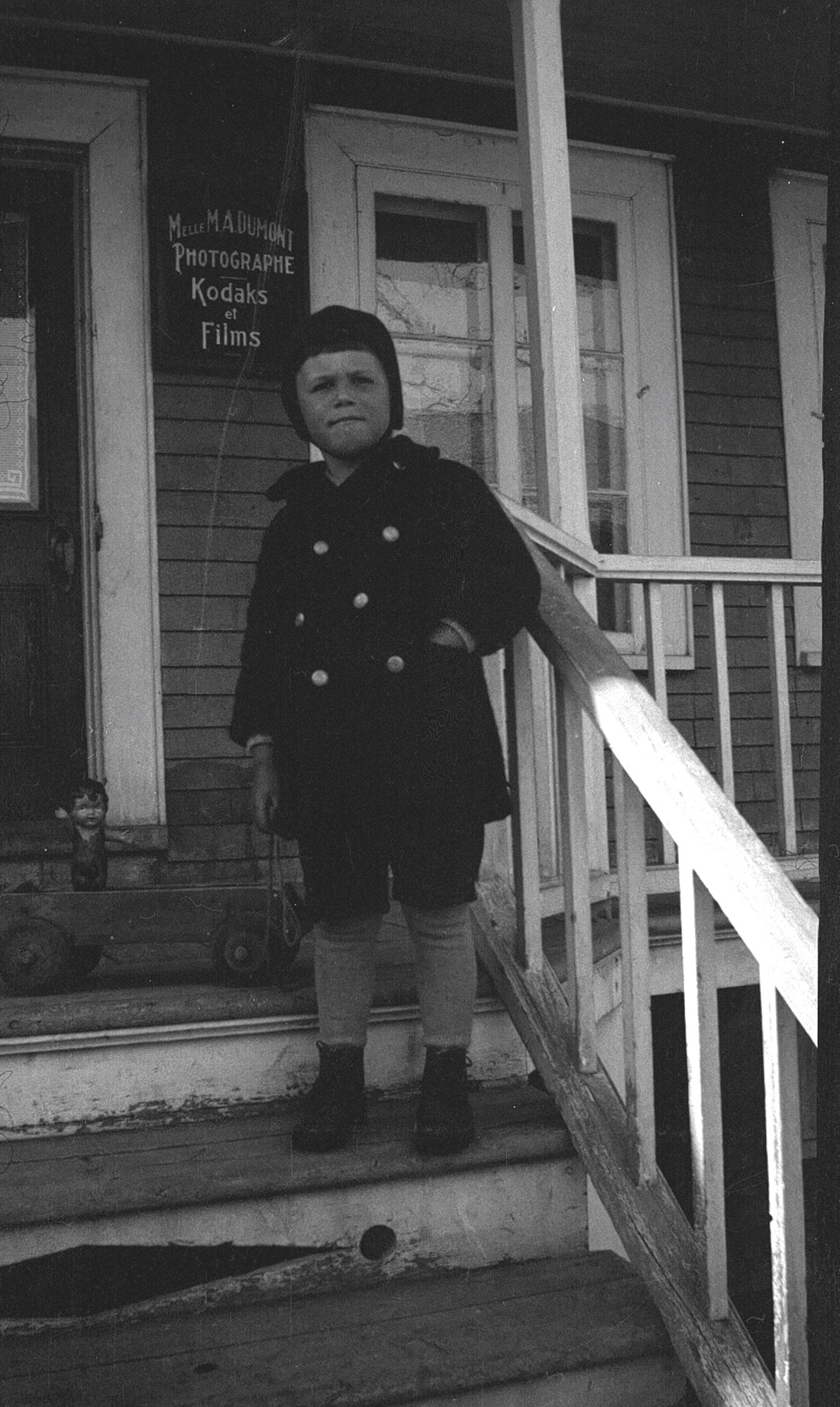
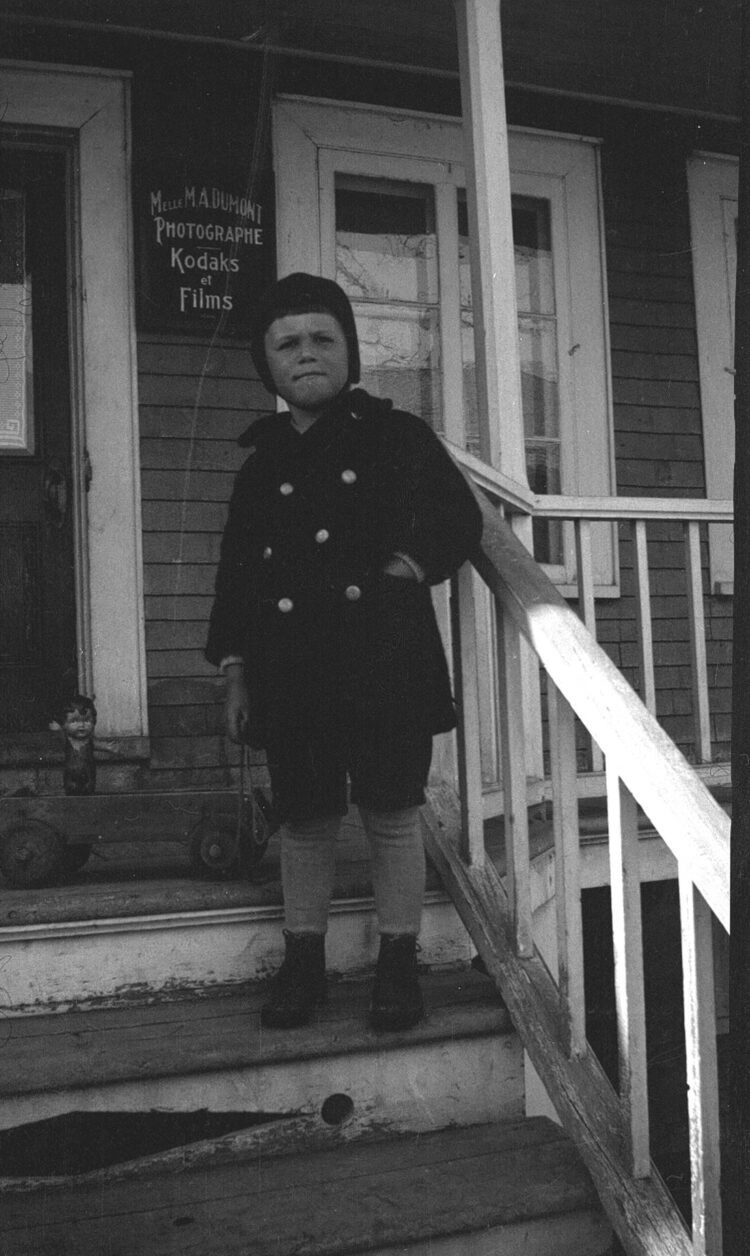
Marcel Boucher stands proudly on the steps of his aunt’s studio, with her shop sign clearly visible in the background.
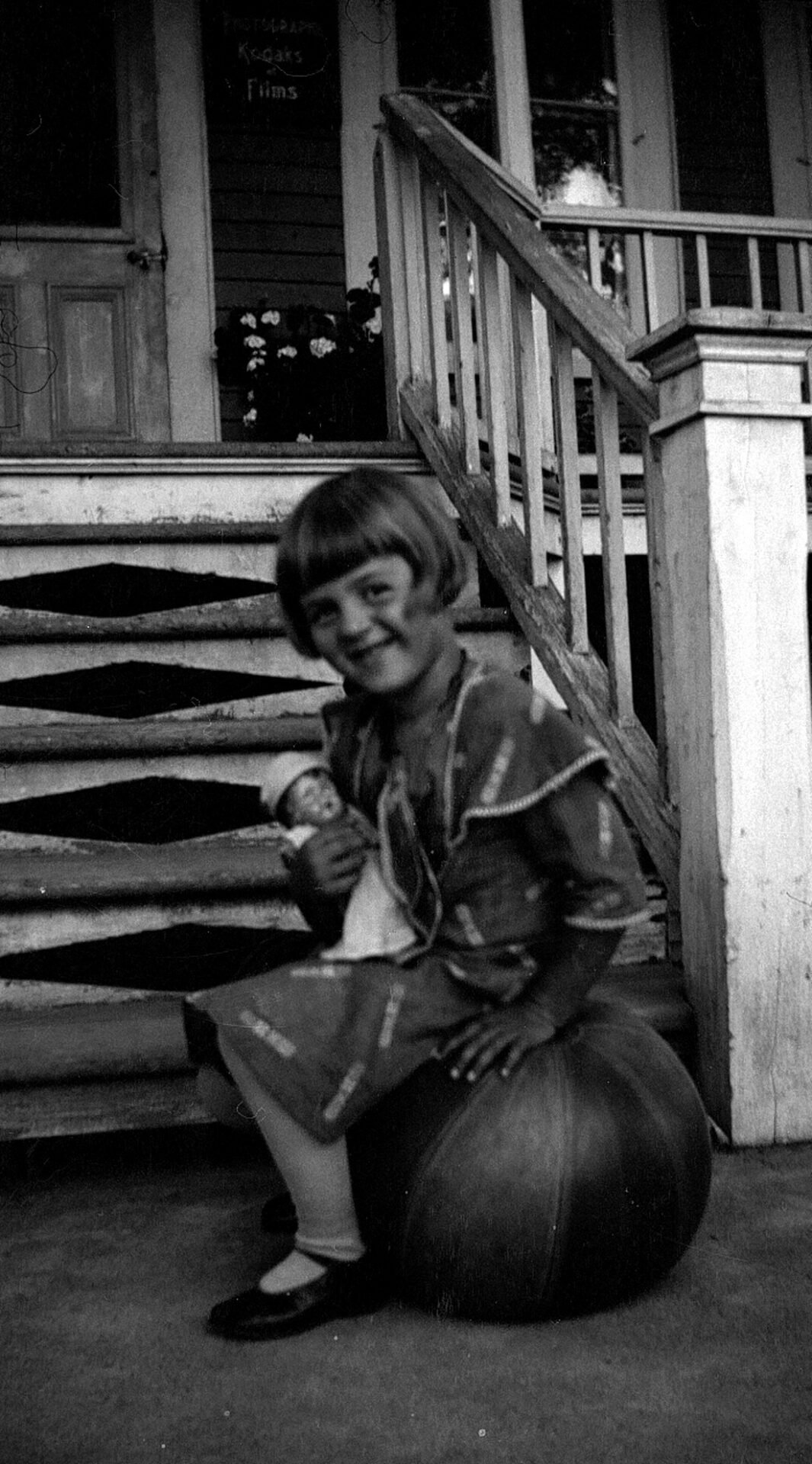
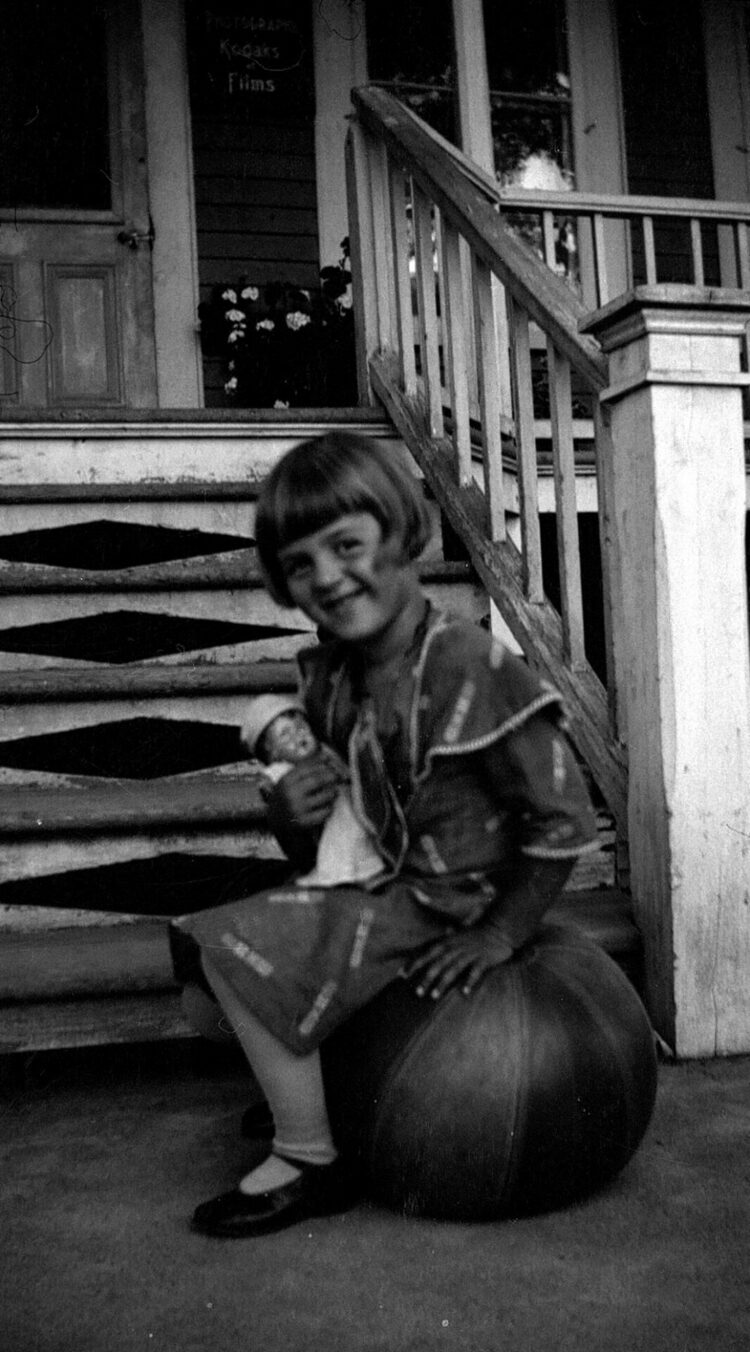
For Dumont, any occasion seemed like a good one to photograph children, or at least, that is the impression her archive gives. In this image, she captures a candid moment as a visiting niece plays in the studio.
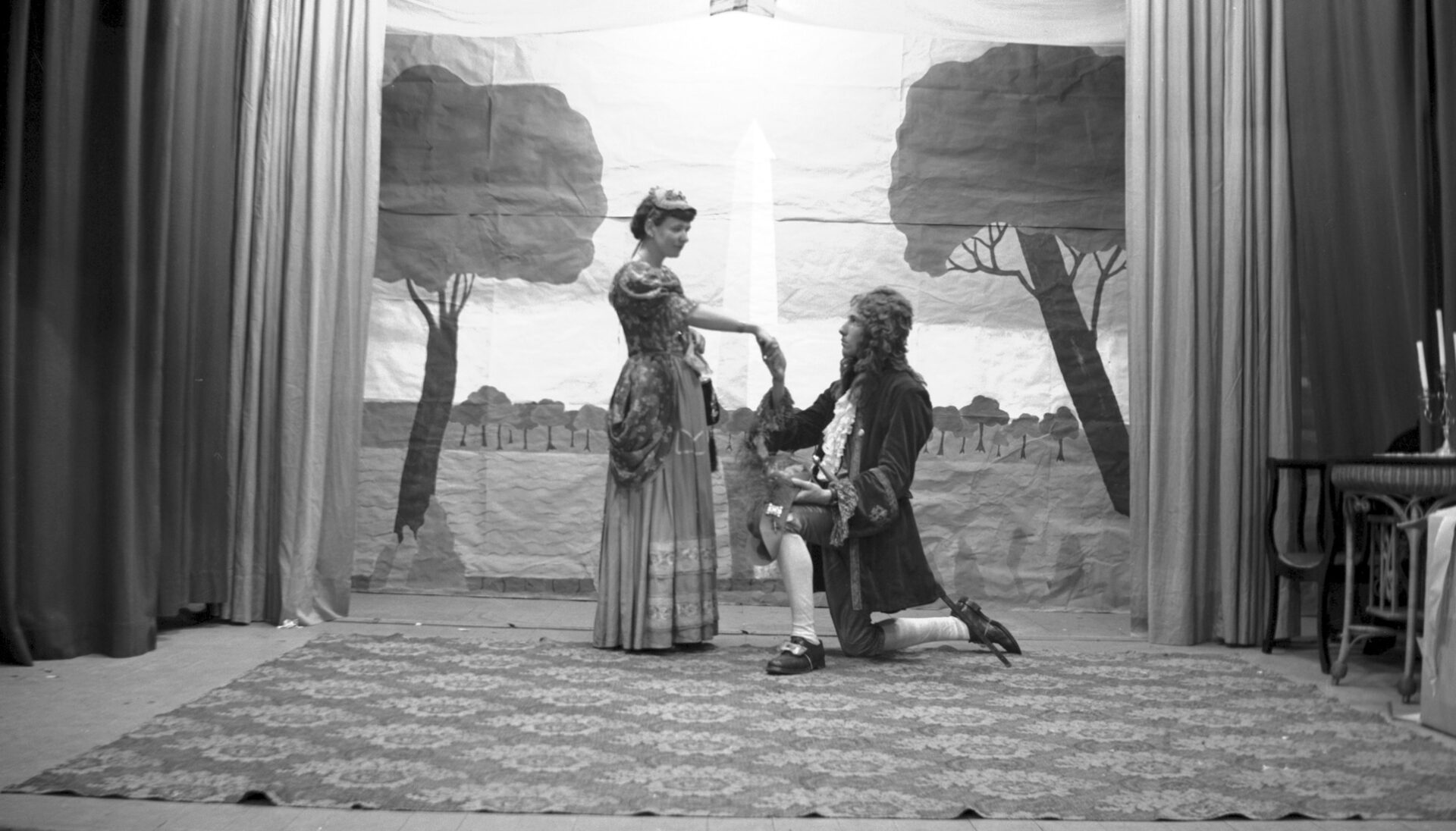
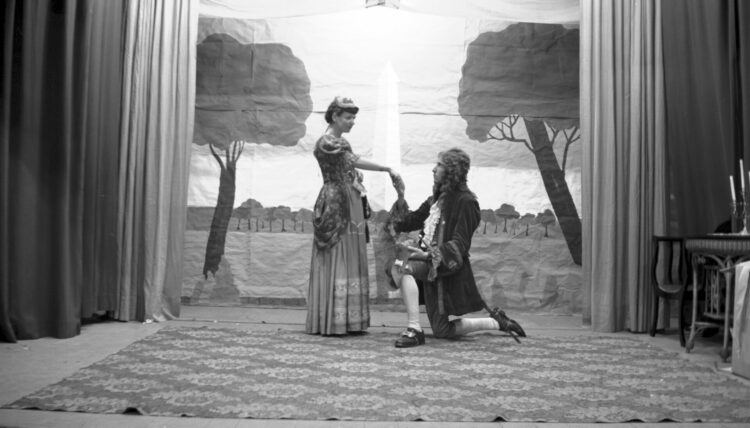
Abbot Joseph-Napoléon Dumont, the photographer’s brother, published dramatic works in the 1930s to provide wholesome entertainment for young audiences. His plays were performed in several colleges, Catholic Action groups and convents. Did the young members of the Saint-Alexandre theatre troupe ever perform the works of this local playwright?
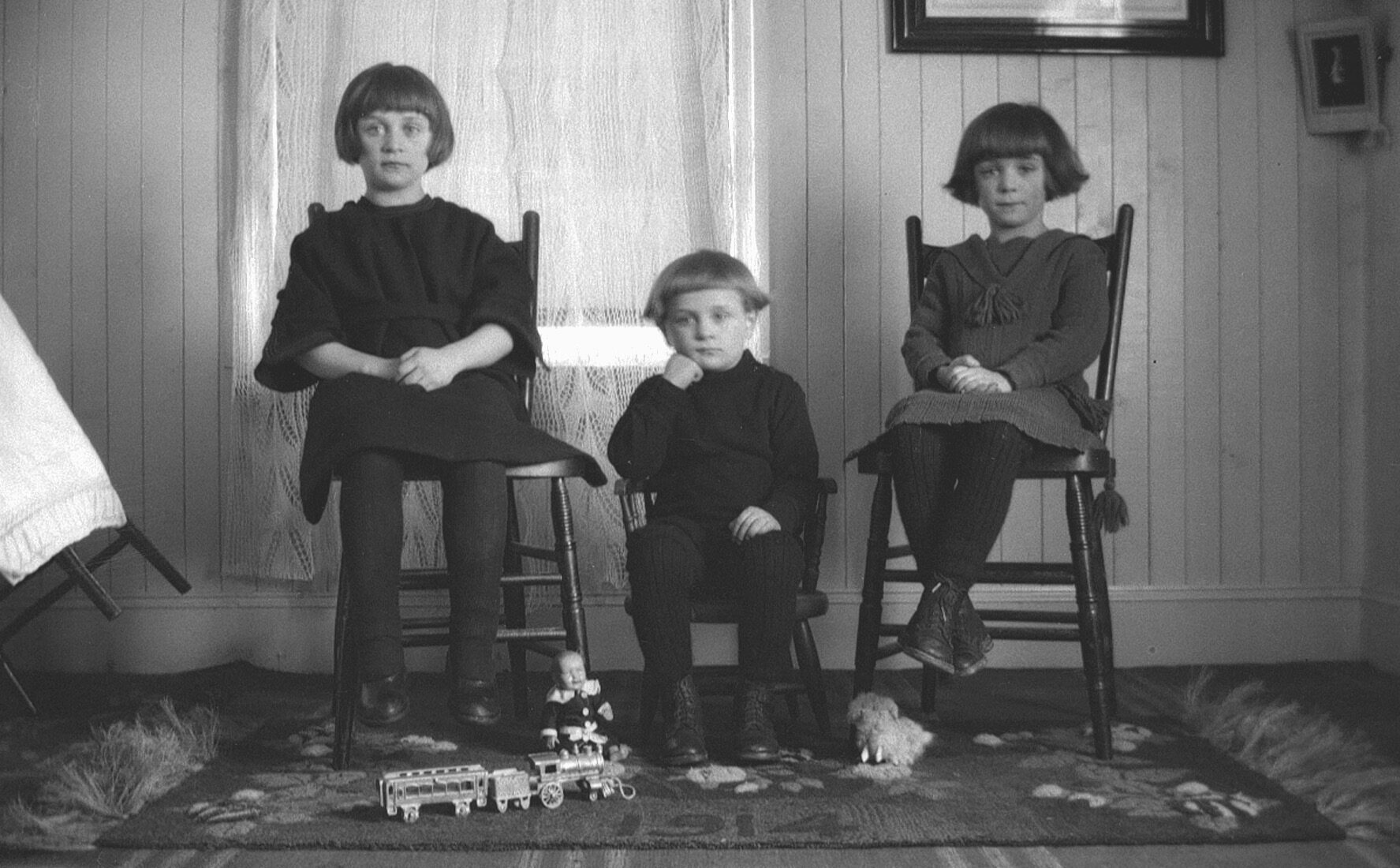
In the early 1920s, family, friends and neighbours came to be photographed by Dumont in a small studio she set up in the family home on the 5e Rang. At this point, she was still learning the craft of photography. Here, three children (likely cousins) serve as her subjects. In the background, we see the slatted wooden wall, the curtained window, the extra chair to the left, the picture frames and scattered toys. Despite the staged pose, the lack of backdrop and the domestic setting give the portrait the look and feel of a candid snapshot.
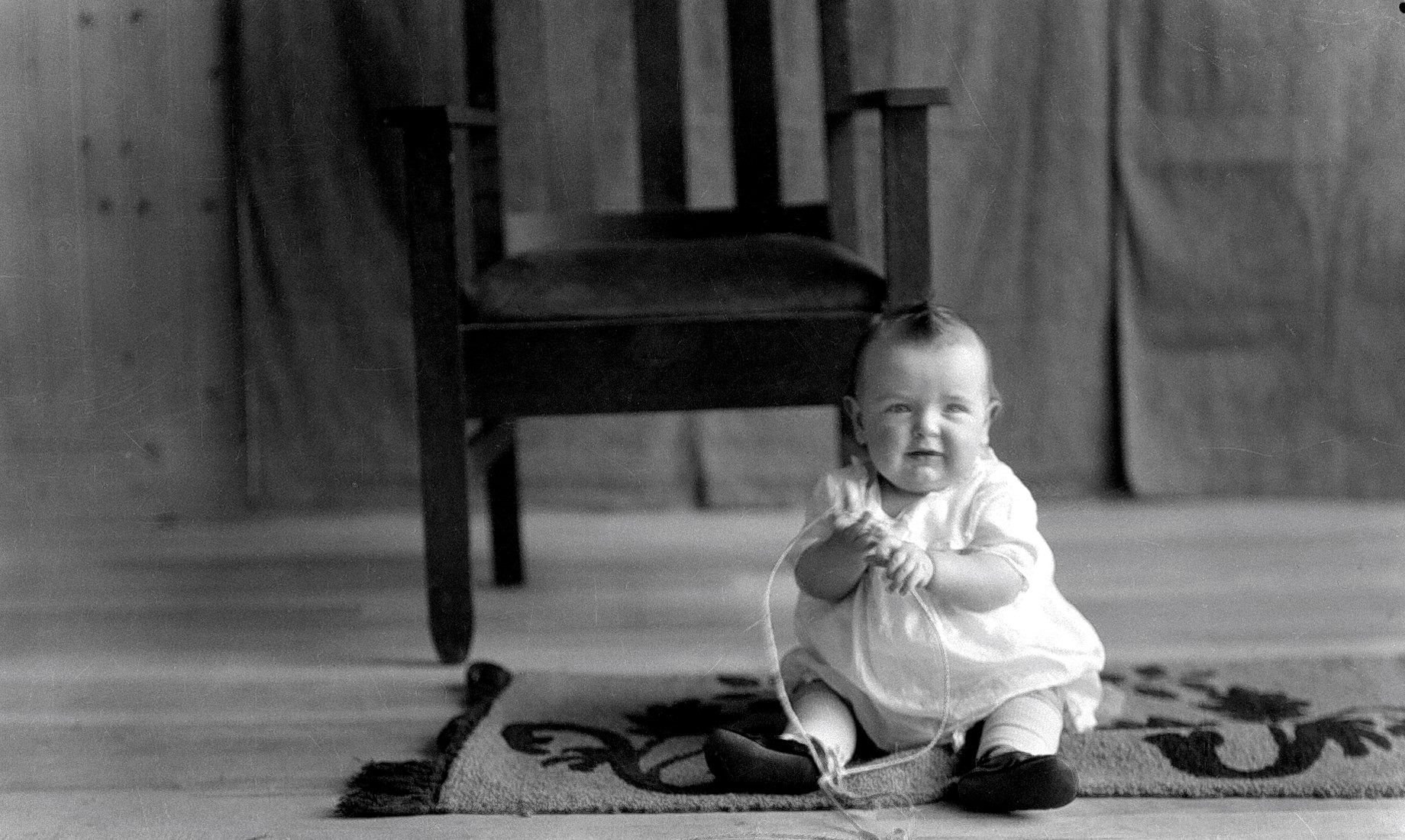
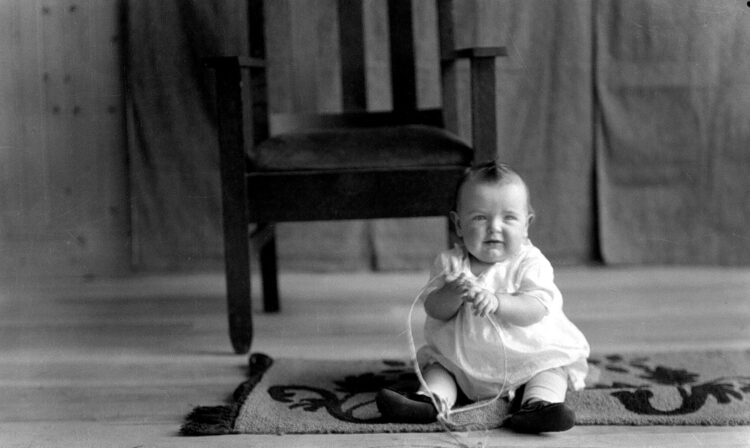
This photograph is another example of the pared-down setup that characterizes many of Marie-Alice Dumont’s early portraits. A simple rug was enough to stage the young subject. Interestingly, a chair can be seen in the background, seemingly forgotten. Perhaps it was used for a previous shot, maybe even of the baby’s parents? It is also worth noting that a simple piece of string was all it took to distract the child just long enough for the photographer to click the shutter.
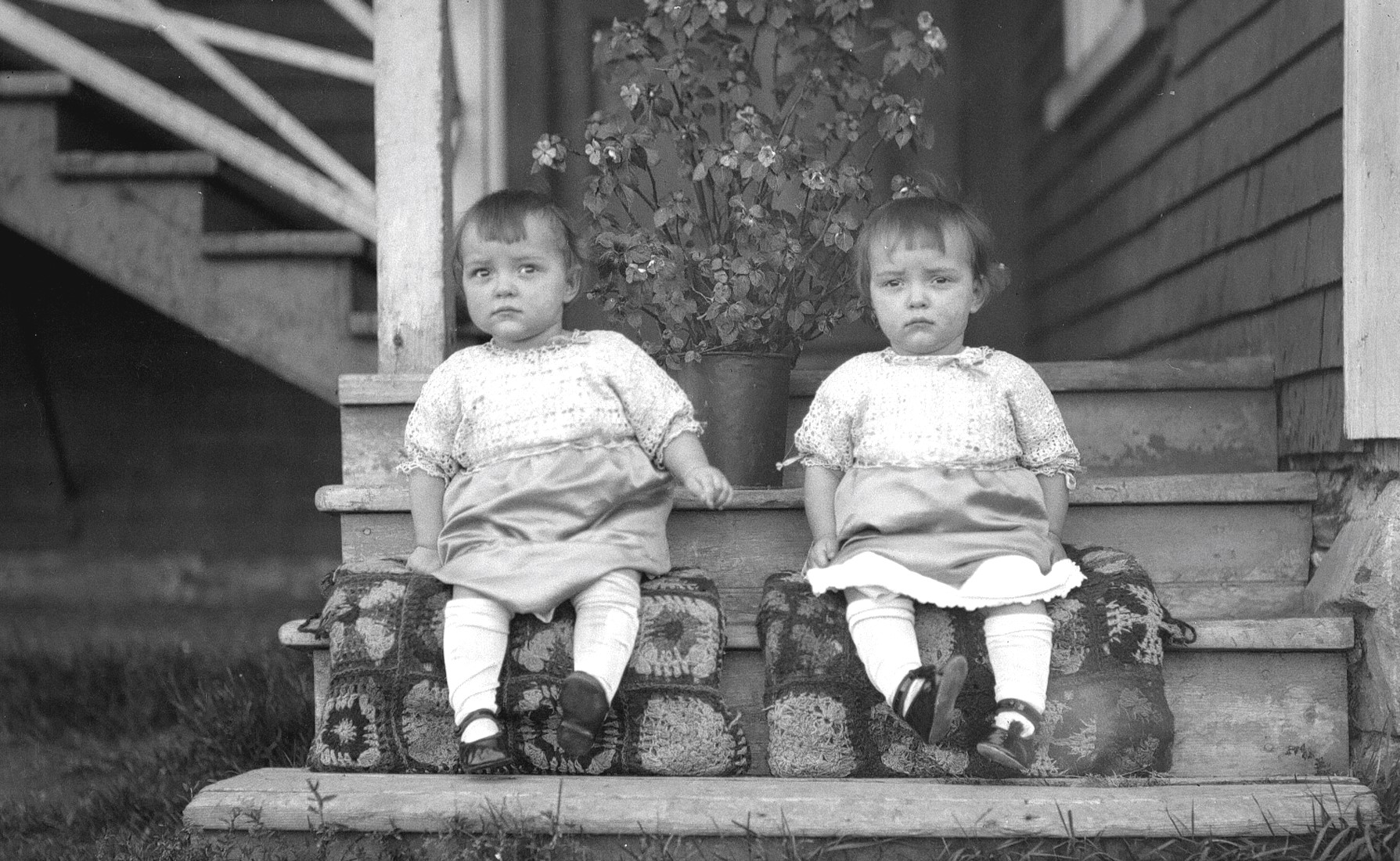
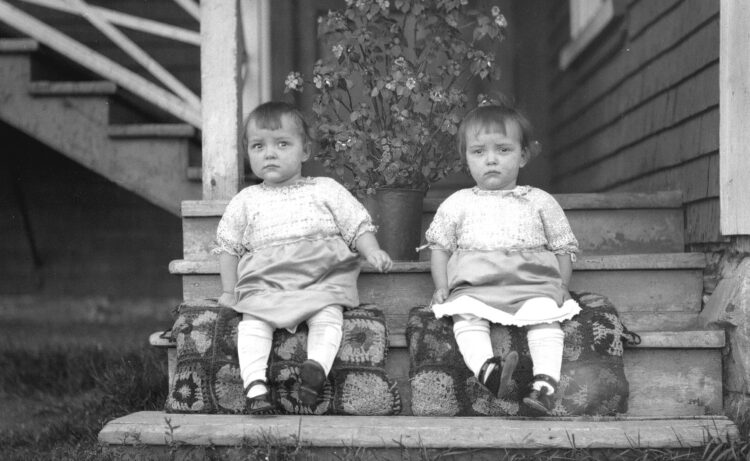
Marie-Alice Dumont loved photographing children. In this image, twins Elizabeth and Marie-Ange have been placed on the front steps of the house, sitting on two hand-knitted wool blankets. This was the best of three shots; the other two, taken indoors, turned out blurry because the girls could not sit still. Even in this image, luck was on Dumont’s side: Just as Elizabeth was about to move, a lock of her hair got caught in the leaves of the nearby plant. Marie-Alice often used these front steps, those of the Dumont family’s first house, as a backdrop during her early years as a photographer.
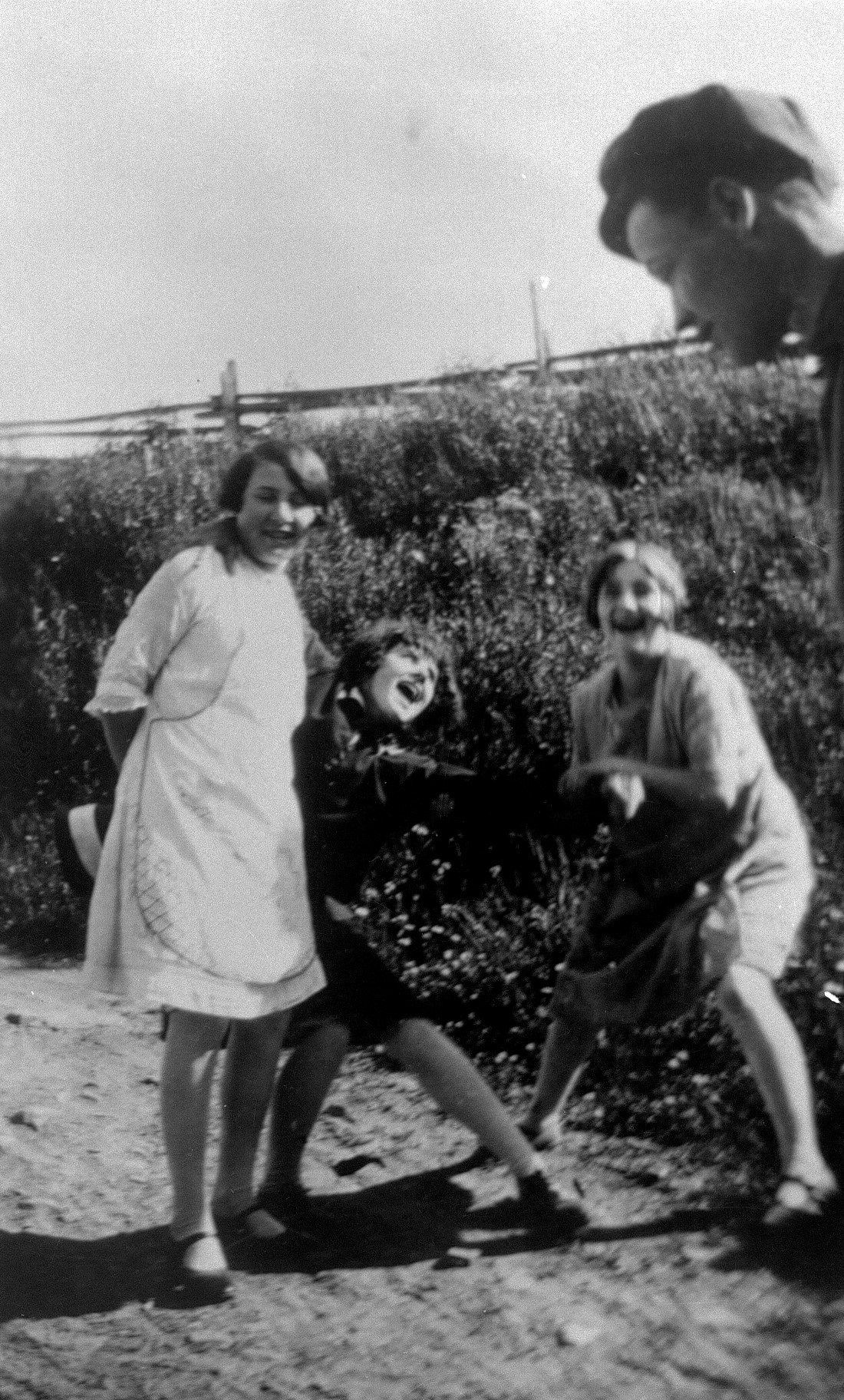
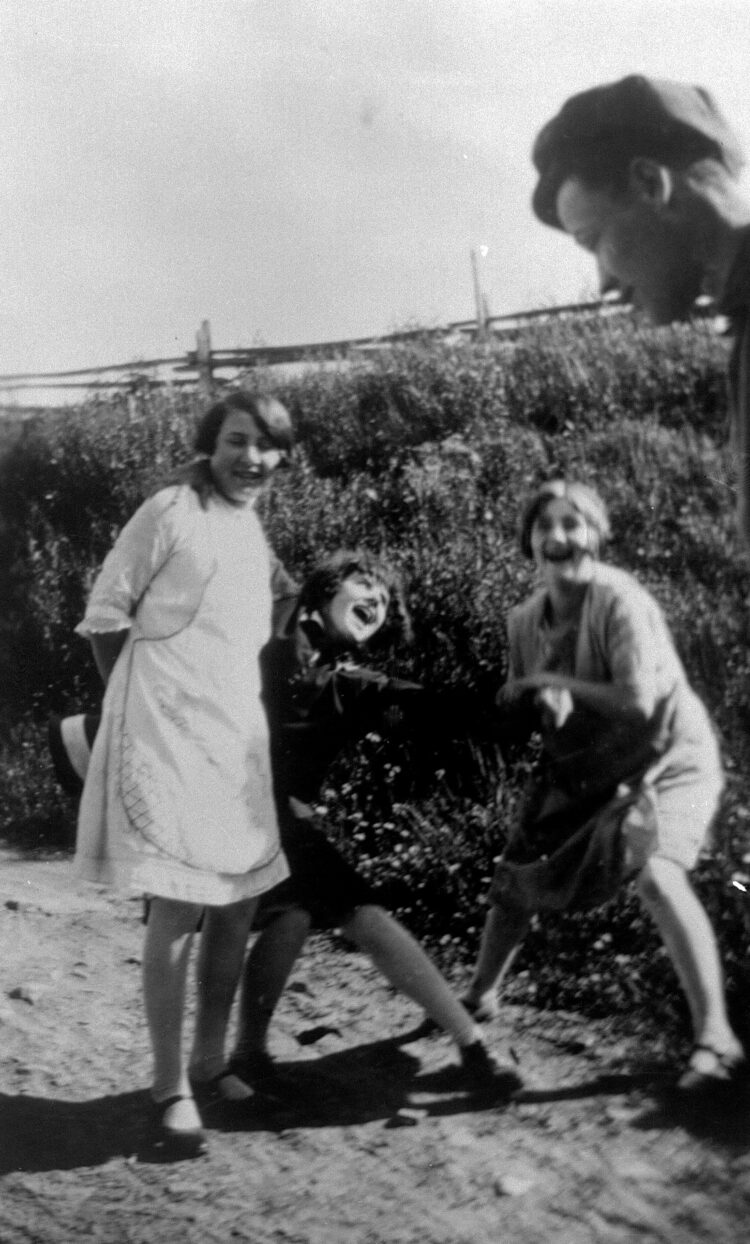
In this photograph, three young women tease and jostle each other playfully under the photographer’s watchful eye. Everything here reflects the spontaneity of the moment: the subjects’ movement, their smiles, the slight blur of the image that reminds us just how quickly each moment in life passes. The Marie-Alice Dumont Fonds includes many of these candid shots that offer a glimpse into the private world of those around her.
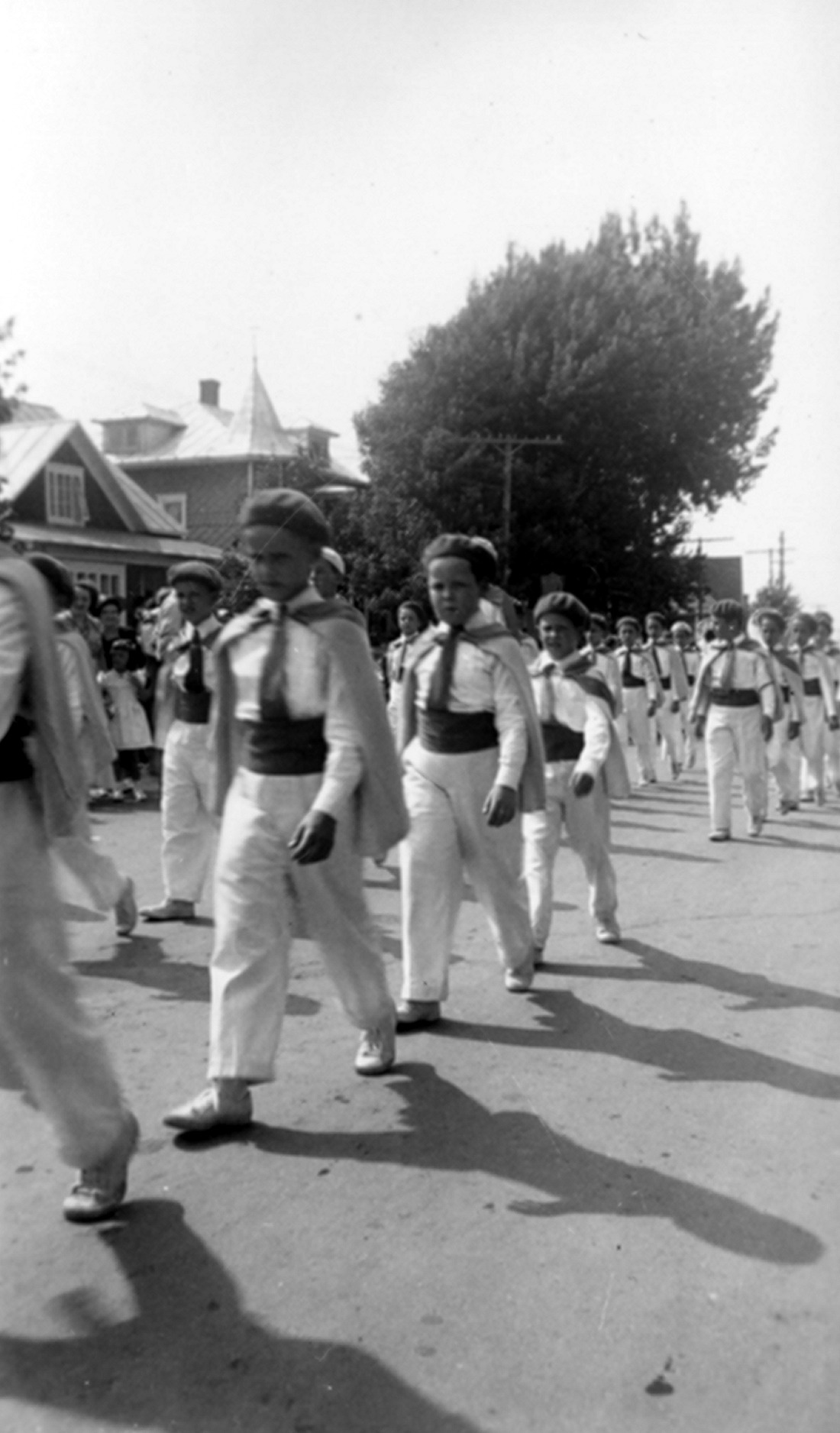
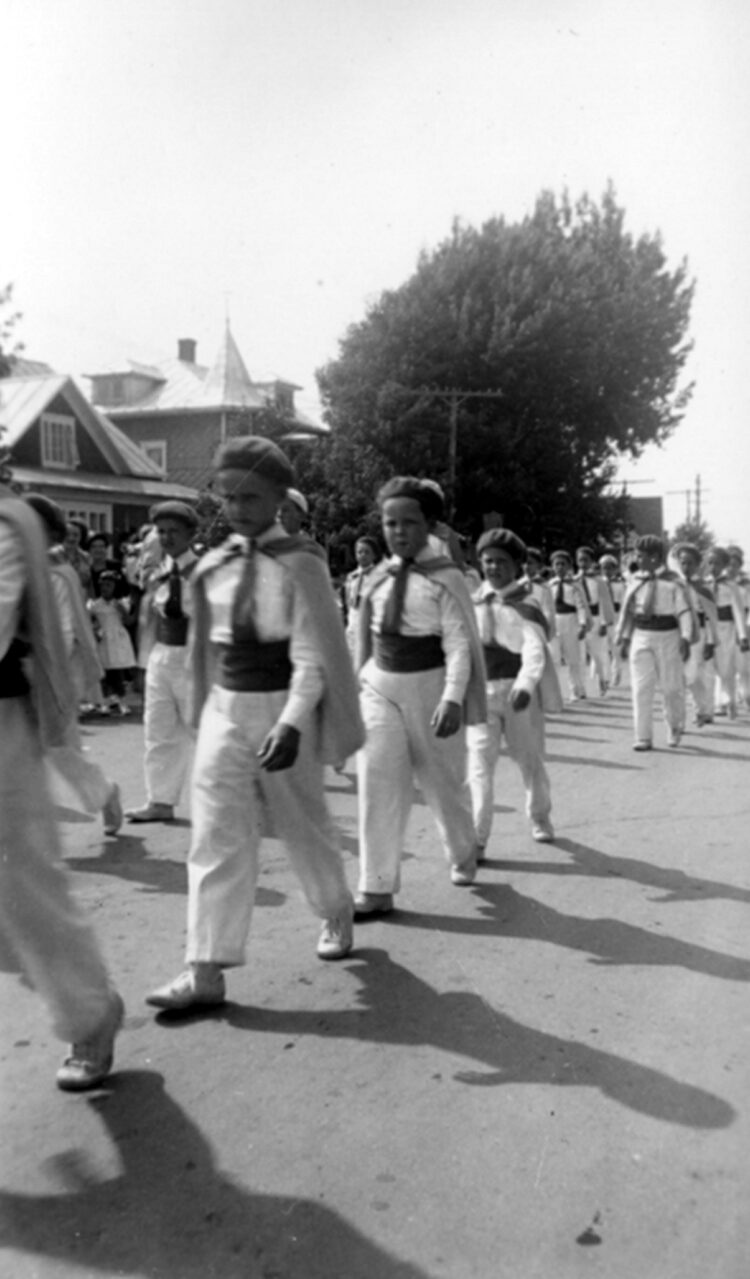
These young people were part of a large parade of 500 Le Patro members that marched through Saint-Alexandre on Sunday, July 27, 1952. The Patro movement, another Catholic Action initiative for youth, first emerged in the early 20th century.
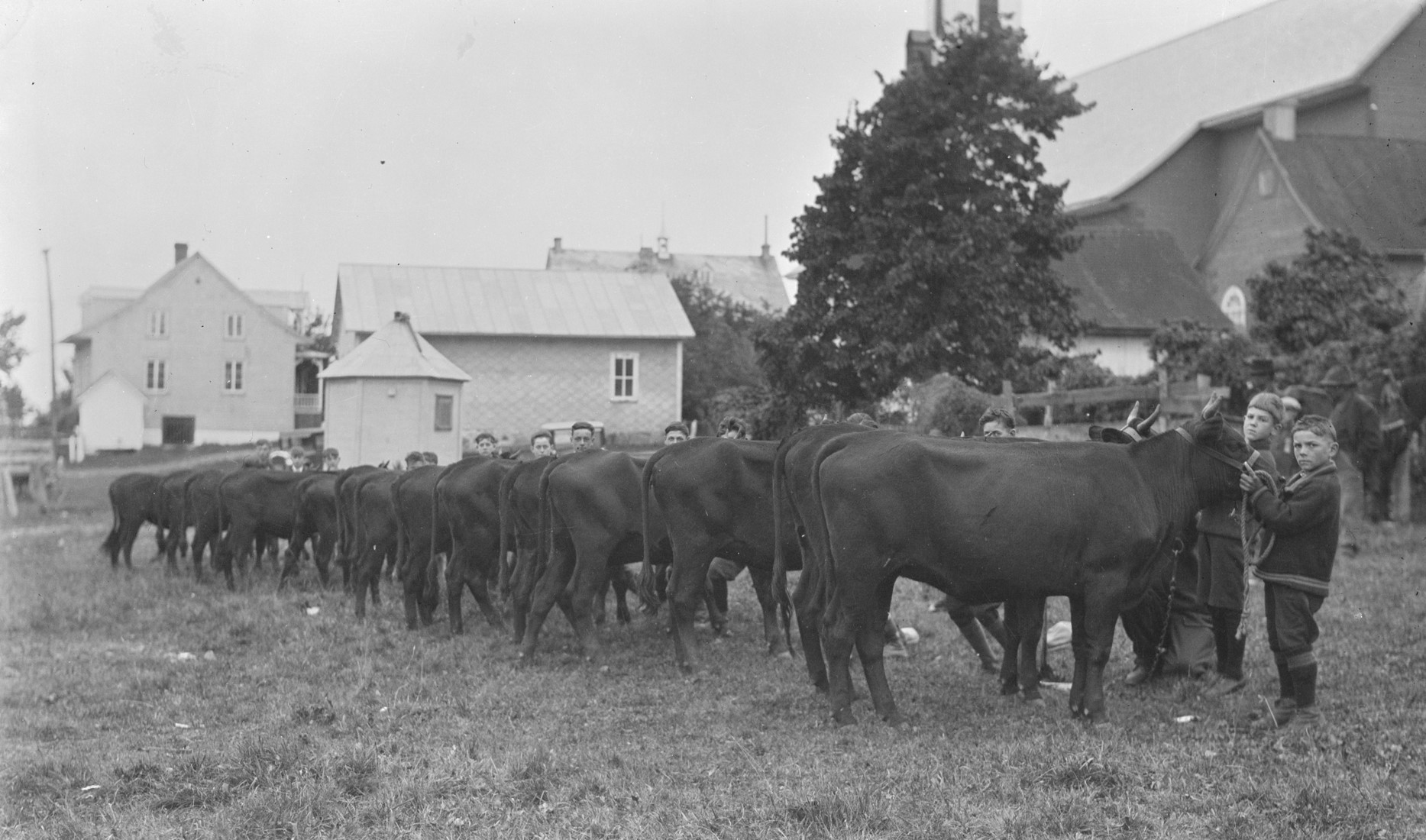
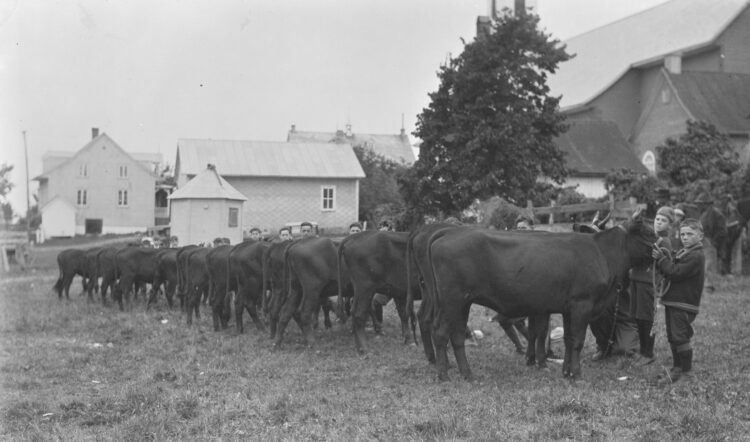
In Marie-Alice Dumont’s day, agricultural fairs were organized every summer throughout the province, and many members of the Dumont family took part. Sometimes, the younger generation even entered competitions, such as this one for the most handsome calf.
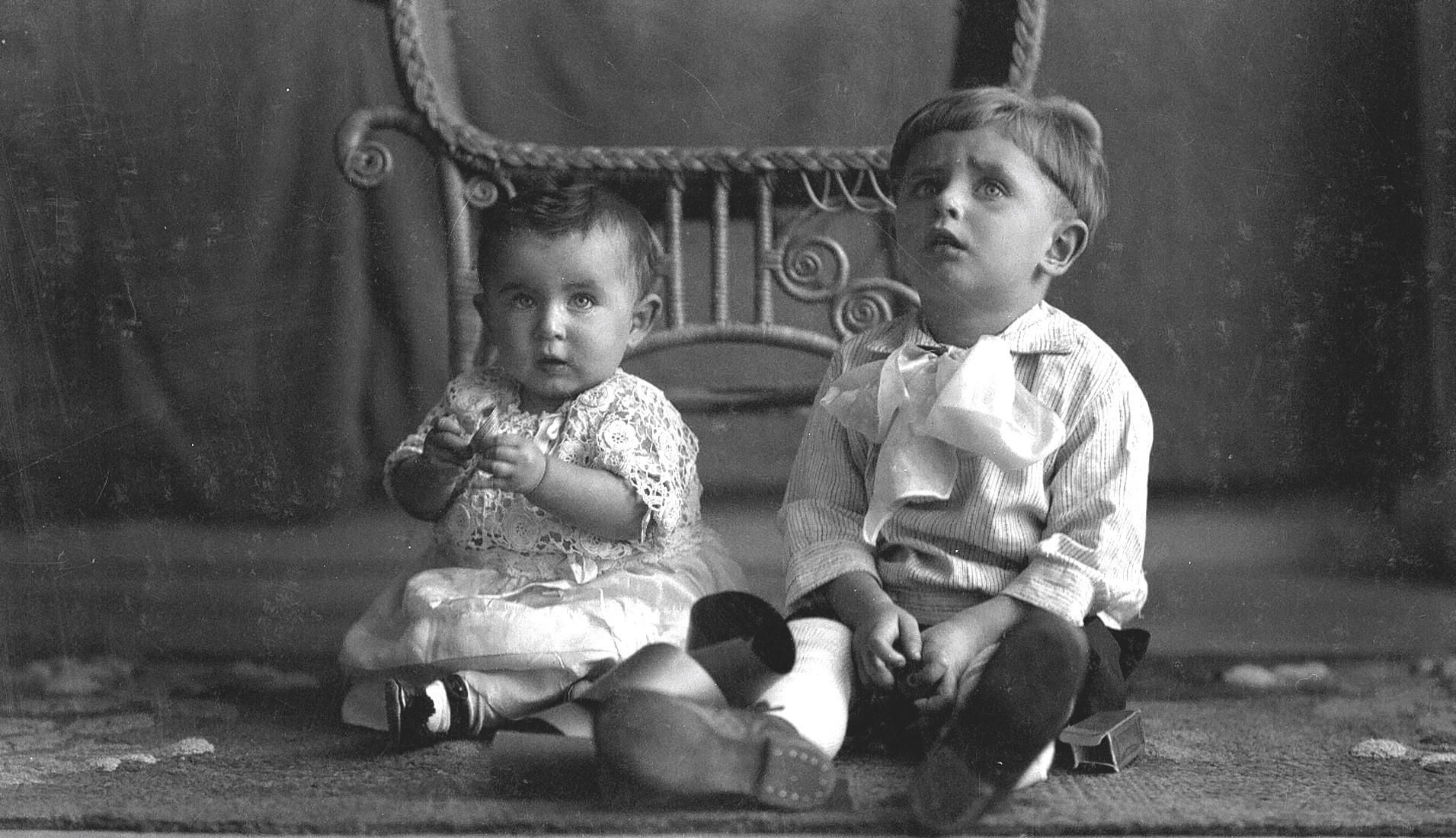
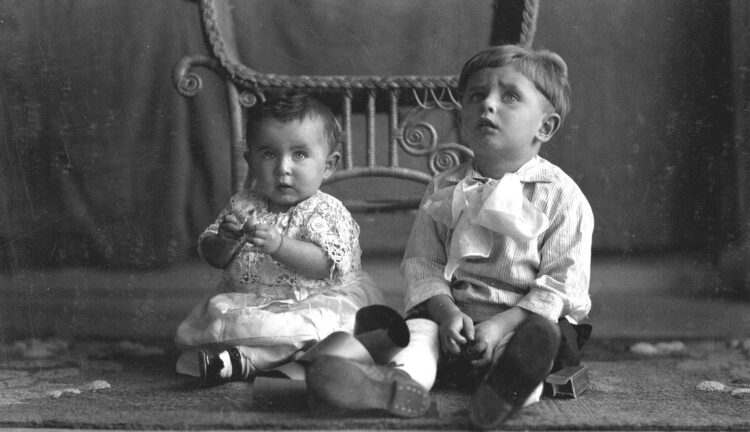
Photographing babies and young children is no easy task. Little people can be uncooperative, fussy, fidgety or distracted. Taking beautiful portraits, like this one, calls for mastery in the art of posing! Marie-Alice Dumont really succeeded here in capturing the innocence, sweet softness and authenticity of children. The child on the right looks puzzled, or perhaps anxious? For some reason, there’s a sense of vulnerability. The child on the left looks calmer, drawn away from his game just long enough to take the picture. Standing low to the ground, the two subjects nevertheless look upwards toward the photographer, or their parents, perhaps, reminding us in either case of their dependence on adults.
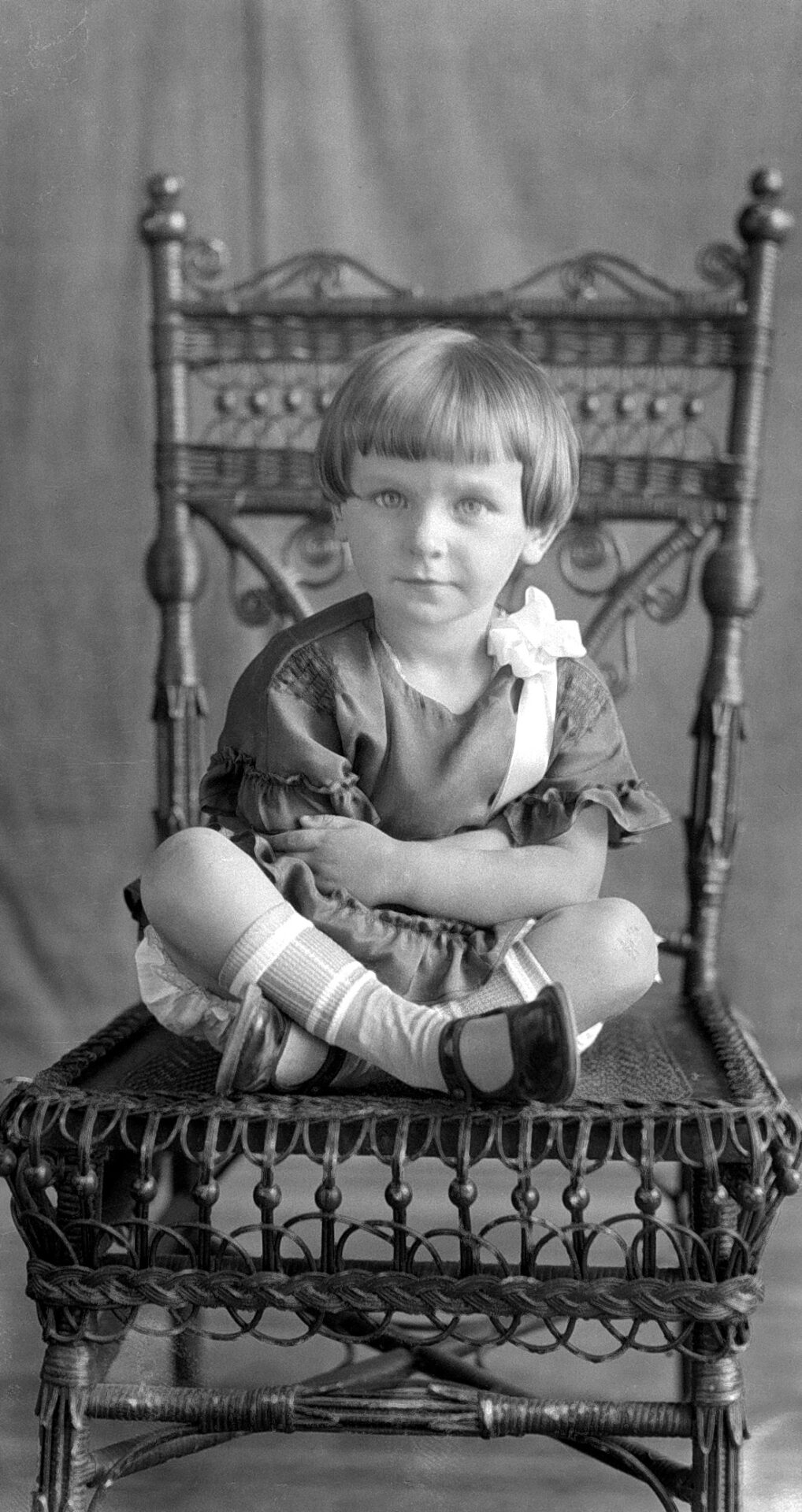
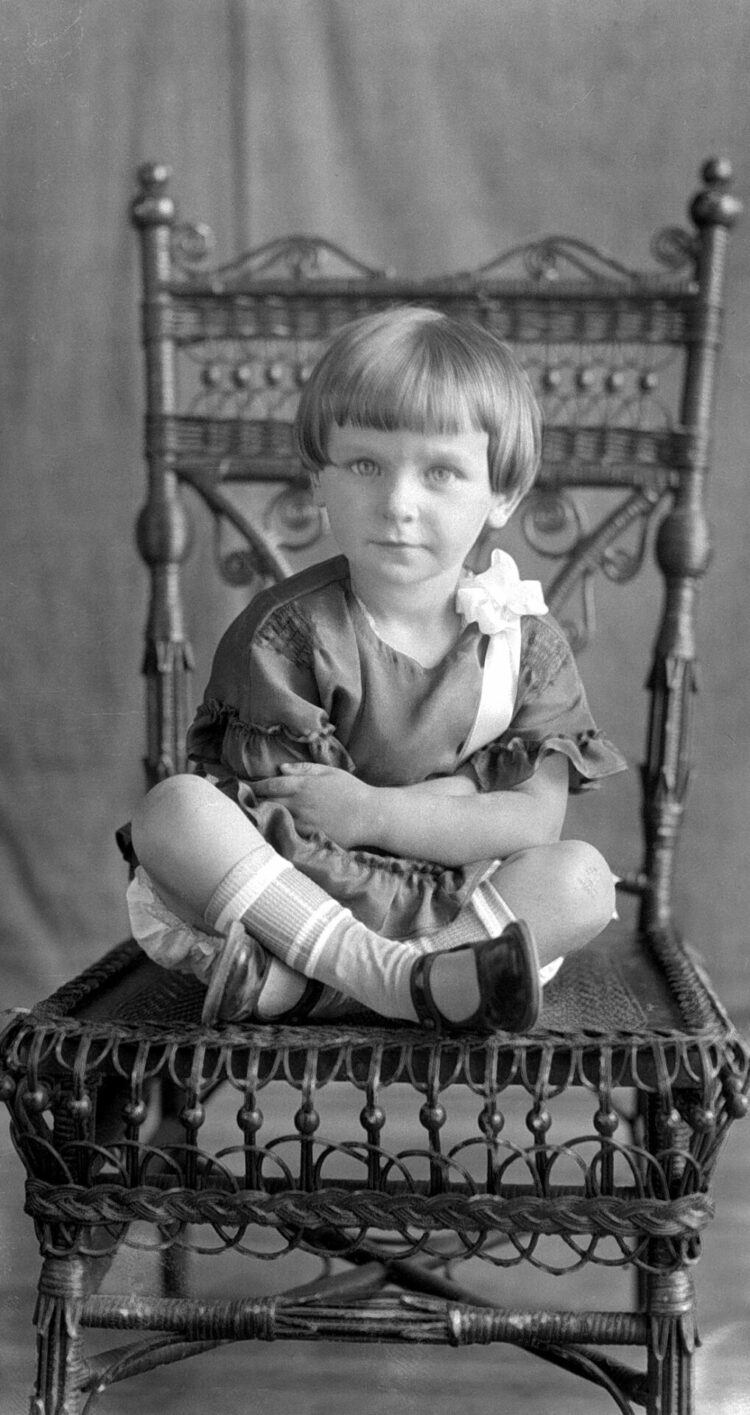
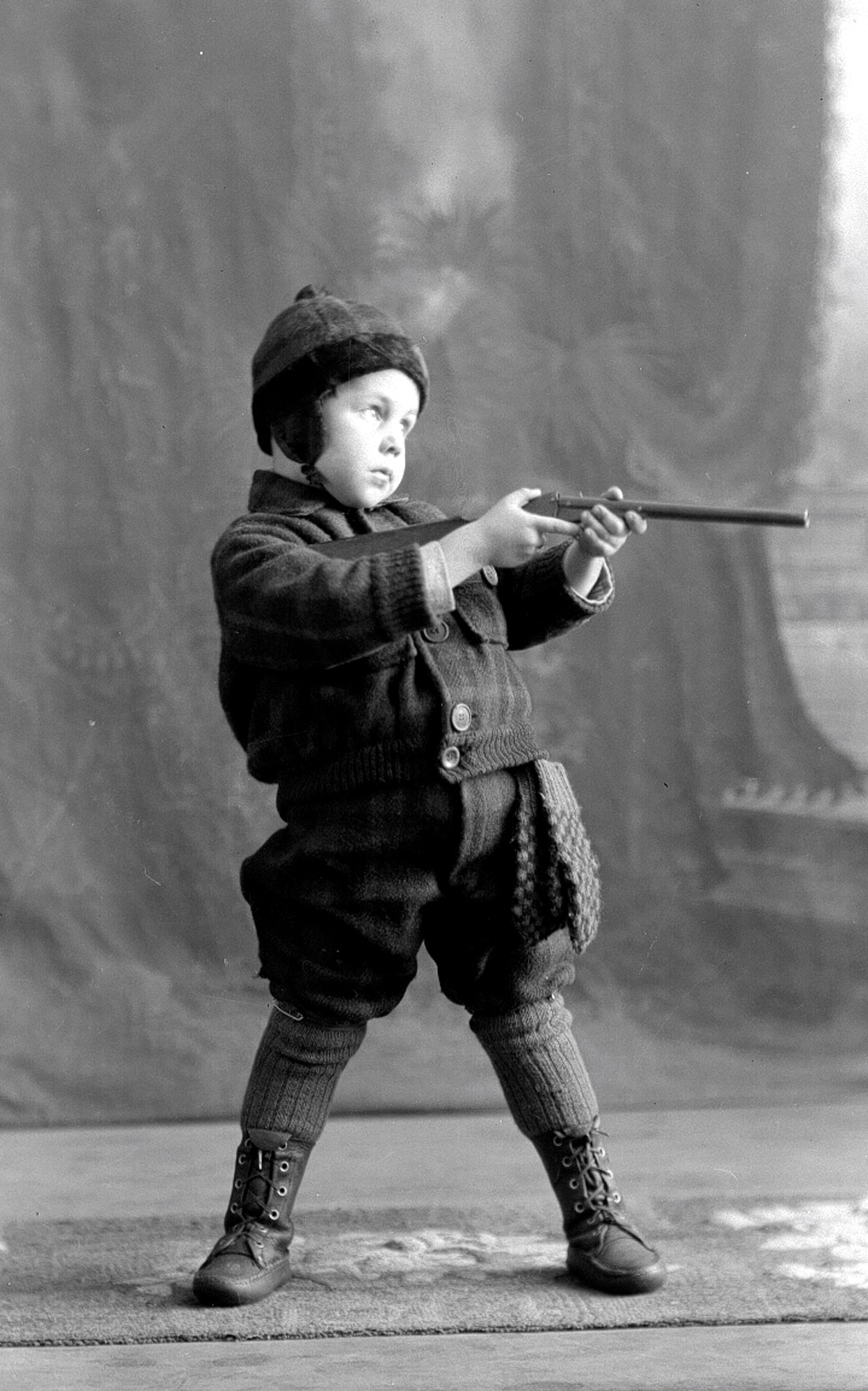
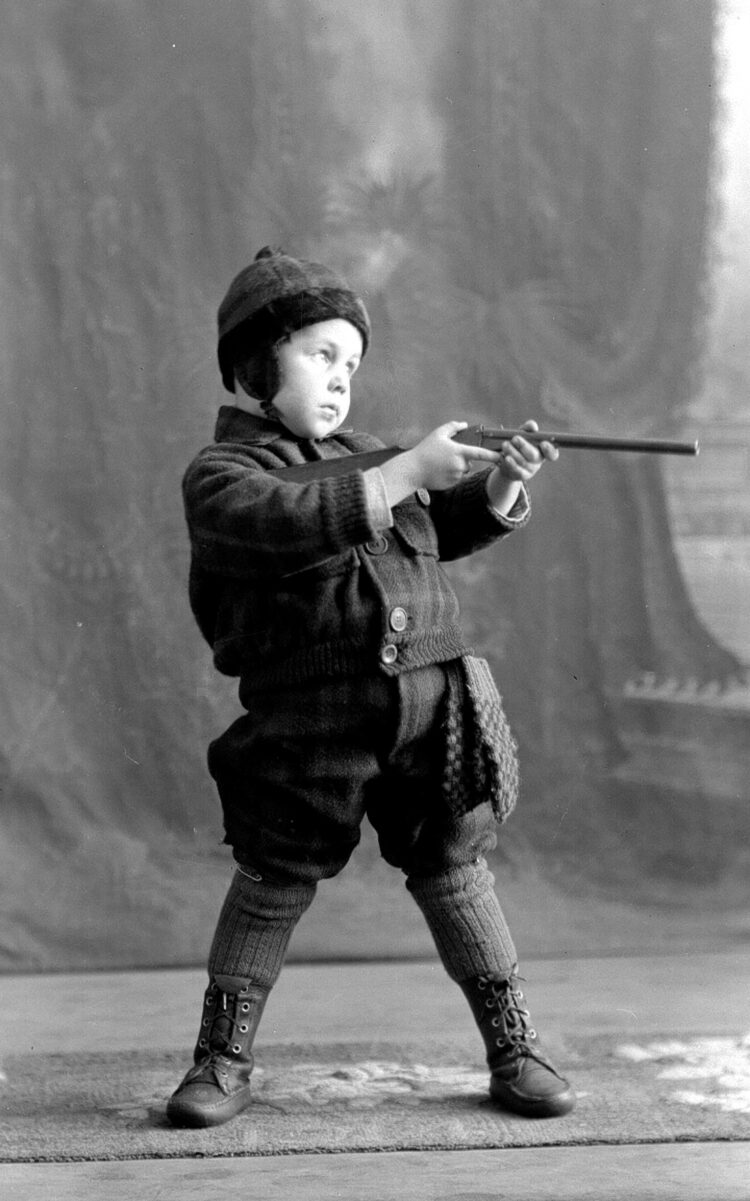
Some passions, like hunting, are handed down from father to son. We can imagine that this is what Pierre Bélanger was aiming to illustrate when he brought his son, Dominique, to Studio Dumont. In a rather amusing photo shoot, the photographer took various portraits of the child dressed as a little hunter, armed with a toy rifle and looking very serious.
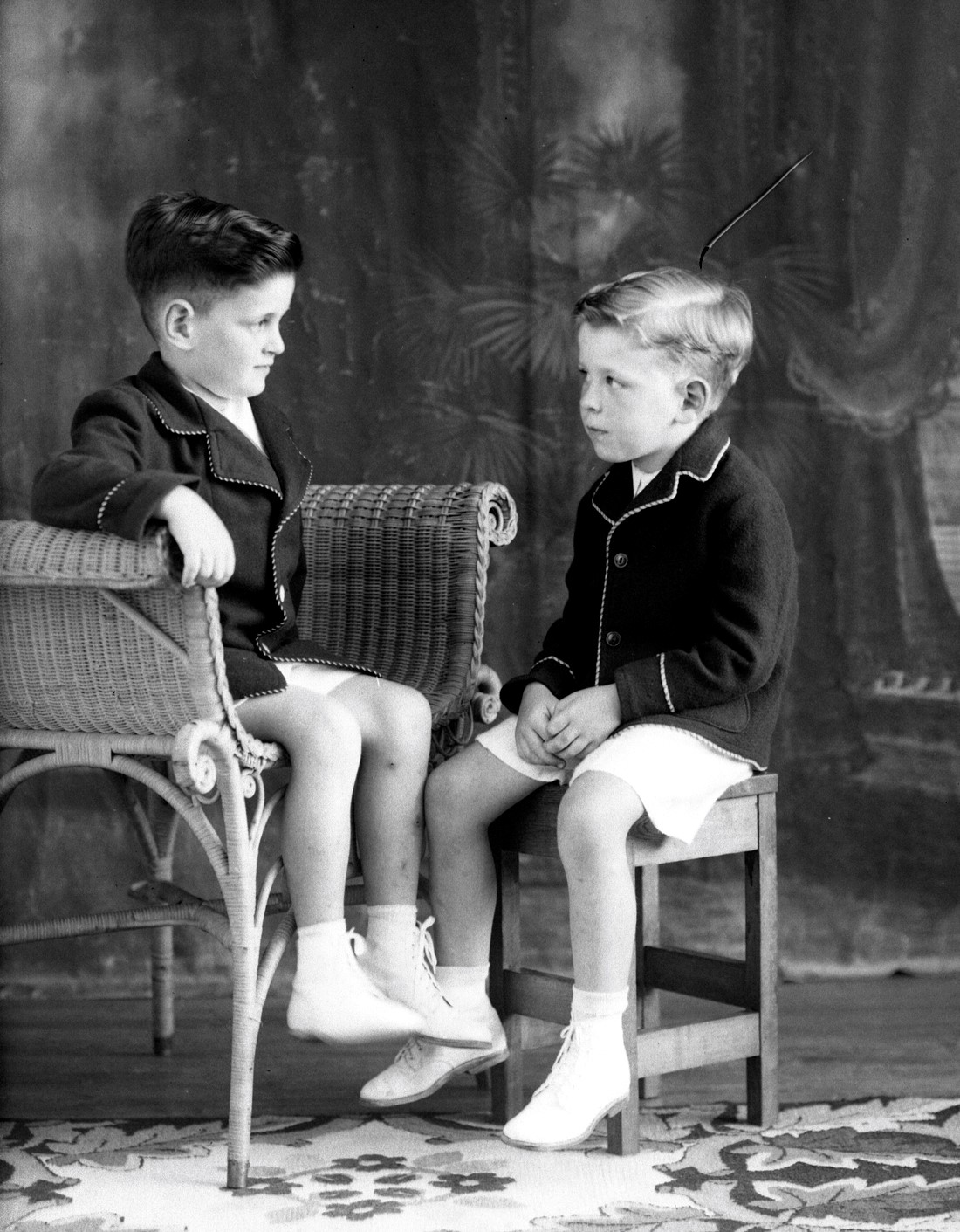
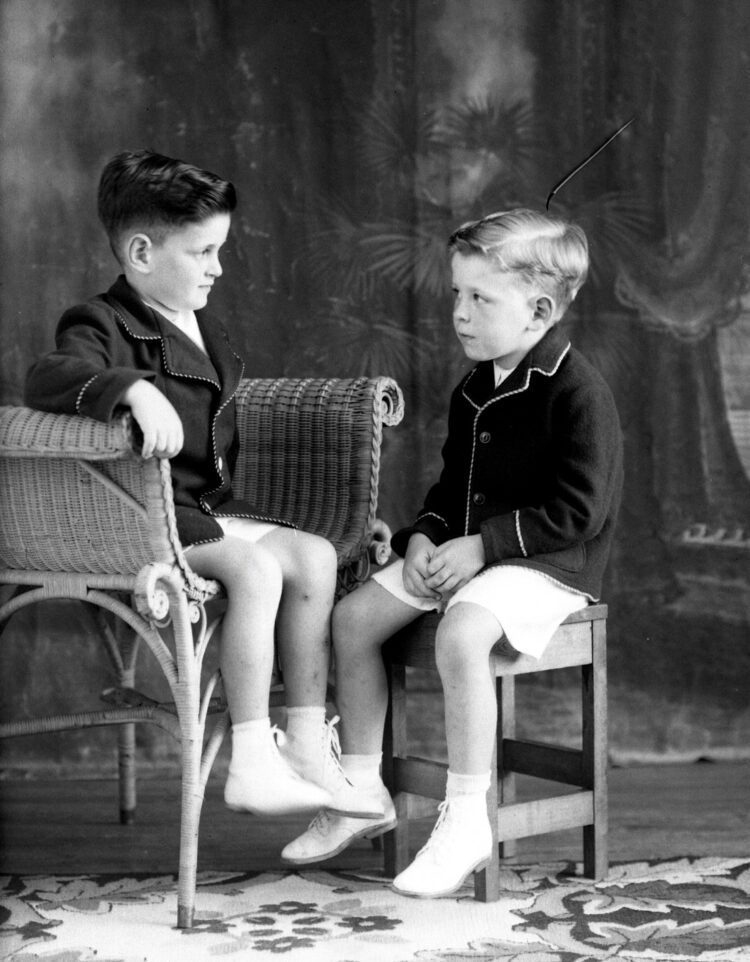
Marie-Alice Dumont’s archives show that she used a variety of techniques and tricks to take portraits of children that are both natural and striking. One was to get the children to interact. Here, she placed these two boys, who must have known each other well, facing one another and, presumably, she asked them to converse. She managed to catch a momentary pause in the conversation, as if they were studying each other, waiting for a reaction.
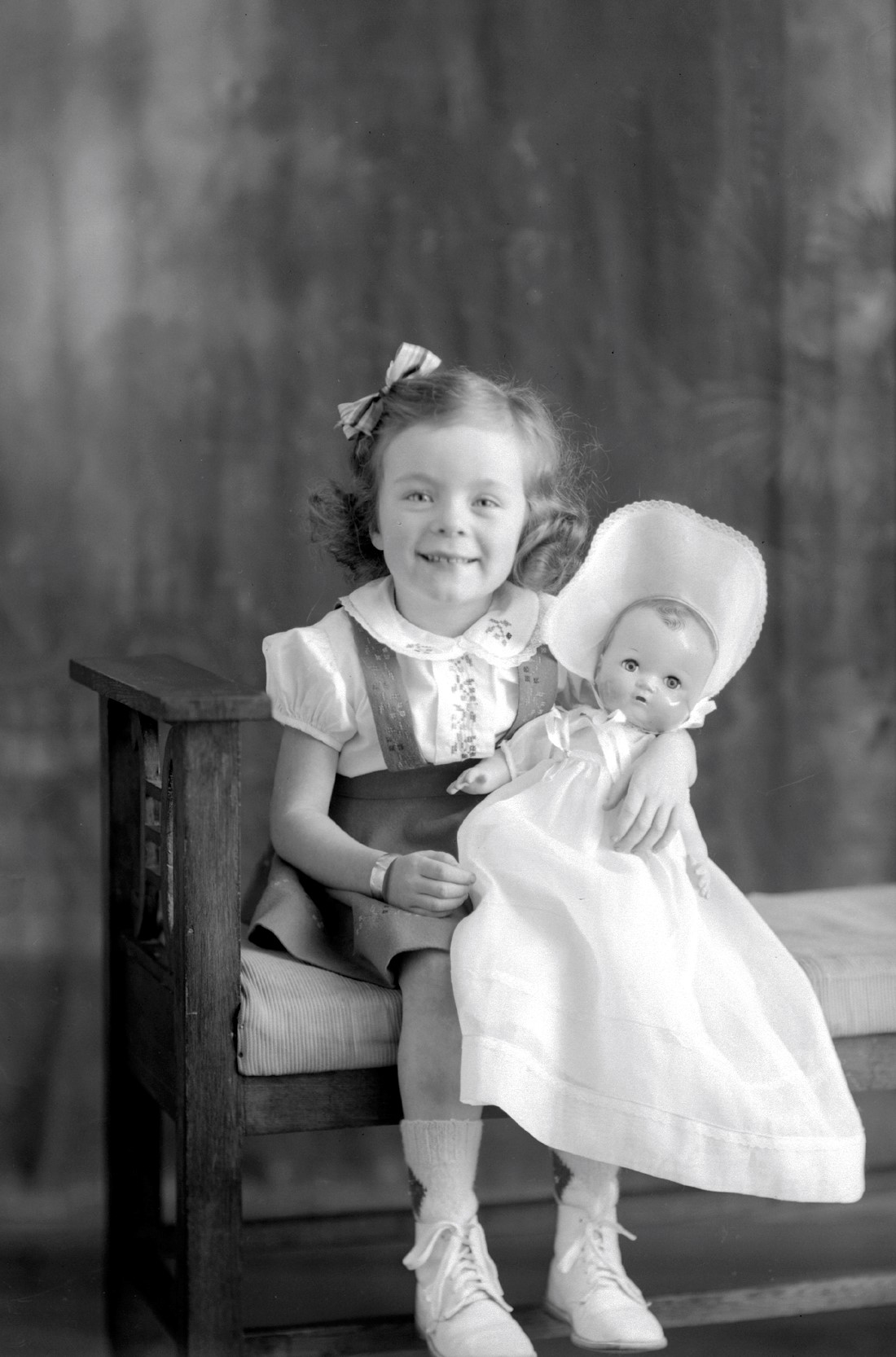
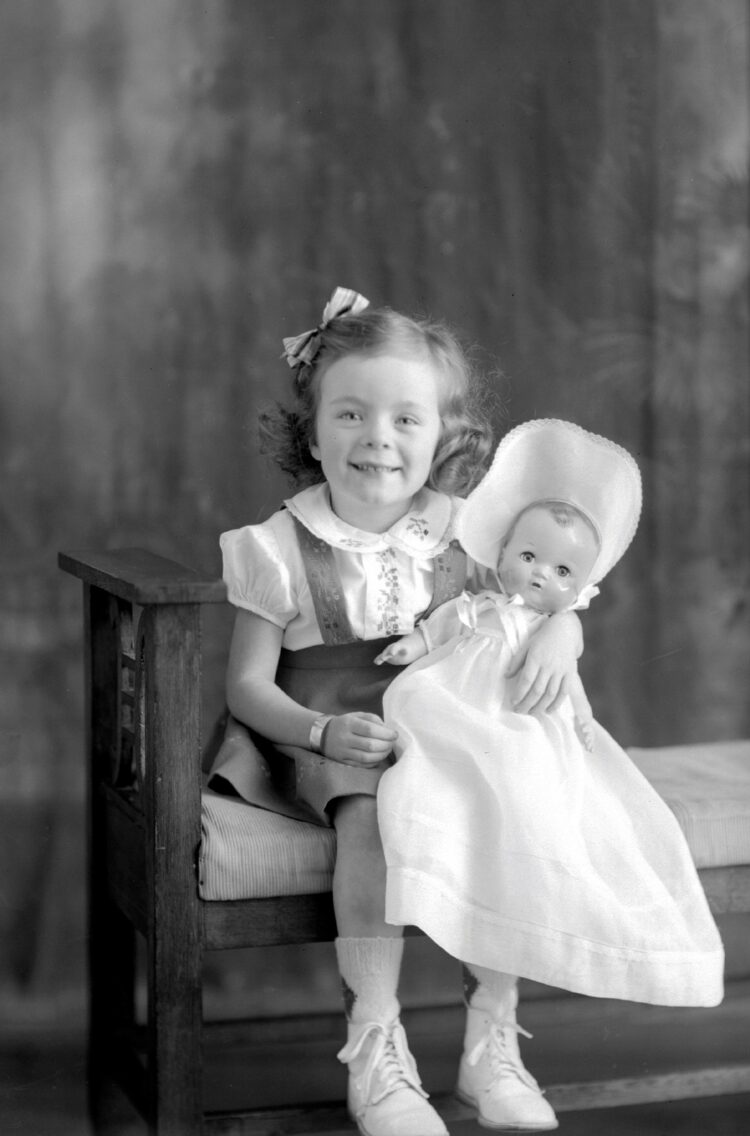
Using a toy, stuffed animal or doll is a winning strategy to make sure a child’s portrait turned out well. To put four-year-old Francine Soucy at ease, the photographer perhaps lent her a doll, asked her mother to bring one or suggested the girl pose with her special friend after seeing her with it in the studio. The portrait is very nice: Francine seems to be enjoying herself, and she flashes a big, genuine smile.
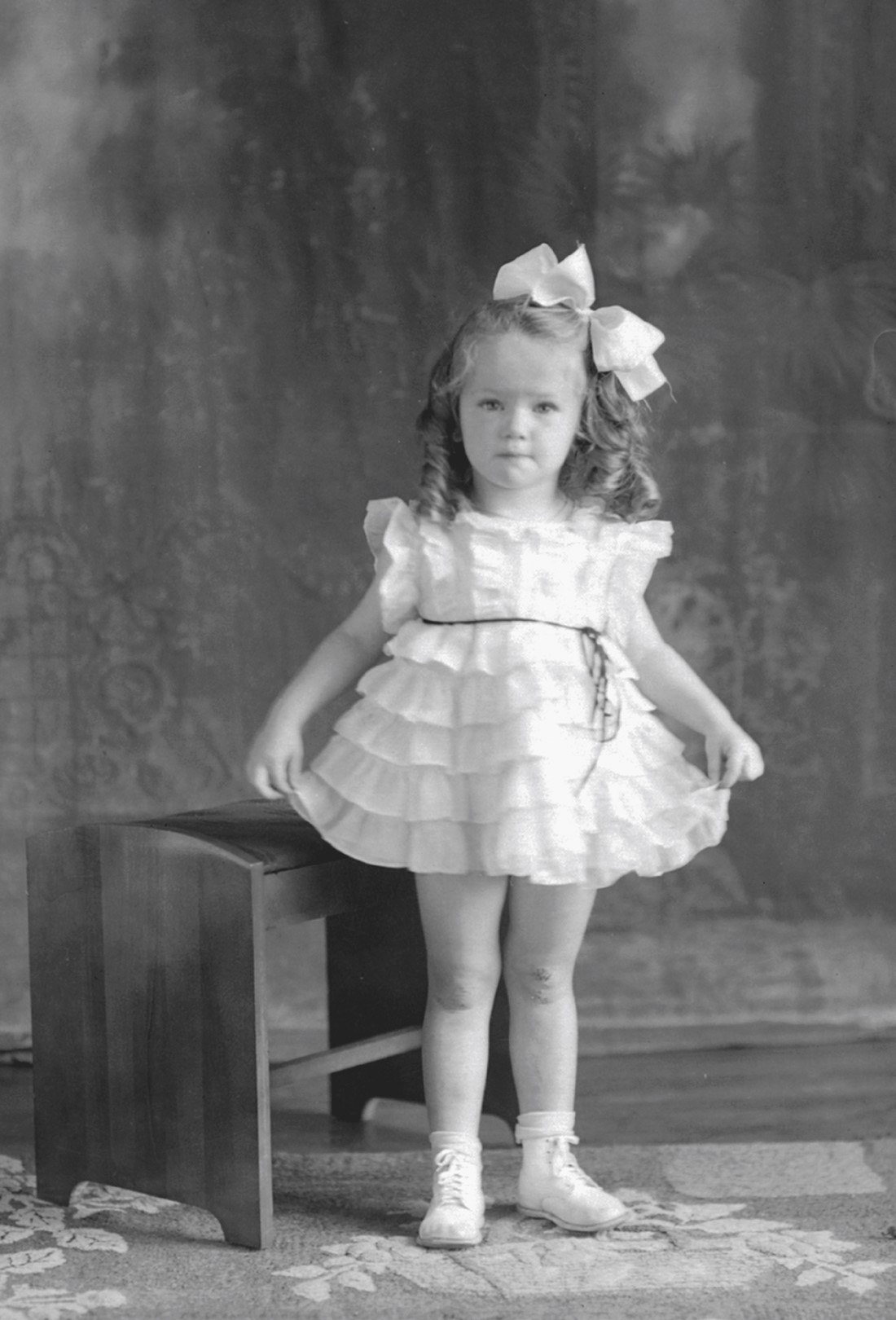
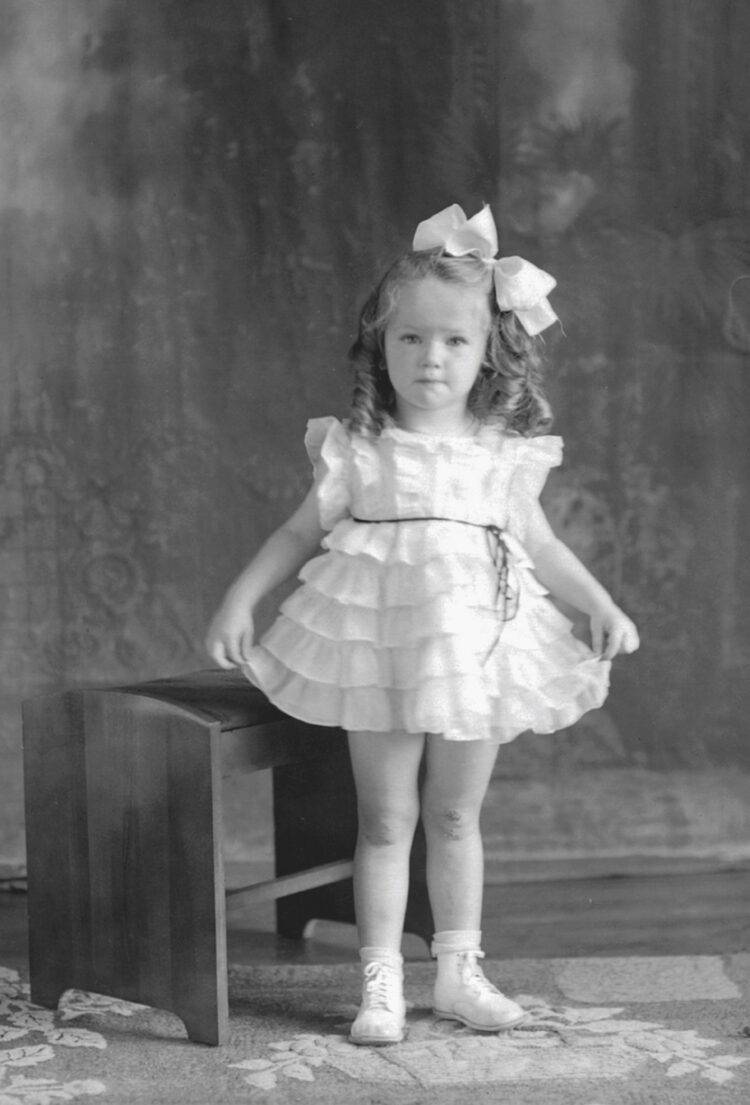
Described as displaying undeniable technical skill, Marie-Alice Dumont’s studio work also expressed a general comfort and trust between the photographer and her subjects. We notice, for example, that the same people were photographed many times, sometimes even over several decades. This was true of Lise Chamard, who visited the Dumont’s studio on at least four occasions: in 1941, 1943 (the date of this portrait), 1949 and 1960.
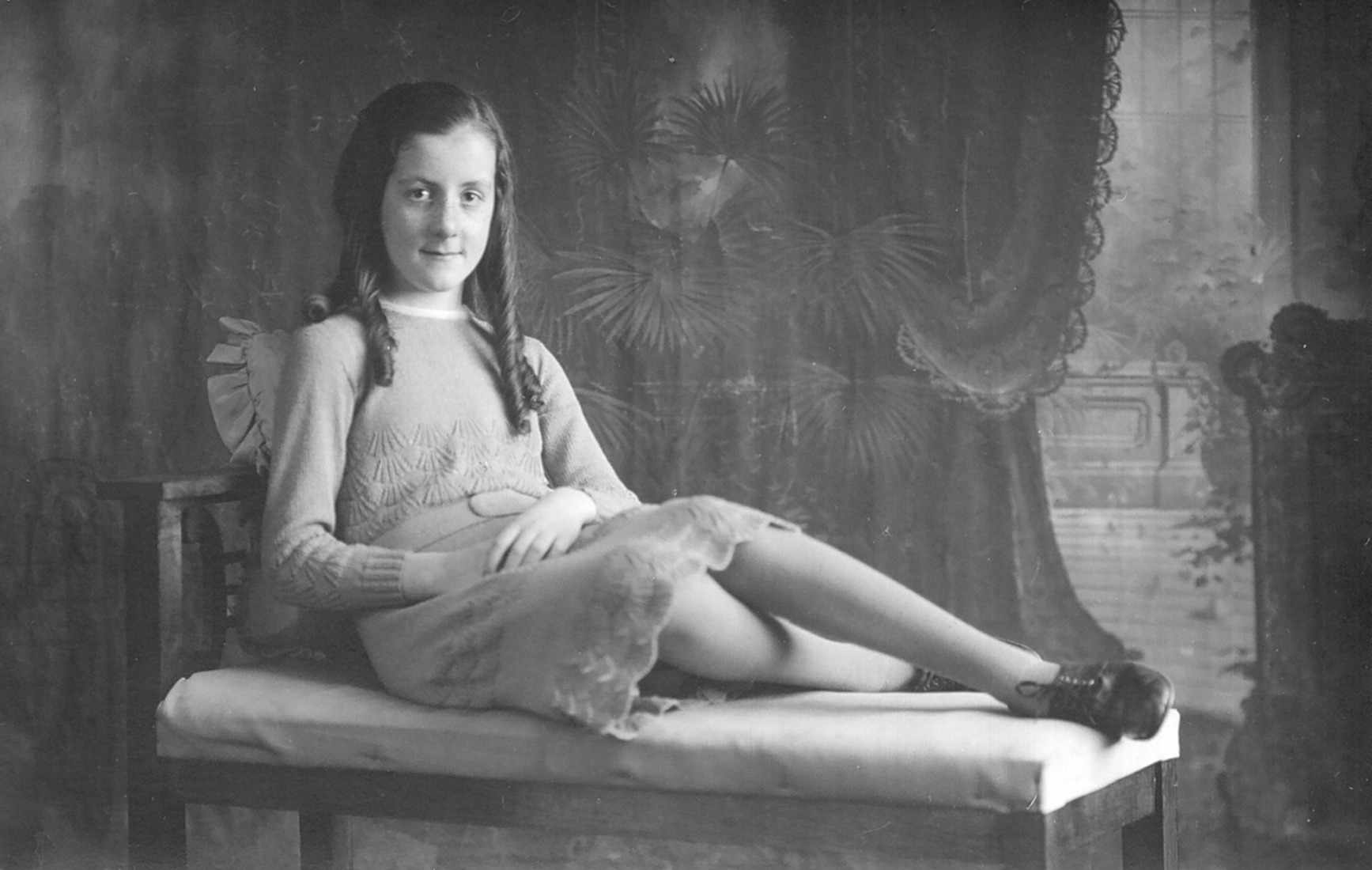
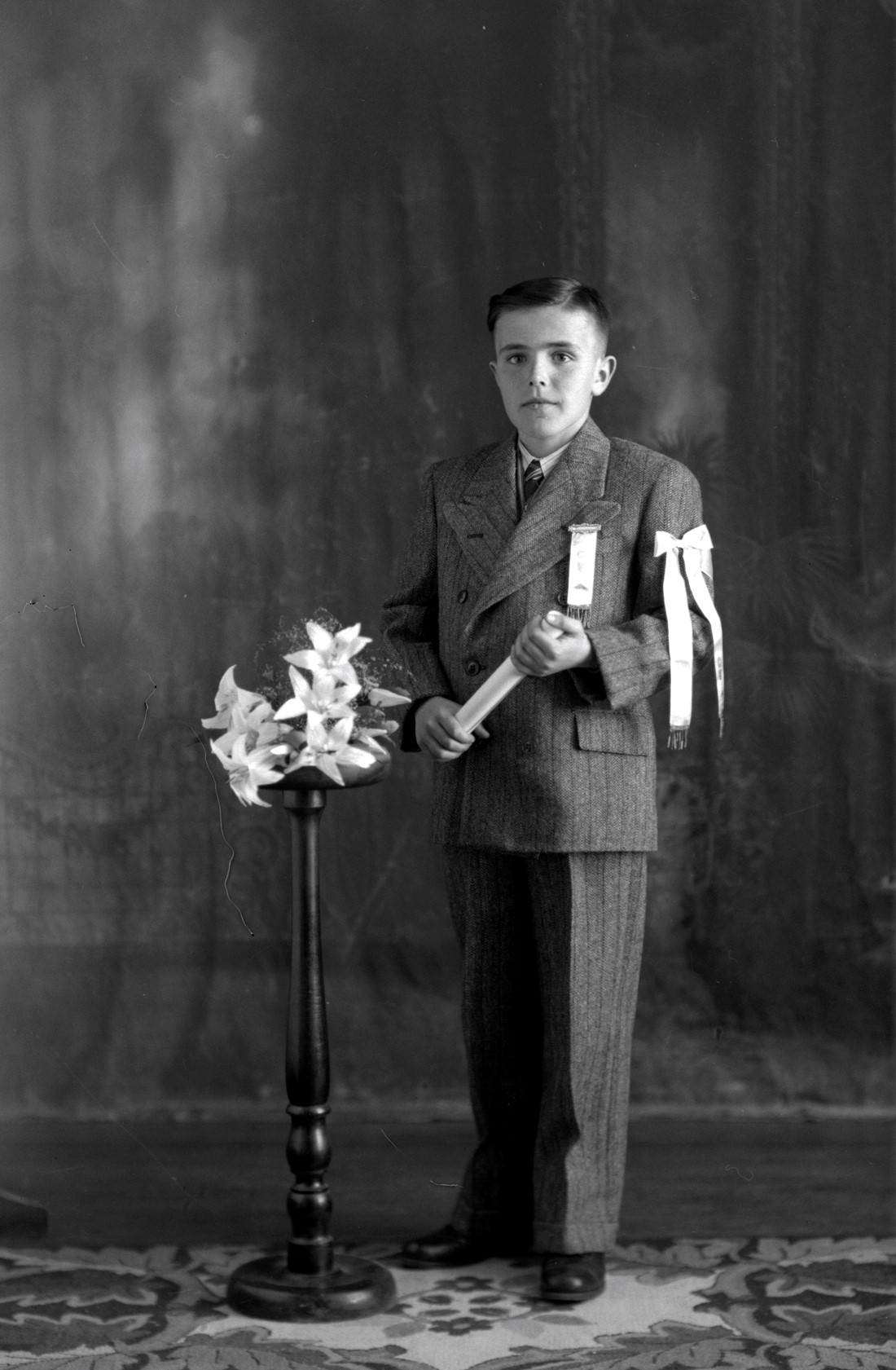
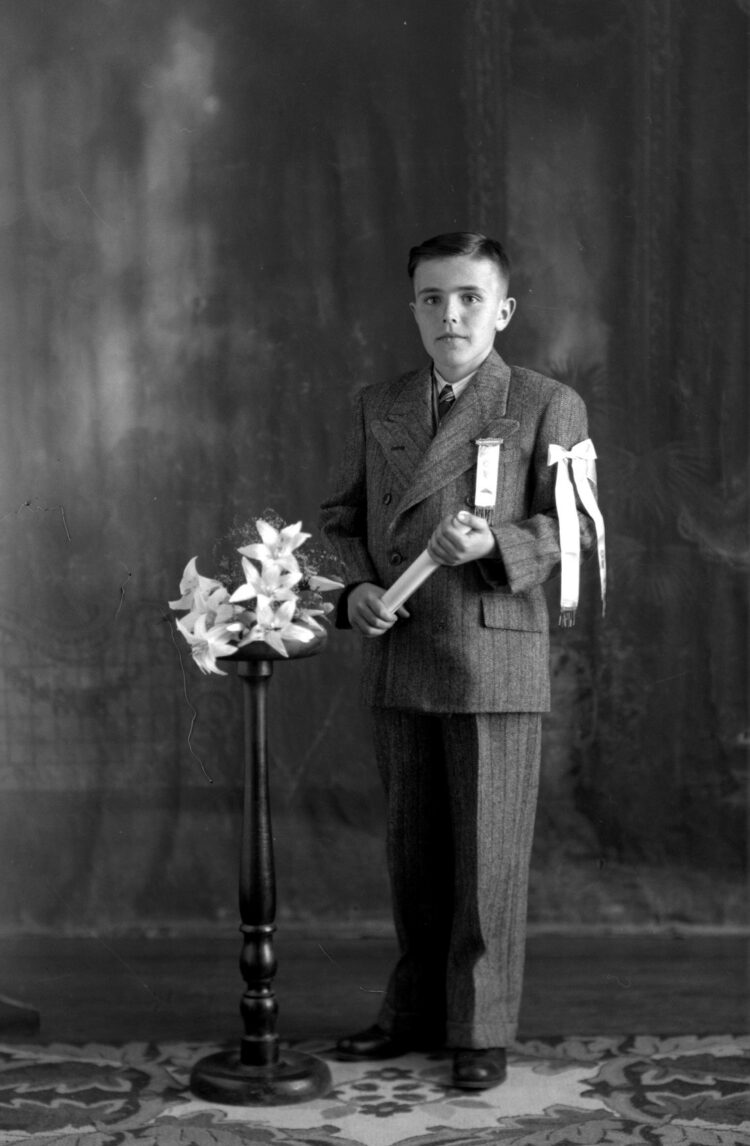
Photographing children who had just passed their solemn communion or confirmation is another kind of ceremony with well-defined codes. Like in this portrait of Réal Beaupré, Dumont’s nephew, the communicants would leave their childhood garb behind to pose in suit and tie. Boys also wore a white armband, symbolizing innocence and purity. They would also hold a rolled certificate in their hands. Finally, one or more white lilies rounded out the decor.
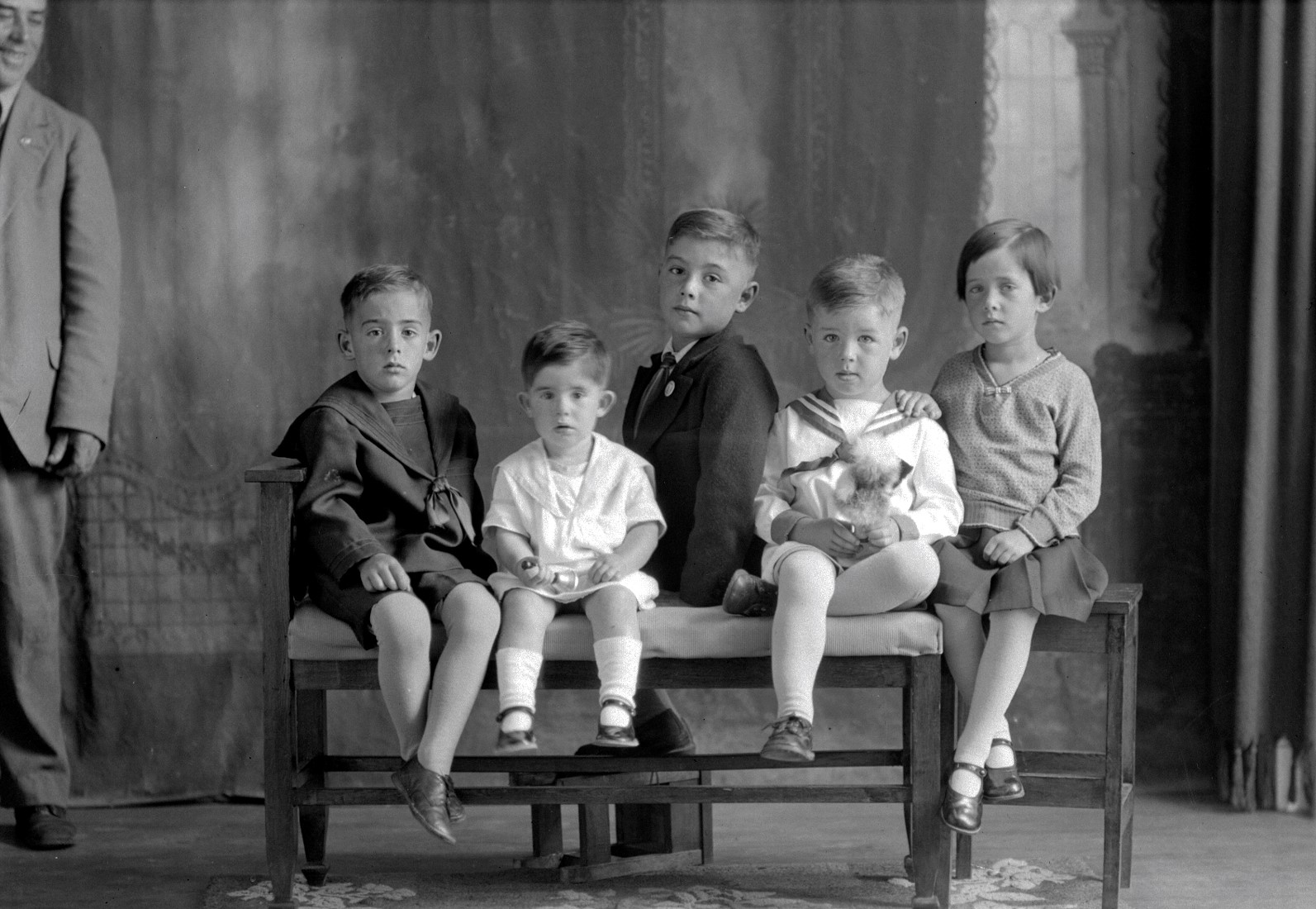
One Sunday after mass, Louis Bernier and Rose-Anna Lavoie took their children to the photographer’s studio. The family portrait was a big day! Dumont surely welcomed them warmly. She may have noticed some of her little visitors seemed nervous, so she lent them a bell and a small piece of fur. That must have helped! The session could begin. First, she would have placed them in birth order: The younger they were, the smaller they were, making for an amusing stairway effect. Then, the photographer had them sit side by side on a long bench. The first pose probably went well, but one of the little boys maybe became jealous that his brother had a piece of fur. He might have even been on the verge of a tantrum. Fortunately, Rose-Anna was there to step in and ask the children to share. This would have worked, with help from one of the older brothers. Louis was standing close behind the children, laughing at the situation. A second shot was taken, just in case. Louis wondered if he should step aside, but the photographer answered that she would cut him out of the photo when it came time to print it. Amused and reassured, he stayed where he was and kept an eye on the children, who were once again serious and posing calmly. That is how, from the various negatives Marie-Alice Dumont left behind and from other archives, we imagine a photo shoot at the Dumont Studio might have taken place.
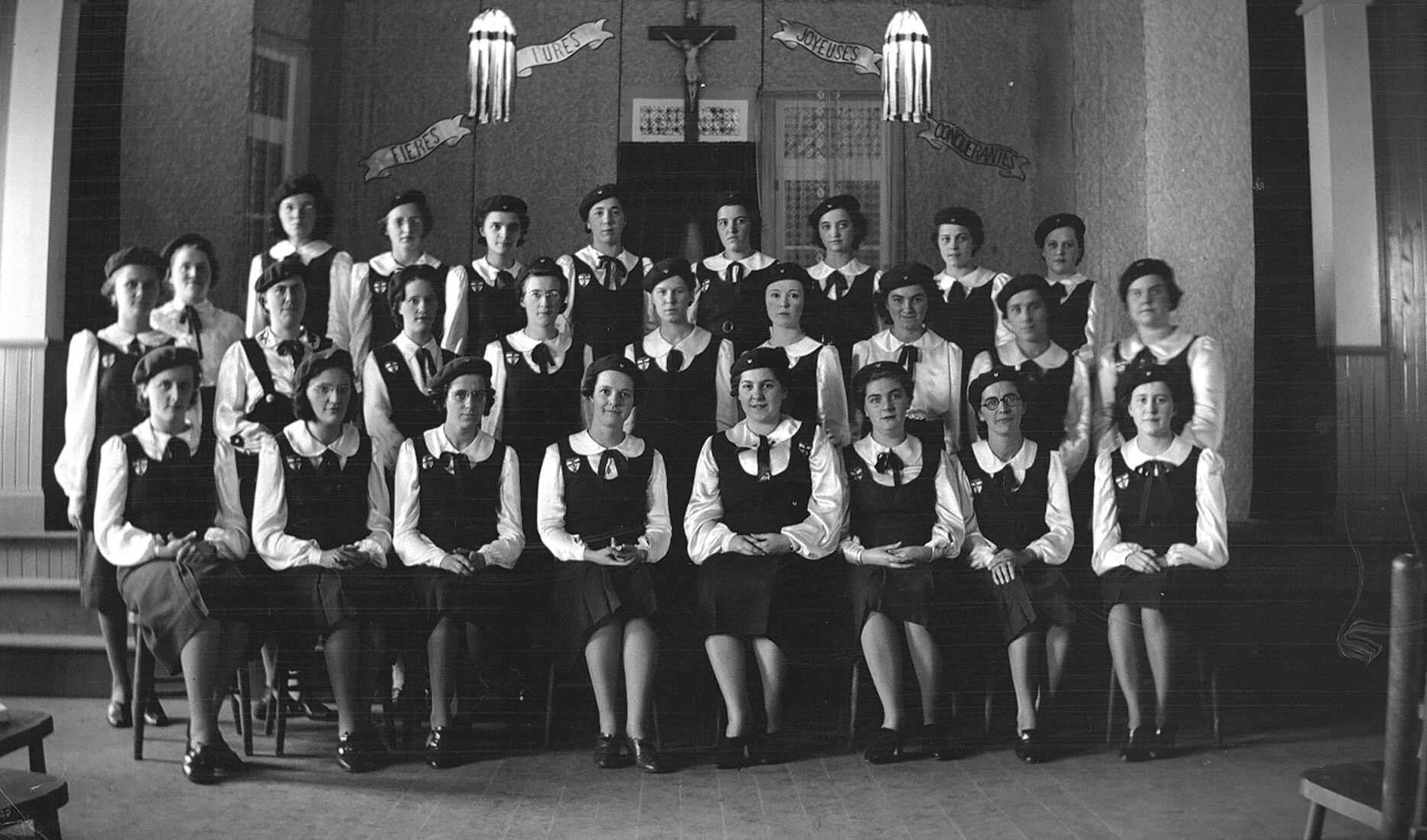
Rosalie Bergeron and Blanche Landry spent time together at school, at home and in the Jeunesse étudiante catholique féminine (JECF), a Catholic girls’ group. They are both in the middle row of this photo: Blanche is first from the right, Rosalie fourth, near the centre. The JECF, founded in the mid-1930s under the supervision of the Catholic Church, was part of a Catholic Action movement that aimed to engage young people and proved very popular in Quebec. The Éclaireurs (or Scouts) were part of the same movement. The JECF focused on leisure activities, education and, above all, social involvement in the spirit of Christianity. During the economic crisis of the 1930s, JECF members like Rosalie and Blanche learned to organize, seeking solutions to problems of the time: misfortune, poverty, social injustice and the declining influence of the Catholic religion.
Life in the village and countryside
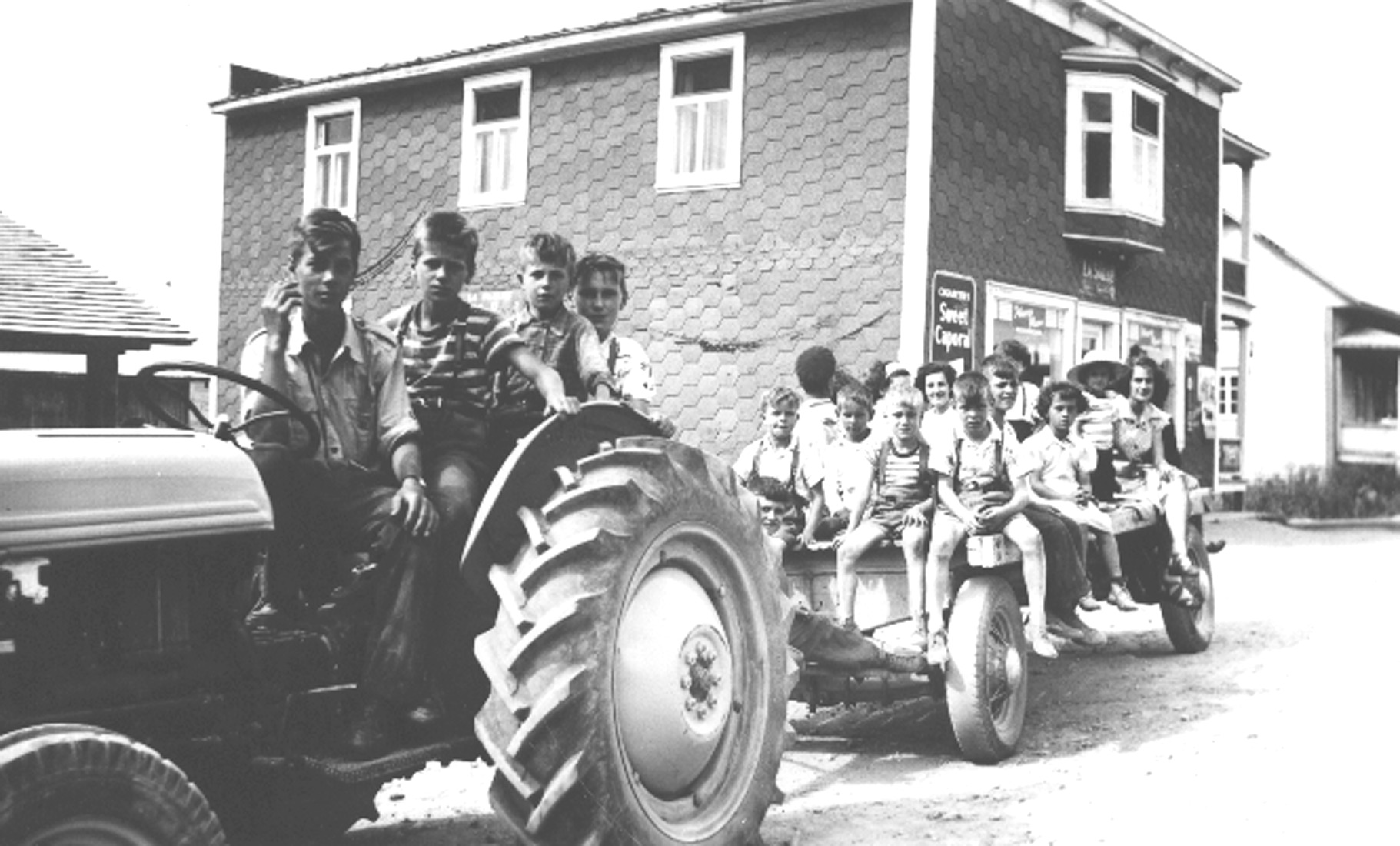
Where might this group of young people be headed, piled onto a tractor and the trailer it is pulling? It must have been a special occasion, although it was hardly unusual to see people of all ages getting around town or country this way.
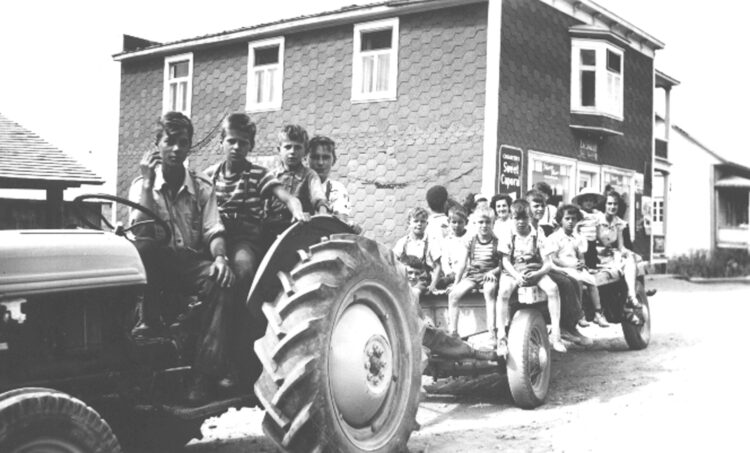
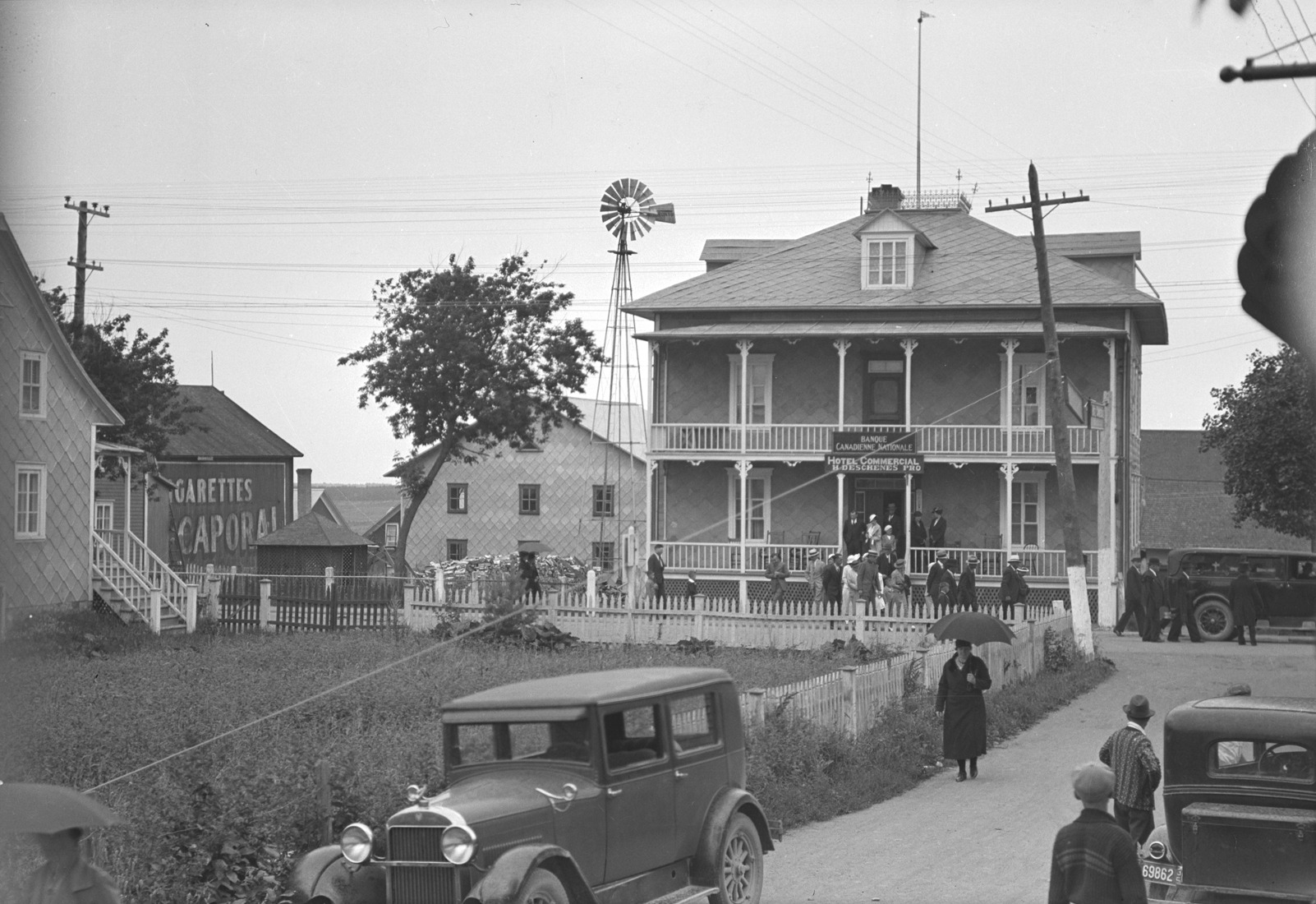
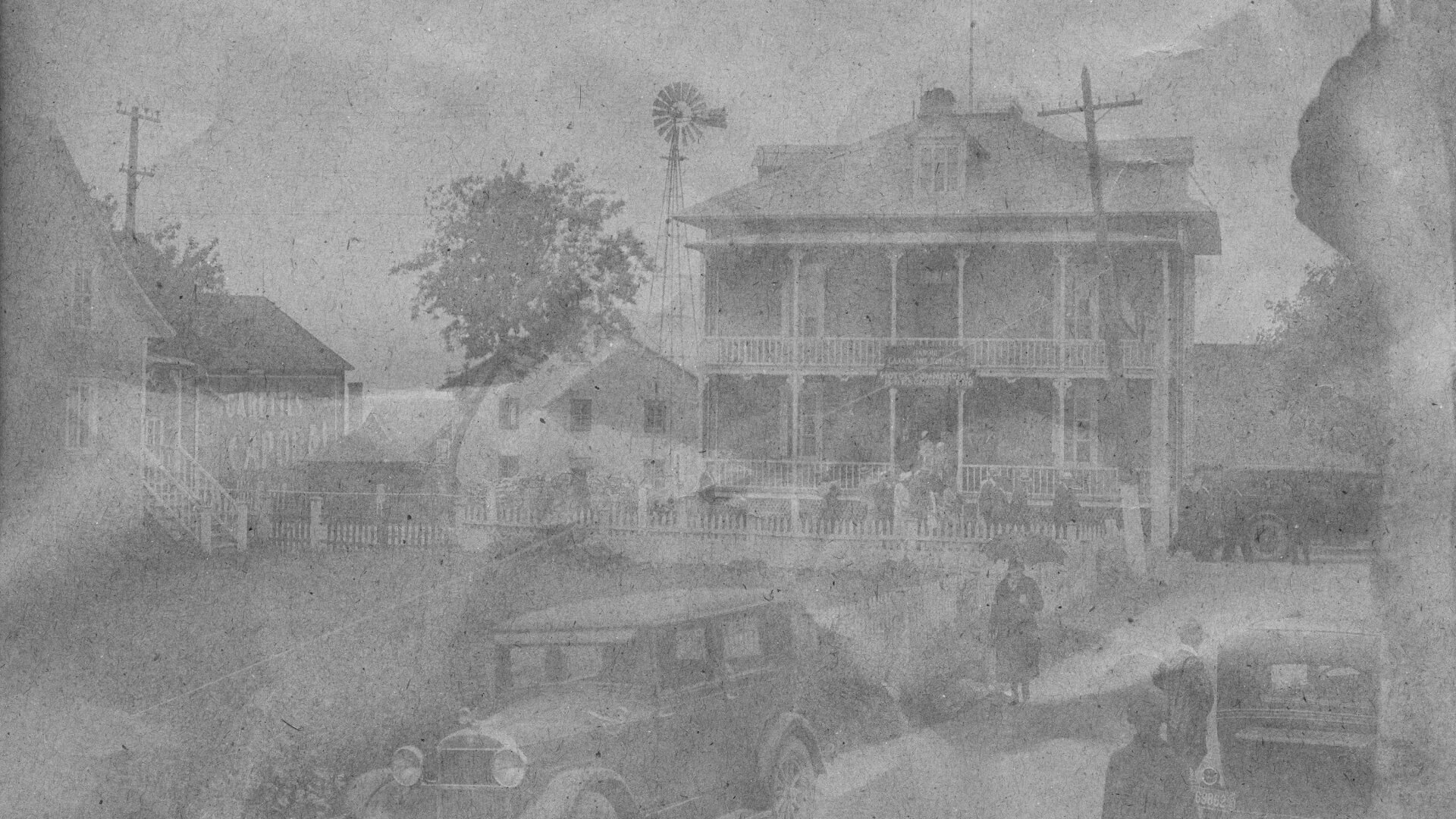
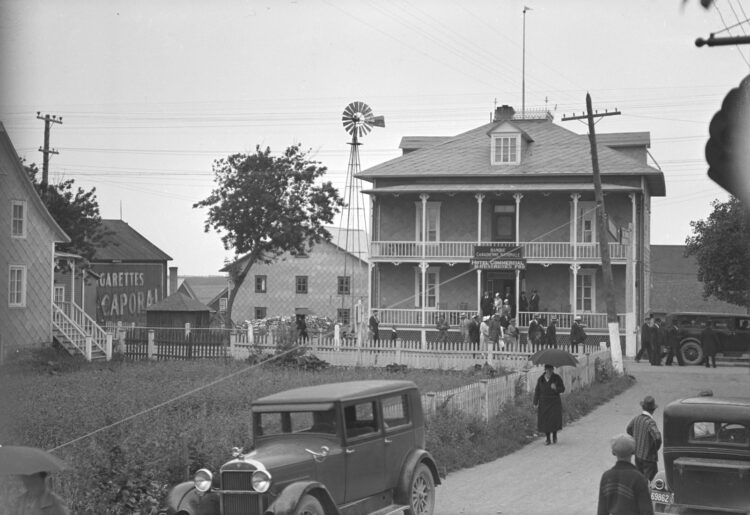
The real star of this village scene is undoubtedly the building owned by Henri Deschênes, which housed the local inn and a branch of the National Bank of Canada.
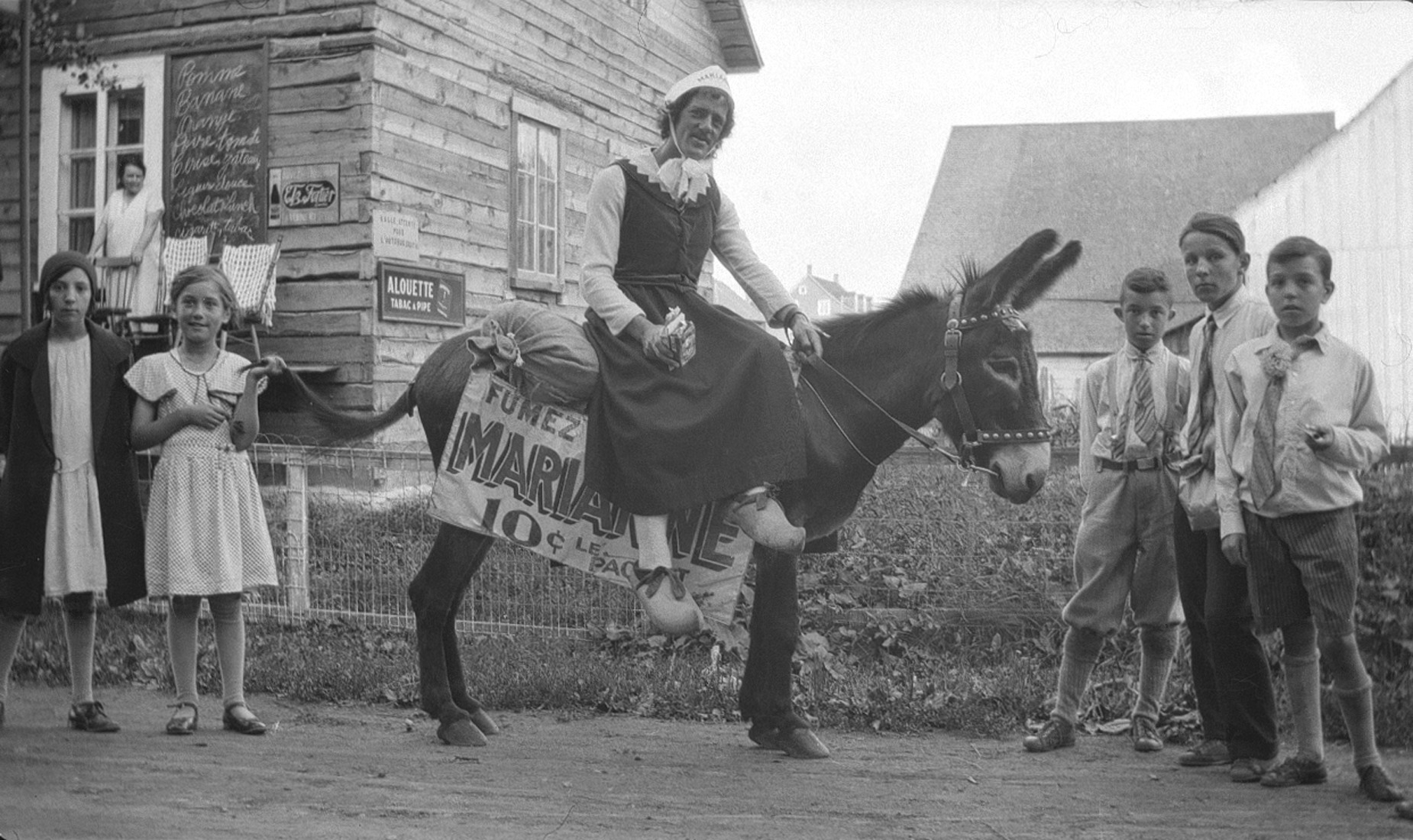
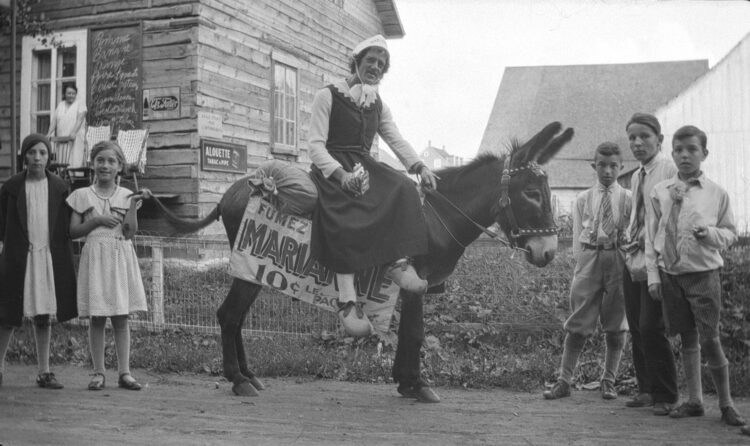
Here is another type of travelling merchant: this time, a tobacco seller. Outfitted in a deliberately comical costume, this salesman leaned into the wordplay associated with the product’s brand. Pulling a donkey and dressed as Marianne, he calls to mind Marianne s’en va au moulin, a popular nursery rhyme in French that the local children surely knew and found amusing!
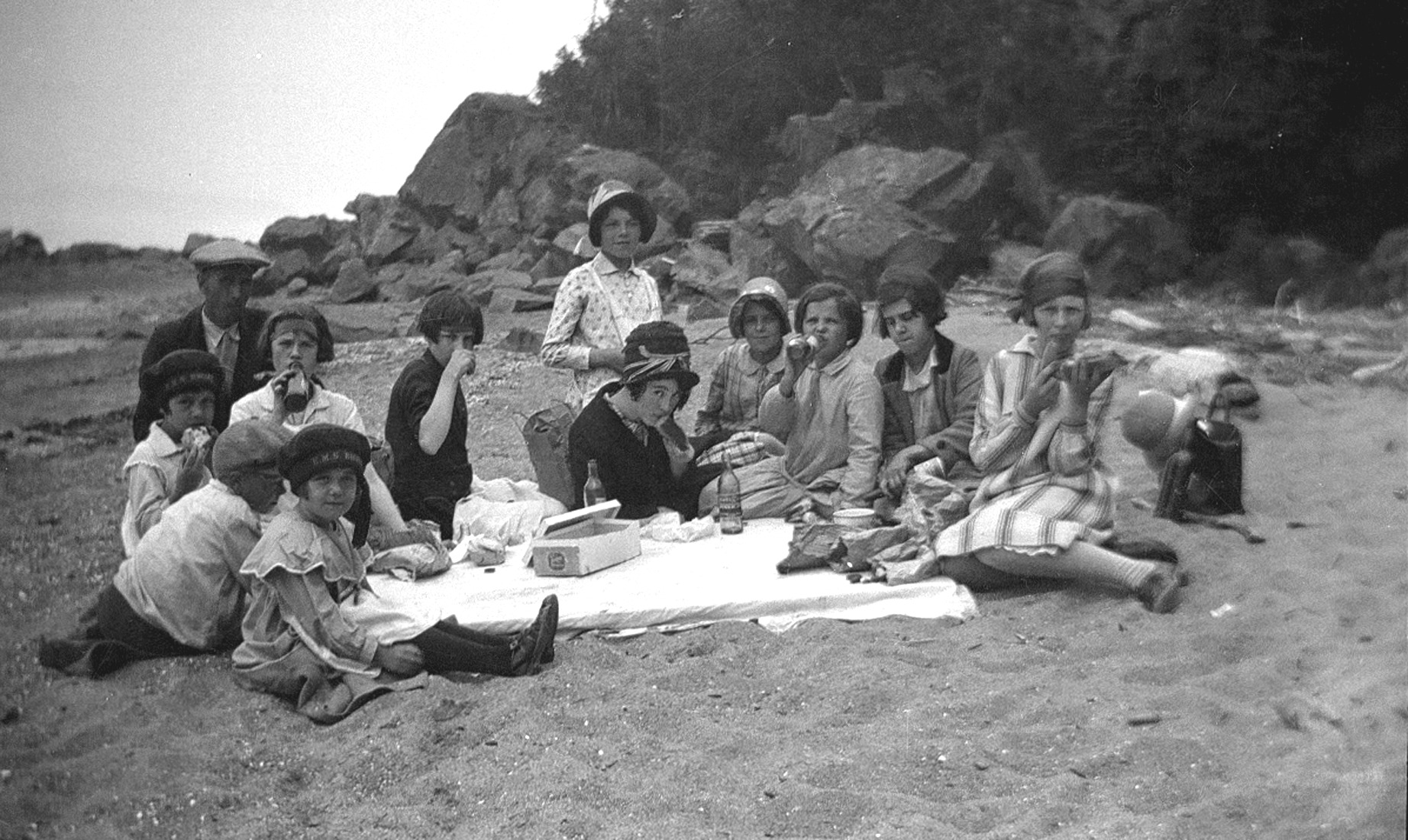
Picnicking on the shoreline was one of the most popular summer activities in Kamouraska during Dumont’s time. At the centre of this photo, lying down, is Rosalie Bergeron, the photographer’s adopted sister.
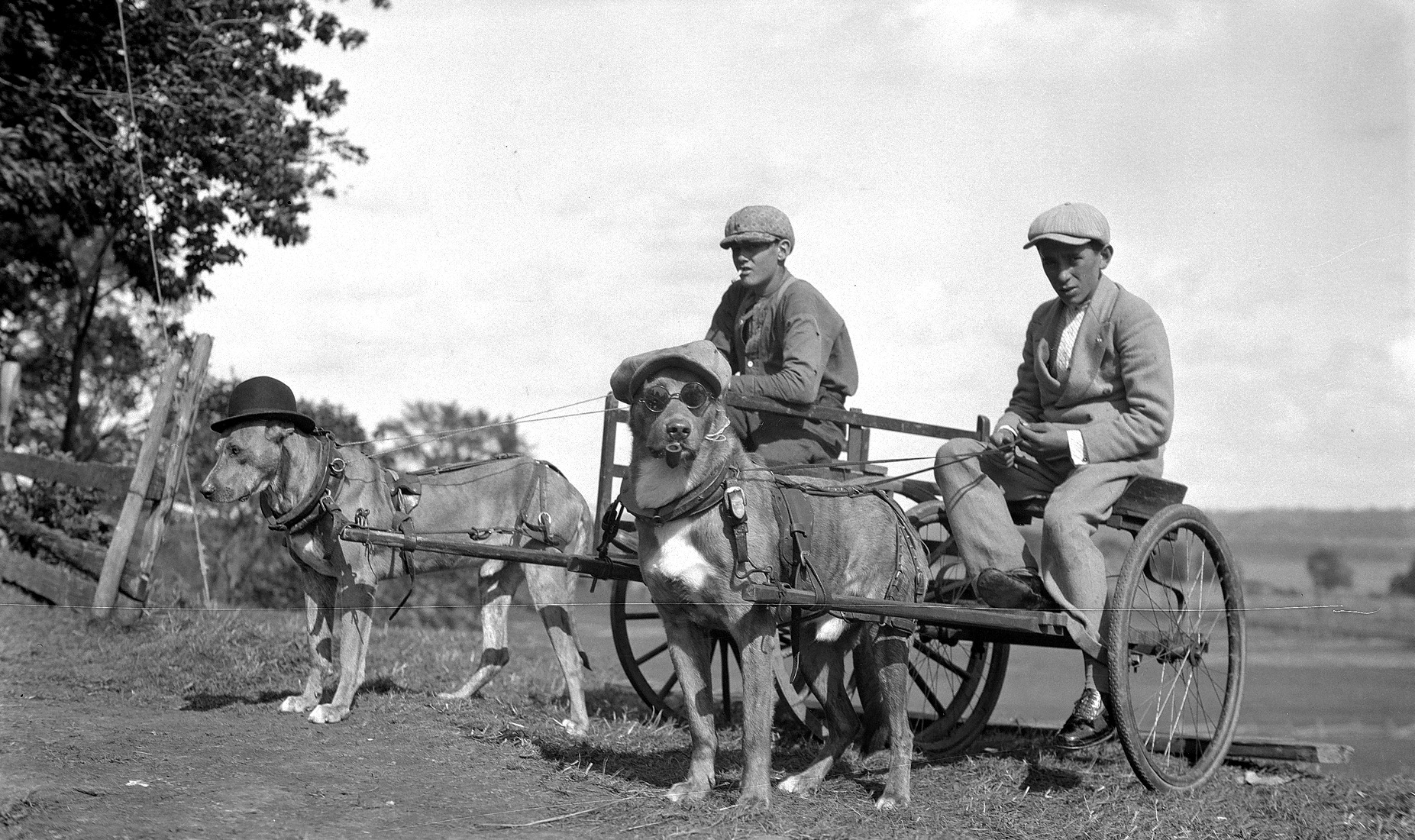
Dumont photographed several dog-drawn sleds, which were used in both summer and winter, sometimes to transport children. In the 1920s, local residents would also entertain tourists in this way. These visitors, often city dwellers from the United States, would leave convinced that French Canadians had preserved a traditional and rustic way of life. One can only wonder what purpose the sleds in this photograph once served.
Is that a bird flying over the Dumont garden or simply damage to the negative? It is fun to imagine it might be one of the “horrible and pesky” crows that Marie-Alice’s siblings once tamed.
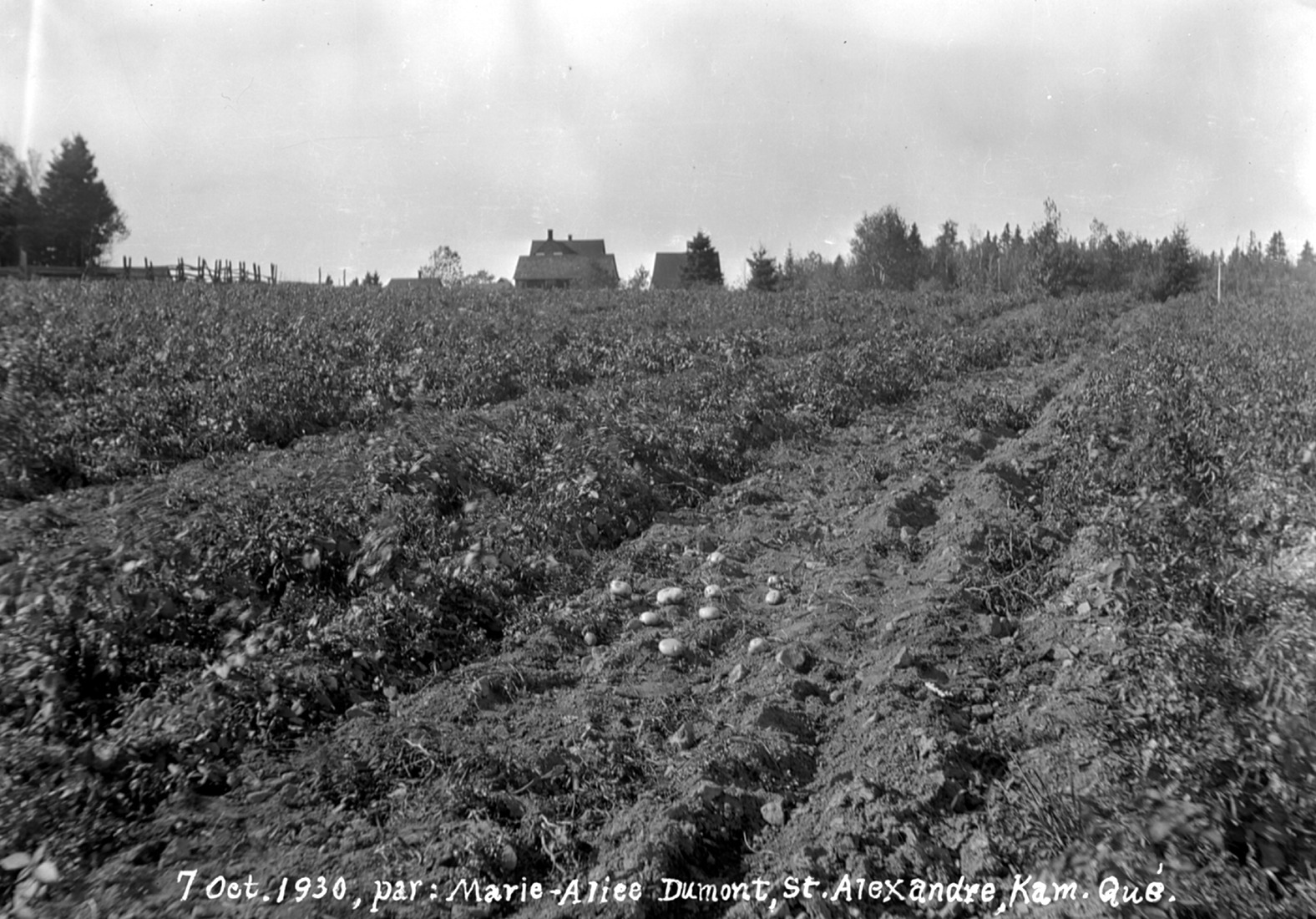
The slightly upward angle on this potato field gives it a sense of scale and depth that conveys the magnitude of the labour required to cultivate it.
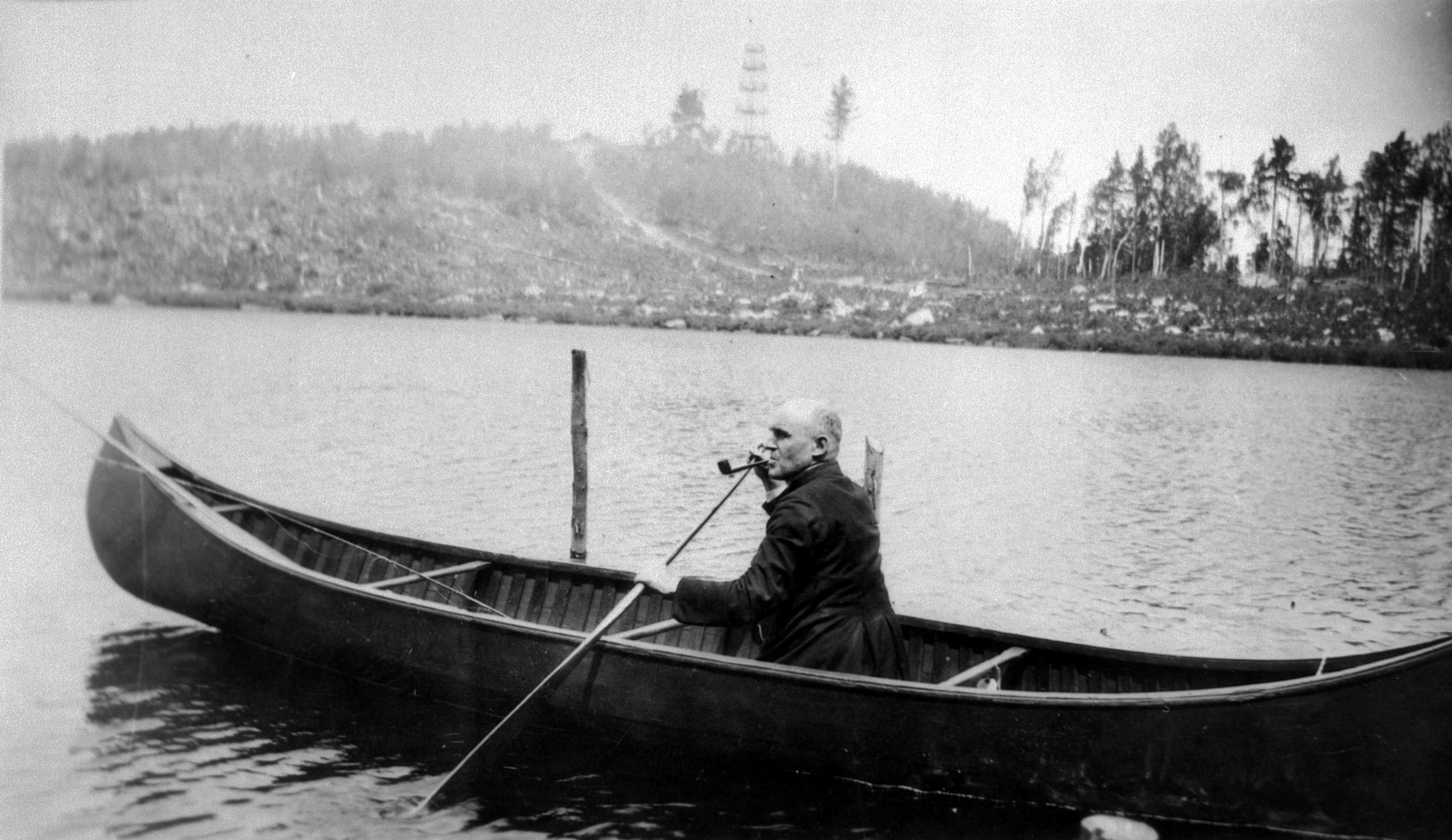
This negative was likely sent to Dumont to be developed. A clergyman inspects the freshly cleared edges of a lake (Pohénégamook, perhaps, or Témiscouata), possibly in preparation for welcoming the first groups of settlers.
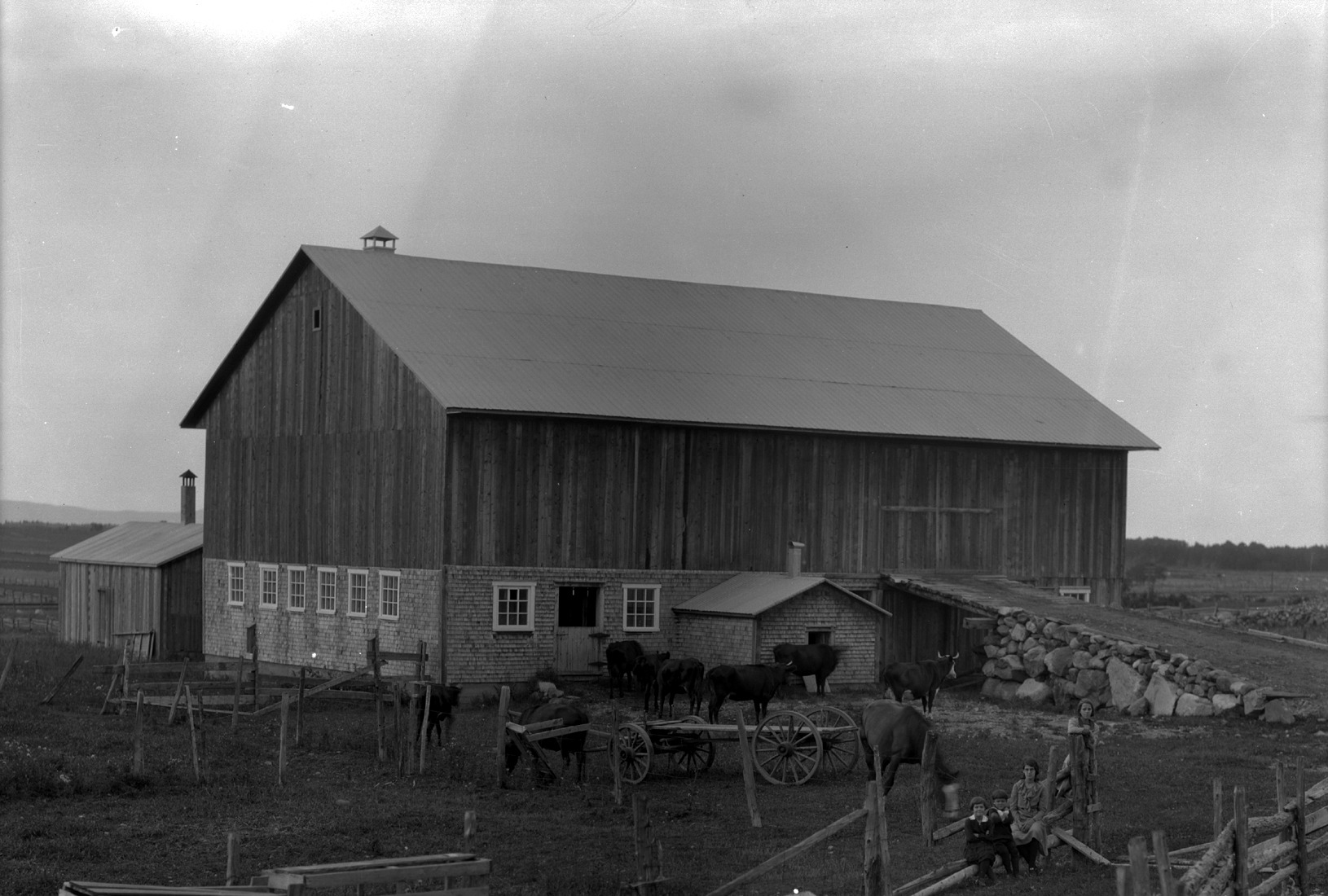
Families sometimes called upon Marie-Alice Dumont to photograph their home and farm buildings. In 1944, Dumont visited Marie-Hermine Plourde, widow of Jules Chénard, to capture their grand and immaculately maintained house and barn.
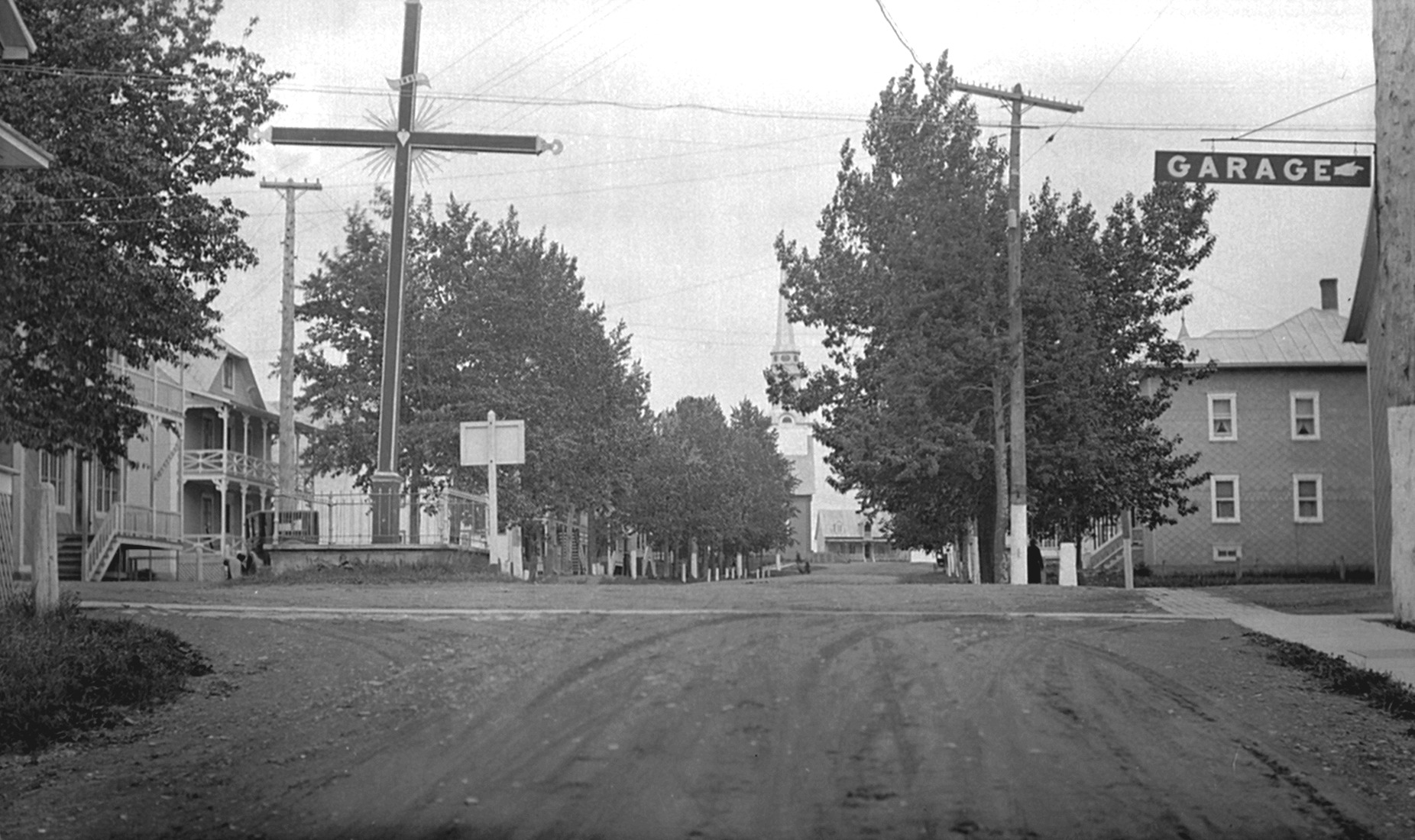
The roadside cross was a familiar sight in the Kamouraska landscape. At the very centre of Saint-Alexandre, where two busy roads meet, this tall cross was erected as a symbol of the villagers’ faith.
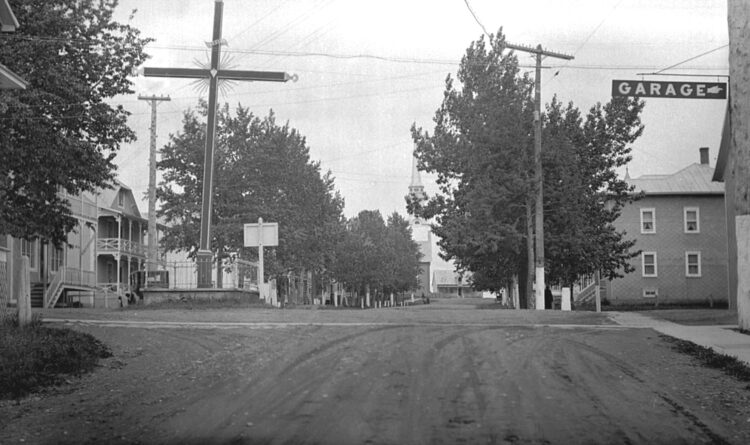
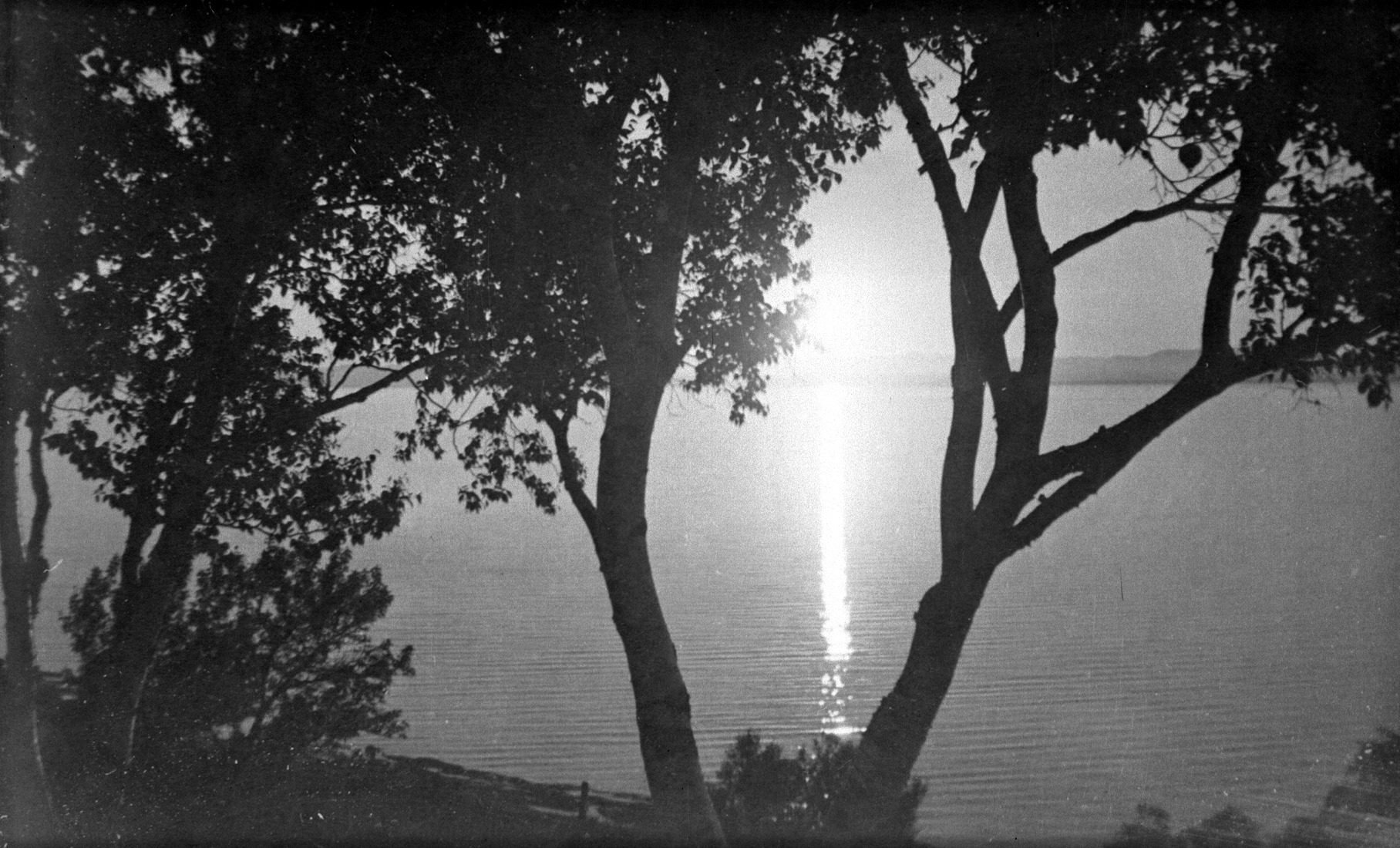
In one of her few preserved self-portraits, Dumont relaxes in the glow of the setting sun during a holiday on Patins Island. Could this image of a sunset have been taken during the same photo session?
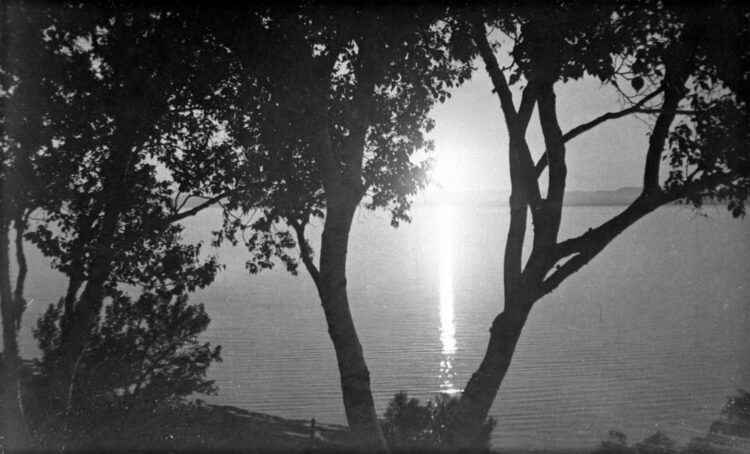
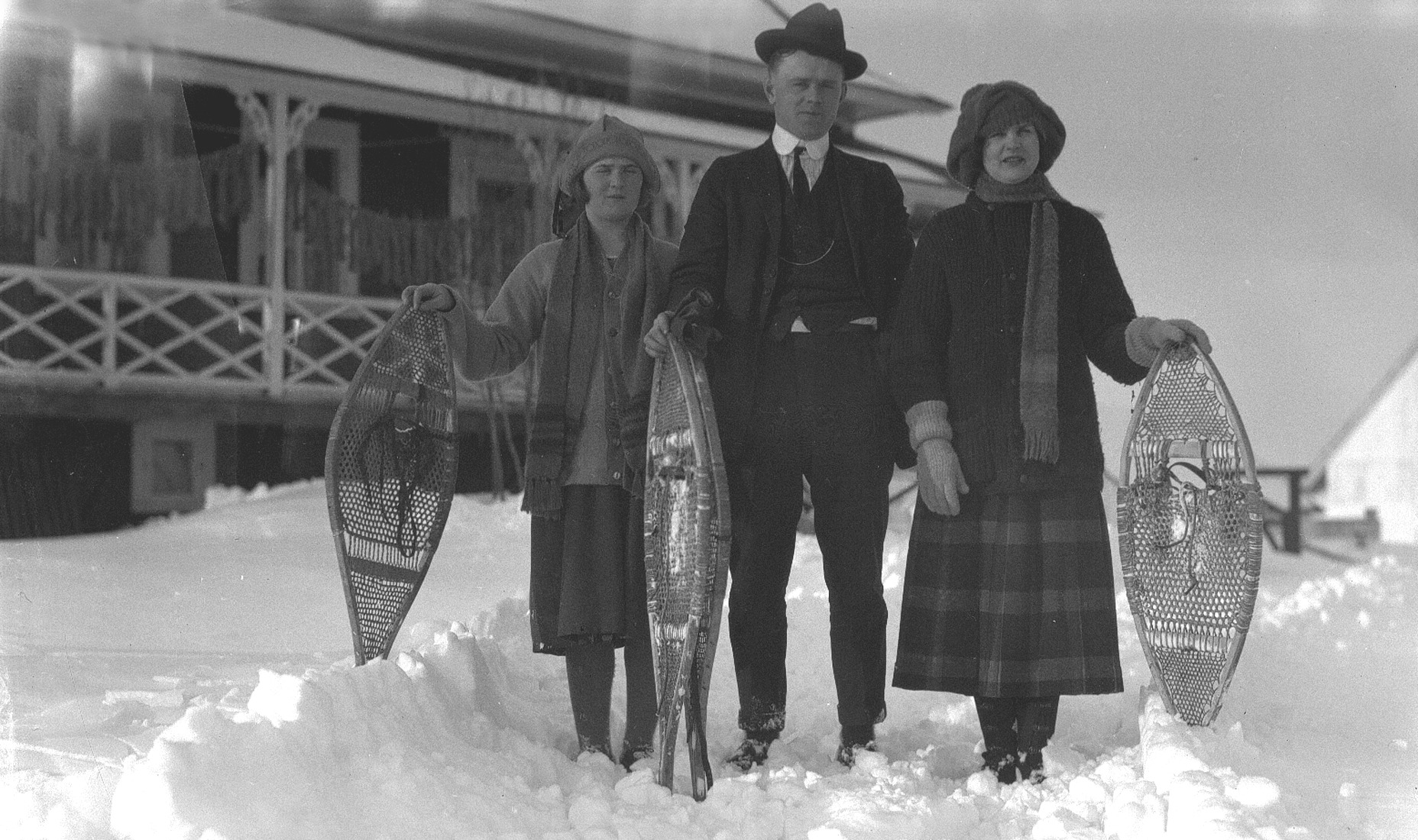
Then, as now, skiing and snowshoeing were favourite winter sports and means of travel for the people of Quebec.
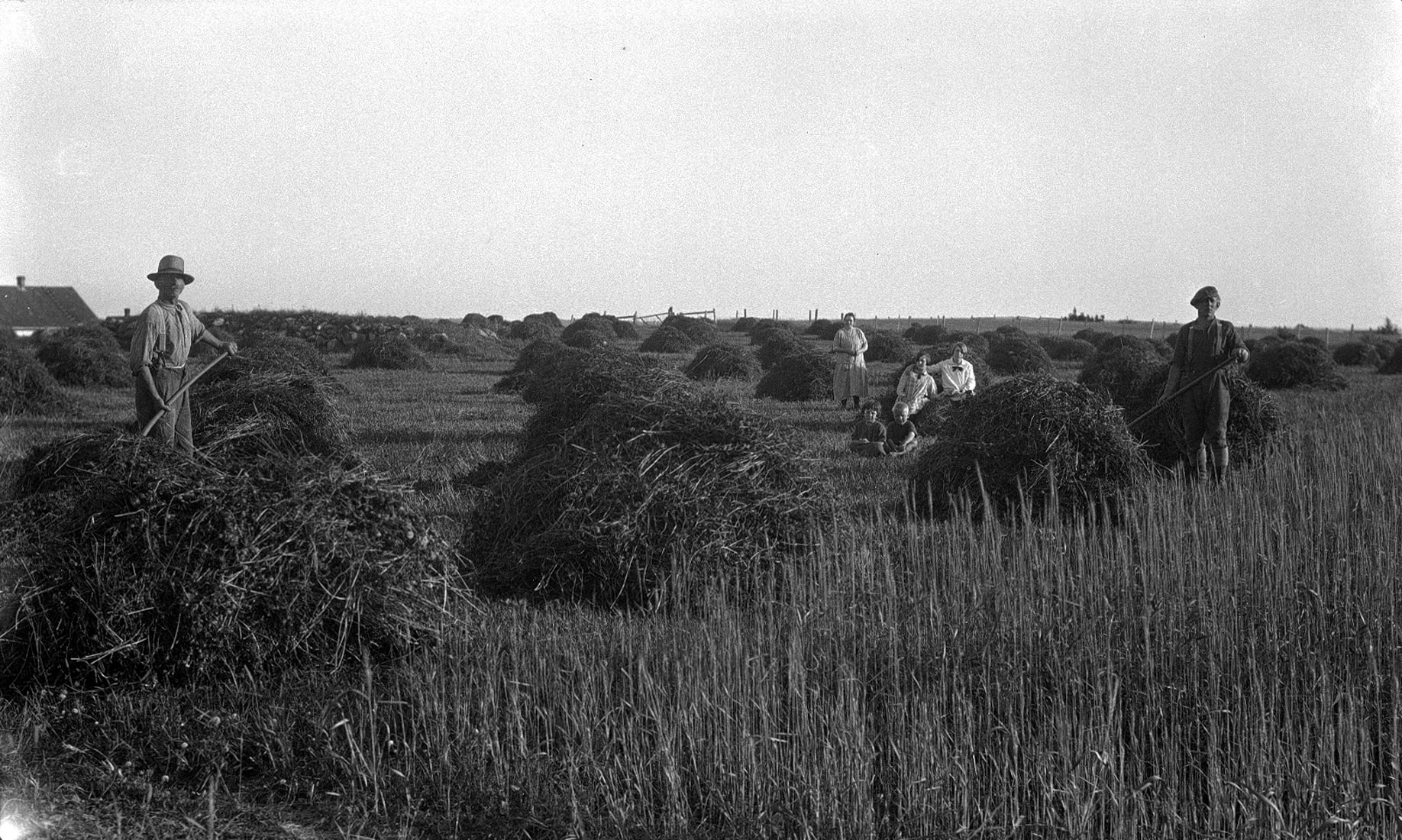
Making hay was a common task for many Kamouraska families in the first half of the 20th century. The composition of this photograph by Marie-Alice Dumont captures the immensity of the chore. Framing the image diagonally, running from the bottom left up to the horizon on the right, lends depth to the picture. The impressive piles of hay captured on film encourage us to imagine the time already spent in the field, pitchfork in hand. The uncut hay along the bottom right of the frame hints at the work still to be done. If Dumont wished to communicate the long, arduous nature of the job, she succeeded.
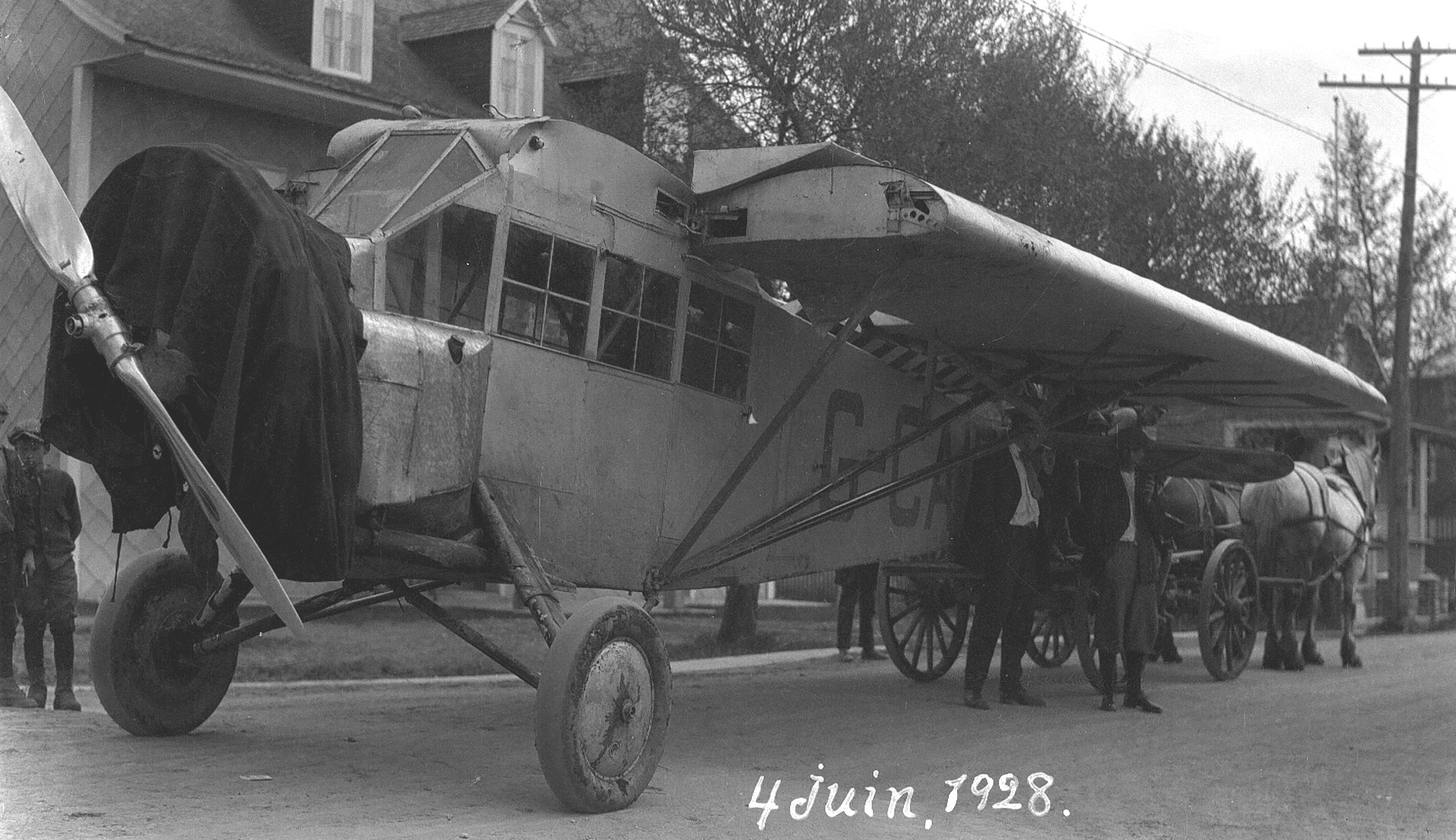
The transport of this airplane in 1928 must have caused quite a stir in Saint-Alexandre. Villagers can be seen gathered along the roadside, eager to witness the spectacle. The contrast is striking between the “modernity” represented by the airplane and the horses, a mode of transport that had endured for millennia.
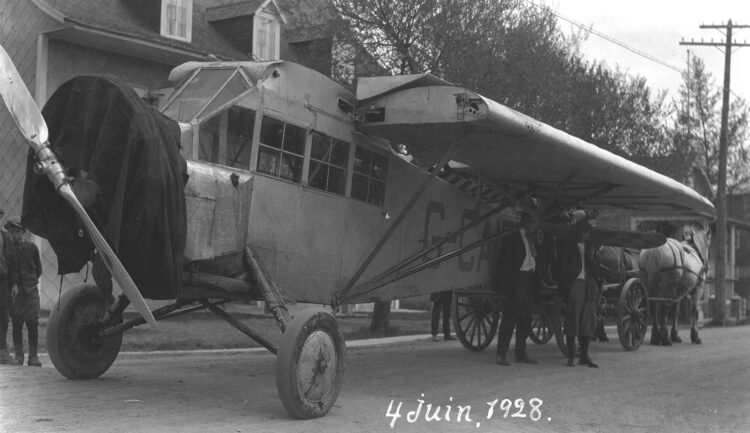
A total solar eclipse took place on August 31, 1932. The newspapers of the time enthusiastically reported this rare phenomenon, which, by good fortune, took place under clear skies in the Québec City region. Dumont did not miss the opportunity to capture the event on film.
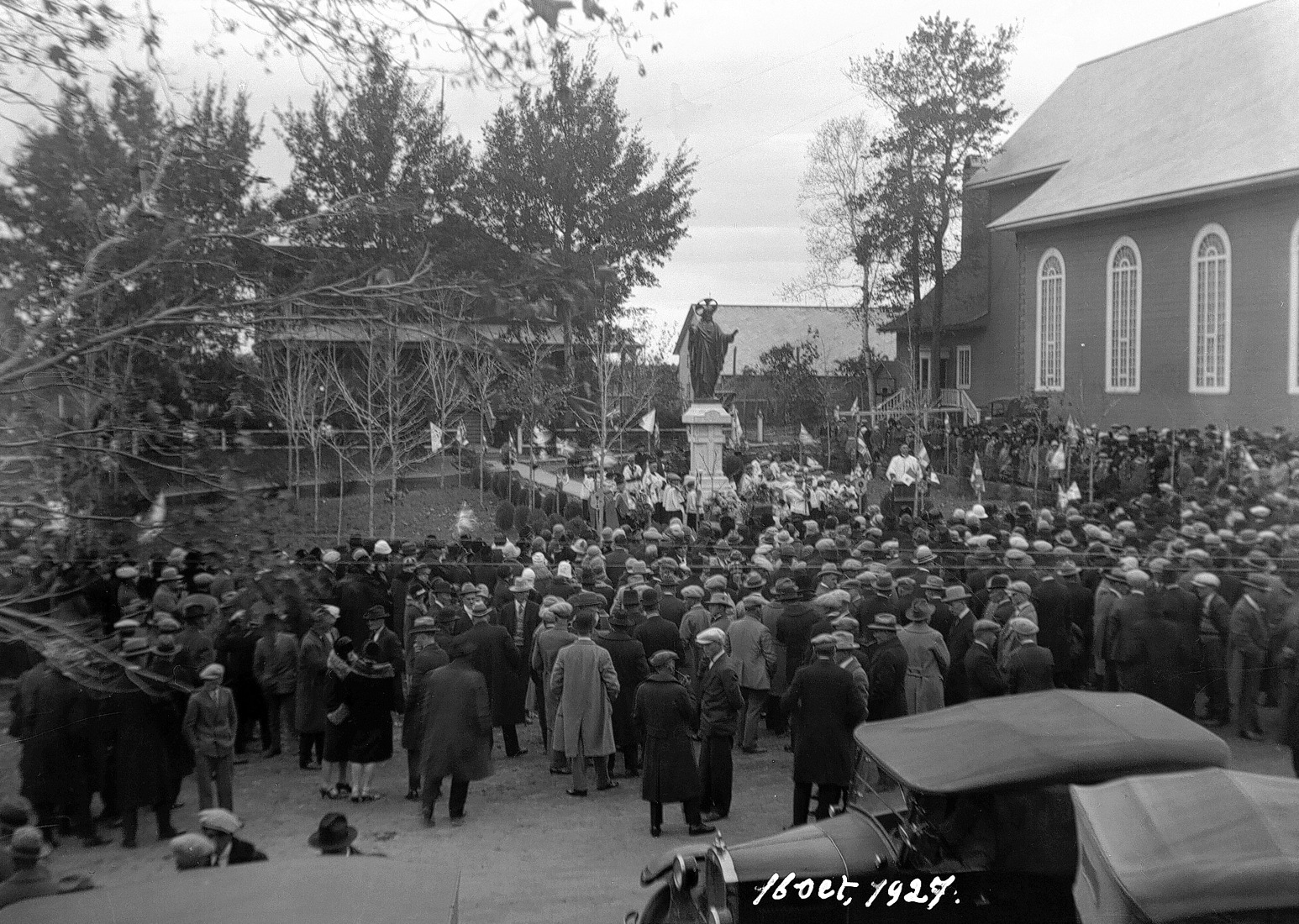
What kind of event could have drawn such a large crowd to Rivière-du-Loup in 1927? The visit of a politician? The arrival of a music or film star? No! It was a religious gathering, as the photograph’s title indicates.
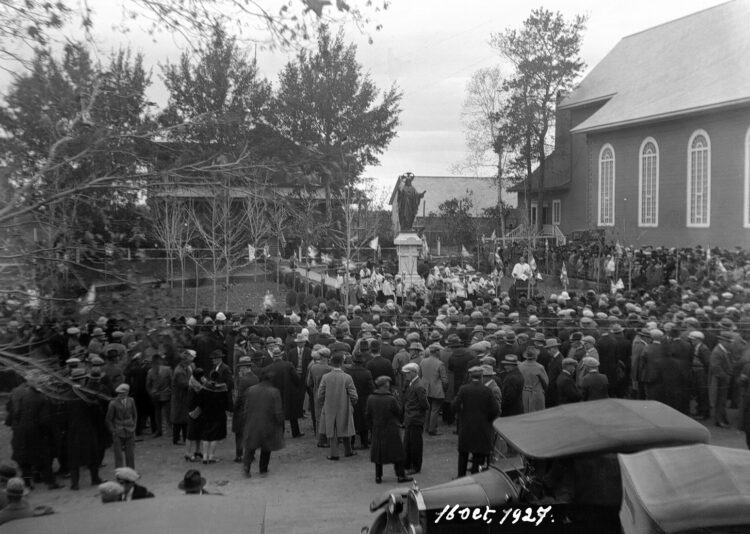
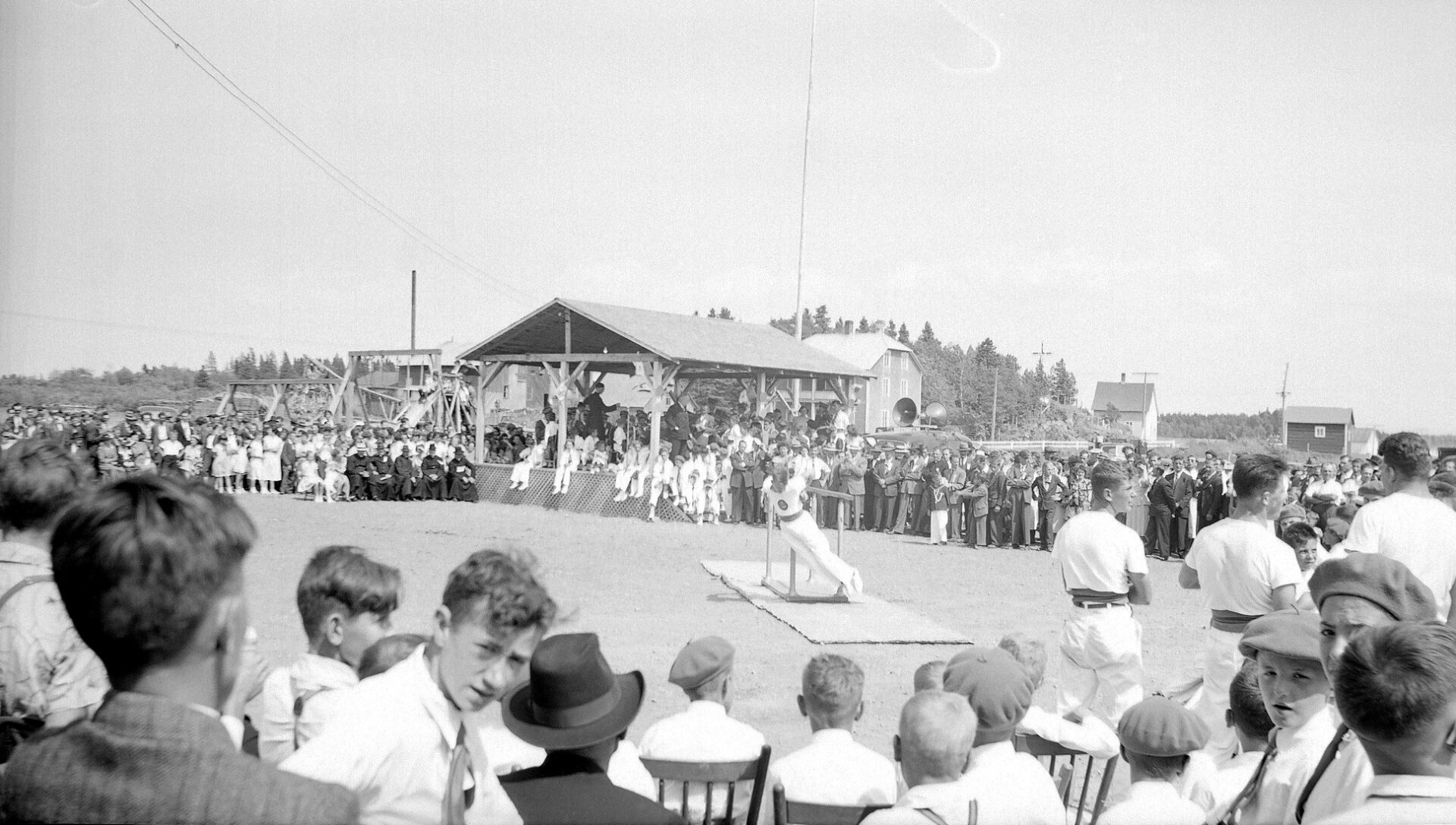
The Cercle Lacordaire societies, a temperance movement, were widespread in Québec from the 1940s onward. Each year, major diocesan congresses were held across the province, offering festive occasions marked by sobriety. The Dumont family was close to this movement, which promoted total abstinence from alcohol.
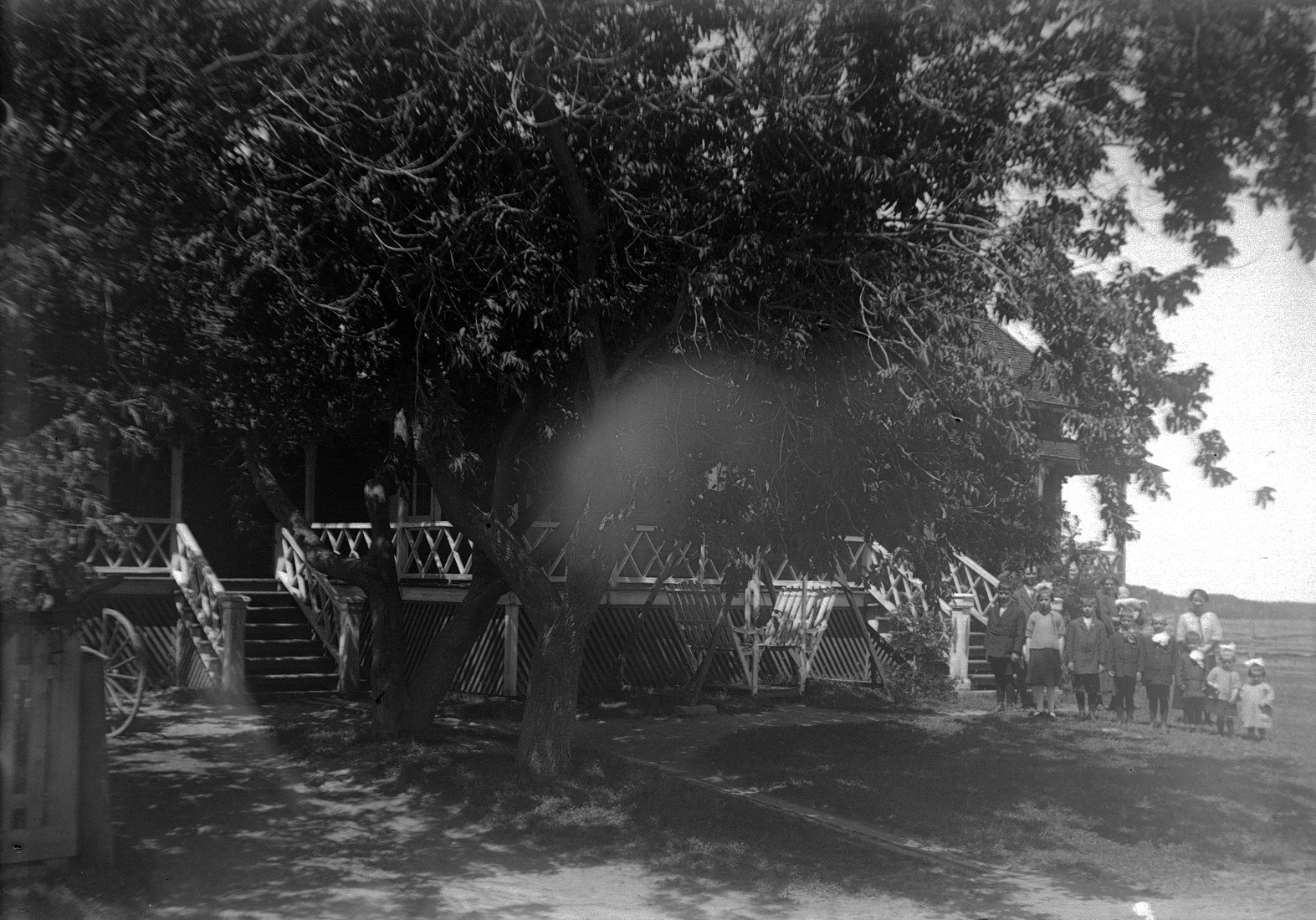
This family of 10 children stands proudly in front of their home. One might wonder about the intention behind the composition: nearly half the image is taken up by a large tree!
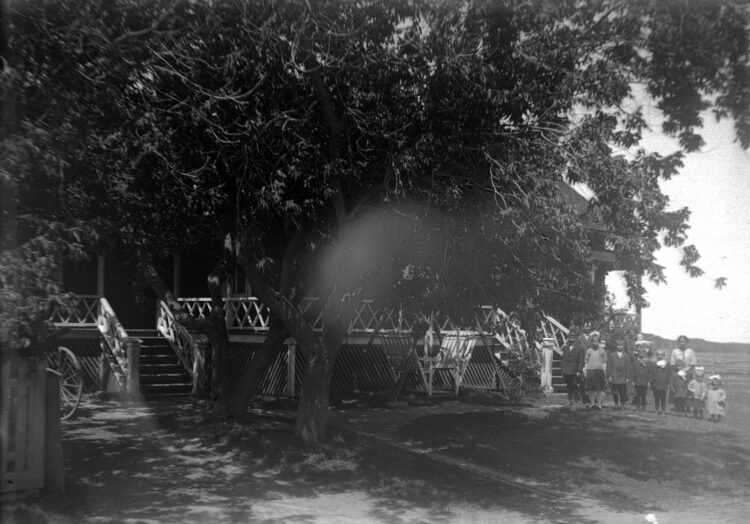
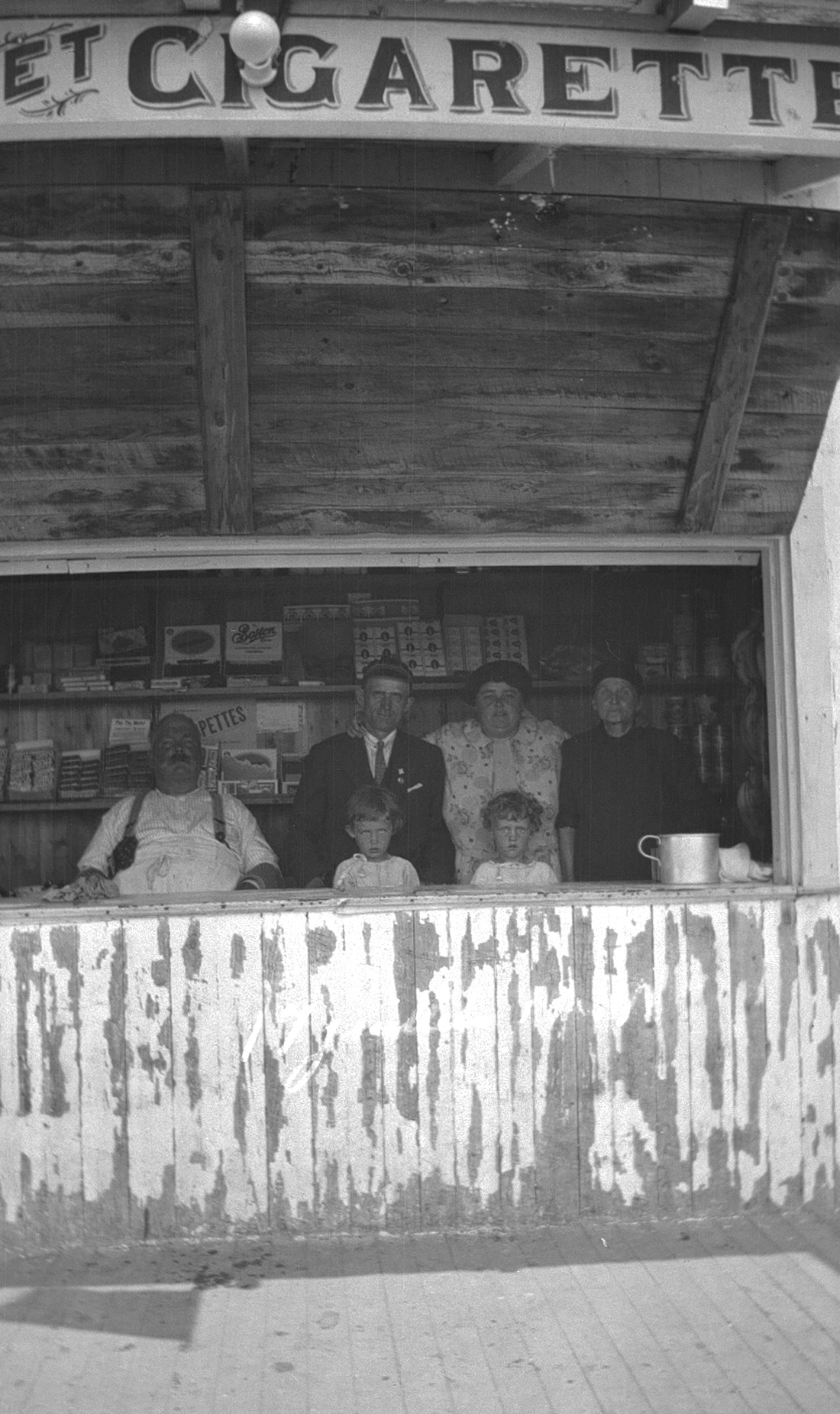
This small family kiosk, located on the point in Rivière-du-Loup, benefited from the influx of travellers brought by the ferry that had been connecting the point to the northern shore of the St. Lawrence since 1909.
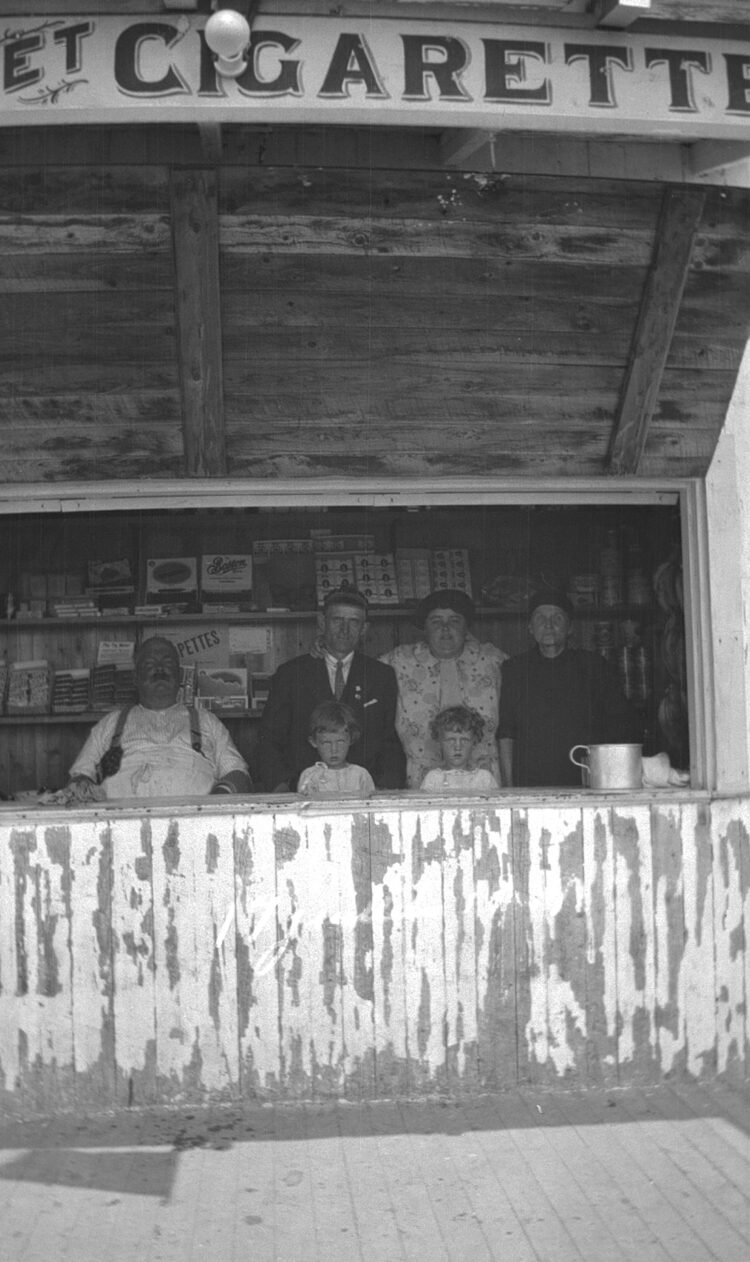
Religious life
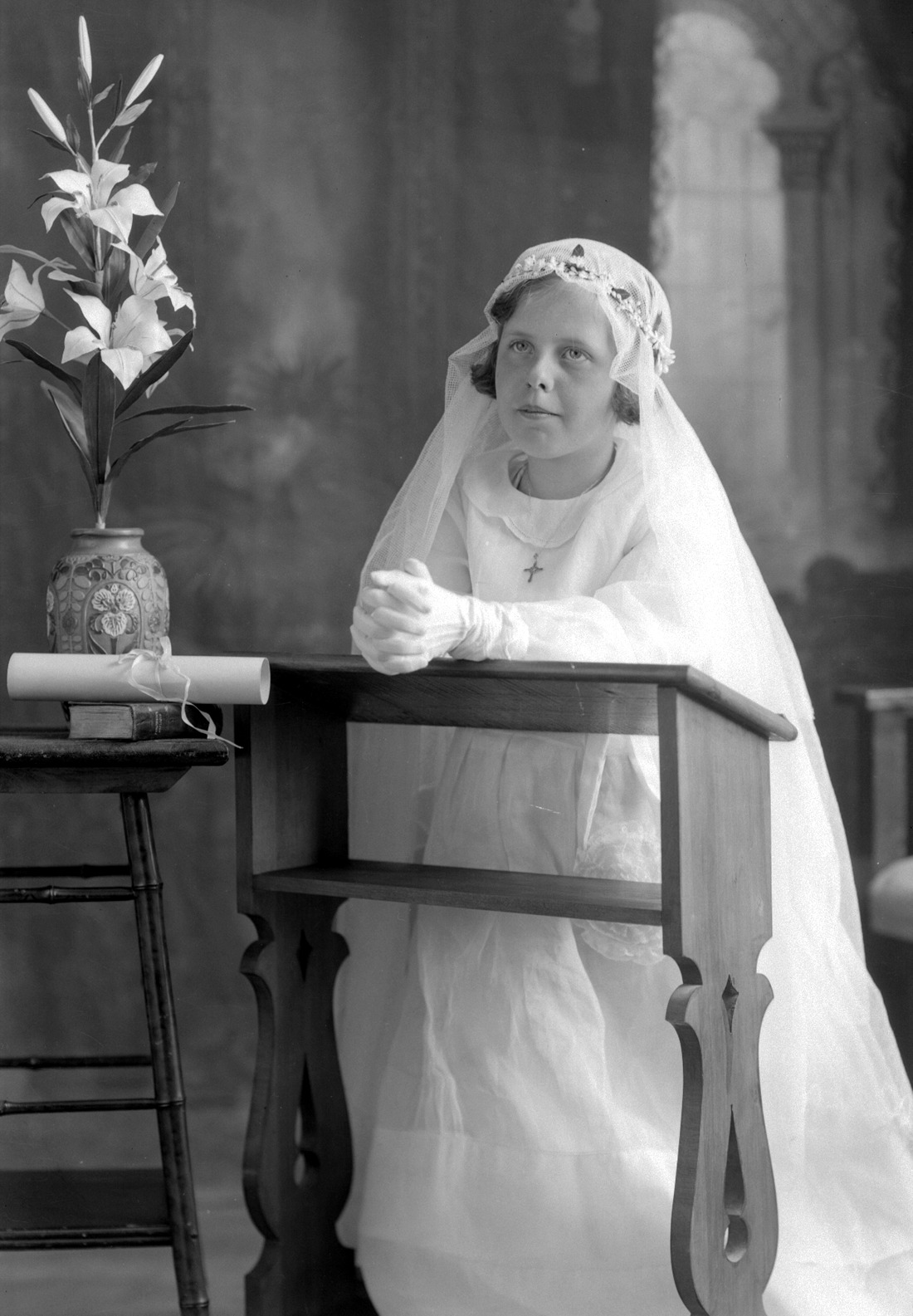
At the time this photo was taken, most Catholic families observed the sacraments faithfully. Miss Gisèle Soucy poses here with confidence, as the photographer is well practised in capturing beautiful confirmation portraits.
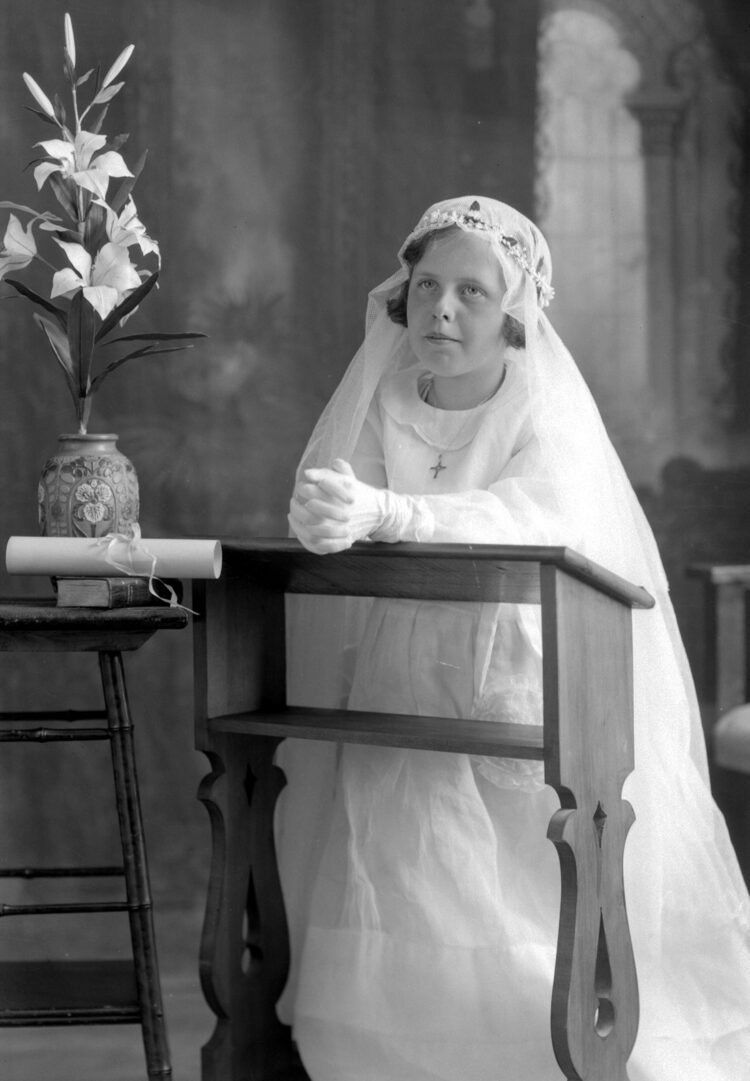
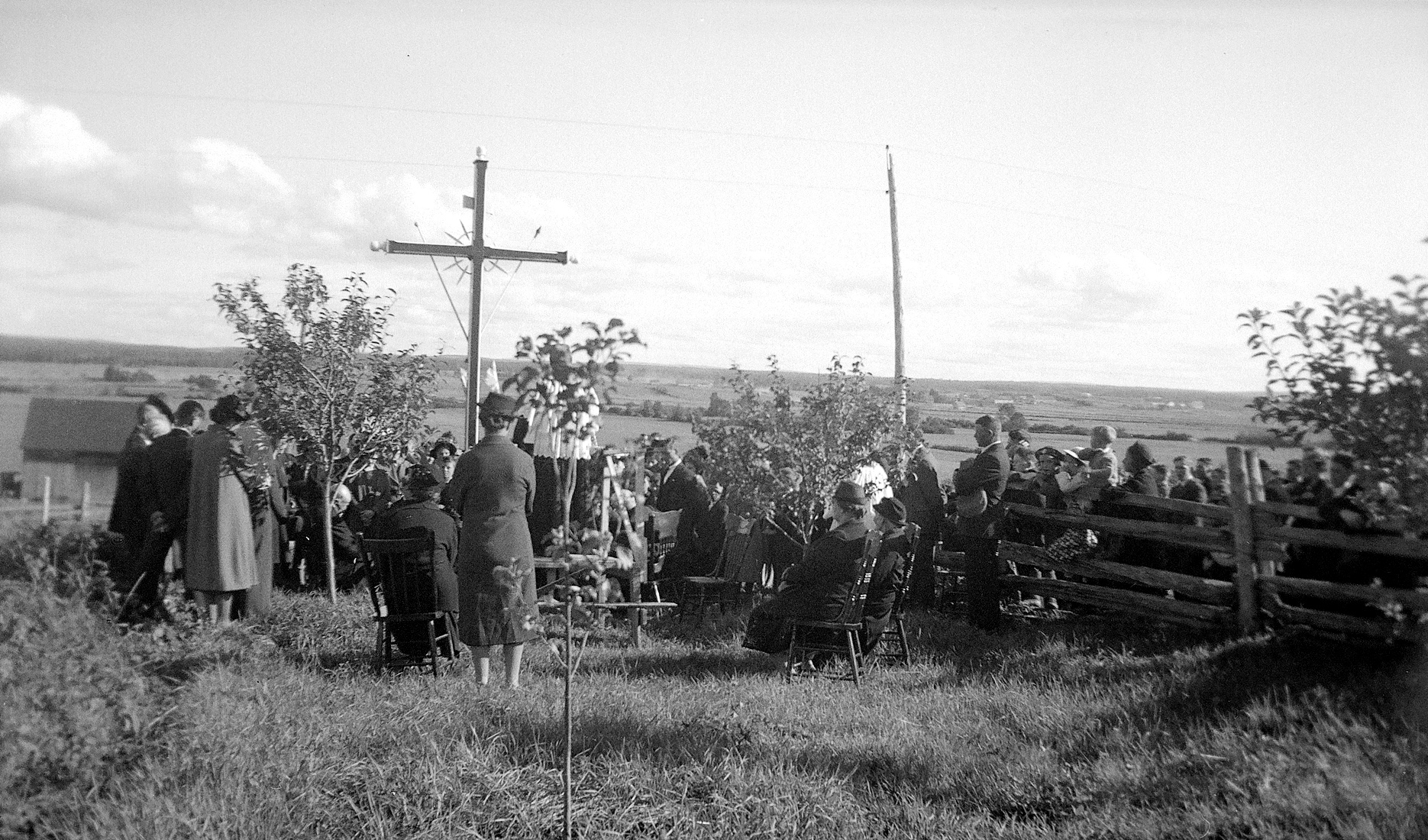
This image documents the blessing ceremony held on September 14, 1940, for a newly built roadside cross constructed by Origène Dumont. In the words of Joseph-Napoléon, such a cross “expresses the Christian spirit that inspired our ancestors.”
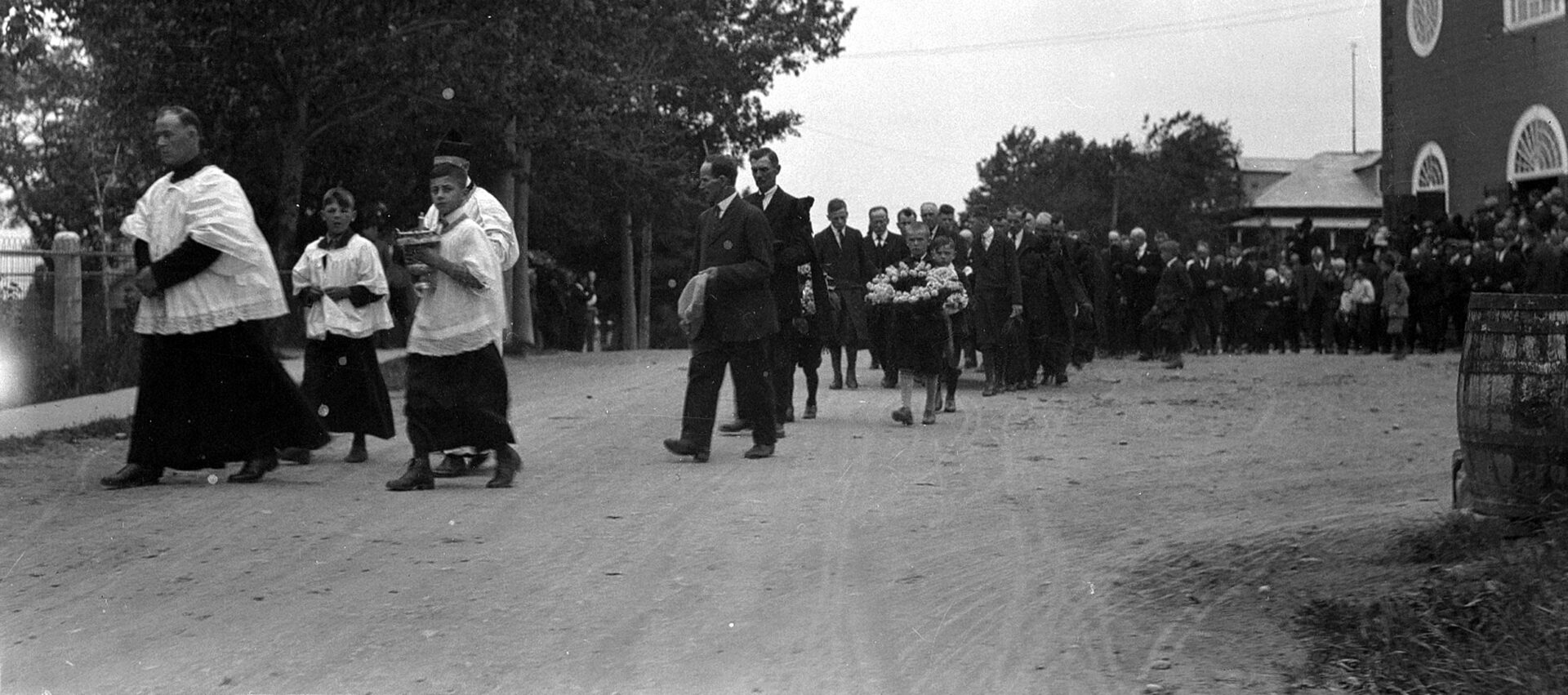
Funerals, by their very nature, are solemn events. In this scene, the mood is heavy as the crowd exits the church, following the priest in procession toward the cemetery in Saint-Alexandre. The image conveys a deep sense of gravity and reverence.
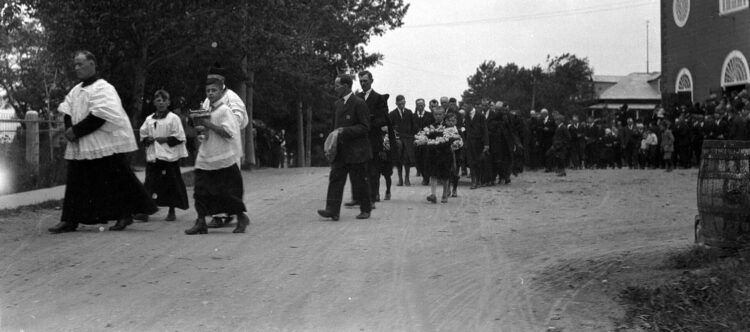
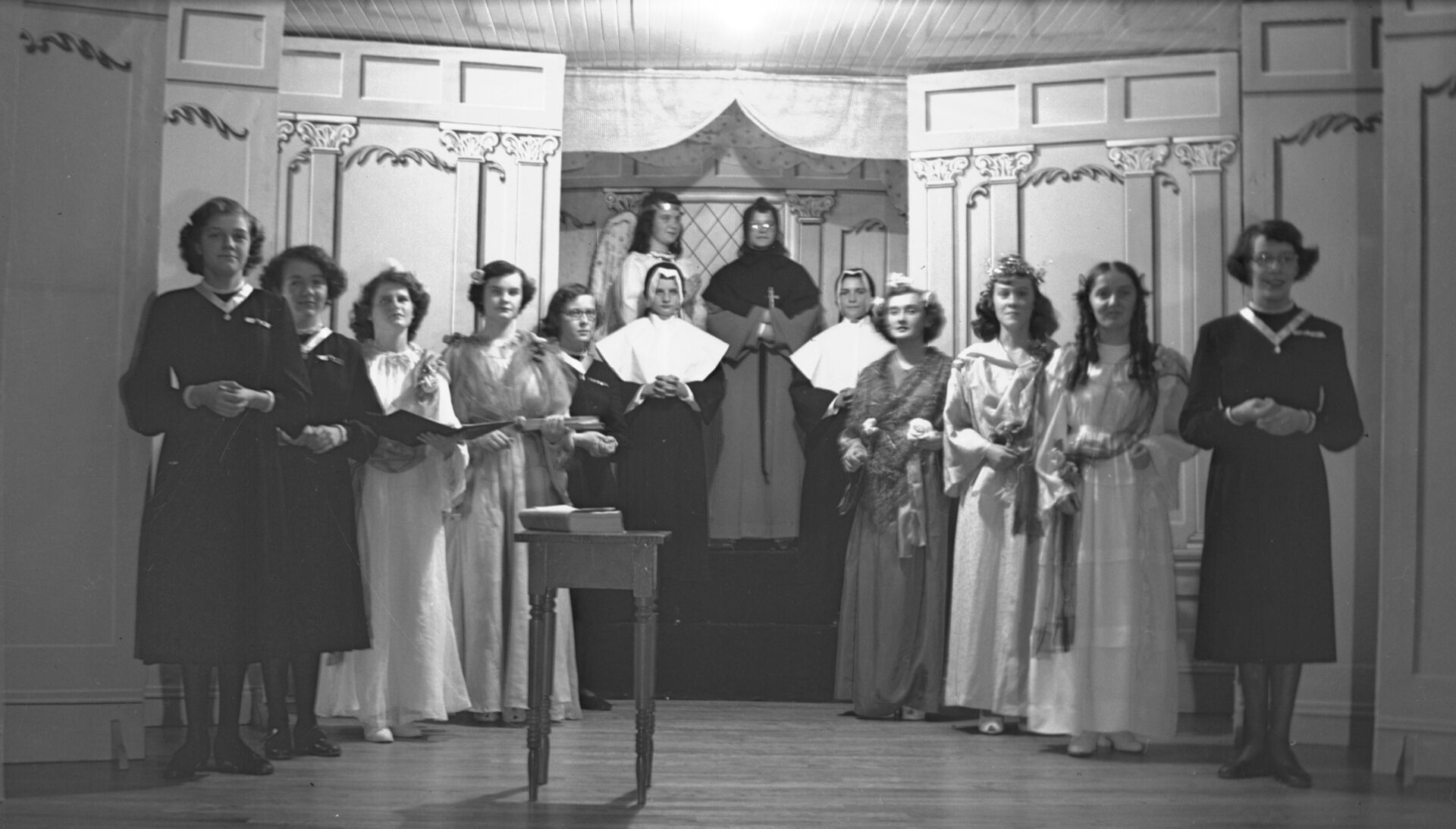
In the first half of the 20th century, French-language theatre in Quebec was deeply influenced by Catholic culture. Here, a group of convent students rehearses a play in honour of Mother Mallet, founder of the Sisters of Charity of Québec, on the occasion of the congregation’s centennial.
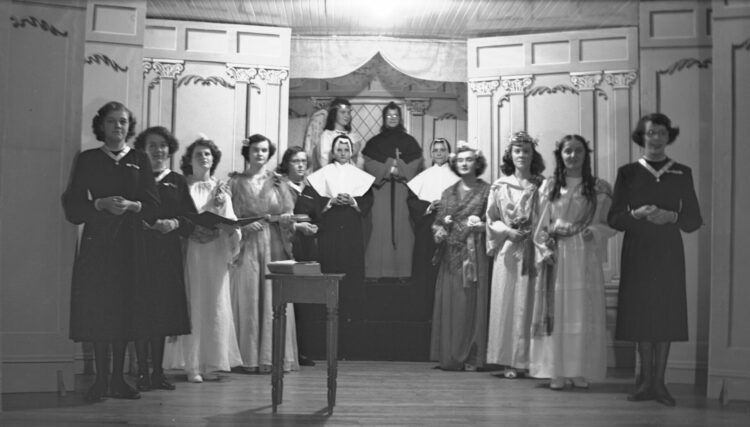
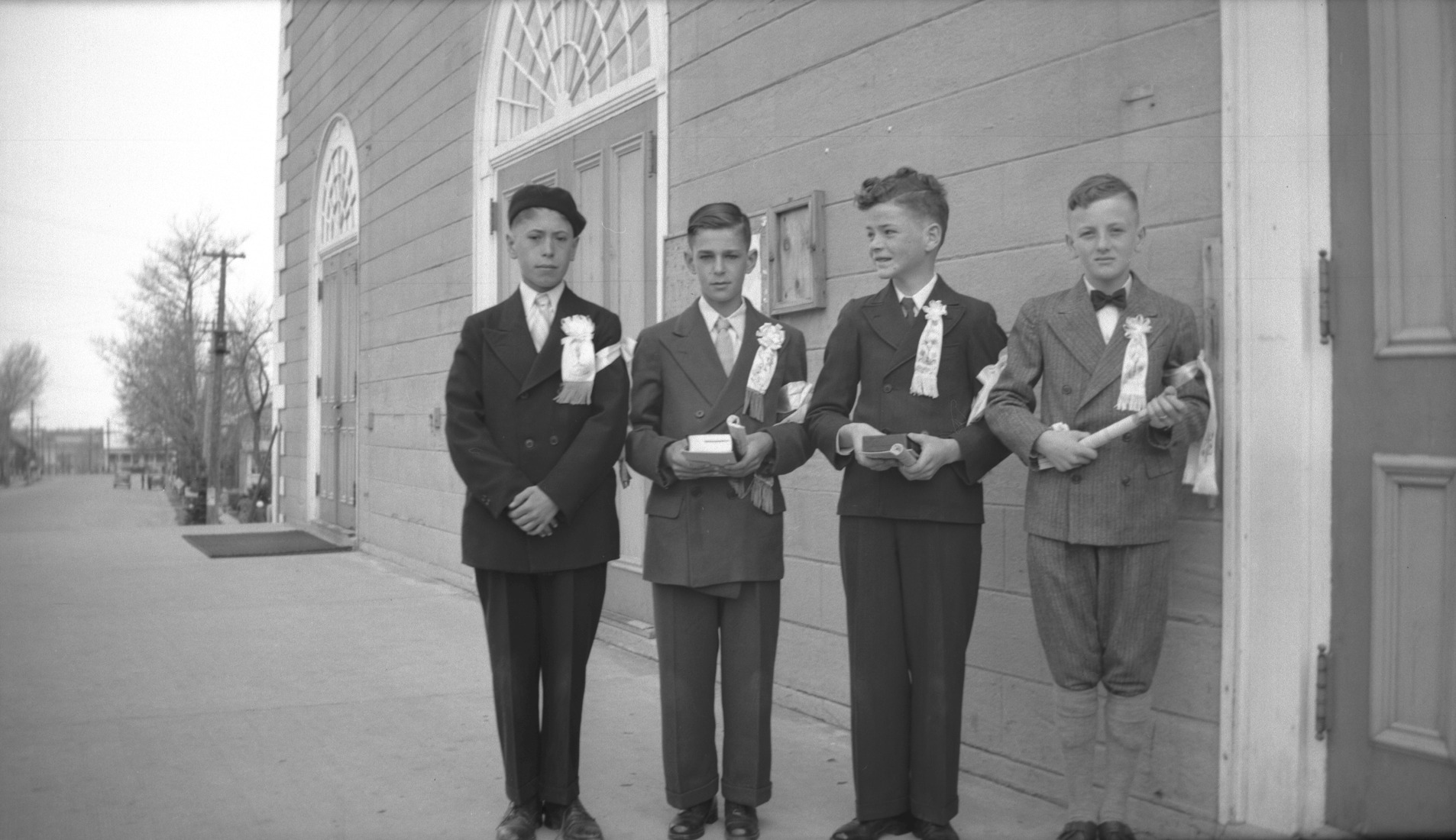
In her studio, Dumont frequently documented the religious sacraments of Saint-Alexandre’s youth. At times, she would also go to the church to photograph young celebrants on the front steps.
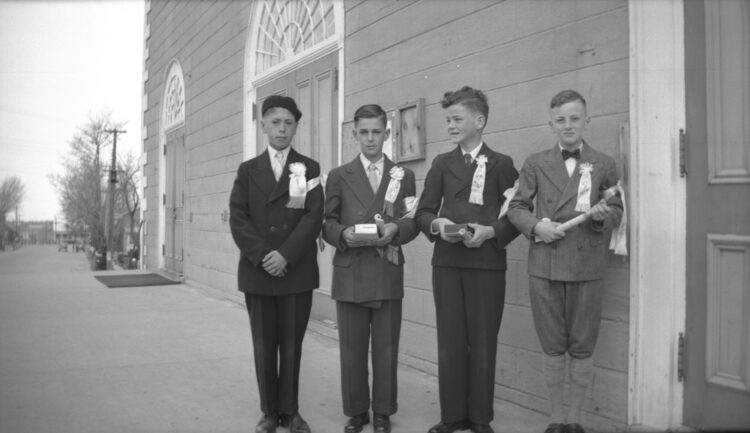
The Saint-Alexandre cemetery featured long, tree-lined paths, a calvary, an oratory and a Lourdes grotto that attracted many visitors to the village. The photographer even included an image of it in the booklet of postcards she published and sold.
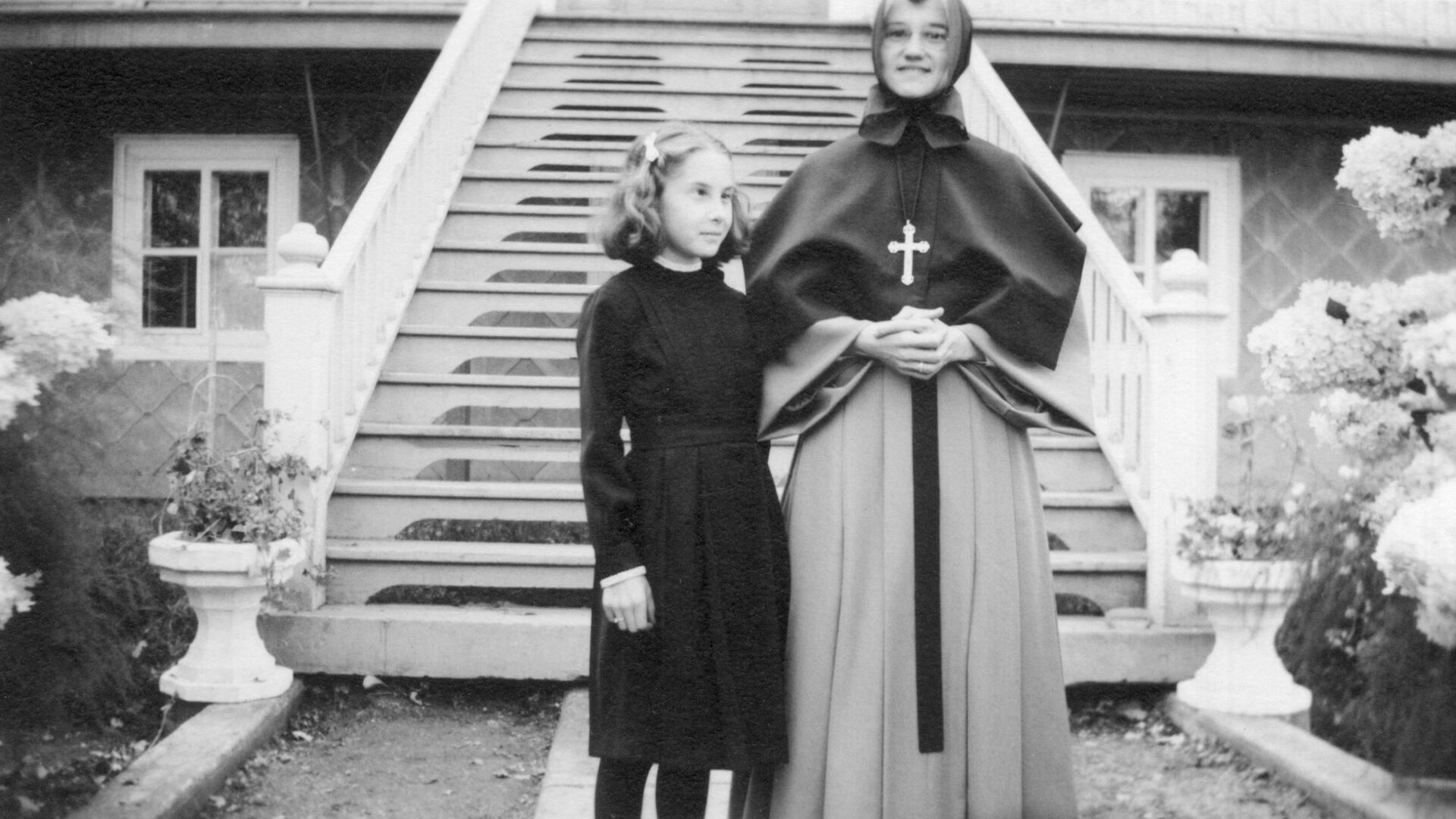
This striking portrait of Sister Saint-Joseph-de-la-Présentation and a convent student who appears to be blind was taken in front of the steps of the Saint-Alexandre convent.
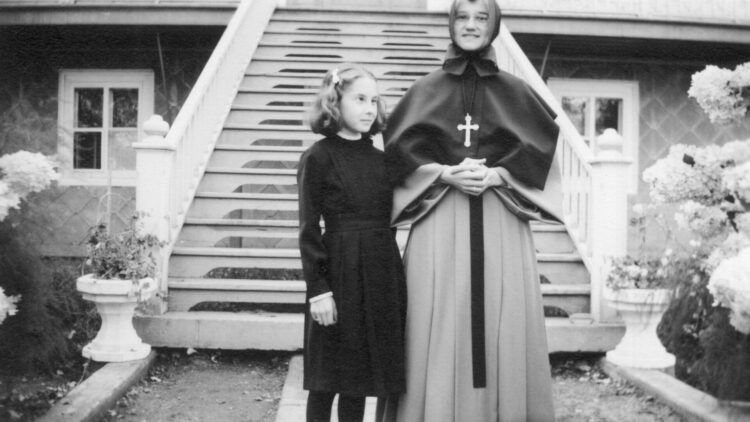
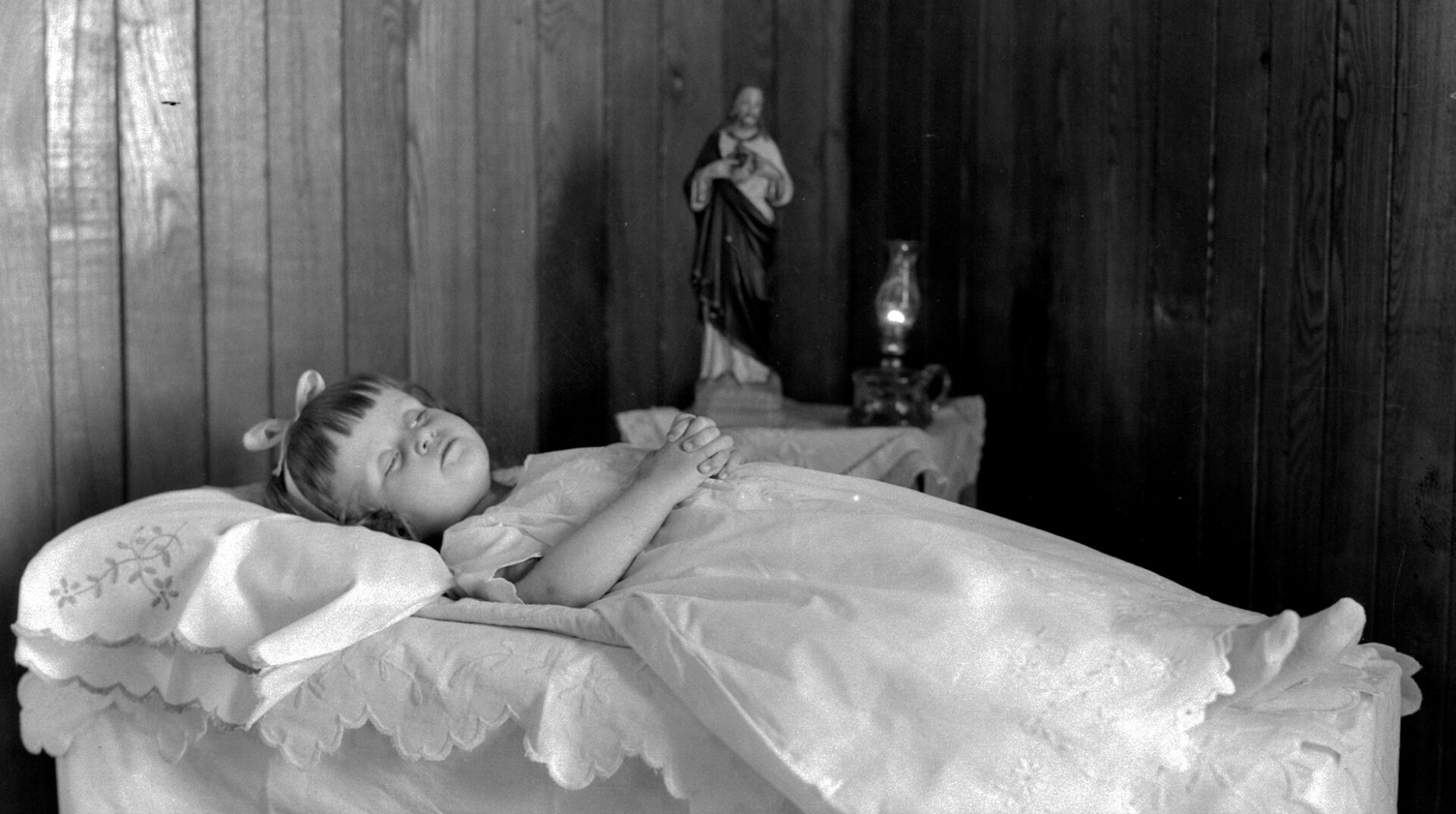
It was common in Dumont’s era to photograph the deceased. Babies, in particular, were dressed in white and posed with their hands clasped, in a way meant to evoke peaceful rest. The effect was intended to feel natural, although in some cases, the babies look more like dolls.
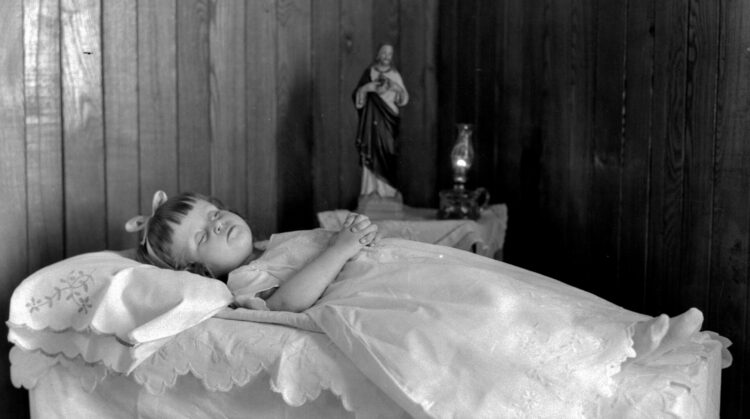
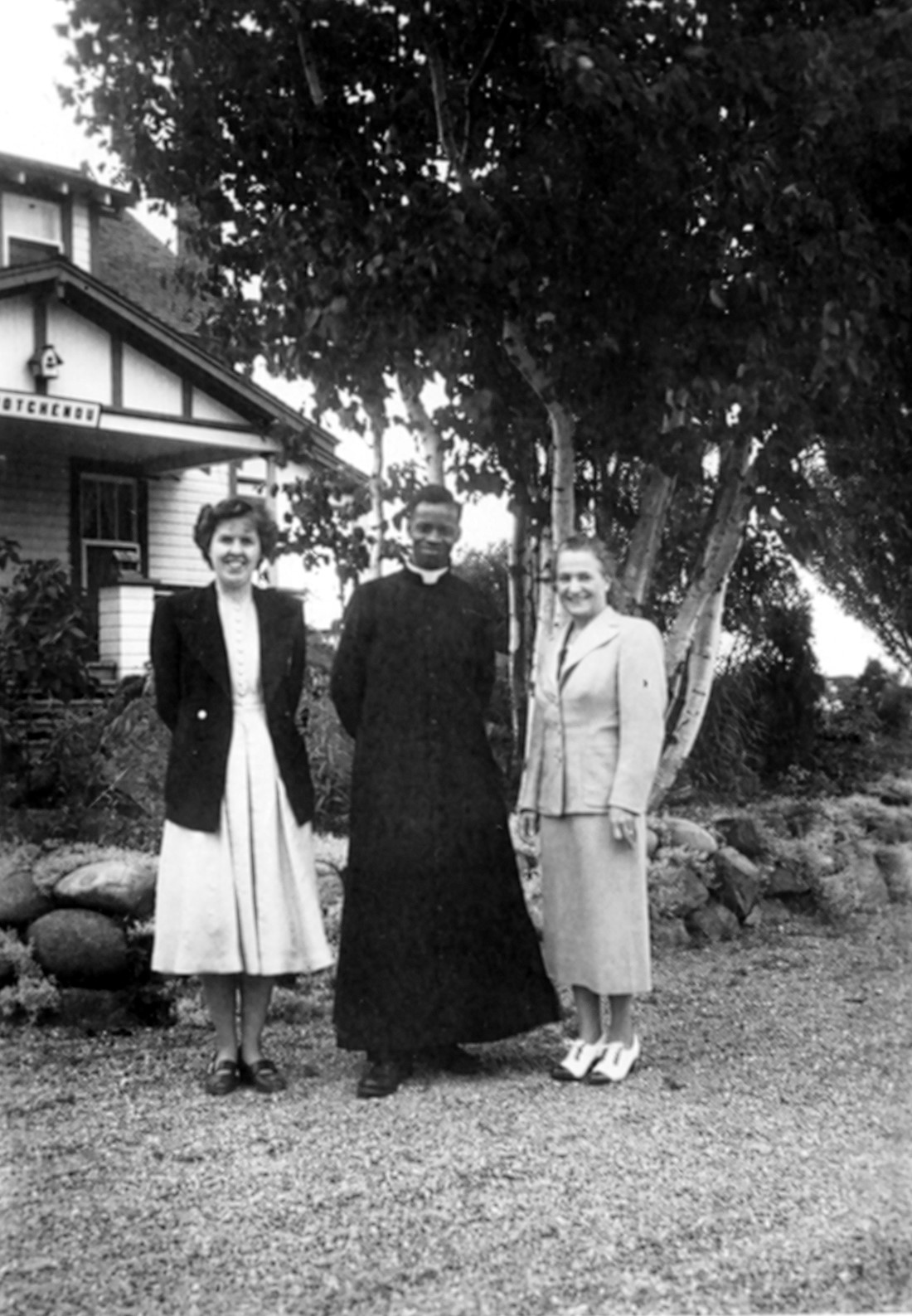
Abbot James Sanga was a priest with the White Fathers Mission in Tanganyika. In 1950, he visited Saint-Alexandre during a vacation spent with the family of his “benefactor,” Ernest Soucy. He is the only Black person to appear in the photographs Dumont left behind.
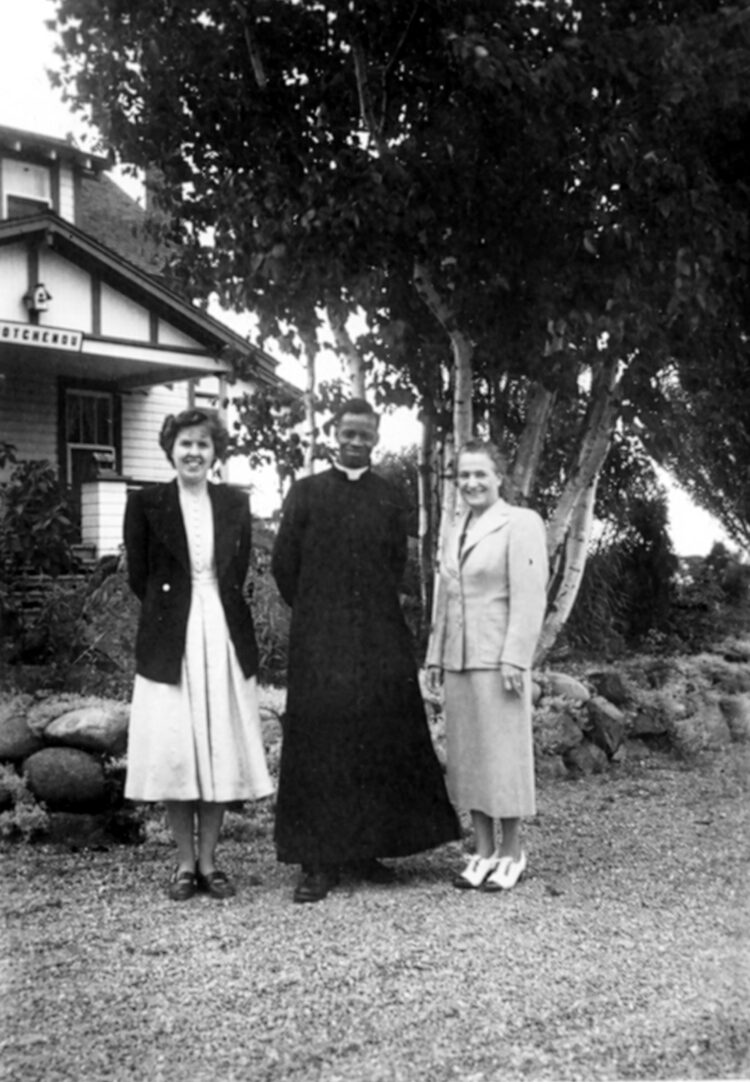
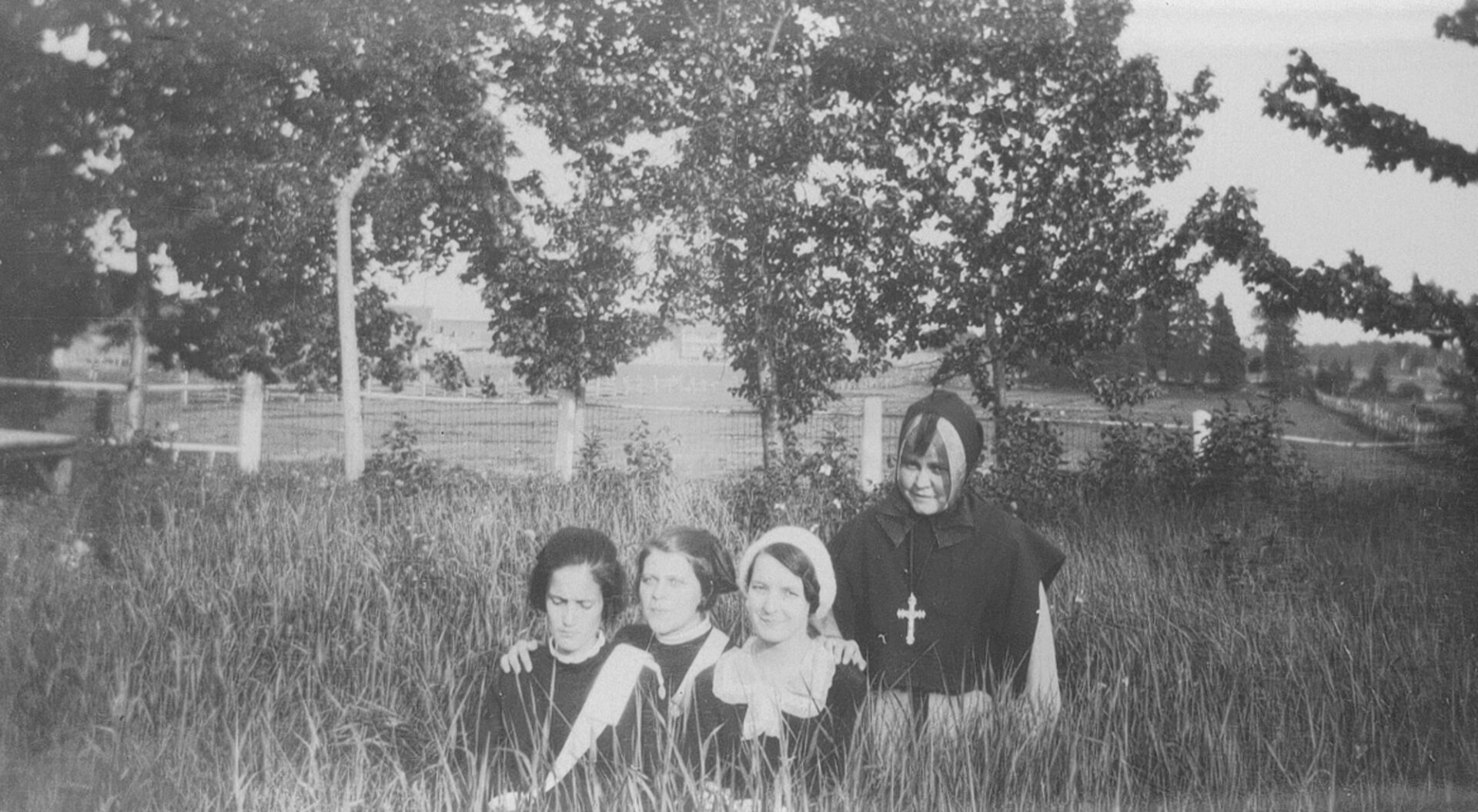
The bucolic landscapes of Kamouraska also served as a playground for the convent students of Saint-Alexandre. Here, Sister Sainte-Anna-Marie is accompanied by three of her pupils, including Madeleine Guérette, on whose shoulder her hand gently rests.
Special effects, poor and altered images
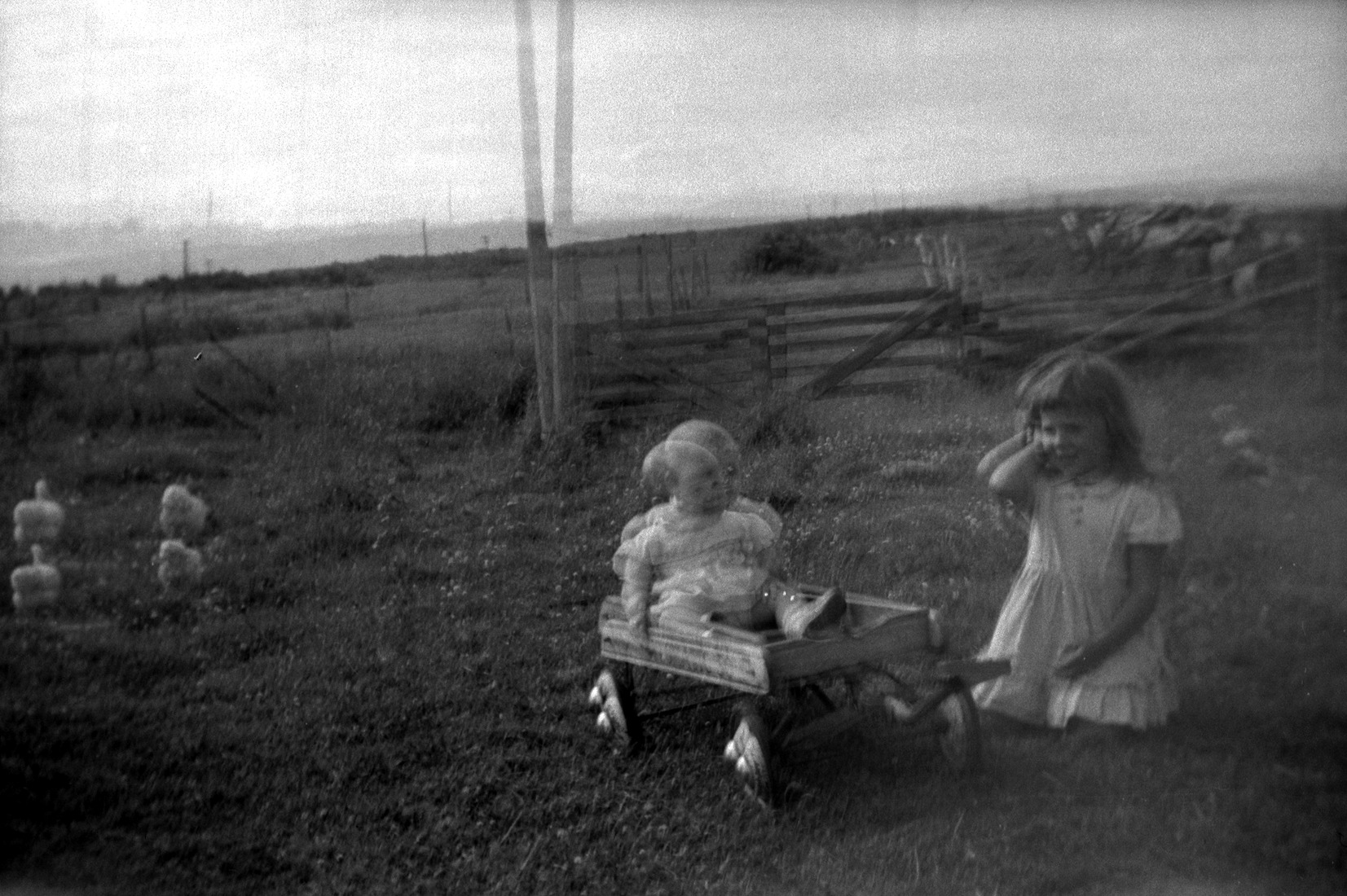
What could have distorted this image so? What mistake could the photographer have made in handling the camera? Since all of it is distorted (not just a specific element, like one of the children, for example), it would be reasonable to presume that the camera moved. Did the ground tremble? Did someone bump into it at the exact moment the photo was being taken? Anything could be possible! Then, do you notice that the same image is doubled? Since each is superimposed and offset in relation to the other, we might think the shutter was inadvertently triggered a second time when the camera moved.
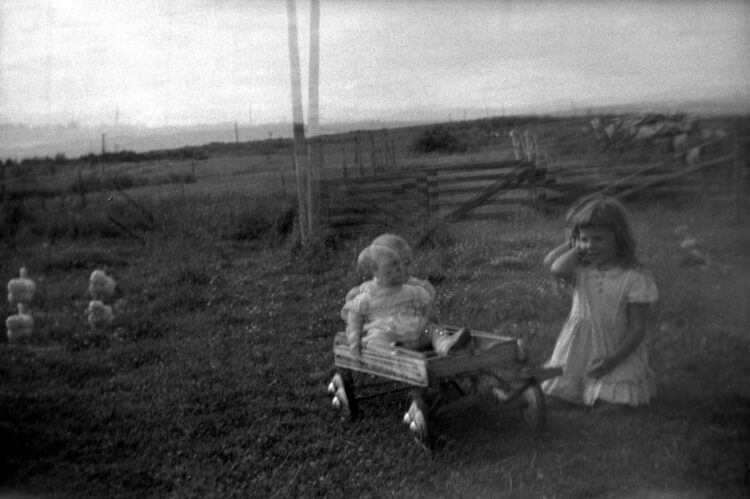
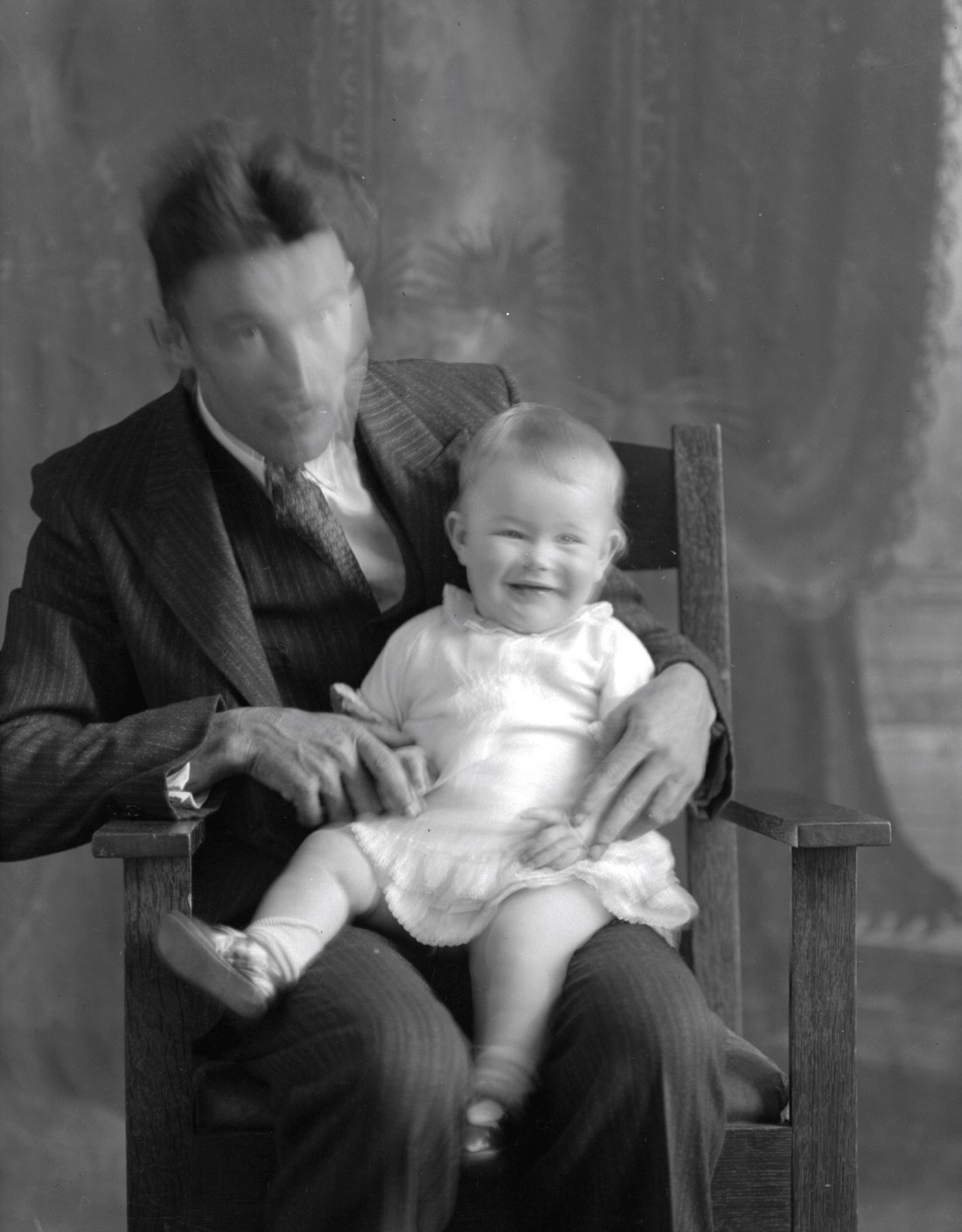
When photographing a child as young as Marie-Paule is here, Marie-Alice Dumont had to keep her as still as possible. Even the fast shutters on her cameras could not capture a sudden gesture without blurring the image. We can imagine how her father, Paul Chénard, probably lowered and then quickly raised his head in reaction to the child’s movement, realizing that, in doing so, the portrait had probably just been ruined. And, indeed, this photograph is all a jiggle! While the effect is comical, especially since the child is having a good laugh, the professional photographer certainly would not want to sell her client a portrait like this. Let us hope for her sake that she realized before developing the negative in her darkroom!
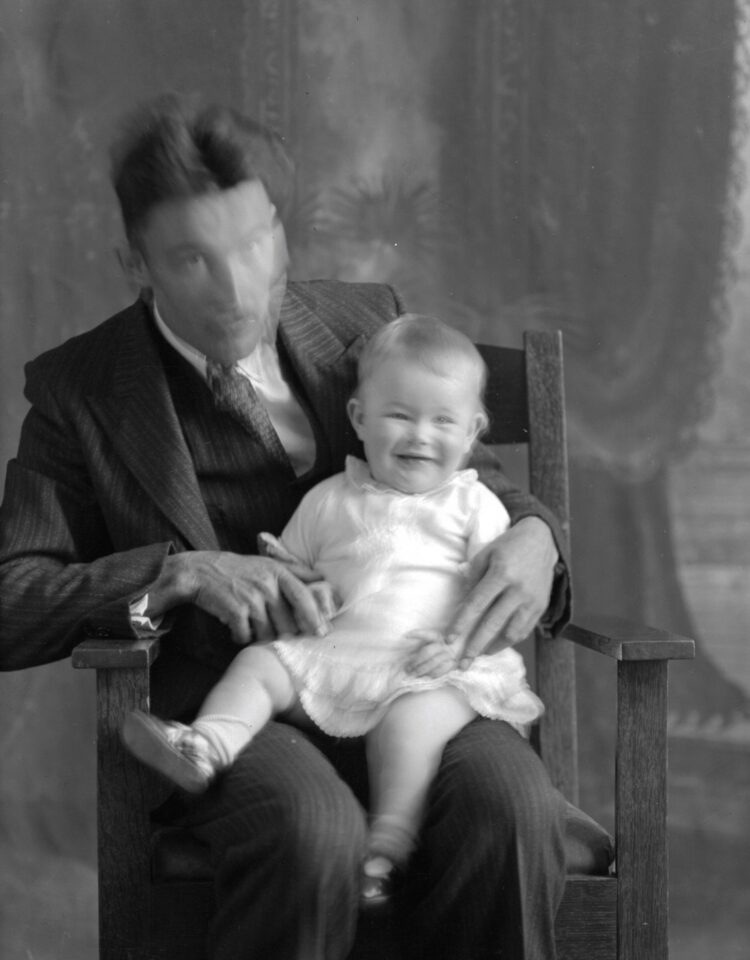
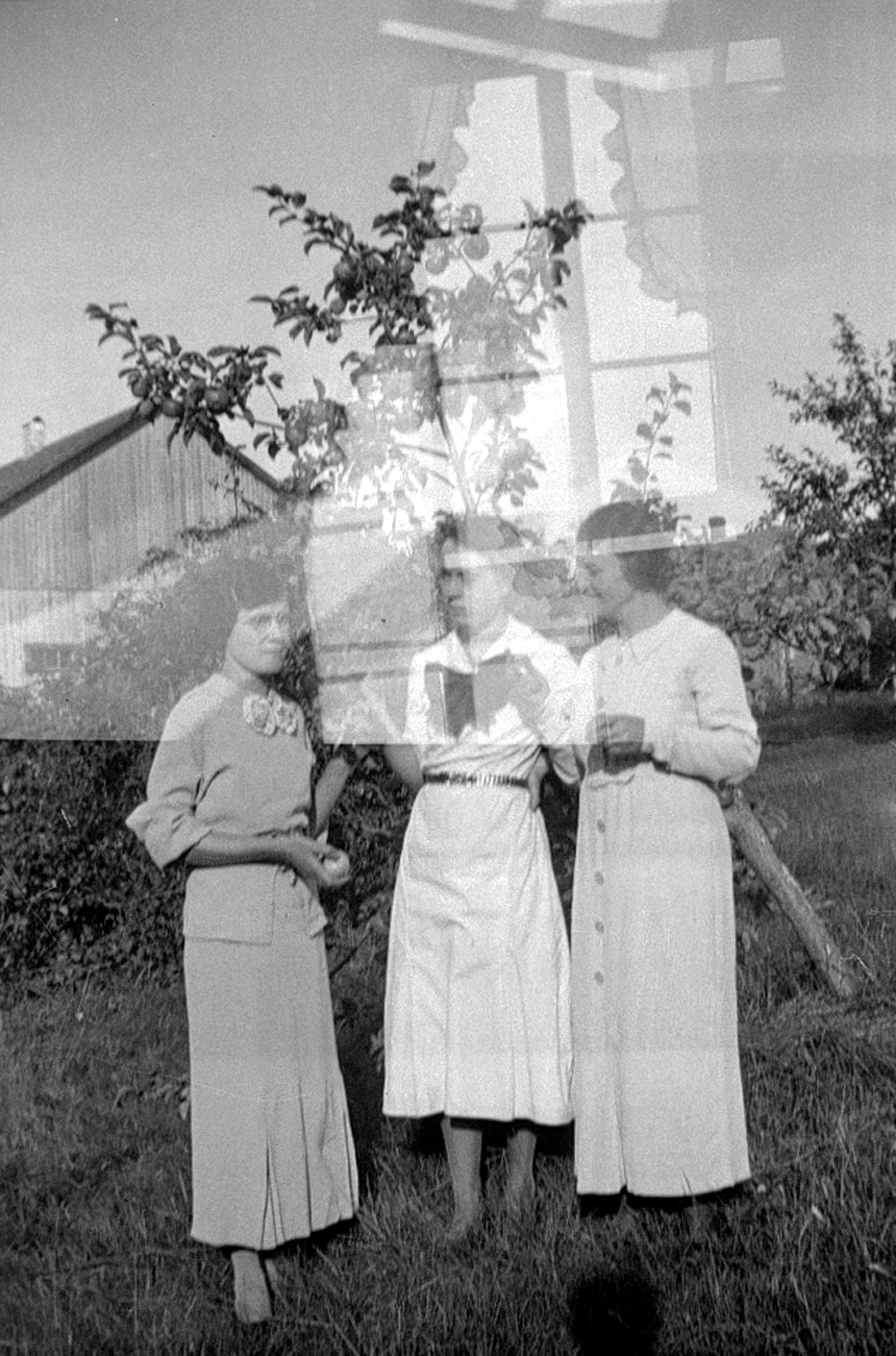
What started out as a beautiful portrait of Elizabeth Dumont and Rosalie Bergeron with a friend in the Dumont orchard turned out a mess. What happened? A common mistake in conventional silver halide photography: the double exposure of the negative. See how two different shots almost merge in the picture? Double exposure is a frustrating mistake to make, especially when it is only caught in the darkroom.
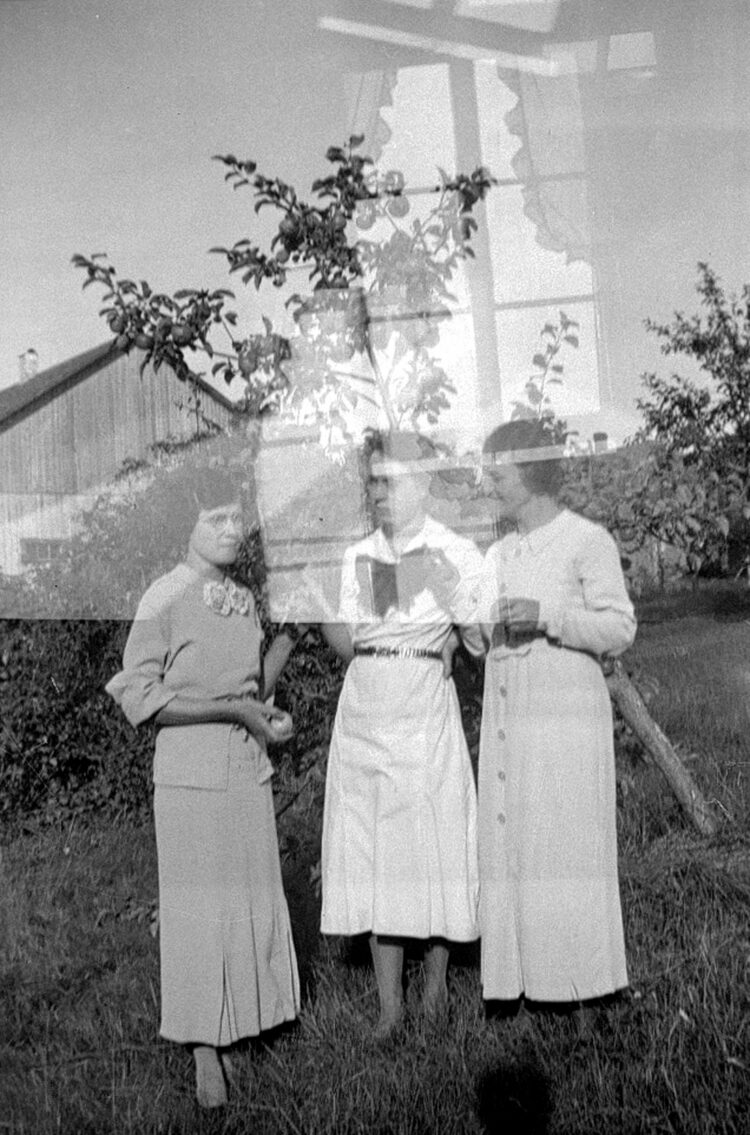
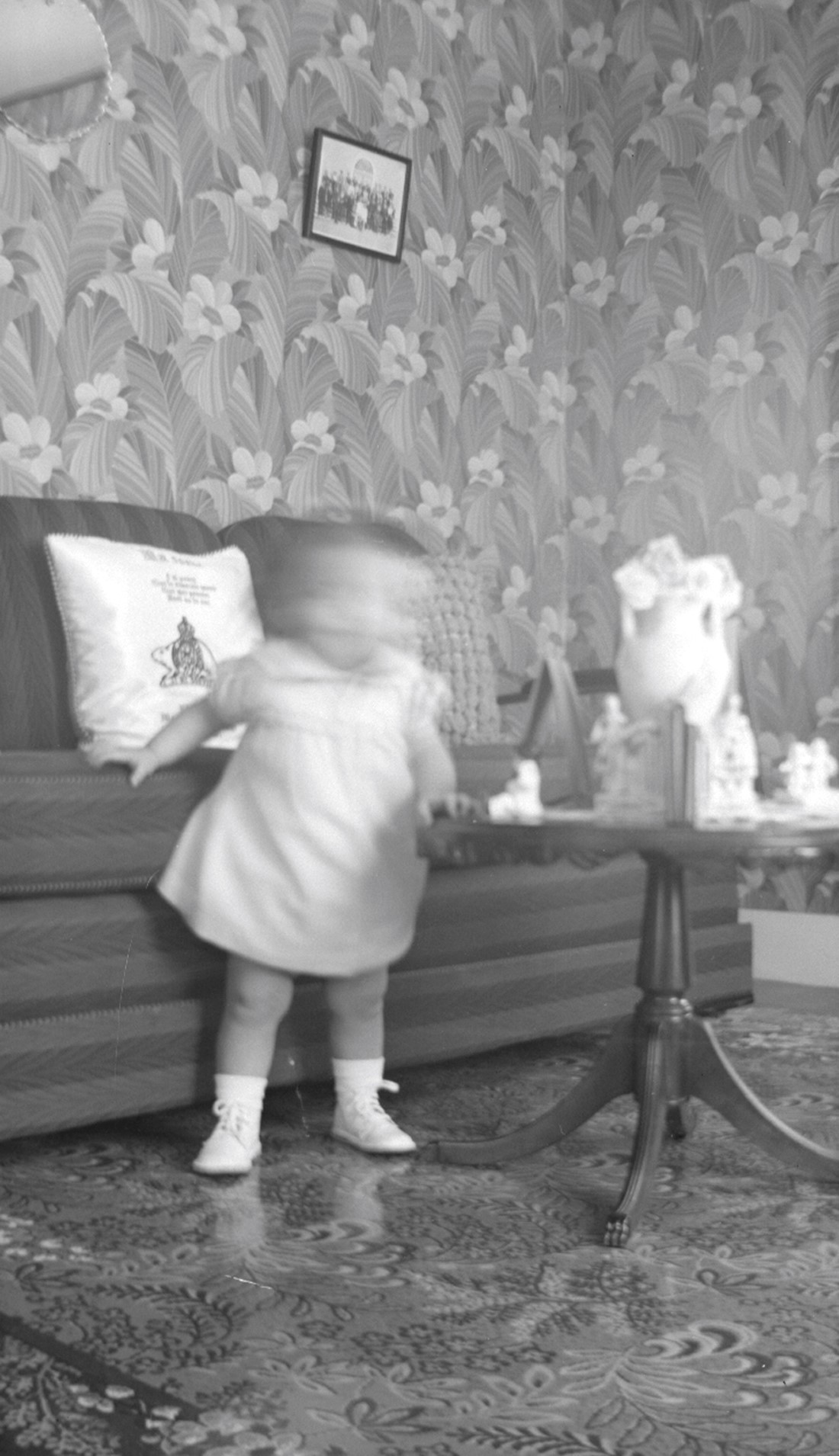
Here is another eloquent example of the difficulty of photographing children. They’re so fidgety! Mother Rosalie Bergeron or Aunt Marie-Alice tried, as best they could, to take Céline Dumont’s portrait, but here she seems much more interested in the vase on the living room table than in the camera lens. Fortunately, modern cameras can take many shots. Errors are therefore not a problem. Shutter speed can also be adjusted to compensate for movement. All the same, very few of the dozen or so portraits from this shoot were a success.
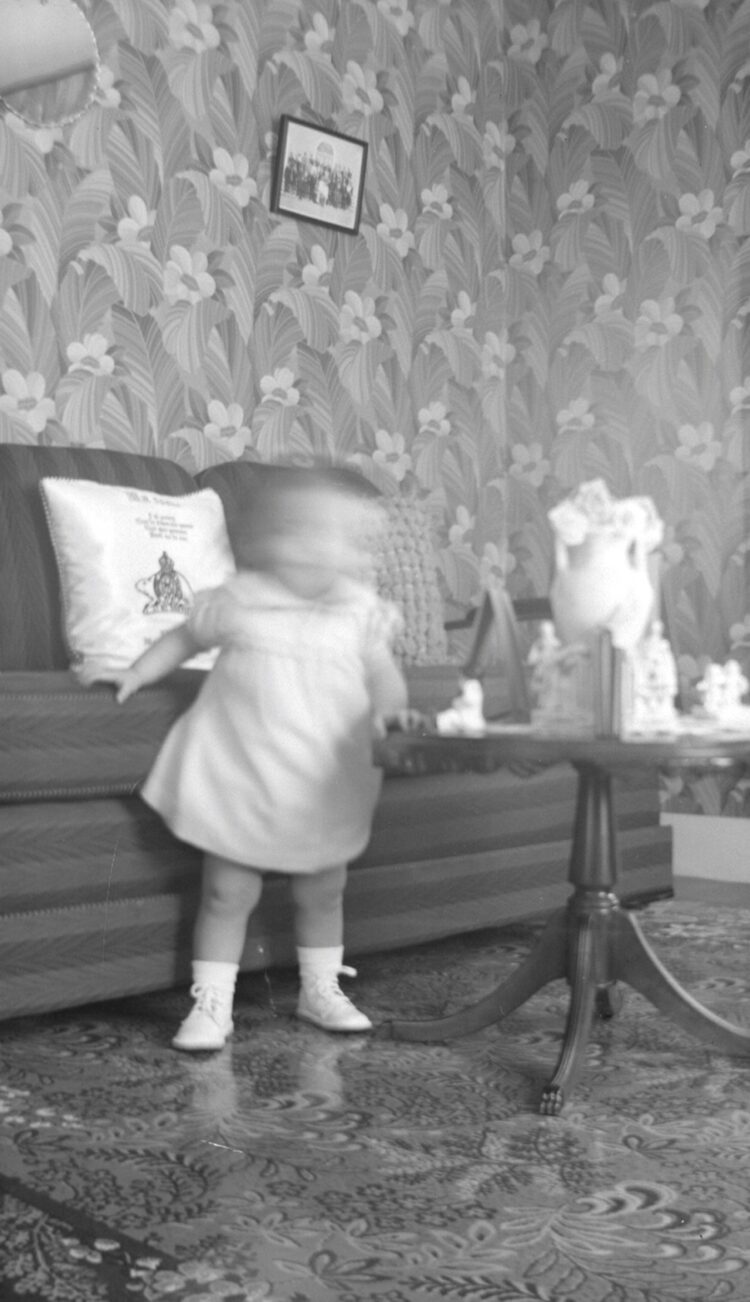
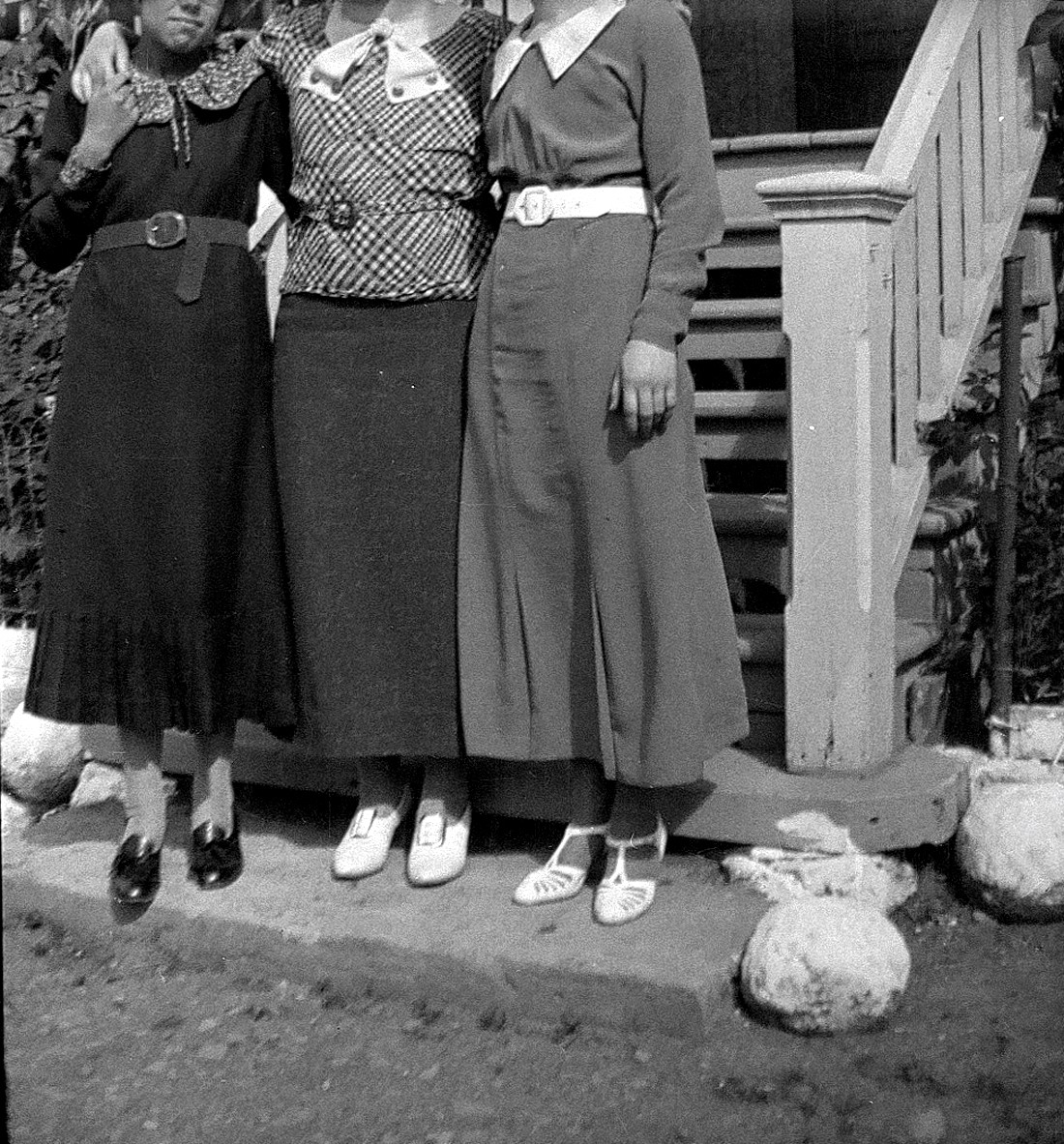
The mistake in this portrait taken in front of Marie-Alice Dumont’s house is quite obvious: the framing is all wrong and cuts off the heads of the three young women! While the result is of little aesthetic interest, it does illustrate a common mistake in photography and can help us understand the ins and outs of this art form. Here again, we can only hope, for the photographer’s sake, that she realized her blunder before going into the darkroom.
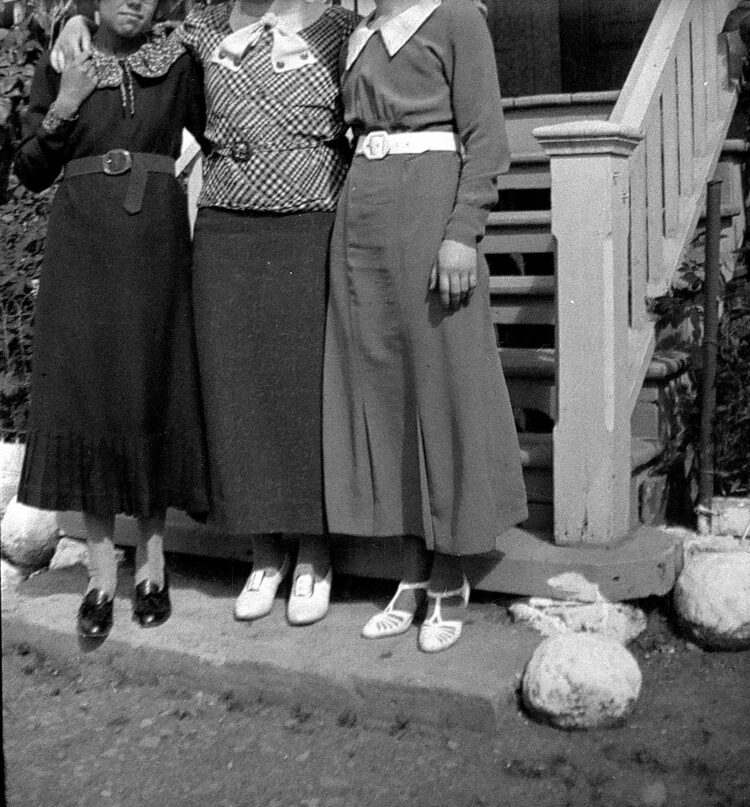
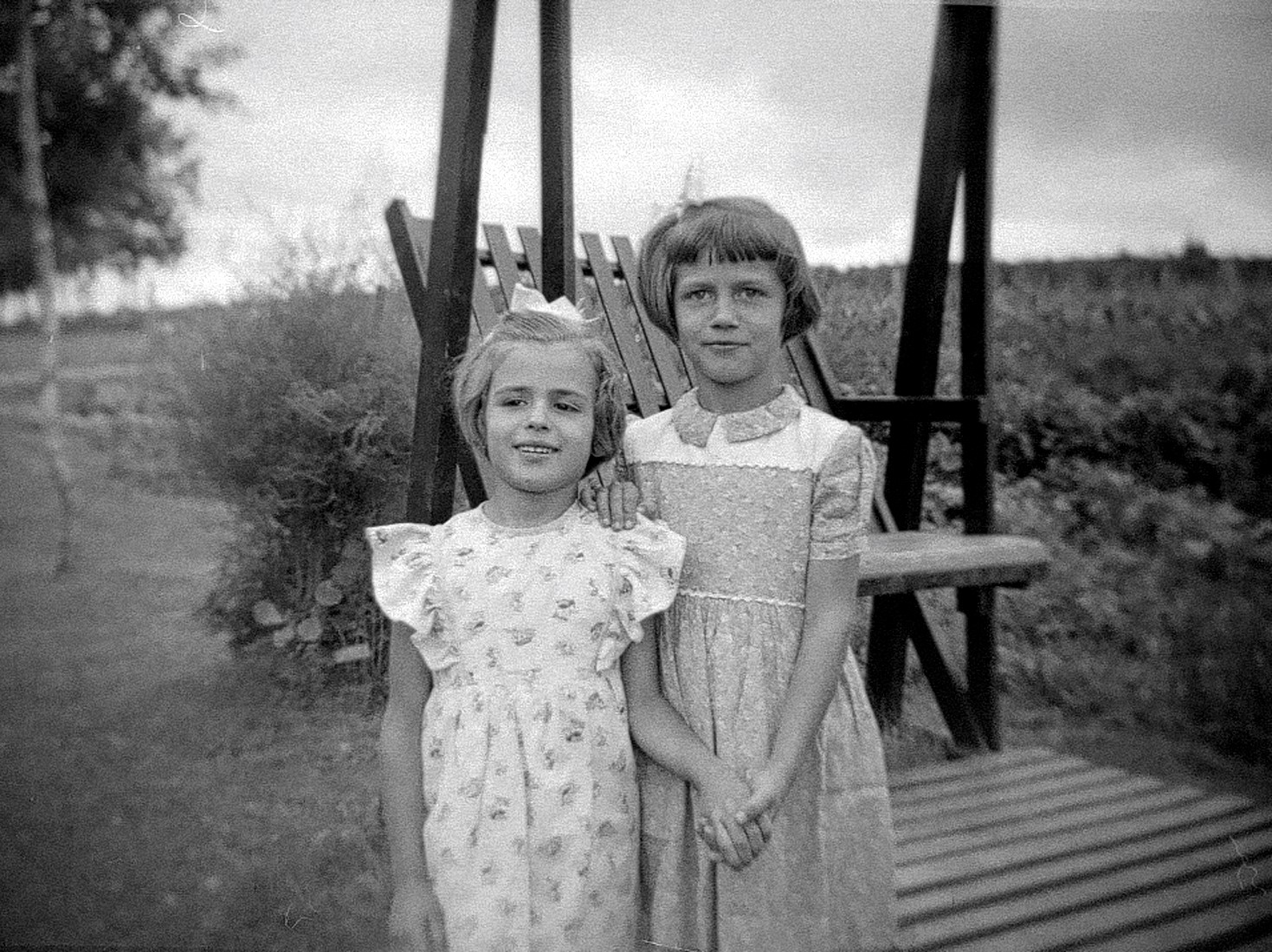
This snapshot does not contain any technical errors per se. The lighting is right, as is the framing. What is notable, however, is the sharpness of the two subjects in the foreground compared to the blurred background. The focus pinpoints what the photographer felt was important to look at: the two girls.
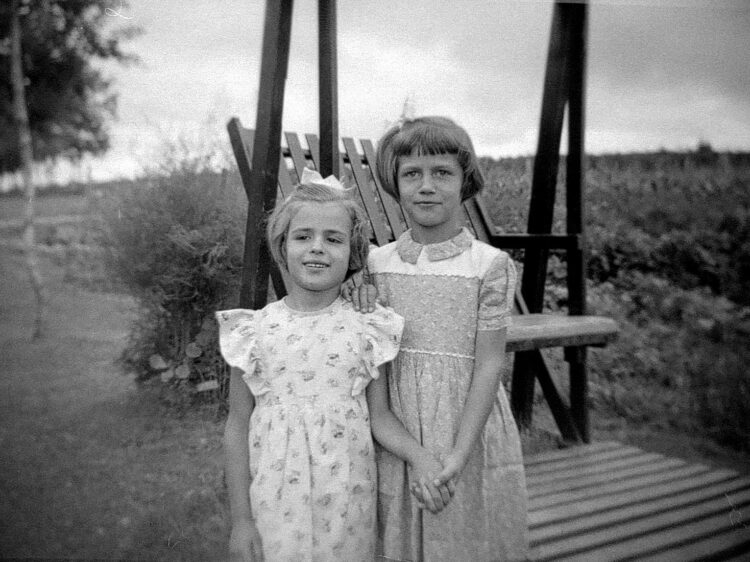
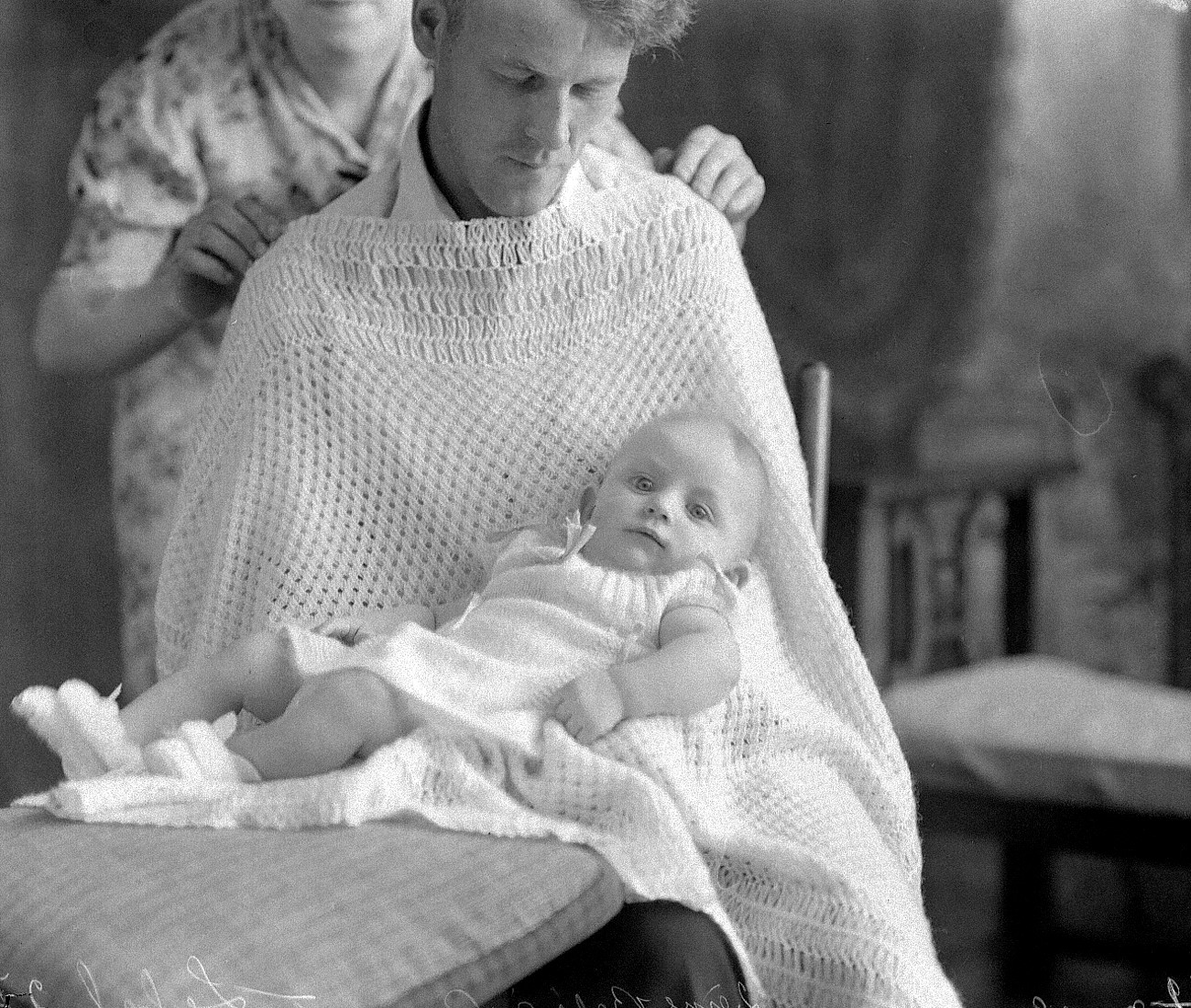
This is one of the most touching images Marie-Alice Dumont took in her studio. It is not the finished print, which featured only the baby, as the negative’s title indicates. But, thanks to the negative, we see how the photographer staged the scene, helping us learn more about her art of posing. It gives us a behind-the-scenes look at Dumont’s work. First, the photographer sat the father on a chair. Next, she covered his torso with a white knit, then asked a woman (the mother? his wife?) to hold the fabric in place. Finally, Dumont placed the baby on his father’s lap, adding a cushion of her own under the infant’s legs. None of this would have been perceptible without the original negative that the photographer kept.
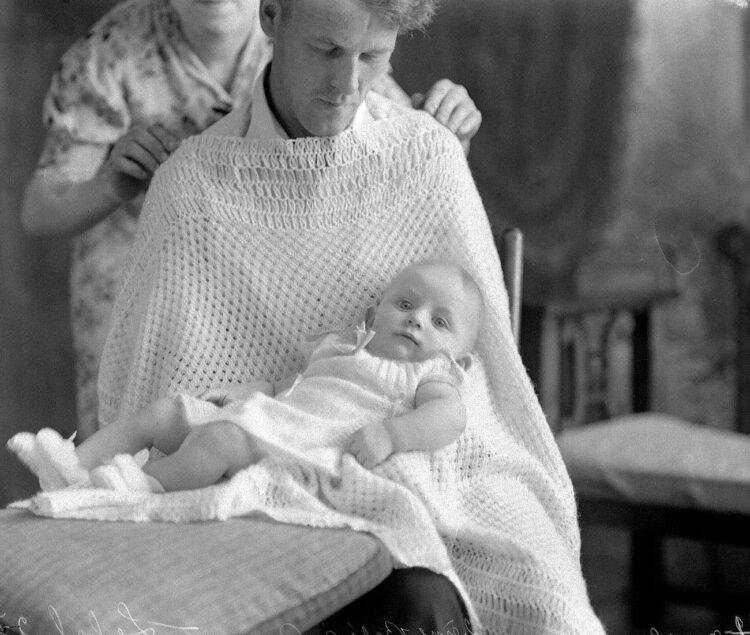
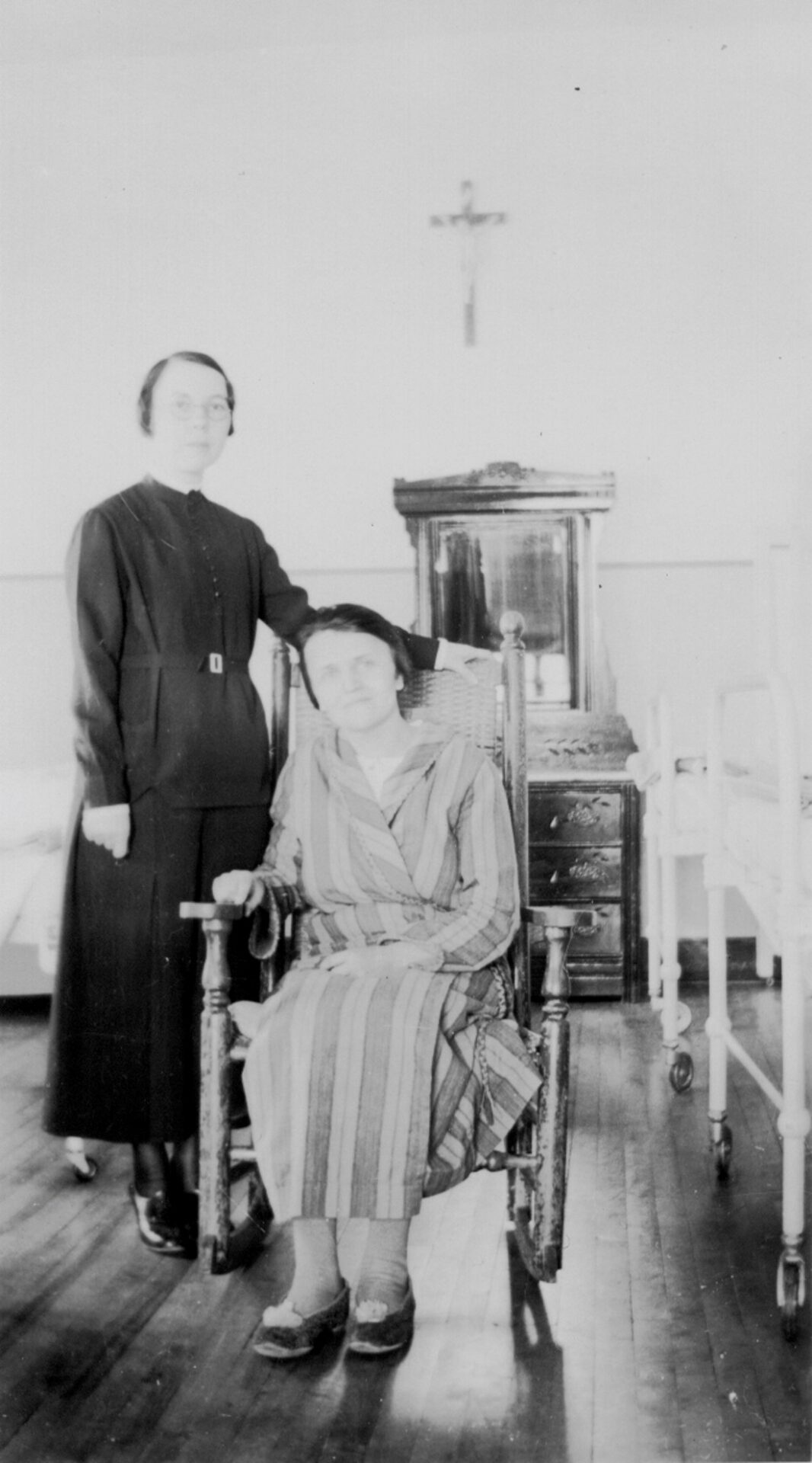
In photography, the skill of composing with light comes with experience. The cameras Marie-Alice Dumont used had an adjustable diaphragm. Like the pupil of the eye, the wider the diaphragm opens, the more light gets in. In poor lighting, a large diaphragm opening, or aperture, is often required. Inversely, if a small aperture is not used in bright conditions, the negative will be overexposed, resulting in an image that is overly white. This is what happened with this portrait of Marguerite Bergeron and Marie-Alice Dumont, taken during the latter’s hospitalization in 1936. Fortunately, more than one shot was taken and some turned out better than this one. Dumont had probably handed her camera to a nurse to press the button, and she made adjustments between each pose as well.
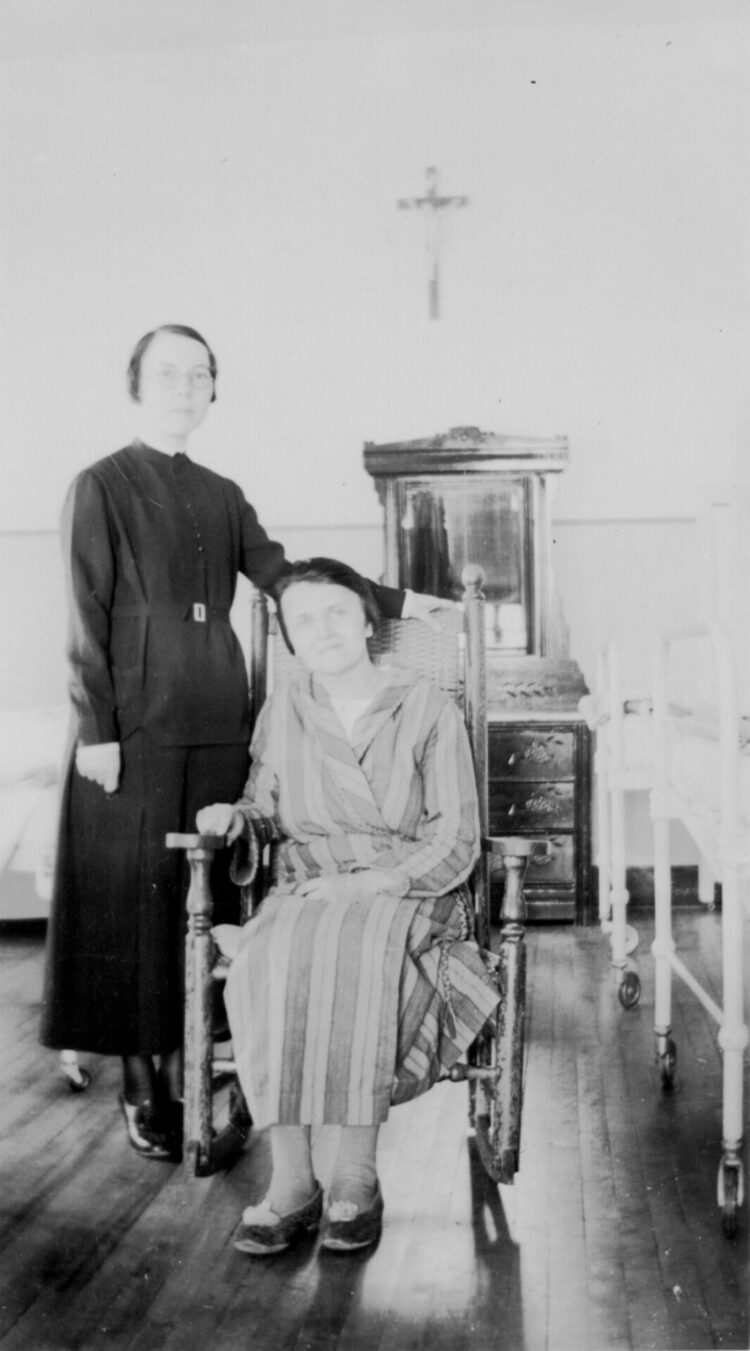
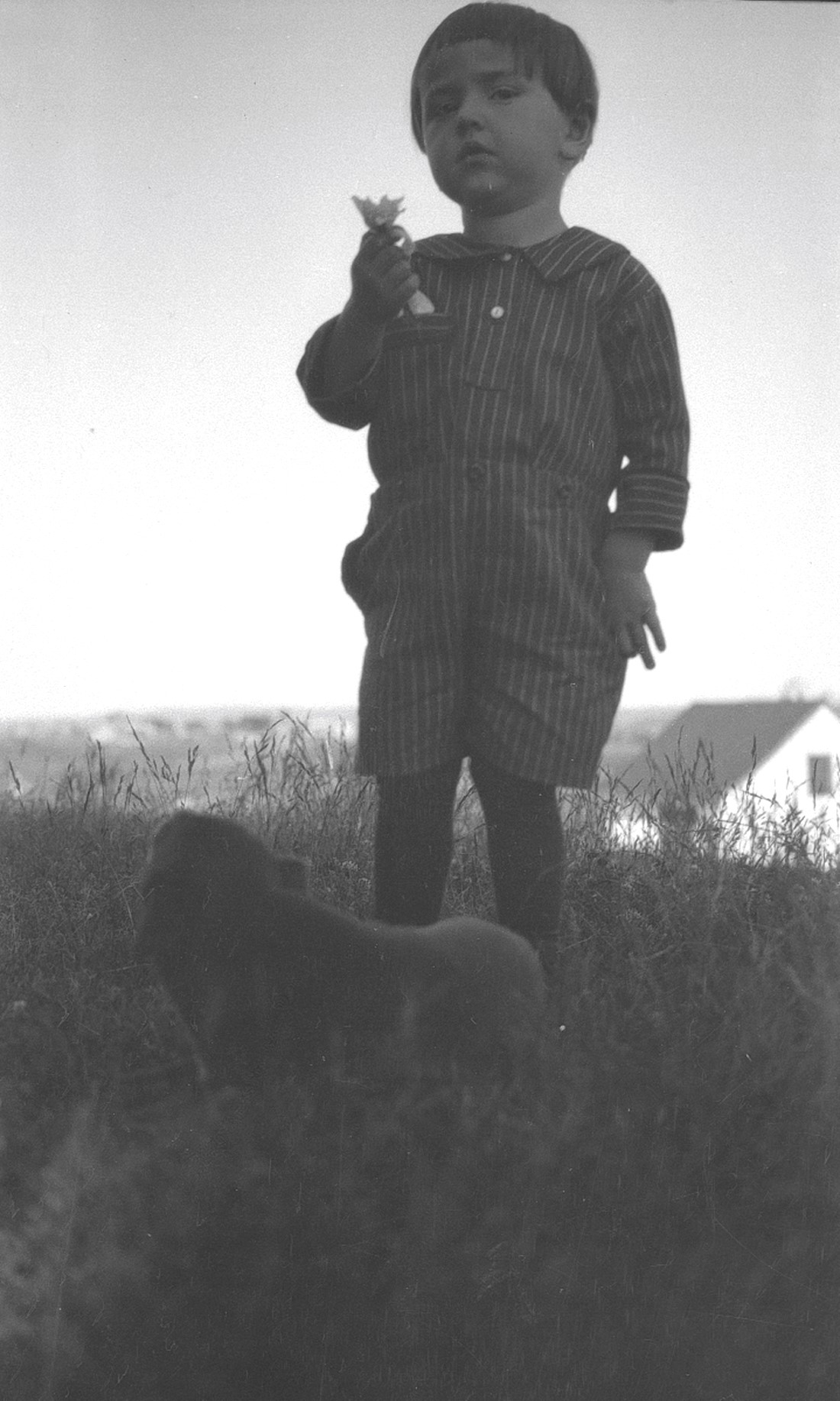
Here is another portrait of Origène Dumont, our photographer’s nephew. It is not always easy to manage the light when taking pictures outdoors. Here, without enough in front of the subject, the photo is backlit and so the details are difficult to make out. To compensate, the camera diaphragm should have been opened wider to let in as much light as possible. Fortunately, the focus was good so that the boy appears clear despite the blurry background. Even so, we can admire the composition of the photo. With what appears to be a piglet at his feet and holding a flower in his right hand, Origène stares into the lens. Also noteworthy is the low-angle shot—a rather rare perspective with children. This was an interesting, probably deliberate choice of composition, since it is recurrent in portraits of Origène. Although the little boy is only about three years old, this angle gives him a certain stature, even a presence that fills the frame. Conversely, if Marie-Alice Dumont had wanted to emphasize her nephew’s smallness and vulnerability, a bird’s-eye view would have been more effective.
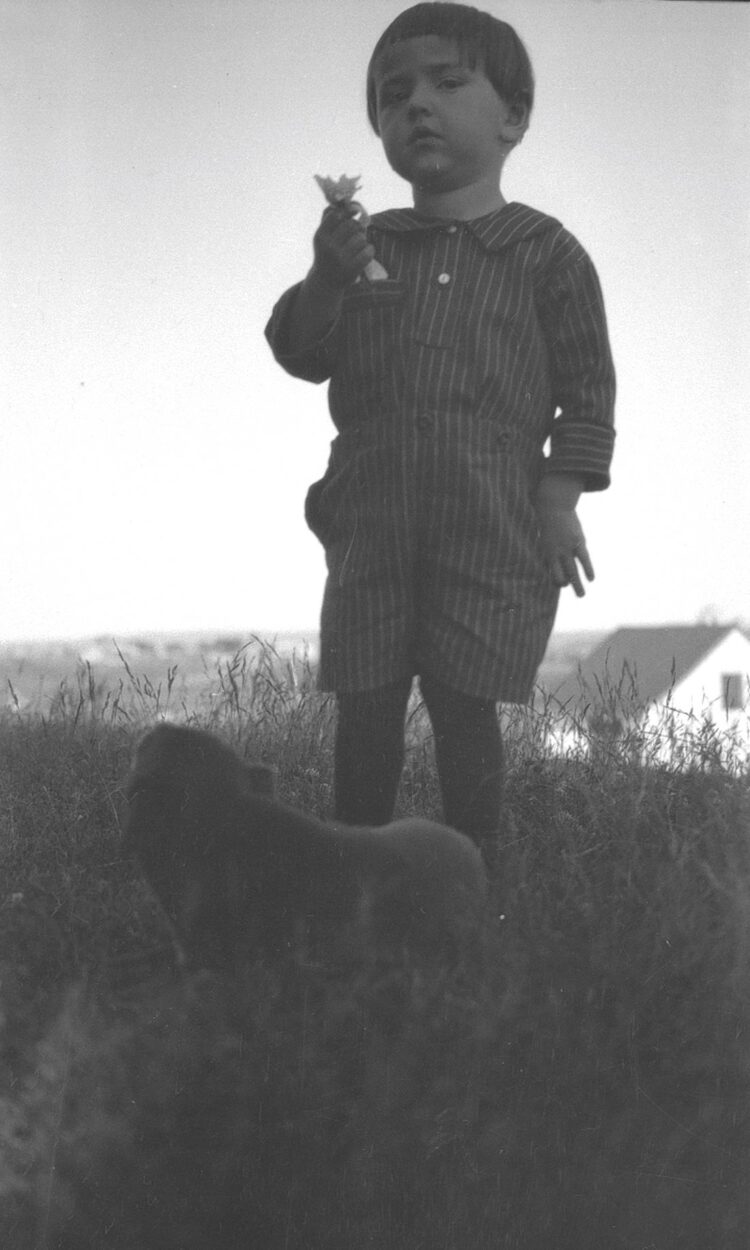
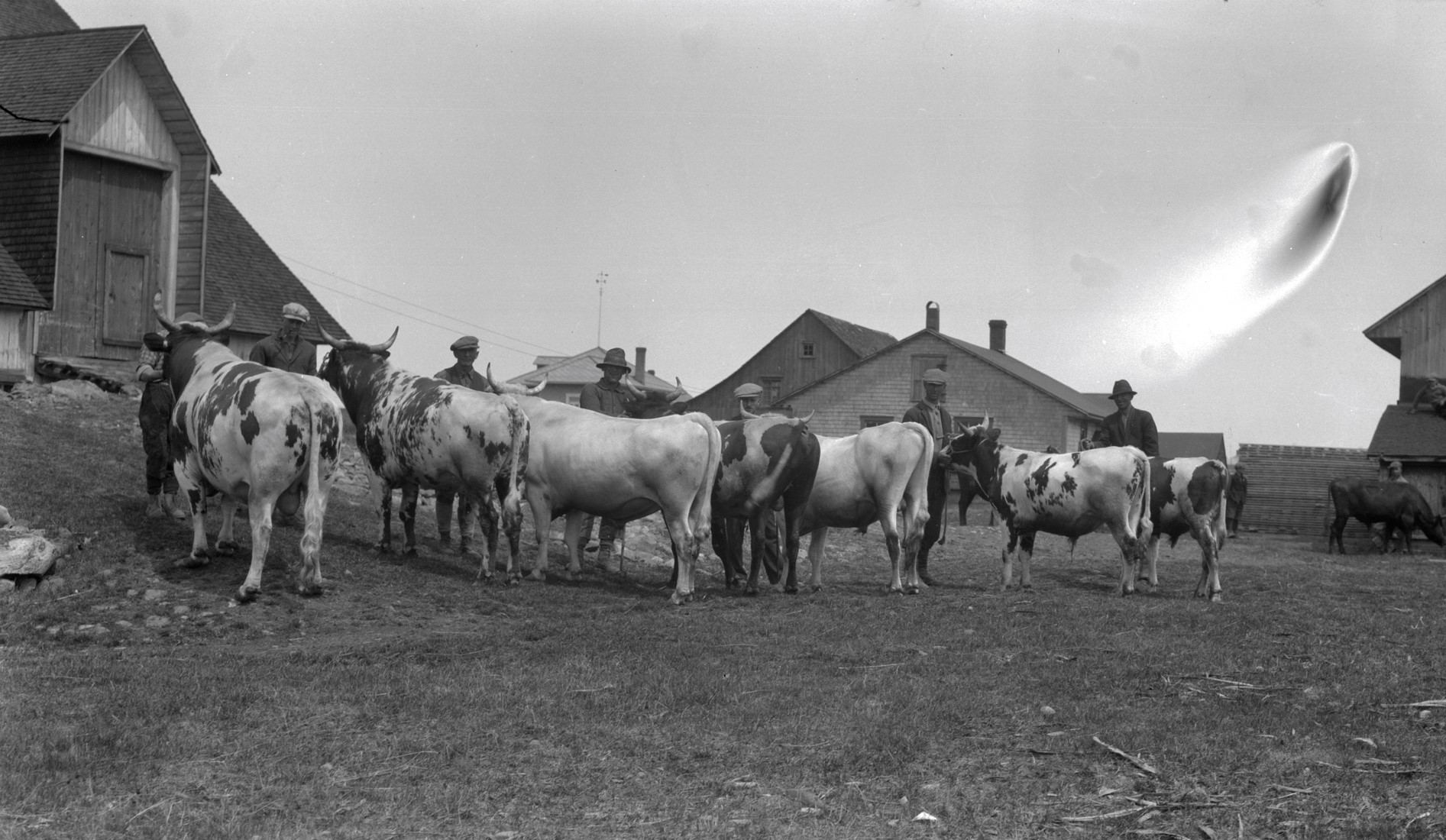
There, in the sky, to the right: is that a comet or a UFO?! Will disaster spoil the day for these proud breeders showing off their finest cattle at an agricultural fair? Oh no, of course not. It is just the cellulose nitrate negative, which was damaged in storage. Negatives of this kind are very fragile. They can easily be creased, torn or folded. They can also be damaged by involuntary chemical reactions, like burning. Here, a liquid was probably spilled on it, staining or partially burning the material. An impeccable version of the negative can be seen in the video of the interview Marie-Alice Dumont gave in 1981 (scroll to the very end of the Trade section of this exhibition).
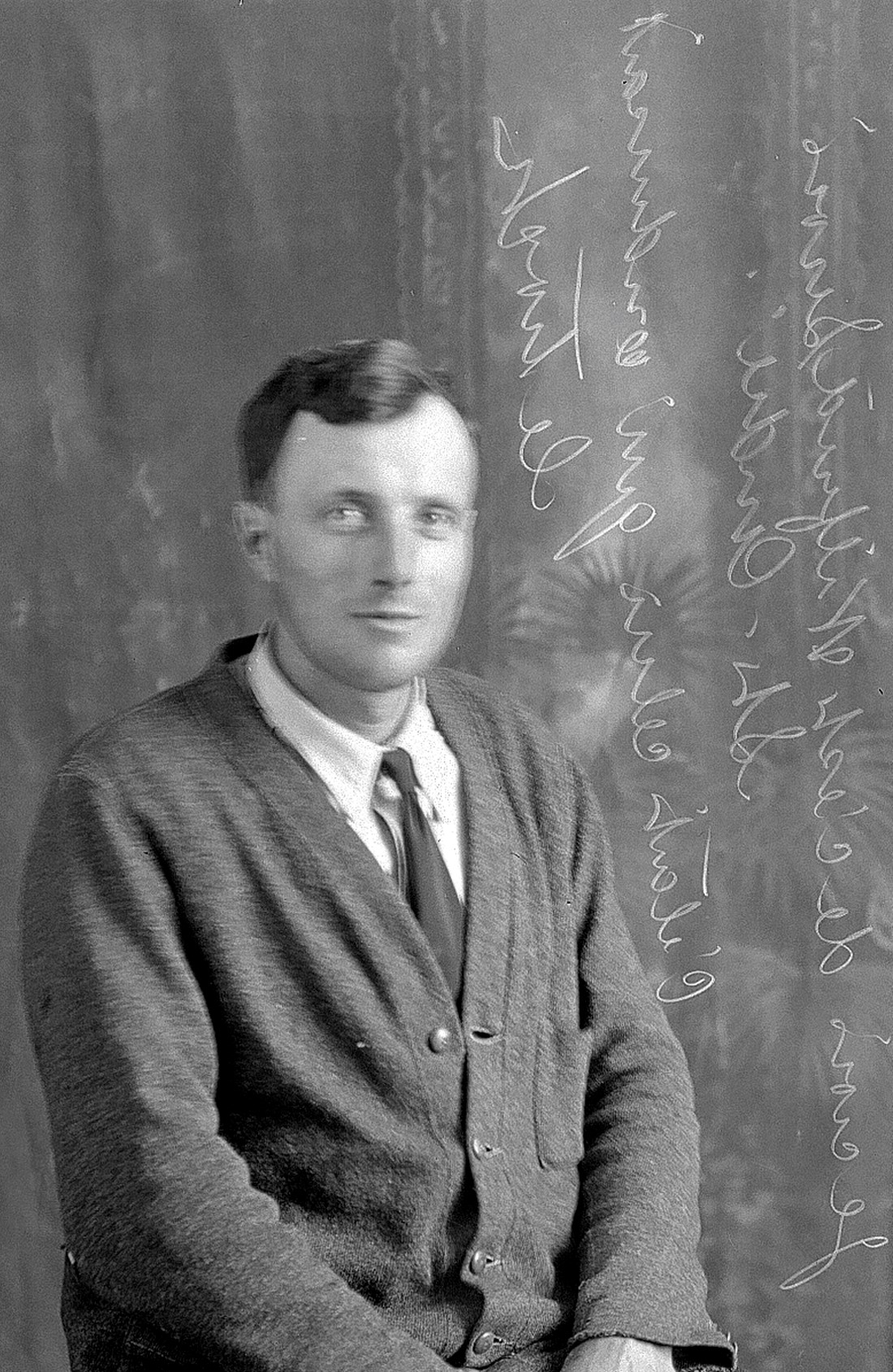
Writing on the negative was fairly common among photographers like Marie-Alice Dumont. They would identify the subject or provide additional information directly on the negative. The photographer would usually exclude handwritten inscriptions from the actual photo. Dumont probably did not make a print from this failed portrait. Nevertheless, the information she added makes it possible to identify the subject, giving the unusable negative another function. On the right, the French words read: “I think it’s Wilfrid Sirois St-André. He was the one driving the truck.”
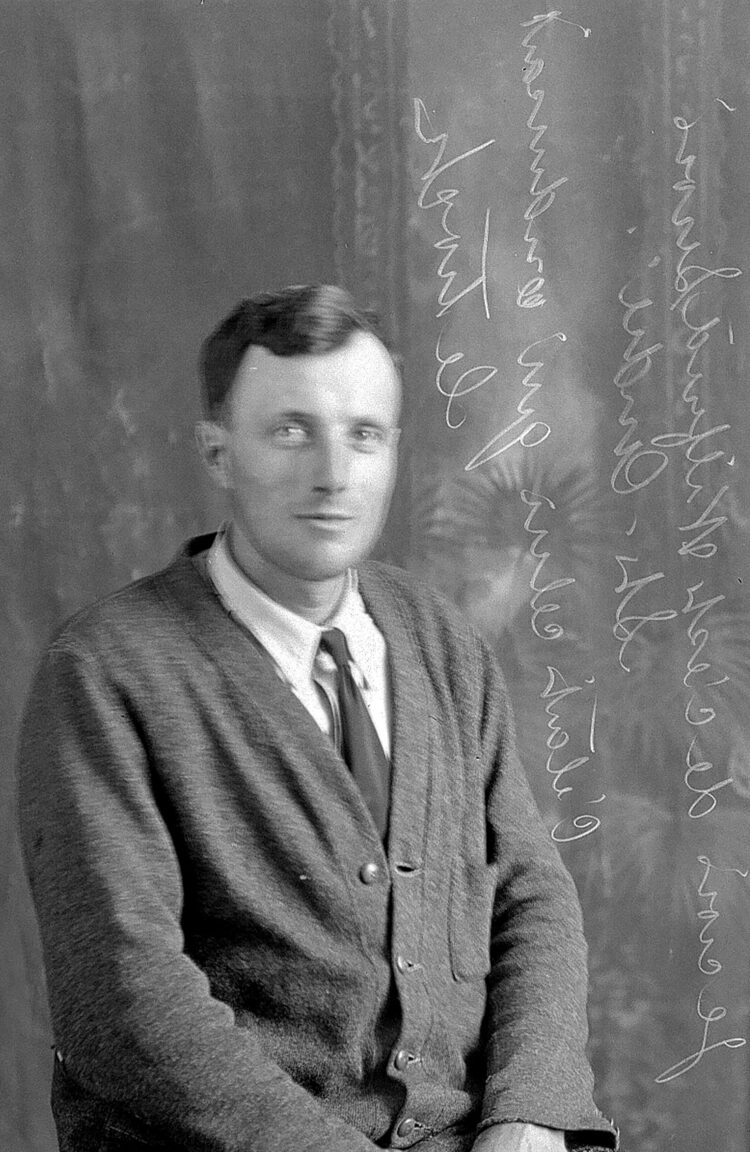
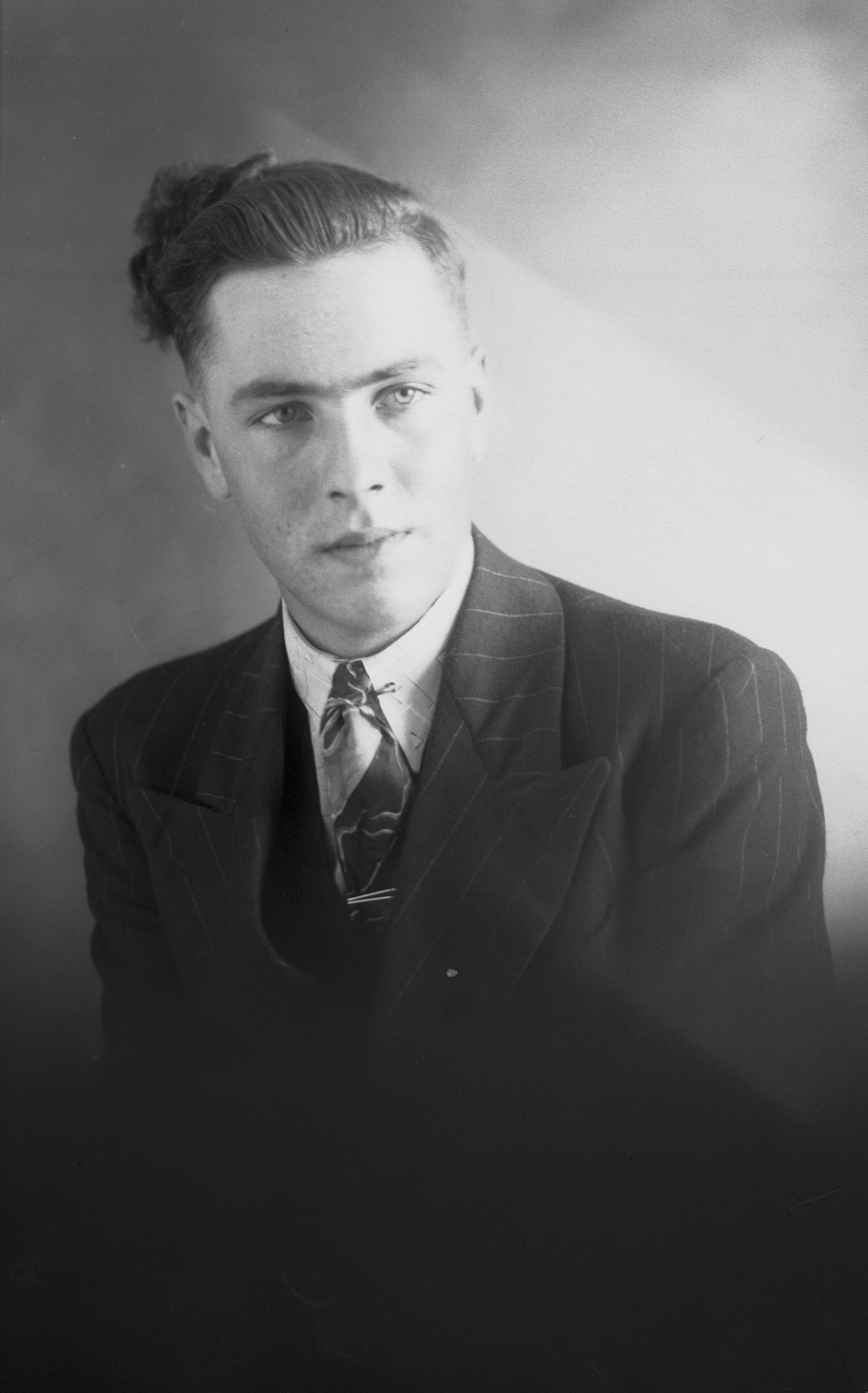
The blacked-out bottom of this portrait of François Ouellet is a technique that appears in many of Marie-Alice Dumont’s photographs. The effect is achieved using a method common in studio photography. It involves hiding parts of the negative as it is projected in the enlarger above the sensitized paper. To do this, a piece of cardboard can be agitated over specific areas of the image to mask them partially or completely. The faster the cardboard is waved, the darker the effect.
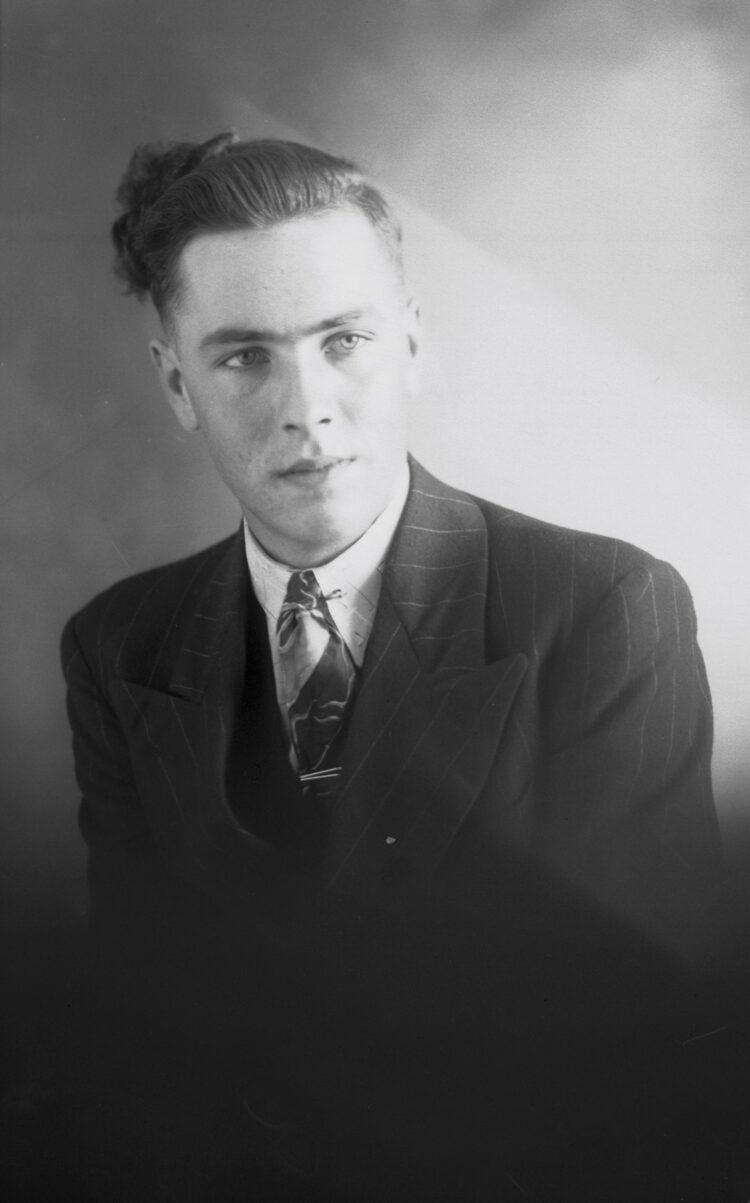
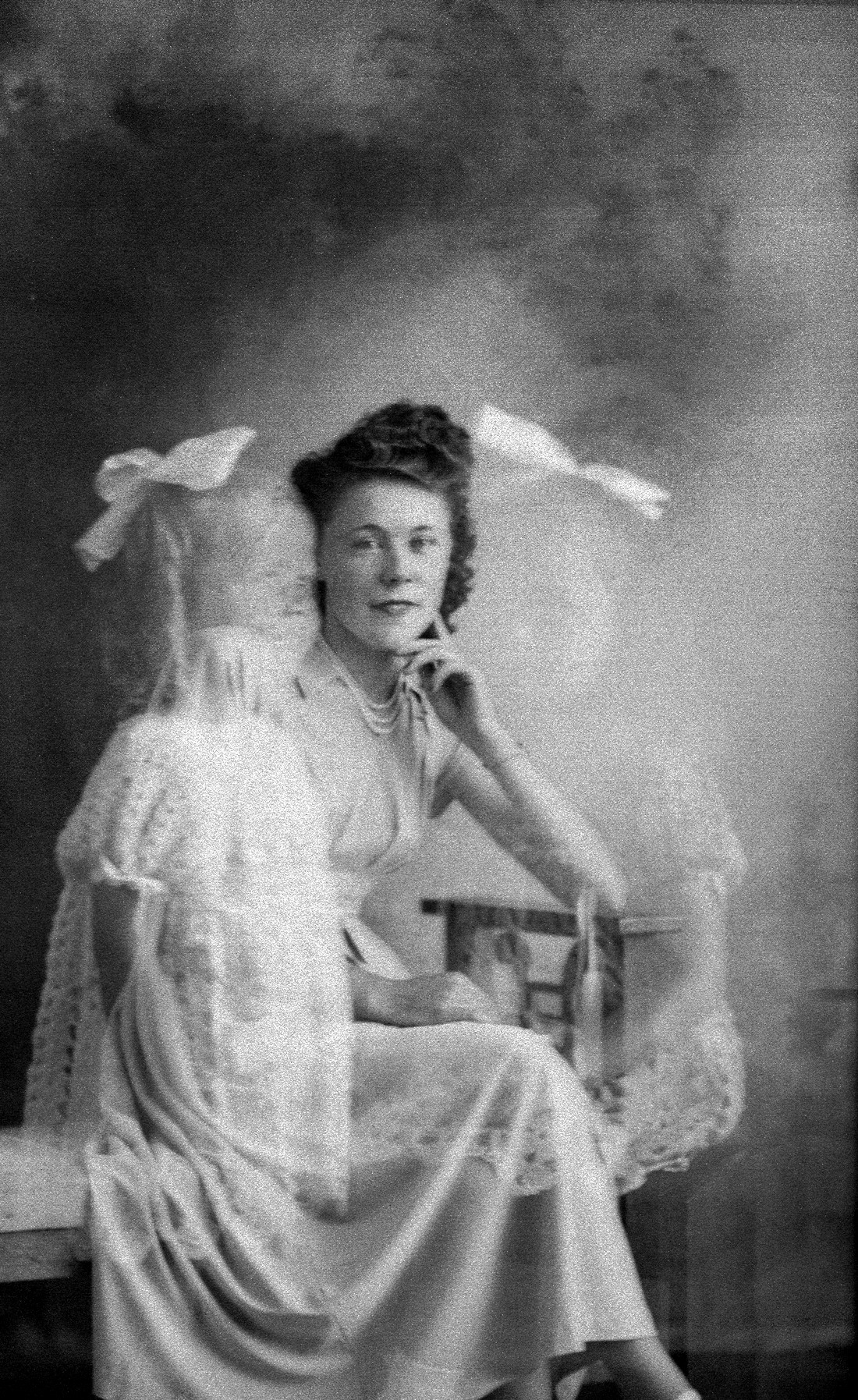
This portrait of Germaine Thibault evokes the way photographer Hannah Maynard (1834–1918) experimented with multiple exposures of a negative. This well-known photographer from Victoria, B.C. used this process to deliberately create surreal images, particularly ones in which she herself appears more than once. In the case of Mrs. Thibault, Marie-Alice Dumont used multiple exposures to create a ghostly image, as if the camera were magically revealing the two girls’ spectre.
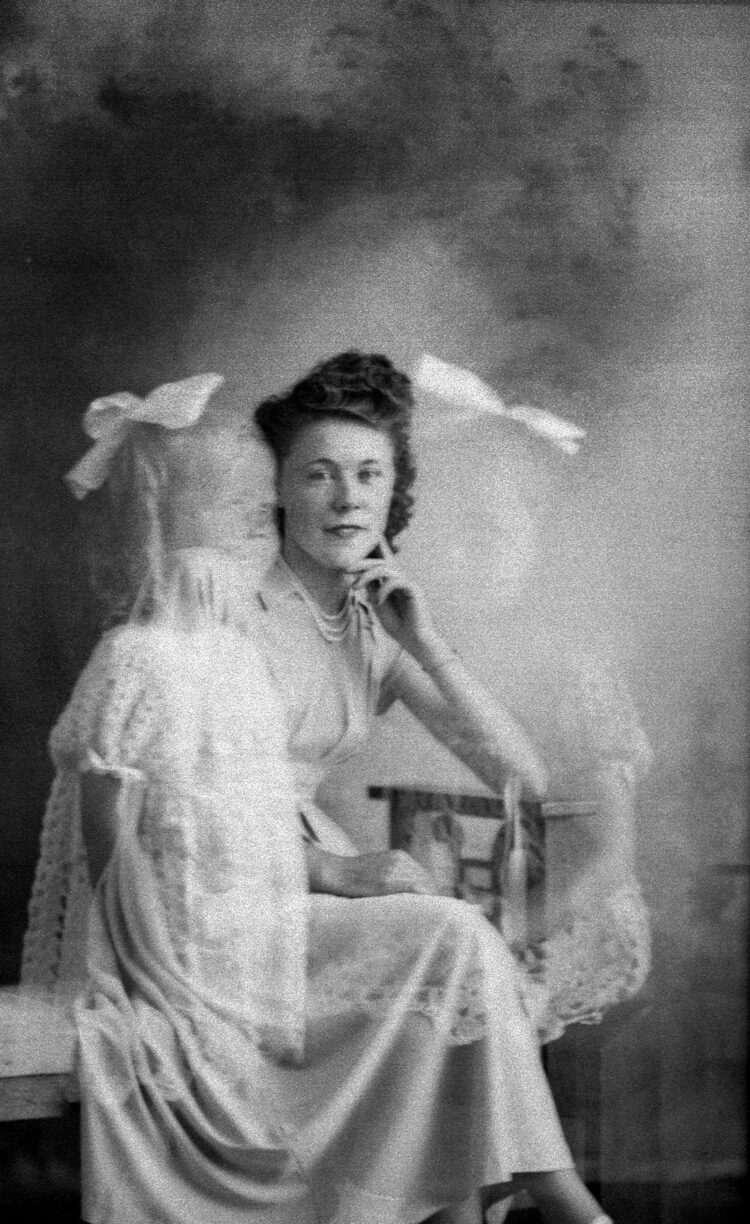
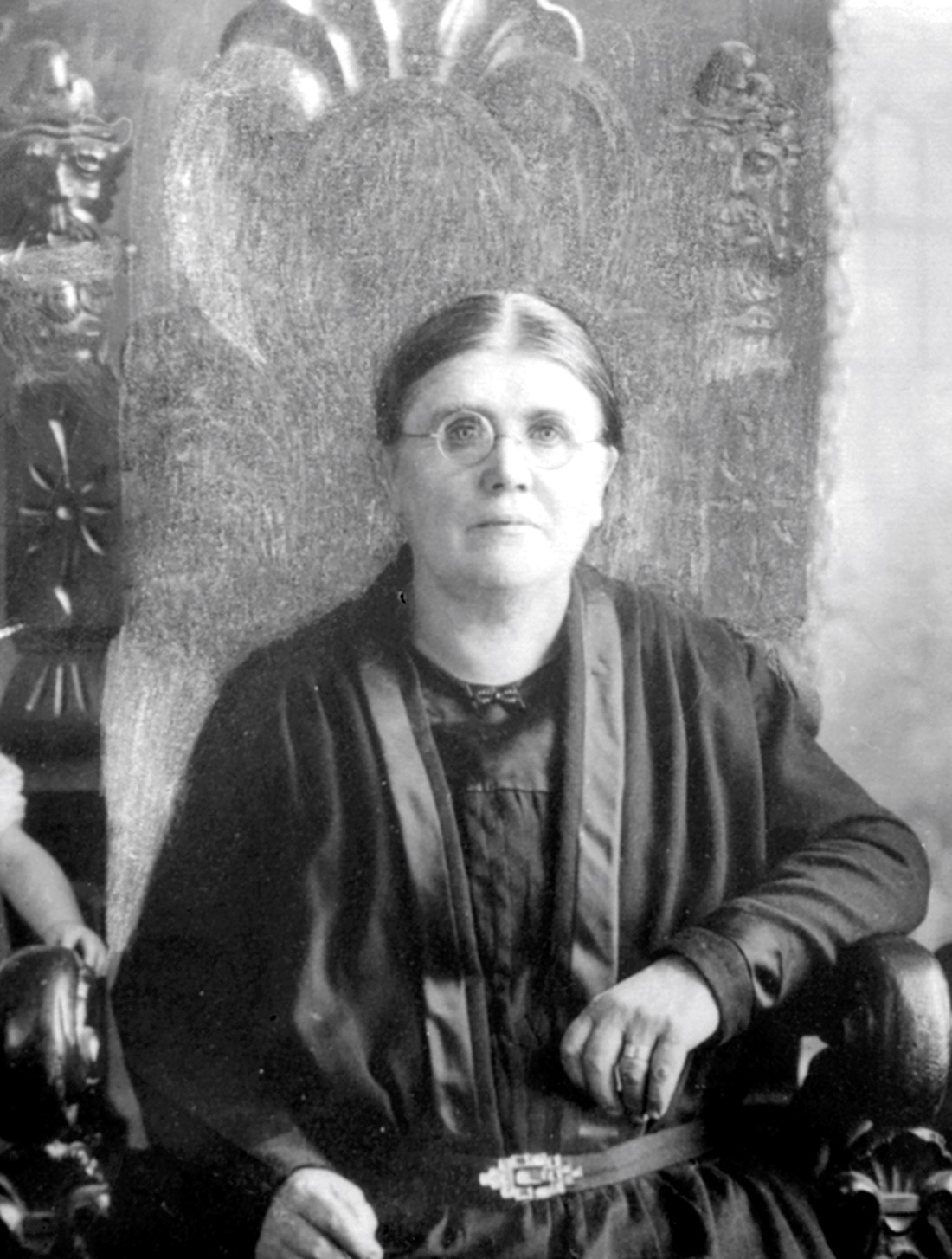
This im is the result of Marie-Alice Dumont’s deliberate alteration of the original negative. We recognize Marie Pelletier from another archive entry of a photo of her with one of her daughters, her granddaughter and great-granddaughter. When Mrs. Pelletier died, the photographer used this negative to make memorial cards. She cut Marie away from the others and tried to isolate her face by erasing the surrounding details. She then retouched the face and shoulders with a brush and pencil before printing.
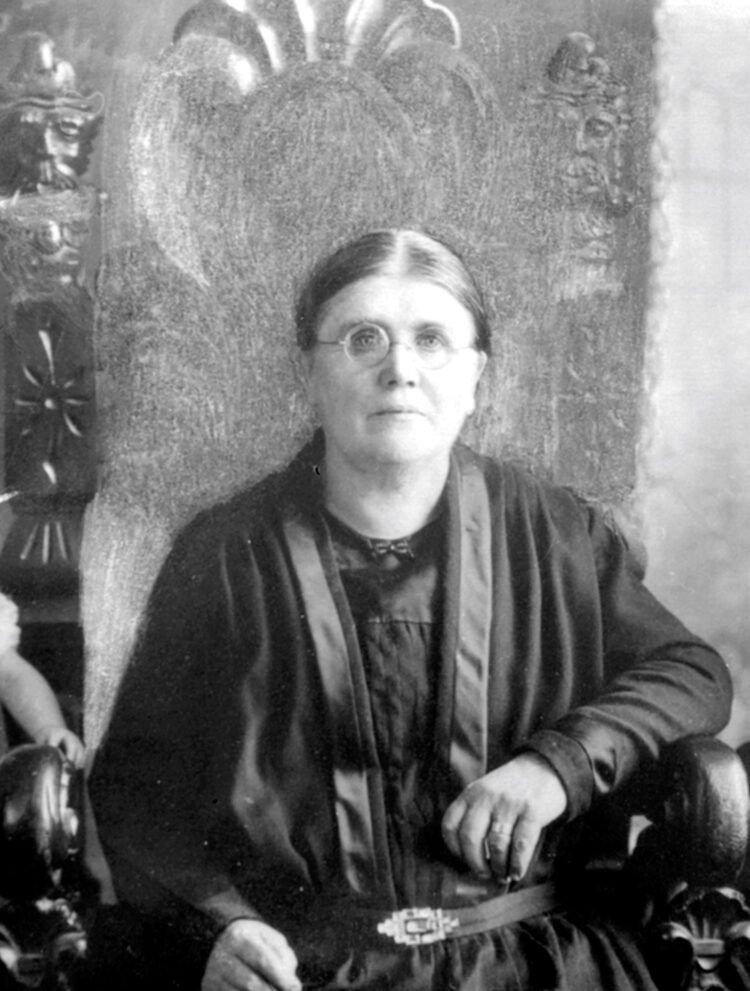
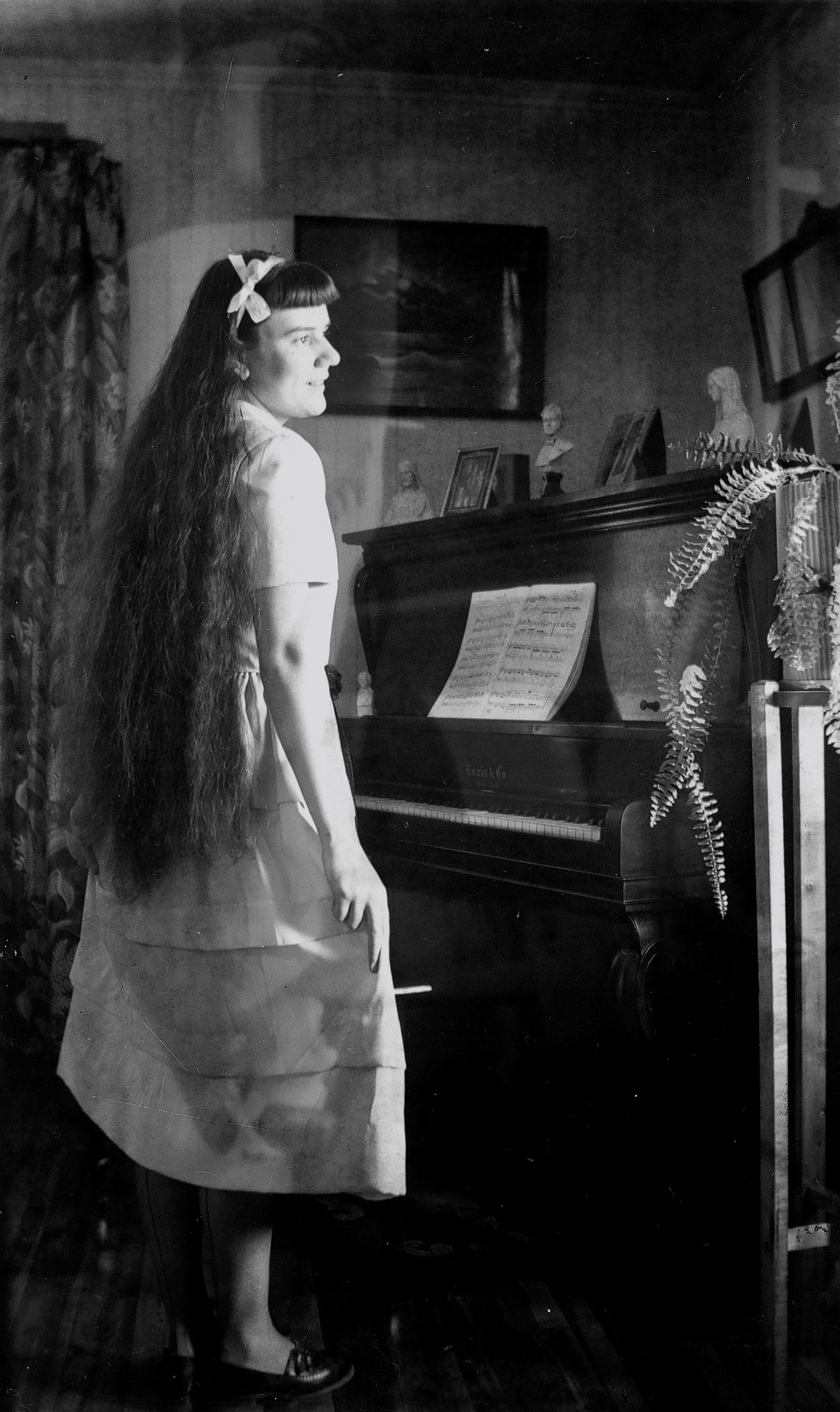
This photograph is among the most intriguing Marie-Alice Dumont ever produced. Look closely and you will notice that two images are superimposed and inverted horizontally. The upside-down one, however, is much paler and therefore difficult to make out at first glance. But it really is there! You don’t see it? Look closely at the bottom of Miss Pelletier’s dress, and you’ll see her face, but upside-down. The photography experts consulted about this montage are very certain: given the perfect symmetry of the image, the effect had to be intentional, and it is unlikely that it was a mistake. They hypothesize that the photographer exposed her negative before turning it over in the darkroom and placing it back in the negative holder, but upside-down. She would then have exposed it again, taking care to position herself (and the subject) in exactly the same way. Surprising, isn’t it?
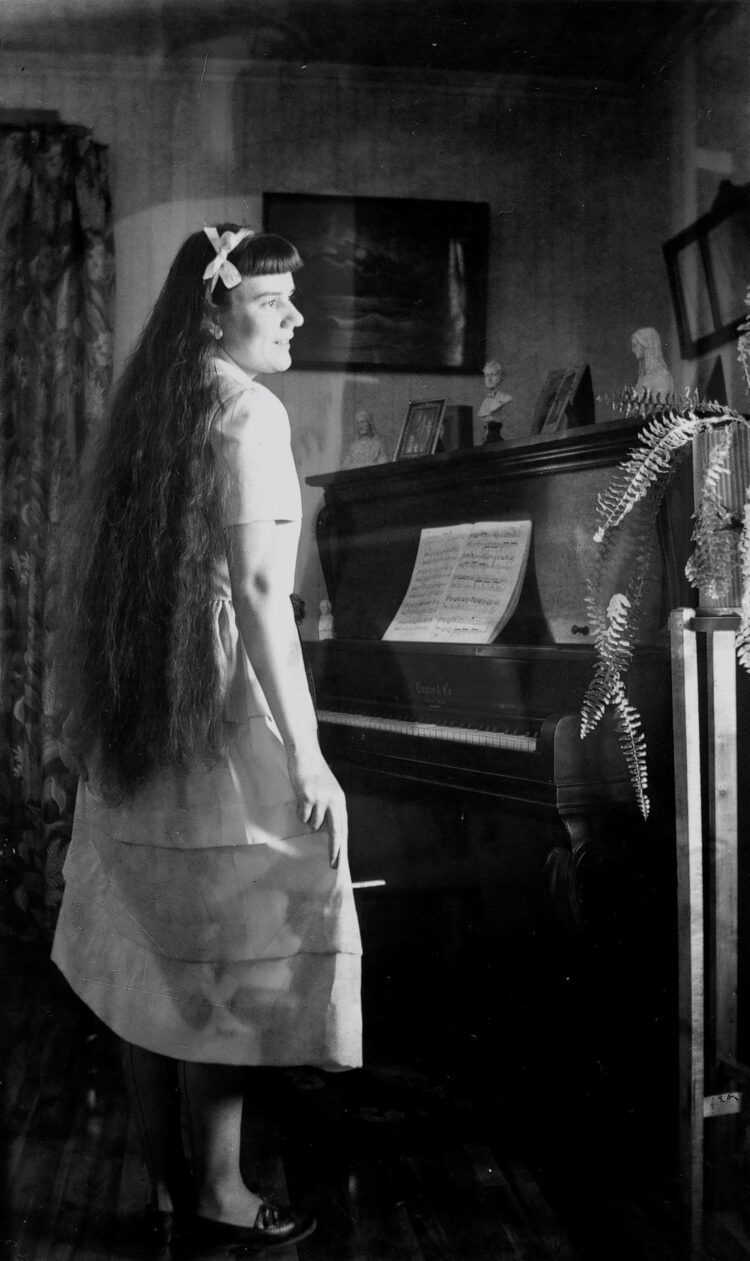
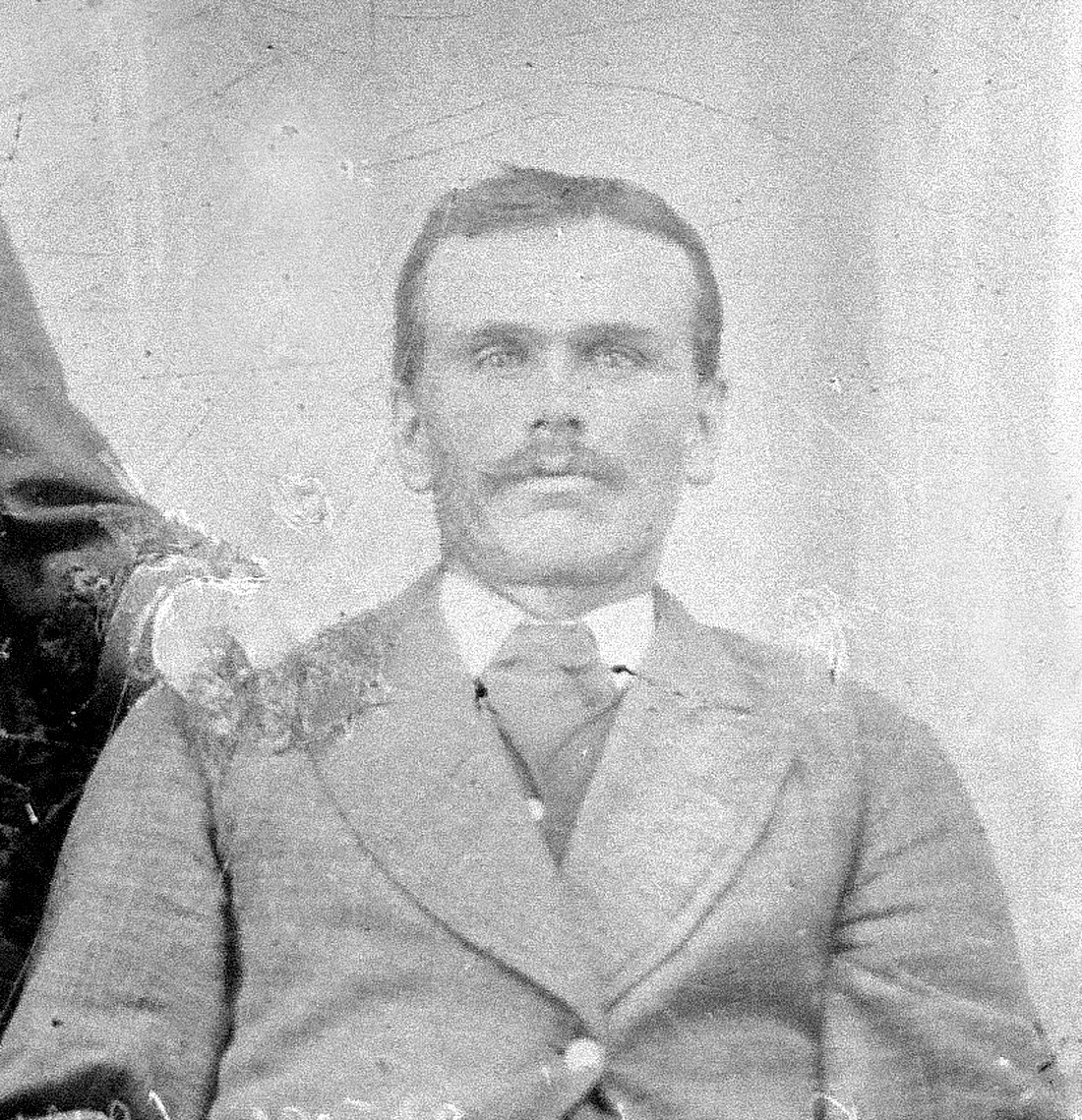
We do not know whether this negative belonged to Marie-Alice Dumont, but it may well have been she who tried to alter it nonetheless. Pierre Beaupré was probably a member of the extended family (one of her sisters married a Beaupré). When Mr. Beaupré died, Dumont may have been asked to make memorial cards, which was a service she routinely provided. To make them, she would have first created a print from the negative without any changes, to preserve the image in its original form. She would then have used the same negative, but this time trying to isolate Mr. Beaupré’s face, by scratching the surface to erase the hand on his right shoulder. She would then have drawn or painted it to reconstruct the missing part of the subject’s shoulder.
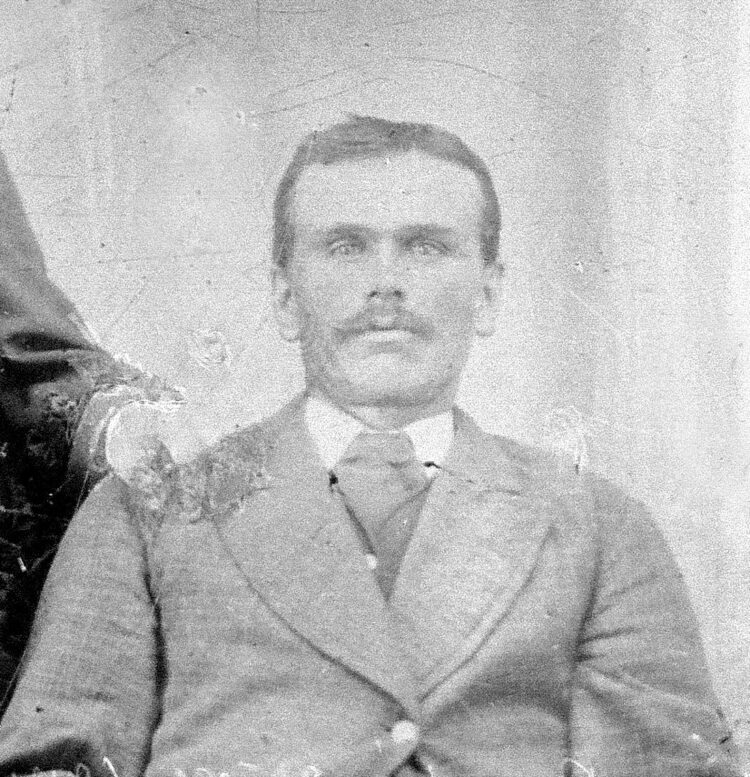
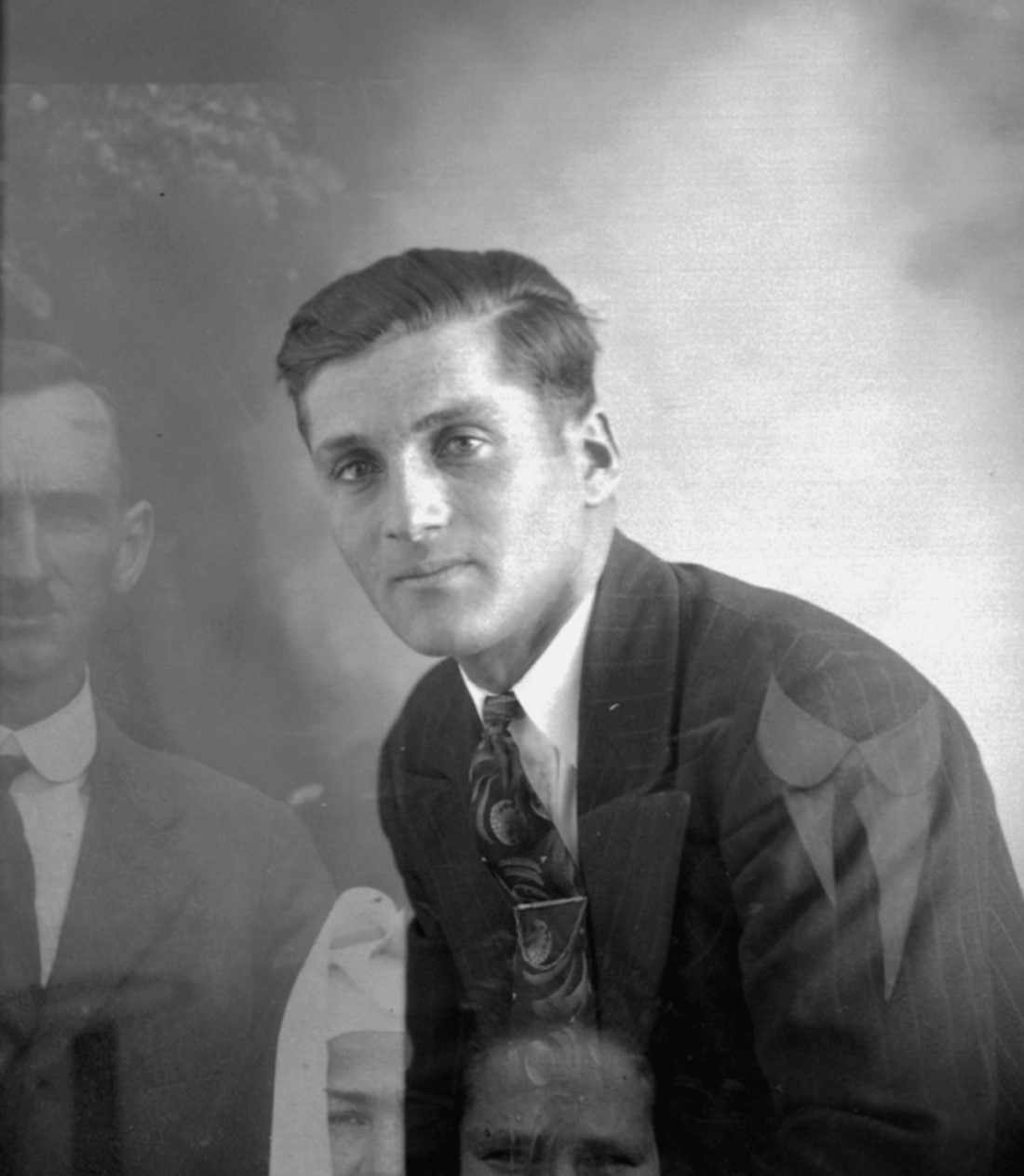
The result of a double, probably triple, exposure of the negative, this image appears to be Régent Nadeau, revealing his thoughts to us. While there is, indeed, something dreamlike about this portrait, it is doubtful that Marie-Alice Dumont deliberately intended to create the visual effect. It is surprising that a professional photographer would make this kind of mistake, however, especially with a studio portrait.
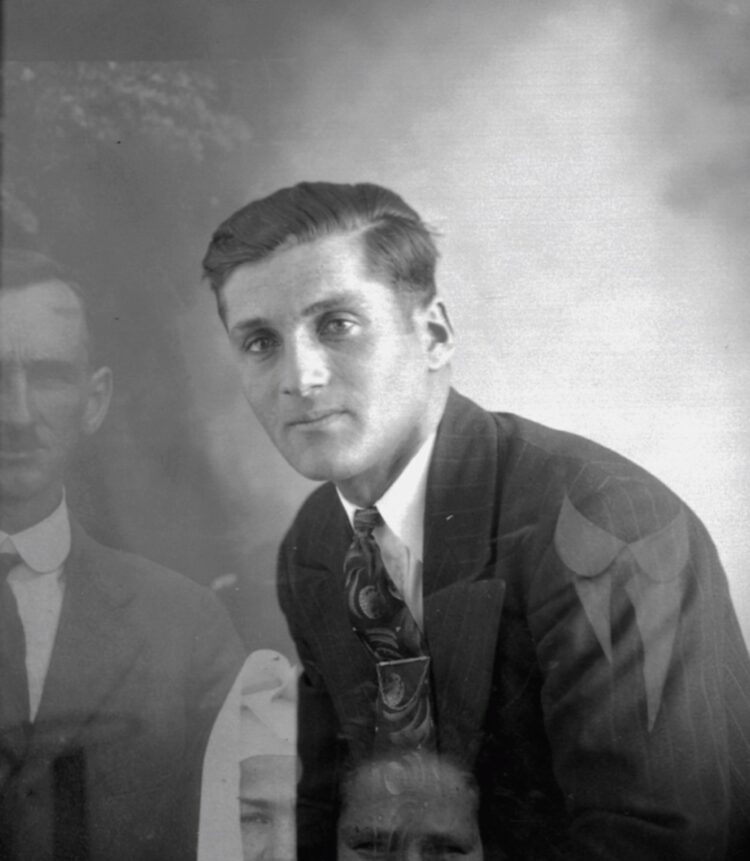
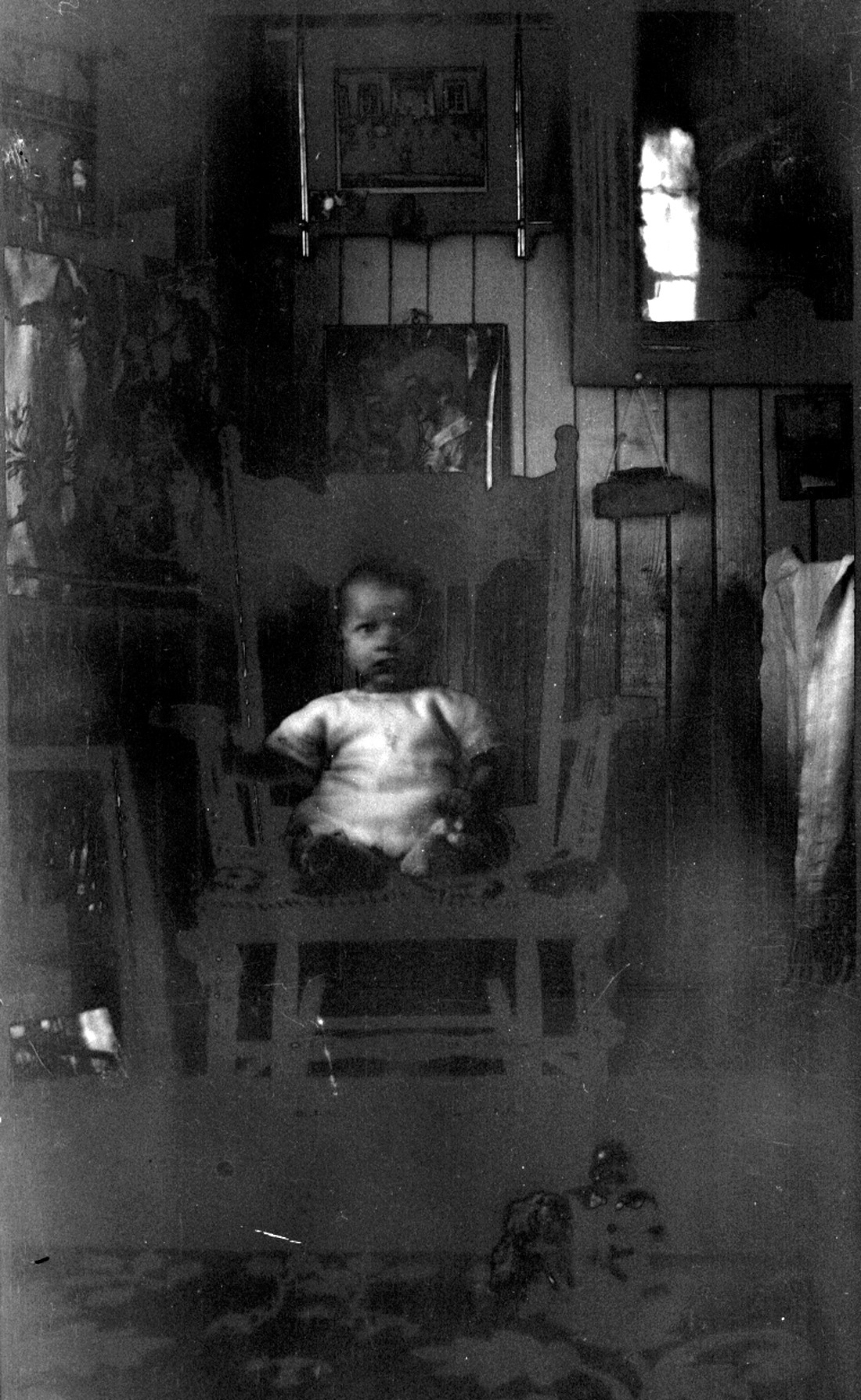
This photograph, which at first glance seems to be a failure, may well have been the result of a technical error, but it may also have been caused by a manipulation meant to have an artistic effect. Perhaps someone cracked open the darkroom door while Marie-Alice Dumont was developing the negative—even just a fraction of a second would have been enough to spoil the negative! Or it is possible that Dumont wanted to produce a Sabattier effect using solarization. A very strong overexposure of the emulsion on the surface of the negative during its development phase in the developer, solarization inverts an image’s densities (its shades of grey). It is a very difficult technique to master and can waste a lot of paper!
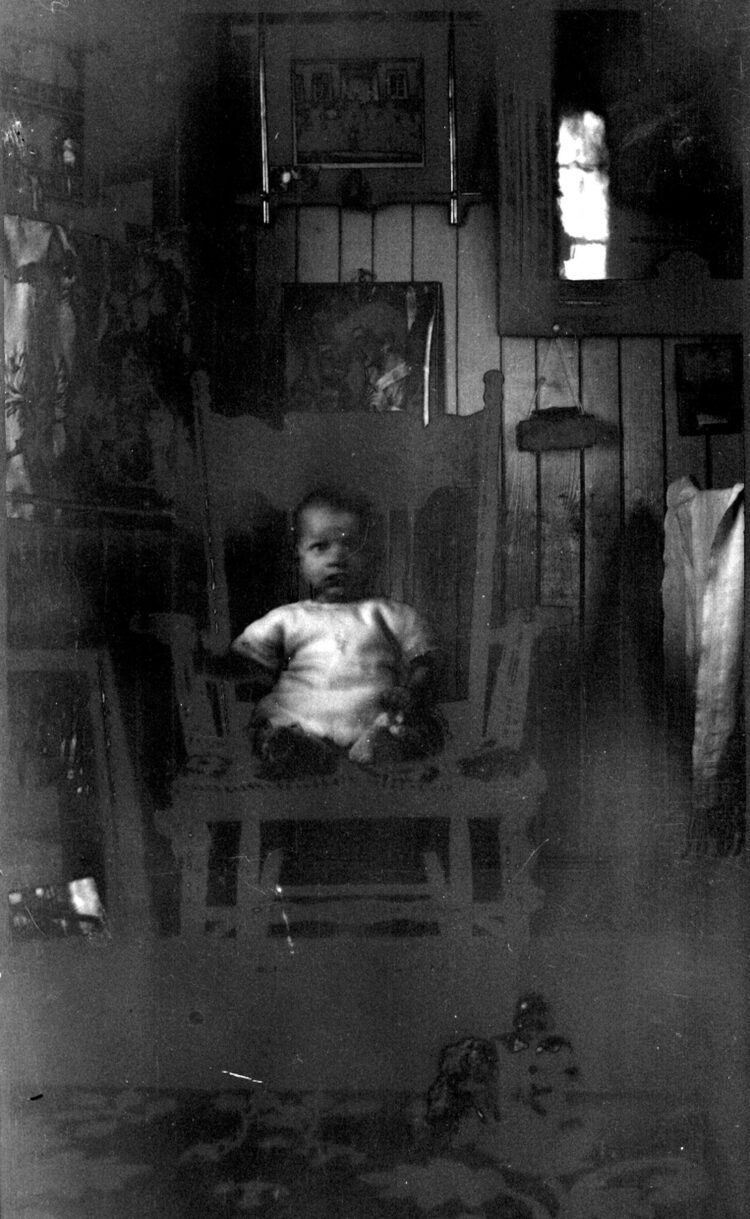
Others, local and historical context
This photograph of a Paris boulevard is considered one of the very first to capture a living person. If you look closely, in the lower left corner, you can make out a figure standing, apparently having their shoes shined. Why is this bustling part of the French capital nearly deserted? The long exposure time (several minutes) required by the Daguerreotype process likely explains why only the silhouette of this client, who had to stay still for a while so the shoeshiner could do their work, was preserved in the image.
Today, it is hard for us to imagine the sense of wonder photography inspired when it was invented in the 19th century. After all, don’t photos render reality more faithfully than paintings or drawings? Would art be forever outdone by photography? In this advertisement by Mrs. Fletcher, the Daguerreotype is described as “the pencillings of nature” that is “as perfect as the imagination can conceive.” The ad also presents the Daguerreotype as proof of the superiority of God’s work and nature over human creation.
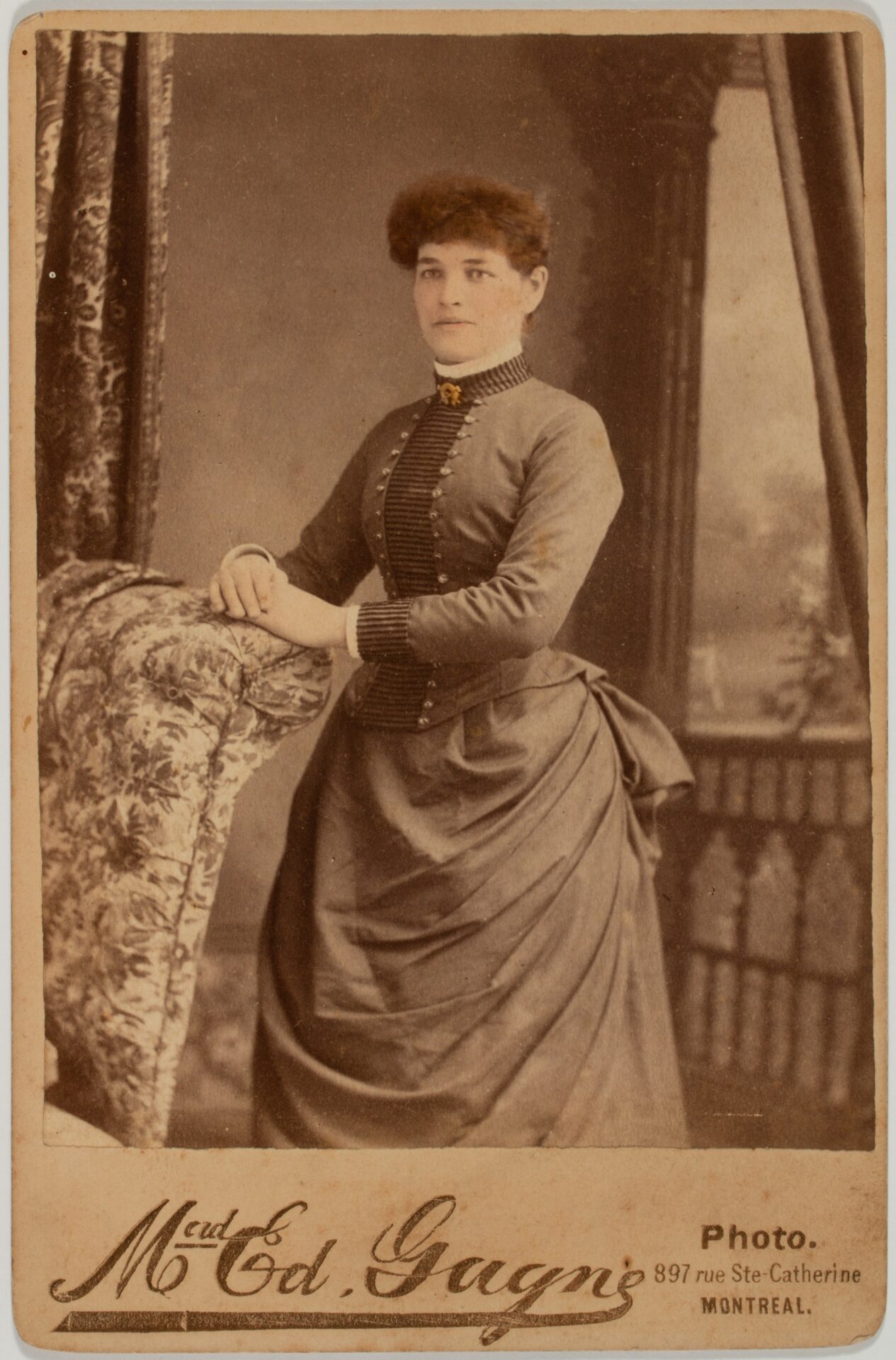
This portrait was taken in Montréal in the mid-1880s by Mrs. Gagné, also known as Eugénie Gagné or Eugénie Pilon (her maiden name). A professional photographer, she worked alongside her husband, Édouard Gagné, also a photographer, with whom she operated three studios in Montréal. She produced so-called “cabinet cards.” These portraits resembled carte-de-visite photographs but were slightly larger in format.
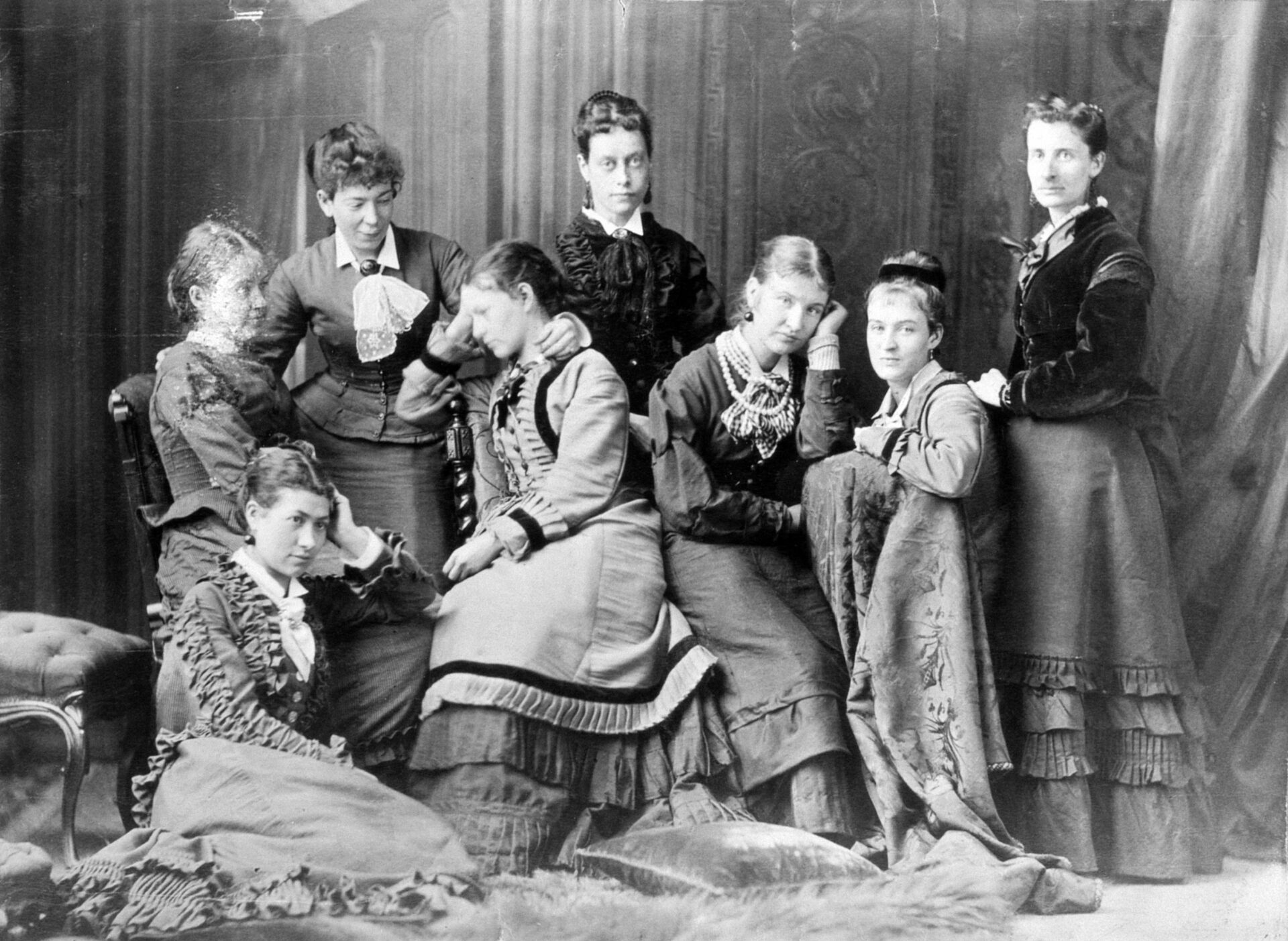
In 1876, the Notman Studio in Montréal employed 52 people, including 9 women. In this group portrait, taken that same year, eight women employees are pictured. Could the ninth listed in the company’s archives be the one behind the camera?
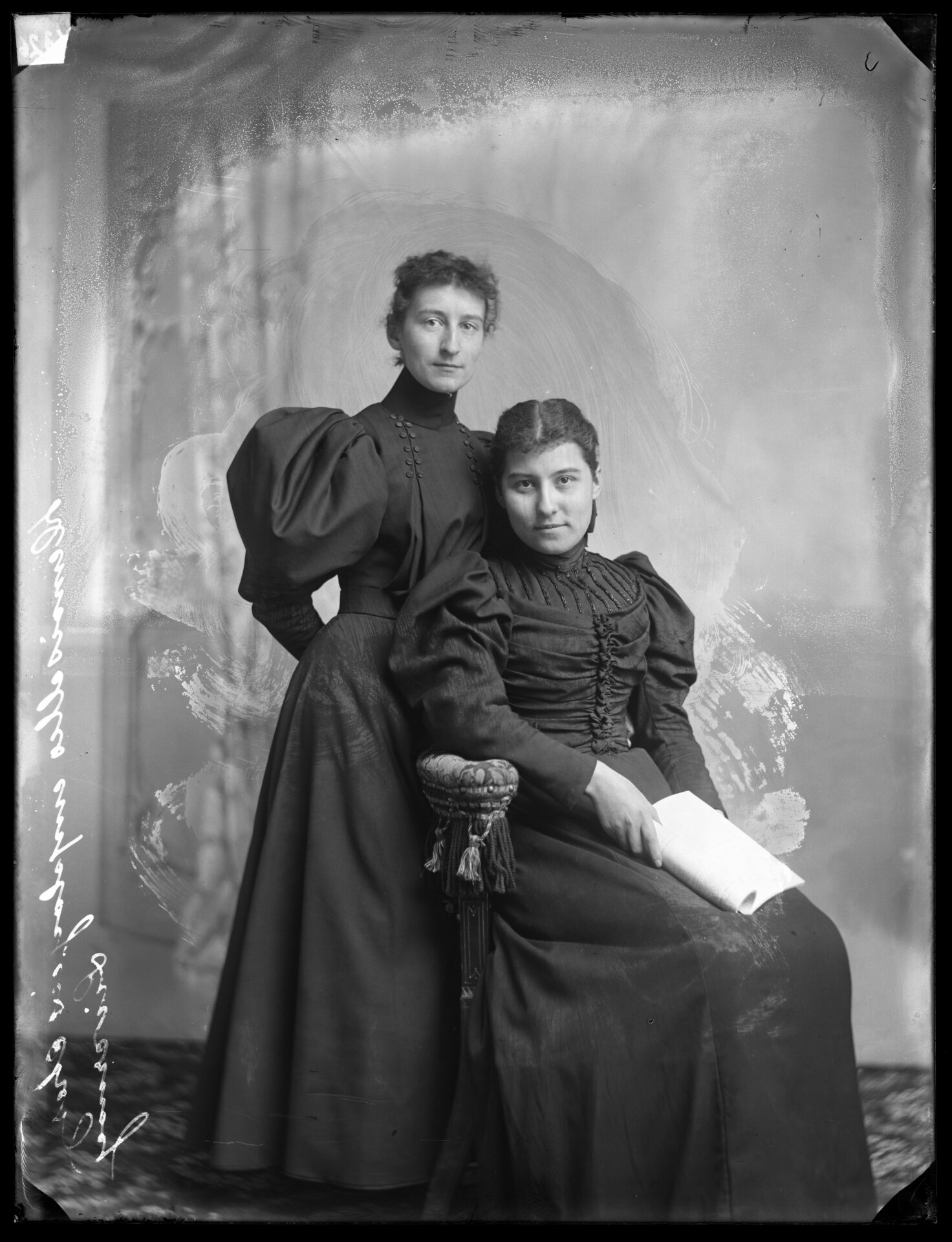
Very few portraits of the women working in Quebec photography studios in the 19th century have survived. This one, showing two young employees from the Livernois’s studio in Québec City, is especially significant. What roles did they play in the studio? Did they greet clients? Work in the darkroom? Handle retouching? Operate the camera? Whatever the case, historian Colleen Skidmore notes that Élise L’Heureux Livernois and her two young assistants produced here a portrait of remarkable quality. Thanks to skillful lighting, the colours and textures of the dresses, along with the pallor and detail of the faces, are clearly rendered.
This image shows the cover page of one of the first catalogues published by the Eastman Dry Plate and Film Company of New York. Released in 1888, it promoted an invention by George Eastman that would revolutionize photography through its simplicity: the Brownie camera. The first lines of the catalogue read: “Anybody who can wind a watch can use the Kodak camera.”
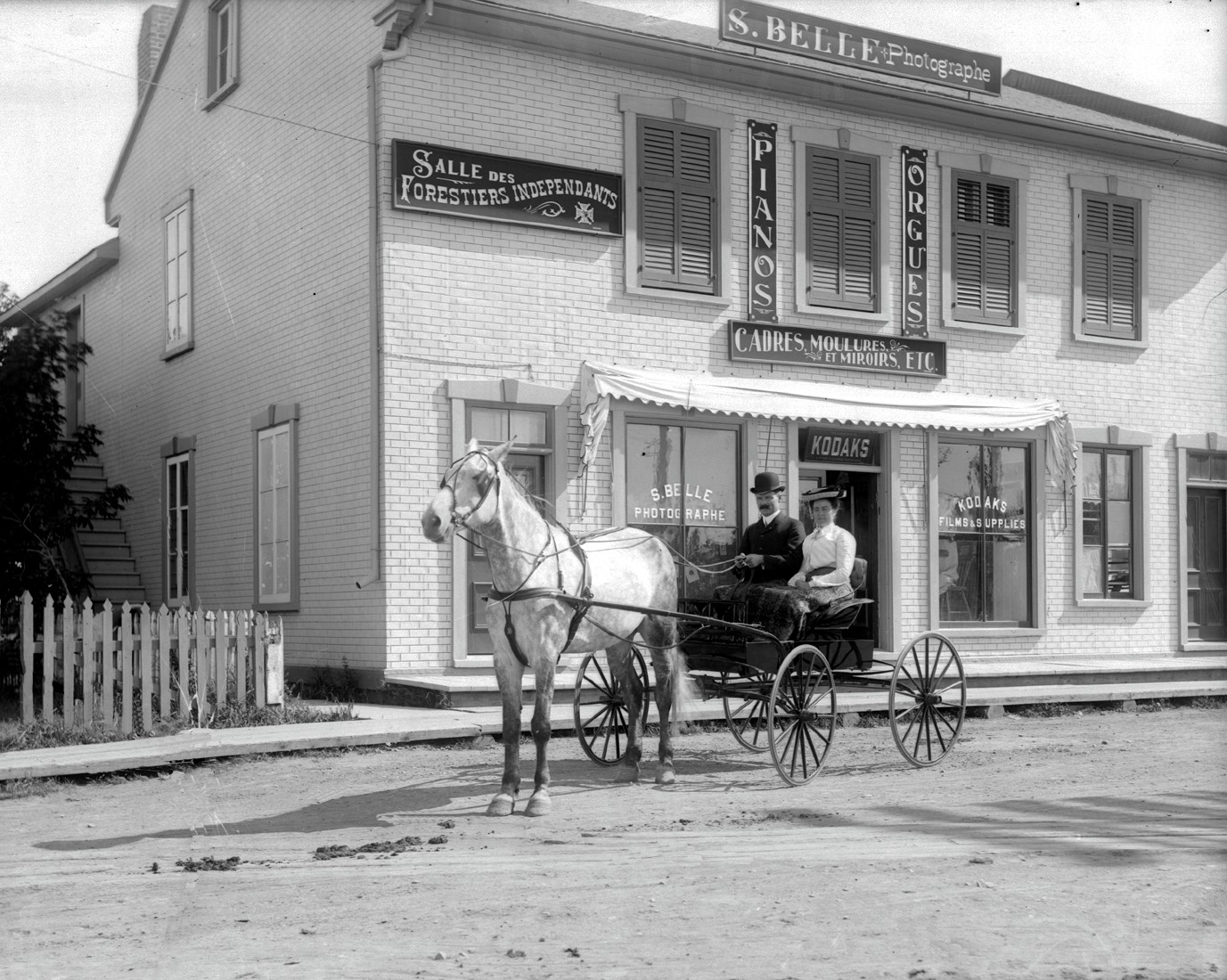
At the age of 15, Stanislas Belle emigrated to the United States with his parents. After a brief return to Montréal, Belle, drawn to the profession of photography, went back to New York for training. He went on to work in his hometown of Saint-Jean-sur-Richelieu in the late 1880s, then moved to Rivière-du-Loup in 1894, likely attracted by the town’s growing tourist trade. This photograph shows the storefront of his studio. Belle was a highly skilled portraitist, known across North America. He also produced postcards and documented the many changes Rivière-du-Loup underwent at the turn of the 20th century. At age 50, Belle left photography to focus on selling musical instruments.

This autochrome photograph was taken as part of a documentary mission sponsored by French banker and philanthropist Albert Kahn. Concerned with preserving true-to-life images of the human world before it “disappeared,” Kahn (1860–1940) hired photographers to create the “world’s archives,” what he called the Archives de la Planète. These photographers travelled the globe, equipped with cameras and film gear. Frédéric Gadmer was one of them, and in 1926 he made a stop in Canada. He photographed, among other sites, several iconic locations in the western provinces. He also visited what was then known as “la Belle Province” to capture city views of Montréal and Québec City. His travels eventually brought him down the St. Lawrence River aboard the Melita, where he immortalized one of the river’s famed sunsets.

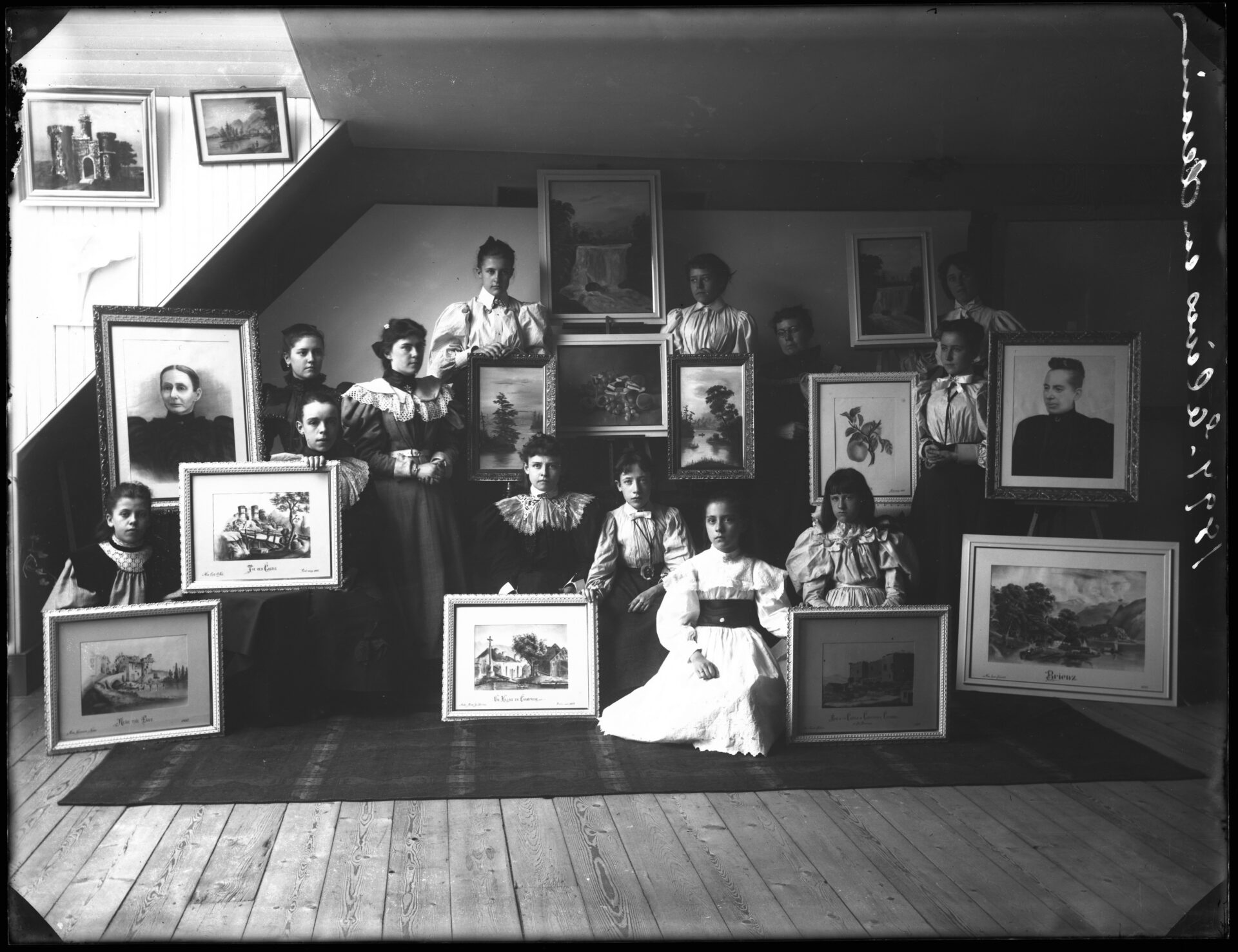
It would be easy to imagine Marie-Alice Dumont among these students at the novitiate of the Sisters of Charity of Québec, except that she attended the institution about 15 years after this portrait was taken. Like the young women pictured here, Dumont would have taken painting and drawing classes with the nuns during the time Sister Marie-de-l’Eucharistie (Elmina Lefebvre) was in charge of the painting and photography workshops.
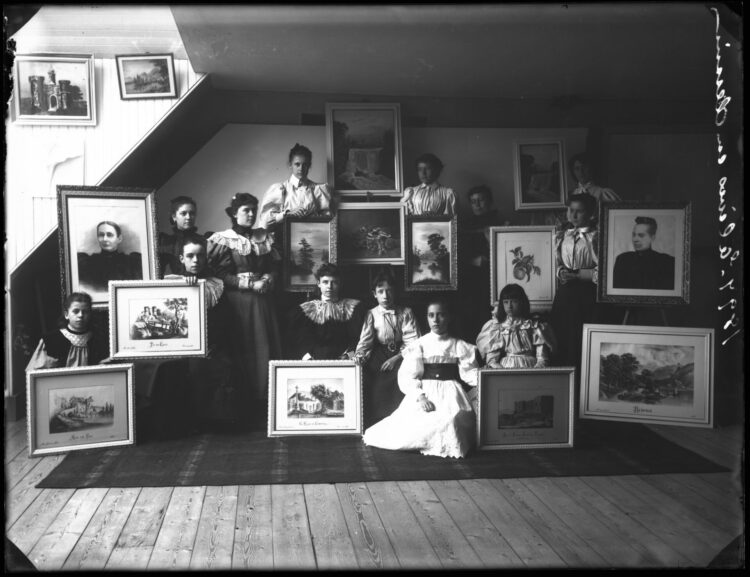
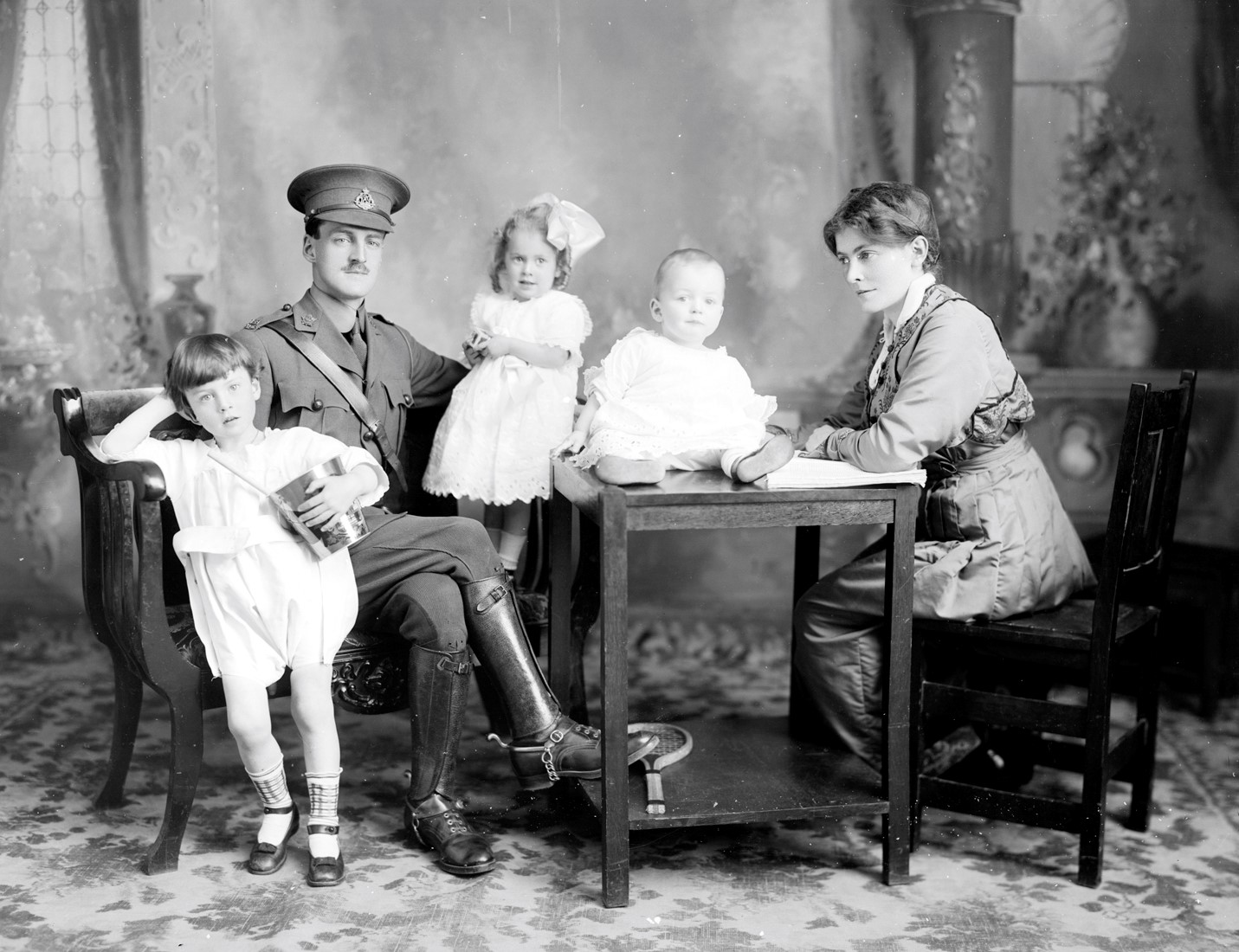
In summer 1914, World War I broke out. The web of alliances among the major European powers was complex and so Canada, which was still part of the British Empire at the time, entered the war as well. Before conscription was introduced in 1917, thousands of Canadians volunteered to enlist. Philippe-Auguste Piuze was one of them. Born in 1888 in Fraserville, now Rivière-du-Loup, Piuze served during the Great War as a recruiting officer in the Lower Saint Lawrence and on the Gaspé Peninsula. He also raised a battalion and deployed overseas with it in 1916. That same year, newly promoted Lieutenant-Colonel Piuze, his wife, Anita Chassé, and their children visited photographer Ulric Lavoie for a portrait session. Did Piuze take this portrait with him to the front? Or was it meant as a keepsake for his family should the unthinkable come to be? Fortunately, Piuze returned safely from the war and lived a long life. He, Anita and their children even returned to Lavoie’s studio for another portrait. At the time of his death in September 1967, Piuze was described as “a distinguished French Canadian officer, deeply devoted to his military, family and religious duties.”
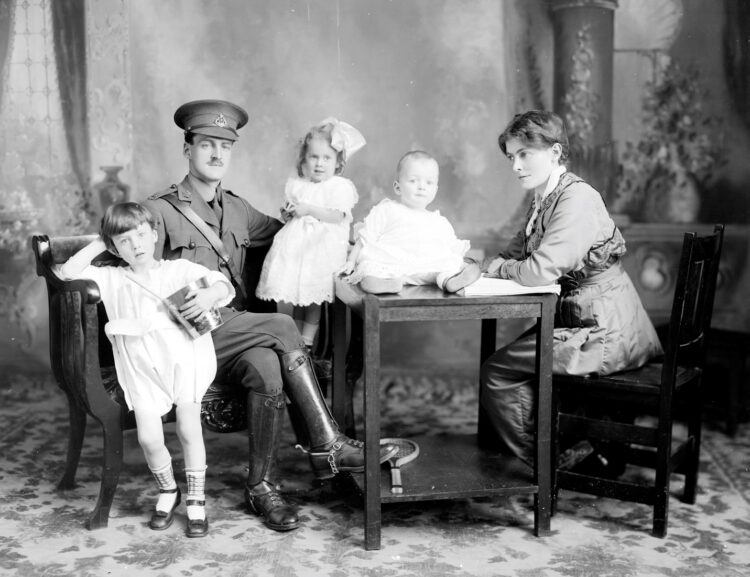
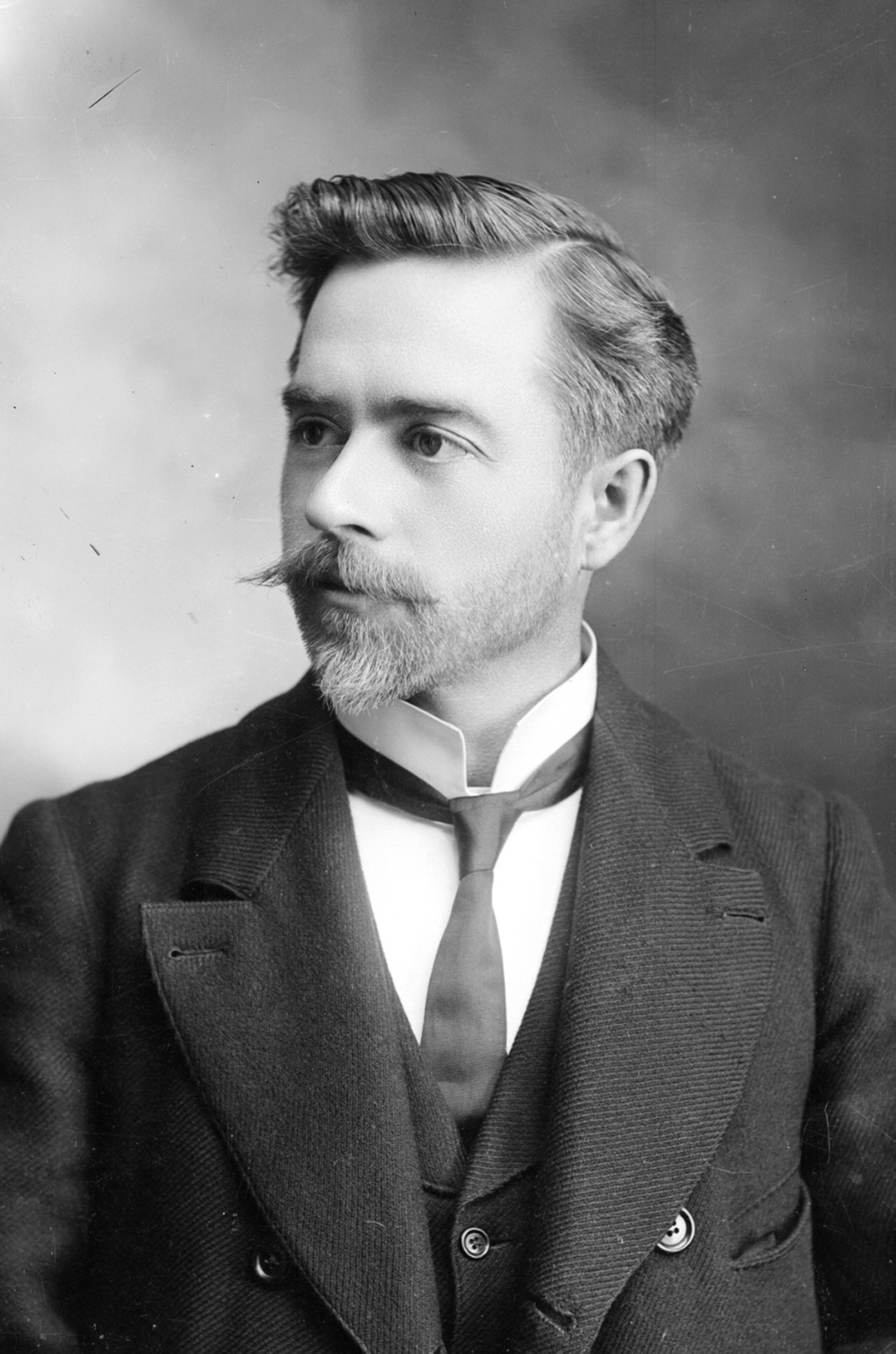
In addition to being a photographer, Stanislas Belle served as a city councillor, churchwarden and founding member of the chamber of commerce in Rivière-du-Loup. A street in the city has borne his name since 2008.
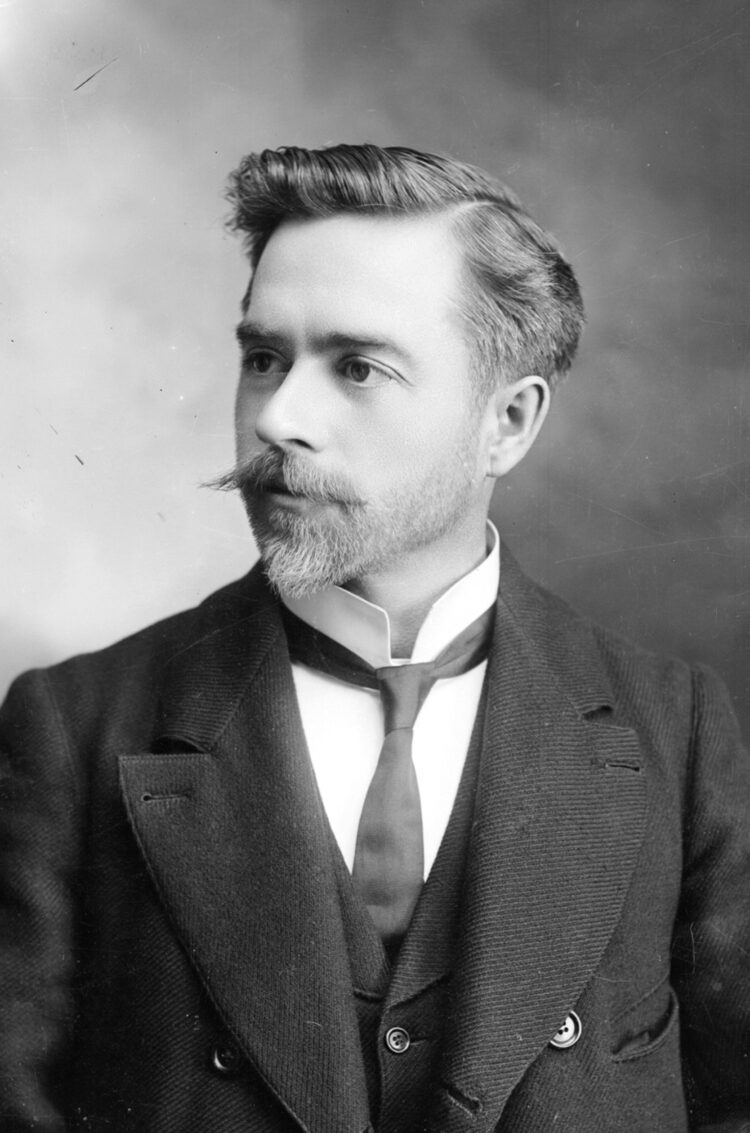
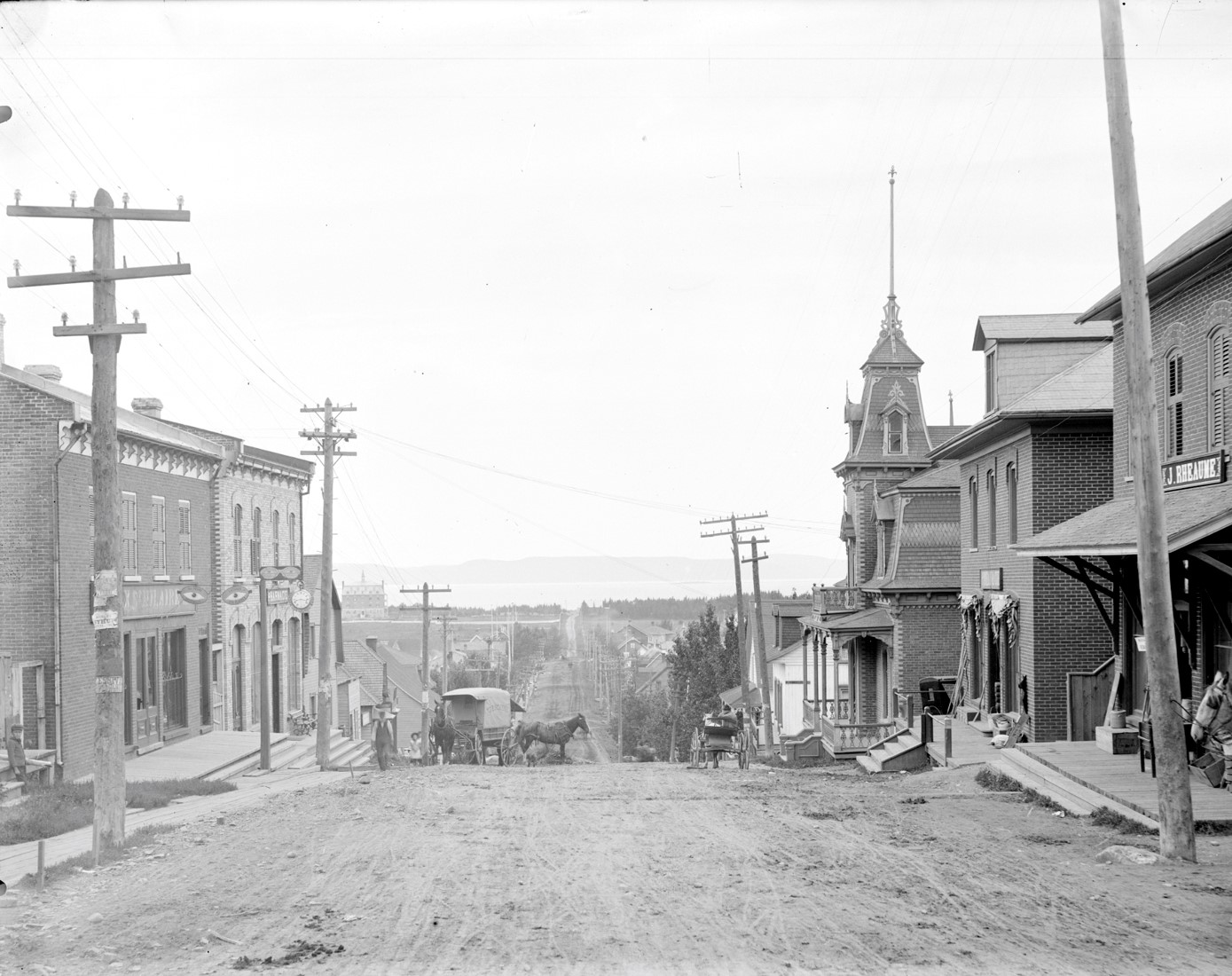
Stanislas Belle also enjoyed photographing the town he came to call home. This image offers a view of Lafontaine Street, one of Rivière-du-Loup’s main arteries. At the same time, it documents the early days of electrification in the region. Electricity was first introduced in 1888 in Fraserville, but it was not until 1945 that the area’s towns and villages were fully electrified, with the village of Rivière-Bleue in Témiscouata being the last to join the network. Electrification progressed more slowly in rural areas and on farms, however. By 1951, less than half were hooked up to the grid but, by 1956, the figure had climbed to 85%. By 1961, with nearly 99% of farms in the region having electricity, the Lower St. Lawrence countryside was even ahead of the average for rural Quebec (97.3%). The arrival of electricity significantly facilitated the work of photographers like Stanislas Belle and Marie-Alice Dumont!
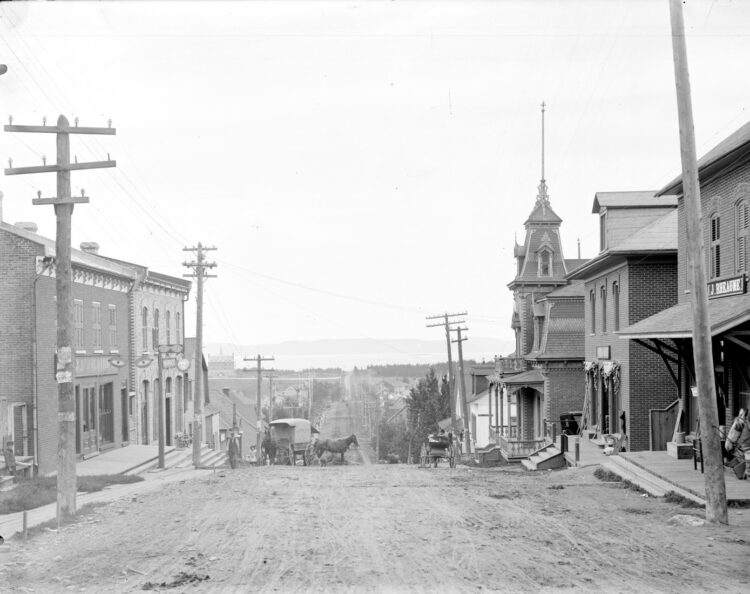
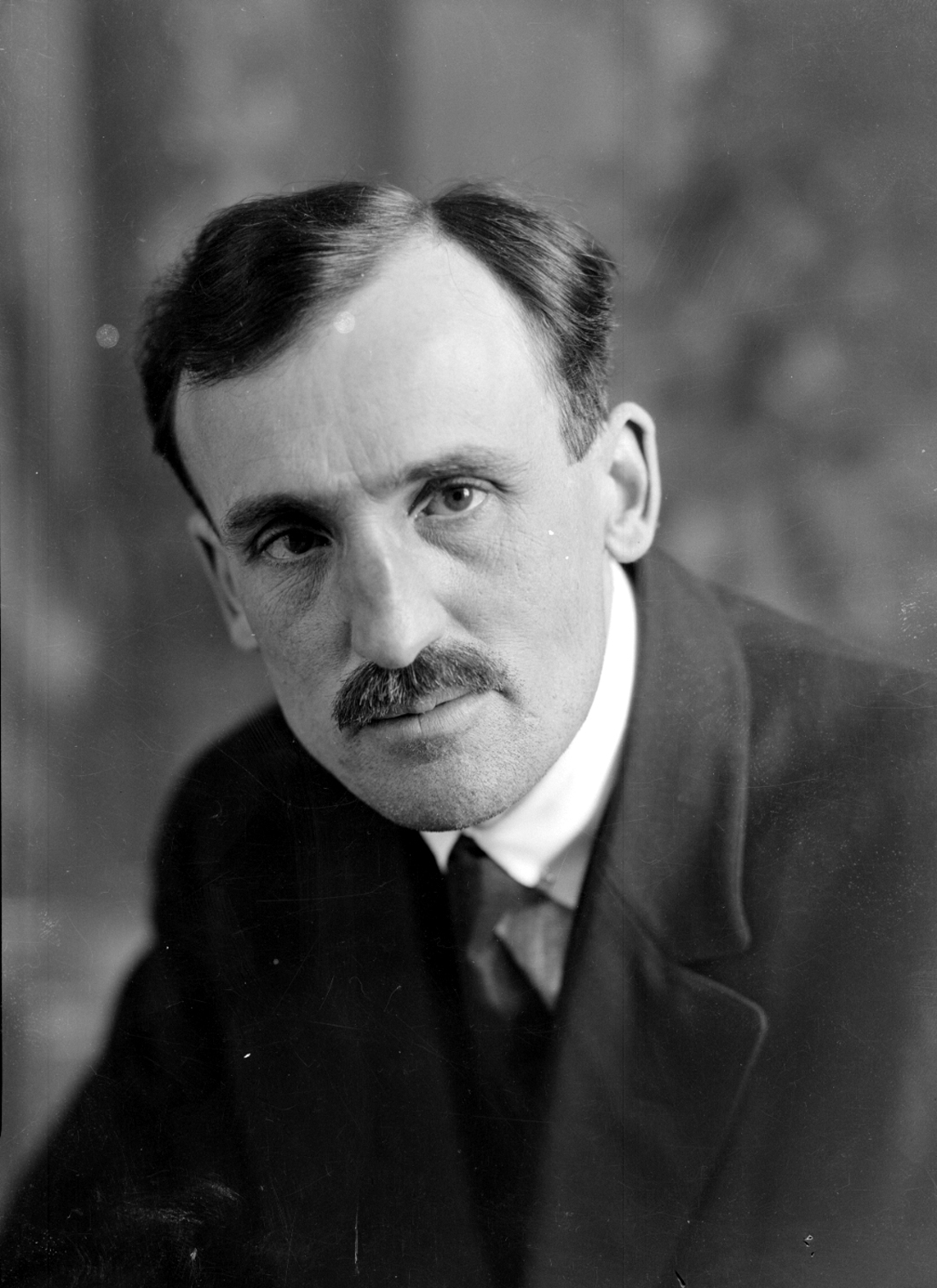
Ulric Lavoie, a native of Rivière-du-Loup, began his photography career in his hometown in 1914 when he took over Stanislas Belle’s studio. Lavoie offered guidance to Marie-Alice Dumont when she decided to launch her own business. Sadly, an eye disease eventually forced Lavoie to confront the inevitable: He was going blind. What a cruel twist of fate for a photographer! To help him in the meantime and, ultimately, to take over his studio, he hired an assistant, Antonio Pelletier, who would purchase Lavoie’s studio in 1942.
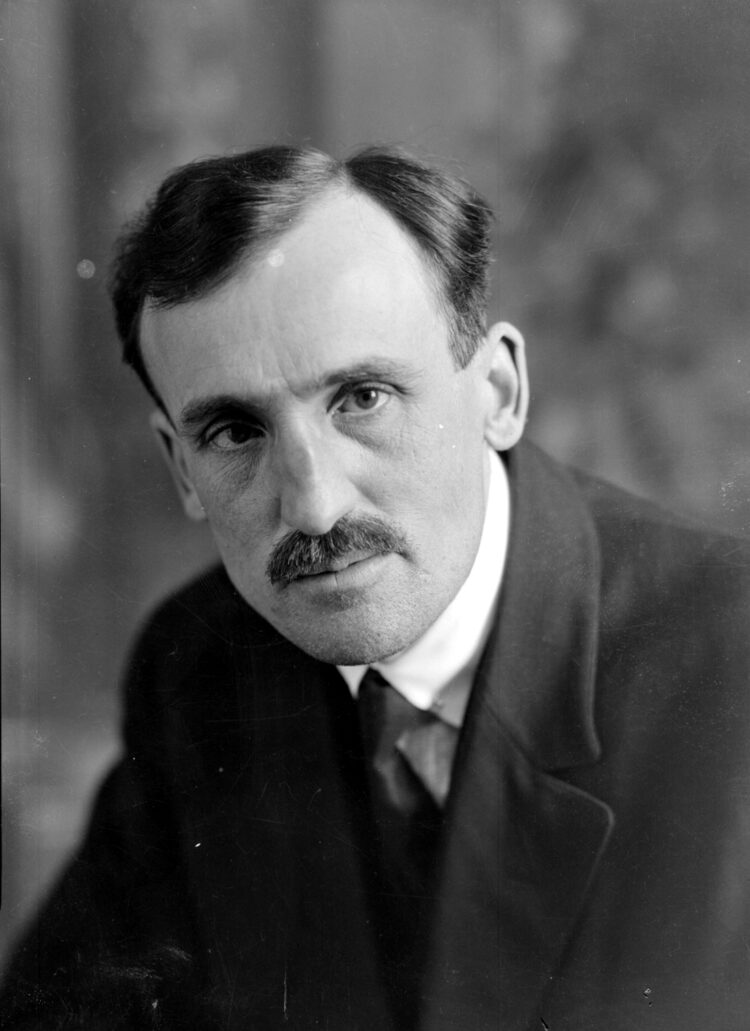
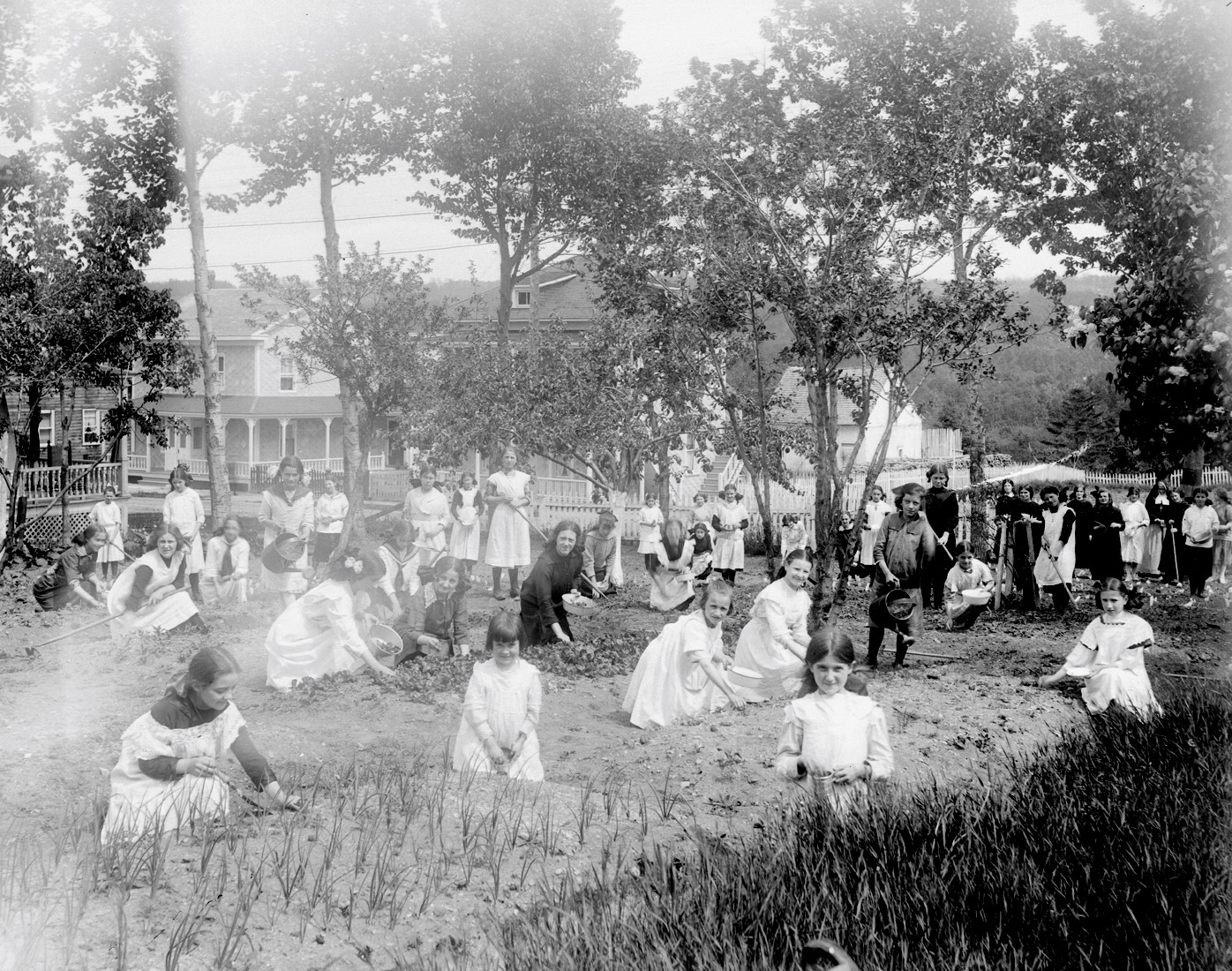
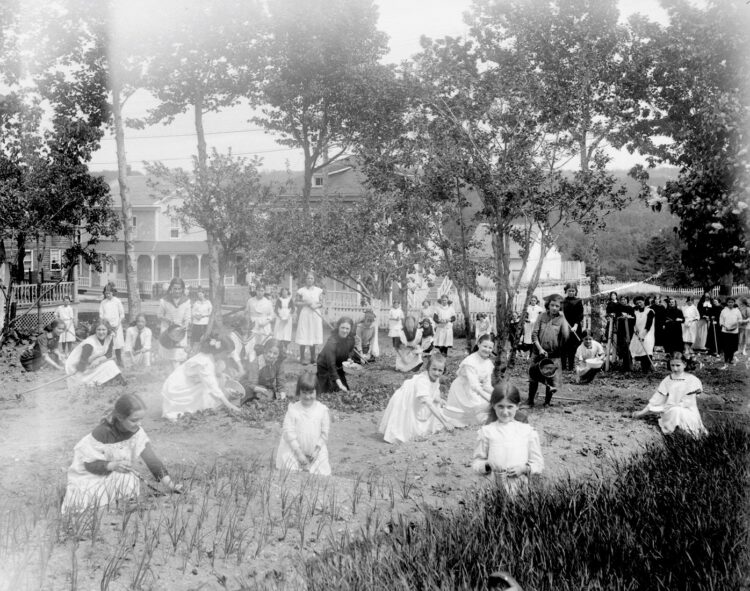
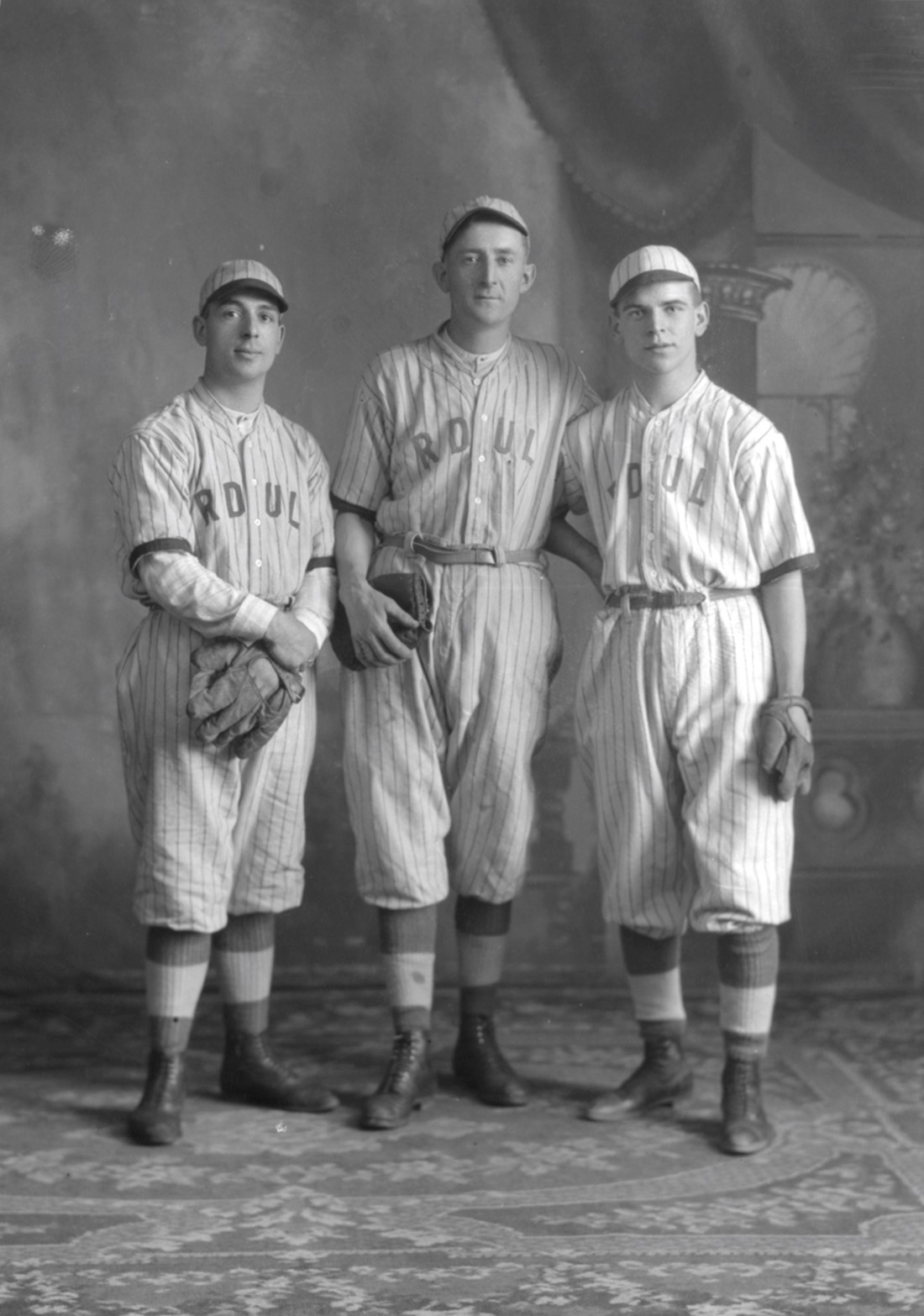
In early 20th-century Quebec, American culture had a growing influence in many areas, including sports. One clear sign of this was the rising popularity of baseball. In 1922, when these three proud young baseball players from Rivière-du-Loup posed for a portrait in Lavoie’s studio, more and more Quebecers were taking up the sport. Amateur leagues had sprung up throughout the province, and some French Canadians even played for major professional teams in the United States. Did you know that baseball has been played in Quebec since the 1860s?
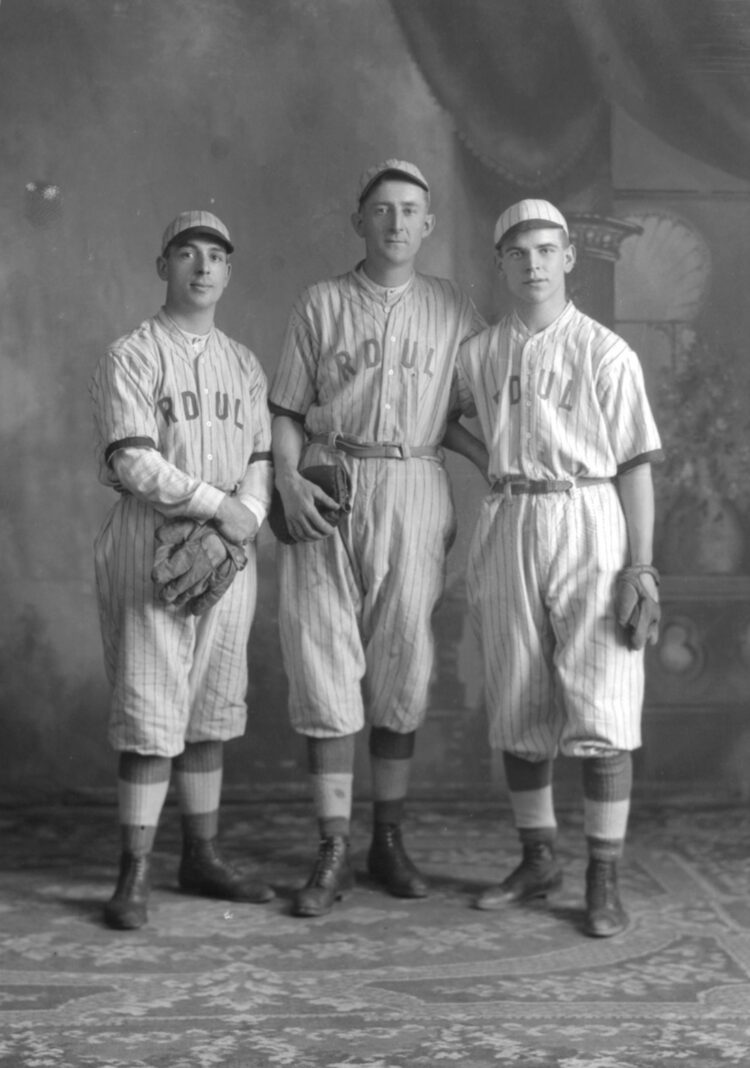
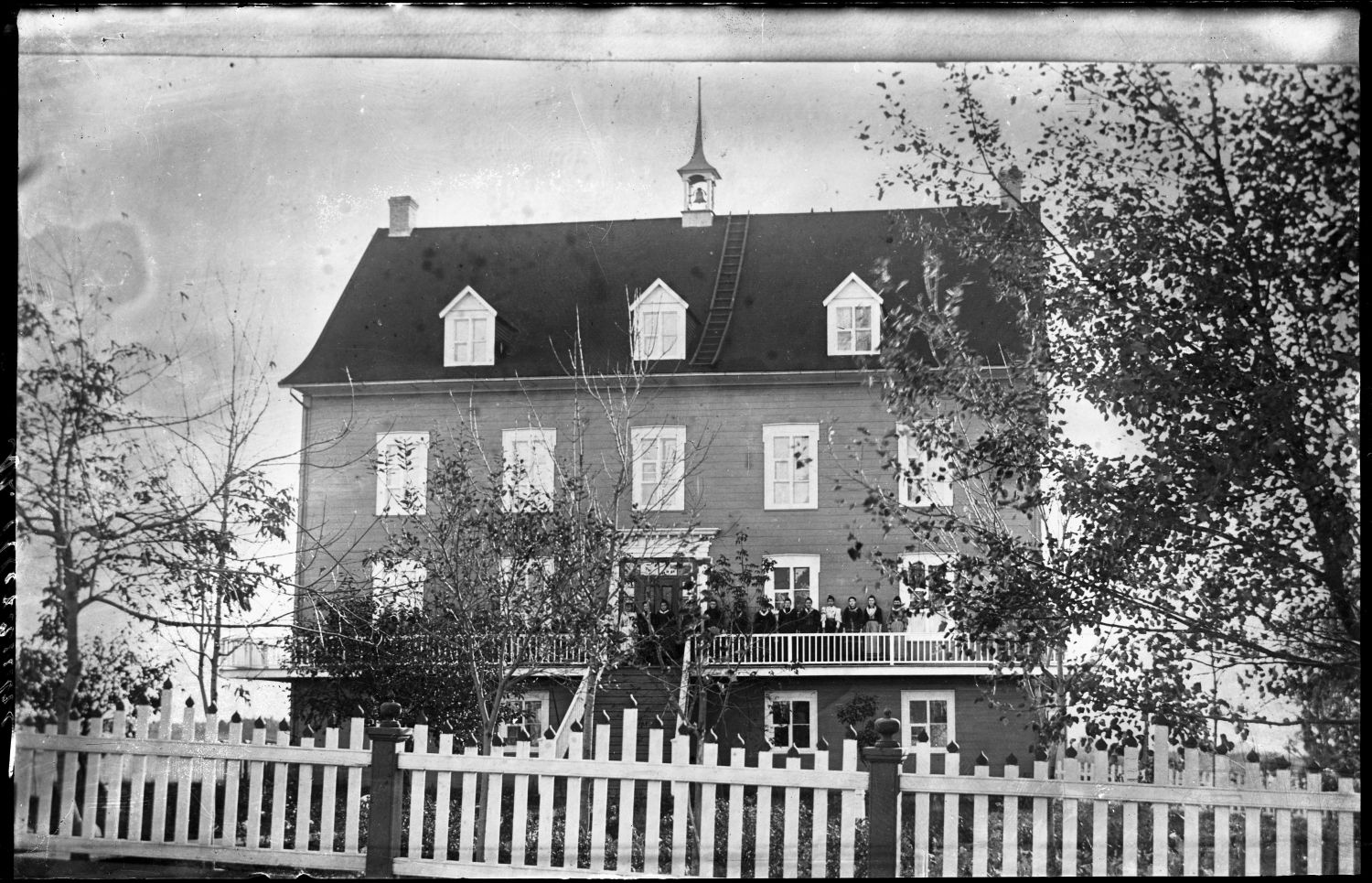
The convent of Saint-Alexandre-de-Kamouraska was founded in 1881 by the Sisters of Charity. This photograph represents a distant view of the building’s facade, located not far from the village church. Can you see the fifteen or so young girls lined up on the porch? It is not impossible that Marie-Alice was among them. From the mid-19th century to the mid-20th century, thousands of young girls received a post-primary education in schools like these. In Saint-Alexandre, a rural setting, the convent girls acquired the necessary skills for maintaining a good home (cooking, sewing, and other manual labor). They were prepared to become good wives and mothers, which may seem ironic given that Marie-Alice Dumont never married. Convent girls in Quebec could also take advanced lessons in geography, history, and arithmetic (among others), not to mention painting, drawing, music, and singing, which were often practiced there. Marie-Alice thus left the convent well-prepared to obtain a teaching certificate.
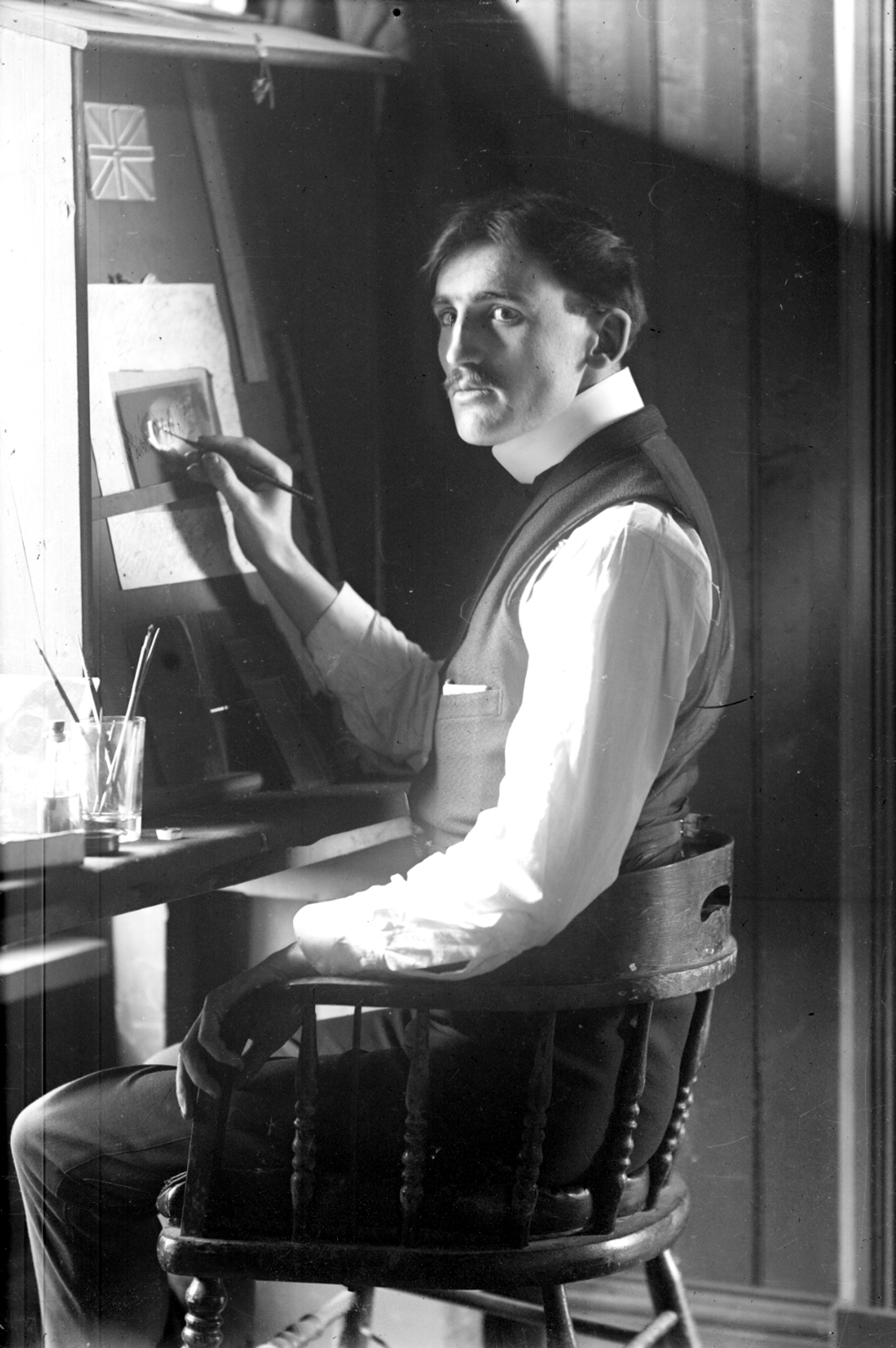
Ulric Lavoie was a skilled photo retoucher. By scraping the negative, he could erase certain details from a portrait. With pencil or paint, he would then modify an image to make it more appealing. Here we see him at work, seated like a painter before his canvas, likely during his time as Belle’s apprentice.
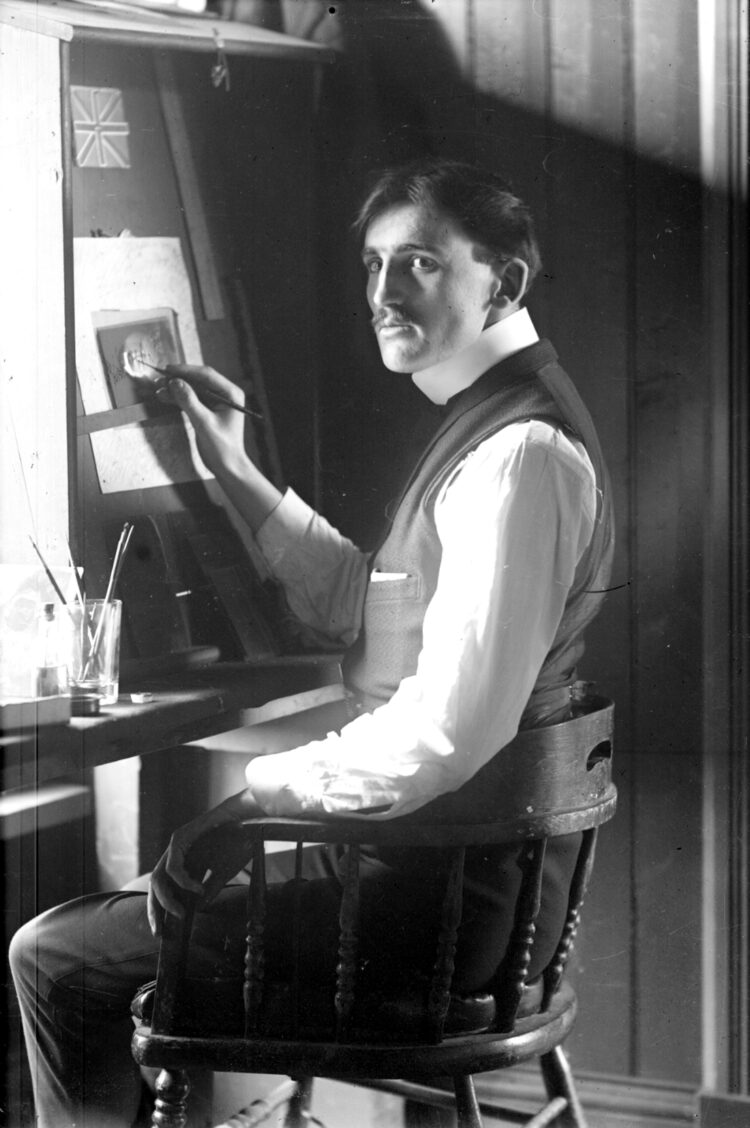
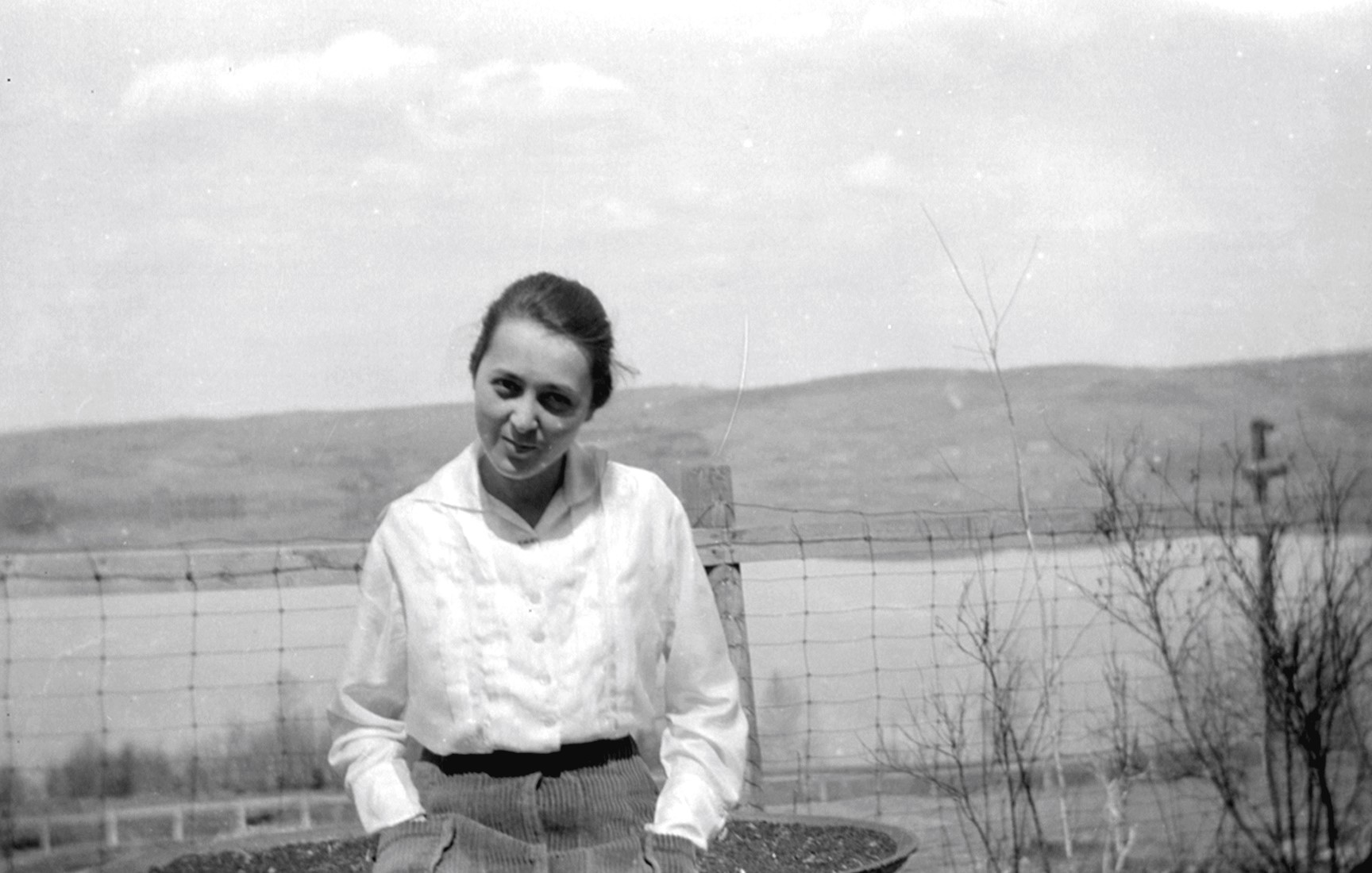
The eldest of eight children, Aline Cloutier helped her mother run the hotel in Notre-Dame-du-Lac, which her father had operated in the Témiscouata region successfully until his death in 1913. Summers were spent working for her family, but she also used the time to photograph everyday life. Her archive includes images from other vacation spots as well, such as the Gaspé Peninsula and its famed rock, the Rocher Percé. Outdoor activities figure prominently in the photographs she left behind.
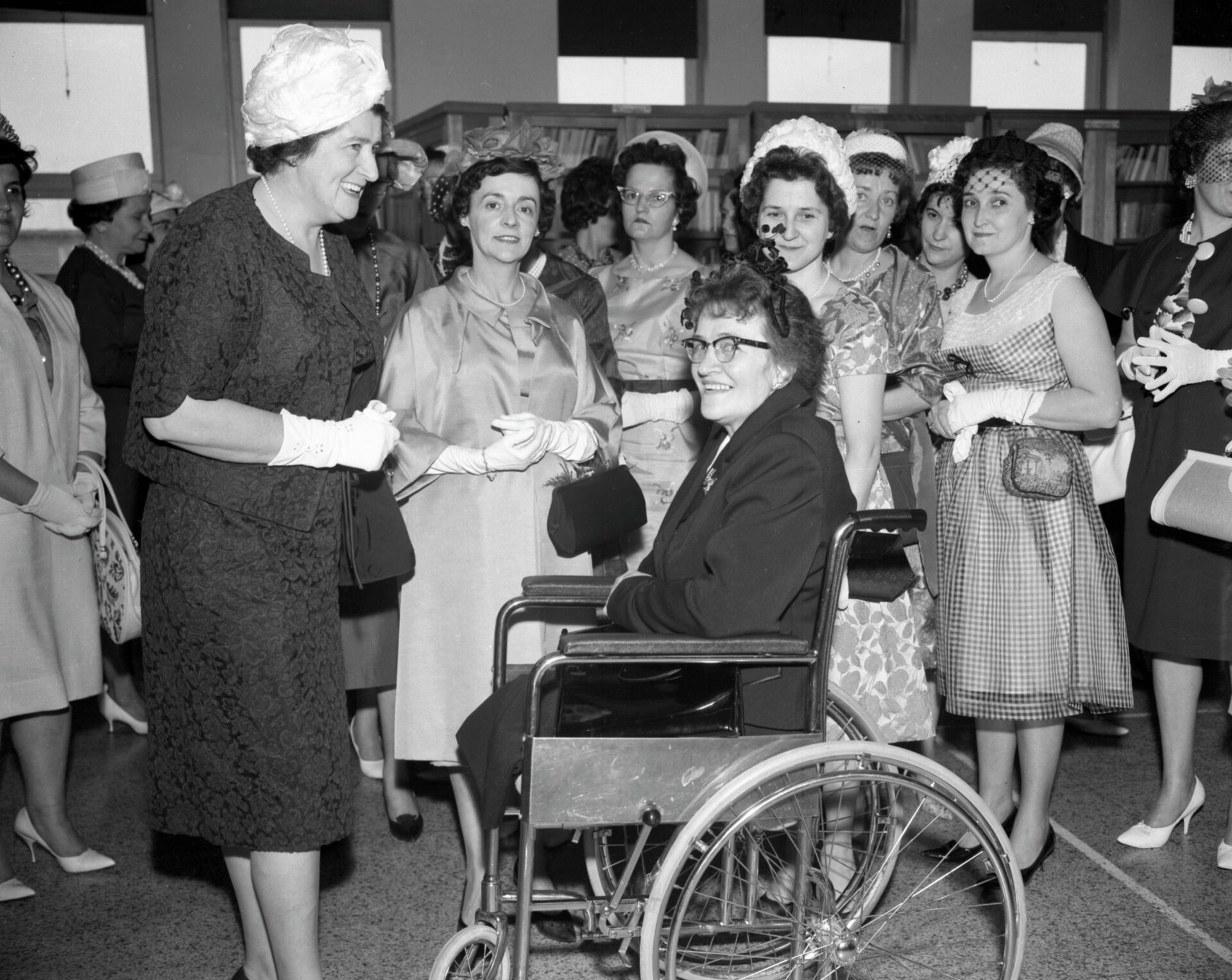
The Liberal Party was in power in Quebec between 1960 and 1966, during a period known as the Quiet Revolution. Under Jean Lesage’s leadership, major political, economic, social and cultural reforms reshaped Quebec’s public institutions. It was also a time marked by the growing emancipation of women. For example, in 1961, Marie-Claire Kirkland-Casgrain became the first woman elected to the Quebec National Assembly. In 1963, the newly created Ministry of Education gave women equal access to higher education and, in 1964, Bill 16 granted married women full legal capacity. Was it in the spirit of this liberation that these women lent their support to the Liberal Party and gathered in Rivière-du-Loup in 1963?
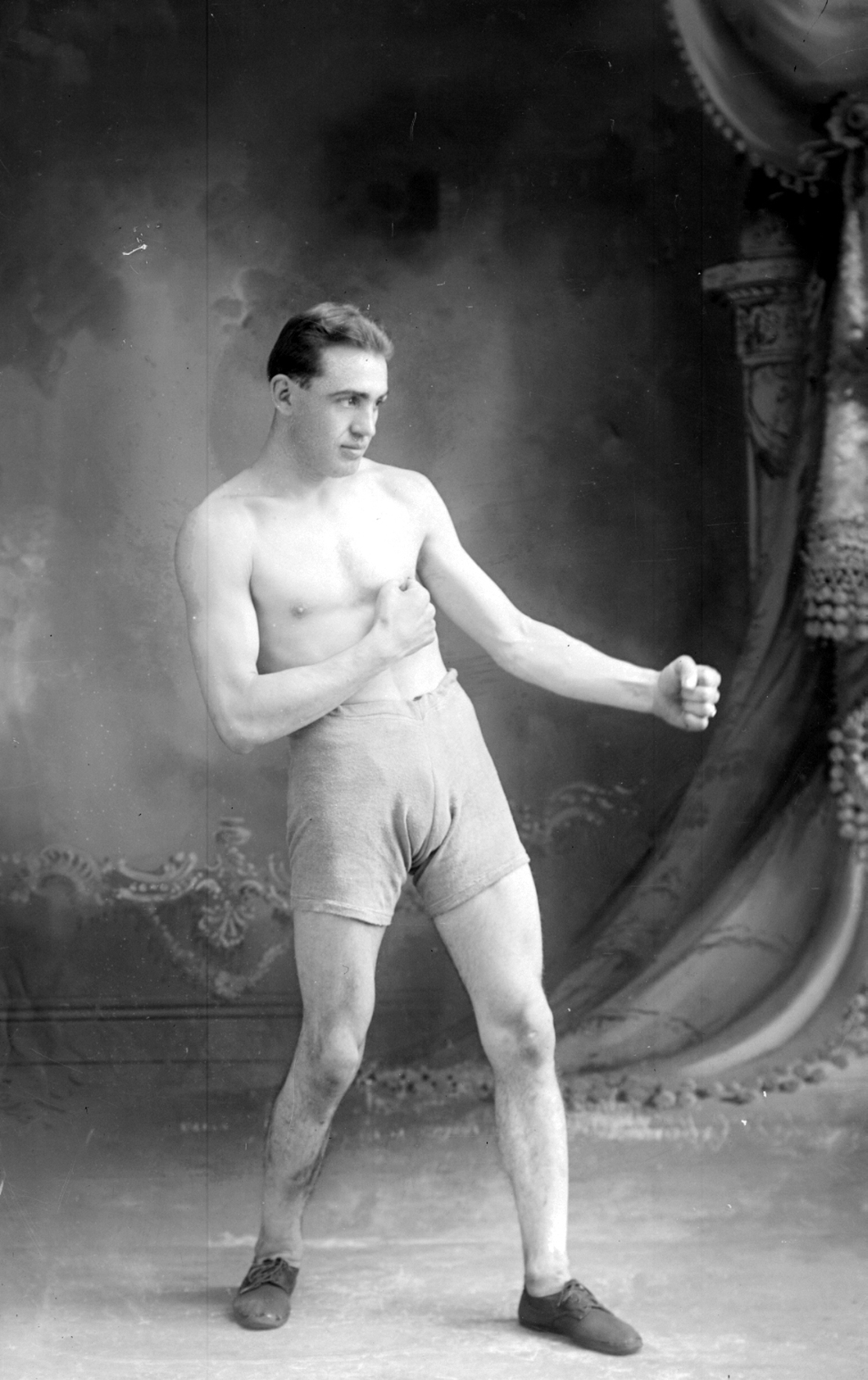
At times, Stanislas Belle welcomed athletes into his studio. For instance, hockey clubs from around Rivière-du-Loup would come to have their team portraits taken. Surprising? Not really. Hockey was already hugely popular by the early 20th century. But this portrait of George Lepage points to the growing popularity of another sport: boxing. Practised in Quebec since the 1820s, boxing was long frowned upon. For most of the 19th century, civil authorities deemed it too violent, while the Church considered it morally dubious. Boxers were often seen as thugs, and it was not unusual for matches to spiral into full-blown brawls among spectators. However, by the time George Lepage posed for Belle’s camera, boxing had been governed for several decades by stricter rules, helping to legitimize what came to be known as the “noble art.” Although his fists are bare in the photo, Lepage would have worn gloves in the ring. A knowledgeable practitioner of the sport, he would later go on to become a boxing referee himself.
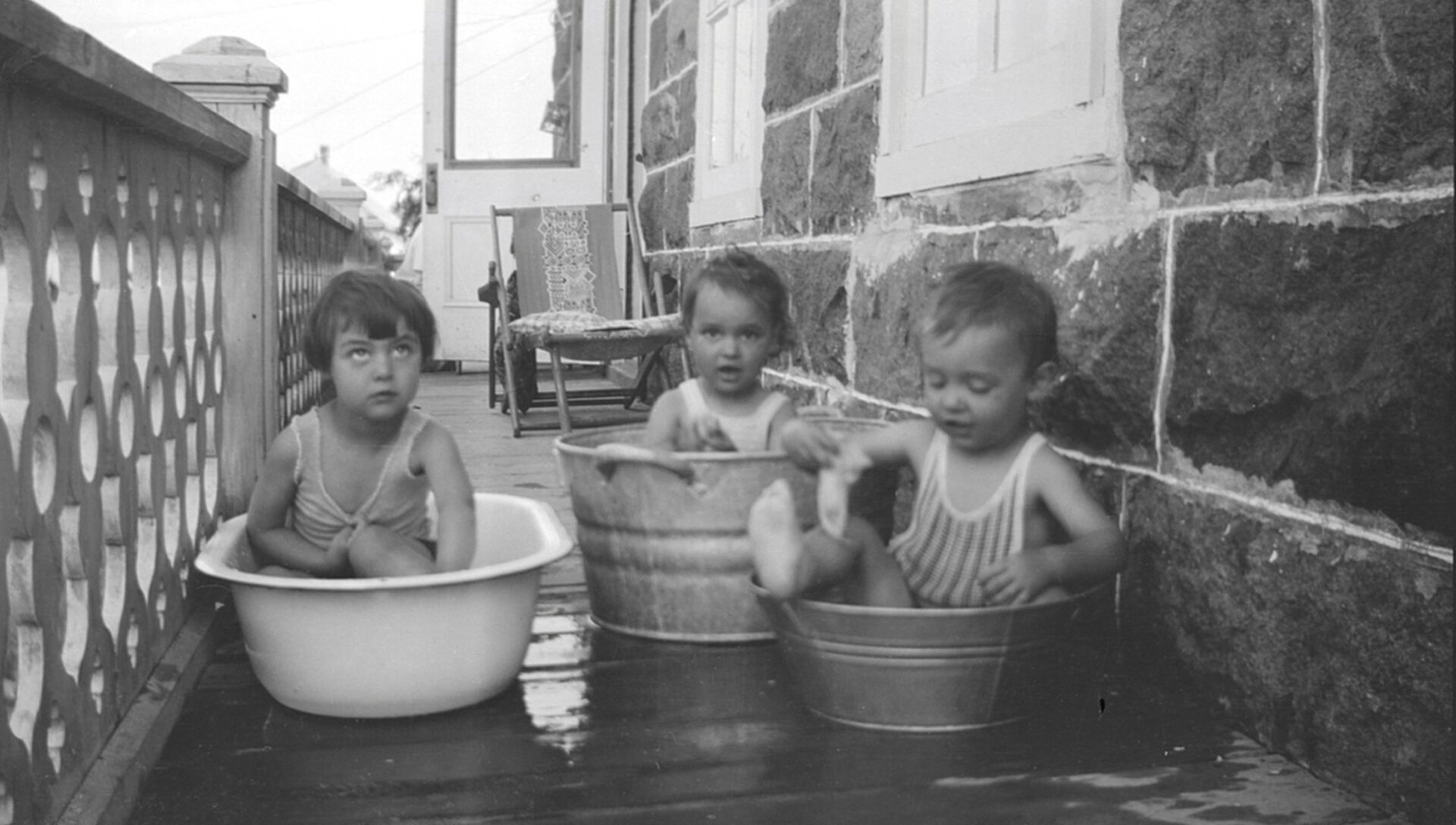
As a chronicler of daily life, Aline Cloutier captured moments that are sometimes surprising, sometimes touching, like this one of three small children taking a bath in basins barely large enough to hold them, set out on the front porch of a house. The portrait is especially lively: we can see movement in the blurred gestures of the little bathers and in the way their gazes each point in a different direction.
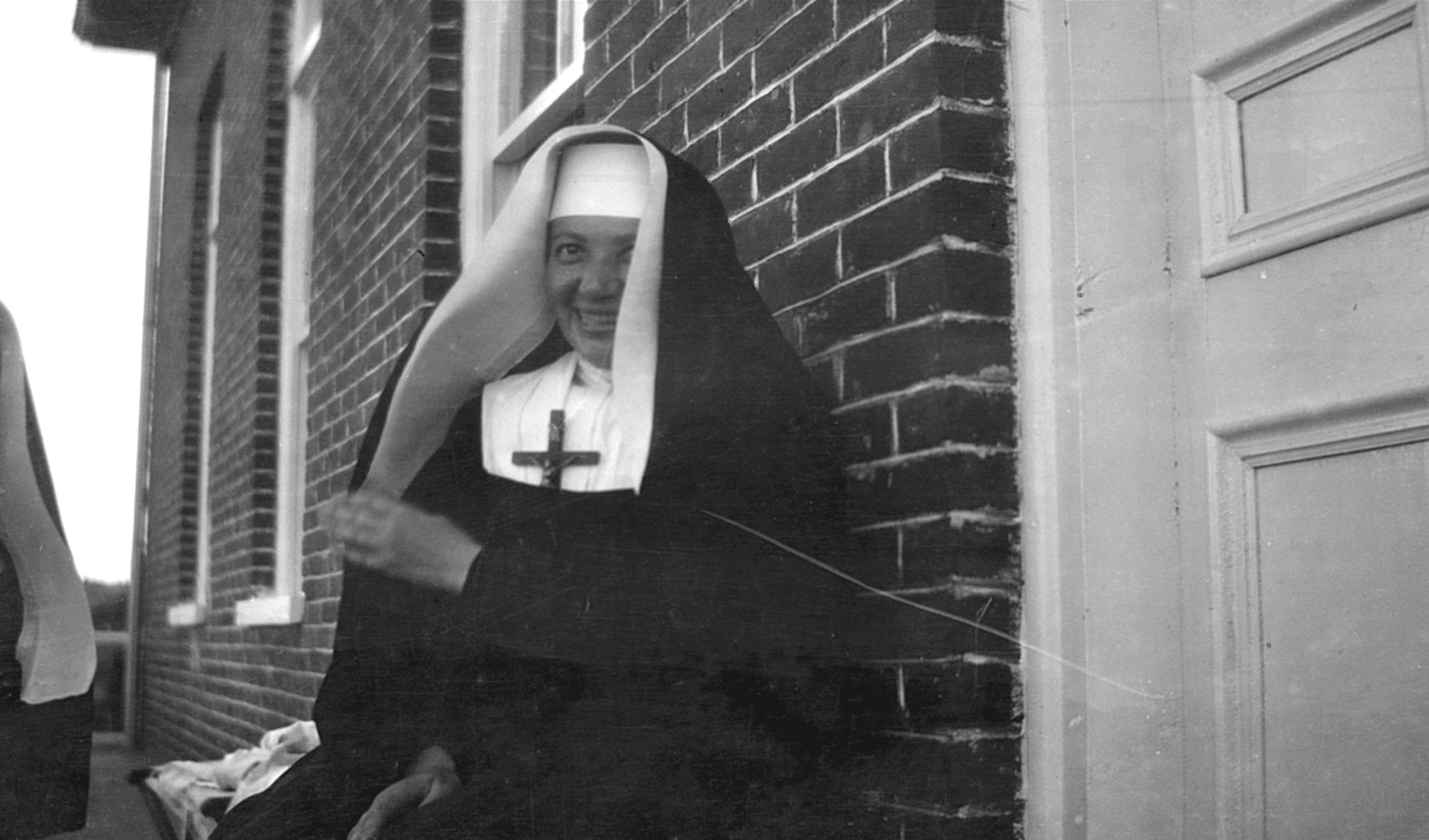
Are amateur women photographers more inclined to keep images that are less polished or less formal? Do they have a special appreciation for photos that are more spontaneous or intimate, the kind we often save today on our phones? That may well be true for Aline Cloutier. After all, she took pictures for her own enjoyment, to preserve memories, not to satisfy clients, as was mostly Marie-Alice Dumont’s case. Take, for instance, this candid and slightly blurry portrait. Cloutier managed to capture a smile, and perhaps even a laugh, from Sister Sainte-Germaine, the superior of the Daughters of Jesus, whose convent was located in Notre-Dame-du-Lac. Perhaps Cloutier had a good relationship with the nuns in her village, something that made this rare moment of joy possible. It is a kind of moment seldom found in the archives related to religious communities.
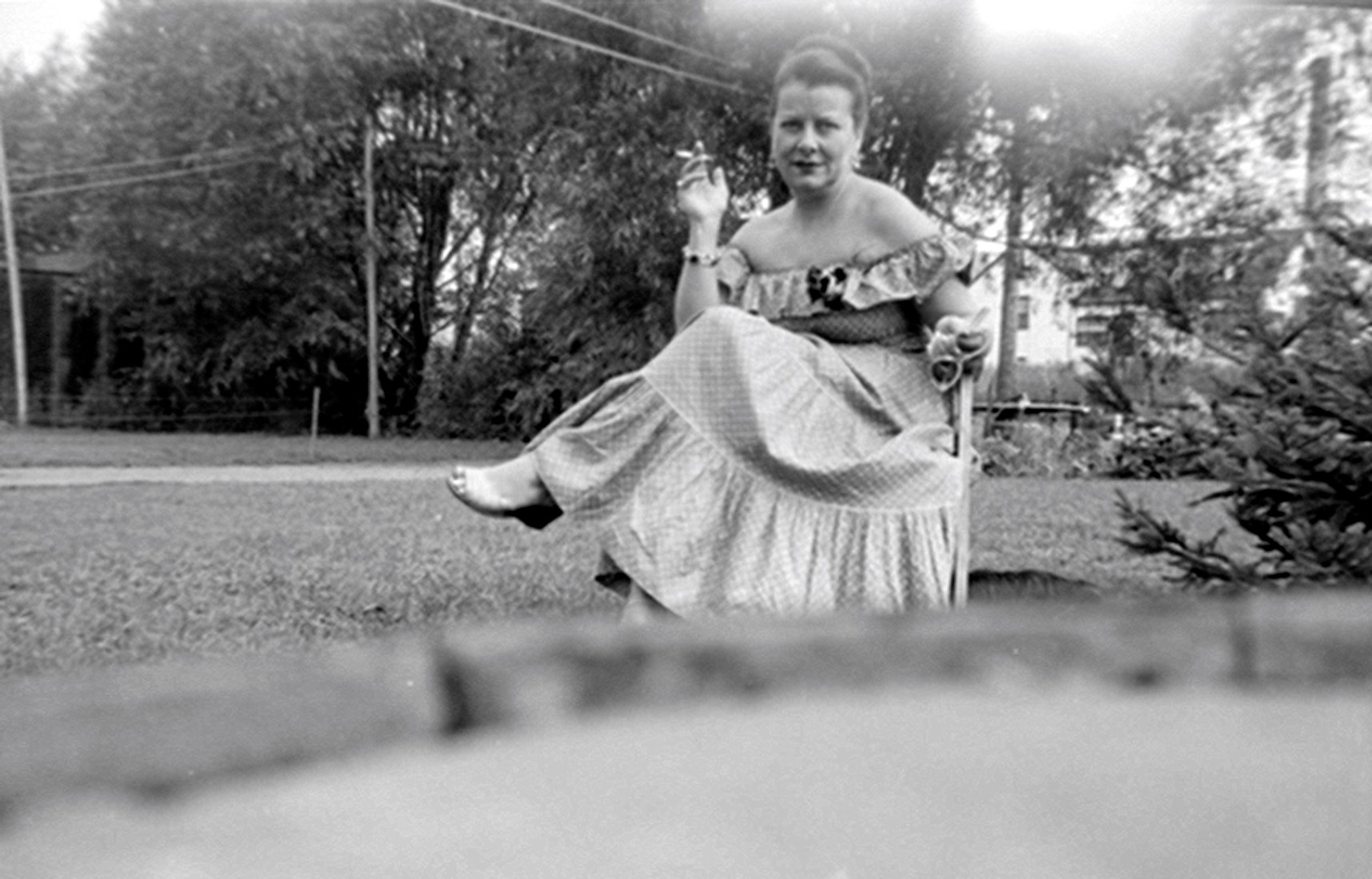
Do you think the quality of this photograph reveals that it was taken by an amateur? The harsh light filtering through the treetops creates a distracting blur, and the barrel used to support the camera clumsily obscures part of the subject, while also revealing the improvised set up the photographer used to take the portrait. Could these compositional elements have been deliberate choices? Whatever the case, Aline Cloutier offers us a window into the private world of a young woman living through the social change of the early 1940s. The bare shoulders exposed by the design of the dress are a hint of how women’s fashion was evolving at the time. What’s more, the subject is smoking a cigarette, which had become increasingly socially acceptable since World War II. And if you look closely, you will notice electrical wires in the background, a clear sign of the modernization of rural areas in the early 20th century. In photographing those around her like this, could Aline Cloutier have known she was also documenting a society in transformation?
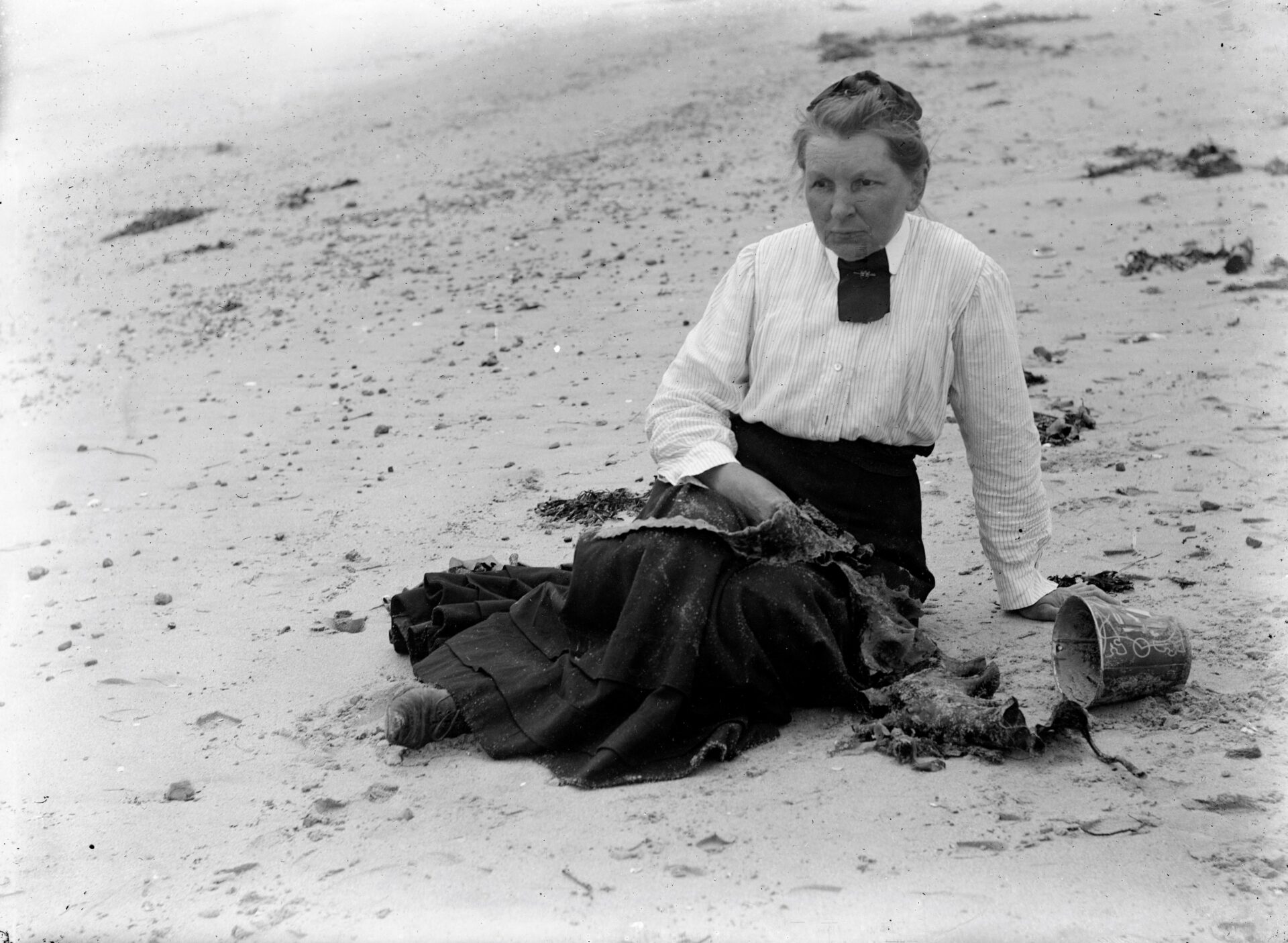
In this self-portrait, Sally E. Wood, who was nearly 60 years old at the time, appears to be using a clever trick to photograph herself: a remote shutter release, likely hidden in her right hand (concealed beneath seaweed), is kept out of sight, possibly buried in the sand. According to art historian Luce Vallières, this self-portrait challenges Victorian-era norms. Taken outdoors, it critiques the “confinement of women to the domestic sphere, as imposed by those in power in Western society at the time” [our translation]. Whether or not this was Wood’s intention, what is clear in this photo, taken on Long Island, New York, is that she is engaging in an activity long popular among Quebec’s upper classes: relaxing along the coast of the eastern United States.
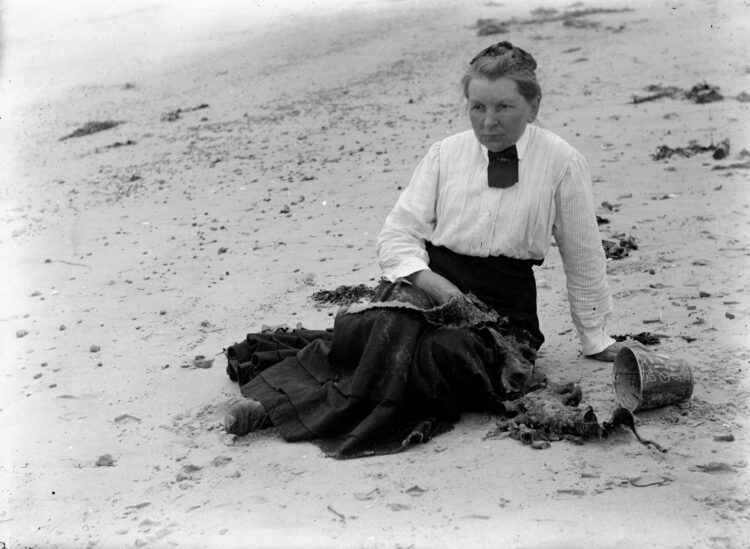
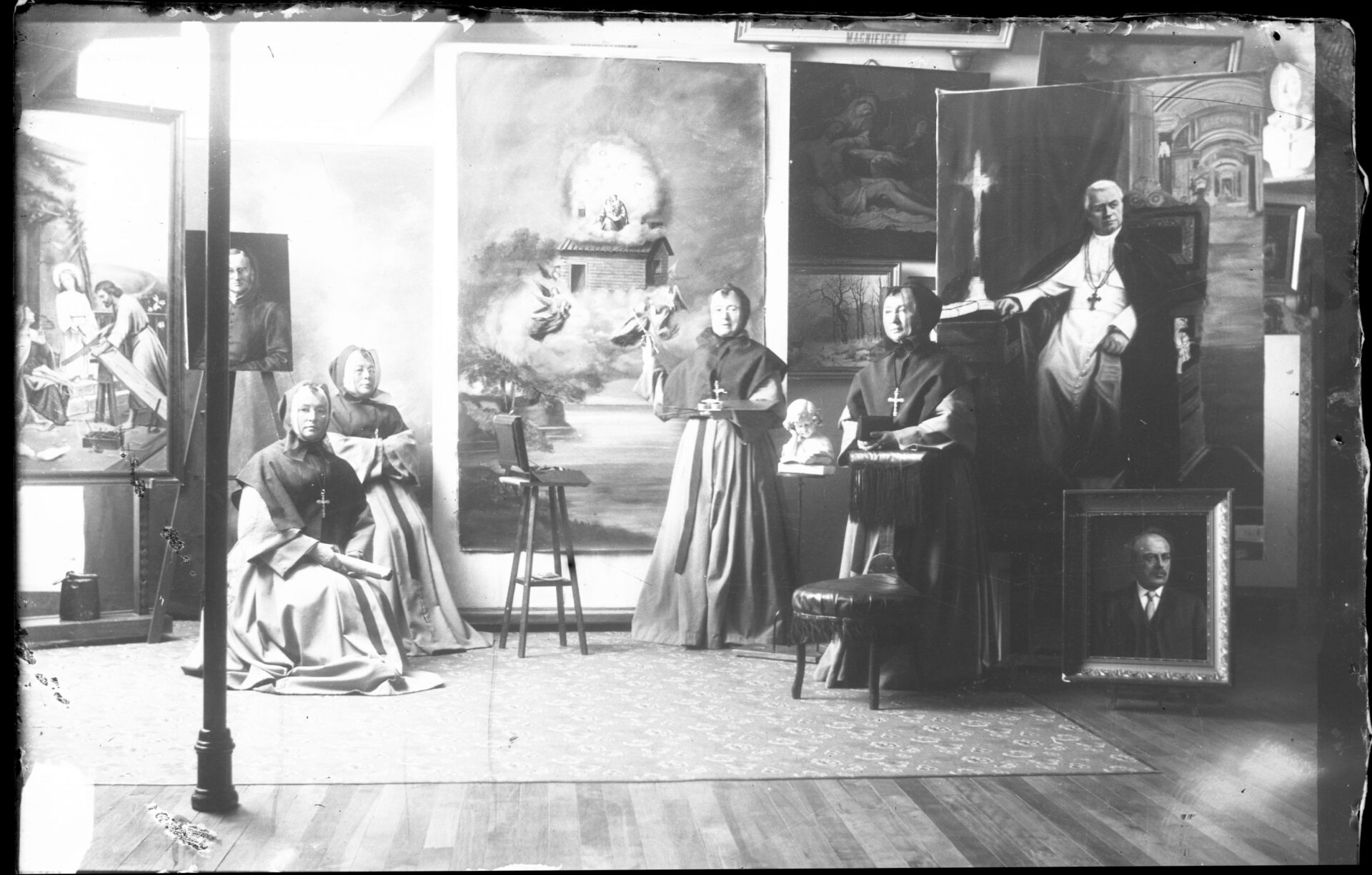
This photograph shows the interior of the painting studio at the novitiate of the Sisters of Charity of Québec. At the centre of the composition is Elmina Lefebvre, flanked by three other nuns and posed with a brush and palette, as if working on her painting La Maison de Lorette.
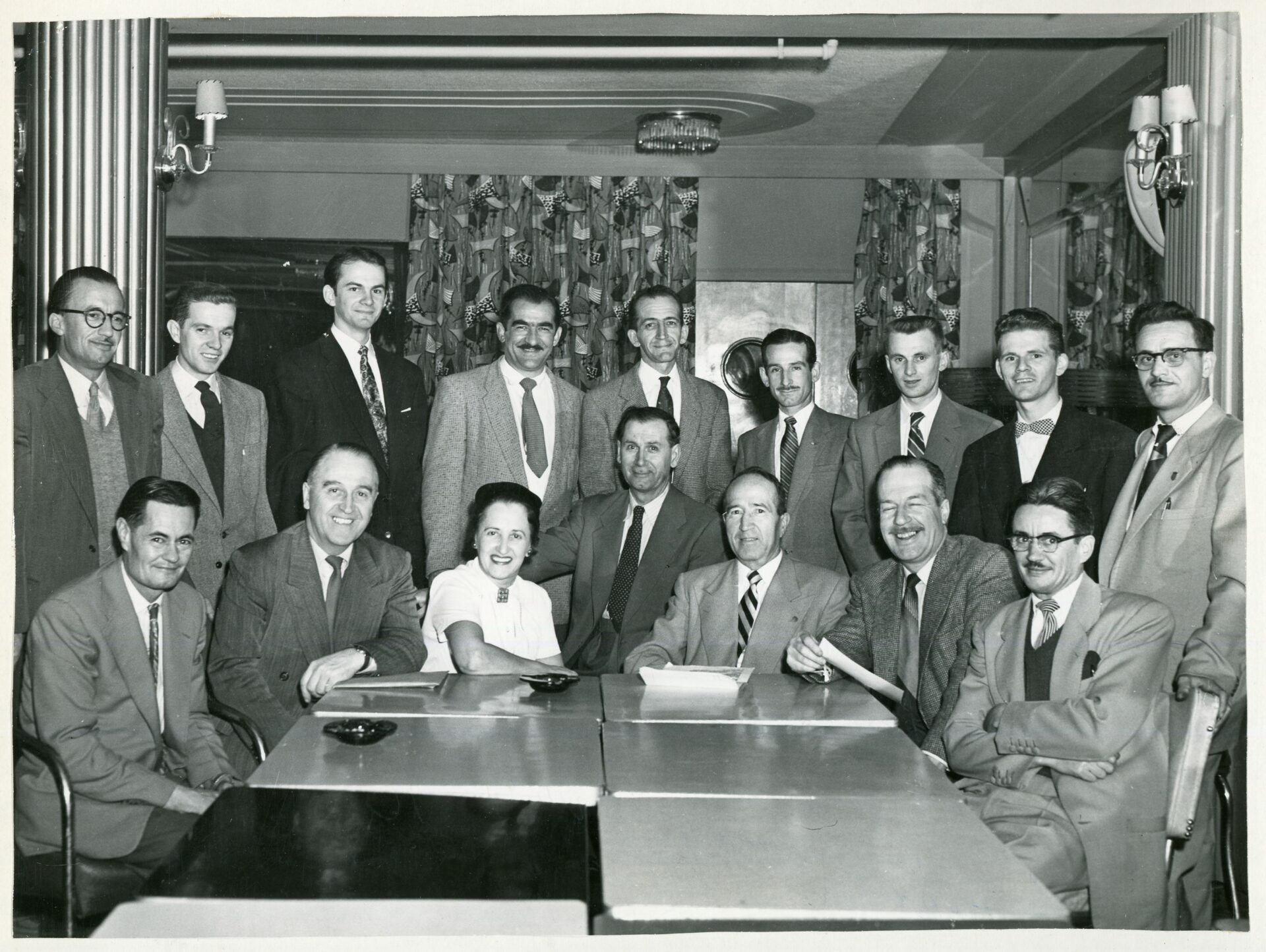
If visual proof were needed that men far outnumbered women in professional photography during Marie-Alice Dumont’s time, this group portrait would provide it. Taken in 1954 in Chicoutimi, it shows all the studio owners from the Saguenay region gathered as a “professional association of photographers.” Aline Lemay, dressed in white and seated in the front row, is the only woman.
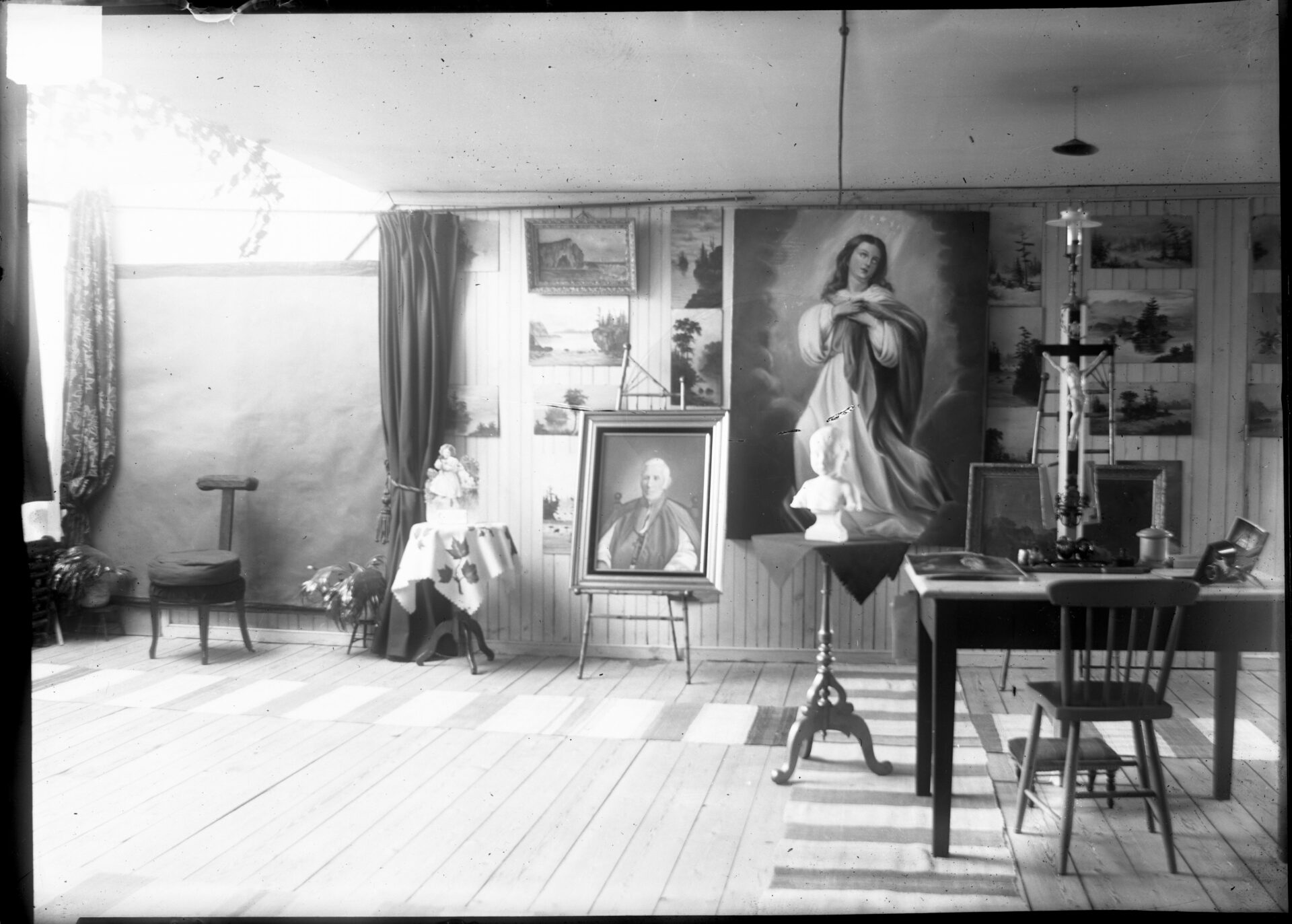
The novitiate of the Sisters of Charity of Québec included a painting studio, which, in turn, housed a small photography studio. Several portraits preserved at Bibliothèque et Archives nationales du Québec suggest there may have been a second, larger photographic studio elsewhere in the building. In any case, this image of the painting studio, and the small space set aside for photography, illustrates the close connection between the two art forms so central to Elmina Lefebvre’s career.
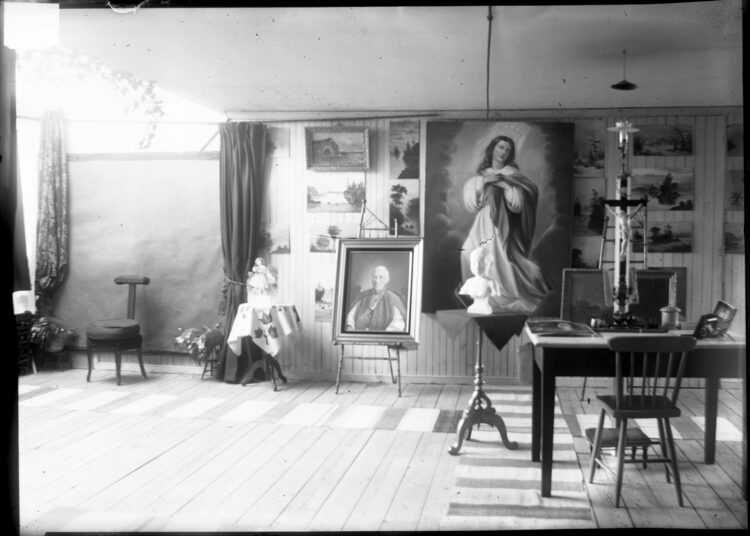
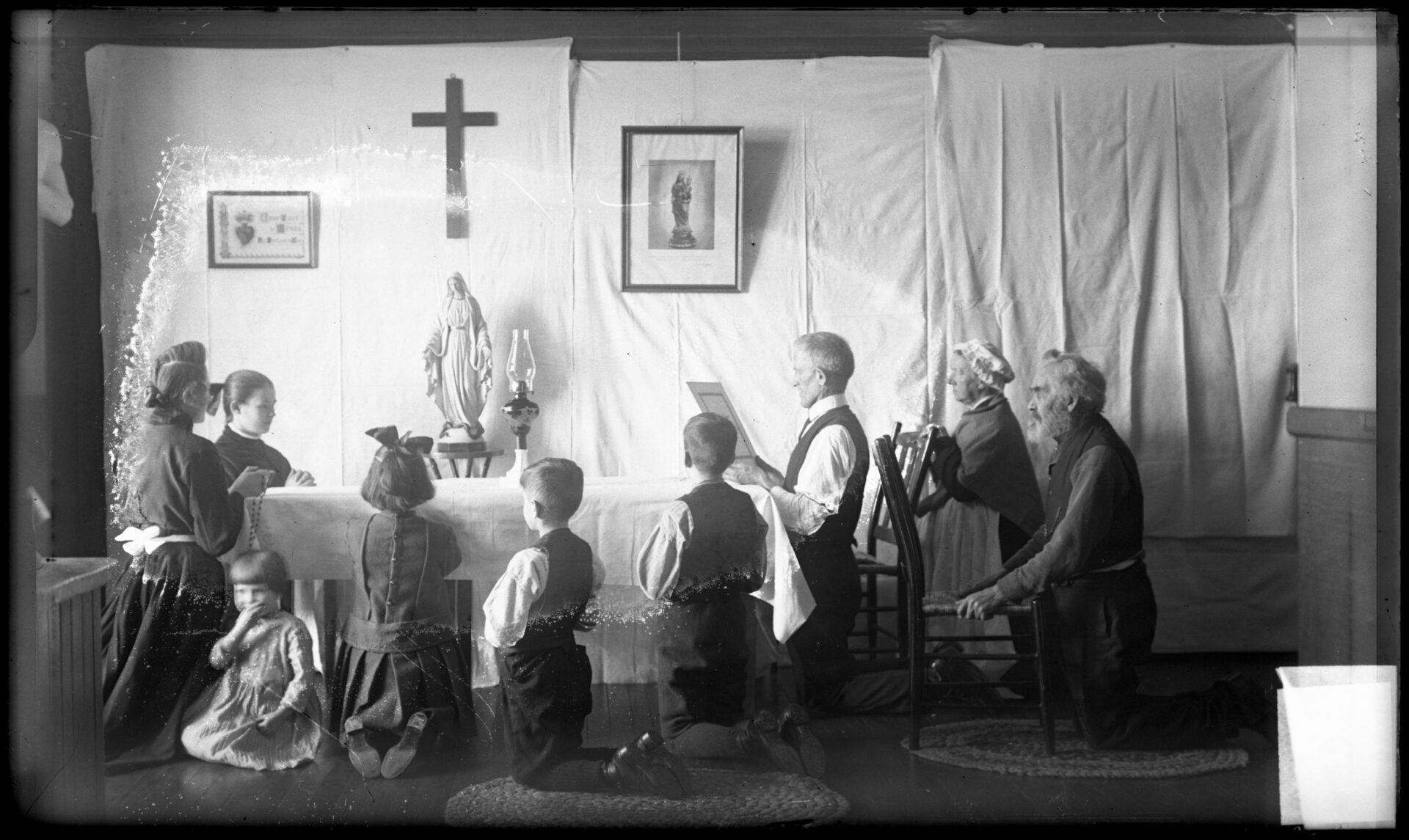
For Elmina Lefebvre, photography often served as a tool in her creative process. She frequently photographed live models to refer to as she painted. Lefebvre would ask her fellow nuns to stage scenes from their daily lives: serving meals to the poor, teaching or visiting the elderly and infirm. Sometimes, she called on people from outside the community to depict moments, such as a child’s baptism or life in a poor family, and she even posed Kateri Tekakwitha in traditional Kanien’kehà:ka (Mohawk) dress. The scene photographed here represents the evening prayer, a common practice in French Canadian homes at the time. We see the father leading the other members of the household. Grandparents, wife and children are kneeling, hands clasped. All appear focused, except the little girl on the left. We can imagine her to be restless, perhaps tugging impatiently on her mother’s dress. Lefebvre would use this photograph as the basis for several paintings of family prayer scenes, often adding additional details: a clock, a baby in a cradle, a stove, a cat and so on. In these paintings, the girl’s moment of inattention is gently corrected. Lefebvre shows her holding the end of her mother’s long rosary close to her mouth. It would seem the now quite angelic little girl is “devouring” her prayers!
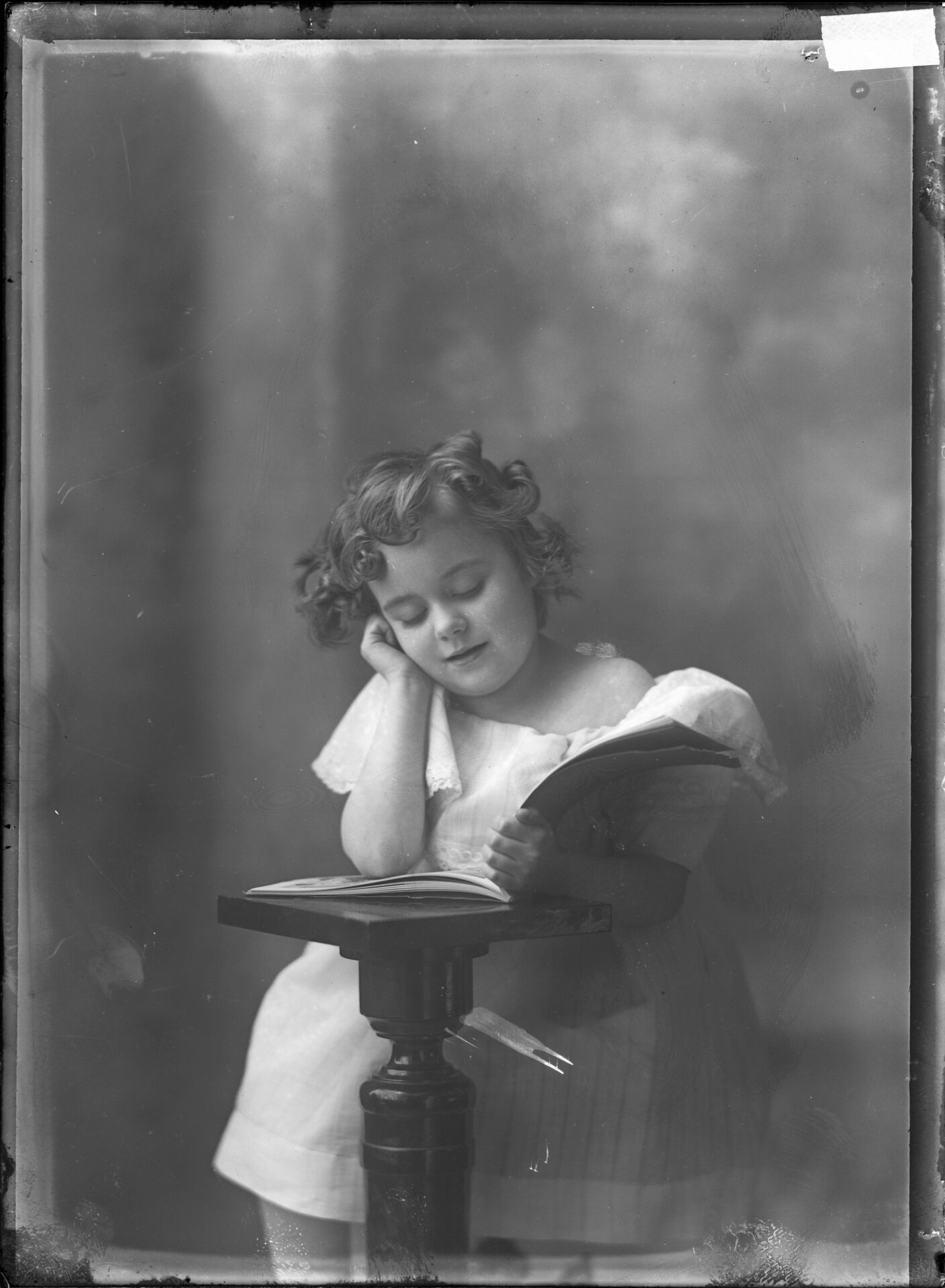
This cherubic-looking girl reading a book is, in fact, a young orphan, one of many taken in by the Sisters of Charity in Québec City.
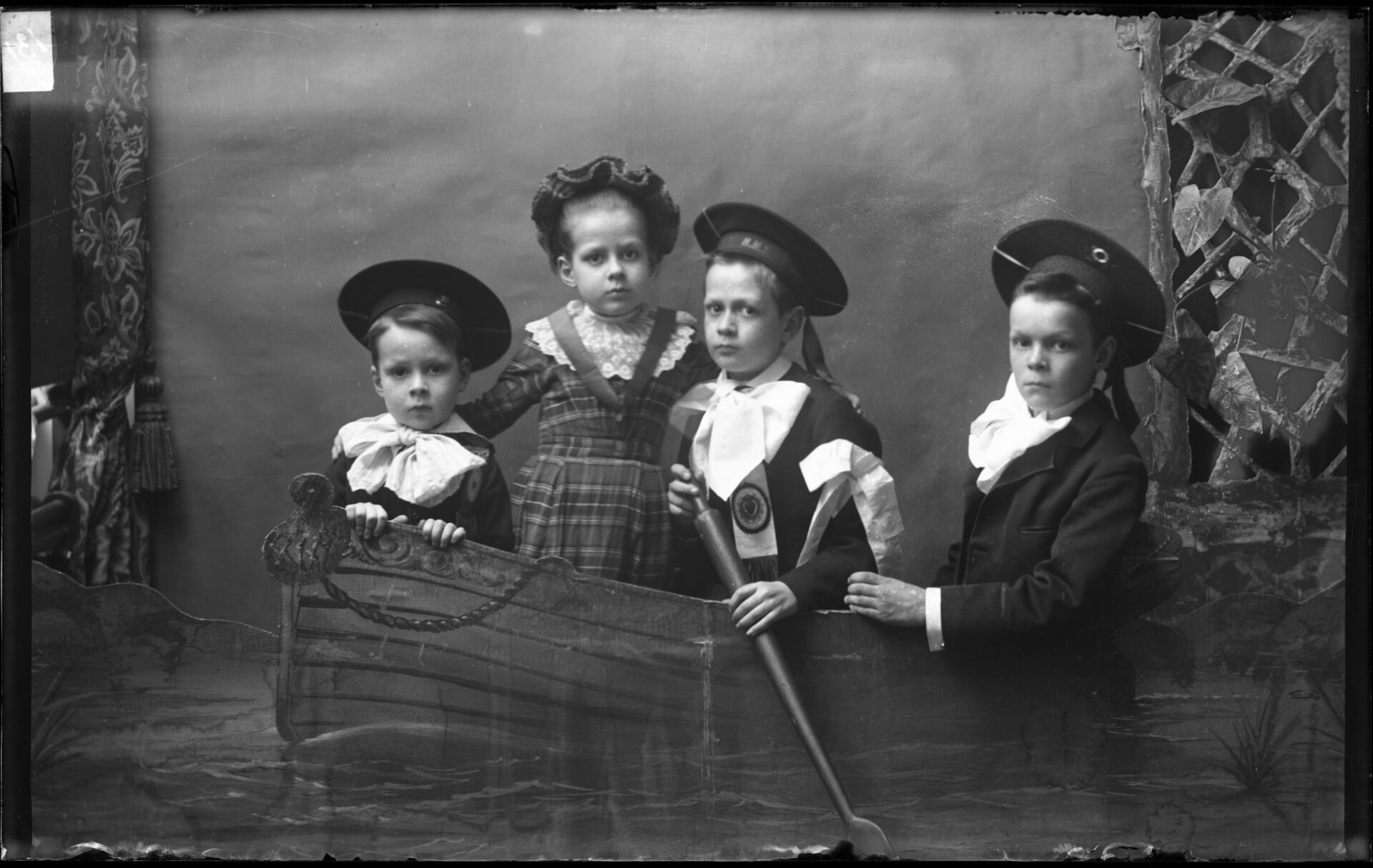
These four orphans (a girl and three boys) strike a pose common in the history of 19th-century studio photography in Quebec. Seated in a trompe-l’œil canoe, they are set in an indoor re-creation of an outdoor scene. The archives of the Notman and Livernois studios are filled with portraits of this kind.
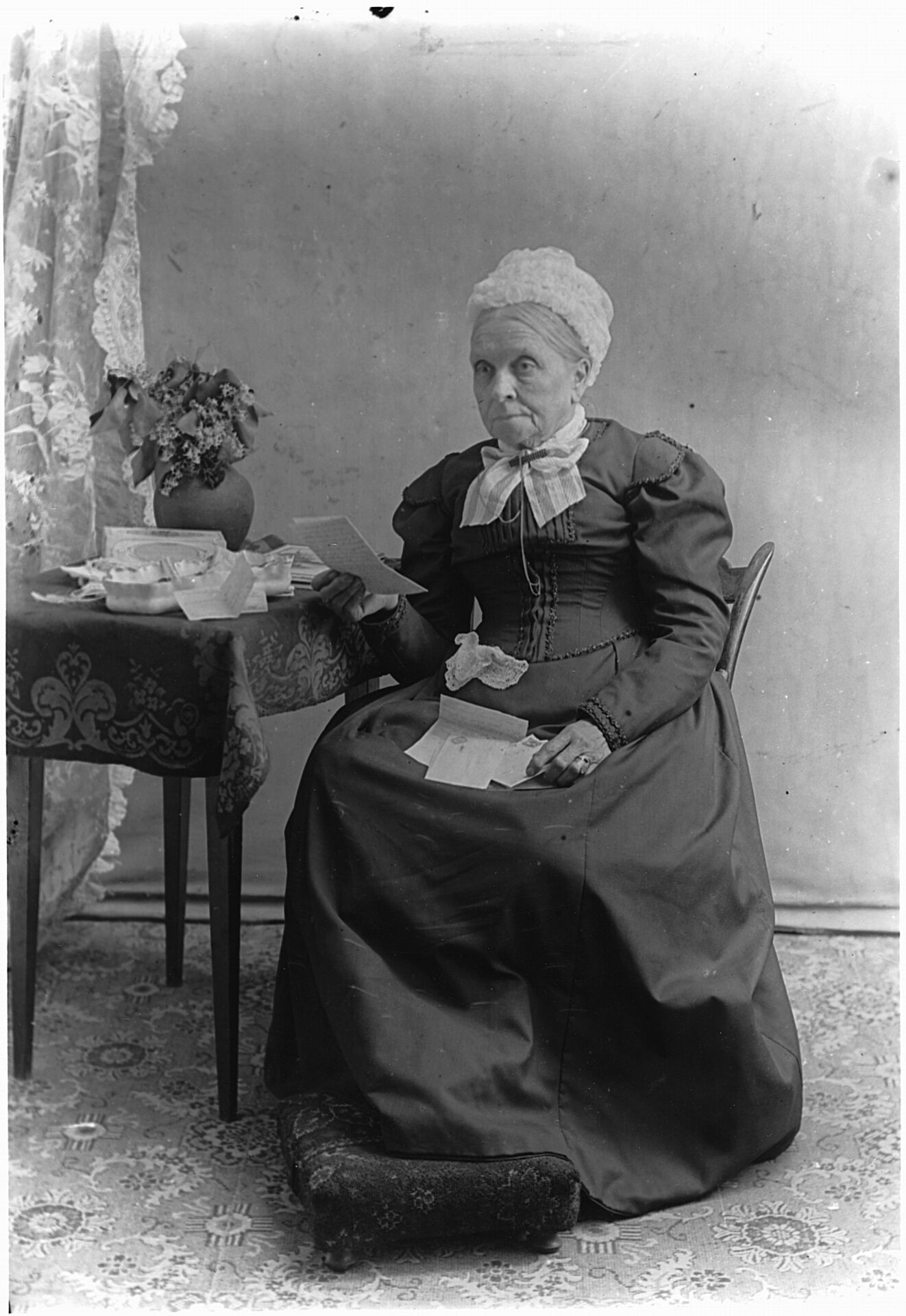
The woman in this portrait is the photographer Sally E. Wood’s mother. Also named Sarah Eliza Foster, she was known as Sally among friends and as Mrs. Philip Wood in public, as was customary at the time. Like Dumont did with her own family, Wood often photographed the women around her. In this image, Mrs. Wood is seated at a table, holding letters in her hands and across her lap. She looks up, as if her reading has just been interrupted. Her gaze, directed away from the camera, enhances the impression of spontaneity and naturalism. Wood portrays her mother engaged in an everyday activity, a recurring theme in her work. According to art historian Luce Vallières, Wood’s photographs depict women as active rather than passive figures. It is also worth noting that Mrs. Wood is dressed in elegant clothing typical of English-speaking upper-class women in the Victorian era. This stands in stark contrast with Marie Pelletier, who, when her daughter Marie-Alice Dumont photographed her going about her daily routines, wore modest clothes suited to housework and farm labour.
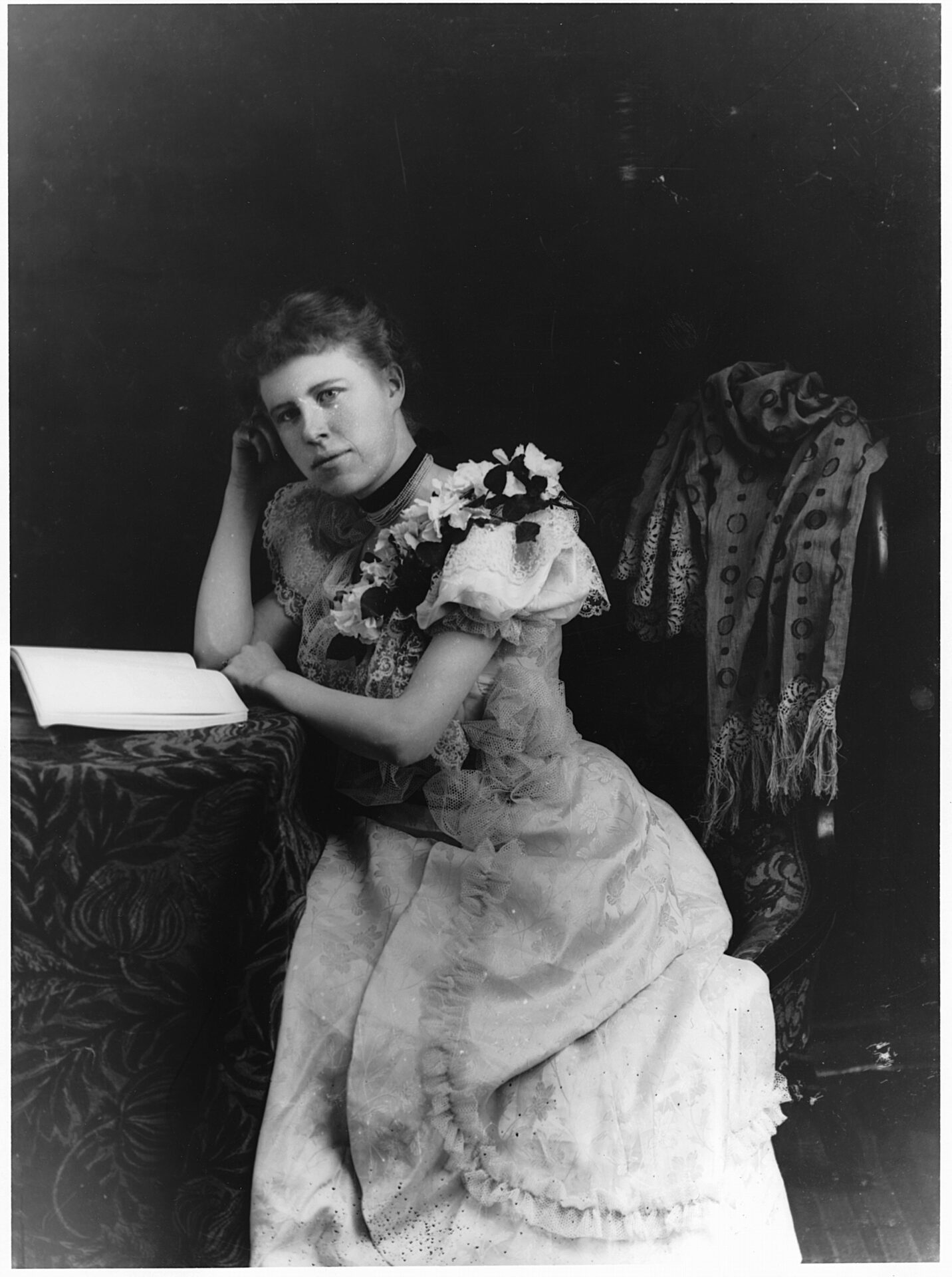
For this portrait of Constance Clare Bancroft, Sally E. Wood chose a plain background and lighting focused on the subject and her book. This technique was meant to avoid distracting the viewer’s eye, which should rest on the young woman. At the same time, the diagonal lines, which Wood frequently used in her compositions, guide the viewer’s gaze across the image. For instance, note how the young woman is leaning over her book. According to art historian Luce Vallières, Wood thus achieved a “very feminine,” “very embodied,” “powerful” and “highly successful” portrait.
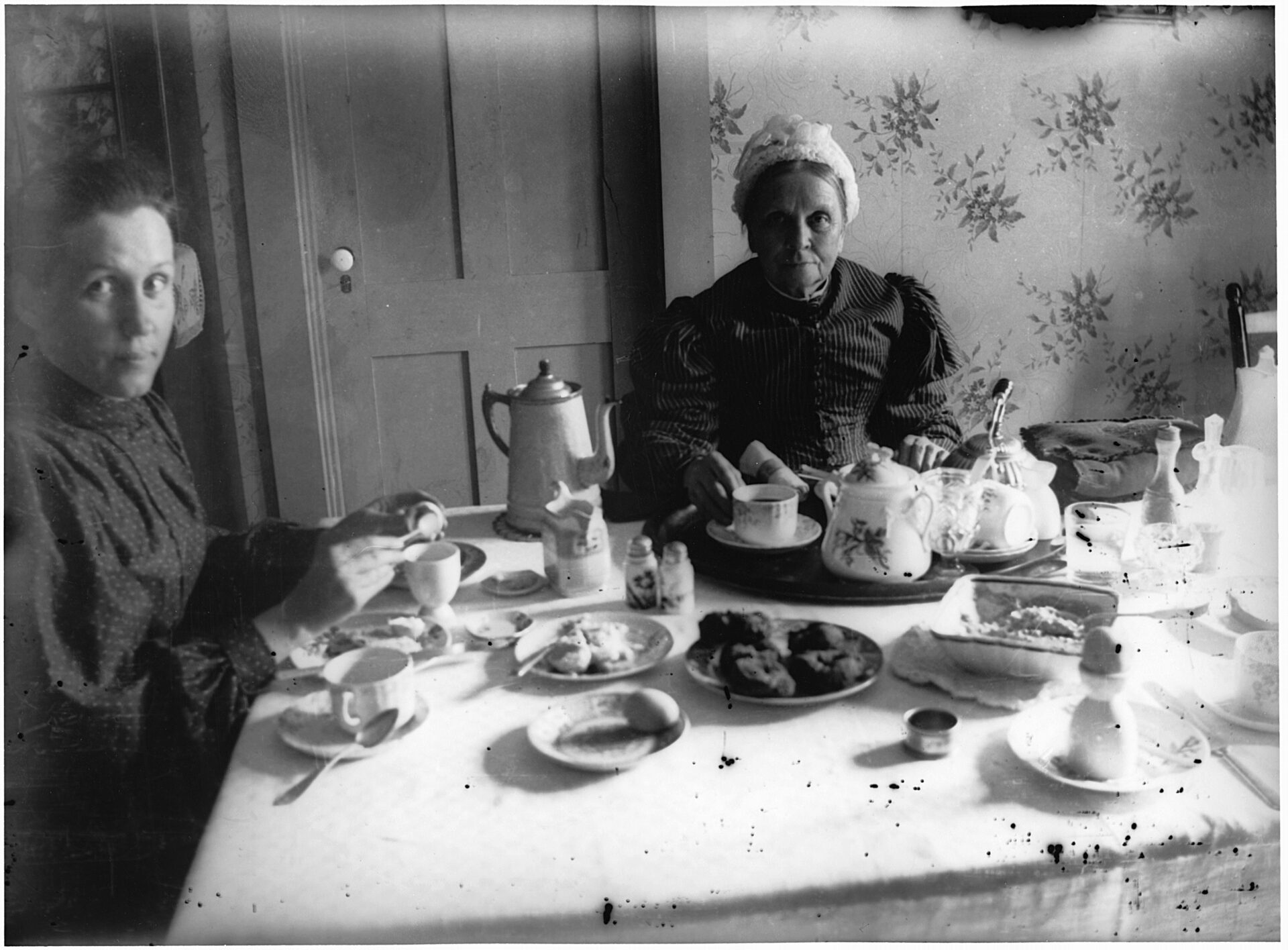
Sally E. Wood’s mother appears once again in this photograph, but this time taken outside the studio. Wearing a white bonnet, Mrs. Wood is seated at a table with another of her daughters: Elizabeth. The composition is visually stimulating, filled with objects, patterns and varied shapes. On the table, we see eggs, what appear to be muffins or scones and tea. Could it be breakfast time? Once again, the portrait conveys a strong sense of spontaneity and naturalness, a hallmark of Wood’s work. The two women barely seem to interrupt their gestures for the camera. However, the intense light striking them from the right appears to have been a challenge for the photographer. It is easy to see the difficulty of working under such lighting conditions: The right side of the table is overexposed, almost lost in a burst of brightness, while the left half of Mrs. Wood’s face disappears into deep shadow.
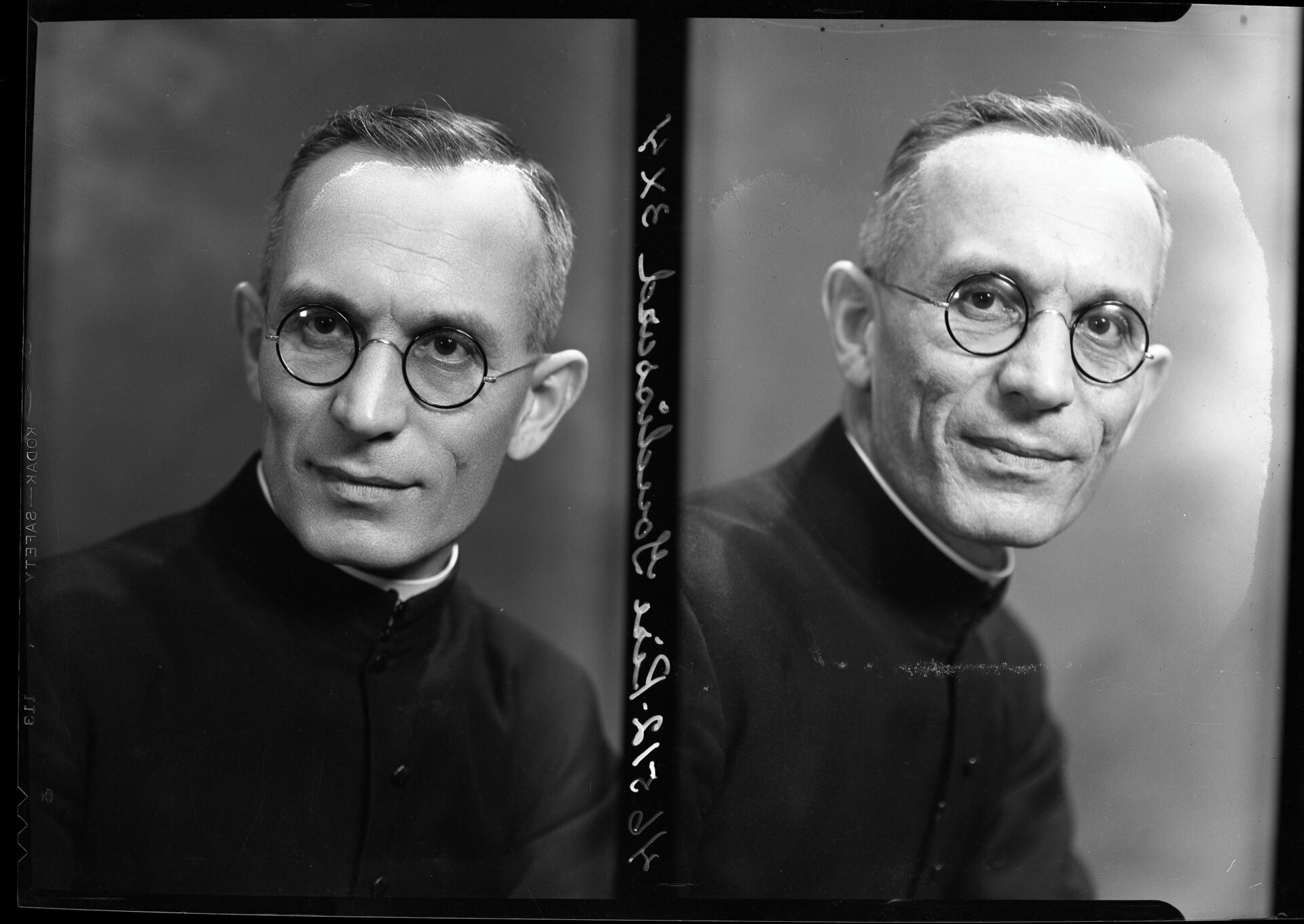
Take a look at this impeccable portrait Aline Lemay took of Father Goudinard. Impeccable, but… retouched! For Lemay, the beauty of a portrait lay largely in the quality of the retouching. Her goal was to correct without distorting. With her sharp eye for detail, she removed what she considered “excess” elements: acne, stray hairs, protruding ears, neck wrinkles, oversized noses and the like. “Perfecting reality” could well have been her motto!
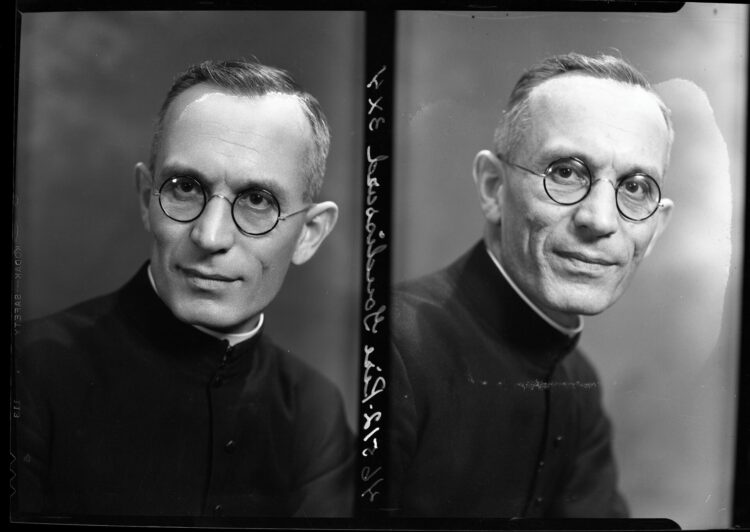
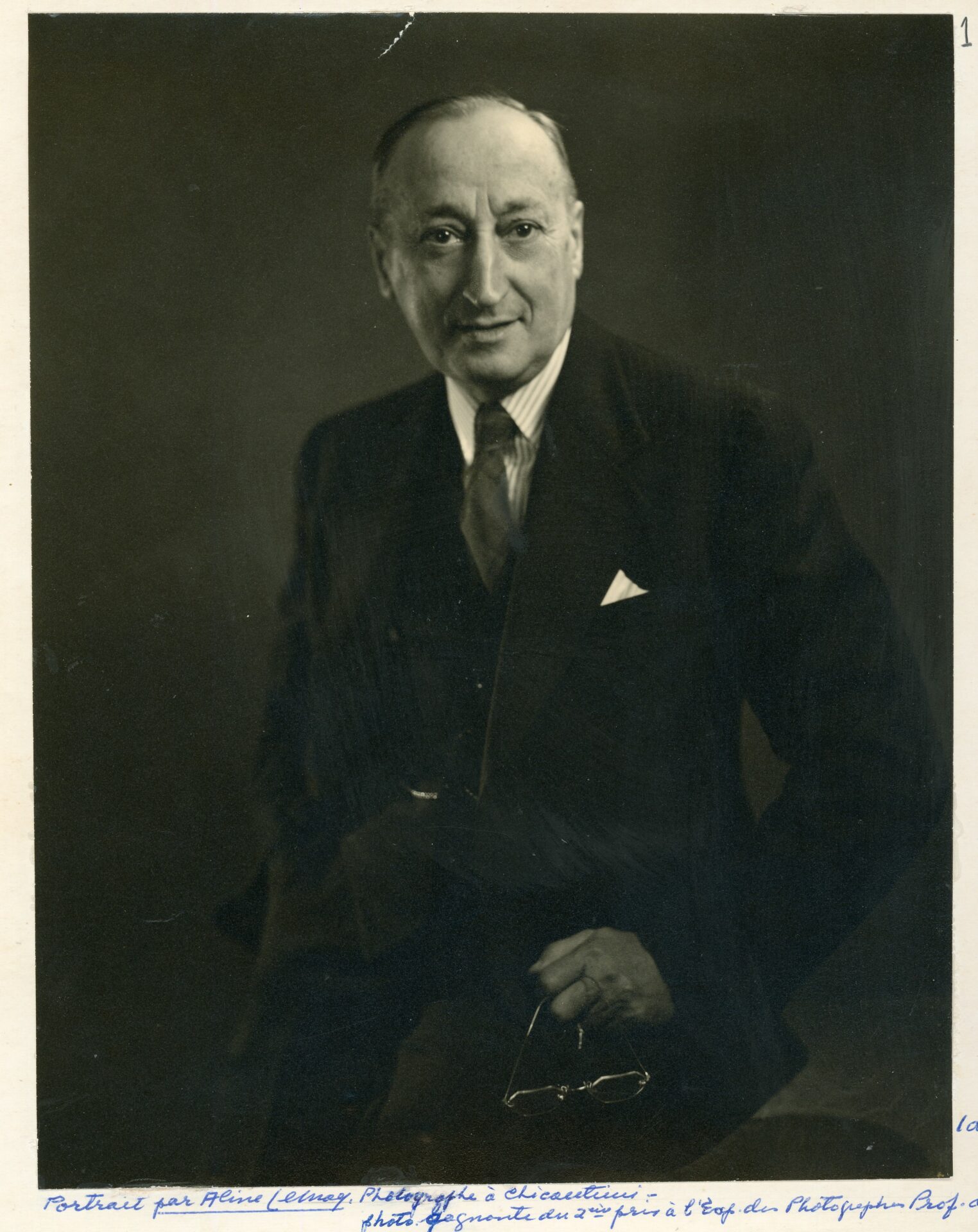
Thanks to the quality of her portraits and retouching work, Aline Lemay received numerous awards. This was the case with her portrait of Georges-Henri Smith, who served as the mayor of Chicoutimi from 1938 to 1950. The image earned her second prize at the first provincial photography exhibition, held in Montréal in 1952 and organized by the provincial association of professional photographers. Recognized for both her technical skill and artistic talent, Lemay was also called upon to serve as a judge in photography competitions. Upon her death in 1996, a major newspaper in Saguenay mourned the loss of a true “pioneer of photography” in the region.